Lady Musgrave Island Sailing Guide
Lady Musgrave Island Sailing Guide. Lady Musgrave Island is the southernmost true coral cay of the Bunker Group and the only one with a fully enclosed lagoon accessible to cruising vessels. It is a remote reef anchorage that rewards disciplined navigation, good visibility and conservative timing. The lagoon is calm and secure once inside, but the approach, entry and exit must be treated as reef operations, not casual island visits. The skipper must arrive with adequate light, a settled sea state and enough time to read the entrance visually. Musgrave is not a place to enter late in the day, in poor visibility or with a rising swell. The lagoon is safe, but the margin for error on approach is small.
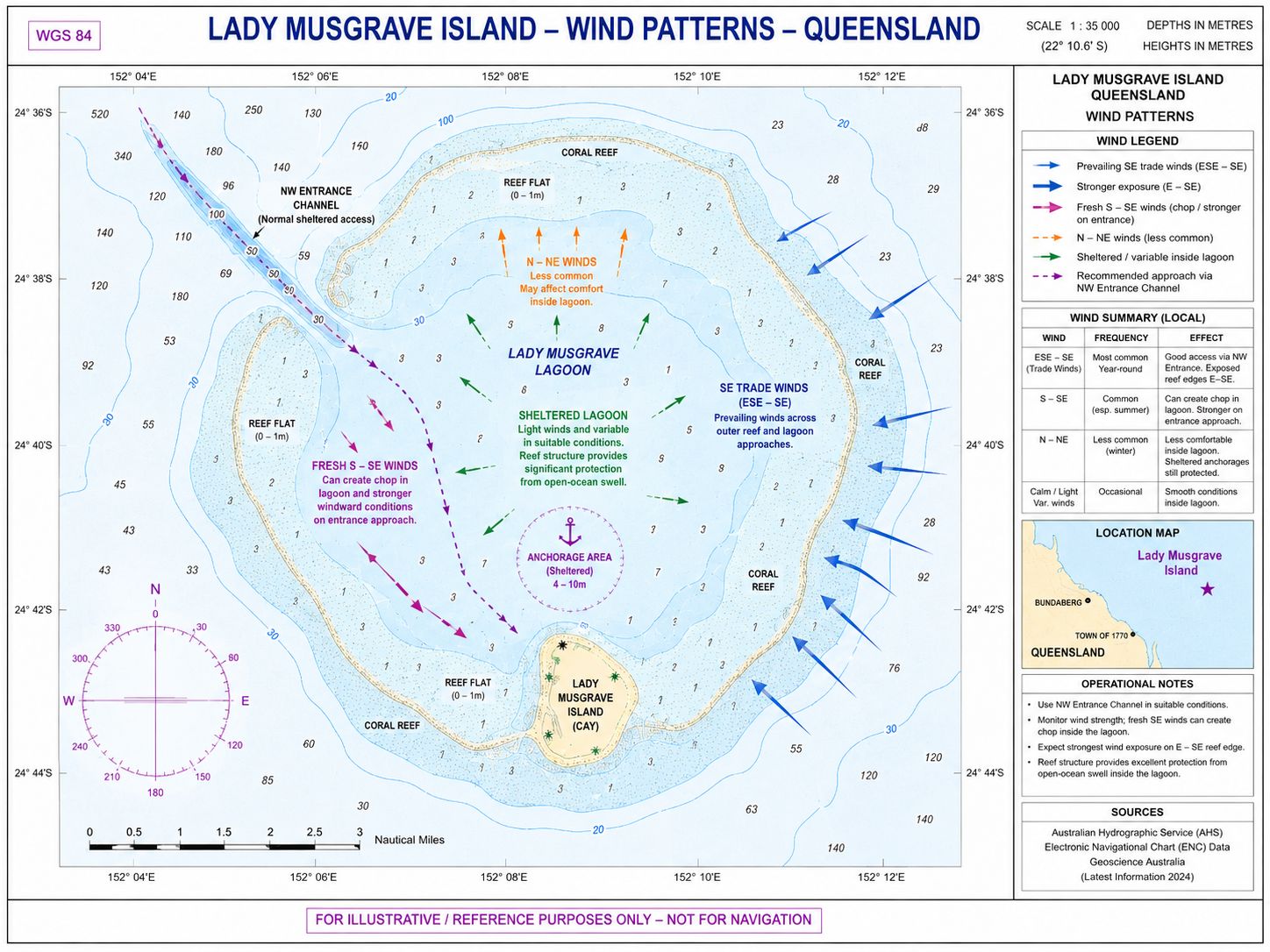
The island lies more than 30 NM offshore, and the sea state on approach is shaped by the prevailing south‑easterly trade wind, offshore swell and the interaction between the outer reef and deeper water. Depths remain 20–30 m until close to the reef edge, where the bottom rises abruptly. The skipper must expect a confused sea state near the reef, especially when the trade wind is fresh. The reef wall is steep and the colour change is obvious in good light. The skipper must maintain a deliberate approach line and avoid being set sideways toward the reef by wind or swell.
Lady Musgrave Island Sailing Guide - Approach
The approach from the north or south is straightforward in deep water, with 20–30 m depths until within a few hundred metres of the reef. The skipper shapes a course toward the western side, where the entrance is located. The reef edge becomes visible as a pale turquoise band against the darker blue of the open sea. In good light, the entrance stands out clearly; in poor light, it can be difficult to distinguish from the surrounding reef. The skipper must not attempt entry without clear visibility.
The swell wraps around the reef and can create rebound waves near the entrance. A fresh south‑easterly can push the vessel sideways toward the reef, and the skipper must hold a positive angle of approach to maintain the correct line. Cutting in early risks encountering coral heads or the outer reef wall. The skipper must treat the approach as a reef pass, not a coastal channel.
A subtle south‑setting current can be present outside the reef, especially when the East Australian Current is running strongly offshore. This can create a slight set toward the reef when approaching from the north‑east. It is rarely more than 0.5–1 knot, but it reduces the margin for error when combined with swell.
Lady Musgrave Island Sailing Guide - Lagoon
Entrance
The entrance is a marked dog‑leg channel with coral walls on both sides. Depths in the entrance range from 6–10 m, but the coral rises abruptly, and the skipper must hold the centre of the channel. The leading marks are reliable, but visual confirmation is essential. The colour change inside the lagoon is clear in good light, with deeper water showing as a darker turquoise. In overcast conditions, the lagoon floor becomes difficult to read, and the skipper must rely on the marks and depth sounder.
The swell can push the vessel sideways in the entrance, and the wind can accelerate through the gap. A steady, controlled speed is essential. Too slow and the vessel loses steerage; too fast and the skipper reduces reaction time. The skipper must maintain enough power to hold the line against wind and swell. The coral walls are unforgiving, and the skipper must avoid drifting toward the bommies that flank the channel.
A common hazard is the cross‑set created when the swell wraps around the reef and meets the outflowing lagoon water on a falling tide. This can nudge the vessel toward the southern wall of the dog‑leg. The skipper must anticipate this and hold a firm mid‑channel line.
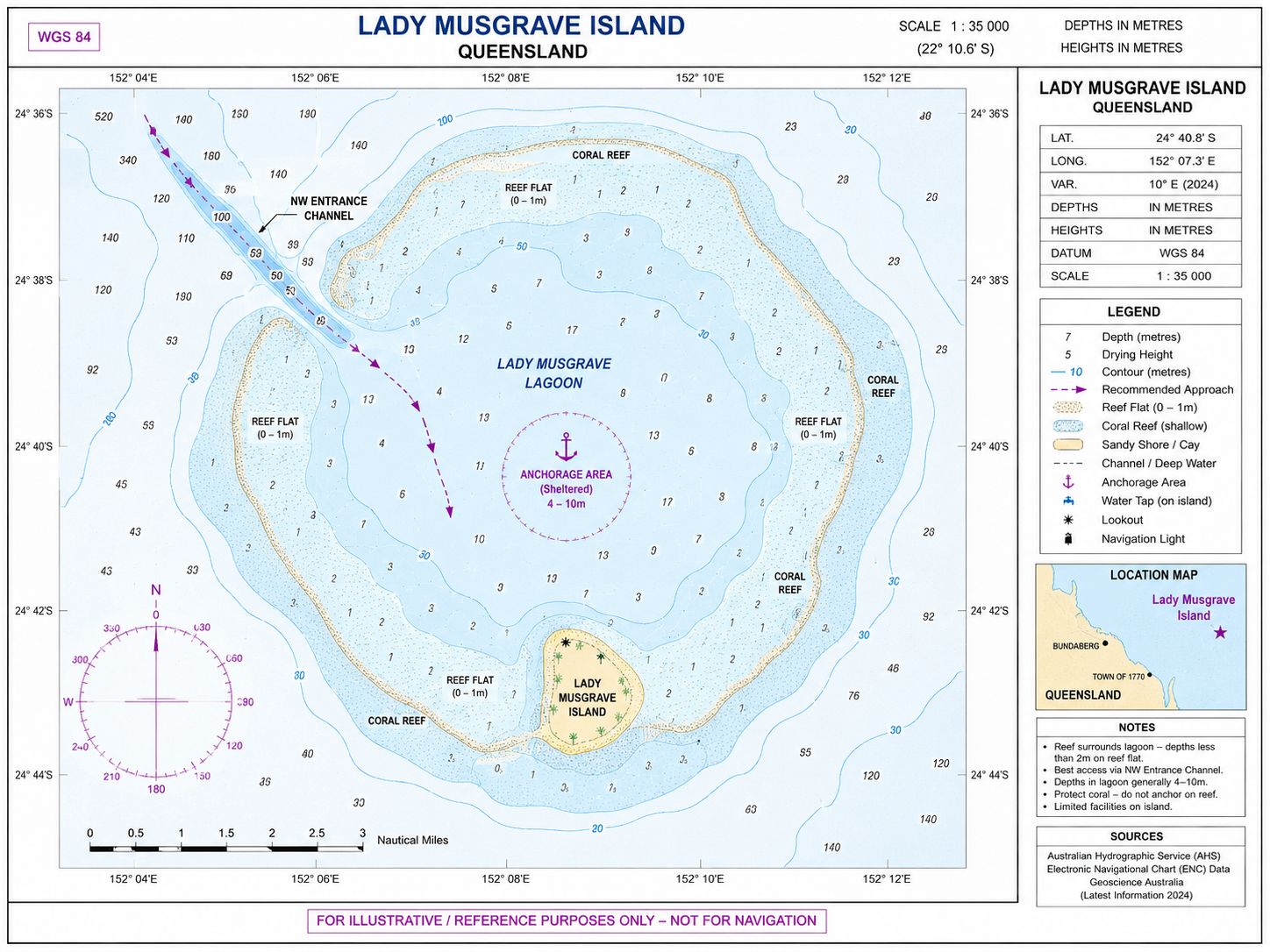
Chart Disclaimer. This chart is a schematic representation for illustrative purposes only and must not be used for navigation. Refer to official hydrographic charts for safe navigation. Be aware ENC charts may differ from official hydrographic charts. Both should be corrected and updated regularly.
Lady Musgrave Island Sailing Guide - Wind Patterns
Lady Musgrave Island Sailing Guide - Inside
the Lagoon
Once inside, the lagoon opens into a wide, calm basin with depths of 8–12 m in the central areas. The holding is excellent in sand, and the lagoon remains calm even when the trade wind is fresh outside. The skipper must still maintain awareness, because isolated bommies rise abruptly from the lagoon floor. These bommies often reach to within 1–2 m of the surface and are easy to avoid in good light but difficult to see in poor visibility.
The best anchoring ground is in the central and southern parts of the lagoon, where the sand patches are larger and the depth more consistent. The northern side has more bommies and less room for swing. The skipper must avoid anchoring too close to the island, where depths reduce to 4–6 m and coral heads are more frequent. The lagoon is comfortable in all wind directions, but the skipper must allow for tide and swing, especially when the wind drops overnight.
Lady Musgrave Island Sailing Guide - Weather & Swell
Lady Musgrave is exposed to the full force of the south‑easterly trade wind, and the sea state outside the lagoon can be rough even when the lagoon itself is calm. The skipper must plan entry and exit around the weather, not the clock. A rising south‑easterly swell can make the entrance uncomfortable, and a strong northerly can create a cross‑sea that pushes the vessel sideways in the channel. The lagoon remains safe, but the entrance becomes less forgiving.
The East Australian Current flows southward offshore and can create a slight set toward the reef when approaching from the north‑east. This is subtle but noticeable in fresh trade conditions. The current is rarely more than 1 knot, but it reduces the margin for error when combined with swell and wind.
Visibility is critical. The skipper must avoid entering or exiting when the sun is low, when the sky is overcast or when the water is choppy enough to obscure the bommies. The reef edge and lagoon floor are easy to read in good light but difficult in poor conditions. Musgrave rewards patience and punishes haste.
Lady Musgrave Island Sailing Guide - Currents and Tides
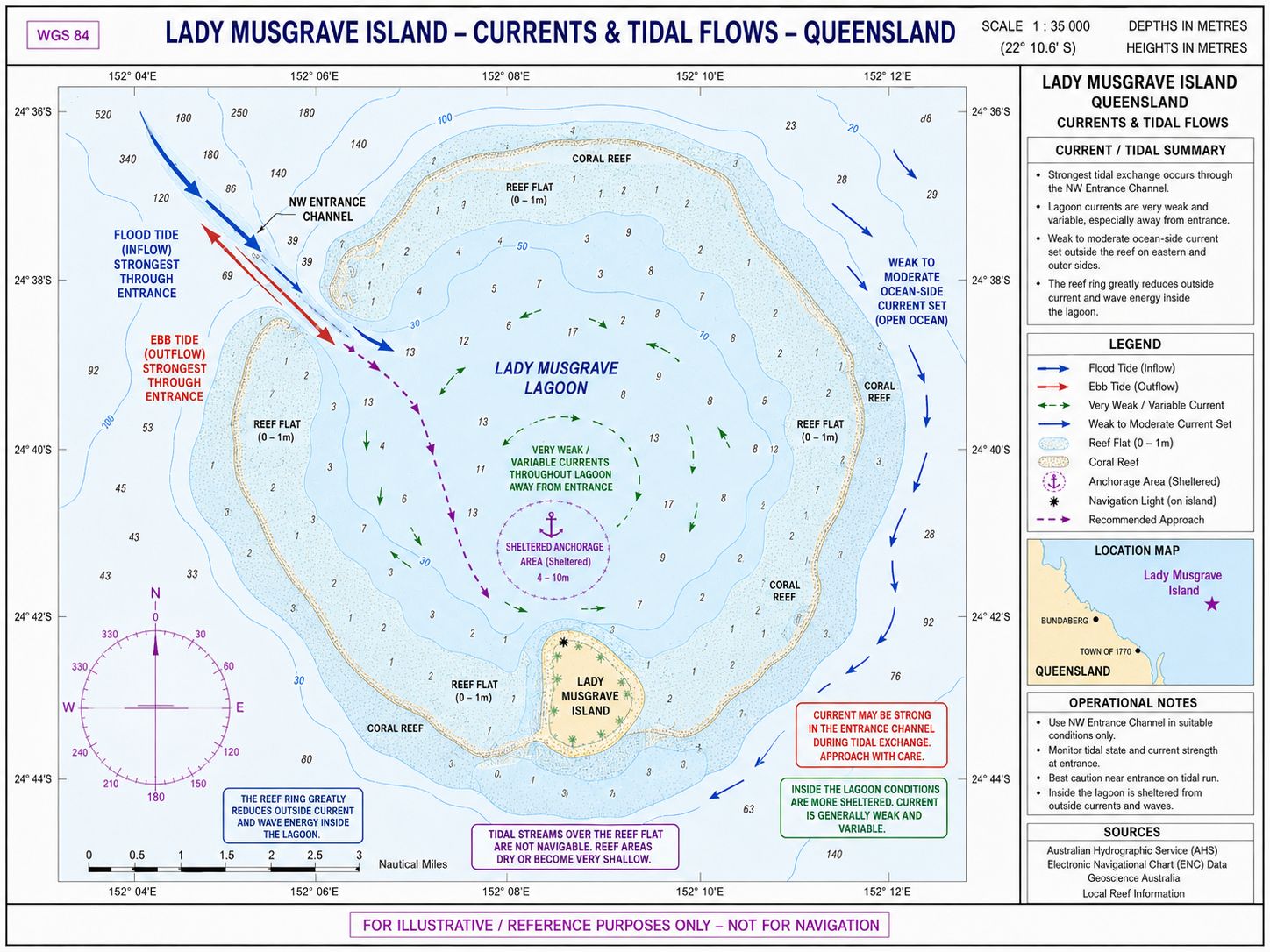
Currents and tides at Lady Musgrave Island are concentrated around the reef entrance and the lagoon exchange. The lagoon is entered through the north-west entrance channel, where tidal flow can be strong because water entering and leaving the lagoon is constrained through a narrow passage. Flood tide sets into the lagoon and ebb tide sets out through the entrance and the run can be significant during springs or when wind and tide oppose each other. Inside the lagoon, current is much weaker and variable because the surrounding reef flat breaks down ocean swell and reduces open-water set. The safest yacht movement is normally timed for good light, suitable tide height, and manageable flow through the entrance. The reef flat dries or becomes very shallow at low water, so all movement close to coral edges, bommies, and shallow patches requires diligent visual pilotage and continuous depth monitoring.
Lady Musgrave Island Sailing Guide - Lagoon
Exit
Exiting the lagoon requires the same discipline as entry. The skipper lines up the dog‑leg channel, holds the centre and maintains steady power. Depths remain 6–10 m through the entrance, but the swell outside can be larger than expected. The skipper must be prepared for the vessel to pitch as it clears the reef. Once outside, the sea state becomes more predictable, and the skipper can shape a course toward Fitzroy Reef, Pancake Creek or the next offshore leg.
The skipper must never exit late in the day unless conditions are perfect. The reef edge becomes difficult to read in low light, and the swell can obscure the colour change. Musgrave is a daylight operation, and the skipper must treat it as such.
Provisioning, Fuel
& Services
Lady Musgrave offers no provisioning, no fuel, and no marine services. Yachts must arrive fully stocked and self‑sufficient. The nearest full‑service hubs are Bundaberg Port Marina to the south and Rosslyn Bay Marina to the west, both offering provisioning, fuel, water, haul‑out facilities, and marine contractors.
Mechanical
and Electrical Repairs Resource
If you are headed somewhere remote consider the need to expand your knowledge base or have an information resource on board. Why not get a copy of my book The Marine and Electrical and Electronics Bible 4th Edition. By and for yachties, with everything from batteries and charging, solar and wind, diesel engines and marine electronics and so much more. Your complete systems guide. 650 pages of practical advice. In Australia and New Zealand order a copy through Boat Books. UK and European boats can buy the UK Edition Here. US and Canadian boats can get the US Edition Order Here. Marine systems are my profession so let me help you. By a liveaboard boat owner for other boat owners


Lady Musgrave Island Sailing Guide Summary
Lady Musgrave Island is one of the safest and most rewarding reef anchorages on the Queensland coast, but it demands respect. The approach, entrance and exit require good visibility, settled conditions and disciplined navigation. The lagoon is calm, clear and secure once inside, with excellent holding and predictable behaviour. The skipper who treats Musgrave as a reef pass finds it straightforward and enjoyable. The skipper who treats it casually discovers how quickly the margin for error disappears. The Lady Musgrave Island Sailing Guide has useful information.