Kythira Greece Sailing Guide
Kythira Greece Sailing Guide. Kythira lies at the southern end of the Peloponnese, forming a transition zone between the Ionian and Aegean seas. The island has a high and varied terrain, rising to over 500 metres, with a coastline characterised by steep cliffs, exposed headlands, and a limited number of sheltered bays. Surrounding waters are generally deep and open, with significant exposure to prevailing winds and sea conditions from multiple directions.
The principal port is located at Diakofti on the north-east coast, with additional smaller harbours and anchorages distributed around the island offering varying degrees of shelter depending on wind direction. Kythira is influenced by both Ionian and Aegean weather systems, resulting in variable conditions and stronger wind interaction than typical inner Ionian locations. For navigation, the island should be treated as exposed, with defined harbour entry points and limited all-weather shelter options.
Kythira Greece
Sailing Guide - History
Kythira has a long and complex history due to its position at the junction of major maritime routes between the Aegean and Ionian seas. The island is associated with ancient mythology as the birthplace of Aphrodite and shows evidence of Minoan and later Mycenaean presence, reflecting early integration into Aegean trade networks. In classical antiquity, Kythira was contested between regional powers, including Sparta, due to its strategic importance for controlling sea lanes.
Through the medieval period, the island came under Byzantine control, followed by extended Venetian rule, which left a lasting influence on its administration, architecture, and fortifications. It later passed to French and then British control as part of the Ionian Islands before being incorporated into the modern Greek state in the 19th century. Throughout these periods, the population relied on agriculture, maritime activity, and trade, with the island maintaining its role as a strategic waypoint rather than a major commercial centre.
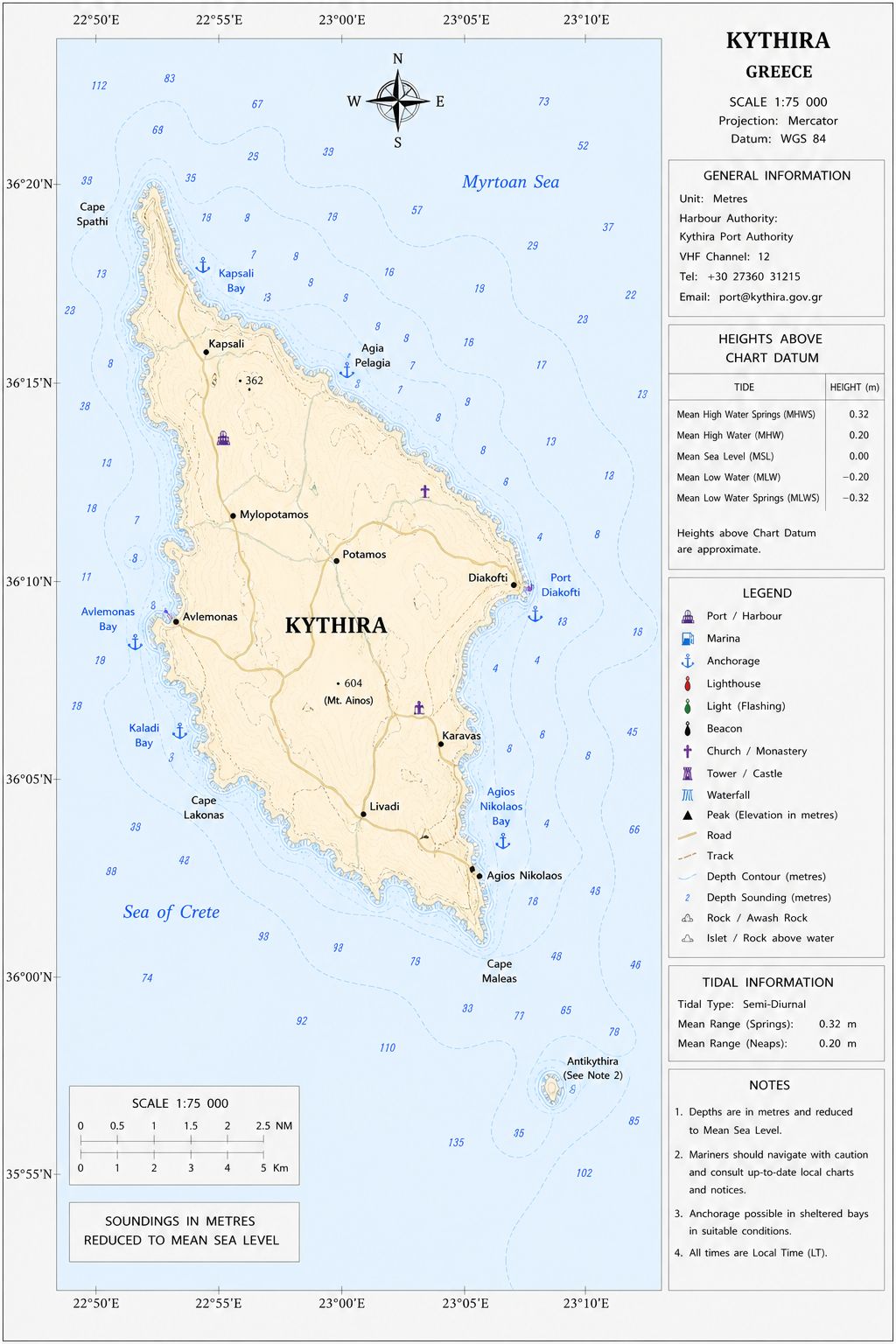
Chart Disclaimer. This chart is a schematic representation for illustrative purposes only and must not be used for navigation. Refer to official hydrographic charts for safe navigation. Be aware ENC charts may differ from official hydrographic charts. Both should be corrected and updated regularly.
Kythira Greece
Sailing Guide - Ocean Currents and Tidal Flow
Currents around Kythira are more pronounced than in the inner Ionian, influenced by the interaction between the Ionian Sea and the Aegean. Tidal range remains small, typically 0.1–0.3 metres, and does not generate a consistent flood or ebb stream; however, regional water movement and wind forcing create noticeable current patterns, particularly in exposed areas and channels.
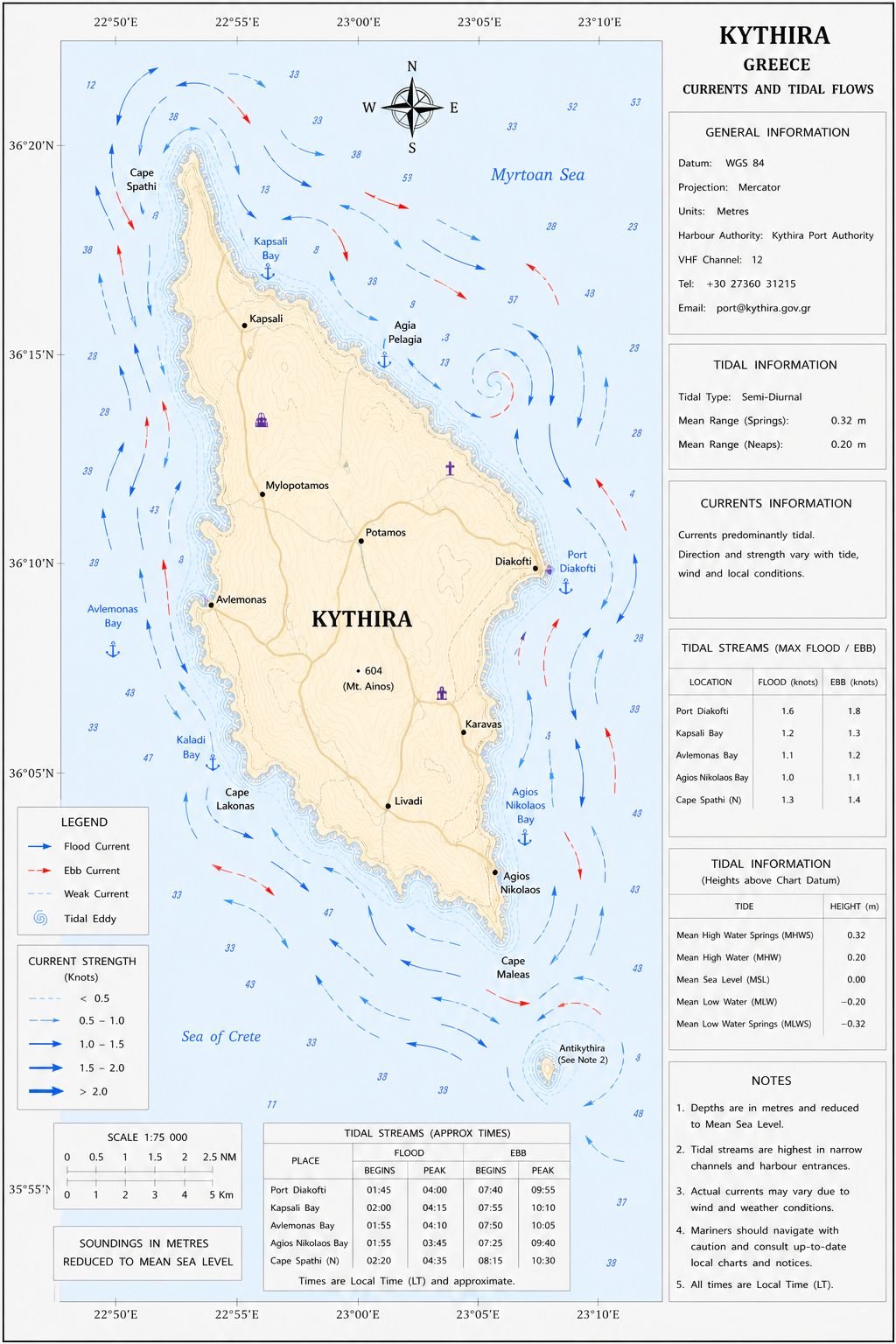
Under prevailing conditions, currents are predominantly wind-driven, with northerly winds producing a south-setting flow along exposed coasts, while southerly systems generate north-setting drift. Current speeds are typically 0.5–1.5 knots, but can increase locally around headlands, in narrow passages, and where opposing wind and sea create overfalls and disturbed water. For navigation, currents should be treated as moderate, variable, and locally intensified, requiring allowance for set, especially in open-water approaches and along exposed coastal sectors.
Kythira Greece
Sailing Guide - Weather
Weather at Kythira is more variable than the inner Ionian, influenced by both Ionian and Aegean systems. During summer, conditions are generally hot, dry, and stable, with daytime temperatures typically 28–32°C, low humidity, and high visibility. However, the island is exposed to northerly Meltemi influence, which can bring sustained winds and moderate sea conditions, particularly along exposed coasts.
Outside summer, weather becomes highly changeable, with frequent passage of low-pressure systems bringing cloud, rainfall, and shifting winds. Southerly to south-westerly winds develop ahead of fronts and can strengthen significantly, followed by cooler north-westerly flow after passage. Winter temperatures remain mild, generally 10–16°C, but conditions can be unsettled with short periods of strong winds and rough seas. Overall, Kythira experiences greater exposure and variability than typical Ionian locations, requiring close attention to forecasts.
The Marine Electrical and Electronics Bible has a complete list of Greek VHF Radio Channel information and weather forecast times for Greece along with NAVTEX UK and Europe and NAVTEX Mediterranean for 490kHz and 518kHz.
Kythira Greece
Sailing Guide - Local Winds
Wind at Kythira is influenced by its position between the Ionian and Aegean, resulting in stronger and more variable conditions than the inner Ionian. During summer, the island is affected by the Meltemi, with N to NE winds commonly reaching 15–25 knots and frequently increasing to 25–35 knots or higher in exposed areas. The interaction of airflow around the island produces local acceleration, gusting, and turbulence, particularly along headlands and through open channels.
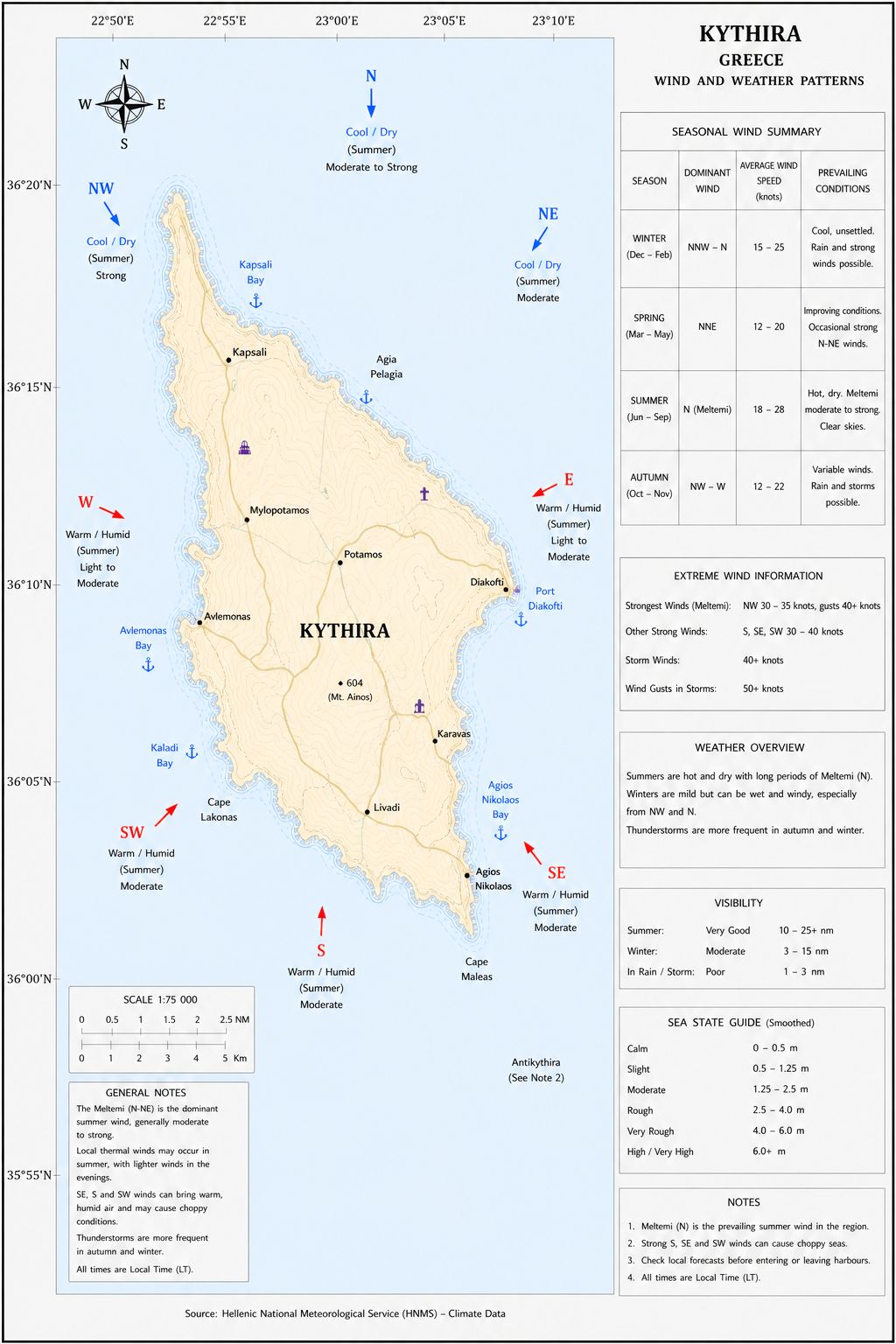
Outside the summer season, wind patterns become synoptic and highly variable, driven by passing low-pressure systems. Southerly to south-westerly winds develop ahead of fronts and can strengthen rapidly, often exceeding 25–30 knots, before veering west to north-west after passage. Local effects include rapid wind shifts, squalls, and confused sea states, especially where opposing winds and currents interact. Overall, wind conditions at Kythira should be treated as exposed, changeable, and often stronger than forecast values due to local acceleration.
Kythira Greece
Sailing Guide - Approaches
Approach to Kythira from the north via the Peloponnese involves open water with depths exceeding 50 metres. From the south, approach from Crete involves long fetch and developed sea state. The east coast offers the most accessible approach points. Diakofti is approached from the east with clearly defined harbour structures and depths reducing from approximately 15–20 metres to harbour depths. Kapsali is approached from the south through an open bay with depths reducing gradually. Hazards include strong wind zones, offshore swell, and rock-bound coastline with limited alternative shelter.
Primary considerations are exposure to wind and sea state rather than navigational constraint. Under northerly Meltemi conditions, expect strong winds, significant fetch, and short, steep seas, particularly along exposed eastern and southern coasts. In southerly weather, conditions can deteriorate rapidly with heavy swell and reduced visibility. There are no defined approach channels, and navigation is conducted by chart and visual reference, with attention required for wind-driven set, local acceleration around headlands, and maintaining clearance from rocky coastal features.
Kythira Greece
Sailing Guide - Navigation
Diakofti (Primary Port). Entry into Diakofti on Kythira is made on the north-east coast into a purpose-built harbour with extensive breakwater protection. The approach is straightforward in deep water (typically 10–20 metres) with no off-lying hazards, leading into a wide entrance channel. Inside, depths remain 5–10 metres, with ample manoeuvring room for ferries and visiting vessels. The harbour is well protected from northerly winds but can be exposed to easterly swell, which may enter the basin in unsettled conditions. Ferry movements are frequent and take priority, requiring careful timing and clear approach.
Kapsali (Secondary Harbour). Entry into Kapsali on the south coast is made into a twin-bay anchorage separated by a small islet, with the main harbour area partially enclosed. The approach is open and conducted visually, with depths of 8–15 metres on entry, shoaling toward the quay to 2–4 metres. There are no formal leading marks, and care is required to maintain clearance from shoreline features and anchored vessels. Shelter is good in northerly conditions, but the harbour is exposed to southerly winds and swell, which can significantly affect holding and manoeuvring. Space is limited, and berthing is typically stern-to using own anchor, requiring attention to anchor placement and proximity to other vessels.
Kythira Greece
Sailing Guide - Chart Accuracy
Hydrographic charts provide accurate coastline and harbour representation. Electronic charts align with official data. Nearshore hazards and harbour configurations should be confirmed visually when manoeuvring.
Kythira Greece
Sailing Guide - Anchorages
Around Kythira anchoring is selective and strongly dependent on wind direction, with limited all-weather options. The following are the primary viable anchorages:
- Kapsali Bay (south coast). The main anchorage in 8–15 metres over sand and weed, offering good shelter from northerlies, but exposed to southerlies; space can be limited in peak season
- Diakofti (north-east coast). Anchoring outside or within the harbour area in 5–10 metres over sand, with good holding; generally sheltered from northerlies but open to easterly conditions
- Avlemonas (east coast). This is a small harbour and anchorage in 5–10 metres, suitable in settled conditions with protection from northerlies, but exposed to east and south-east swell
- Agia Pelagia (north coast). There is anchoring in 5–12 metres over sand, offering reasonable shelter from southerlies, but open to northerly Meltemi winds
- Fyri Ammos & Kaladi area (east coast). This is a temporary anchorage in 10–20 metres, usable only in calm weather with no reliable shelter
There are no mooring buoy fields or structured anchorage systems, and many coastal areas are steep-to and exposed. For operational planning, anchorage selection at Kythira must be based on prevailing wind direction, with Kapsali and Diakofti as the primary working options, and all others considered secondary and weather-limited
Kythira Greece
Sailing Guide - Entry Formalities
Entry formalities follow standard Greece procedures for visiting yachts. This is not a designated port of entry for international clearance, and there are no customs or immigration facilities on the island. Vessels arriving from outside Greece or the Schengen Area must first clear into the country at an official port of entry before proceeding to this port. Direct arrival from a non-Schengen country is not permitted. The Greek cruising tax (TEPAI) must be valid and paid, and the vessel’s cruising log (DEKPA for non-EU vessels, or transit log where applicable) should be up to date and available for inspection if requested by port authorities or coastguard.
Kythira Greece
Sailing Guide - Marina Facilities
Kythira has no full-service marina, with berthing concentrated at the ports of Diakofti and Kapsali, along with smaller harbour locations such as Avlemonas.
At Diakofti, berthing is along substantial commercial quays designed for ferry traffic, with depths typically 5–10 metres alongside and ample manoeuvring space. Facilities are basic but functional, with water and electricity available in parts, though supply may vary. There are no pontoons or laid moorings, and vessels berth stern-to or alongside where permitted, with priority given to ferries.
At Kapsali, berthing is more limited, with vessels either anchoring off in 8–15 metres or stern-to the quay in approximately 2–4 metres, using own ground tackle. Space is restricted and exposed to southerly conditions. Avlemonas and other minor harbours provide very limited alongside berthing in shallow depths, suitable only for small vessels or short stays.
Kythira Greece
Sailing Guide - Provisioning
Supermarkets. Provisioning for vessels sailing Kythira Greece is available at moderate scale. Supermarkets include AB Vasilopoulos Kythira (Potamos area) and local grocery outlets in Kapsali and Chora.
Markets. Supply is concentrated in Potamos, Chora (Kythira), and near Diakofti, where greengrocers and supermarkets carry seasonal fruit and vegetables. A weekly market operates in Potamos, providing the most consistent access to locally grown produce.
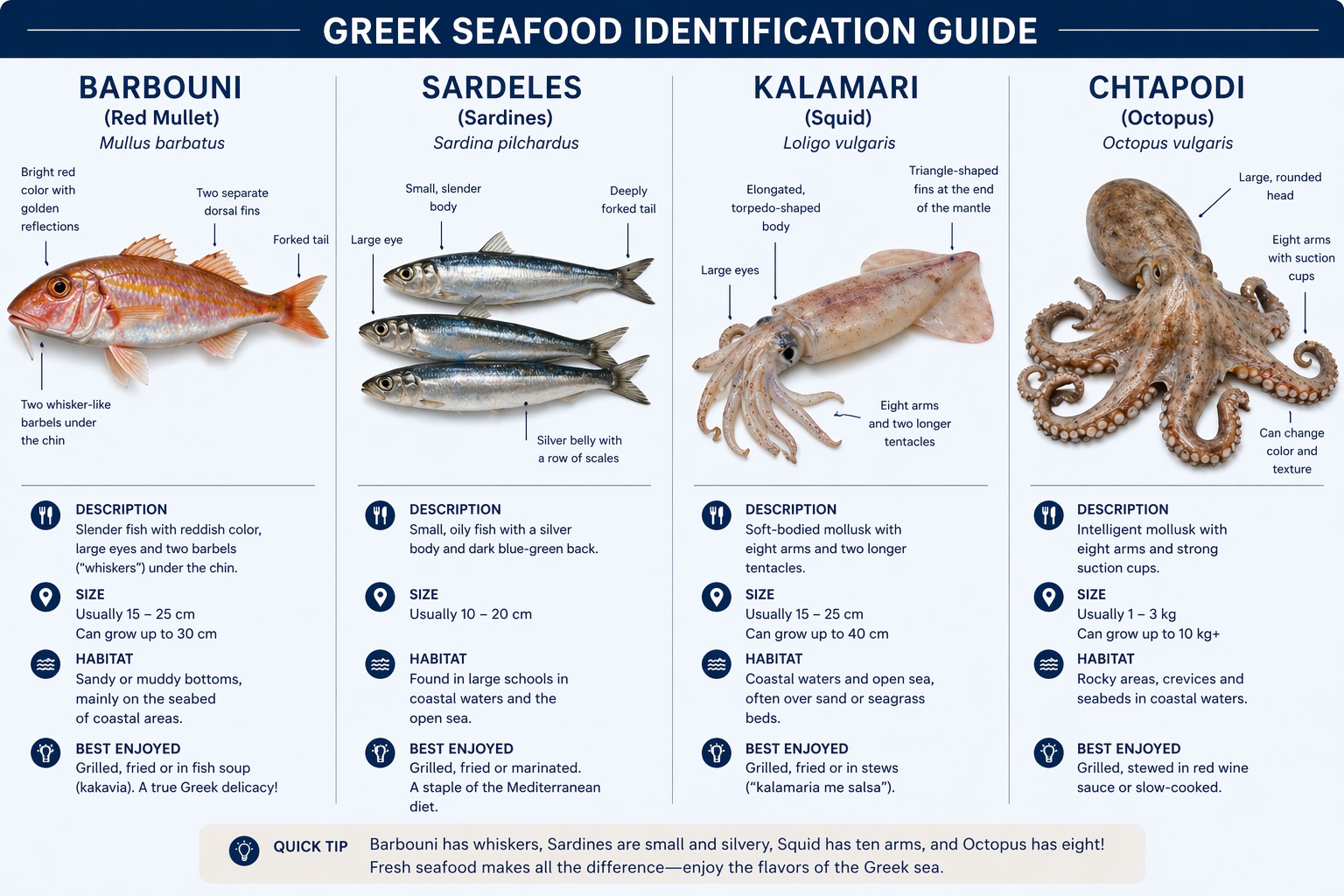
Fish Markets. Fresh seafood is sourced from local small-scale fishing activity, with landings occurring at ports such as Diakofti, Kapsali, and Avlemonas. Fish may occasionally be obtained directly from fishermen, subject to the day’s catch and availability.
Kythira Greece
Sailing Guide - Local Cuisine
Local cuisine on Kythira reflects a mix of Ionian and Cretan influences, based on olive oil, grains, vegetables, and locally produced meat and dairy. A distinctive dish is tsirigotiko paximadi, a local rusk often served with tomato and olive oil. Local dishes include pastitsada Kythiras and regional preparations influenced by Venetian heritage. Also chicken or goat dishes cooked in wine or tomato, and simple vegetable stews (ladera) using seasonal produce. Fish is prepared as psari psito using available species, and as psari sto fourno. Small fish are served as gavros tiganitos. Meat dishes include souvlaki, gyro, and kontosouvli, with slow-cooked dishes such as kokkinisto and stifado.
Kythira Greece
Sailing Guide - Local Beverages
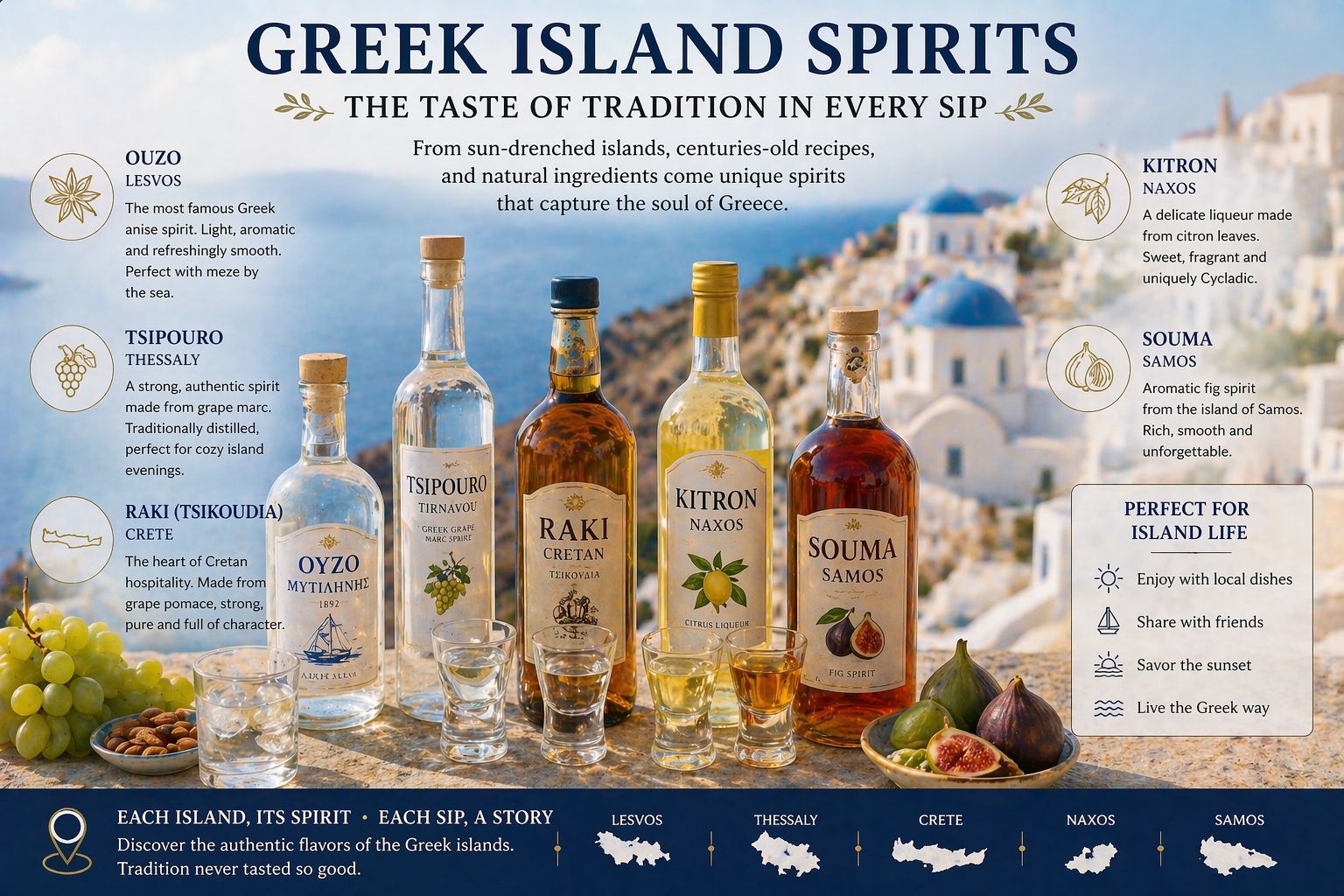
Local beverages on Kythira consist of regional wines, bottled beers includes Alpha, Mythos, and Fix and traditional spirits such as ouzo, tsipouro, and raki, available through tavernas and local shops.
Kythira Greece
Sailing Guide - Diesel Fuel Supplies
Diesel fuel at Kythira is available but limited and location-specific, with supply primarily at Diakofti. There is no fixed fuel dock, and refuelling is typically carried out via road tanker delivery to the quay, which must be arranged in advance through local suppliers or port contacts. At secondary locations such as Kapsali, fuel is not normally available alongside, and any supply would be limited to small quantities by container from roadside stations.
Kythira Greece
Sailing Guide - Water Supplies
Potable water at Kythira is available but limited and location-dependent, with the most reliable access at Diakofti. Water is supplied via quay connections where available, though pressure and consistency can vary, particularly during peak summer demand. At secondary harbours such as Kapsali and Avlemonas, supply is restricted or intermittent, and vessels may need to obtain water by container or local arrangement. Water is sourced from local storage and supply systems, with priority given to residents.
Mechanical and Electrical Repairs
Resource
If you are headed somewhere remote consider the need to expand your knowledge base or have an information resource on board. Why not get a copy of my book The Marine and Electrical and Electronics Bible 4th Edition. By and for yachties, with everything from batteries and charging, solar and wind, diesel engines and marine electronics and so much more. Your complete systems guide. 650 pages of practical advice. In Australia and New Zealand order a copy through Boat Books. UK and European boats can buy the UK Edition Here. US and Canadian boats can get the US Edition Order Here. Marine systems are my profession so let me help you. By a liveaboard boat owner for other boat owners.



Kythira Greece
Sailing Guide - Marine Services
Marine service capability is limited. Basic mechanical and electrical support may be available locally, though no authorised service agents are present. For major repair or haul-out, vessels must relocate to Kalamata or other mainland facilities.
Kythira Greece
Sailing Guide - Local Etiquette
Ashore, behaviour is informal but respectful, consistent with small island communities. Noise should be minimised, particularly at night in harbour and residential areas. Waste disposal should use designated facilities, and discharge within harbour limits is not acceptable. Dress is casual, but appropriate attire is expected in towns, shops, and churches, with swimwear covered. Overall, etiquette is based on cooperation in confined harbour space and respect for local residents and working port activity.
Kythira Greece
Sailing Guide - Summary
Kythira presents a transitional offshore operating environment with limited harbour infrastructure and exposure to multiple weather systems. Navigation requires planning for variable wind and sea conditions, particularly on exposed coasts. Anchorage and harbour options are limited but usable with correct selection. Provisioning and services are moderate, positioning Kythira as a staging point rather than a primary cruising base, consistent with a Kythira Greece Sailing Guide for all you need to know.