Krabi Sailing Guide for Yachts
Krabi Sailing Guide for Yachts. Krabi is a sheltered Andaman Coast destination used by yachts moving between Phuket, Phi Phi, Koh Lanta, and the Trang islands. The region consists of river estuaries, mangrove channels, limestone headlands, and offshore islands, with depths reducing from 25–40 m offshore to 6–12 m near the coast. Navigation is shaped by tidal streams, shallow bars, and unlit fishing gear.
Ao Nang, Railay, and the Krabi River provide the main access points. Services are limited compared to Phuket, but provisioning, fuel, water, and basic repairs are available in Krabi Town and Ao Nang. Anchorages are seasonal, with the west‑facing bays exposed during the southwest monsoon.
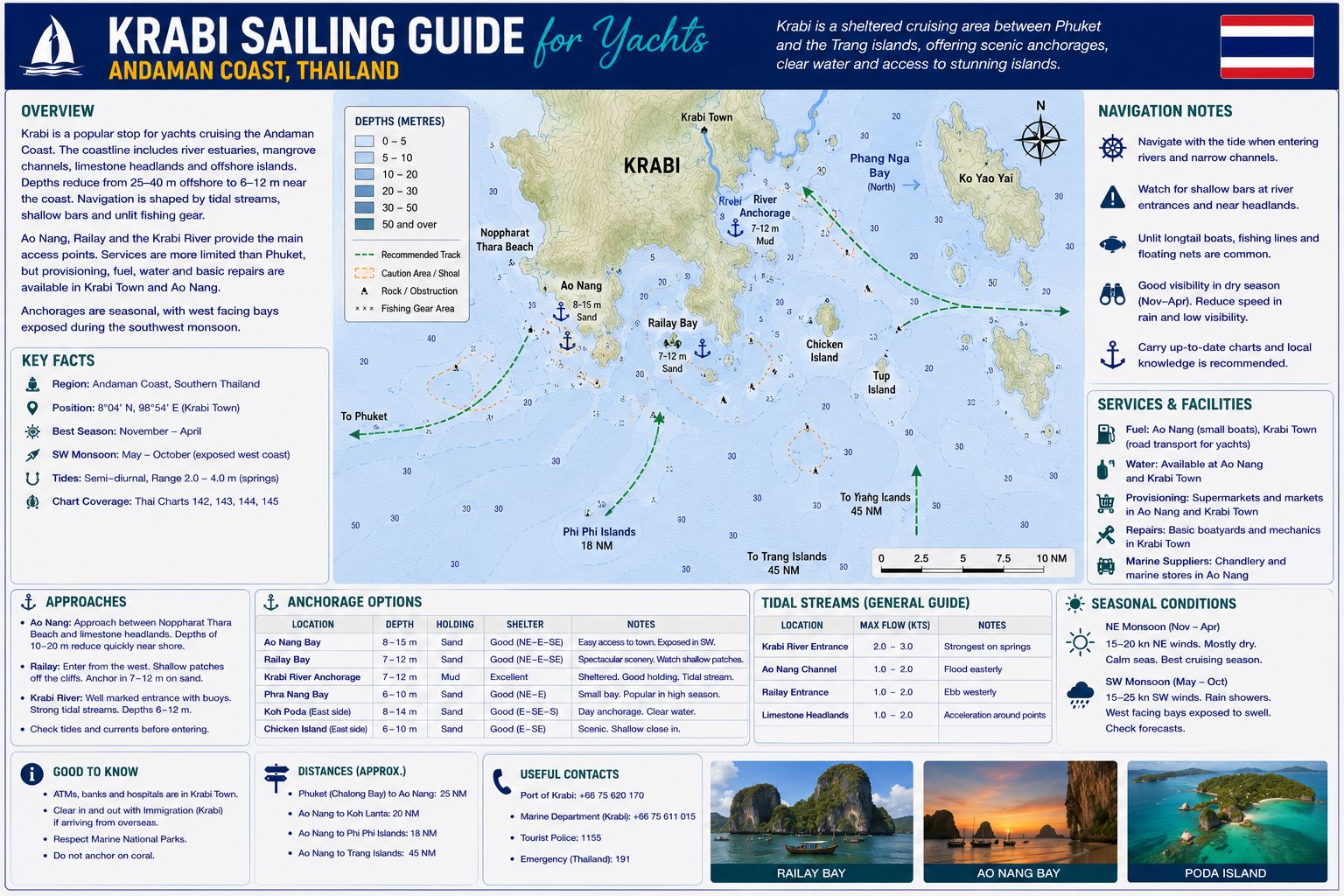
Krabi Sailing Guide for Yachts - Approaches
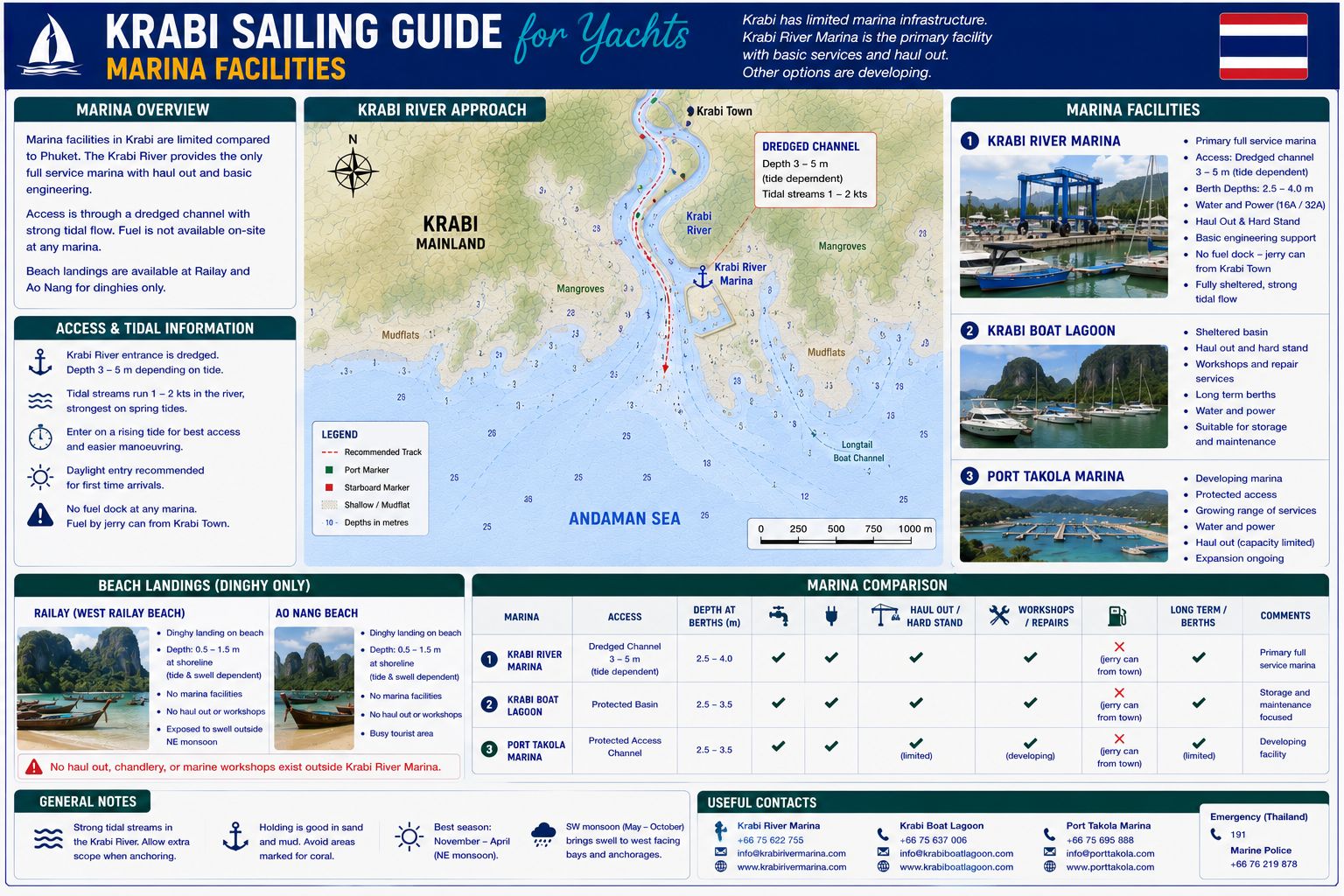
Approaching Krabi requires more attention than Phuket due to shallow areas, river entrances, and tidal effects. Offshore depths of 25–40 m reduce to 12–18 m approaching the Krabi coastline and 6–12 m inside the island chain. The Krabi River entrance has a dredged channel with 3–5 m depending on tide, bordered by mudflats that dry at low water. Tidal streams run 1–2 knots, increasing near constricted bends. Unlit fishing traps and nets are common in 6–12 m, especially between Ao Nang and Koh Lanta. Approaches to Railay and Ao Nang are clear in settled weather, with depths of 10–15 m outside the headlands and 6–10 m inside the bays. Swell affects all west‑facing approaches during the southwest monsoon.
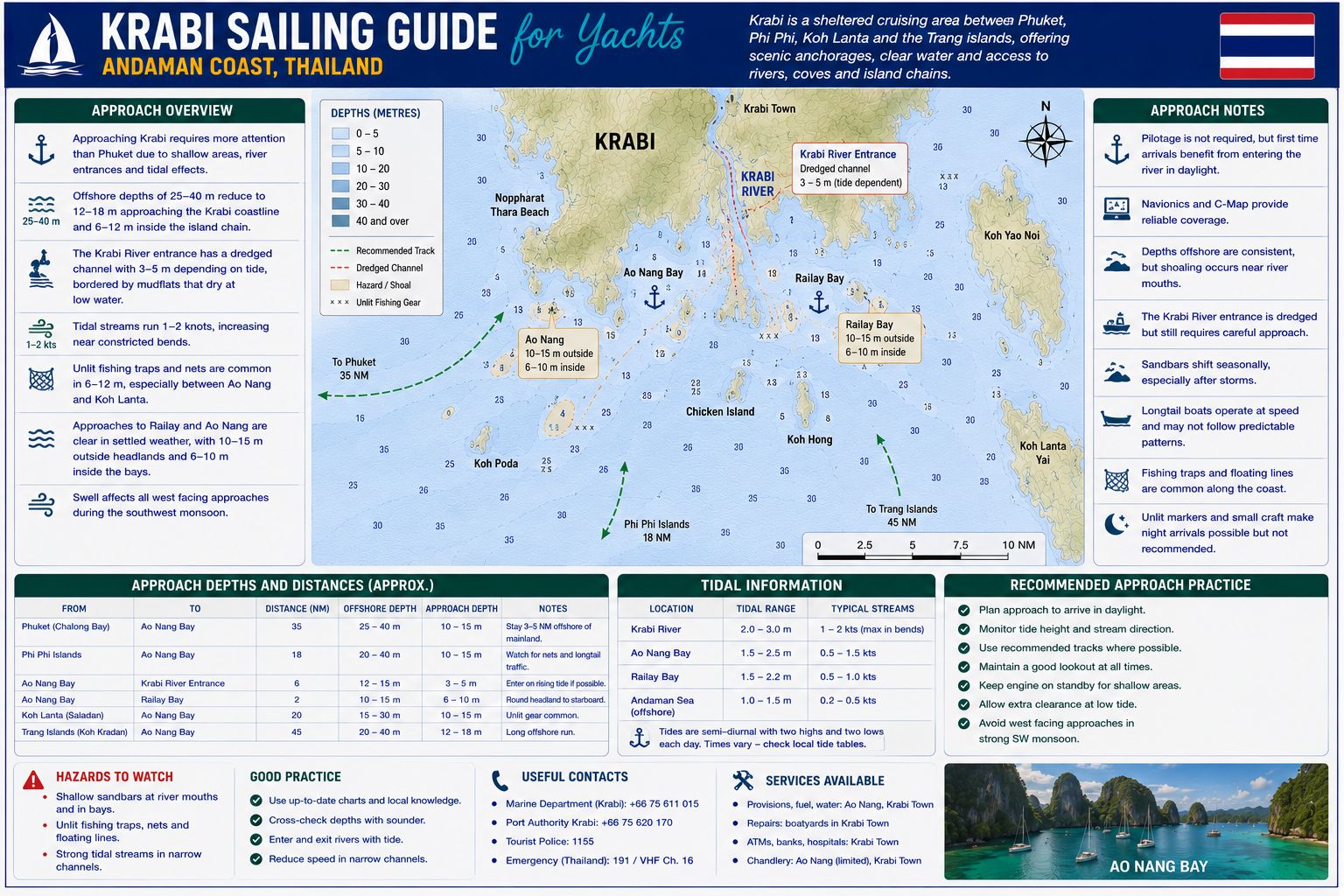
Krabi Sailing Guide for Yachts - Approach
Notes
Pilotage is not required, but first‑time arrivals benefit from entering the river in daylight. Navionics and C‑Map provide reliable coverage. Depths offshore are consistent, but shoaling occurs near river mouths. The Krabi River entrance is dredged but still requires careful approach. Sandbars shift seasonally, especially after storms. Longtail boats operate at speed and may not follow predictable patterns. Fishing traps and floating lines are common along the coast. Unlit markers and small craft make night arrivals possible but not recommended.
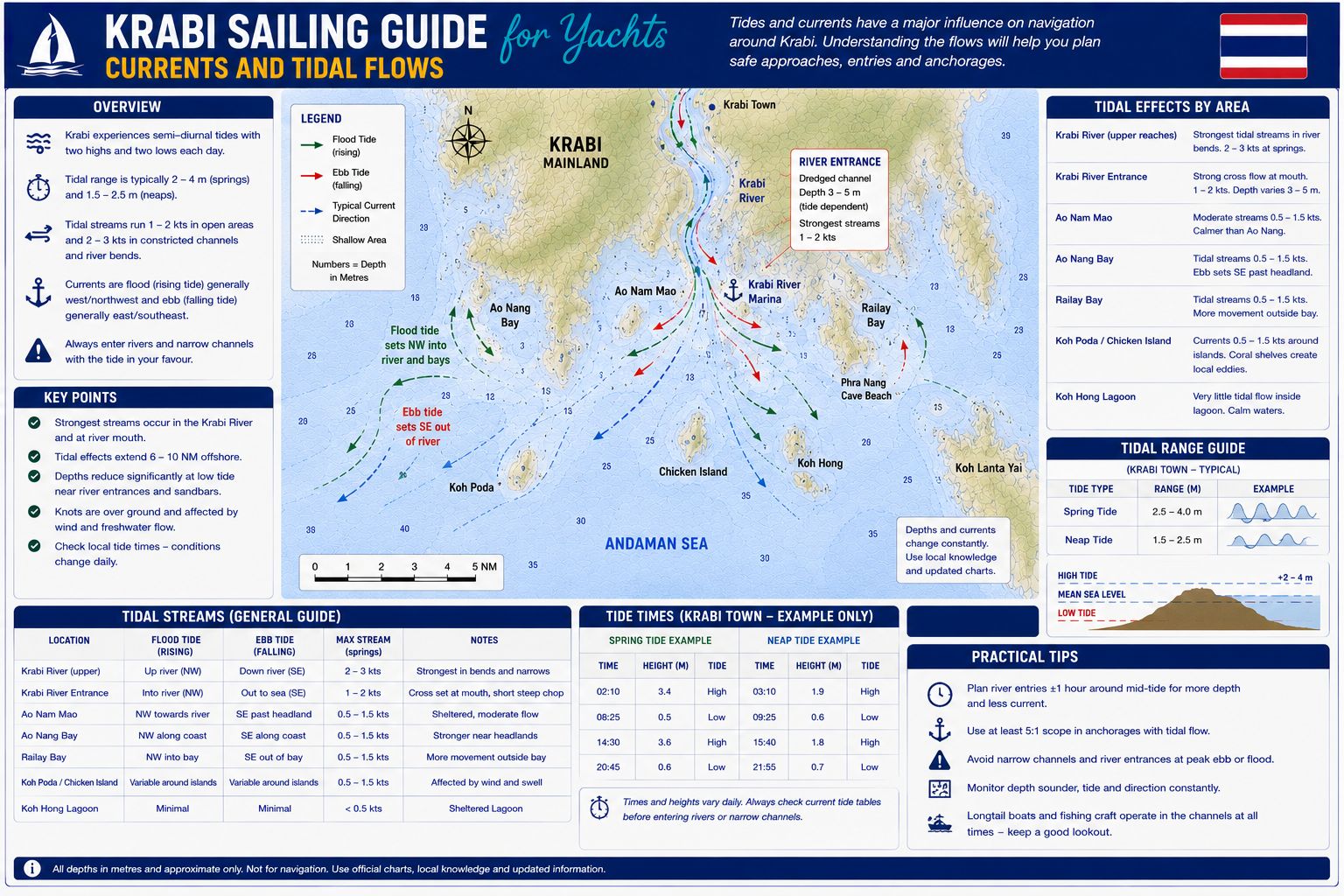
Krabi Sailing Guide for Yachts - Anchorage
Holding is generally good in sand and mud. Coral areas are marked by buoys and should be avoided. Tidal currents in the Krabi River can be strong, so adequate scope is essential. Ao Nang provides anchoring in 6–12 m over sand with moderate holding. Railay offers 8–14 m over sand but is exposed to swell outside the northeast monsoon. Koh Poda and Chicken Island provide 10–15 m in settled weather, with coral shelves rising into 4–6 m. The Krabi River offers protected anchoring in 4–8 m over mud, with strong tidal influence and limited swing room. All west‑facing anchorages are exposed during the southwest monsoon. Krabi River (Krabi Town) – Sheltered anchorage with access to markets, fuel, and basic services. Ao Nam Mao – Sheltered anchorage east of Railay; calmer than Ao Nang.
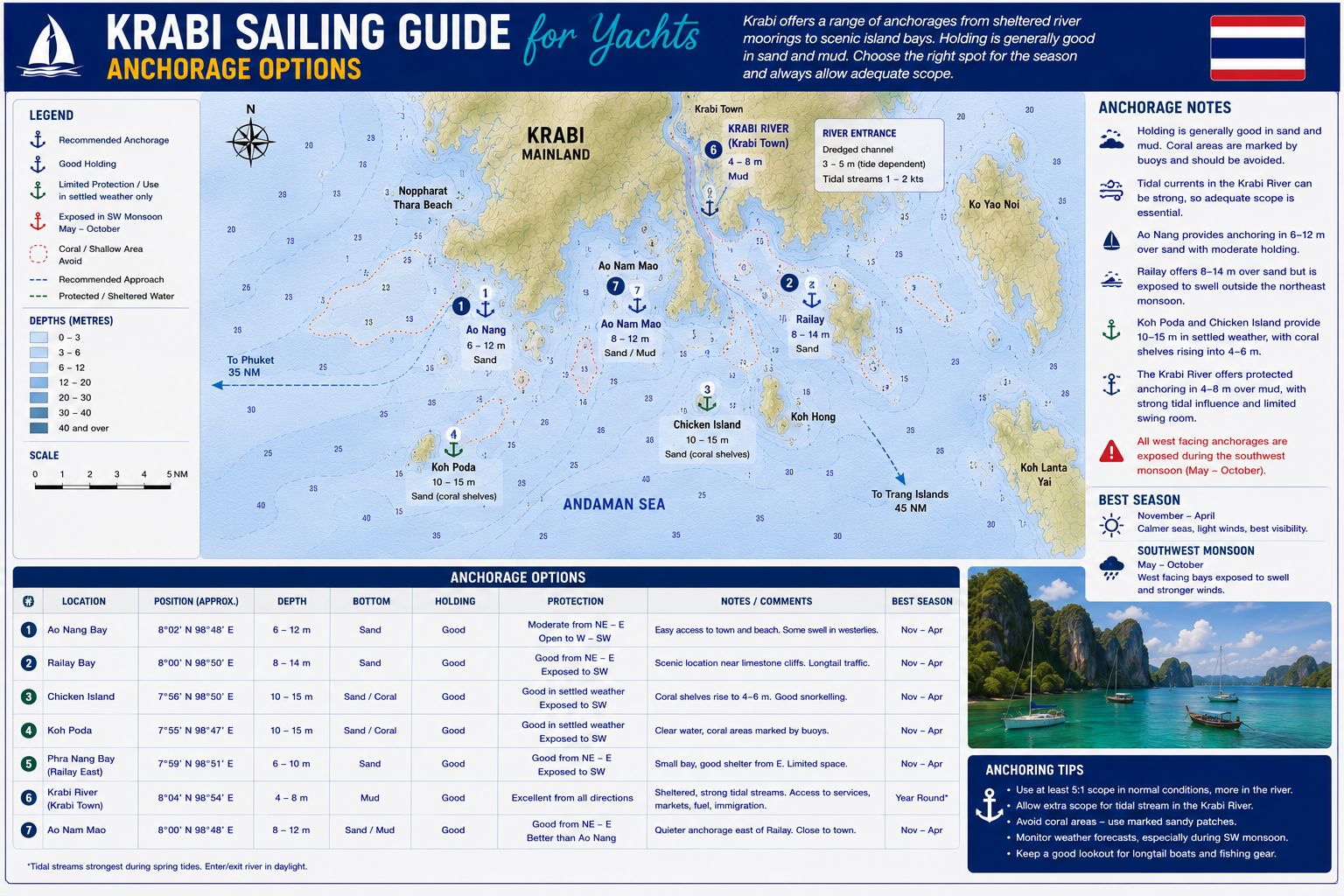
Krabi Sailing Guide for Yachts - Entry
Formalities
Immigration services are available in Krabi Town for visa extensions. Agents are not required, and procedures are generally straightforward. Krabi is an official port of entry when staffed. Yachts clear Customs, Immigration, and Quarantine at Krabi River Marina or designated government offices in Krabi Town. Domestic movements within Thailand require no further clearance once entry is completed. Harbour inspections occur as required. Starlink and other satellite systems are permitted but must not interfere with local frequencies.
Krabi Sailing Guide for Yachts - Marina
Facilities
Krabi has limited marina infrastructure. Krabi River Marina is the primary facility. Access is via a dredged channel with 3–5 m depending on tide. Inside depths are 2.5–4 m. The marina provides water, power, haul‑out, hard‑stand, and basic engineering support. No fuel dock is available; fuel is transported by jerry can from Krabi Town. The marina is fully sheltered but subject to strong tidal flow. Krabi Boat Lagoon is a sheltered basin, haul‑out, workshops, long‑term berths. Port Takola Marina is a developing marina with protected access and growing services. There are no other marinas in the Krabi region. Railay and Ao Nang offer only beach landings for dinghies, with 0.5–1.5 m at the shoreline depending on tide and swell. No haul‑out, chandlery, or marine workshops exist outside Krabi River Marina.
Krabi Sailing Guide for Yachts - Local
Weather
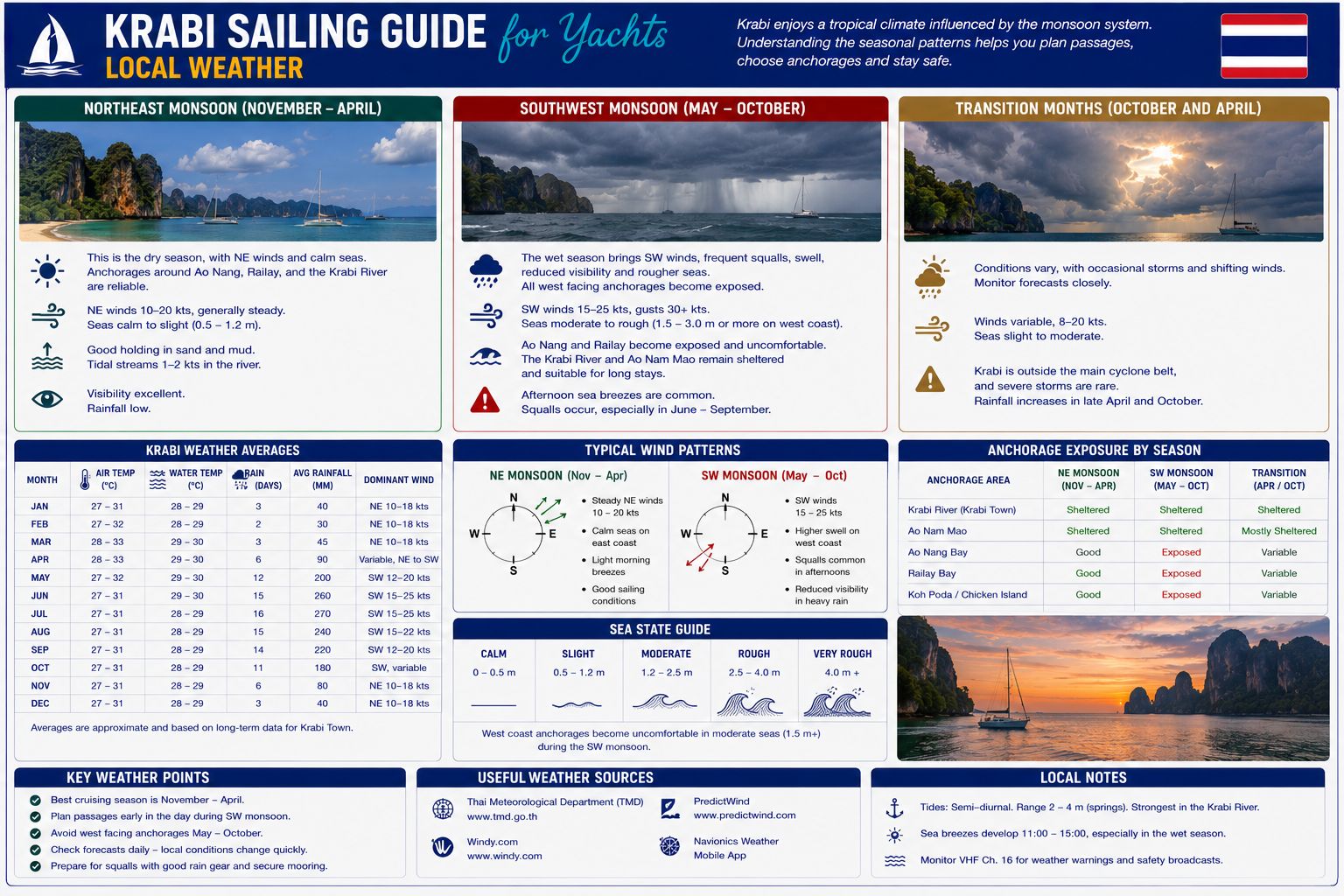
- Northeast Monsoon (November–April). This is the dry season, with NE winds and calm seas. Anchorages around Ao Nang, Railay, and the Krabi River are reliable. Visibility is good, and rainfall is low.
- Southwest Monsoon (May–October). The wet season brings SW winds, frequent squalls, swell, reduced visibility and rougher seas limiting operations on all west‑facing anchorages. Ao Nang and Railay become exposed and uncomfortable. The Krabi River and Ao Nam Mao remain sheltered and suitable for long stays. Afternoon sea breezes are common, and squalls occur during transitional periods.
- Transition Months (October and April). Conditions vary, with occasional storms and shifting winds. Krabi is outside the main cyclone belt, and severe storms are rare. Rainfall peaks from June to September.
Krabi Sailing Guide for Yachts - Provisioning
Supermarkets. Krabi Town has reliable supermarkets including Big C Krabi, Lotus’s Krabi, and Makro Krabi. These stores carry vegetables, herbs, fruit, dairy, dry goods, and packaged imports. Makro provides the most consistent bulk quantities. Specialty Western products are available in limited quantities at Big C and Lotus’s.
Markets. Krabi Town Fresh Market and Ao Nang Market operate daily with high turnover. They supply local greens, herbs, tropical fruit, tofu, noodles, and curry pastes. Morning trading provides the best selection. Maharat Market. Good for spices, herbs, and Thai ingredients. Produce arrives from southern Thailand and local farms.
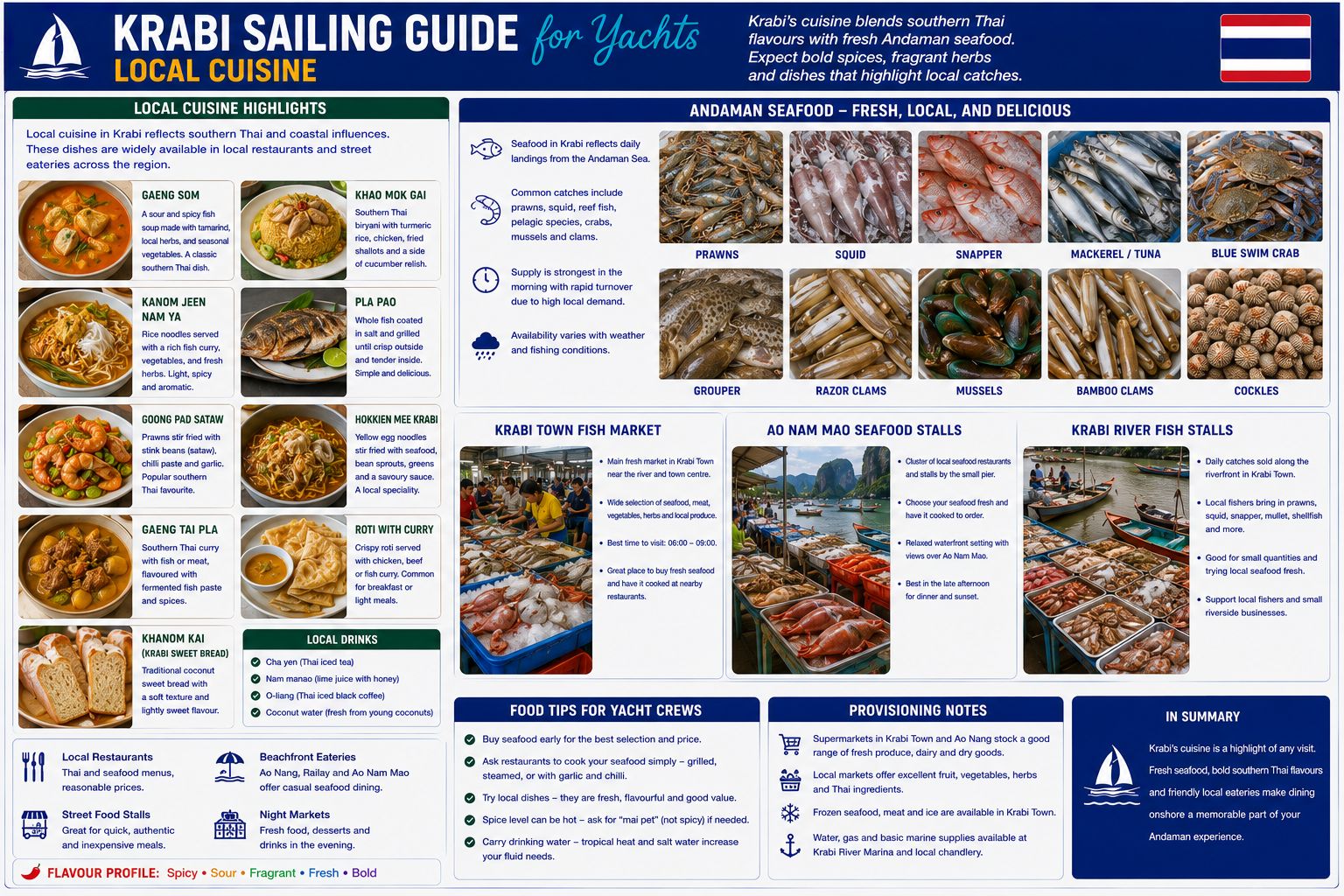
Fish Markets. Seafood reflects Andaman landings. Krabi Town Fish Market and Ao Nam Mao seafood stalls carry prawns, squid, reef fish, pelagic species, and shellfish. Supply is strongest in the morning, with rapid turnover due to local demand. Availability varies with weather and fishing conditions. Krabi River fish stalls with daily catches including prawns, squid, snapper, and shellfish.
Krabi Sailing Guide for Yachts - Local
Cuisine
Local cuisine in Krabi reflects southern Thai and coastal influences. Common regional dishes include gaeng som, a sour, spicy fish soup; khao mok gai, southern Thai biryani; and kanom jeen nam ya, rice noodles with fish curry. Coastal stalls often prepare pla pao, whole fish grilled with salt, and goong pad sataw, prawns stir‑fried with stink beans. Local eateries also serve Hokkien mee Krabi, a seafood noodle dish.
Krabi Sailing Guide for Yachts - Fuel
Supplies
Roadside stations. Diesel available for jerry can transport. Fuel delivery trucks can be arranged in Krabi Town or Ao Nam Mao. Fishing docks, some supply diesel, though quality varies. Ao Nang has limited fuel availability; jerry cans are the norm. Quality is generally consistent, though checks for water or sediment are recommended when purchasing from smaller outlets. High‑sulfur diesel is common. Payment is usually cash.
Krabi Sailing Guide for Yachts - Water
Supplies
Fresh water is available throughout Krabi, though not always directly at the shoreline. Sources include water delivery trucks which are common in Krabi Town and Ao Nam Mao. Roadside refill stations are suitable for jerry cans. Restaurants and resorts often allow small fills for a fee. Krabi River water available at docks, though treatment is essential. Most crews use carbon filters or UV sterilizers. Water pressure from delivery trucks is usually adequate for tank filling.
Mechanical
and Electrical Repairs Resource
If you are headed somewhere remote consider the need to expand your knowledge base or have an information resource on board. Why not get a copy of my book The Marine and Electrical and Electronics Bible 4th Edition. By and for yachties, with everything from batteries and charging, solar and wind, diesel engines and marine electronics and so much more. Your complete systems guide. 650 pages of practical advice. In Australia and New Zealand order a copy through Boat Books. UK and European boats can buy the UK Edition Here. US and Canadian boats can get the US Edition Order Here. Marine systems are my profession so let me help you. By a liveaboard boat owner for other boat owners

Krabi Sailing Guide for Yachts - Marine
Services
Marine services are limited. Krabi River Marina provides haul‑out, hard‑stand, and basic mechanical and electrical work. No authorised Volvo or Yanmar agents operate in Krabi; major engine work is handled in Phuket. Fibreglass repairs, small‑engine servicing, and general labour can be arranged through local contractors. Chandlery and specialist parts are limited and typically sourced from Phuket.
Krabi Sailing Guide for Yachts - Local
Customs
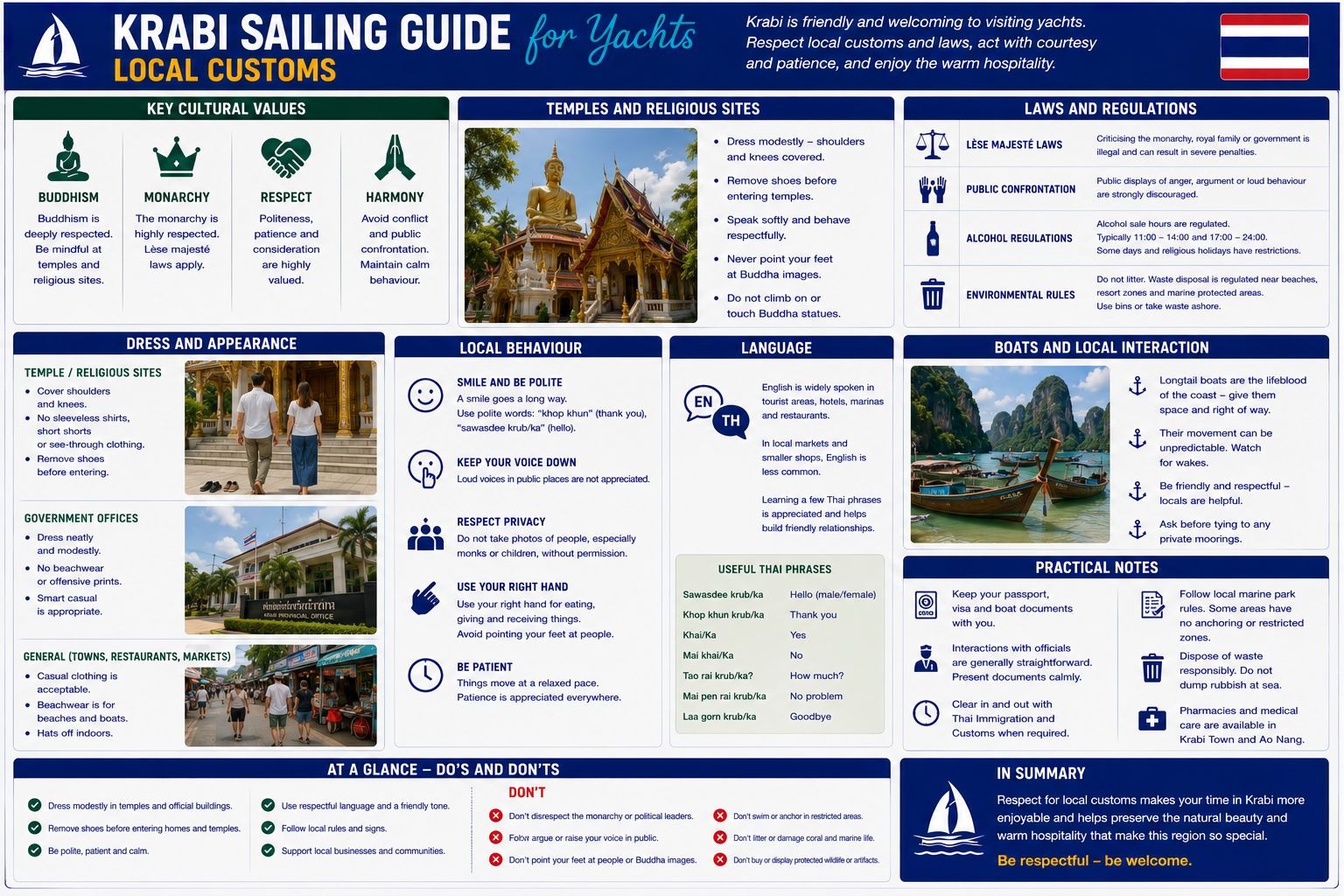
Krabi follows national norms shaped by Buddhism and strong reverence for the monarchy. Respectful behaviour is required near temples and religious sites. Lèse‑majesté laws apply. Public confrontation is discouraged. Alcohol sale hours are regulated. Waste disposal rules apply near beaches, resort zones, and marine‑protected areas. Politeness and calm behaviour are valued. Remove shoes before entering homes or temples. Dress modestly in government offices and religious sites. Public displays of anger are discouraged. English is widely spoken in tourist areas but less common in markets. Interactions with officials are generally straightforward, and patience is appreciated.


Krabi Sailing Guide for Yachts - Summary
Krabi provides sheltered river access, limited marina facilities, and reliable provisioning for yachts operating between Phuket, Phi Phi, Lanta, and the Trang islands. Navigation requires attention to tidal streams, shallow bars, and unlit fishing gear. Anchorages are seasonal, with west‑facing bays exposed during the southwest monsoon. Krabi functions as a secondary service point supporting movements along the Andaman Coast. The Krabi River and Ao Nam Mao provide sheltered options during the southwest monsoon, while Ao Nang and Railay are suitable in the dry season. Krabi Sailing Guide for Yachts has useful information about everything.