Kefalonia Greece
Sailing Guide
Kefalonia Greece Sailing Guide. Kefalonia is the largest of the Ionian Islands, located off the west coast of mainland Greece, south of Lefkada and west of Ithaca. The island has a high and mountainous profile, rising to over 1,600 metres at Mount Ainos, with a coastline characterised by deep bays, steep cliffs, and a number of well-defined harbours. Surrounding waters are generally deep and sheltered compared to the Aegean, with more moderate sea states under typical Ionian conditions.
The principal port is located at Argostoli on the west side of a large, enclosed bay, with additional major harbours at Sami and Fiskardo providing multiple entry points and shelter options. Kefalonia benefits from less intense wind regimes than the Cyclades, though local winds and sea breezes still influence conditions. For navigation, the island should be treated as well-provided with harbours and anchorages, offering good shelter and infrastructure relative to smaller Ionian islands.
Kefalonia Greece
Sailing Guide - History
Kefalonia has a long and continuous history shaped by its size and position on Ionian maritime routes. Evidence of habitation dates back to the Paleolithic period, with later development under Mycenaean influence, linking the island to nearby Ithaca and wider Greek networks. In antiquity, Kefalonia was divided into several city-states, including Sami, which became a regional centre of trade and naval activity.
Through the Roman and Byzantine periods the island remained inhabited, later coming under Norman and then extended Venetian rule, which left a strong architectural and administrative influence. Kefalonia subsequently passed to French and British control as part of the Ionian Islands before being incorporated into the modern Greek state in the 19th century. The island experienced significant damage during the 1953 Ionian earthquake, after which much of the infrastructure and settlements were rebuilt. Today, Kefalonia reflects a history of strategic maritime importance, external influence, and modern reconstruction.
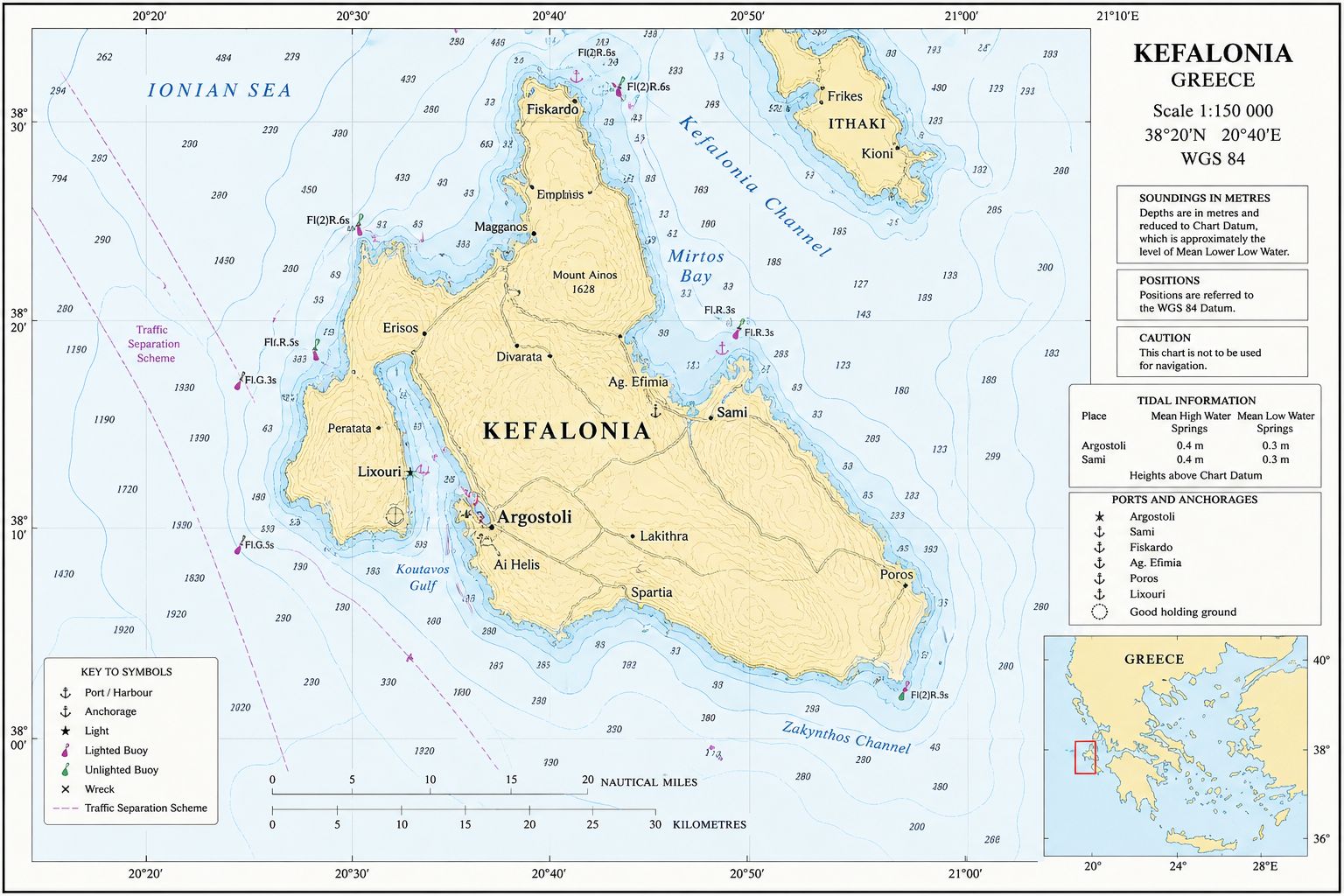
Chart Disclaimer. This chart is a schematic representation for illustrative purposes only and must not be used for navigation. Refer to official hydrographic charts for safe navigation. Be aware ENC charts may differ from official hydrographic charts. Both should be corrected and updated regularly.
Kefalonia Greece
Sailing Guide - Ocean Currents and Tidal Flow
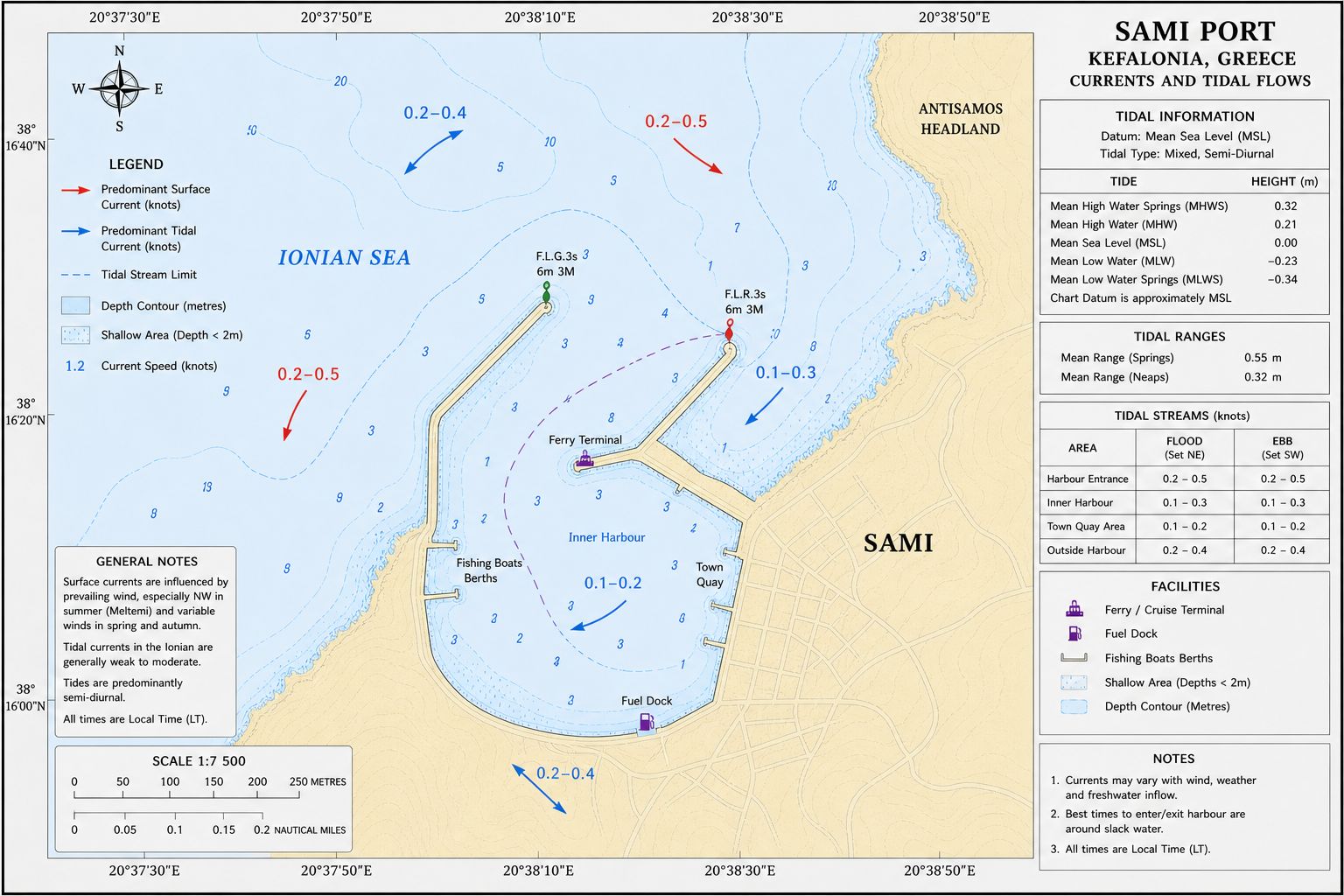
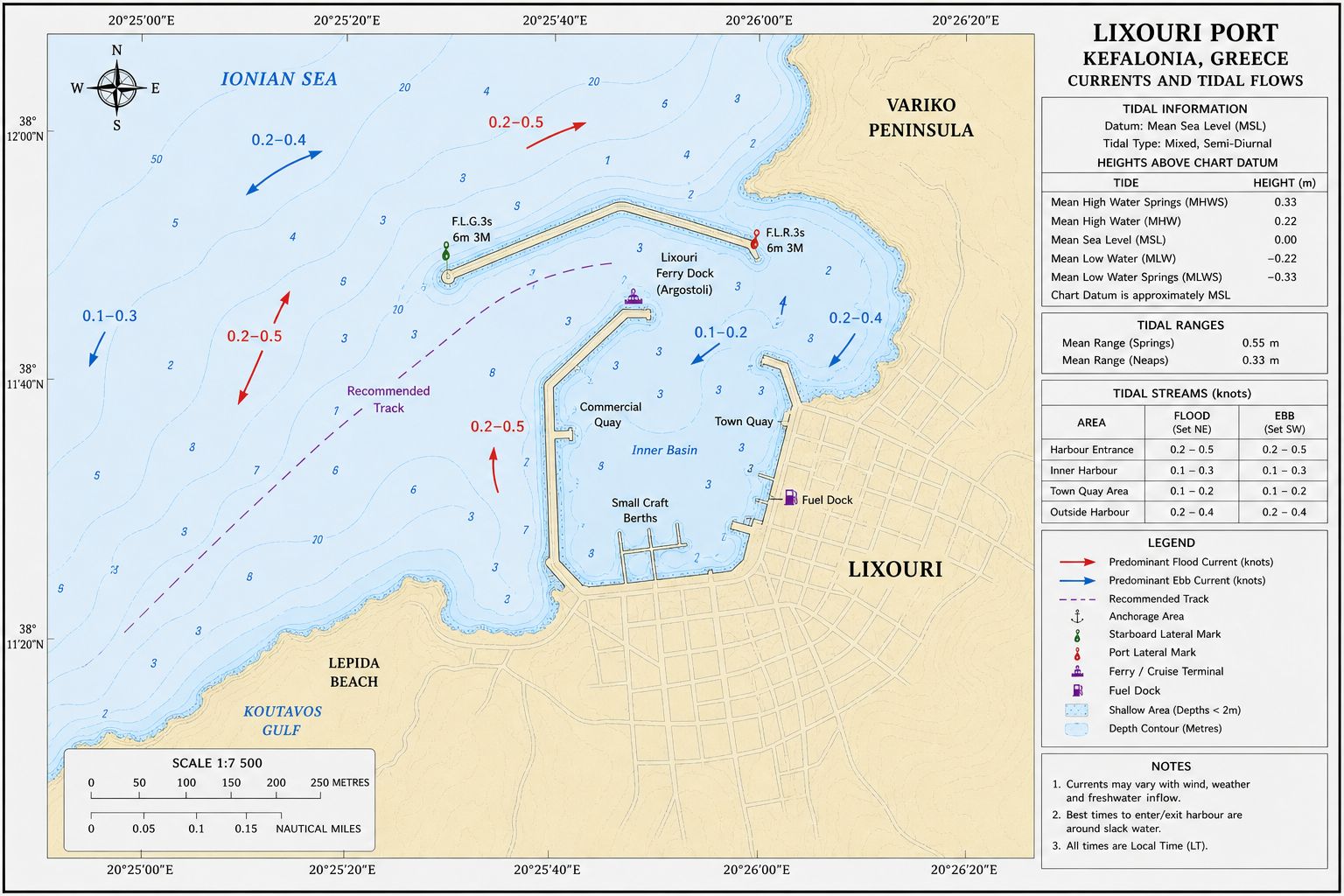
Currents around Kefalonia are generally weak and predominantly wind-driven, with minimal tidal influence. Tidal range is small, typically 0.2–0.4 metres, and does not generate a consistent flood or ebb stream. Water movement should be treated as variable set and drift rather than predictable tidal flow, with local conditions influenced by wind strength and duration.
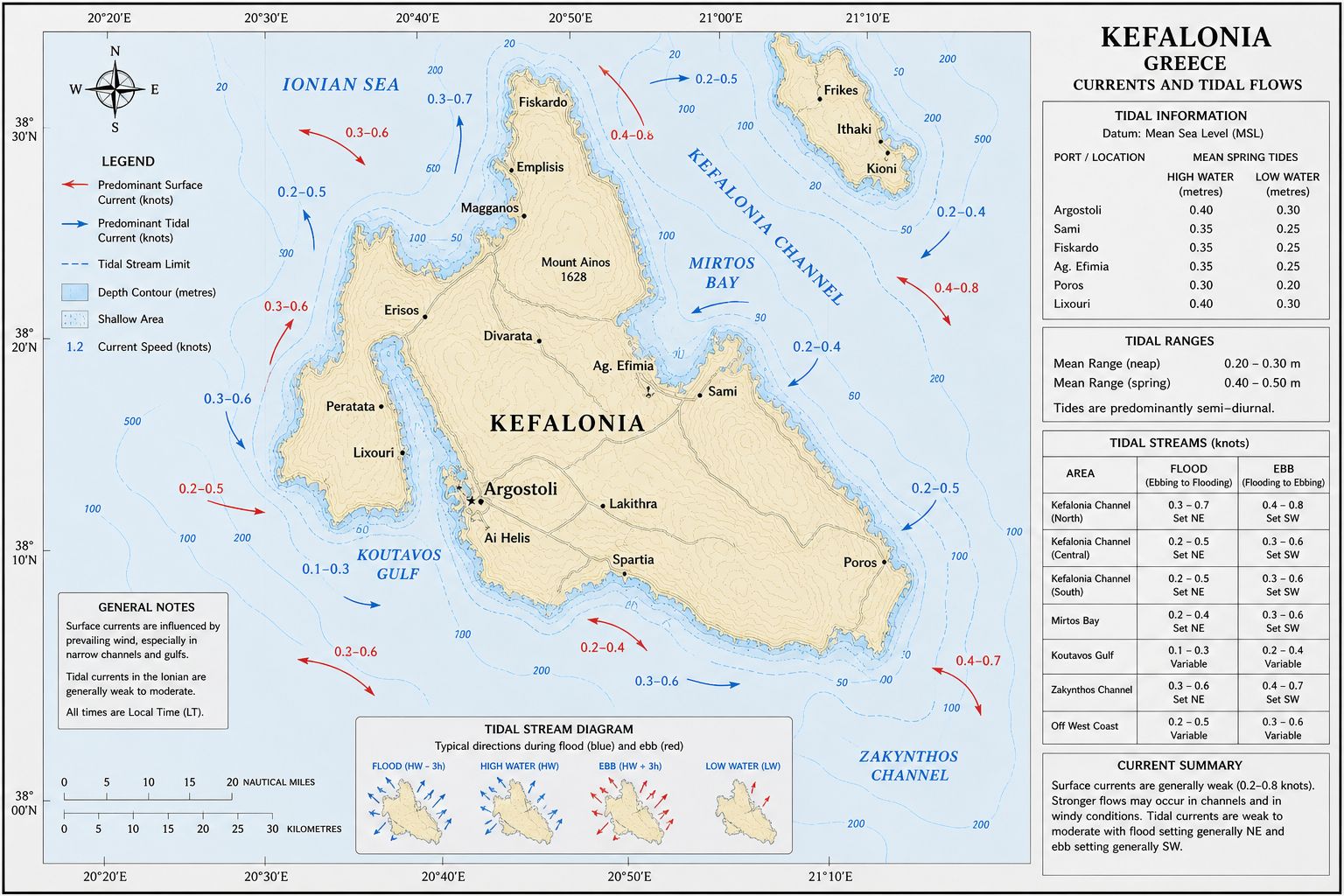
Under prevailing summer north-westerly winds (Maistro), a south to south-east setting surface flow may develop along exposed coasts and through channels between Kefalonia and Ithaca. Current speeds are typically 0.3–0.8 knots, increasing locally in constricted areas and around headlands. In unsettled or southerly weather, flow may reverse or become irregular. Within enclosed bays such as Argostoli, current influence is minimal and not operationally significant, with conditions dominated by local wind and harbour effects.
Kefalonia Greece
Sailing Guide - Weather
Weather at Kefalonia is typical of the Ionian region, with hot, dry, and stable conditions during summer under persistent high pressure. Daytime temperatures generally range from 28–32°C, with moderate humidity and good visibility. Winds are typically lighter than in the Aegean, with a north-westerly afternoon sea-breeze pattern developing and easing overnight, resulting in generally manageable sea states in coastal waters.
Outside the summer season, weather becomes more variable under passing low-pressure systems, bringing increased cloud cover, rainfall, and shifting winds. Southerly to south-westerly winds develop ahead of fronts and can strengthen, followed by westerly to north-westerly flow after passage. Winter temperatures remain mild, typically 10–16°C, with rainfall more frequent and occasionally heavy. Overall, Kefalonia experiences less extreme wind conditions than the Cyclades, but more frequent weather changes outside the summer period.
The Marine Electrical and Electronics Bible has a complete list of Greek VHF Radio Channel information and weather forecast times for Greece along with NAVTEX UK and Europe and NAVTEX Mediterranean for 490kHz and 518kHz.
Kefalonia Greece
Sailing Guide - Local Winds
Wind at Kefalonia is governed in summer by a north-westerly sea-breeze regime (Maistro) rather than a persistent Meltemi. Winds typically establish late morning, build through the afternoon to 10–20 knots, and ease after sunset, often dropping light overnight. The strongest effects are felt along the west and south coasts, where open exposure to the Ionian can produce higher sea states and localized gusting, while the east coast and enclosed bays experience more moderated conditions.
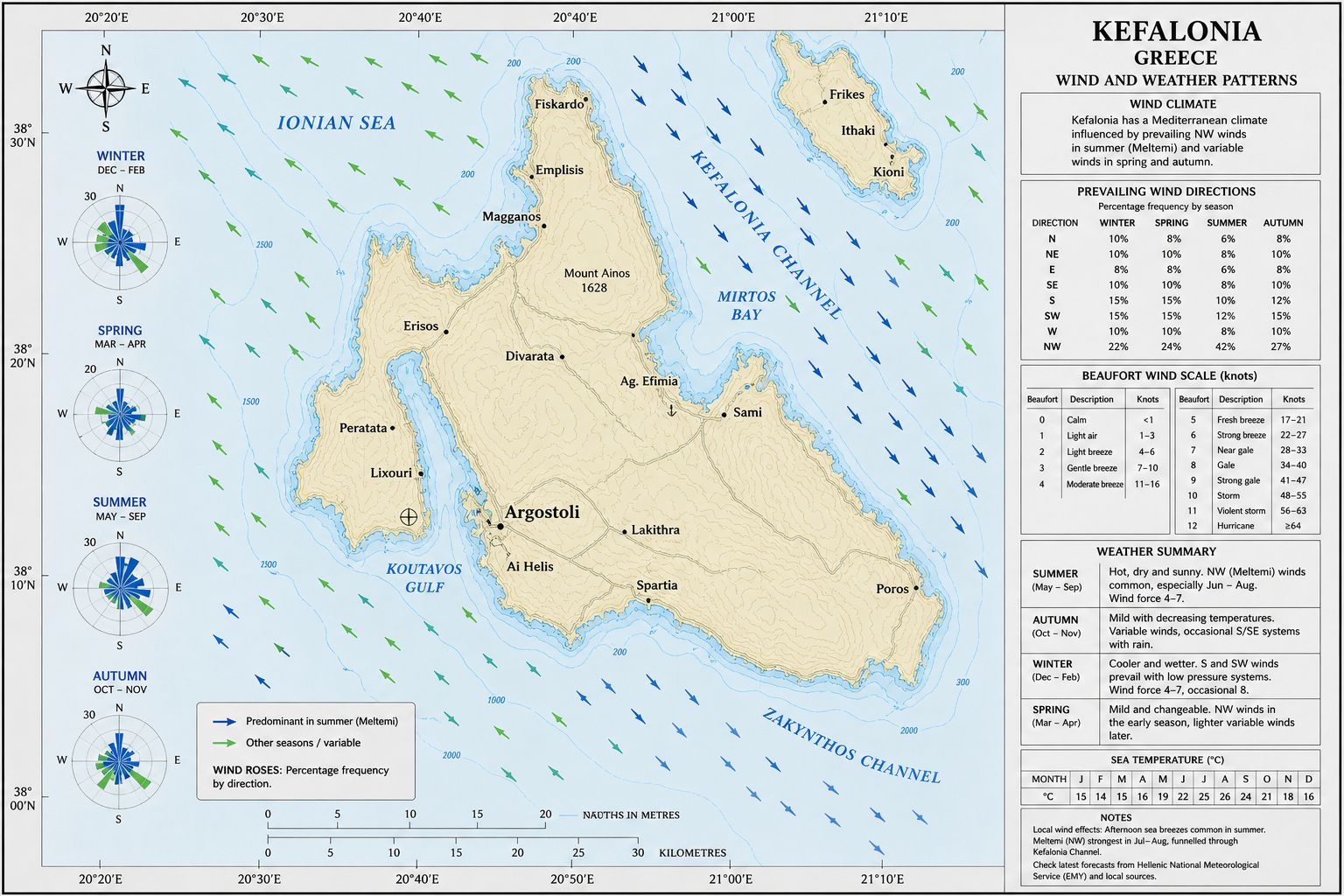
Outside summer, wind patterns become synoptic and more variable, driven by passing low-pressure systems. Southerly to south-westerly winds develop ahead of fronts and can increase to 20–30 knots or more, followed by a shift to westerly or north-westerly flow after passage. Local effects include gusting and wind funneling in channels such as between Kefalonia and Ithaca, while sheltered bays often experience reduced wind strength.
Maistro (Ionian Sea, Greek term) and Maestral (Adriatic, Croatian term) both describe a north-westerly thermal wind driven by daytime land–sea temperature differences. The behaviour is similar: develops late morning, strengthens through the afternoon, and weakens toward evening.
Kefalonia Greece
Sailing Guide - Approaches
Approaches to Kefalonia are made in open Ionian waters with generally deep, steep-to coastlines, allowing close approach in depths typically exceeding 30–100 metres. The island is prominent, with high terrain providing clear visual identification, and access routes are straightforward from all directions, particularly via the channel with Ithaca on the east side and open approaches from the west. There are no extensive off-lying shoals, though care is required near rocky headlands, reefs close to shore, and harbour entrances.
Primary considerations are wind and sea state rather than navigational constraint. Under prevailing north-westerly winds, expect moderate sea conditions with afternoon strengthening, particularly along the west coast where exposure to open Ionian swell can increase wave height. Visibility is generally good, and navigation is conducted by chart and visual reference. Overall, approaches are unrestricted and straightforward, with attention required for local wind effects, vessel traffic near major ports, and maintaining clearance from coastal features.
Kefalonia Greece
Sailing Guide - Navigation
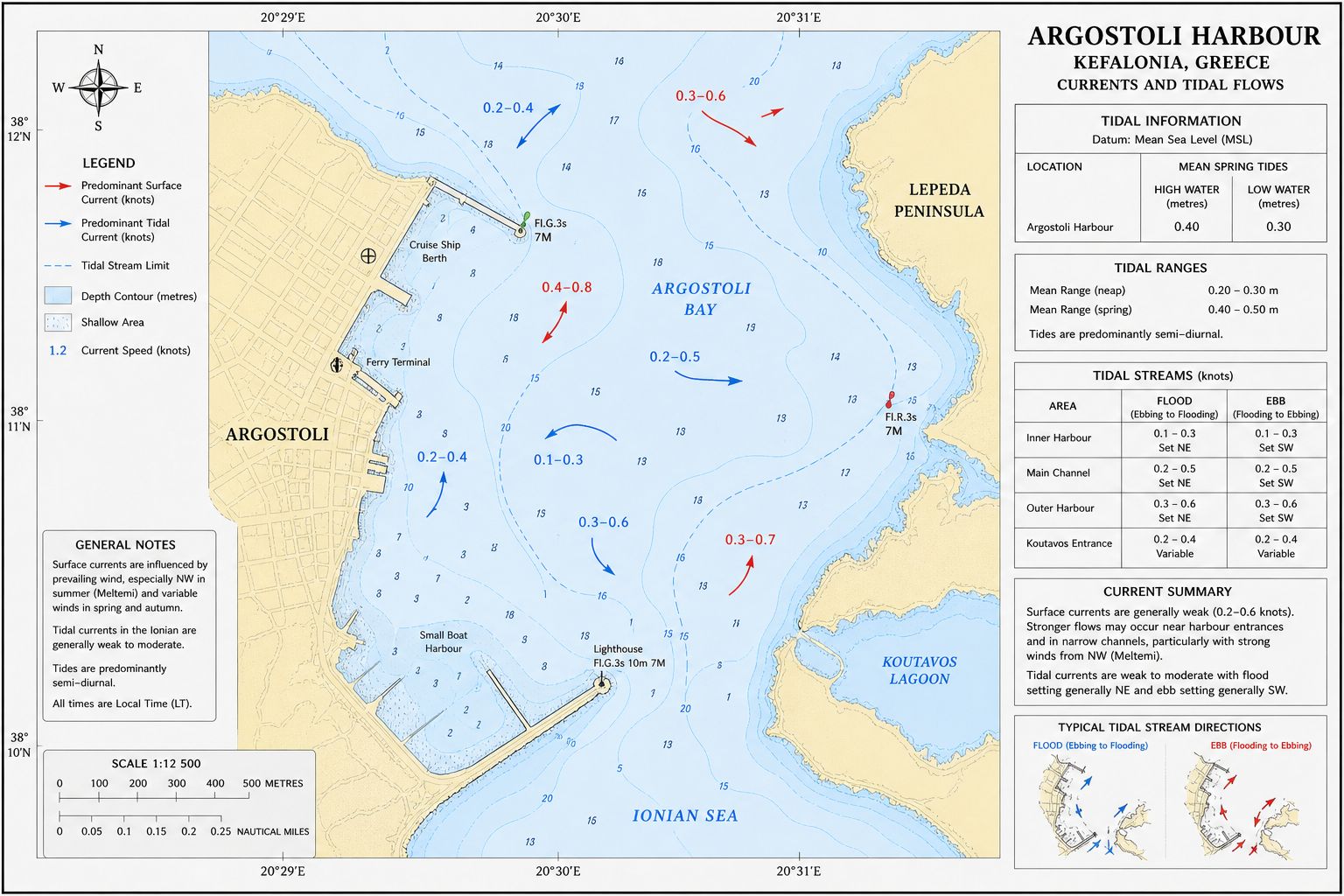
Argostoli (Primary Port). Entry is via a narrow, well-defined channel on the west coast, with depths typically 5–10 metres in the dredged fairway. The approach is straightforward but requires attention to lateral limits of the channel and ferry traffic, which has priority. Once inside, the harbour opens into a large, enclosed basin with depths of 3–6 metres alongside quays, and ample manoeuvring space. Currents are minimal, but wind effects can influence handling near the entrance and along the quay.
Sami. Entry is direct from the east coast into a wide, open bay with deep water on approach (10–20 metres) and no off-lying hazards. The harbour is partially protected by a breakwater, with depths of 5–8 metres inside, shoaling to 3–5 metres alongside. Ferry traffic is frequent, and vessels should maintain clearance of the main berth areas. Shelter is generally good, though southerly winds can introduce swell into the harbour.
Fiskardo. Entry is made into a small, enclosed natural harbour on the north coast, approached in deep water (10–20 metres). The entrance is clear and well defined, though space inside is limited. Depths are typically 3–5 metres alongside and 8–12 metres in the anchorage area. Manoeuvring is constrained, particularly in peak season, with vessels berthing stern-to using own anchor. The harbour offers good shelter from most directions, though strong northerlies can create gusting and pressure within the basin.
Poros. Entry is on the south-east coast into a small harbour protected by breakwaters, approached in 10–15 metres with no significant hazards. Inside, depths are typically 4–7 metres, with alongside berthing available. The harbour is exposed to southerly conditions, which can create swell and affect manoeuvring. Ferry traffic is present and takes priority.
Other Harbours and Anchorages. Smaller locations around the island provide limited quay access and anchorage, generally with depths of 2–5 metres alongside and 8–15 metres at anchor. Entry is typically visual and straightforward, with primary considerations being wind direction, local traffic, and confined manoeuvring space rather than navigational hazards.
Kefalonia Greece
Sailing Guide - Chart Accuracy
Chart accuracy around Kefalonia is generally reliable in main approaches, ports, and shipping routes, but variable outside these areas due to mixed survey quality. Electronic Navigational Charts (ENCs) meet international standards, but their accuracy depends on the underlying survey data, with high confidence in major ports such as Argostoli, Sami, and Fiskardo, and lower confidence in remote or nearshore areas where older or sparse data may exist. Positional accuracy can vary significantly, and depth data may be less precise in shallow or lightly surveyed zones, so charts should be treated as guidance rather than absolute reference, with navigation supported by visual fixing and depth. Visual navigation remains essential when entering smaller harbours or anchoring in less surveyed areas.
Kefalonia Greece
Sailing Guide - Anchorages
Around Kefalonia anchoring is well supported with multiple viable options, generally offering better shelter than Cycladic locations. The principal anchorages are:
- Fiskardo Bay. Has anchoring in 8–15 metres over sand and weed, good holding; good shelter from most directions, busy in peak season
- Sami Bay. Has extensive anchoring in 10–20 metres, good holding; sheltered from N–W, exposed to S–E
- Argostoli Outer Bay. Has anchoring in 8–15 metres over mud, very good holding; well sheltered, minimal current
- Assos Bay. Has anchoring in 5–10 metres, good holding; sheltered from N, exposed to W–S
- Poros Bay. Has anchoring in 10–15 metres, moderate holding; exposed to southerlies
- Agia Efimia Bay. Has anchoring in 8–15 metres, good holding; sheltered from W, exposed to E–SE
- Myrtos & West Coast bays. Has anchoring in 10–20 metres, temporary only, exposed to swell and unsuitable in prevailing conditions
There are no organised mooring fields in most locations, and anchoring is the primary method outside quays. Selection should be based on wind direction, with east coast and enclosed bays offering more reliable shelter under prevailing north-westerlies, and west coast anchorages used only in settled conditions
Kefalonia Greece
Sailing Guide - Entry Formalities
Argostoli is the primary designated port of entry, and Sami is a secondary port of entry and supports full clearance procedures for visiting yachts. Vessels arriving from outside Greece or the Schengen Area may clear in directly at Argostoli or Sami, subject to standard Greek entry requirements. Clearance is conducted through the local Port Authority (Limenarchio), with customs and immigration formalities handled in accordance with national procedures. All vessels must ensure that the Greek cruising tax (TEPAI) is valid and paid prior to or on arrival. Required vessel documentation, including registration papers and insurance, must be available. Non-EU vessels must hold a DEKPA cruising log or Transit Log, completed and presented for endorsement as required. Passports and crew documentation are subject to inspection, and clearance procedures should be completed promptly after arrival. For departures to non-Schengen countries, exit formalities are also conducted at Argostoli or Sami. As with all Greek ports of entry, procedures are formal but straightforward, with compliance dependent on correct documentation and adherence to reporting requirements on arrival and departure.
Kefalonia Greece
Sailing Guide - Marina Facilities
Argostoli (Primary Port). Argostoli provides the most developed berthing facilities on Kefalonia, with extensive town quay berthing and a municipal marina area. Berthing is stern-to or alongside, with depths typically 3–3.5 metres alongside and deeper water in the approach channel. The port supports ~200+ berths, with access to water, electricity, fuel, sanitary facilities, chandlery, and technical services, making it the only location on the island with meaningful yacht support capability.
Sami. Sami is a secondary commercial port with mixed yacht berthing, consisting of a main ferry harbour and a smaller fishing harbour (“Sami marina”). Berthing is stern-to, alongside, or at anchor, with quay depths typically 2.5–3.5 metres and deeper water in the outer basin. Facilities exist but are limited, including water, electricity, fuel, and basic amenities, with better shelter inside the fishing harbour.
Fiskardo. Fiskardo is a small natural harbour used extensively by yachts, with berthing stern-to the quay or anchored in the bay. Depths are typically 3–5 metres alongside and 8–12 metres at anchor. There are no formal marina facilities, but limited water and electricity may be available on the quay. Shelter is generally good, and the harbour is one of the most frequently used yacht ports on the island, though space is restricted.
Poros. Poros is a working ferry port with quay berthing only, offering stern-to or alongside mooring. Depths are generally 4–7 metres inside the harbour, though silting and variation require depth monitoring. Facilities are basic, with limited water supply and minimal services, and no marina infrastructure. The harbour provides reasonable protection, but ferry wash and surge must be considered.
Agia Efimia. Agia Efimia provides a purpose-used yacht harbour with quay berthing, commonly used by charter vessels. Berthing is stern-to, with depths typically 3–5 metres alongside and good holding in adjacent anchorage areas. Facilities include water and electricity, with local support services available, but no full marina infrastructure. The harbour offers good all-round shelter except in strong easterlies.
Other Locations (Assos, Lixouri, Minor Harbours)
- Assos: Has very limited quay berthing (~2–4 metres depth), no services, weather-dependent
- Lixouri: Is a small port across Argostoli bay with basic quay berthing and local services
- Pessada and minor harbours: They are shallow, limited capacity, primarily for local craft
Kefalonia Greece
Sailing Guide - Provisioning
Argostoli (Primary Supply Hub). Argostoli provides the most comprehensive provisioning on Kefalonia, with multiple supermarkets, Major supermarkets include AB Vasilopoulos Argostoli, Lidl Argostoli, and Sklavenitis Argostoli. Also there are My market, AB Synergas, Kritikos Super Market, Dolphin Supermarket, Bazaar Supermarket, Express Market Argostoli and Papantonatos Grocery. There are bakeries, and specialty food shops. Fresh produce is widely available through greengrocers and market-style outlets, with good variety and regular mainland deliveries. Fish supply is reliable, with fishmongers and harbour landings providing fresh and frozen seafood. This is the primary location for full provisioning and replenishment.
Sami. Sami offers moderate provisioning, with several supermarkets and mini-markets Bazaar Sami (Klaoudatos Market), Klaoudatos Market Erisos and SPAR Market (Dimoulas) which are supplying essential goods and a reasonable range of fresh items. Fresh produce is available but more limited than Argostoli. Fish supply is intermittent, with availability through local vendors or supermarkets, depending on catch and delivery. Suitable for partial resupply and top-up provisioning.
Fiskardo. Fiskardo has small supermarkets Tofalos Supermarket and Klaoudatos Market and boutique food shops, catering to visiting yachts with a good but limited range of provisions. Fresh produce is available in moderate quantities, often supplemented by deliveries. Fish supply is occasional, with some access to local catch and retail seafood. This is a convenient but not comprehensive provisioning location, with higher seasonal demand
Lixouri. Lixouri provides moderate provisioning, second only to Argostoli, with several established supermarkets. AB Food Market Lixouri, Rigatos Supermarket and Kritikos Lixouri
Agia Efimia. Agia Efimia provides small supermarkets and local grocers with essential goods and limited fresh produce. Fish supply is inconsistent, with occasional availability through local sources. Suitable for basic resupply only, with limited variety.
Poros. Poros offers basic supermarkets and mini-markets, supplying dry goods, water, and limited fresh produce. Fish supply is minimal and irregular, typically dependent on local catch. Provisioning is functional but limited, suitable for top-up only.
Other Locations (e.g. Assos, Lixouri, Minor Harbours)
- Lixouri: Has moderate provisioning with supermarkets and produce, less extensive than Argostoli
- Assos and small villages: Has very limited shops, minimal fresh produce, no reliable fish supply
Kefalonia Greece
Sailing Guide - Markets
Argostoli. Argostoli has the only regular open market activity on Kefalonia, consisting of a weekly street market (laiki agora) where local vendors sell seasonal fruit, vegetables, olives, honey, and regional products. In addition, there are permanent greengrocers and deli-style shops operating daily, supplying fresh produce and basic local foods.
Lixouri. Lixouri also hosts a weekly local market, smaller in scale than Argostoli, providing fresh produce, local goods, and basic food items. Supplementary supply is through independent greengrocers and small shops, with moderate availability.
Sami. Sami does not have a formal market, with produce supplied through supermarkets and small greengrocers. Availability is consistent but limited in variety compared to the main towns.
Fiskardo. Fiskardo has no formal market, with produce available through boutique food shops and mini-markets. Supply is seasonal and demand-driven, with limited local sourcing.
Kefalonia Greece Sailing Guide - Fish Markets
Argostoli. Argostoli is the primary location for fish and seafood supply on Kefalonia, with dedicated fishmongers and regular harbour landings. Fresh fish is available daily, sourced from local fishing vessels, with additional frozen and imported stock through larger supermarkets. This is the only location with consistent and reliable seafood availability.
Lixouri. Lixouri provides moderate seafood supply, with local fishmongers and periodic landings. Availability is generally good but less consistent than Argostoli, depending on catch and delivery.
Sami. Sami has limited fish supply, with seafood available through small fishmongers or supermarkets, supplemented by local catch.
Fiskardo. Fiskardo has no dedicated fish market, but fresh fish may be obtained directly from local fishermen or through small retailers. Availability is seasonal and variable, with limited quantities.
Other Locations (Agia Efimia, Poros, Assos)
These locations have no structured fish markets, with seafood supply dependent on local fishing activity and small retail outlets, typically inconsistent and limited in range
Kefalonia Greece
Sailing Guide - Local Cuisine
Local cuisine on Kefalonia reflects Ionian culinary traditions with Venetian influence, based on olive oil, wine, vegetables, and locally raised meat. A defining dish is kreatopita Kefalonias, a meat pie combining beef, pork, or goat with rice and herbs, along with sofrito-style preparations and tomato-based casseroles. The cuisine emphasises slow cooking and layered flavours, distinguishing it from simpler Cycladic styles.
Seafood is widely used where available, typically grilled or baked, while goat, lamb, and pork form the core meat dishes. Local produce includes greens, legumes, and seasonal vegetables, and dairy products such as feta and hard cheeses are common. Kefalonia is also known for local wines such as Robola, and sweets often incorporate honey and almonds.

Kefalonia Greece
Sailing Guide - Local Food Products
Kefalonia produces distinct local honeys, with thyme (thymari) honey being the most characteristic. This honey is derived from wild thyme growing on the island’s dry, rocky terrain and is known for its strong aromatic profile, amber colour, and high viscosity.
In addition, there are multi-floral (wild herb) honeys produced from a mix of native plants, as well as smaller quantities of pine and fir honey from forested areas such as Mount Ainos. Production is typically small-scale and local, with honey sold through village shops, markets, and roadside producers rather than large commercial distribution.
Kefalonia produces several distinct local products beyond wine and honey, reflecting its agricultural base and Ionian influences.
- Olive oil. This is locally produced, typically cold-pressed with moderate acidity, used as the primary cooking fat. Worth buying a bottle for the galley stores.
- Mandoles. These are caramelised almonds coated in sugar, a traditional confection specific to the Ionian Islands Nice snacks when sailing.
- Pasteli. These are sesame and honey bars, produced locally in simple forms and also a great sailing snack.
- Local cheeses. These include feta-type cheeses and harder goat/sheep varieties, produced in small quantities
- Herbs and oregano. These are wild-harvested or locally cultivated, commonly sold dried A great galley pantry addition.
- Quince and citrus preserves. These are seasonal products reflecting local fruit cultivation and really delicious and worth buying for the pantry.
Kefalonia Greece
Sailing Guide - Local Beverages
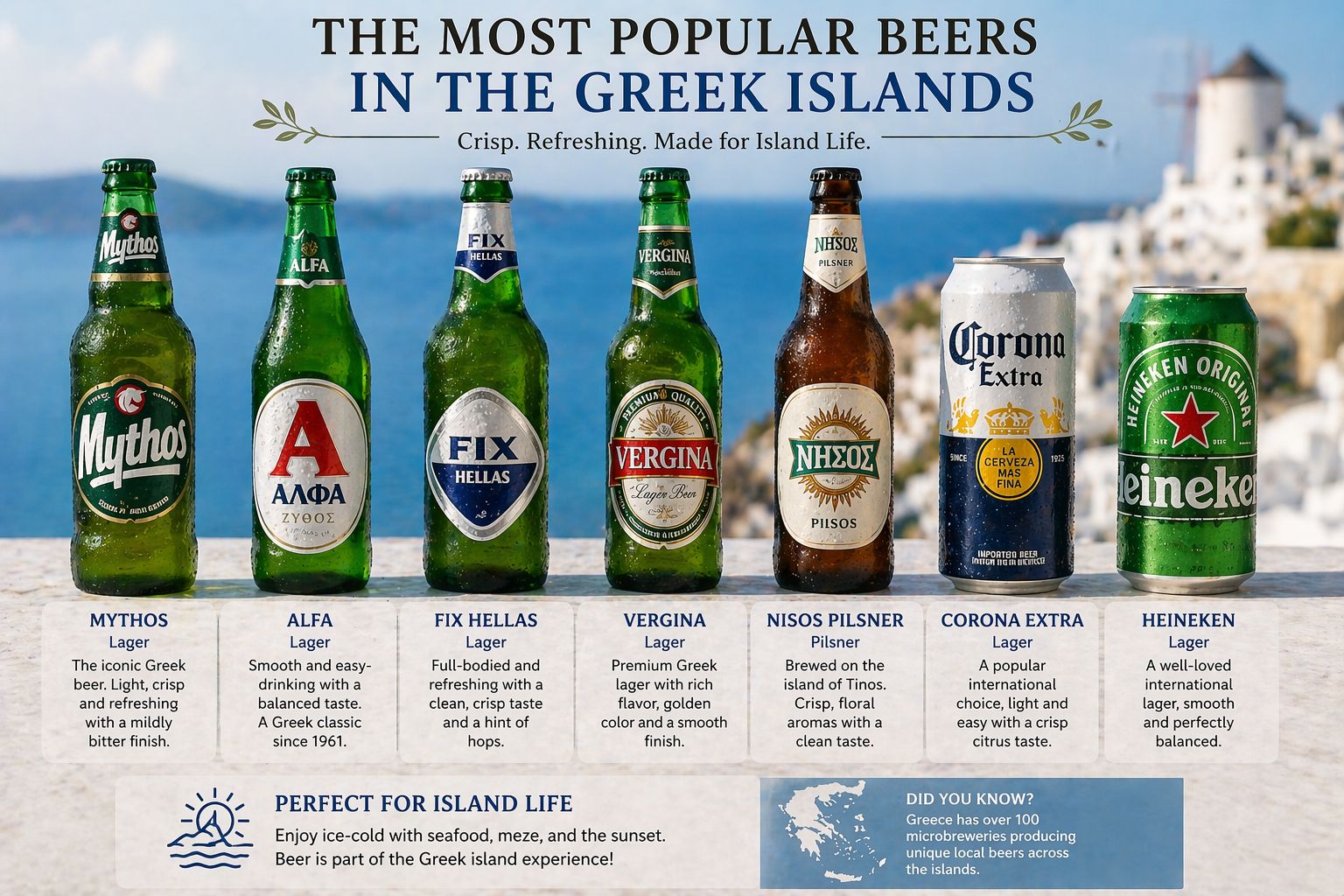
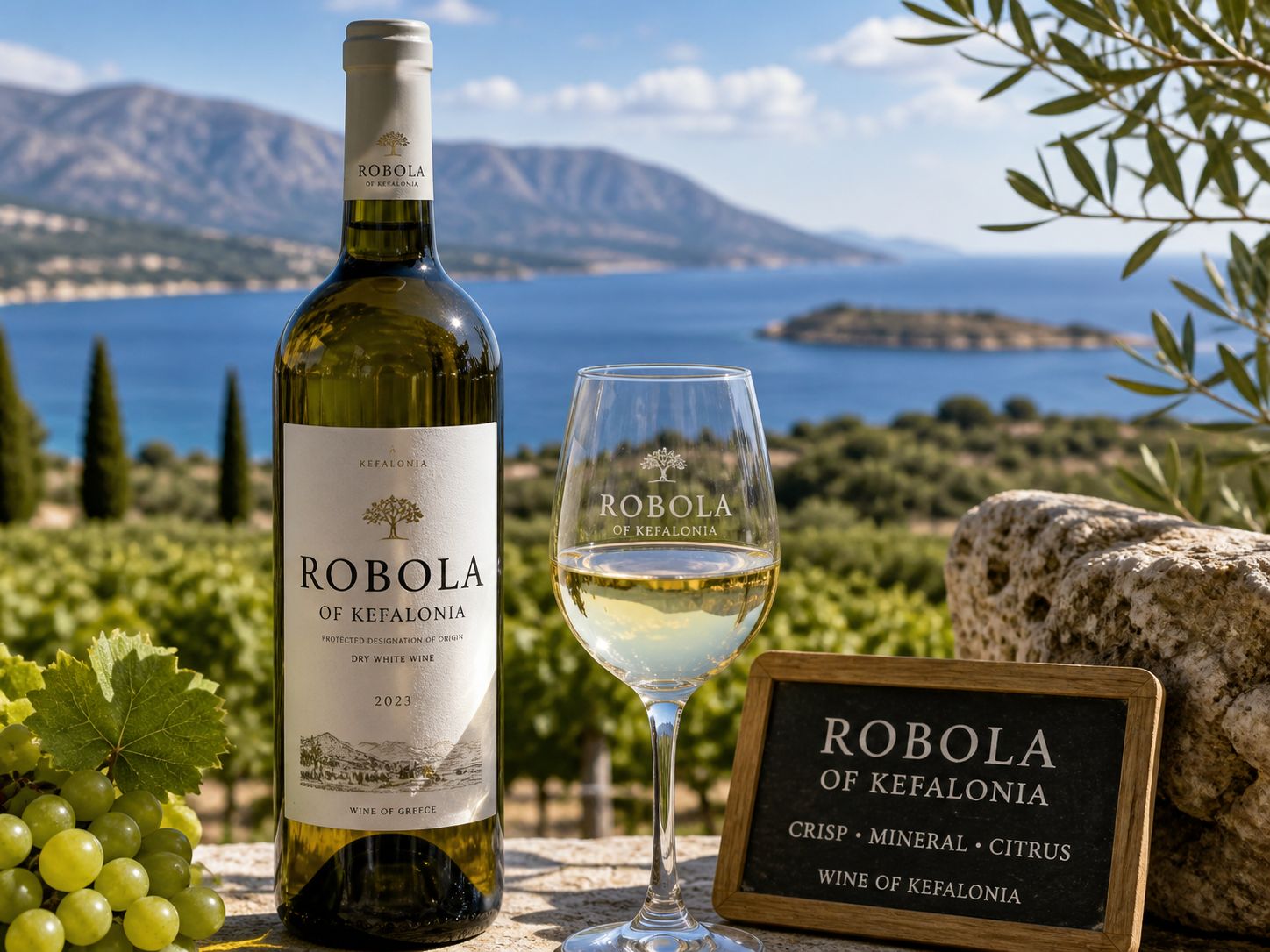
Local beverages on Kefalonia include local Robola wines, bottled beers, and traditional spirits such as ouzo and tsipouro, widely available through tavernas, wineries, and retail outlets. Robola from Kefalonia is a dry white wine produced from the Robola grape grown on the slopes of Mount Ainos, within a controlled appellation (PDO Robola of Kefalonia). The vineyards are typically on limestone soils at elevation, which contribute to the wine’s high acidity, mineral character, and clean structure.
In profile, Robola is light to medium-bodied, with citrus-driven notes (lemon, grapefruit), along with green apple and subtle floral elements. It is typically unoaked, emphasising freshness and clarity rather than weight. The wine is served chilled and is commonly paired with seafood and simple Mediterranean dishes, reflecting its crisp, dry finish and balanced acidity.
Kefalonia Greece
Sailing Guide - Diesel Fuel Supplies
Diesel fuel on Kefalonia is widely available at the main ports, with the most reliable access at Argostoli, Sami, and Fiskardo. There are no fixed fuel docks in most locations, and supply is typically provided by road tanker delivery to the quay, arranged through port authorities or local suppliers. Delivery is generally routine in these ports but should be scheduled in advance, particularly during peak season. At secondary locations such as Agia Efimia and Poros, fuel availability is limited or intermittent, often requiring container transfer from nearby fuel stations.
Kefalonia Greece
Sailing Guide - Water Supplies
Potable water on Kefalonia is widely available at the main ports, with reliable supply at Argostoli, Sami, Fiskardo, and Agia Efimia. Water is typically provided via quay connections, with access arranged directly at the berth or through local port staff. Supply is generally consistent and suitable for full tank replenishment, though pressure and flow rates can vary during peak summer demand. At smaller locations such as Poros and minor harbours, availability may be more limited or intermittent, sometimes requiring container transfer
Mechanical and Electrical Repairs
Resource
If you are headed somewhere remote consider the need to expand your knowledge base or have an information resource on board. Why not get a copy of my book The Marine and Electrical and Electronics Bible 4th Edition. By and for yachties, with everything from batteries and charging, solar and wind, diesel engines and marine electronics and so much more. Your complete systems guide. 650 pages of practical advice. In Australia and New Zealand order a copy through Boat Books. UK and European boats can buy the UK Edition Here. US and Canadian boats can get the US Edition Order Here. Marine systems are my profession so let me help you. By a liveaboard boat owner for other boat owners.



Kefalonia Greece
Sailing Guide - Marine Services
Marine services on Kefalonia are well developed for the region, with the main concentration at Argostoli and secondary capability at Sami. Facilities include engine servicing, electrical and electronic repair, hull maintenance, and general technical support, with access to chandlery and spare parts suppliers. There are haul-out and yard facilities on the island, supporting lift-out, antifouling, and structural work, though capacity is limited compared to major mainland centres. At smaller ports such as Fiskardo and Agia Efimia, services are basic, limited to minor repairs and local assistance, with parts often sourced from Argostoli or the mainland.
Kefalonia Greece
Sailing Guide - Local Etiquette
Ashore, behaviour is informal but respectful, consistent with Ionian island communities. Noise should be controlled, particularly at night in harbour areas and residential zones. Waste disposal should use designated facilities, and discharge within harbour limits is not acceptable. Dress is casual, but appropriate attire is expected in towns, shops, and churches, with swimwear covered. Overall, etiquette is based on cooperation in shared harbour space and respect for local residents and working port activity
Kefalonia Greece Sailing Guide - Summary
Kefalonia provides a large and diverse cruising environment with multiple sheltered harbours, reliable anchorages, and established infrastructure. Navigation is straightforward with minimal current and moderate wind conditions. Provisioning, fuel, and marine services are available at a regional level, making Kefalonia a primary operational base within the Ionian Sea, consistent with a Kefalonia Greece Sailing Guide for all you need to know.