Kea Greece Sailing
Guide
Kea Greece Sailing Guide. Kea lies at the north-western edge of the Cyclades, close to the Attica mainland and forming a transition zone between the Aegean and the Saronic Gulf. The island has a high, rugged profile, rising to over 560 metres, with deeply indented coastlines and numerous bays providing varying degrees of shelter. Depths generally increase rapidly offshore, and the surrounding waters are influenced by strong wind interaction between the Cyclades and mainland Greece.
The principal port is at Korissia on the north-west coast, serving as the main harbour and ferry connection point, with additional anchorages distributed around the island. Kea is exposed to Meltemi conditions in summer, often with significant wind acceleration in the channels to the north and west. For navigation, the island should be treated as partially exposed with multiple anchorage options, but subject to strong and sometimes unpredictable wind patterns.
Kea Greece Sailing
Guide - History
Kea has a long and continuous history of settlement, with evidence of habitation from the Neolithic and Early Bronze Age. In antiquity, the island, known as Keos, supported several independent city-states, including Ioulis, Karthaia, Korissia, and Poieessa, which were active in regional trade and maritime activity. Its location near mainland Greece made it a strategic and commercial waypoint, and it played a role in wider Aegean networks, including participation in alliances during the classical period.
Through the Hellenistic, Roman, and Byzantine eras, Kea remained inhabited but declined in prominence. In the medieval period, it came under Venetian control, followed by Ottoman rule, during which the population was largely engaged in agriculture, pastoralism, and local trade. The island was incorporated into the modern Greek state in the 19th century. Today, Kea retains visible remains of its historical settlements, particularly at ancient Karthaia, while its development reflects continuity of small-scale habitation shaped by proximity to the mainland and maritime routes.
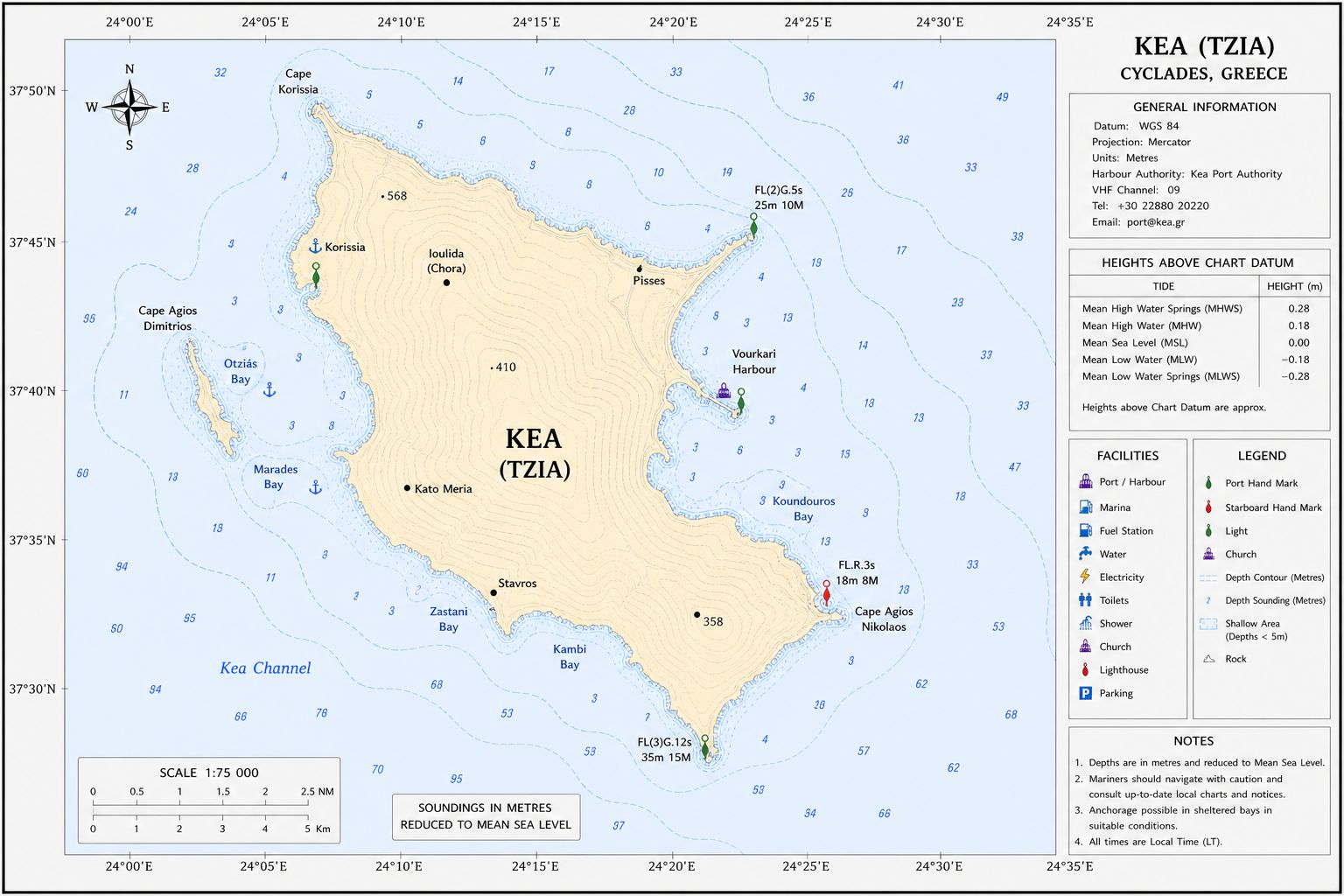
Chart Disclaimer. This chart is a schematic representation for illustrative purposes only and must not be used for navigation. Refer to official hydrographic charts for safe navigation. Be aware ENC charts may differ from official hydrographic charts. Both should be corrected and updated regularly.
Kea Greece Sailing
Guide - Ocean Currents and Tidal Flow
Currents around Kea are primarily wind-driven, with only minor tidal influence. Tidal range is small, typically 0.1–0.3 metres and does not generate a consistent flood or ebb stream. Water movement should be treated as variable set and drift rather than predictable tidal flow, with conditions changing in response to prevailing winds.
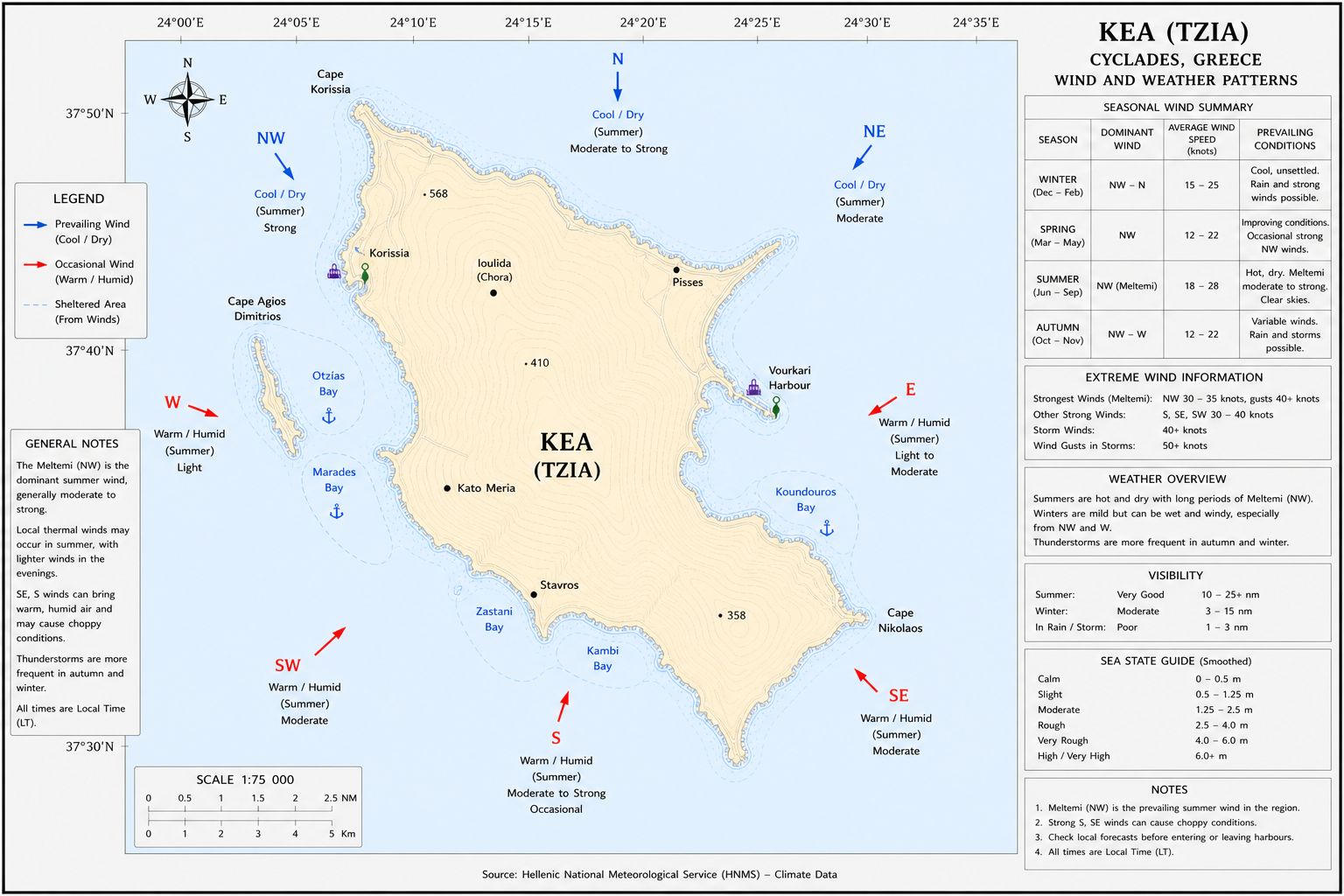
Under summer Meltemi (N–NE) conditions, a south to south-west setting current commonly develops, particularly in the channels between Kea and the Attica mainland and toward Kythnos. Current speeds are typically 0.5–1.5 knots, with local acceleration in constricted passages and around headlands, where overfalls and disturbed water may occur in strong winds. In southerly or unsettled weather, flow may reverse or become irregular. For navigation, currents should be considered moderate, wind-aligned drift with localised increases, requiring allowance for set, especially in exposed channels
Kea Greece Sailing
Guide - Weather
Weather at Kea follows a typical Cycladic pattern, with hot, dry, and stable conditions during summer under persistent high pressure. Daytime temperatures generally range from 28–32°C, with low humidity and excellent visibility. The dominant feature is the Meltemi (N–NE winds), which maintains dry air but can produce sustained wind and sea conditions, particularly along exposed coasts and in surrounding channels.
Outside the summer season, weather becomes more variable under passing low-pressure systems, bringing increased cloud cover, rainfall, and shifting winds. Southerly to south-westerly winds develop ahead of fronts and may strengthen significantly, followed by cooler north-westerly flow after passage. Winter temperatures remain mild, typically 10–16°C, with rainfall occurring intermittently, sometimes in short, heavy events. Overall, Kea experiences more exposure and stronger wind influence than the Ionian, with weather driven largely by Aegean systems.
The Marine Electrical and Electronics Bible has a complete list of Greek VHF Radio Channel information and weather forecast times for Greece along with NAVTEX UK and Europe and NAVTEX Mediterranean for 490kHz and 518kHz.
Kea Greece Sailing
Guide - Local Winds
Wind at Kea is dominated in summer by the Meltemi, a persistent N to NE airflow that can be strong and sustained. Typical wind strengths are 15–25 knots, with frequent periods of 25–35 knots or higher, particularly in July and August. The island’s position near the Attica mainland creates significant acceleration zones, especially in the channels to the north and west, where winds can exceed forecast values and produce gusting and short, steep seas.
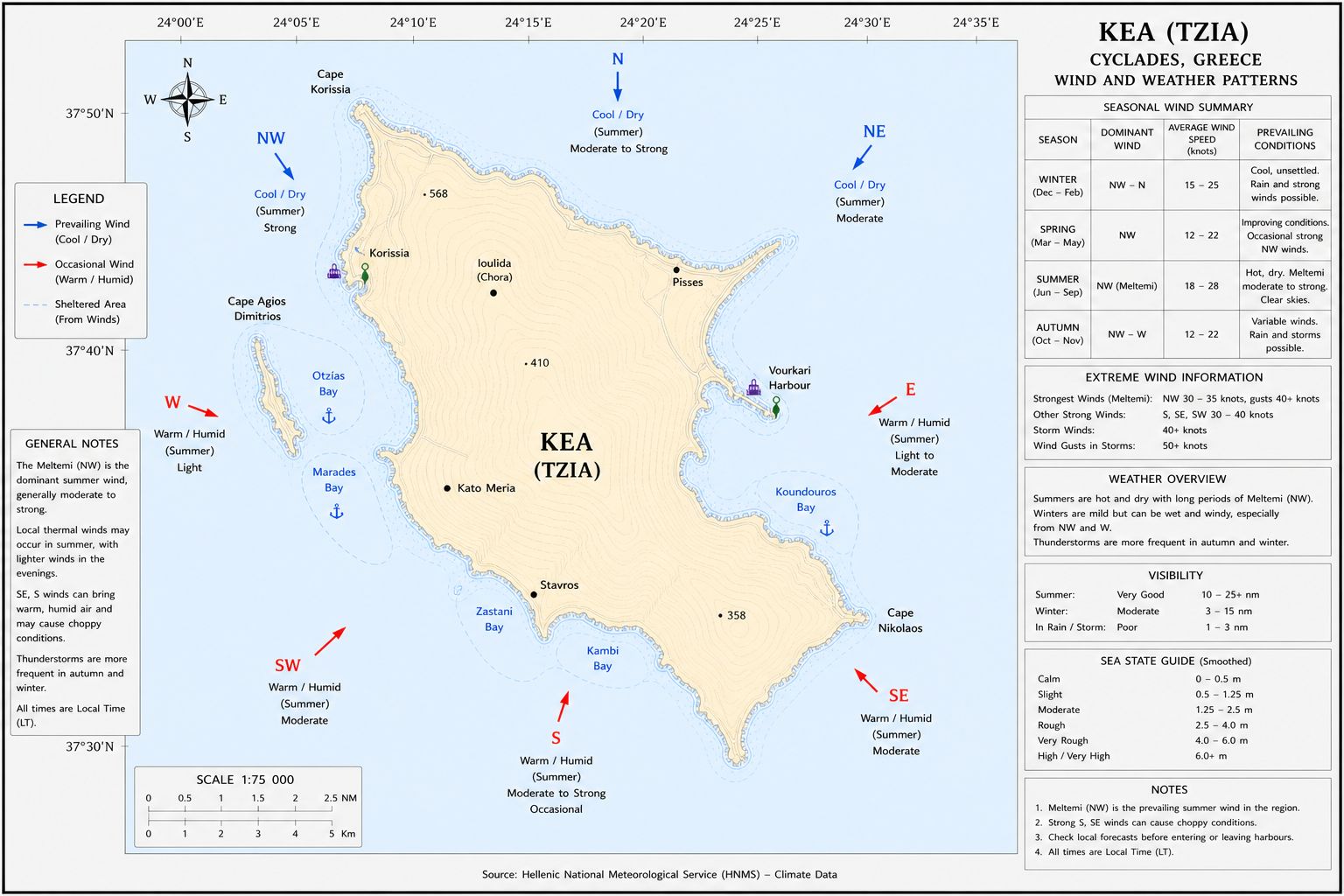
Outside the Meltemi season, wind patterns become synoptic and variable, driven by passing low-pressure systems. Southerly to south-westerly winds develop ahead of fronts and can strengthen rapidly, often reaching 20–30 knots, before veering west to north-west after passage. Local effects include turbulence and gusting around headlands and within bays, with limited shelter on exposed coasts. Overall, wind conditions at Kea should be treated as strong, persistent in summer, and highly variable outside it, with notable local acceleration.
Kea Greece Sailing
Guide - Approaches
Approaches to Kea are made in open Aegean waters with generally deep, steep-to coastlines and no extensive off-lying shoals, allowing close approach in depths typically exceeding 20–50 metres. The island is prominent and easily identified, with access routes from the north via the channel with Attica, from the west through the Kea–mainland passage, and from the south and east within the Cyclades group. Navigation is conducted by standard charting and visual reference, with good sea room in all sectors.
Primary considerations are wind and sea state rather than depth or hazards. Under Meltemi conditions, expect strong N–NE winds, significant fetch, and short, steep seas, particularly in the channels to the north and west where local acceleration and overfalls may occur. Visibility is generally good, and traffic is moderate, including ferries and commercial vessels. There are no defined approach channels, and navigation remains straightforward but exposed, requiring allowance for wind strength, sea conditions, and maintaining clearance from rocky headlands.
Kea Greece Sailing
Guide - Navigation
Entry into the main port at Korissia on Kea is made into a well-defined bay on the north-west coast, partially protected by a breakwater. The approach is direct with deep water on entry (typically 10–20 metres), shoaling gradually within the harbour to 3–6 metres alongside. There is no narrow channel, and navigation is conducted visually using the breakwater and shoreline as reference.
Under prevailing Meltemi conditions, the harbour provides partial lee, but strong northerly winds can enter the bay, producing gusting and affecting manoeuvring, particularly near the entrance. Crosswinds may be experienced on final approach, and care is required when aligning for berthing. Traffic includes ferries and local vessels, which take priority, and adequate clearance should be maintained.
Inside the harbour, space is moderate but can become restricted during peak periods. Berthing is typically stern-to or alongside using own ground tackle, with attention required to wind effects and proximity to other vessels. Entry is straightforward in clear conditions, with primary considerations being wind strength, ferry movements, and controlled manoeuvring within the harbour area.
Kea Greece Sailing
Guide - Chart Accuracy
Hydrographic charts provide accurate coastline and harbour representation. Electronic charts align well with official data. Nearshore hazards and quay configurations should be visually confirmed when manoeuvring.
Kea Greece Sailing
Guide - Anchorages
Kea provides several operational anchorages with varying protection. No anchorage provides full protection under all conditions.
- Korissia Bay in depths of approximately 5–15 metres over sand and weed, offering reasonable holding and shelter from southerly winds but exposed to the Meltemi.
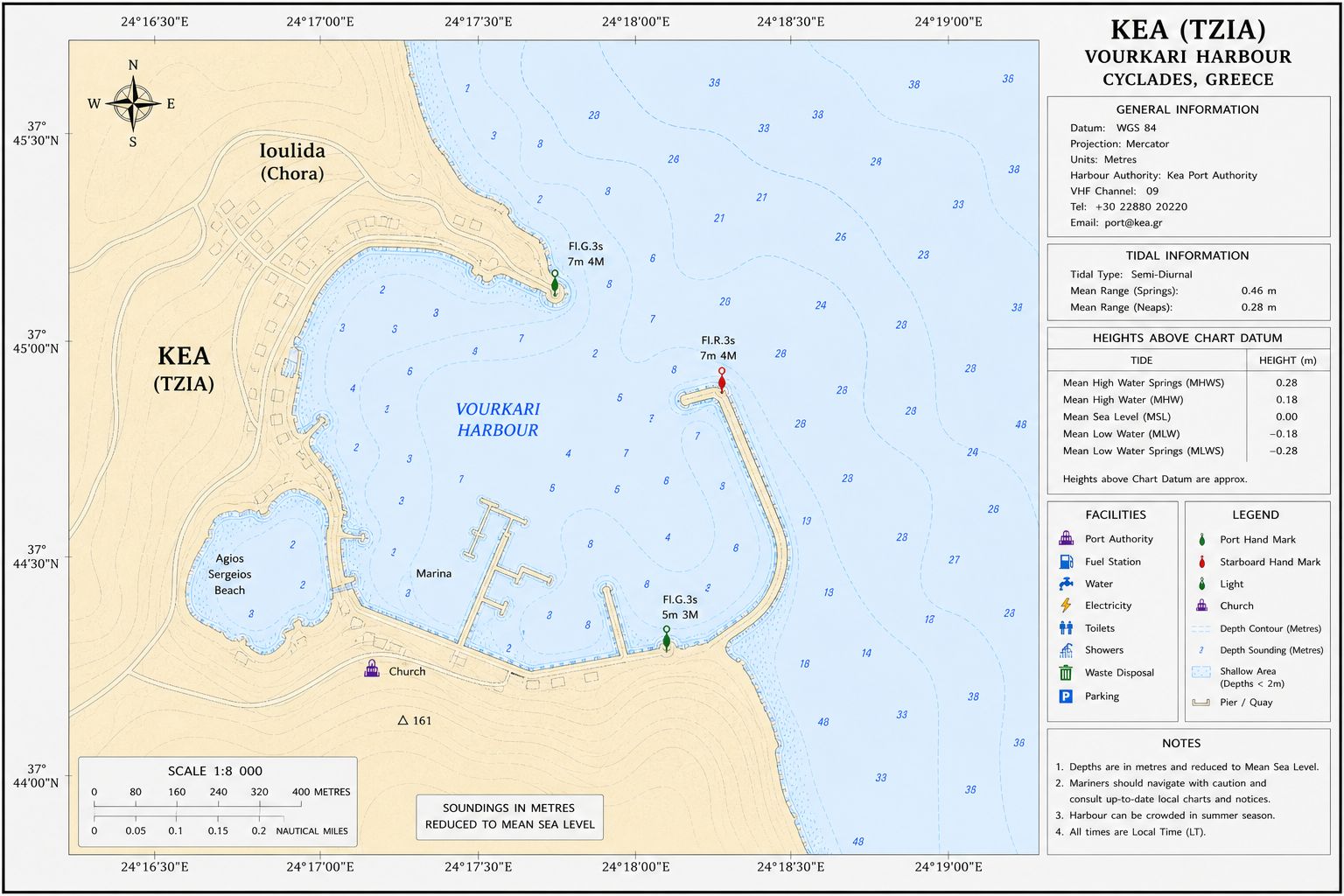
- Vourkari provides anchoring in 3–8 metres over mud with good holding and improved shelter but limited space.
- Otzias Bay provides anchoring in 4–12 metres over sand with good holding and partial protection from northerly winds.
- Koundouros on the southwest coast provides anchoring in 5–10 metres over sand with good holding and protection from northerly winds, but exposure to southerlies.
Kea Greece Sailing
Guide - Entry Formalities
Entry formalities follow standard Greece procedures for visiting yachts. This is not a designated port of entry for international clearance, and there are no customs or immigration facilities on the island. Vessels arriving from outside Greece or the Schengen Area must first clear into the country at an official port of entry before proceeding to this port. Direct arrival from a non-Schengen country is not permitted. The Greek cruising tax (TEPAI) must be valid and paid, and the vessel’s cruising log (DEKPA for non-EU vessels, or transit log where applicable) should be up to date and available for inspection if requested by port authorities or coastguard.
Kea Greece Sailing
Guide - Marina Facilities
Kea has no large, fully developed marina, with berthing centred on Korissia harbour and the adjacent bay. Facilities consist of a quay and breakwater system, where vessels berth stern-to or alongside using own ground tackle, with depths typically 3–6 metres alongside and deeper water further off. Manoeuvring space is adequate but can become constrained during peak periods due to ferry traffic and visiting yachts. he harbour offers partial protection, but is exposed to northerly Meltemi winds which can create gusting and surge, particularly on outer berths. Vourkari provides limited quay and mooring options with smaller-scale infrastructure.
Kea Greece Sailing
Guide - Provisioning
Supermarkets. Provisioning for vessels sailing Kea Greece is well developed. Supermarkets in Korissia include AB Vasilopoulos Kea, Carrefour Market Kea, and additional local grocery stores within walking distance of the harbour. These supply full provisions including fresh produce, meat, and packaged goods. Bakeries, butchers, and specialty stores operate in Korissia and Vourkari.
Markets. Local produce on Kea is available in small shops and periodic market-style outlets, primarily around Korissia and inland villages such as Ioulis. Supply includes seasonal vegetables, fruit, olives, and basic local products, with availability dependent on local production and deliveries from the mainland. There is no large central produce market, and offerings are limited in scale and variety.
Fish Markets. Fish supply on Kea is limited and largely informal, with no central fish market or consistent retail outlet dedicated to seafood. Availability depends on local small-scale fishing activity, and fresh fish may occasionally be obtained directly from fishermen in Korissia or nearby landing points, subject to the day’s catch.
Kea Greece Sailing
Guide - Local Cuisine
Local cuisine on Kea reflects traditional Cycladic cooking with some distinct island specialities, based on olive oil, cereals, vegetables, and locally raised meat. Meat dishes include souvlaki, gyro, and kontosouvli, along with slow-cooked dishes such as kokkinisto and stifado. Local dishes include loza Keas (cured pork) reflecting regional preparation, and is a cured pork preparation seasoned with spices, along with paspalas, a simple dish of pork with eggs, and revithada, a slow-cooked chickpea stew. These dishes reflect the island’s pastoral and agricultural base, with emphasis on preservation and slow cooking methods. Vegetable-based dishes are common, including ladera-style preparations using seasonal produce, while goat and lamb are the primary meats, often oven-cooked or braised. Local dairy includes fresh and aged cheeses from goat and sheep milk, and bread remains a staple. Fish is prepared as psari psito using tsipoura and lavraki, and as psari sto fourno. Small fish are served as gavros tiganitos.
Kea Greece Sailing
Guide - Local Beverages
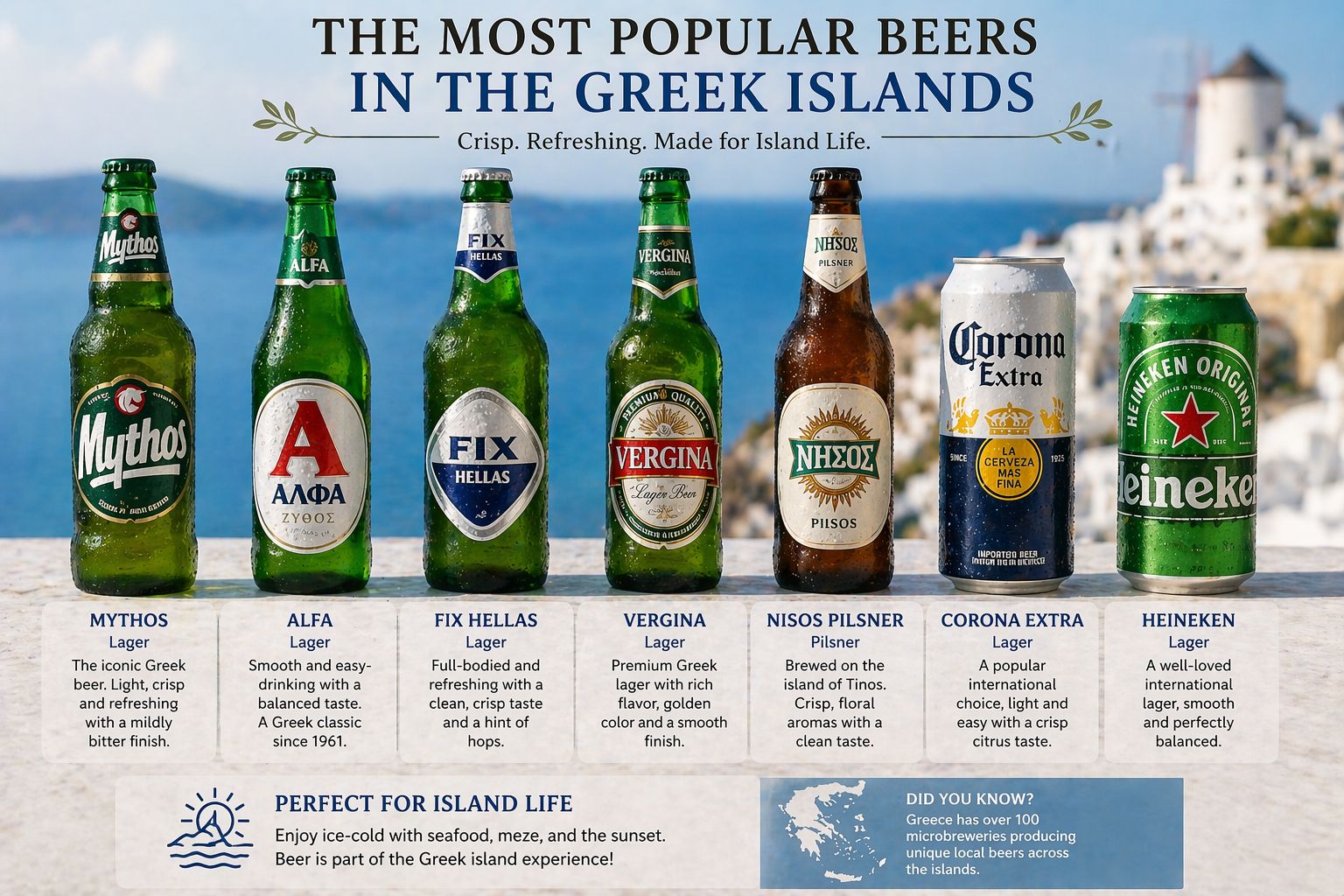
Local beverages on Kea are typical of the Cyclades, with locally produced and mainland-supplied wine, along with bottled beers and spirits such as ouzo, tsipouro, and raki. Selection is moderate rather than specialised, available through tavernas, cafés, and small shops, with emphasis on basic regional products rather than distinct island-specific production
Kea Greece Sailing
Guide - Diesel Fuel Supplies
Diesel fuel is available at Kea, primarily at the main port of Korissia. There is no dedicated fixed fuel dock, and supply is typically provided by road tanker delivery to the quay, which can be arranged through local agents, marina staff, or fuel suppliers. Delivery is generally reliable but should be scheduled in advance, particularly during peak summer periods. Small quantities can be obtained from local roadside fuel stations using containers, though this is not practical for full refuelling.
Kea Greece Sailing
Guide - Water Supplies
Potable water at Kea is available at the main port of Korissia, primarily via quay connections. Supply is generally accessible at sections of the harbour used by visiting vessels, though pressure and availability can vary, particularly during peak summer demand. Water is sourced from local storage and supply systems, and conservation measures may apply. Access is usually arranged directly at the quay or through local contacts
Mechanical and Electrical Repairs
Resource
If you are headed somewhere remote consider the need to expand your knowledge base or have an information resource on board. Why not get a copy of my book The Marine and Electrical and Electronics Bible 4th Edition. By and for yachties, with everything from batteries and charging, solar and wind, diesel engines and marine electronics and so much more. Your complete systems guide. 650 pages of practical advice. In Australia and New Zealand order a copy through Boat Books. UK and European boats can buy the UK Edition Here. US and Canadian boats can get the US Edition Order Here. Marine systems are my profession so let me help you. By a liveaboard boat owner for other boat owners.



Kea Greece Sailing
Guide - Marine Services
Marine services on Kea are limited and basic, centred around Korissia. There are no shipyards, no lift-out facilities, and no travel lifts, and only minor technical assistance is available locally. Small-scale services such as engine checks, basic electrical work, and general repairs may be arranged through local trades or visiting technicians, but capability is restricted.
Kea Greece Sailing
Guide - Local Etiquette
Ashore, behaviour is informal but respectful, with expectations aligned to local Greek practice. Noise should be kept controlled, particularly at night in harbour areas and residential zones. Waste disposal should use designated facilities, and discharge within harbour limits is not acceptable. Dress is casual, but appropriate attire is expected in towns, shops, and churches, where swimwear should be covered. Overall, etiquette is straightforward: cooperation in confined harbour space and respect for local community and operations
Kea Greece Sailing
Guide - Summary
Kea provides a key staging harbour at the entrance to the Cyclades with multiple anchorage options and reliable infrastructure. Navigation requires attention to wind acceleration near Cape Sounion and harbour traffic. Provisioning, fuel, and basic services are available, making Kea a primary operational stop for vessels entering or exiting the Aegean, consistent with a Kea Greece Sailing Guide for all you need to know.