Katakolo Greece Sailing Guide
Katakolo Greece Sailing Guide. Katakolo is a harbour town on the western Peloponnese, positioned on the Ionian Sea coast of Elis. It is the seaward port for Pyrgos and Olympia and lies on the coastal route between Zakynthos, Kyparissia, the Gulf of Patras approaches, and the southern Ionian. For yachts, Katakolo functions as a practical harbour stop with quay berthing, fuel by road, water access, provisioning, and shelter inside a working port environment.
The harbour is used by cruise ships, fishing boats, local craft, and visiting yachts. The outer port has commercial traffic and large-vessel movement, while yacht berthing is normally handled in the smaller harbour area or along available quay space where permitted. The approach is generally open and straightforward in settled weather, but the area is exposed to Ionian swell, westerly weather, and southerly systems. Berth position, port traffic, and local instructions should be checked on arrival.
Katakolo Greece
Sailing Guide - History
Katakolo developed as the maritime outlet for the inland town of Pyrgos and the agricultural region of Elis. Its harbour became important because the low western Peloponnese coast has few protected ports, and Katakolo provided a practical loading point for local produce, especially currants, olive oil, wine, grain, and other regional goods. The port also served Olympia, located inland, giving it a transport role for visitors and supplies moving between the coast and the archaeological site.
In the 19th and early 20th centuries Katakolo was a busy commercial harbour, linked to Pyrgos and Olympia by rail and used for export trade from the Elis plain. Shipping activity later declined as road transport and larger commercial ports developed, but the harbour remained active for fishing, local traffic, cruise ships, and visiting yachts. Today its maritime role is a mix of working port, cruise-call harbour, local fishing base, and cruising stop on the western Peloponnese coast.
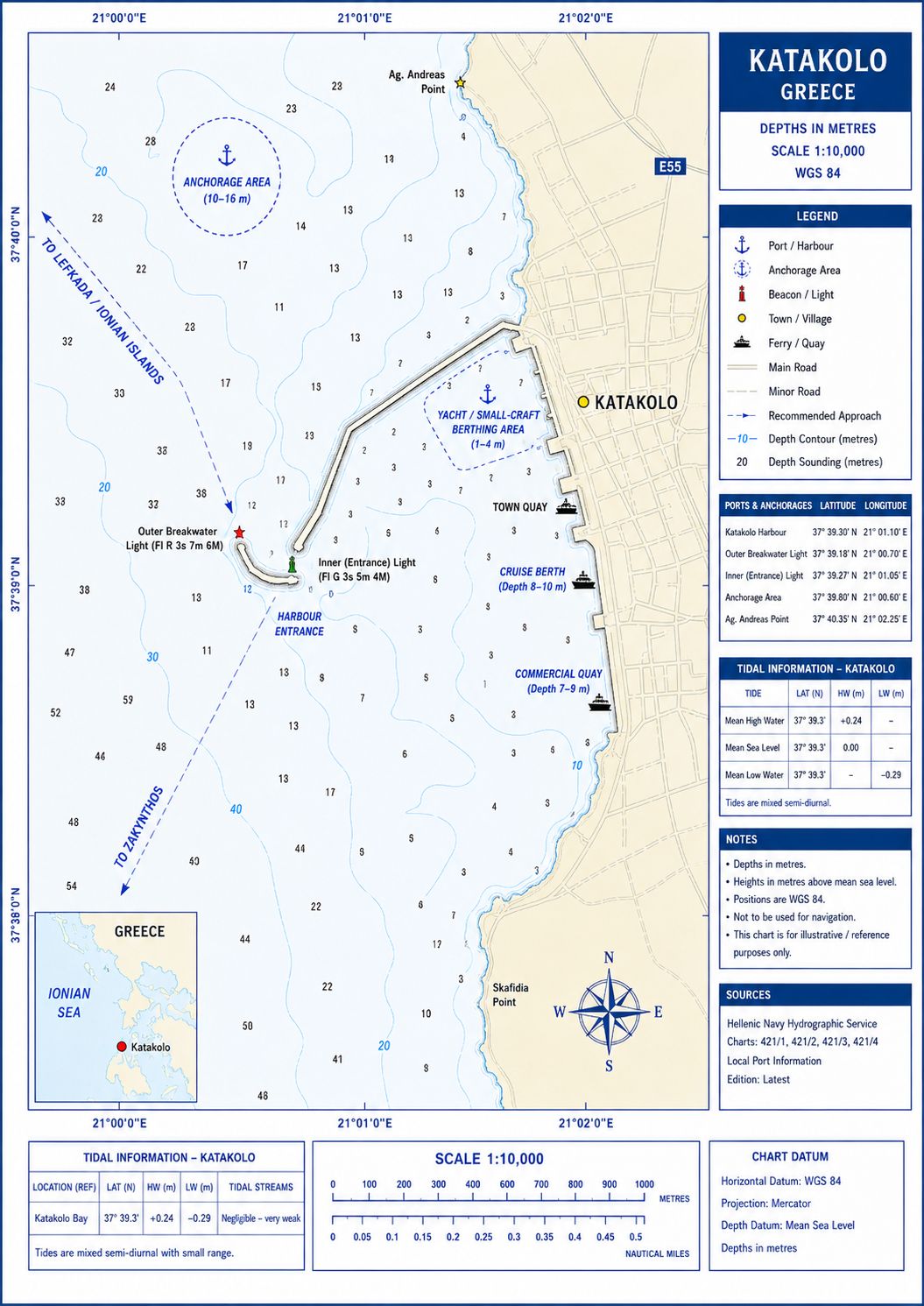
Chart Disclaimer. This chart is a schematic representation for illustrative purposes only and must not be used for navigation. Refer to official hydrographic charts for safe navigation. Be aware ENC charts may differ from official hydrographic charts. Both should be corrected and updated regularly
Katakolo Greece
Sailing Guide - Ocean Currents and Tidal Flow
Tidal range at Katakolo is small, normally around 0.2–0.4 m, and astronomical tidal streams are weak. Current inside the harbour is usually negligible, with water movement affected mainly by wind, swell, and harbour surge rather than tide. In settled conditions, tidal flow has little effect on yacht handling or anchoring.
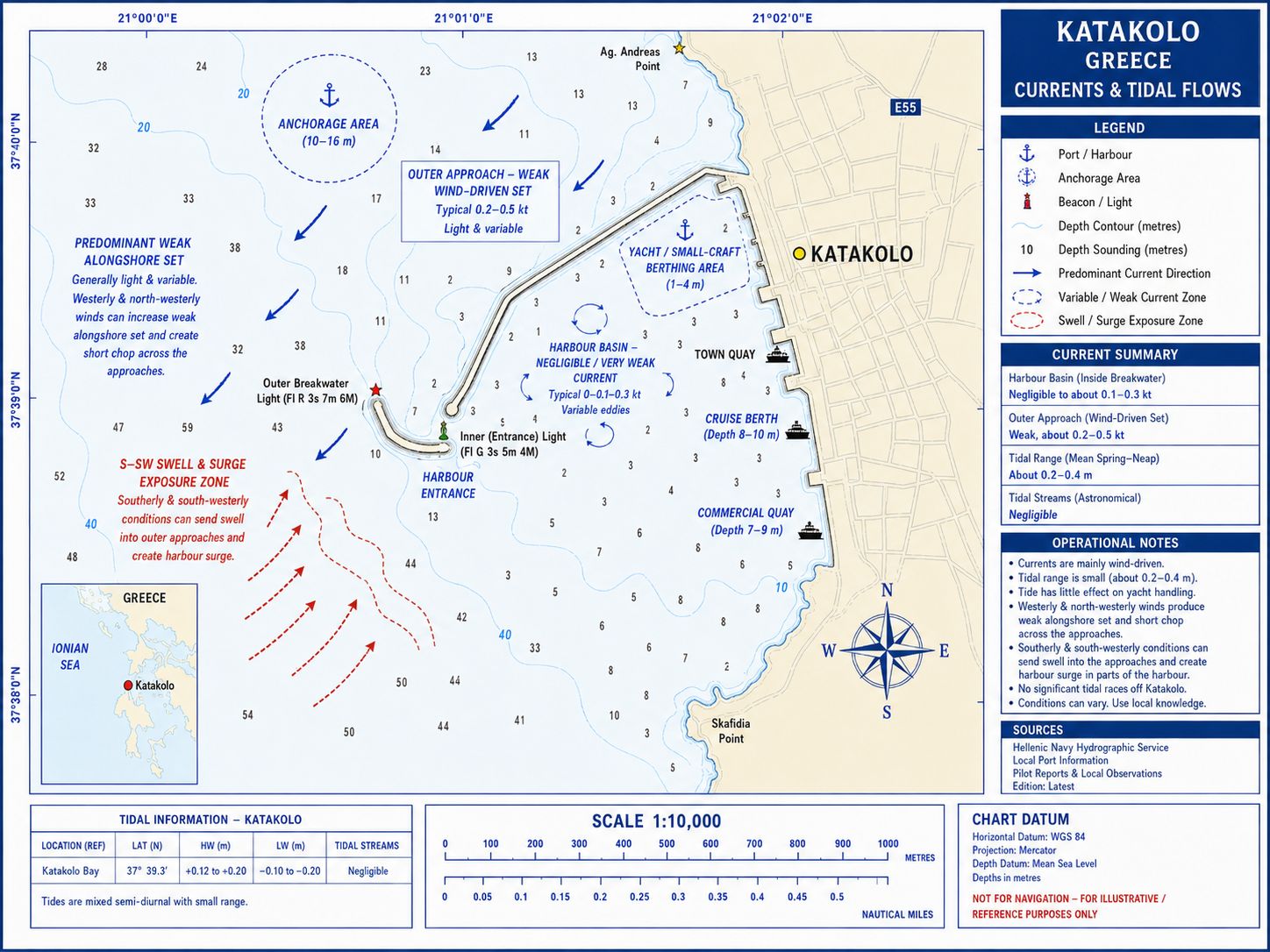
Outside the harbour, water movement is mainly wind-driven along the open Ionian coast. Westerly and north-westerly winds can produce a weak alongshore set and short chop across the harbour approaches. Southerly and south-westerly weather can send swell into the outer approaches and create surge inside parts of the port. There are no significant tidal races off Katakolo, but sea state can build quickly when Ionian swell meets local wind near the harbour entrance.
Katakolo Greece
Sailing Guide - Weather
Katakolo has a western Peloponnese Ionian climate, with hot dry summers and wetter winter periods. The main cruising season from May to September is generally settled, with clear visibility, high temperatures, and limited rainfall. Summer daytime temperatures commonly sit around 28–35°C, with stronger heat inland toward Pyrgos and Olympia.
The harbour is exposed to weather arriving from the west, south-west, and south, which can bring Ionian swell and surge into the approaches. Summer afternoons often bring a north-westerly or westerly sea breeze, producing chop outside the harbour. Winter and shoulder-season fronts can bring strong southerlies, heavy rain, thunderstorms, and rapid wind shifts.
The Marine Electrical and Electronics Bible has a complete list of Greek VHF Radio Channel information and weather forecast times for Greece along with NAVTEX UK and Europe and NAVTEX Mediterranean for 490kHz and 518kHz.
Katakolo Greece
Sailing Guide - Local Winds
Katakolo is mainly affected by north-westerly and westerly sea breezes in summer. Mornings are often light, with wind building from late morning or early afternoon, commonly 10–18 knots and sometimes stronger under an established Ionian pressure pattern. This creates short chop outside the harbour entrance and along the open western Peloponnese coast.
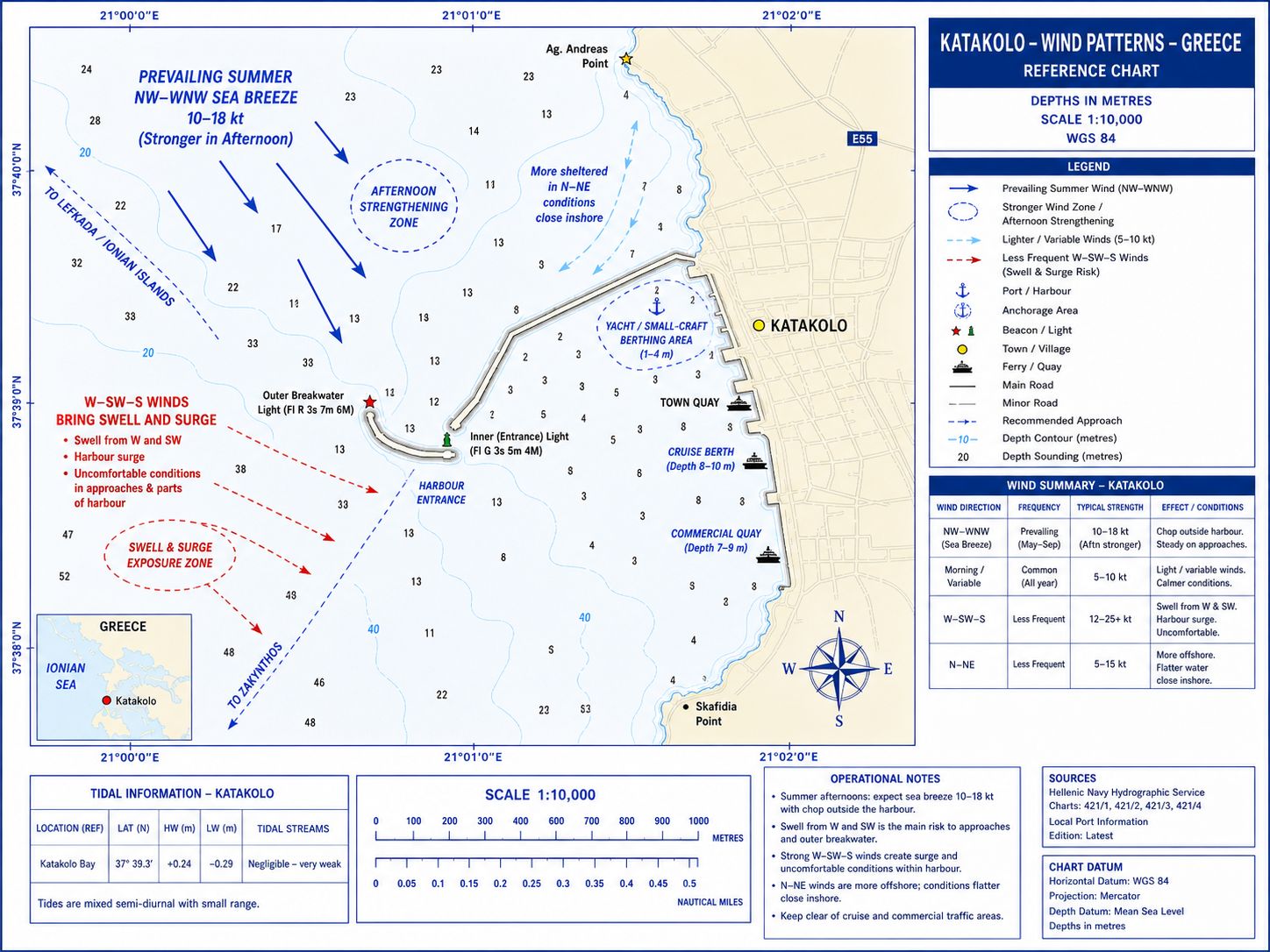
West, south-west, and south winds are the main problem directions for Katakolo. These winds can bring swell into the approaches and surge inside parts of the harbour. North and north-east winds are usually offshore or partly sheltered by the land, giving flatter water close inshore, but gusts can still descend from the low inland hills during unstable weather.
Katakolo Greece
Sailing Guide - Approaches
Approach Katakolo from the Ionian Sea on the western Peloponnese coast. The harbour is identifiable by the outer breakwater, commercial port structures, cruise-ship berth, and the low headland north-west of the town. Offshore depths are deep and clear, then reduce gradually toward the harbour approaches. Keep clear of commercial traffic, cruise-ship movements, fishing vessels, and small craft operating close to the entrance.
Entry is from the open western sector into the protected harbour area. In settled weather the approach is straightforward, but westerly, south-westerly, and southerly weather can create swell, rebound, and surge near the entrance. Summer afternoon westerlies and north-westerlies can produce crosswind and short chop on final approach. Maintain VHF watch, identify any port traffic before closing the entrance, and avoid obstructing the cruise berth or commercial manoeuvring area.
Katakolo Greece
Sailing Guide - Navigation
Navigation into Katakolo harbour is by the outer breakwater and commercial port entrance. Approach from the west or south-west, keeping clear of the cruise-ship berth, commercial quay, fishing traffic, and harbour entrance traffic. Depths in the outer approach are generally ample for yachts, reducing toward the port structures. Inside the main port, depths are greater near the commercial and cruise berths and shallower toward the small-craft and yacht areas.
Yachts normally use available space in the small harbour or designated quay area, separate from the cruise berth. Expect working depths of about 3–5 m in the yacht and small-craft areas, with deeper water in the outer commercial basin and reduced depths close to quay edges, inner corners, and fishing-boat areas. Manoeuvre slowly, use the depth sounder continuously, and avoid entering or turning across the cruise-ship manoeuvring zone. Westerly or southerly swell can cause surge inside the harbour, and afternoon north-westerlies can create crosswind during berthing.
Katakolo Greece
Sailing Guide - Chart Accuracy
Hydrographic charts accurately depict harbour layout, breakwaters, and depth contours. Electronic charts align with official data. Caution is required for harbour traffic and mooring arrangements. Depth soundings are reliable but should be verified when berthing.
Katakolo Greece
Sailing Guide - Anchorages
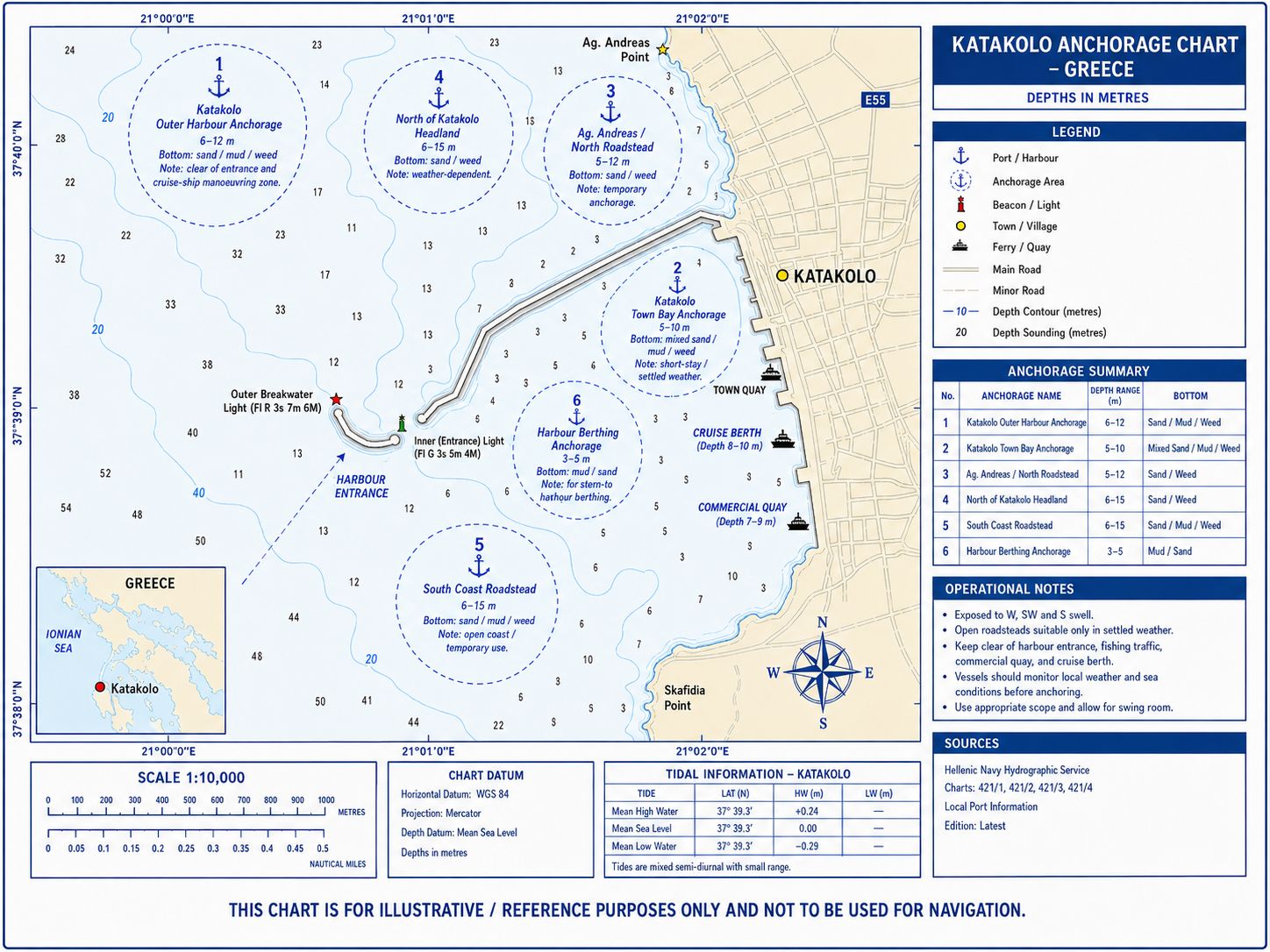
Katakolo has limited anchorage options because the coast is open to the Ionian Sea and the harbour is the main shelter. Most anchoring outside the port is suitable only in settled weather. Westerly, south-westerly, and southerly conditions can make the roadsteads uncomfortable or unsafe.
- Katakolo outer harbour anchorage. This is the most practical position when yachts are not able to berth inside. Anchor outside the small-craft area, clear of the harbour entrance, cruise-ship manoeuvring zone, fishing traffic, and port approach. Depths are generally 6–12 m over sand, mud, and weed patches. Holding is reasonable where sand or mud is found. The position is exposed to swell from the west and south-west and can be affected by harbour wash, surge, and commercial traffic.
- Katakolo town bay (off the waterfront). This can be used in settled weather when there is no swell running. Anchor clear of local moorings and small-craft tracks in about 5–10 m. Bottom is mixed sand, mud, and weed. This is a short-stay anchorage rather than a secure overnight position. It becomes uncomfortable quickly with westerly sea breeze chop or any southerly swell.
- North of Katakolo headland. This gives temporary shelter from light southerly or south-easterly conditions, depending on exact wind angle. Depths are generally 6–15 m over sand and weed. Holding must be checked carefully. The anchorage is exposed to west and north-west swell and should not be used with the normal Ionian afternoon breeze if it is building.
- Agios Andreas (northern roadstead). This lies north of Katakolo along the low coast. It is an open anchorage for settled weather only, with depths around 5–12 m over sand and weed patches. It can be used as a short daylight stop but has little protection from the prevailing westerly and north-westerly sea breeze. It is unsuitable in west, south-west, or southerly weather.
- South of Katakolo (open coast roadstead). This is a temporary anchoring option only in calm offshore conditions. Depths are usually 6–15 m over sand, mud, and weed. The coast is low and exposed, with poor shelter from Ionian swell. This area should not be treated as a normal yacht anchorage in unsettled conditions.
- Harbour anchoring while berthing stern-to may be required if taking quay space inside the small harbour. Depths in the yacht area are commonly 3–5 m, with mud and sand holding. Allow for crossed anchors, fishing-boat moorings, quay traffic, and surge. Keep clear of commercial berths and cruise-ship areas
Katakolo Greece
Sailing Guide - Entry Formalities
Katakolo is the primary designated port of entry and supports full clearance procedures for visiting yachts. Vessels arriving from outside Greece or the Schengen Area may clear in directly at Katakolo, subject to standard Greek entry requirements. Clearance is conducted through the local Port Authority (Limenarchio), with customs and immigration formalities handled in accordance with national procedures. All vessels must ensure that the Greek cruising tax (TEPAI) is valid and paid prior to or on arrival. Required vessel documentation, including registration papers and insurance, must be available. Non-EU vessels must hold a DEKPA cruising log or Transit Log, completed and presented for endorsement as required. Passports and crew documentation are subject to inspection, and clearance procedures should be completed promptly after arrival. For departures to non-Schengen countries, exit formalities are also conducted at Katakolo. As with all Greek ports of entry, procedures are formal but straightforward, with compliance dependent on correct documentation and adherence to reporting requirements on arrival and departure
Katakolo Greece
Sailing Guide - Marina Facilities
Katakolo does not have a full-service yacht marina. Berthing is inside the working harbour, separate from the cruise-ship berth and commercial quay areas. Visiting yachts normally use available space in the small-craft harbour or along permitted quay sections. Working depths in the yacht area are commonly about 3–5 m, with shallower water close to quay edges, inner corners, and fishing-boat areas.
Berthing is normally stern-to with anchor or alongside where space permits. The harbour is used by cruise ships, fishing vessels, local craft, and visiting yachts, so movement of larger vessels takes priority. Water and electricity may be available on some quay sections but should be checked locally. There is no dedicated yacht fuel berth; diesel is normally supplied by road tanker or collected by jerry can from local fuel stations. Marine services are limited, with major repairs and haul-out handled at larger Ionian service centres
Katakolo Greece
Sailing Guide - Provisioning
Supermarkets. Supermarket provisioning in Katakolo is limited to small local grocery stores, mini markets, bakeries, and general household suppliers near the harbour. For larger supermarket stock, the main options are in Pyrgos, including AB Vassilopoulos, Sklavenitis, Lidl, and My Market.
Markets. Fresh produce in Katakolo is available from local greengrocers, small grocery stores, and seasonal produce stalls near the harbour and town area. Wider produce supply is available in Pyrgos, including greengrocers, supermarket produce sections, and local market stalls
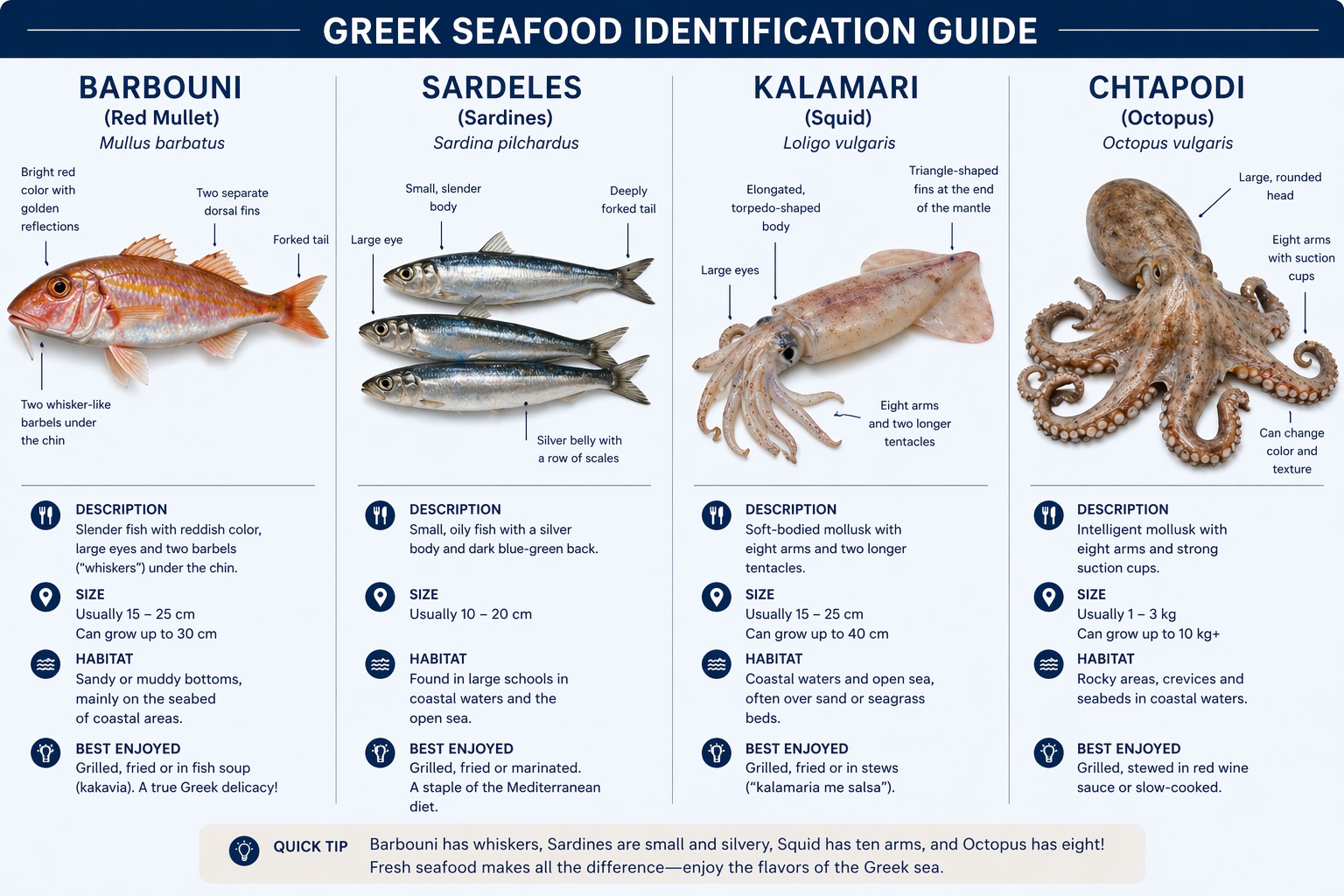
Fish Markets. Fish supply in Katakolo comes from local fishing boats, harbour-side seafood sellers, and tavernas supplied by the local fleet. Common local catch includes sardines, anchovies, red mullet, sea bream, sea bass, mullet, squid, octopus, cuttlefish, and prawns. Availability depends on weather, season, and daily landings.
Katakolo Greece
Sailing Guide - Local Cuisine
Local cuisine in Katakolo is western Peloponnese coastal cooking, using seafood, olive oil, vegetables, pulses, lamb, pork, and local cheeses. Common dishes include grilled fish, fried calamari, octopus, sardines, anchovies, shrimp saganaki, kakavia fish soup, souvlaki, grilled lamb, pork kontosouvli, kokkinisto, moussaka, gemista, fasolada, horiatiki salad, feta, olives, and seasonal vegetable dishes. Regional food from Elis includes olive oil, table olives, citrus, grapes, raisins, watermelon, honey, local cheeses, and wine from the western Peloponnese. Tavernas around Katakolo generally serve seafood, grilled meats, cooked dishes, salads, pies, and standard harbour-front Greek meals.
Katakolo Greece
Sailing Guide - Local Beverages
Local beverages in Katakolo include western Peloponnese wines, ouzo, tsipouro, retsina, Greek beer, Greek coffee, frappe, freddo espresso, mountain tea, fresh citrus juice, and bottled soft drinks. Local tavernas and cafés commonly stock regional wine, domestic beer. Regional wines from the Peloponnese are common.
Katakolo Greece
Sailing Guide - Diesel Fuel Supplies
Diesel fuel in Katakolo is normally supplied by local fuel stations rather than a dedicated yacht fuel berth. Road tanker delivery to the harbour may be available by arrangement. Small quantities can be collected by jerry can from fuel stations in Katakolo or Pyrgos.
Katakolo Greece
Sailing Guide - Water Supplies
Water in Katakolo may be available from quay points in the small harbour or permitted yacht berthing area, depending on berth position and local port arrangements.
Mechanical and Electrical Repairs
Resource
If you are headed somewhere remote consider the need to expand your knowledge base or have an information resource on board. Why not get a copy of my book The Marine and Electrical and Electronics Bible 4th Edition. By and for yachties, with everything from batteries and charging, solar and wind, diesel engines and marine electronics and so much more. Your complete systems guide. 650 pages of practical advice. In Australia and New Zealand order a copy through Boat Books. UK and European boats can buy the UK Edition Here. US and Canadian boats can get the US Edition Order Here. Marine systems are my profession so let me help you. By a liveaboard boat owner for other boat owners.



Katakolo Greece
Sailing Guide - Marine Services
Limited marine services are available locally. More advanced service capability is accessible at Patras.
Katakolo Greece
Sailing Guide - Local Etiquette
Interpersonal etiquette in Katakolo is informal and direct. Use basic greetings in shops, cafés, tavernas, fuel stations, and harbour offices. Kalimera in the morning, kalispera later in the day, and efcharisto when leaving are appropriate. Dress is casual, but swimwear is not normal in shops, cafés, offices, or away from the beach. Keep communication with harbour staff, shopkeepers, fishers, and taverna owners polite and patient. Cruise-ship days can make the waterfront busy, so direct requests for fuel, water, berthing, or supplies should be made clearly and without pressure.
Katakolo Greece
Sailing Guide - Summary
Katakolo provides a controlled harbour environment with limited anchorage options. Protection is available within the harbour but exposure exists outside. Infrastructure supports commercial operations with basic yacht access. Navigation is straightforward with attention required for vessel traffic. The Katakolo Greece sailing guide for all you need to know.