Kastos Greece Sailing Guide
Kastos Greece Sailing Guide. Kastos is a small island in the inner Ionian Sea, located east of Ithaca and north of Kalamos. The island is low-lying with limited elevation, rising to approximately 140 metres, and is characterised by a rocky, indented coastline with scattered coves and narrow inlets. Depths increase gradually offshore, and surrounding waters are generally sheltered compared to the outer Ionian, though exposure varies with wind direction.
The principal settlement and harbour are located on the east coast, forming the main anchorage and berthing area for visiting vessels. There are no large-scale port facilities, and infrastructure is minimal, with operations centred around a small quay and anchorage system. Kastos should be regarded as a lightly developed cruising stop, with basic shelter and limited services, suitable for short stays and straightforward harbour use rather than extended provisioning or technical support.
Kastos Greece
Sailing Guide - History
Kastos has a limited but continuous habitation history, typical of the smaller Ionian islands. Archaeological evidence indicates ancient settlement activity, likely connected to nearby Ithaca and regional maritime routes, though the island never developed into a major centre. Its small size and lack of natural resources meant it remained peripheral to larger political and commercial developments in the Ionian Sea.
During the medieval and early modern periods, Kastos fell under successive control of regional powers, including Venetian administration, followed by French and later British governance as part of the Ionian Islands. Throughout these periods, the population remained small, relying on fishing, limited agriculture, and coastal trade. In the modern era, after incorporation into the Greek state in the 19th century, the island has seen gradual depopulation, with its economy shifting toward seasonal maritime activity and limited tourism, while retaining its traditional settlement pattern centred on the main harbour.
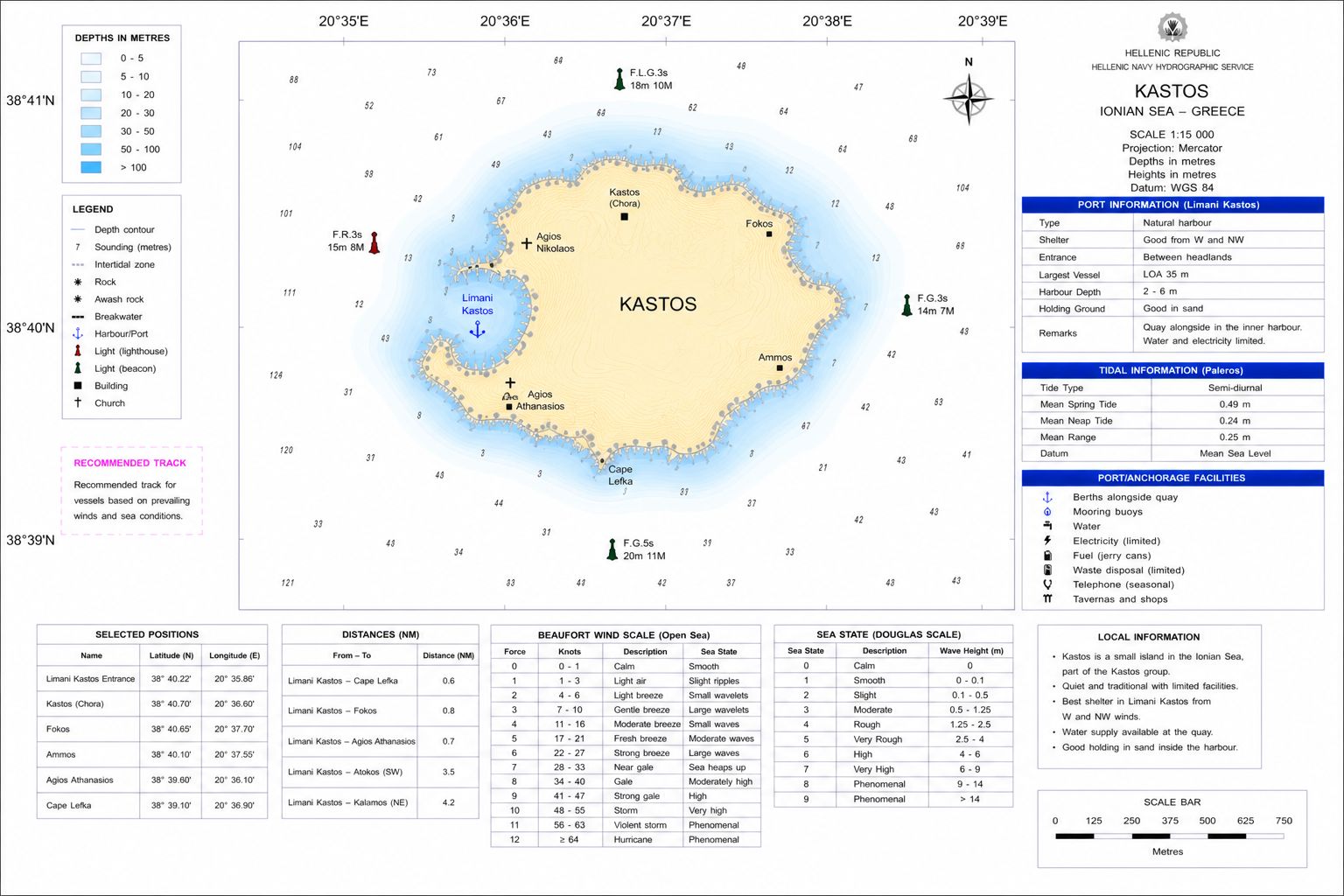
Chart Disclaimer. This chart is a schematic representation for illustrative purposes only and must not be used for navigation. Refer to official hydrographic charts for safe navigation. Be aware ENC charts may differ from official hydrographic charts. Both should be corrected and updated regularly.
Kastos Greece
Sailing Guide - Ocean Currents and Tidal Flow
Currents around Kastos are weak and predominantly wind-driven, with minimal tidal influence. Tidal range in this part of the Ionian is small, generally 0.2–0.4 metres, and does not generate any consistent or operationally significant tidal stream. There is no defined flood or ebb pattern, and water movement should be treated as variable set and drift rather than predictable tidal flow.
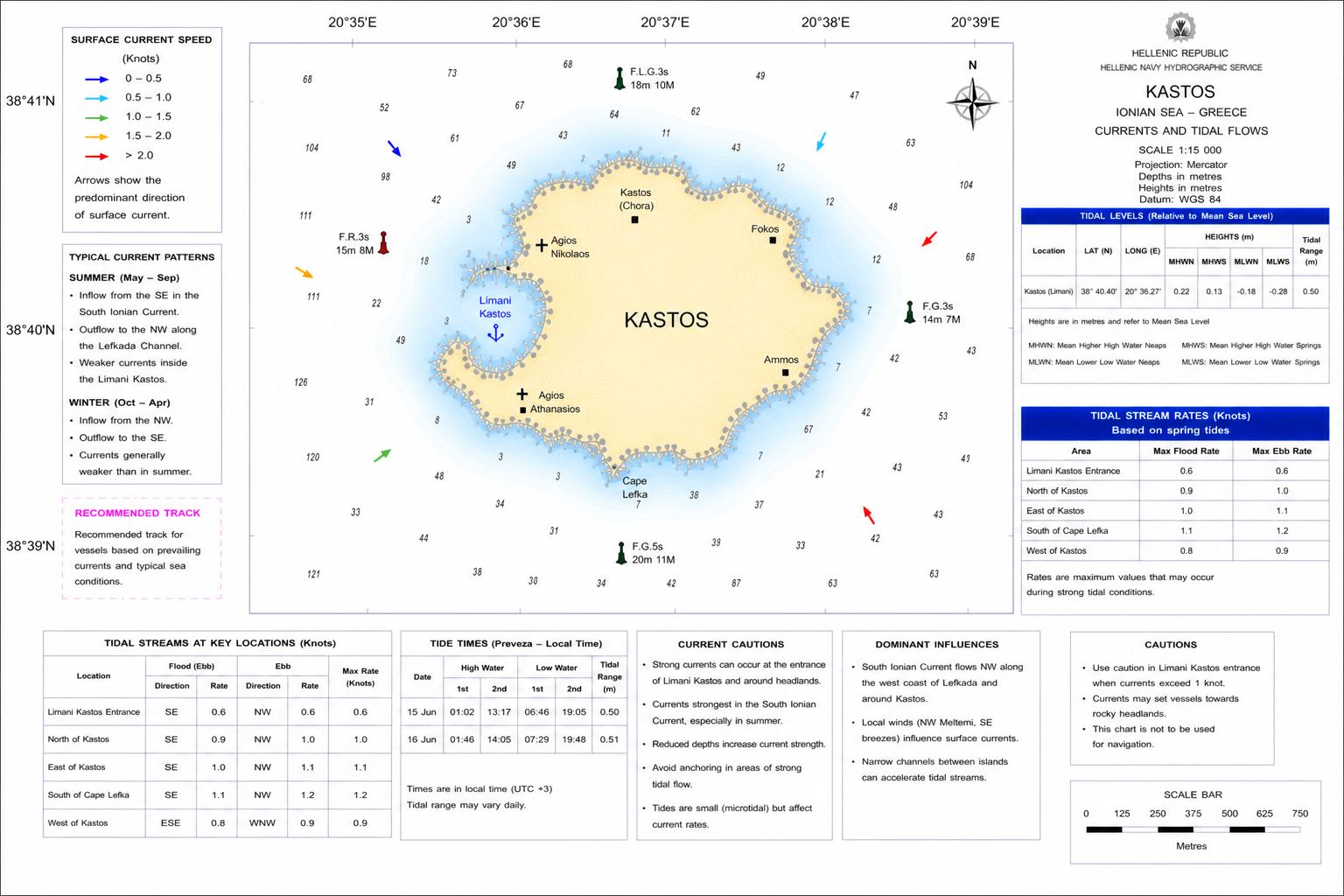
Under the prevailing north-westerly wind regime (Maistro) in summer, a south to south-east setting surface flow may develop through the channels between Kastos, Kalamos, and the mainland. Current speeds are typically 0.2–0.5 knots, increasing locally in constricted passages. In southerly or unsettled conditions, flow may reverse or become irregular. Close to the island, localised eddies and backflow can occur around headlands and within bays, but overall current influence is minor and secondary to wind and sea state.
Kastos Greece
Sailing Guide - Weather
Weather at Kastos follows the typical inner Ionian pattern, with hot, dry, and stable conditions during summer under persistent high pressure. Daytime temperatures generally range from 28–32°C, with slightly higher humidity than the Aegean but moderated by afternoon sea breezes. Skies are predominantly clear with very low rainfall and high visibility, and settled conditions can persist for extended periods.
Outside the summer season, weather becomes more variable under passing low-pressure systems, bringing increased cloud cover, rainfall, and shifting winds. These systems typically introduce southerly to south-westerly winds ahead of fronts, followed by westerly or north-westerly flow after passage. Winter temperatures remain mild, generally 10–16°C, with rainfall occurring intermittently, sometimes heavy but short-lived. Overall, conditions are less extreme than the Aegean, but more changeable outside the stable summer period.
The Marine Electrical and Electronics Bible has a complete list of Greek VHF Radio Channel information and weather forecast times for Greece along with NAVTEX UK and Europe and NAVTEX Mediterranean for 490kHz and 518kHz.
Kastos Greece
Sailing Guide - Local Winds
Wind at Kastos is governed by a diurnal north-west to west sea-breeze regime during summer rather than a persistent regional system. Winds typically establish late morning, build through the afternoon to 10–20 knots, and ease after sunset, often dropping light overnight. The channels between Kastos, Kalamos, and the mainland can produce local acceleration, with gusts exceeding forecast values, particularly near headlands and in confined passages.
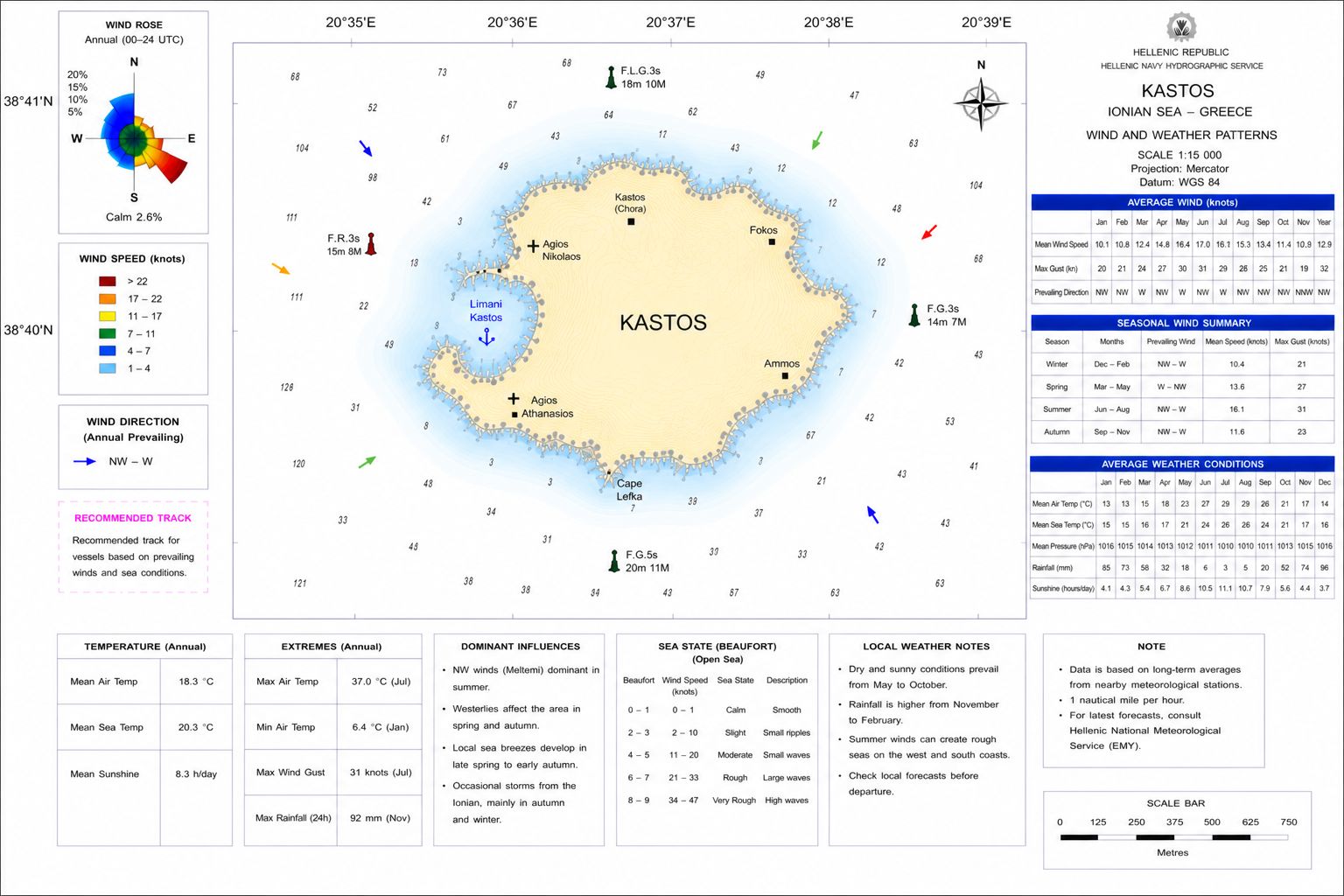
Outside summer, wind patterns become synoptic and variable, driven by passing low-pressure systems. Southerly to south-westerly winds develop ahead of fronts and can strengthen to 20–30 knots or more, veering west to north-west after passage. Local effects include gusting, turbulence, and short-lived wind shadows within bays, though overall wind strength remains moderate compared to the Aegean, with conditions influenced more by weather systems than persistent seasonal winds.
Kastos Greece
Sailing Guide - Approaches
Approaches to Kastos are made in sheltered inner Ionian waters with no significant off-lying hazards. The island is low-lying and clearly identifiable, with depths generally 10–30 metres on approach, allowing close inshore navigation. Access is typically from the north or south via the channels between Kastos, Kalamos, and the adjacent mainland coast.
Under prevailing summer north-westerlies, expect moderate afternoon winds with slight south-setting drift, and some local acceleration in the channels. Sea state is usually slight to moderate, with good visibility. There are no defined approach channels, and navigation is conducted by visual reference and charting, with primary considerations being wind effects, local traffic, and maintaining clearance from rocky points near the shoreline rather than depth or hazard constraints.
Kastos Greece
Sailing Guide - Navigation
Entry into the harbour at Kastos is made on the east coast into a small, open bay forming the main settlement anchorage. There is no defined entrance channel or breakwater; approach is direct on visual navigation with clear water and depths generally 8–15 metres on entry, shoaling gradually toward the quay to approximately 2–4 metres alongside.
The harbour is open to the east, but lies in relative lee under prevailing north-westerly winds, resulting in generally calm conditions on entry. In easterly or south-easterly winds, swell and surge can develop, affecting manoeuvring and berthing. Space is limited, and vessels typically anchor off and reverse to the quay using own ground tackle, requiring attention to anchor placement and clearance from other vessels.
There are no leading marks or formal navigation aids, and traffic is light, consisting mainly of cruising yachts and local craft. Entry is straightforward in settled conditions, with primary considerations being wind direction, confined space, and avoiding fouling of moorings and anchor chains within the harbour area.
Kastos Greece
Sailing Guide - Chart Accuracy
Hydrographic charts provide accurate coastline and depth representation. Electronic charts align well with official data. Minor nearshore hazards require visual confirmation when anchoring.
Kastos Greece
Sailing Guide - Anchorages
Around Kastos anchoring is practical but limited to a few defined locations, with the primary anchorage at the main harbour on the east coast. Here, vessels anchor in 8–15 metres over mud and sand, with generally good holding, and stern-to the quay where space permits. This anchorage provides good shelter from prevailing north-westerly winds, but is open to the east and becomes uncomfortable in easterly conditions.
A secondary anchorage exists at Sarakiniko Bay on the south-east coast, offering reasonable shelter from northerlies, with depths typically 5–12 metres over sand and weed. Holding is moderate to good depending on seabed composition. The bay is open to the south and east and should only be used in settled conditions. Additional small coves around the island provide temporary anchorage, generally in 10–20 metres, but are exposed and lack consistent protection.
There are no mooring buoys or structured anchorage systems, and the west coast is largely unsuitable due to exposure to prevailing winds and swell. For operational planning, anchoring at Kastos should be based on wind direction and short-term conditions, with the main harbour remaining the primary and most reliable option.
Kastos Greece
Sailing Guide - Entry Formalities
Entry formalities follow standard Greece procedures for visiting yachts. This is not a designated port of entry for international clearance, and there are no customs or immigration facilities on the island. Vessels arriving from outside Greece or the Schengen Area must first clear into the country at an official port of entry before proceeding to this port. Direct arrival from a non-Schengen country is not permitted. The Greek cruising tax (TEPAI) must be valid and paid, and the vessel’s cruising log (DEKPA for non-EU vessels, or transit log where applicable) should be up to date and available for inspection if requested by port authorities or coastguard.
Kastos Greece
Sailing Guide - Marina Facilities
Kastos has no marina facilities. All berthing is centred on the small harbour on the east coast, where a simple village quay provides the only alongside access. There are no pontoons, no laid moorings, and no organised marina infrastructure. Vessels typically berth stern-to the quay using their own anchor or anchor off where space is limited. Depths alongside are generally 2–4 metres, increasing quickly away from the quay. Bollards and rings are available but basic, and spacing can be tight during peak periods. There is no harbour management system or berth allocation, and manoeuvring is conducted independently. The harbour offers adequate shelter under prevailing north-westerlies, but is open to the east and can experience swell and surge in easterly conditions, affecting mooring security
Kastos Greece
Sailing Guide - Provisioning
Supermarkets. Provisioning on Kastos is very limited, with only a small number of local mini-markets located near the harbour. These stores supply basic essentials including dry goods, bottled water, bread, and a small range of fresh items such as vegetables and dairy. There are no full supermarkets, no chain stores, and no bulk provisioning options on the island.
Markets. There is no organised market. Prohere are no dedicated produce markets or regular vendors, and supply is intermittent rather than continuous. Locally grown produce may appear in small quantities, but this is not consistent
Fish Markets. There is no formal fish market. Fish may occasionally be obtained directly from fishermen operating from the harbour, typically on an ad hoc basis and subject to the day’s catch.
Kastos Greece
Sailing Guide - Local Cuisine
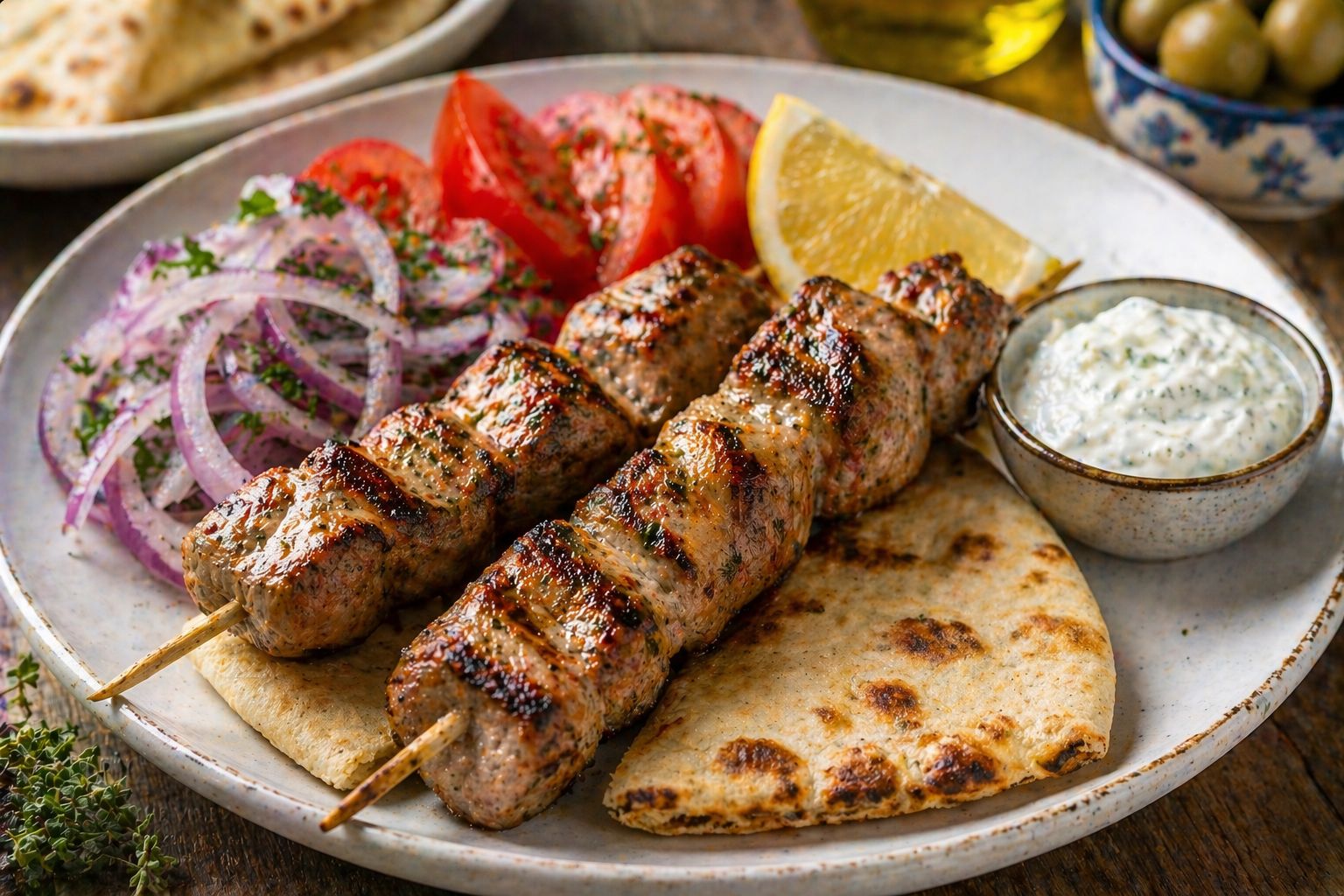
Common offerings include grilled or baked fish when catch is available, along with lamb or goat dishes prepared in oven or casserole. Vegetable-based meals are standard, including ladera-style dishes such as green beans, okra, or mixed vegetables cooked in olive oil and tomato. Legumes, particularly lentils and chickpeas, are used in soups and stews. Local dairy includes goat and sheep cheeses, served fresh or lightly aged, with bread forming a staple accompaniment. Fish is prepared as psari psito using available species. Small fish are served as gavros tiganitos when available. Baked fish is prepared as psari sto fourno. Meat dishes include souvlaki, gyro, and kontosouvli, with slow-cooked dishes such as kokkinisto and stifado. Vegetable dishes include horiatiki salata, gemista, and briam. Bread is served as psomi. No dishes are unique to Kastos.
Kastos Greece
Sailing Guide - Local Beverages
Local beverages on Kastos are typical of the Ionian region, centred on locally produced wine, bottled beer, and spirits such as ouzo and tsipouro. Supply is limited and largely imported from nearby islands or the mainland, with basic selection available through tavernas and small shops rather than specialised outlets.
Kastos Greece
Sailing Guide - Diesel Fuel Supplies
Fuel availability is limited to small roadside supply for local use, and any diesel obtained would be in small quantities by container (jerry cans), which is not practical for primary refuelling. There is no regular tanker delivery service to the harbour.
Kastos Greece
Sailing Guide - Water Supplies
Potable water on Kastos is very limited and not reliably available on the quay. There are no formal marina facilities, and any access to water at the harbour is intermittent and not guaranteed, typically via informal arrangements with local sources. Water on the island is supplied through local storage and delivery systems, prioritised for residents. Visiting vessels may obtain small quantities by arrangement or via containers, and bottled water is available from local shops.
Mechanical and Electrical Repairs
Resource
If you are headed somewhere remote consider the need to expand your knowledge base or have an information resource on board. Why not get a copy of my book The Marine and Electrical and Electronics Bible 4th Edition. By and for yachties, with everything from batteries and charging, solar and wind, diesel engines and marine electronics and so much more. Your complete systems guide. 650 pages of practical advice. In Australia and New Zealand order a copy through Boat Books. UK and European boats can buy the UK Edition Here. US and Canadian boats can get the US Edition Order Here. Marine systems are my profession so let me help you. By a liveaboard boat owner for other boat owners.



Kastos Greece
Sailing Guide - Marine Services
There are no formal marine service providers on Kastos. No authorised engine or electronics agents are present. Basic assistance may be available locally. For maintenance or repair, vessels must relocate to Lefkada or Preveza.
Kastos Greece
Sailing Guide - Local Etiquette
Interaction is direct and formal on first contact, with a greeting expected before any request or transaction. Conversation tone is measured and transactional, with limited small talk unless initiated locally. Personal space is closer than in northern Europe, but physical contact is minimal unless familiarity is established. Shore behaviour is conservative in non-tourist areas, particularly near churches and village centres where modest dress and low noise are expected.
Kastos Greece
Sailing Guide - Summary
Kastos provides a sheltered Ionian cruising environment with multiple reliable anchorages and a small harbour facility. Navigation is straightforward with minimal current and moderate wind conditions. Provisioning and services are limited but accessible via nearby islands. The island functions as a practical anchorage destination within the Ionian cruising area, consistent with a Kastos Greece Sailing Guide for all you need to know.