Kastellorizo
Greece Sailing Guide
Kastellorizo Greece Sailing Guide. Kastellorizo lies in the far eastern Mediterranean, close to the Turkish coast, and is geographically isolated from the main Dodecanese group. The island is characterised by a deeply indented natural harbour on the north coast, which forms the primary settlement and operational centre. Surrounding coastlines are predominantly steep-to with limited landing points, and depths increase rapidly offshore. The harbour itself provides a well-defined basin with clear approaches and deep water close in, supporting straightforward navigation in settled conditions.
For a cruising yacht, Kastellorizo functions as a self-contained port of entry with defined harbour operations and essential services. The enclosed harbour offers good protection in most conditions, though exposure can occur under certain wind directions, particularly from the east. The island’s remote position means it is often used as a waypoint for longer passages rather than a transit stop within a broader cruising circuit. Facilities are present but limited in scale, and all operations are influenced by weather, harbour space, and the island’s logistical isolation.
Kastellorizo
Greece Sailing Guide - History
Kastellorizo has a long maritime history shaped by its strategic position at the eastern edge of the Mediterranean, close to the coast of Asia Minor. The island was known in antiquity as Megisti and was associated with the Lycian and later Greek worlds, functioning as a minor but active trading outpost. Its natural harbour provided a secure anchorage on a key east–west sea route, and archaeological evidence indicates continuous habitation from classical through Hellenistic periods.
During the medieval era, Kastellorizo gained greater strategic importance. In the 14th century it was fortified by the Knights of St John, who constructed a castle overlooking the harbour, from which the modern name derives. Control of the island passed through successive powers, including the Mamluks, the Kingdom of Naples, and eventually the Ottoman Empire. Under Ottoman administration, the island developed into a prosperous maritime and trading centre, with a substantial Greek population engaged in shipping, sponge diving, and regional commerce.
In the late 19th and early 20th centuries, Kastellorizo reached its peak population and economic activity, but this period was followed by decline due to war, shifting trade routes, and political change. The island was occupied by Italian forces during the Italo-Turkish War and formally incorporated into the Italian Dodecanese. During the Second World War, it was subject to bombardment and occupation, resulting in significant destruction and depopulation. After the war, Kastellorizo was transferred to Greece in 1947 along with the rest of the Dodecanese. Much of its population had emigrated, and recovery was gradual. Today, the island maintains a small permanent population, with activity centred on the harbour settlement. Its historical development reflects strategic importance, maritime trade, and subsequent isolation, shaped by changing regional control and modern geopolitical boundaries.
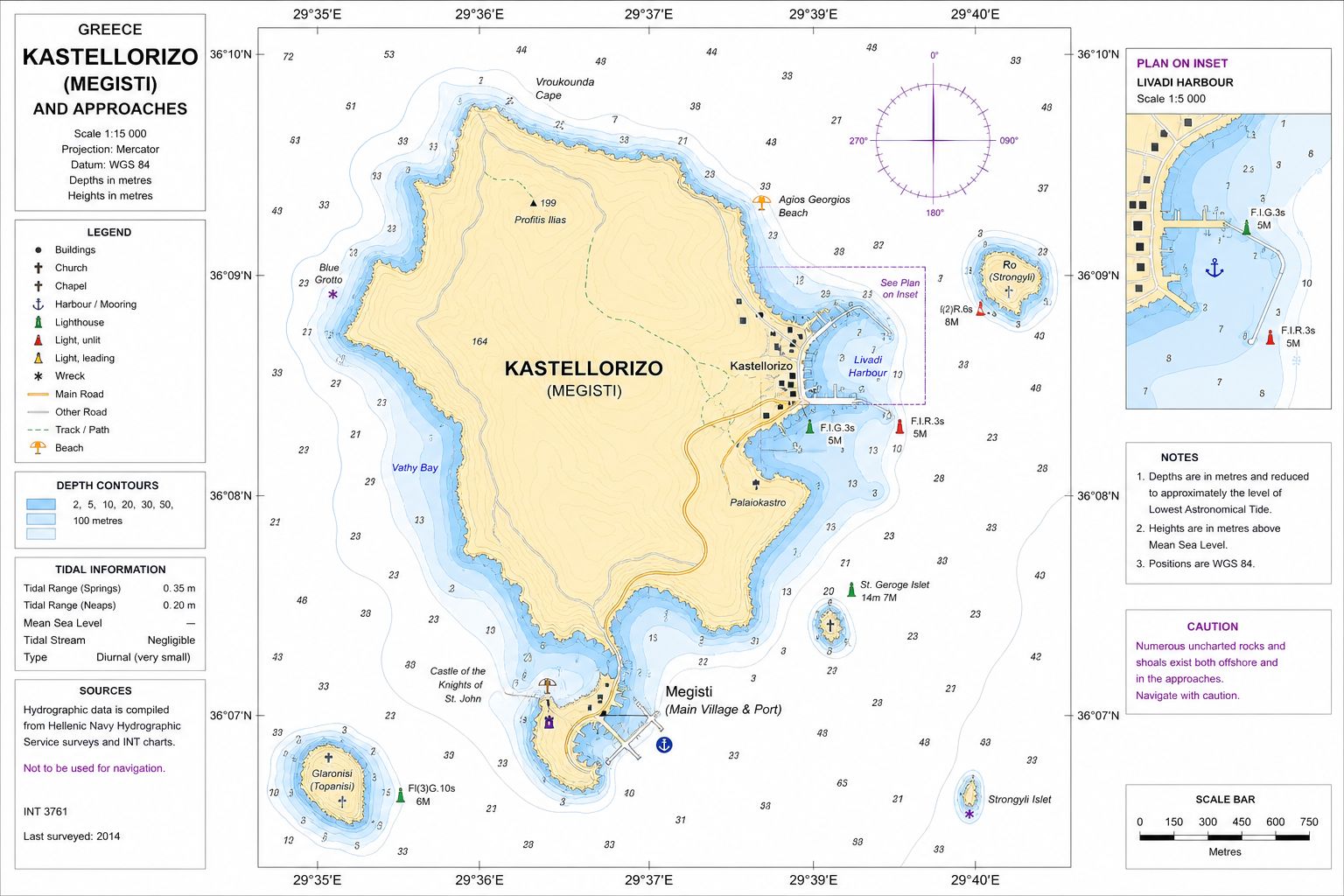
Chart Disclaimer. This chart is a schematic representation for illustrative purposes only and must not be used for navigation. Refer to official hydrographic charts for safe navigation. Be aware ENC charts may differ from official hydrographic charts. Both should be corrected and updated regularly.
Kastellorizo
Greece Sailing Guide - Ocean Currents and Tidal Flow
Kastellorizo lies in the far eastern Mediterranean where tidal influence is minimal and currents are primarily wind-driven. The tidal range is small, typically in the order of 0.1 to 0.3 metres, and does not generate any consistent or operationally useful tidal stream. There is no defined flood or ebb pattern, and any surface movement should be treated as variable drift rather than predictable tidal flow.
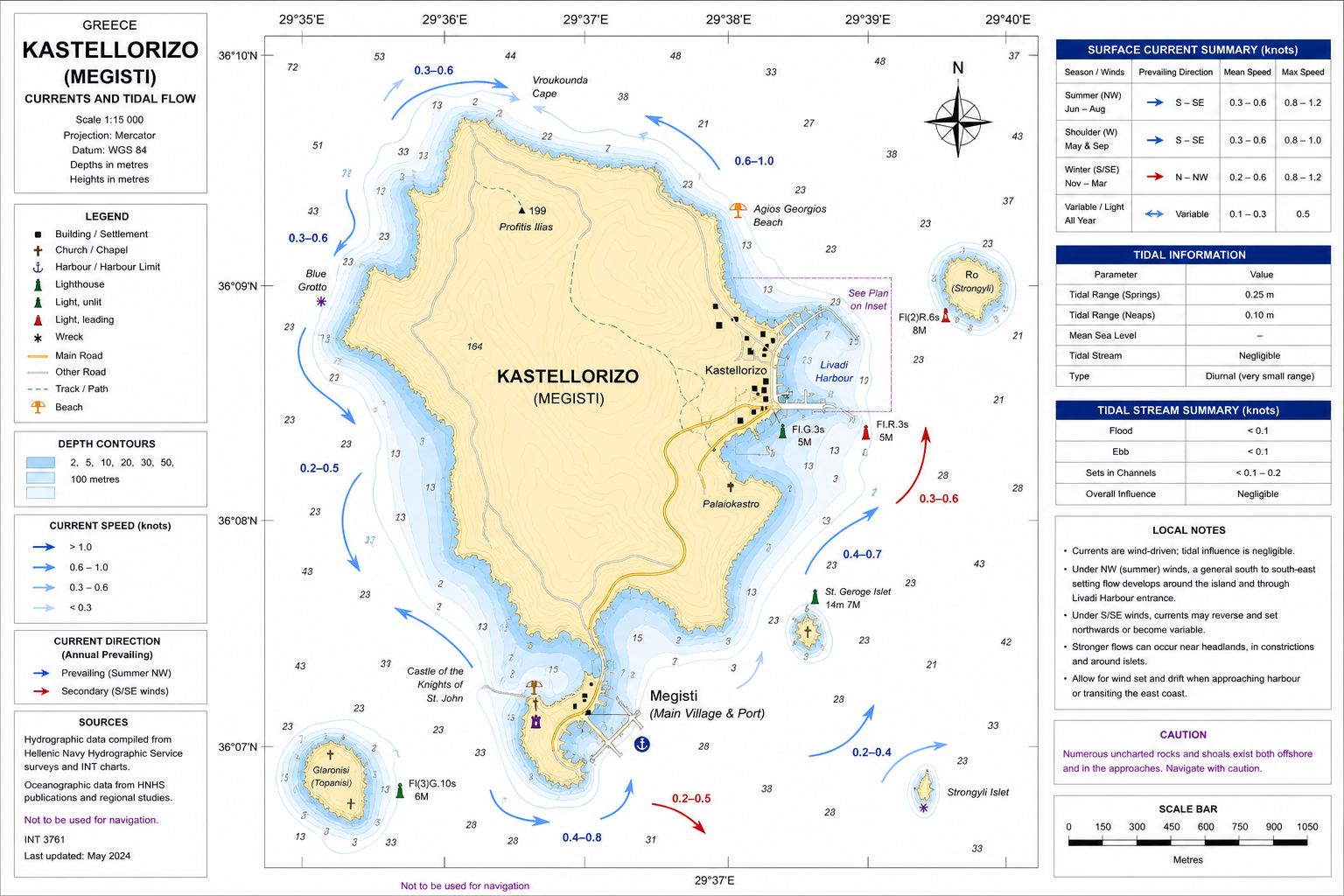
Current behaviour around the island is influenced by the interaction between regional circulation in the eastern Mediterranean and local wind conditions. Under prevailing northerly winds, particularly during extended periods of Meltemi influence reaching this far east, a general south to south-west setting flow may be observed around the island. In contrast, during periods of southerly or south-easterly winds associated with low-pressure systems, current may reverse to a north-setting flow. Typical current speeds are low, generally in the range of 0.2 to 0.8 knots, but can increase locally under sustained wind conditions.
Close to the island and within the main harbour, current influence is negligible due to the enclosed nature of the basin. Outside the harbour, localised effects occur around headlands and along the coast where eddies, backflow, and slight shear zones may develop, particularly when wind opposes residual surface movement. Sea state is more often governed by wind than by current interaction.
Kastellorizo
Greece Sailing Guide - Weather
Kastellorizo experiences a hot eastern Mediterranean climate with long, dry summers and mild, wetter winters. During the summer period, persistent high-pressure systems dominate, producing clear skies, very high visibility, and negligible rainfall. Daytime temperatures typically range from 30°C to 35°C, with higher peaks during heat events, and warm nights remaining above 24°C. Humidity is moderate, influenced by proximity to the mainland, and haze can occasionally reduce clarity.
Unlike the central Aegean, the Meltemi influence is weaker and less consistent at Kastellorizo. While northerly winds do occur, local summer weather is more often characterised by light to moderate breezes with a diurnal pattern, including sea breezes from the south or south-west during the afternoon. Periods of calm or light variable winds are more common here than further west, contributing to higher perceived heat and reduced ventilation.
From late autumn through early spring, weather becomes more variable under passing low-pressure systems moving across the eastern Mediterranean. These systems bring increased cloud cover, rainfall, and shifting winds, typically from the south-east to south-west ahead of fronts, followed by westerly or north-westerly flow after passage. Rainfall is concentrated in this period and can occur in short, heavy events. Winter temperatures remain moderate, generally between 12°C and 18°C, with no prolonged cold conditions. Visibility is typically good outside of rainfall, and fog is rare. For operational purposes, weather at Kastellorizo should be considered stable and hot with lighter winds in summer, and variable with frontal systems in winter, with less persistent wind but higher heat load than the central Aegean islands.
The Marine Electrical and Electronics Bible has a complete list of Greek VHF Radio Channel information and weather forecast times for Greece along with NAVTEX UK and Europe and NAVTEX Mediterranean for 490kHz and 518kHz.
Kastellorizo
Greece Sailing Guide - Local Winds
Wind at Kastellorizo is less dominated by the Meltemi than the central Aegean and is instead influenced by a mix of regional pressure patterns and local thermal effects. During summer, winds are generally light to moderate and variable, with a developing diurnal sea-breeze cycle. In the late morning and afternoon, a south to south-west sea breeze typically sets in at 10–15 knots, occasionally higher, before easing again after sunset. Overnight and early morning conditions are often calm or light and variable.
When northerly flow associated with the wider Aegean Meltemi extends into the area, it arrives as a weakened N to NW wind, usually in the 10–20 knot range, though stronger periods can occur. These northerlies are less consistent and of shorter duration than further west, but when present they can produce increased wind strength at harbour entrances and around exposed headlands, with local acceleration effects.
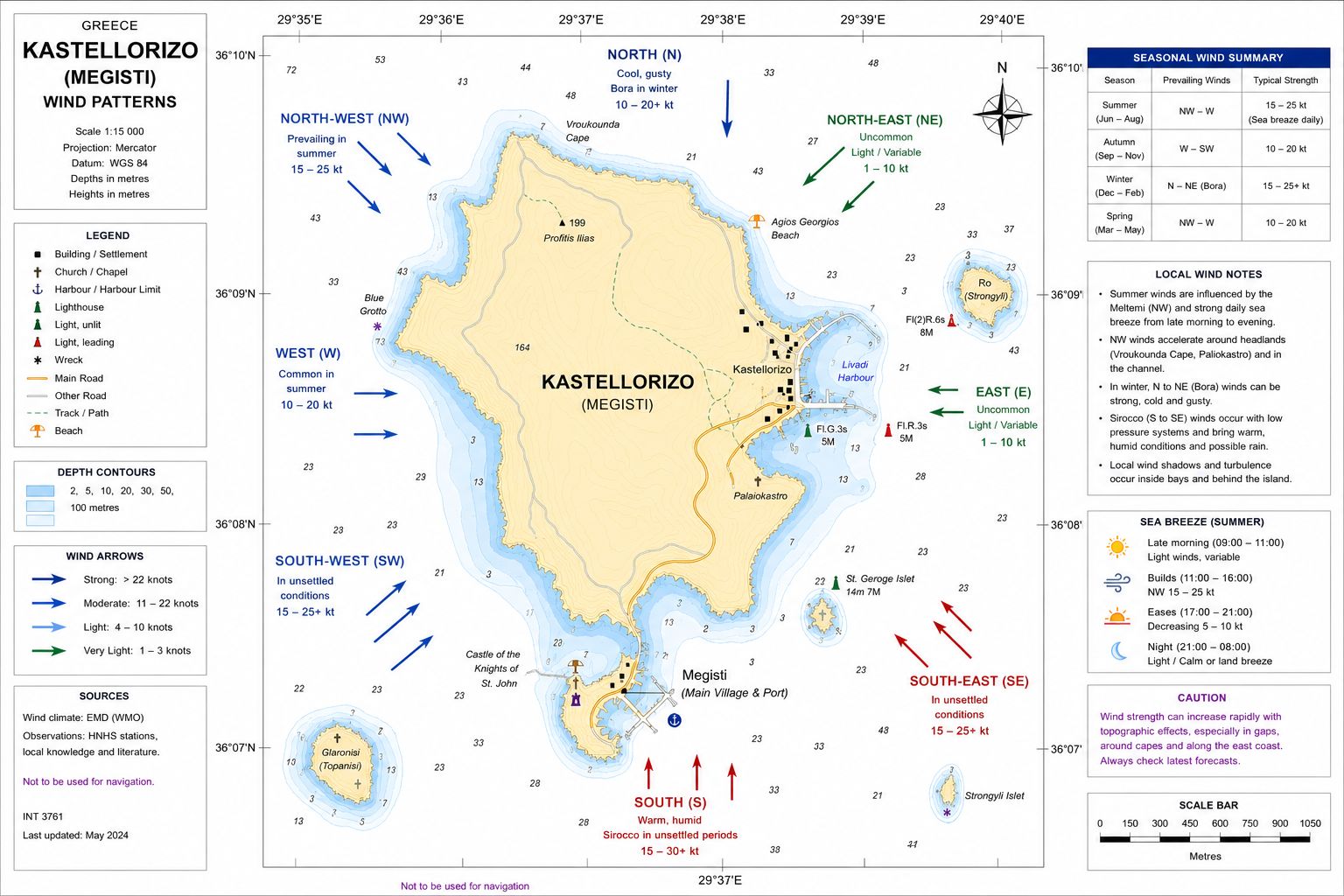
Outside the summer period, wind becomes synoptic and more variable, driven by low-pressure systems moving across the eastern Mediterranean. Ahead of these systems, SE to SW winds develop and can strengthen rapidly, often reaching 20–30 knots or more in exposed areas. After frontal passage, winds typically veer to W or NW and gradually ease. Directional changes can be marked, though usually with more gradual transitions than in the central Aegean.
Local effects are evident around the island’s steep terrain, with gusting and turbulence near headlands and in confined coastal areas, and occasional katabatic flows descending from higher ground during stable nighttime conditions. Within the main harbour, surrounding hills provide some modification of wind strength, but gusts can still enter, particularly under northerly or easterly flow. Overall, wind at Kastellorizo should be treated as lighter and more variable than the Aegean core, with a strong diurnal component in summer and weather-driven variability outside it.
Kastellorizo
Greece Sailing Guide - Approaches
Approaches to Kastellorizo are made in open water with clear sea room, with no offshore shoals of significance and generally deep water close inshore, typically exceeding 20–50 metres within short distance of the coast. The island is readily identifiable by its steep, rocky terrain and the distinct indentation of the main harbour on the north coast. Traffic in the area is light to moderate, consisting of local ferries, fishing vessels, and occasional commercial traffic operating along the nearby Turkish coastline.
From the west and north-west, approaches are straightforward but fully exposed to any prevailing wind and sea. Under northerly conditions, expect moderate sea state and a slight south-setting drift, while in southerly weather, seas may build on approach from open fetch to the south. From the east, proximity to the Turkish coast requires attention to traffic and coastal features, though navigation remains unconstrained. Visibility is generally good, with reduced clarity only in haze or rain.
As the island is closed, the main harbour entrance on the north coast becomes prominent. There are no extensive off-lying hazards, but caution is required near headlands where localised gusting and turbulence may be encountered. Navigation is by standard charting and visual reference, with no defined traffic separation or approach channels. Primary considerations are wind strength, sea state, and maintaining clearance from coastal features, rather than restricted navigation.
Kastellorizo
Greece Sailing Guide - Navigation
Entry into the harbour of Kastellorizo is made through a narrow, well-defined opening on the north coast between two headlands. The entrance is approximately 40–60 metres wide and clearly identifiable on approach, with no off-lying shoals or hazards extending beyond the immediate shoreline. Depths in the approach remain deep, typically increasing rapidly from 20–40 metres offshore to around 12–20 metres within the entrance itself, allowing a direct approach without the need to follow a dredged channel or specific alignment.
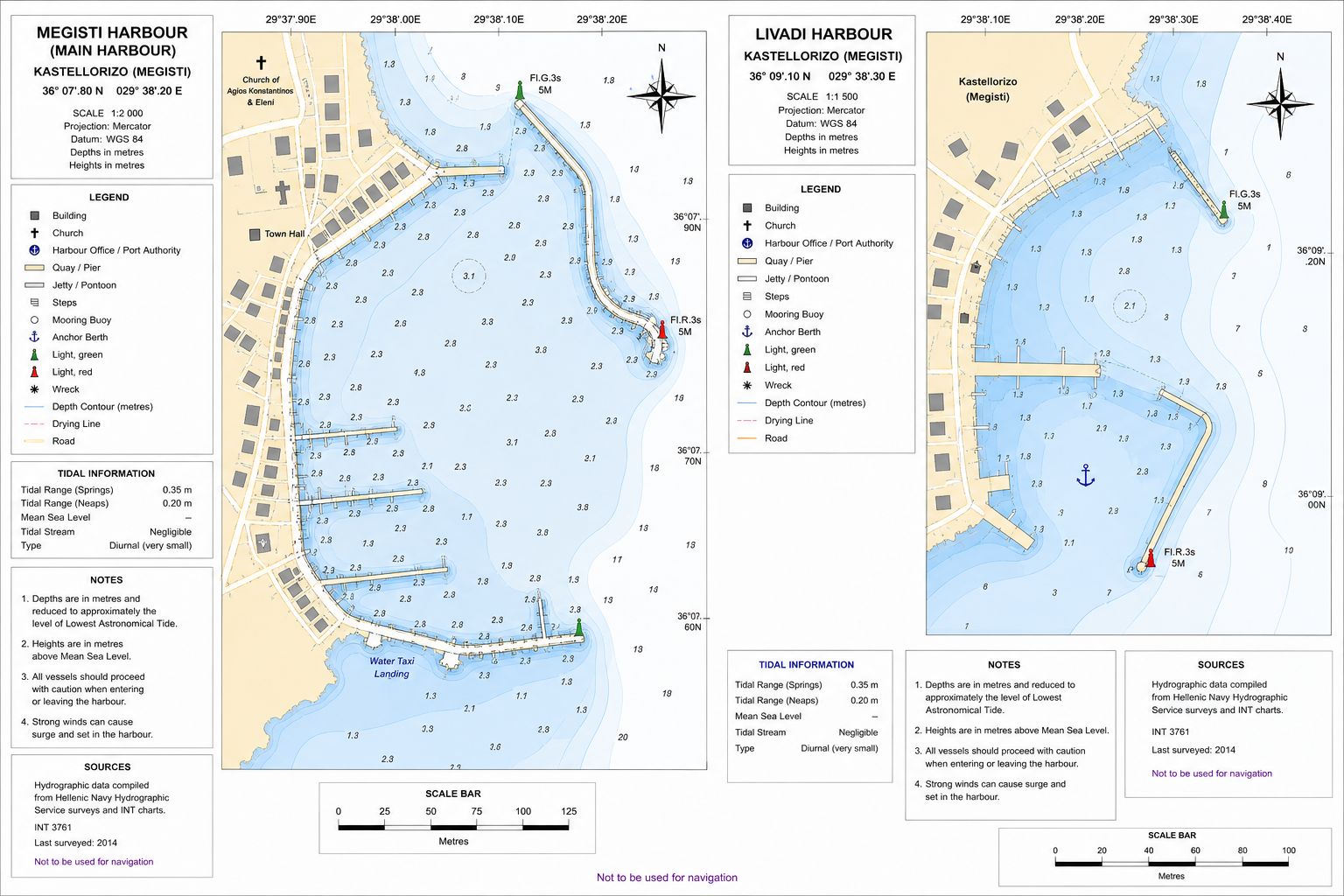
Maintaining a central track through the entrance provides consistent depth clearance, with no bar, sill, or shallow obstruction present. Once inside, the harbour opens into a broad, enclosed basin where depths remain substantial, generally in the range of 10–15 metres in the central area. Depths gradually reduce toward the quay, where alongside depths typically range from approximately 3 to 6 metres depending on position. The seabed is predominantly mud and sand, providing suitable holding for vessels anchoring off the quay where required.
Wind effects are the primary consideration on entry rather than depth. Northerly winds may funnel through the entrance, producing gusting and localised acceleration, while easterly or south-easterly winds can create a slight cross-set across the entrance that requires correction during final approach. Current influence is negligible. Navigation is conducted visually, using the headlands and harbour opening as reference points, with adequate depth throughout for cruising yachts and no significant depth-related constraints on entry.
Kastellorizo
Greece Sailing Guide - Chart Accuracy
Hydrographic charts provide accurate representation of harbour layout and depths. Electronic charts align with official data. Close-quarters manoeuvring requires visual confirmation due to quay configuration and vessel positioning.
Kastellorizo
Greece Sailing Guide - Anchorages
Anchoring at Kastellorizo is limited and secondary to quay berthing, but is possible both within the main harbour and, in settled conditions, outside the harbour. Inside the harbour basin, vessels may anchor off the quay where space permits. Depths in the central harbour are typically 10–15 metres, shoaling toward the waterfront to 3–6 metres, with a seabed of mud and sand providing generally good holding. Swinging room is restricted, and care is required to avoid fouling moorings or interfering with vessels secured stern-to along the quay.
Outside the harbour, temporary anchoring may be possible in settled weather only, typically to the west or east of the entrance, where depths remain suitable in the 10–20 metre range over mixed sand and rock. These areas are fully exposed to prevailing wind and sea, with no protection from swell or wind shifts, and are not suitable for overnight use except in calm conditions.
Kastellorizo
Greece Sailing Guide - Entry Formalities
Kastellorizo is a designated port of entry and supports full clearance procedures for visiting yachts. Vessels arriving from outside Greece or the Schengen Area may clear in directly at Kastellorizo, subject to standard Greek entry requirements. Clearance is conducted through the local Port Authority (Limenarchio), with customs and immigration formalities handled in accordance with national procedures. All vessels must ensure that the Greek cruising tax (TEPAI) is valid and paid prior to or on arrival. Required vessel documentation, including registration papers and insurance, must be available. Non-EU vessels must hold a DEKPA cruising log or Transit Log, completed and presented for endorsement as required. Passports and crew documentation are subject to inspection, and clearance procedures should be completed promptly after arrival. For departures to non-Schengen countries, exit formalities are also conducted at Kastellorizo. As with all Greek ports of entry, procedures are formal but straightforward, with compliance dependent on correct documentation and adherence to reporting requirements on arrival and departure.
Kastellorizo
Greece Sailing Guide - Marina Facilities
Kastellorizo provides quay-based berthing within the main harbour, with no marina installations. Vessels berth stern-to along the waterfront surrounding the harbour basin, using own ground tackle. Depths alongside generally range from 3 to 6 metres, with deeper water available further off the quay. The seabed is mud and sand, providing reliable holding for stern anchors. The harbour is enclosed and offers good protection in most conditions, though some surge and wind can enter depending on direction, particularly from the east. Manoeuvring space is adequate but can become restricted during busy periods due to the number of vessels using the quay. Berths are not allocated, and mooring is conducted independently, with bollards and rings available along the waterfront.
Kastellorizo
Greece Sailing Guide - Provisioning
Supermarkets. Provisioning for vessels sailing Kastellorizo Greece is available through several small supermarkets within immediate proximity of the harbour including Megisti Market Kastellorizo and other local grocery stores. These supply packaged goods, fresh produce, meat, and bottled water. Stock is dependent on ferry deliveries and is generally consistent but limited compared to larger islands.
Markets. There is no organised municipal market. Produce is supplied through local retailers.
Fish Markets. There is no formal fish market. Fish is available through local fishermen and restaurants depending on daily catch.
Kastellorizo
Greece Sailing Guide - Local Cuisine
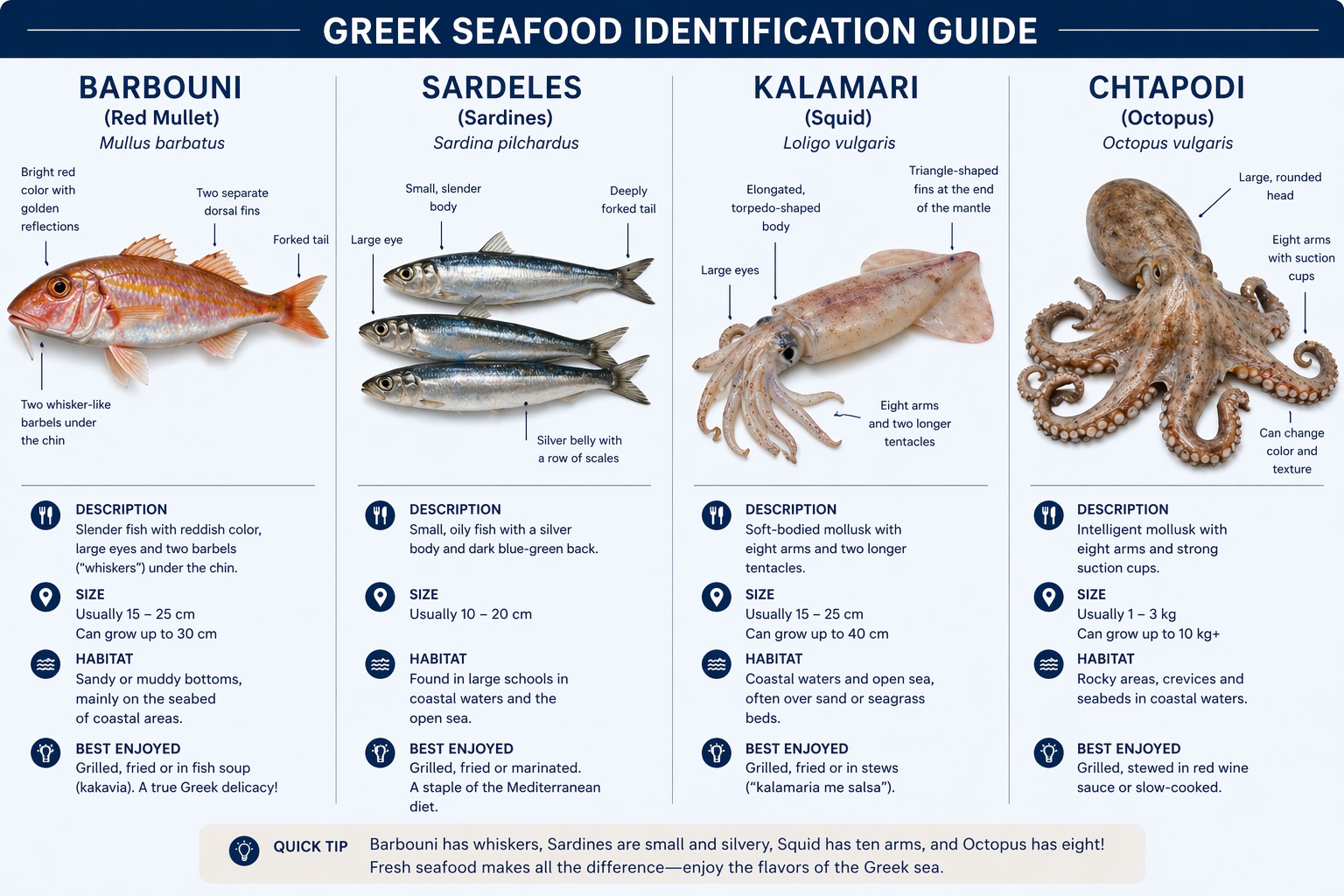
Seafood is central when available, including small local fish, octopus, and squid, typically grilled, fried, or prepared in basic stews. A well-known local preparation is stuffed squid (kalamari gemisto), often filled with rice and herbs. Vegetable-based dishes are common, including ladera-style cooking, where seasonal vegetables are prepared in olive oil and tomato. Pulses such as chickpeas and lentils are regularly used in soups and simple stews. Meat dishes are usually based on goat or lamb, prepared slowly in oven or casserole. Local dairy production provides goat and sheep cheeses, served fresh or lightly aged. Bread is supplied through local bakeries and forms a staple accompaniment.
Kastellorizo
Greece Sailing Guide - Local Beverages
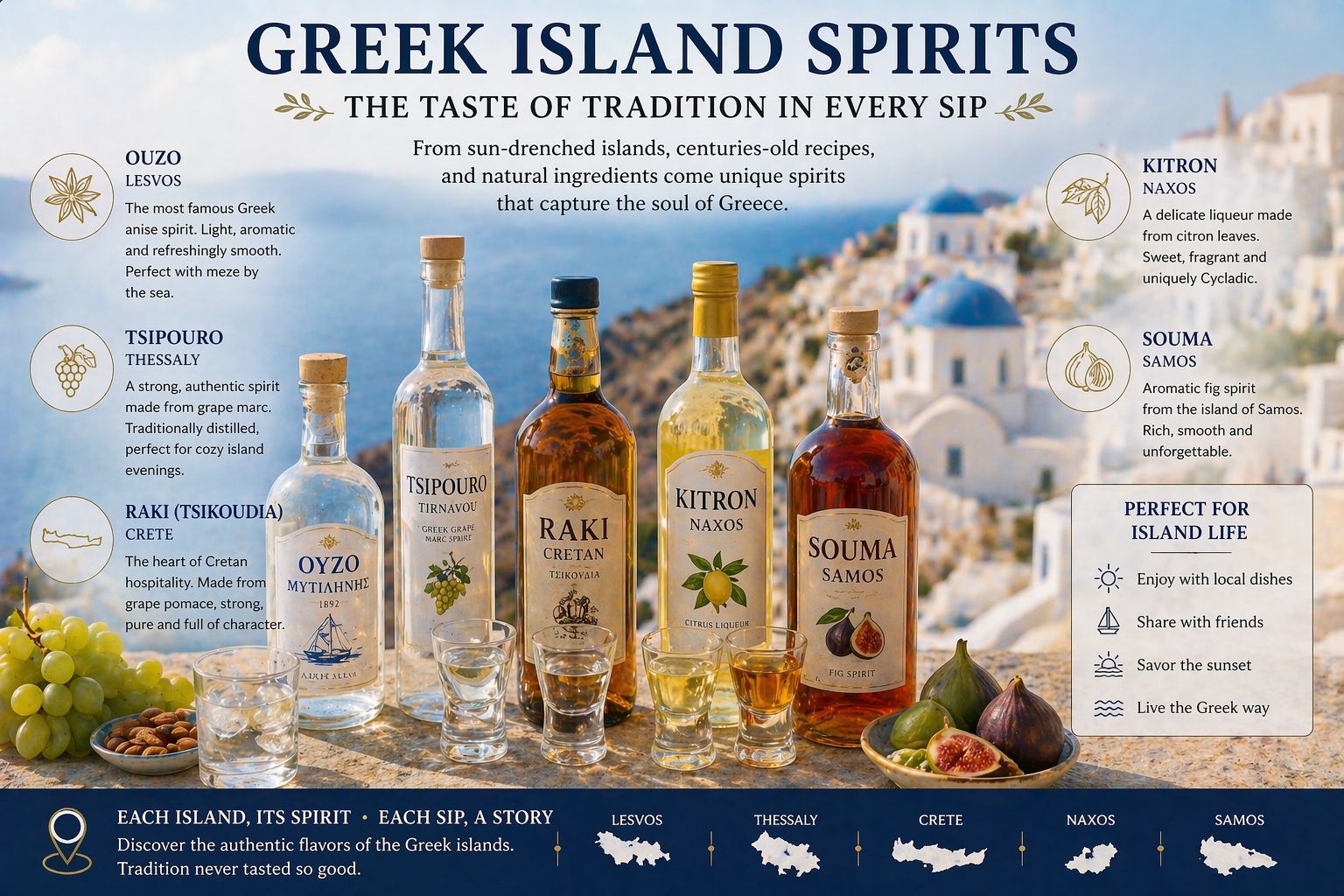
Beer, wine, and spirits across the Greek islands are locally produced and widely available through tavernas, small bars, and provisioning outlets. Beer is predominantly lager, with domestic brands including Mythos, Alfa, Fix, and Vergina alongside imported products; and over 100 microbreweries operate on several islands with limited distribution. Wine is region-specific, with white varieties dominant in the islands, including Assyrtiko, Moschofilero, and Roditis, alongside local table wines served in bulk; retsina remains in circulation as a resin-flavoured wine. Distilled products include ouzo (anise-based), tsipouro (grape marc distillate), raki or tsikoudia (Crete), souma (fig or grape distillate in eastern Aegean islands), and kitron (citrus liqueur from Naxos), with alcohol strength typically in the 37–45% range and higher for unregulated local distillations.
Kastellorizo
Greece Sailing Guide - Diesel Fuel Supplies
Diesel fuel at Kastellorizo is available but not via a fixed fuel dock within the harbour. There are no permanent quay-side pumps, and vessels cannot refuel directly alongside in the standard marina sense. Fuel is supplied by road tanker delivery to the quay, which can usually be arranged through local agents, the Port Authority, or by contacting the supplier in advance. Delivery is dependent on scheduling and demand, and may not be immediate on arrival, particularly during busy periods. Small quantities can also be obtained from local roadside fuel stations using containers, though this is not practical for primary refuelling
Kastellorizo
Greece Sailing Guide - Water Supplies
Potable water at Kastellorizo is available on the harbour quay, though supply is controlled and not continuous at all berths. Water points are installed along sections of the waterfront, and access is typically arranged through the Port Authority or local management. Pressure and flow rates are variable, and high-demand periods can result in reduced availability.
Mechanical and Electrical Repairs
Resource
If you are headed somewhere remote consider the need to expand your knowledge base or have an information resource on board. Why not get a copy of my book The Marine and Electrical and Electronics Bible 4th Edition. By and for yachties, with everything from batteries and charging, solar and wind, diesel engines and marine electronics and so much more. Your complete systems guide. 650 pages of practical advice. In Australia and New Zealand order a copy through Boat Books. UK and European boats can buy the UK Edition Here. US and Canadian boats can get the US Edition Order Here. Marine systems are my profession so let me help you. By a liveaboard boat owner for other boat owners.



Kastellorizo
Greece Sailing Guide - Marine Services
Marine service capability is limited. Basic mechanical and electrical assistance may be available locally, though capability is restricted. No authorised service agents for major brands are present. For significant repairs, vessels must relocate to larger ports such as Rhodes or Turkish mainland facilities.
Kastellorizo
Greece Sailing Guide - Local Etiquette
Local etiquette reflects a small but active port community. Dress standards in town areas are moderate. Behaviour in public areas is expected to align with local norms. Taverna service is table-based with ordering required when seated. Waste disposal is conducted through municipal systems.
Kastellorizo
Greece Sailing Guide - Summary
Kastellorizo provides a confined but functional harbour environment with full port-of-entry capability. Navigation requires careful handling within limited space and consideration of surge under southerly winds. Provisioning and basic services are available at a limited scale. The island functions as a remote but operational port within the eastern Mediterranean, consistent with a Kastellorizo Greece Sailing Guide for all you need to know.