Iraklia Greece Sailing Guide
Iraklia Greece Sailing Guide. Iraklia lies within the Small Cyclades group between Naxos and Ios, positioned in open Aegean waters with exposure to northerly Meltemi conditions. The island is sparsely populated, with the main settlement and harbour at Agios Georgios on the north coast. The coastline is generally steep-to with intermittent bays, and depths increase rapidly offshore. The surrounding waters are clear, with minimal off-lying hazards, but the island is fully subject to regional wind and sea state.
For a cruising yacht, Iraklia provides limited but usable facilities centred on Agios Georgios, with additional anchorage options in settled conditions along the south coast. The harbour offers basic berthing with variable protection depending on wind direction, while other parts of the island remain open and exposed. There are no marina facilities, and all operations are dependent on prevailing weather, particularly the strength and persistence of the Meltemi.
Iraklia Greece
Sailing Guide - History
Iraklia has a history tied to its position within the Small Cyclades, though it has never supported large or continuous settlement. Archaeological evidence indicates occupation from at least the Early Bronze Age, with finds suggesting links to the wider Cycladic culture and maritime networks. The island’s limited water resources and arable land constrained development, and habitation remained small-scale and dispersed.
During the classical and Hellenistic periods, Iraklia fell within the sphere of larger regional centres such as Naxos. It did not develop as a major port or administrative centre, functioning instead as a minor outlying territory used for grazing, subsistence agriculture, and limited coastal activity. Under Roman and later Byzantine control, the island continued in this marginal role, with little strategic or economic significance beyond local use.
In the modern era, Iraklia became part of the Greek state in the 19th century. Population levels have remained low, and development has been limited. The island has retained a largely traditional character, with small settlements and minimal infrastructure. Its history is therefore defined less by major events and more by continuity of small-scale habitation under changing regional governance.
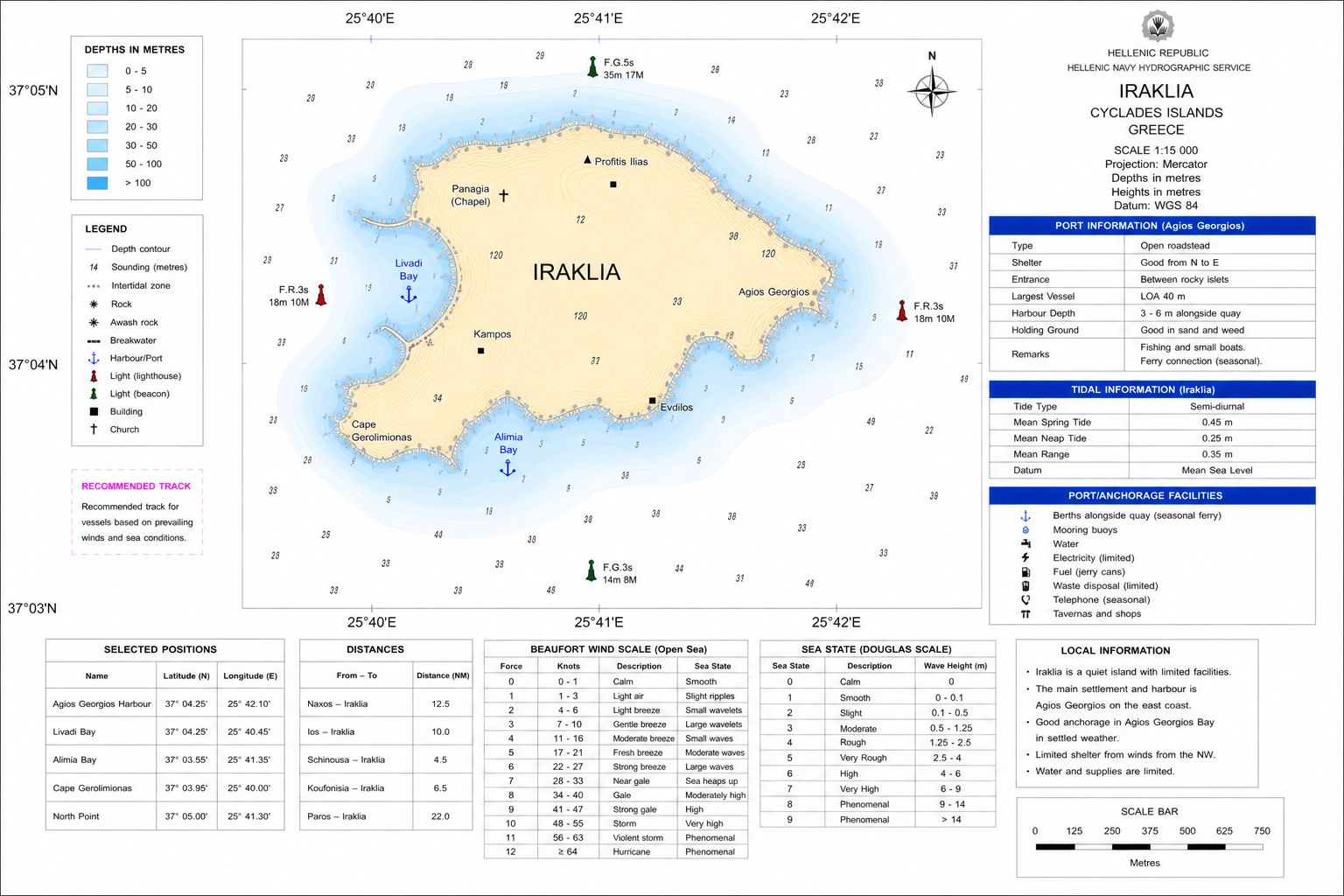
Chart Disclaimer. This chart is a schematic representation for illustrative purposes only and must not be used for navigation. Refer to official hydrographic charts for safe navigation. Be aware ENC charts may differ from official hydrographic charts. Both should be corrected and updated regularly.
Iraklia Greece
Sailing Guide - Ocean Currents and Tidal Flow
I Currents at Iraklia are primarily wind-driven, with negligible tidal influence. Tidal range is minimal, typically 0.1–0.3 metres, and does not produce any consistent flood or ebb stream. Under prevailing Meltemi conditions, a south to south-west setting drift develops around the island, generally in the range of 0.5–1.0 knots, increasing locally in the passages toward Naxos and Schoinoussa.
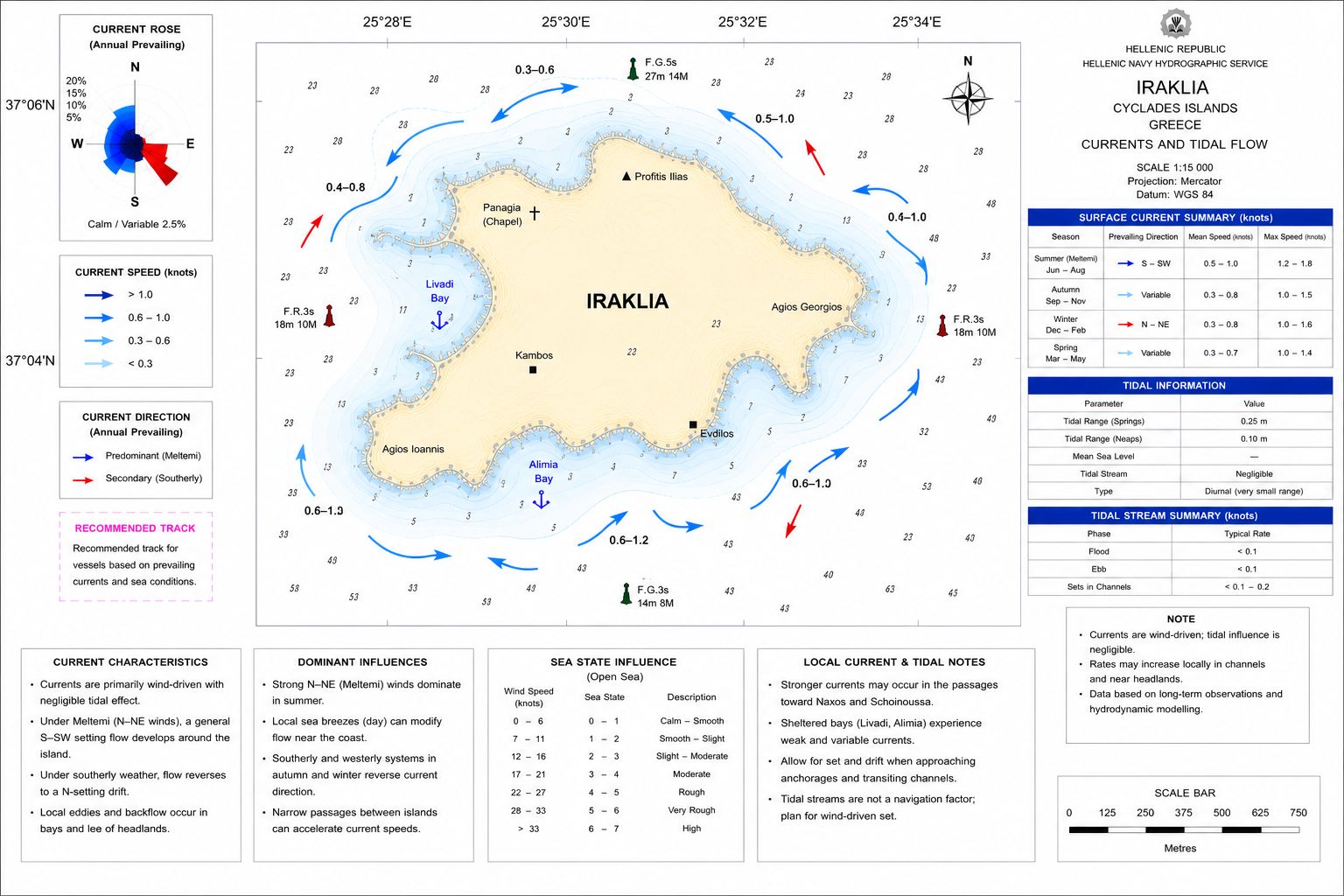
Outside the Meltemi season, current direction becomes variable and aligned with wind, with southerly systems producing a north-setting flow and more irregular patterns under shifting conditions. Localised effects include eddies, backflow, and slight acceleration near headlands and within channels, with current influence reducing in sheltered bays. For navigation, currents should be treated as moderate, wind-aligned drift rather than predictable tidal flow, requiring allowance for set during approaches and coastal transits.
Iraklia Greece
Sailing Guide - Weather
Weather at Iraklia is hot, dry, and stable in summer, with persistent high pressure producing clear skies, excellent visibility, and negligible rainfall. Daytime temperatures typically range from 27–31°C, moderated slightly by the surrounding sea, while humidity remains low. The Meltemi wind regime dominates, maintaining dry air and consistent conditions over extended periods.
Outside summer, weather becomes more variable with passing low-pressure systems, bringing cloud cover, rainfall, and shifting winds. Rainfall is concentrated between late autumn and early spring, often in short, heavy events. Winter temperatures remain mild, generally 10–16°C, with good visibility outside of rain and no prolonged cold conditions.
The Marine Electrical and Electronics Bible has a complete list of Greek VHF Radio Channel information and weather forecast times for Greece along with NAVTEX UK and Europe and NAVTEX Mediterranean for 490kHz and 518kHz.
Iraklia Greece
Sailing Guide - Local Winds
During the summer period, the Meltemi dominates, establishing a persistent flow from the north to north-east. Wind typically builds through the morning, reaches peak strength during the afternoon, and eases slightly overnight without dropping out completely. Sustained speeds of 15 to 25 knots are common, with frequent periods exceeding 30 knots, particularly in July and August. Acceleration occurs in the passages around the island and off exposed headlands, producing higher wind speeds than those forecast for open water. Gusting is common, and local increases of 5 to 15 knots above the mean should be expected.
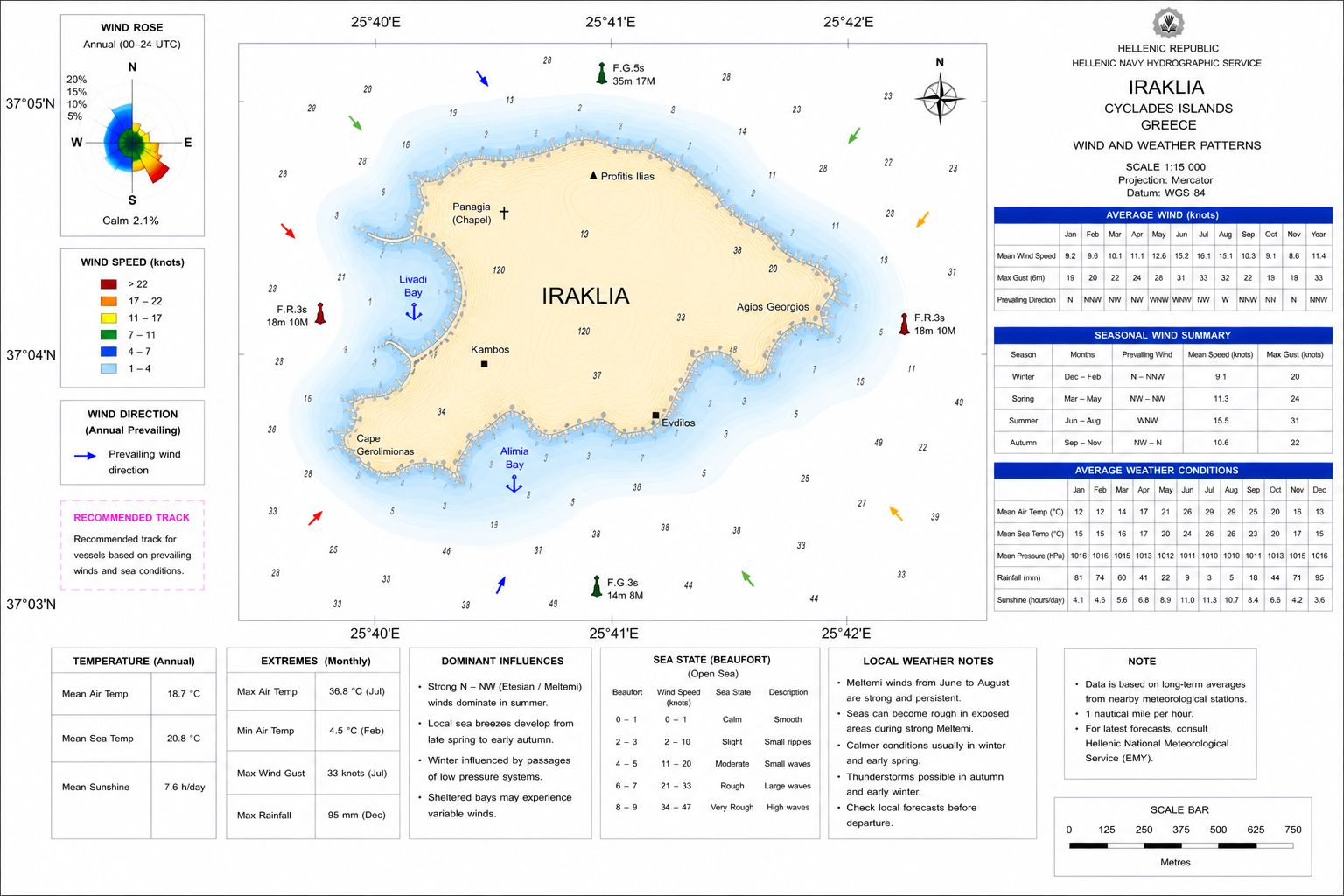
Local effects around Iraklia include wind acceleration at headlands, turbulence in the lee of higher ground, and short-lived wind shadows within bays. Shelter is limited in both extent and reliability, particularly under strong northerly flow where even nominally protected areas can experience gusting and wrap-around wind. For operational purposes, wind at Iraklia should be treated as persistent, frequently accelerated, and strongly influenced by regional pressure patterns, with peak conditions occurring during afternoon Meltemi cycles and during winter frontal passages.
Iraklia Greece
Sailing Guide - Approaches
Approaches to Iraklia are made in open Aegean water with generally clear sea room and no defined traffic lanes, though local ferry movements and inter-island traffic should be expected. The island is steep-to on most coasts, with depths increasing rapidly to 20–50 metres within a short distance offshore, allowing close approach without off-lying shoals. From the north and north-east, the approach is fully exposed to Meltemi conditions, with short, steep seas and wind-driven spray, and a consistent set to the south or south-west requiring allowance for drift. From the south, sea state is typically more regular but becomes confused where wind opposes residual flow.
Identification is straightforward in good visibility, with the main settlement and harbour of Agios Georgios visible on the north coast. There are no offshore dangers of significance, but caution is required near headlands and within bays where localised gusting, turbulence, and back-eddies may be encountered. Navigation relies on standard charting and visual pilotage, with no formal approach channels outside the harbour itself. Primary considerations on approach are wind strength, sea state, and set, rather than constrained navigation hazards.
Iraklia Greece
Sailing Guide - Navigation
Entry into the harbour at Agios Georgios on Iraklia is made from the north into an open bay with no defined approach channel or leading marks. The harbour becomes identifiable on closing the coast, with the quay and small breakwater providing limited shelter. Depths in the approach remain adequate and generally uniform, allowing direct entry, but there is no dredged alignment and navigation is by visual reference and chart. Under Meltemi conditions, expect strong northerly winds directly on the entrance, producing short, steep seas and a noticeable set across the approach, requiring correction to maintain track.
Once inside, manoeuvring space is limited, and the harbour offers partial protection only, with swell and wind often entering from the north sector. Gusting may be present within the basin, particularly near the entrance and around structures. Traffic is light but may include local ferries and fishing vessels, and priority should be given to commercial movements. There are no formal traffic controls, and entry should be conducted with awareness of changing wind strength, limited turning room, and the need for controlled speed in exposed conditions.
Iraklia Greece
Sailing Guide - Chart Accuracy
Hydrographic charts provide accurate coastline and depth representation. Electronic charts align with official data but may lack detail in shallow harbour areas. Visual navigation is required when entering harbour or anchoring.
Iraklia Greece
Sailing Guide - Anchorages
Iraklia anchorage options are limited but operationally useful. There are no all-weather anchorages.
- Agios Georgios bay provides anchoring in 4–8 metres over sand with moderate holding. The bay offers partial shelter from northerly winds but is exposed to southerly systems.
- Alimia Bay on the south coast provides anchoring in approximately 5–12 metres over sand and weed with generally good holding. The bay offers protection from Meltemi winds but is open to southerly swell.
- Additional small bays provide anchoring in settled conditions with depths between 6 and 15 metres over mixed seabed
Iraklia Greece
Sailing Guide - Entry Formalities
This is not a designated port of entry for international clearance, and there are no customs or immigration facilities on the island. Vessels arriving from outside Greece or the Schengen Area must first clear into the country at an official port of entry before proceeding to this port. Direct arrival from a non-Schengen country is not permitted. The Greek cruising tax (TEPAI) must be valid and paid, and the vessel’s cruising log (DEKPA for non-EU vessels, or transit log where applicable) should be up to date and available for inspection if requested by port authorities or coastguard.
Iraklia Greece
Sailing Guide - Marina Facilities
Berthing at Agios Georgios on Iraklia is provided along a small municipal quay, with additional use of the inner side of the short breakwater where space permits. There are no marina installations, and all berthing is alongside or stern-to using own ground tackle, depending on space and conditions. Depths alongside are generally adequate for cruising yachts, typically in the range of 2.5 to 4.0 metres, but vary along the quay and should be checked on approach.
The harbour offers limited shelter, particularly from the north sector. Under Meltemi conditions, wind and swell can enter the basin, resulting in surge and movement alongside. Berths are not assigned, and space is constrained, especially during summer periods. Mooring arrangements rely on standard quay bollards and rings, with no laid moorings or harbour assistance. Vessels should be prepared to anchor off the stern when required and allow for crosswind during manoeuvring.
Iraklia Greece
Sailing Guide - Provisioning
Supermarkets. Provisioning on Iraklia is limited and basic, centred on the small settlement at Agios Georgios adjacent to the harbour. There are one or two small general stores (mini-markets) supplying packaged goods, dry stores, bottled water, and a restricted range of fresh items. Availability is variable and dependent on ferry deliveries, with stock levels reducing between supply runs, particularly during periods of high seasonal demand..
Markets. There is no organised market. Produce availability is intermittent and dependent on deliveries.
Fish Markets. There is no fish market. Fish supply is based on local fishermen landings and is not consistent.
Iraklia Greece
Sailing Guide - Local Cuisine
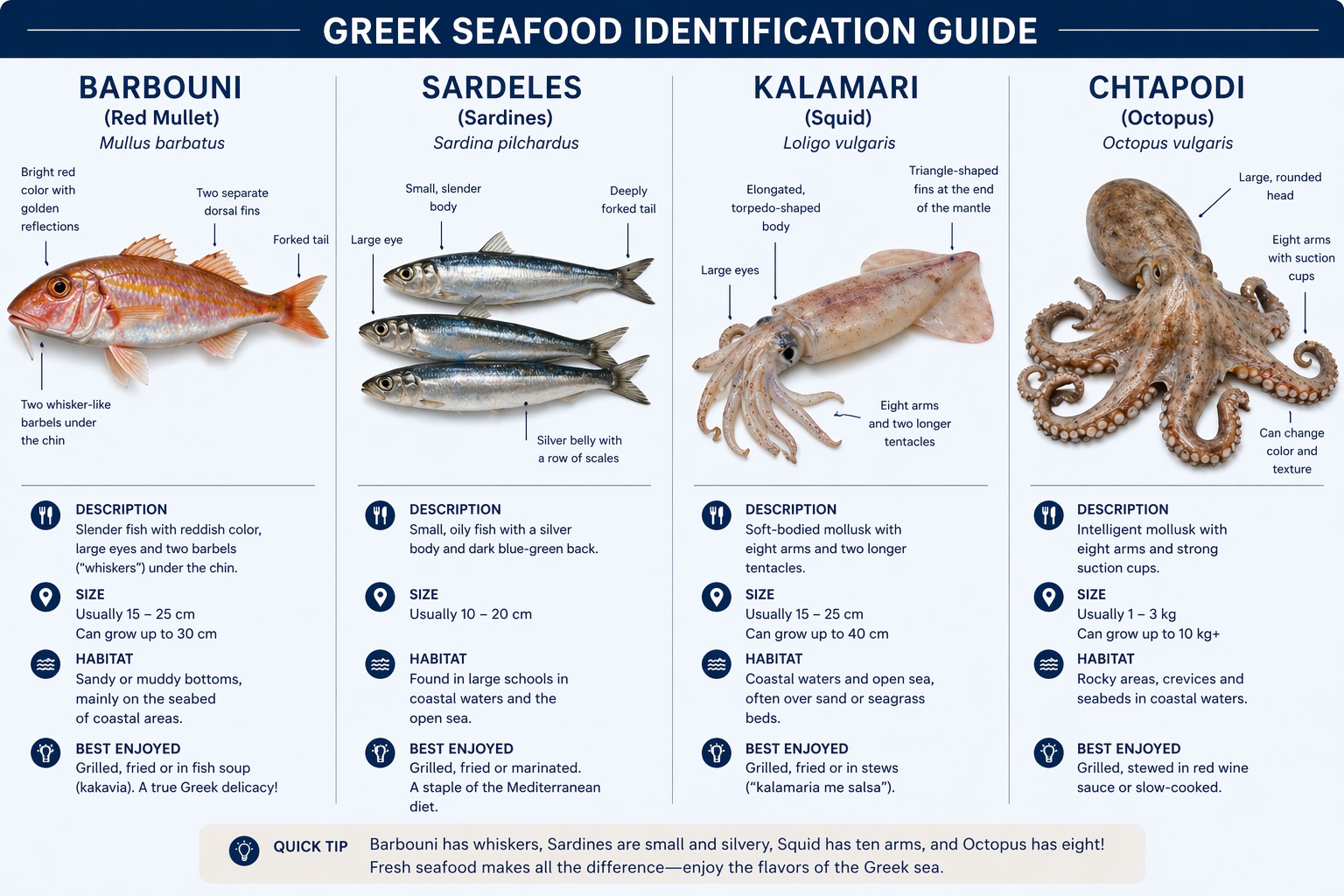
Local cuisine on Iraklia reflects small-scale island production, with dishes based on goat, lamb, simple vegetables, pulses, and locally caught fish when available. Supply is limited and seasonal, and menus are typically short, depending on what can be sourced or produced locally rather than fixed offerings. Common dishes include slow-cooked goat (katsikaki) and lamb (arni) prepared in oven or casserole, often with potatoes or simple herbs. Pulses such as revithia (chickpeas) and fava (yellow split pea purée) are standard staples, along with ladera-style dishes using vegetables cooked in olive oil. Fresh fish is not guaranteed daily, but when available may include small reef fish, grilled or fried, supplied directly by local fishermen rather than through a structured market. Dairy products are locally produced in small quantities, particularly goat and sheep cheeses, sometimes served fresh or lightly aged. Bread is basic and supplied through local bakeries or delivered intermittently. No dishes are unique to Iraklia.
Iraklia Greece
Sailing Guide - Local Beverages
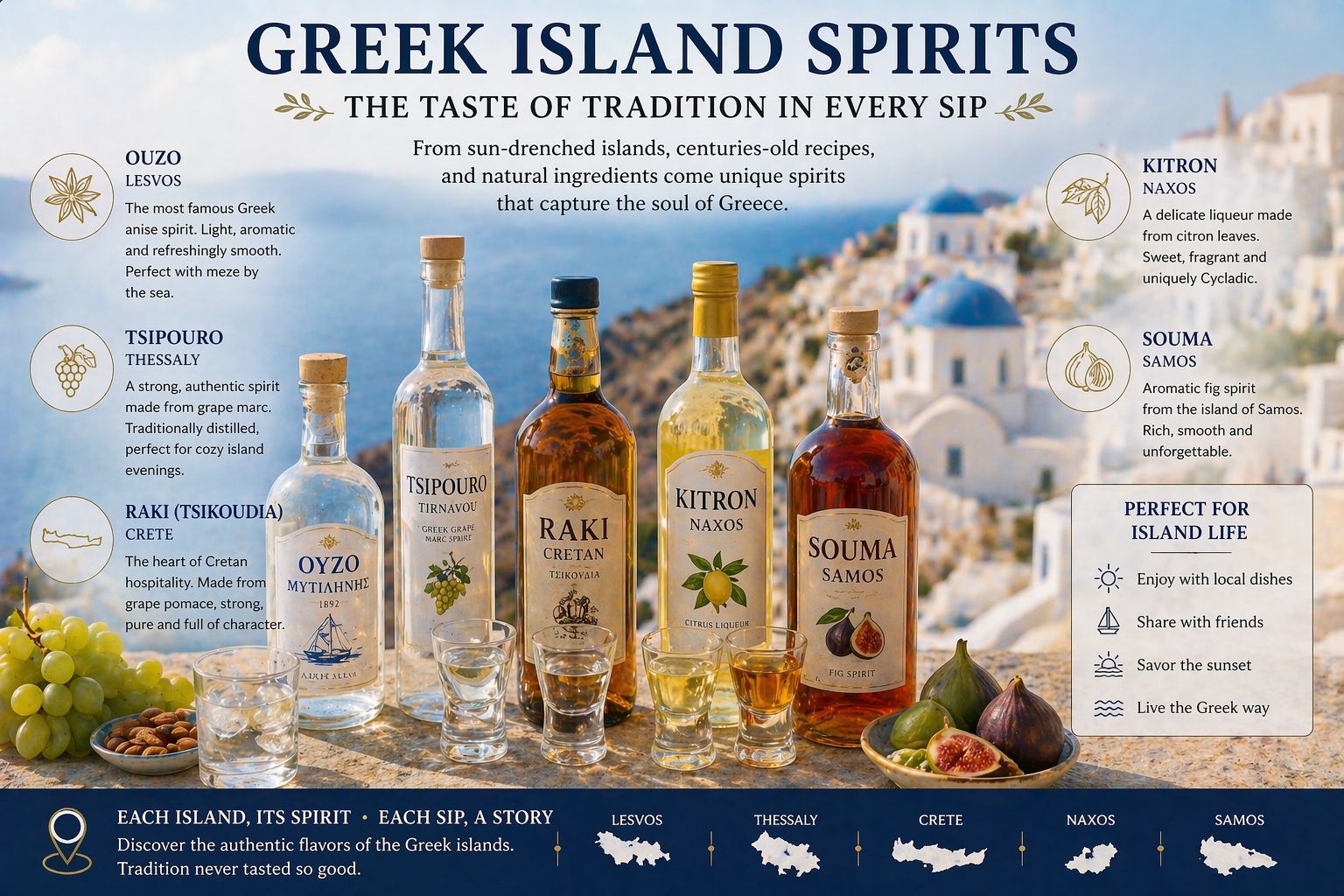
Beer supply includes Alpha, Mythos, and Fix delivered from Naxos. Wine is sourced from Cyclades and mainland Greece. Spirits include ouzo and tsipouro.
Iraklia Greece
Sailing Guide - Diesel Fuel Supplies
There is no diesel fuel available on the quay at Agios Georgios on Iraklia and no fixed marine fuel installation anywhere on the island. Vessels cannot refuel alongside, and there are no harbour-side pumps or organised bunkering services. Fuel is limited to small roadside petrol stations inland, intended for local vehicles. In some cases, it may be possible to obtain diesel in small quantities by container (jerry cans), but this is informal, labour-intensive, and not suitable for primary refuelling. There is no regular tanker delivery service to visiting yachts, and any arrangement would be ad hoc and uncertain.
Iraklia Greece
Sailing Guide - Water Supplies
Potable water availability on Iraklia is limited and not provided on the quay at Agios Georgios. There are no fixed marina services, and visiting vessels should not expect a direct dockside water connection or reliable hose access at the harbour. Water on the island is sourced from local storage and supply systems, supplemented by deliveries, and is prioritised for resident use. Small quantities of potable water can be obtained ashore from local shops in bottled form, and in some cases limited access may be arranged through local establishments, but this is informal and not guaranteed.
Mechanical and Electrical Repairs
Resource
If you are headed somewhere remote consider the need to expand your knowledge base or have an information resource on board. Why not get a copy of my book The Marine and Electrical and Electronics Bible 4th Edition. By and for yachties, with everything from batteries and charging, solar and wind, diesel engines and marine electronics and so much more. Your complete systems guide. 650 pages of practical advice. In Australia and New Zealand order a copy through Boat Books. UK and European boats can buy the UK Edition Here. US and Canadian boats can get the US Edition Order Here. Or through Amazon. Marine systems are my profession so let me help you. By a liveaboard boat owner for other boat owners.


Iraklia Greece
Sailing Guide - Marine Services
There are no marine service providers on Iraklia. No authorised engine or electronics agents are present. Technical support requires relocation to Naxos where full marine service capability exists.
Iraklia Greece
Sailing Guide - Local Etiquette
Local etiquette reflects a small island community with limited population. Dress standards in Agios Georgios are consistent with residential norms. Behaviour in public areas is expected to align with local expectations. Taverna service is table-based with ordering required when seated. Religious sites require appropriate conduct and dress. Waste disposal is conducted at designated collection points ashore.
Iraklia Greece
Sailing Guide - Summary
Iraklia presents a small-scale harbour environment with limited infrastructure and exposure to Meltemi conditions. Navigation is straightforward but constrained by harbour size and wind exposure. Anchorage options are limited but usable depending on wind direction. Provisioning and services are minimal and require planning through Naxos, consistent with an Iraklia Greece Sailing Guide for all you need to know.