Ibiza Balearic Sailing Guide
Ibiza Balearic Sailing Guide. Ibiza lies west of Mallorca and north of Formentera, with its principal yacht traffic concentrated around Port d’Eivissa/Ibiza Town, Sant Antoni de Portmany, Santa Eulària des Riu, and the smaller northern and eastern harbour areas. The island has more developed marina infrastructure than Formentera, but the usable harbour choices are still strongly affected by wind direction, ferry traffic, seasonal congestion and Posidonia anchoring restrictions. Ibiza Town is the main commercial and passenger port, while Sant Antoni and Santa Eulària provide alternative yacht bases on the west and east coasts. The north coast has few true harbour options and should be treated mainly as an anchorage coast. Skippers should plan Ibiza as an island with good port facilities in specific locations, not as a coast with continuous shelter.
The main operational issues around Ibiza are the exposed north coast in Tramuntana and Gregal, the east coast in Llevant, the south and southeast approaches in Xaloc and southerly swell, and the traffic density around Ibiza Town and the channel to Formentera. The passage between Ibiza and Formentera is short but not trivial, because fast ferries, day boats, wind-driven chop and protected seabed areas all affect route planning. Anchorages are numerous, but many are fair-weather stops with sand, rock, weed and Posidonia close together. The best harbour choice should be made from forecast wind direction, vessel draft, berth availability and onward route. Ibiza is a high-traffic cruising area, so port calls, fuel, water and berths should be confirmed early in season.

Ibiza Balearic Sailing Guide - History
Ibiza’s maritime history is older and more commercially significant than that of most of the smaller Balearic anchorages. The island’s main port at Eivissa was established in relation to the fortified settlement and the natural harbour below Dalt Vila, giving access to the western Mediterranean trade routes. Phoenician, Punic, Roman, Islamic and later Catalan maritime activity shaped the island, and the port remained the principal access point for cargo, fishing, defence and passenger movement. The old harbour area still sits below the historic town, but modern port operations now include ferry traffic, commercial traffic, cruise berthing and yacht marinas.
The Port Authority of the Balearic Islands describes Port d’Eivissa as including the Botafoc breakwater, used for fuel discharge and large cruise ships, as well as commercial and passenger quays. This matters to a skipper because Ibiza Town is not simply a marina basin; it is an active commercial and passenger port with traffic patterns that must be respected. Sant Antoni developed as the major west-coast harbour and ferry link, while Santa Eulària became the main marina base on the east coast. Smaller places such as Portinatx, Port de Sant Miquel and Cala de Portmany are better treated as anchorage or local-harbour areas rather than full port alternatives.
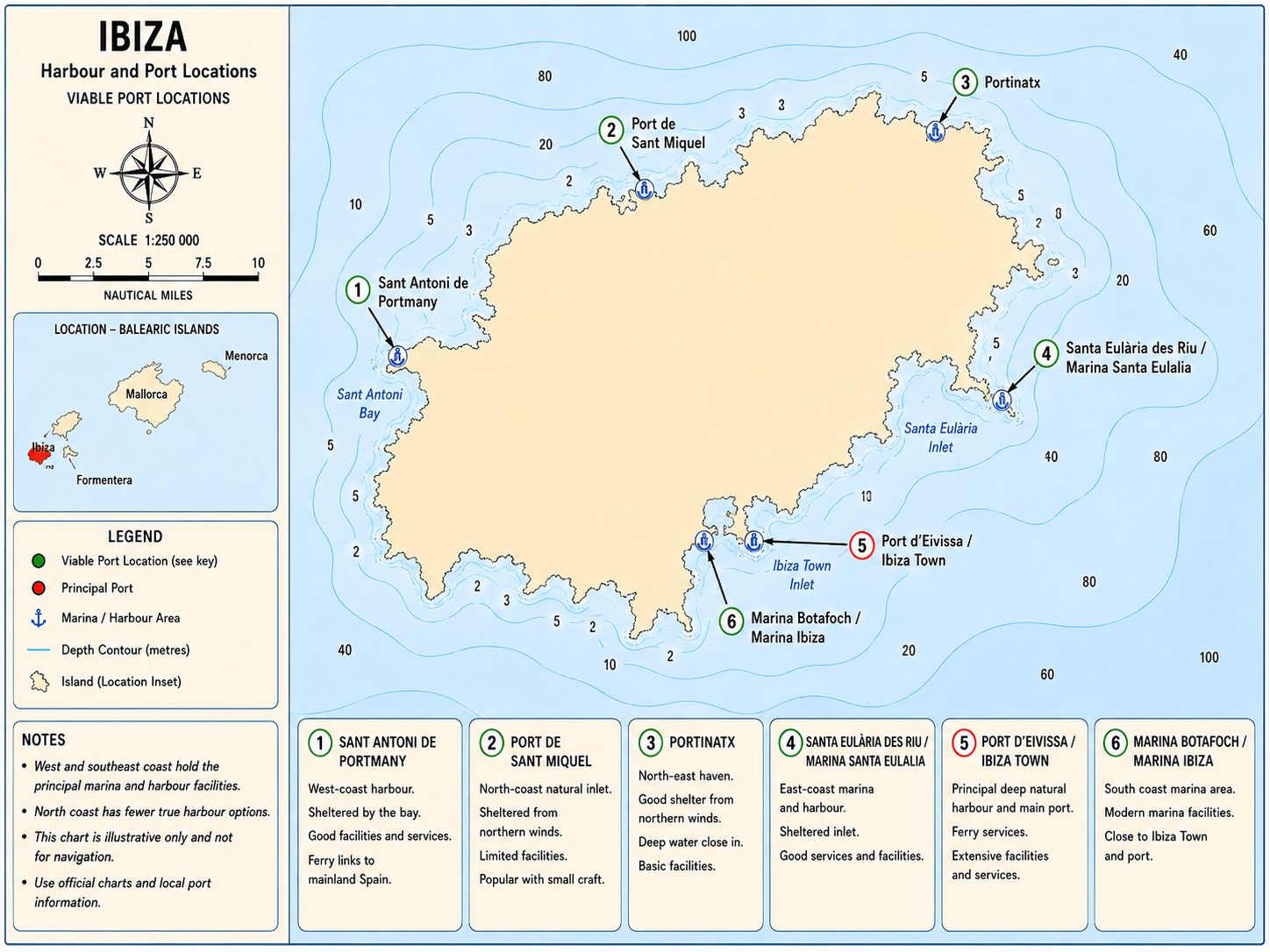
Chart Disclaimer. This chart is a schematic representation for illustrative purposes only and must not be used for navigation. Refer to official hydrographic charts for safe navigation. Be aware ENC charts may differ from official hydrographic charts. Both should be corrected and updated regularly.
Ibiza Balearic Sailing Guide - Currents and Tidal
Flow
Ibiza is in a microtidal part of the western Mediterranean. Around the Balearics, tidal range and tidal streams are generally small, and yacht handling is affected more by wind-driven surface set, residual drift, sea state and local acceleration around headlands than by tide. Scientific work on the Balearic Sea also notes that tidal currents in the area are weak, while broader circulation is more complex and linked to regional water-mass movement. A skipper should not plan Ibiza passages around tidal gates, but should allow for set and chop when wind has blown for several hours.
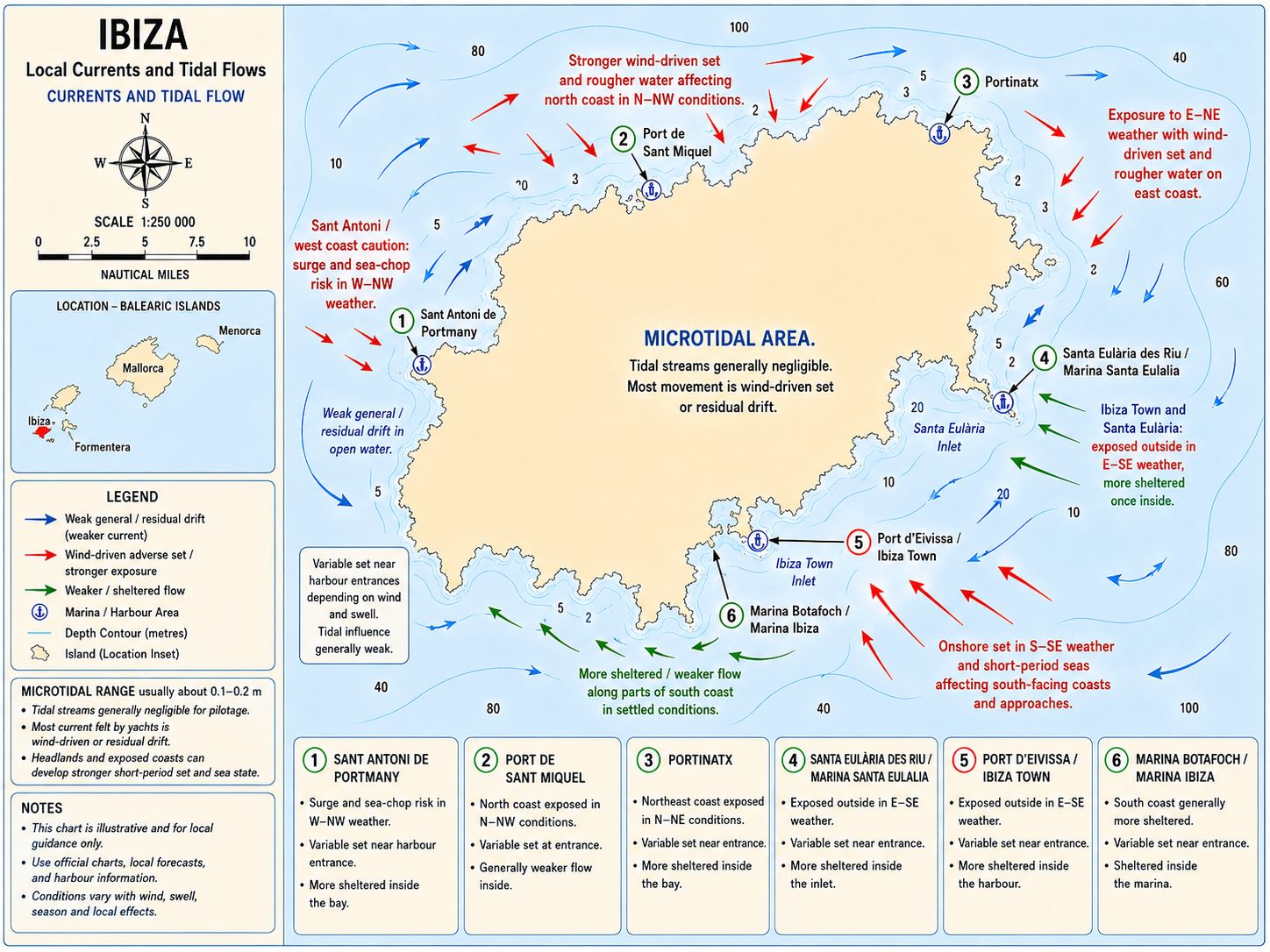
The most relevant local current area is the Ibiza–Formentera channel/Es Freus sector, where traffic, wind-driven chop, residual flow and shoal water combine. Strong northerly or easterly winds can make the channel short and steep, while southerly or southeasterly weather affects the southern approaches and the anchorages around Ses Salines and Es Cavallet. Around exposed headlands on the north and west coasts, short-period sea and local set can affect slow-speed handling close to anchorages. Inside the main harbours, tidal stream is negligible; the practical concerns are ferry wash, gusts, prop wash, crosswind and traffic separation.
Ibiza Balearic Sailing Guide - Weather
Ibiza has more shelter options than Formentera, but the island is still exposed by sector. The north coast is exposed to N, NW and NE weather and becomes unsuitable in Tramuntana or Gregal conditions. The east coast, including Santa Eulària and the approaches north and south of it, is affected by E and SE winds. The south and southeast coast is affected by S, SE and E sea, including Xaloc. The west coast, including Sant Antoni, is affected by W and NW weather and can develop surge, chop and uncomfortable approaches in strong Ponent or Mestral.
Summer usually brings lighter mornings and a building afternoon sea breeze, often from the east through southeast or south depending on the day and coast. Sea state can build quickly over short distances, especially where the breeze opposes residual drift or wraps around the island. Autumn and winter bring more frontal systems, sharper wind shifts and stronger northerly or westerly episodes. A skipper moving between Ibiza Town, Sant Antoni, Santa Eulària and Formentera should treat forecasts as coast-specific rather than island-general.
The Marine Electrical and Electronics Bible has a complete list of Spanish VHF Radio Channel information and weather forecast times along with NAVTEX UK and Europe and NAVTEX Mediterranean for 490kHz and 518kHz.
Ibiza Balearics
Sailing Guide - Local Winds
The Tramuntana from N to NW is the main cold northerly risk. It affects the north coast directly and can make Portinatx, Port de Sant Miquel, Cala Benirràs and Cala Xarraca unsuitable. The Mestral and Ponent from W to NW affect Sant Antoni and the west coast, creating surge risk and sea chop in the bay and around west-facing anchorages. Sant Antoni is a useful harbour in many conditions, but strong W–NW weather should still be treated as an approach and harbour-comfort issue.
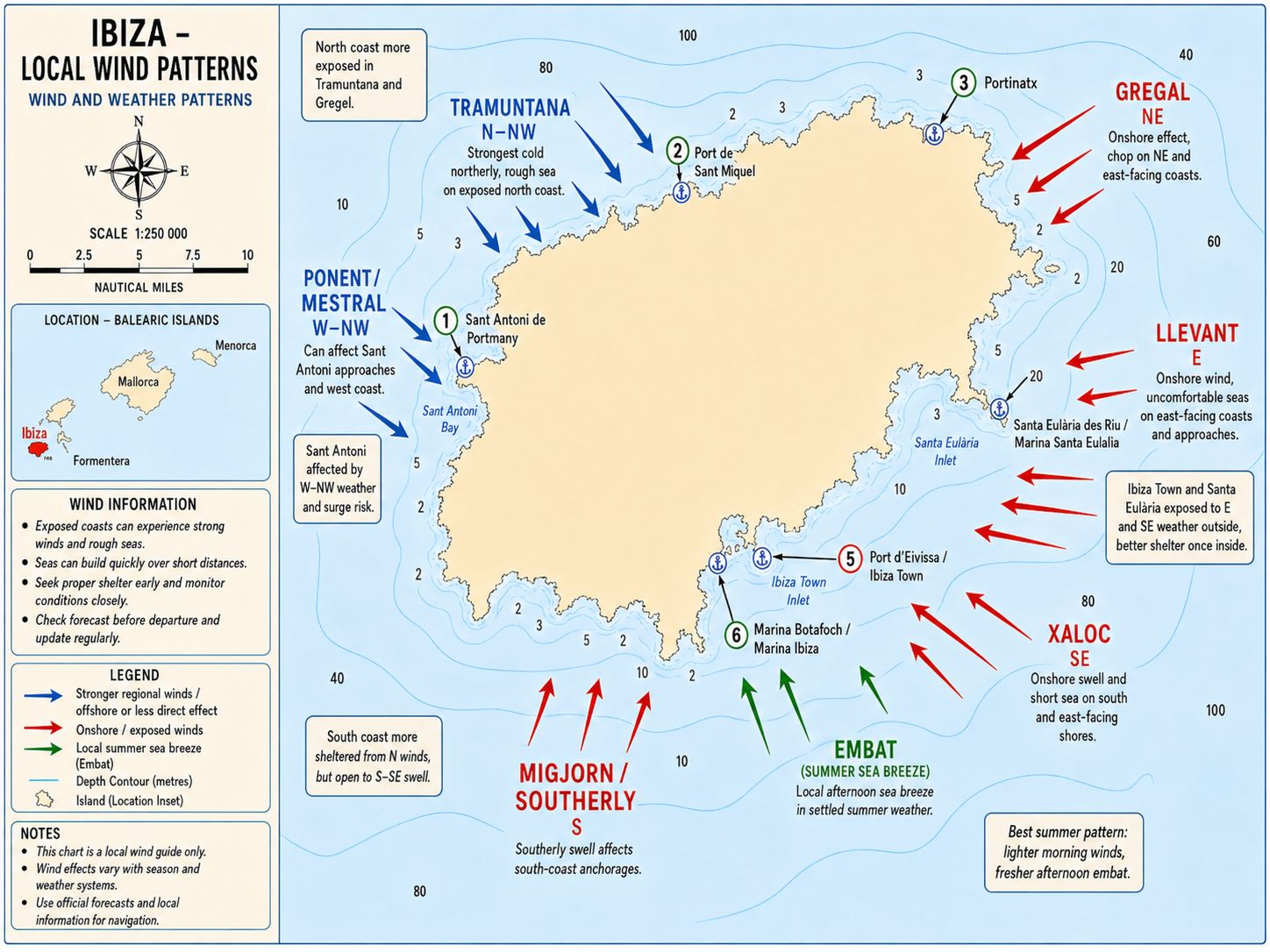
The Gregal from NE affects the north-east and east-facing coasts. The Llevant from E affects Santa Eulària, Talamanca, Ibiza Town approaches outside the harbour, Es Canar, Cala Llonga and Portinatx depending on angle. The Xaloc from SE affects the south and southeast coast and can send swell toward Ses Salines, Es Cavallet, Cala Jondal and the Ibiza–Formentera channel. The summer Embat commonly freshens in the afternoon and can make open anchorages uncomfortable even when the morning appears settled.
Ibiza Balearic Sailing Guide - Approaches
Ibiza can be approached from Mallorca to the east, from mainland Spain to the west or northwest, from Formentera to the south, or from offshore passages across the western Mediterranean. The main deep-water commercial approach is to Port d’Eivissa, with traffic separation concerns, ferry routes and port-control procedures. Approaches to Ibiza Town should account for ferries running to Formentera, mainland Spain and other Balearic ports. The Botafoc breakwater and commercial quays are part of the active port layout, not yacht-only water.
Approaches to Sant Antoni are made into the west-coast bay, where the bay gives useful water space but can be exposed to W–NW weather. Approaches to Santa Eulària are made on the east coast and are affected by E–SE sea. North-coast approaches to Portinatx, Port de Sant Miquel and Benirràs are mainly anchorage approaches, with limited harbour protection and exposure to northerly weather. Depths around Ibiza fall from offshore contours into shallow shelves close to the coast; many anchorages are in 3–10 m, with sand, rock, weed and Posidonia close together. Do not close pale-water areas without visual bottom confirmation and a current chart.

Ibiza Balearic Sailing Guide - Navigation
Navigation around Ibiza should be divided into four operating sectors: the commercial approaches to Port d’Eivissa, the west-coast approach to Sant Antoni, the east-coast approach to Santa Eulària, and the anchorage coastlines north, west and south of the island. The approach to Port d’Eivissa is the highest-traffic area, with ferry routes, commercial traffic, marina traffic, tenders and fast craft concentrated around the harbour entrance, Talamanca, Botafoc and the route toward Formentera. Yachts should keep clear of commercial movements, maintain a continuous lookout, use VHF as required by port control or marina instructions, and avoid crossing ferry tracks at close range. Keep your AIS on and radar is very useful. Tonnage Law applies, that means give way to big and heavy vessels!
On the west coast, entry toward Sant Antoni de Portmany is made through the bay rather than a confined cliff harbour, but the area is affected by local traffic, moorings, ferries, trip boats and west-sector swell. In W–NW conditions the bay can become uncomfortable, and the final approach should be made with enough sea room to assess swell and traffic before committing. On the east coast, Santa Eulària is approached from open water and is more exposed to E–SE conditions; an easterly sea can make the entrance and outer approach uncomfortable even where the marina basin is sheltered. Along the north coast, most destinations are anchorage approaches rather than harbour entries, with rocky margins, variable depths, Posidonia, swimming zones and limited room to turn once close in. Navigation should therefore be based on sector exposure, visible seabed, traffic, charted hazards and the ability to leave before the wind shifts, rather than on marina-service information.

Ibiza Balearic Sailing Guide - Lighthouses
I still like navigating using traditional methods to “back up” my electronics. The principal lighthouse and coastal-light landmarks for Ibiza are Botafoc at Port d’Eivissa, Moscarter on the north coast, Tagomago off the east coast, Es Vedrà off the southwest coast, Sa Conillera and na Bleda Plana on the west coast, and Penjats in the Ibiza–Formentera channel; Punta Grossa and Coves Blanques are historic or disused lights and should be treated as visual landmarks only, not active navigational lights unless shown on charts as such.
- Faro del Botafoc. Located at the entrance to Port d’Eivissa (Ibiza Town)
- Faro del Moscarter. Located on the north coast near Portinatx; active, black-and-white spiral tower, listed with isolated flashes every 5 seconds and nominal range 15 NM by Fars de Balears.
- Faro de Tagomago. Located on Tagomago island off Ibiza’s east coast.
- Faro del Vedrà. Located on Es Vedrà, off the southwest coast.
- Faro de la Conillera. Located on Sa Conillera, off the west coast.
- Faro de na Bleda Plana/Ses Bledes. Located on the western islets.
- Faro dels Penjats. Located on the islets between Ibiza and Formentera.
- Faro de Punta Grossa. Located at north-east Ibiza, but disused.
- Faro de Coves Blanques. Located at Sant Antoni, also out of use as a lighthouse.

Ibiza Balearic Sailing Guide - Chart Accuracy
Use current official charts and updated electronic charts, but do not rely on electronic contours alone for anchoring. Ibiza has extensive Posidonia areas, seasonal buoy zones, swimming areas, local moorings and traffic channels. The seabed can change from sand to weed or rock over short distances, particularly in popular calas. Anchorages that look clear on a plotter may not be legal or safe if the bottom is Posidonia, rock or crowded by seasonal moorings.
The Balearic Government’s Posidonia protection framework prohibits uncontrolled anchoring on Posidonia meadows, and the operational rule is that both anchor and chain must remain clear of seagrass. In 2026, the Spanish government approved seven ecological anchoring zones on Ibiza at Benirràs, Cala Bassa, Cala Salada, Cala Vedella, Es Xarco, Portinatx and Talamanca, aimed at reducing anchor damage to Posidonia. These areas should be checked for current buoy availability and restrictions before anchoring.
Ibiza Balearic Sailing Guide - Anchorages
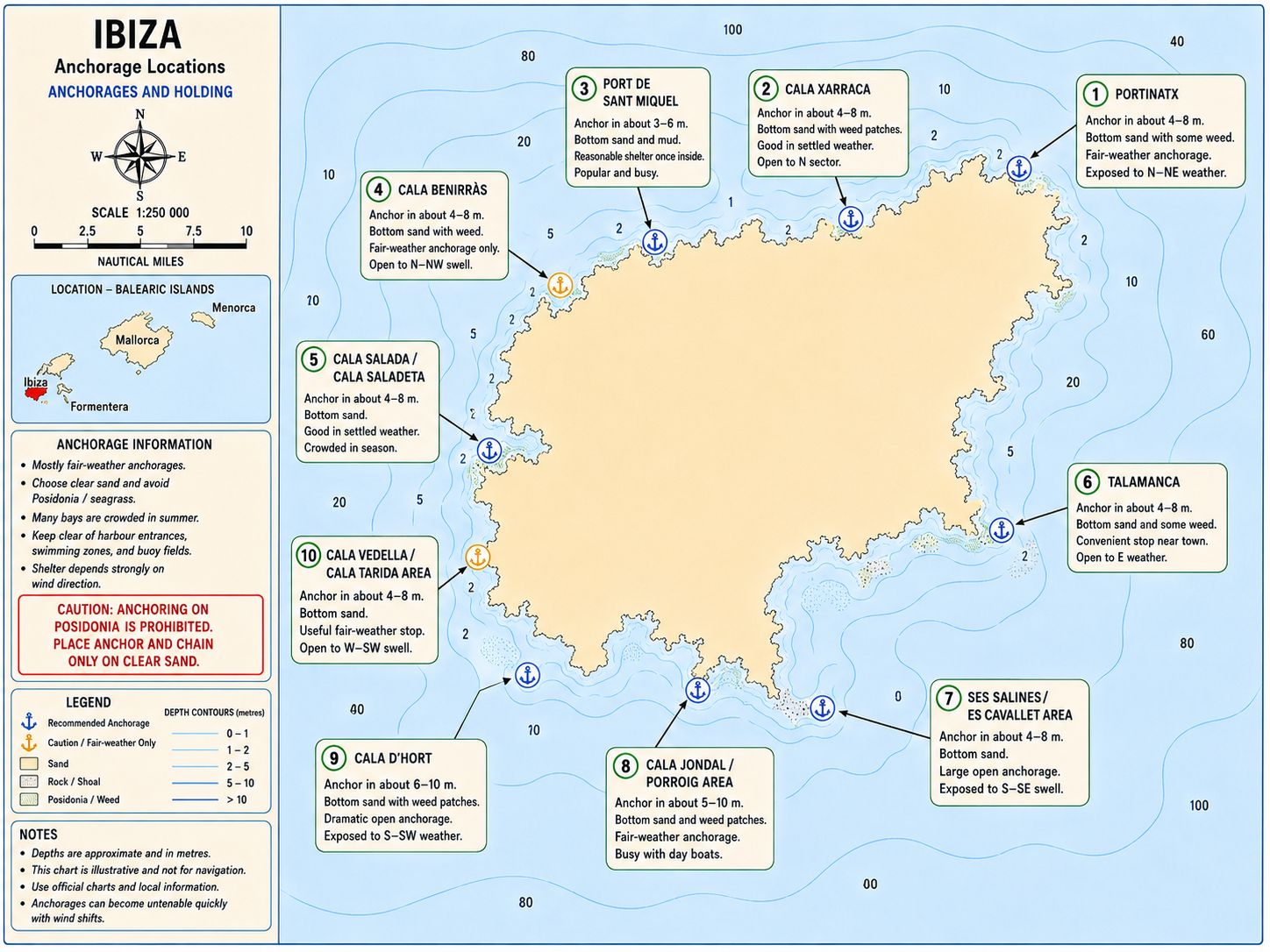
- Portinatx. North-east coast anchorage area. Anchor in about 4–8 m over sand with weed patches. Fair-weather only. Exposed to N–NE weather and affected by swell in Tramuntana or Gregal. Ecological mooring arrangements may apply under the approved 2026 buoy-zone programme.
- Cala Xarraca. North coast anchorage. Anchor in about 4–8 m over sand and weed patches. Good holding only where the anchor is on clean sand. Exposed to N sector weather and unsuitable in northerly swell.
- Port de Sant Miquel. North coast bay. Anchor in about 3–6 m over sand and mud, with better shelter once inside than more open north-coast calas. Exposed to northerly swell at the entrance.
- Cala Benirràs. North-west coast anchorage. Anchor in about 4–8 m over sand with weed patches. Fair-weather stop only and exposed to N–NW swell. Included in the approved ecological anchoring-zone programme, so current buoy rules should be checked.
- Cala Salada/Cala Saladeta. West coast north of Sant Antoni. Anchor in about 4–8 m over sand. Good in settled weather but crowded in season. Exposed to westerly and northwesterly swell. Included in the ecological anchoring-zone programme.
- Cala Bassa. West coast fair-weather anchorage. Anchor in about 4–8 m over sand, avoiding weed and marked swim zones. Exposed to W–SW swell and busy in season. Included in the ecological anchoring-zone programme.
- Cala Vedella. Southwest coast anchorage. Anchor in about 4–8 m over sand, with weed patches near the margins. Better than many open west-coast stops in settled weather, but exposed to W–SW swell. Included in the ecological anchoring-zone programme.
- Cala d’Hort. Southwest anchorage facing Es Vedrà. Anchor in about 6–10 m over sand with weed patches. Open and exposed to S–SW–W swell. Use only in settled weather and clear light.
- Cala Jondal/Porroig area. South coast anchorage area. Anchor in about 5–10 m over sand and weed patches. Busy with day boats in season. Exposed to S–SE swell.
- Ses Salines/Es Cavallet area. Southeast roadstead. Anchor in about 4–8 m over sand, avoiding Posidonia and swimming areas. Use only with suitable forecast. The Es Freus channel should be treated with caution. There may be sandy patches suitable for anchoring outside restricted or buoyed areas, but much of the protected seabed is Posidonia, and anchoring on it is prohibited. The area is also exposed to E–SE–S weather, affected by ferry and day-boat traffic, and can become untenable quickly in onshore swell. Patrol and advisory services operate in Ibiza and Formentera; published guidance identifies the Posidonia Surveillance Service on VHF Channel 68 and by mobile/WhatsApp +34 617 975 172 for anchoring guidance
- Talamanca. Anchorage near Ibiza Town. Anchor in about 4–8 m over sand with weed patches. Convenient for Ibiza Town, but exposed to E weather and subject to high traffic and environmental controls. Included in the ecological anchoring-zone programme.
Ibiza Balearic Sailing Guide - Entry Formalities
Spain and the Balearic Islands are within the Schengen Area and the EU customs territory, so yachts arriving from another Spanish or Schengen/EU port normally do not complete full border clearance again. Yachts arriving from a non-Schengen port must clear through an authorised port of entry, for practical yacht clearance, the main Balearic entry ports include Palma, Alcudia, Ibiza, Mahon and La Savina. The usual formalities include crew passports handled by the Frontier Police and vessel/customs formalities handled through the appropriate Spanish authorities. Since 10 April 2026, the EU Entry/Exit System records non-EU short-stay entries and exits electronically rather than by passport stamping. Non-EU visitors remain subject to Schengen short-stay limits, normally 90 days in any 180-day period, unless they hold a visa or residence status allowing longer stay. Non-EU flagged yachts may also need to consider Temporary Admission rules for EU waters, commonly allowing private non-EU yachts used by non-EU residents to remain in EU customs territory for up to 18 months without VAT/import duty being due, provided the conditions are met
Communications equipment normally used on cruising yachts does not require harbour-specific clearance, but drone use is regulated under Spanish and EU UAS rules. AESA states that drone operators must register in the member state of residence or activity and that the operator registration number must be included on the operator’s drones. Starlink use should be checked against the service plan and local availability; Starlink states that in-motion use in territorial waters requires local government approval and may not be available in all regions.
Ibiza Balearic Sailing Guide - Ibiza Ports and Harbour Guides
The main yacht harbour areas on Ibiza are Port d’Eivissa (Ibiza Town), Sant Antoni de Portmany and Santa Eulària des Riu. Port d’Eivissa is the island’s principal commercial harbour, ferry port and large-yacht marina centre, with Marina Ibiza, Marina Port Ibiza, Marina Botafoch, Ibiza Magna and Club Náutico de Ibiza all operating within or immediately beside the same harbour system. Sant Antoni de Portmany is the main west-coast harbour and should be used as the primary reference for yachts working the west and north-west coast. Santa Eulària des Riu is the principal east-coast marina and the practical harbour base for the east coast, Tagomago sector and passages toward the northeast of the island.
Outside those harbour areas, most Ibiza destinations should be linked as anchorage or cruising-area guides rather than port guides. Portinatx and Port de Sant Miquel provide north-coast anchorage or small-harbour options, but they do not replace the main marina centres for fuel, water, service depth or technical support. Talamanca is operationally connected to the Ibiza Town harbour area and should be read with Port d’Eivissa pilotage. Cala Llonga, Cala Vedella, Cala Jondal/Porroig, Ses Salines/Es Cavallet, Cala Bassa, Cala Salada, Benirràs and Cala d’Hort should be treated as anchorage points. Posidonia restrictions and any seasonal buoy controls.

Ibiza Balearic Sailing Guide - Marina Facilities
Port d’Eivissa/Ibiza Town is the principal marina and port cluster. Marina Port Ibiza lists 89 berths for yachts up to 60 m LOA and 10 m draft, with berthside services and 24-hour security. Marina Ibiza lists fuel service with high-flow nozzles, berth rental and management, bilge and waste services, diver service, harbour master service, dry dock, repairs/refit for boats up to 10 tonnes, reception dock, showers, laundry, chandlery and nautical services. Marina Botafoch and Ibiza Magna also operate in the Ibiza Town harbour area, and berth allocation should be confirmed directly.
Sant Antoni de Portmany is the main west-coast harbour. PortsIB reservation information lists Sant Antoni among its ports where reservable moorings are for boats up to 15 m LOA and 4.46 m beam. In 2025, PortsIB completed pontoon renewal works at Sant Antoni, including new floating modules, electricity and water networks, supply pedestals and safety improvements. Marina Santa Eulalia is the main east-coast marina; independent listings describe it as having 755 berths for vessels from 6 m to 22 m. It lies about 14 km from Ibiza Town, according to the marina’s own site.

Ibiza Balearic Sailing Guide - Provisioning
Supermarkets. Ibiza has strong provisioning compared with smaller Balearic islands. The main yacht-provisioning centres are Ibiza Town, Sant Antoni, Santa Eulària and the road network inland. Major supermarket groups on the island include Mercadona, Lidl, ALDI, EROSKI, Hiper Centro, Carrefour and local Spar/Coviran-style stores, with the best choice around Ibiza Town and the larger towns. For marina-based shopping, Ibiza Town gives the strongest combination of supermarkets, specialist food shops, chandlers, delivery services and transport.
Sant Antoni and Santa Eulària both provide practical provisioning for yachts based on the west and east coasts. For a full crew shop, use a taxi or delivery service rather than hand-carrying water and bulk goods from harbour-front shops. In high season, supermarket opening hours are generally extended, but Sunday and holiday hours vary by store and municipality. Skippers should confirm opening hours on the day, especially when provisioning before a Formentera or north-coast departure.
Markets. Ibiza’s markets are a mix of produce, local food, craft and seasonal visitor markets. For food provisioning, the most useful fixed market is Mercat Nou in Ibiza Town, where fresh fruit, vegetables, meat, fish, cheese and local produce are available in a covered-market format. Sant Antoni and Santa Eulària also have municipal market and town-market options depending on day and season. Weekly and seasonal markets are common across the island, but many are more craft-focused than provisioning-focused.
Markets should be treated as supplementary unless the specific food market and opening time are confirmed. Ibiza’s better-known hippy markets, including Las Dalias and Punta Arabí, are not primary yacht-provisioning markets. They may have local products, bread, preserves or food stalls, but they should not replace a supermarket or municipal market run. Ibiza market schedules change seasonally, and local market guides note that many operate mainly in summer.
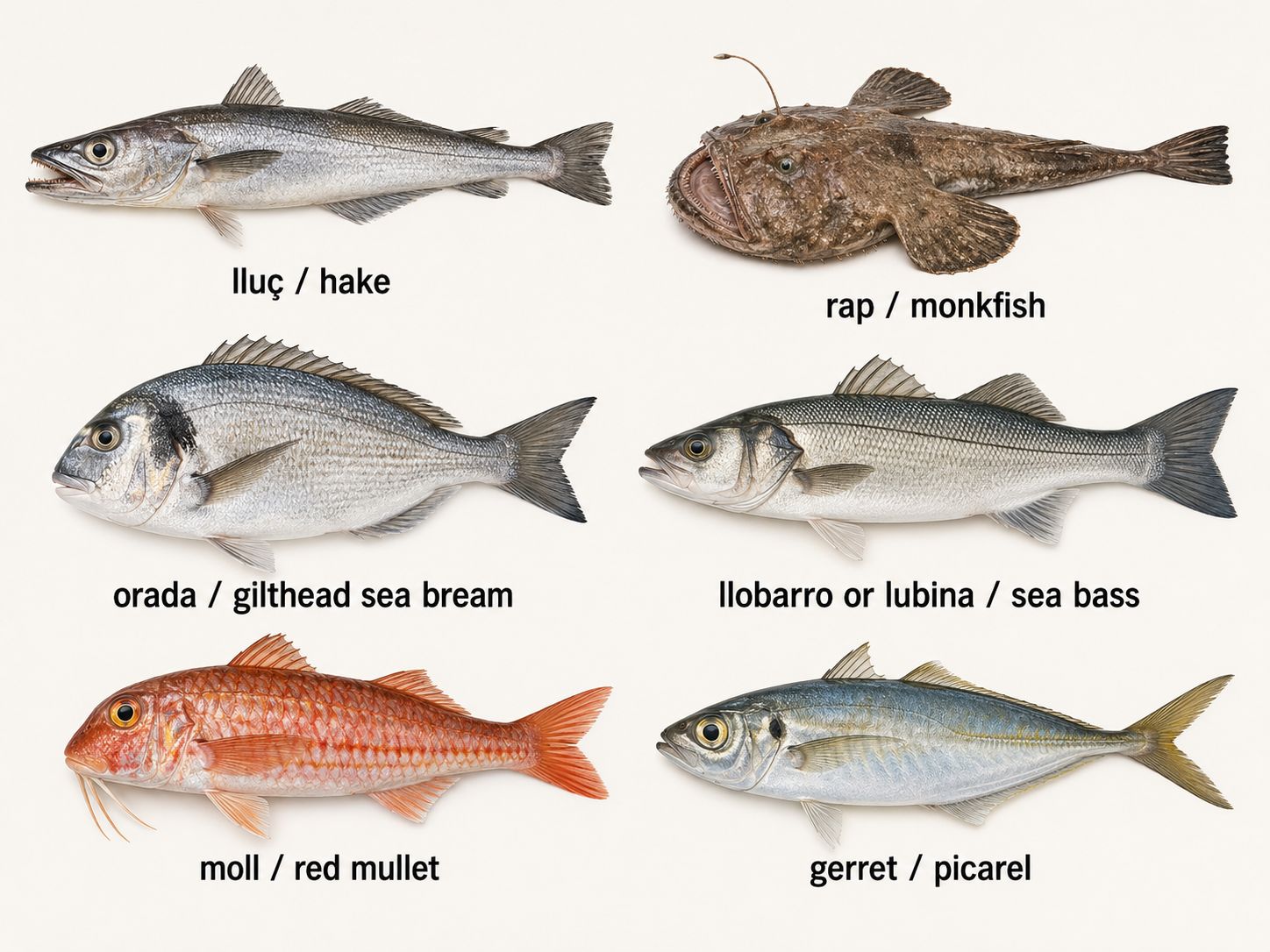
Fish Markets. Ibiza Town is the best place for planned fresh fish provisioning. Fish can be sourced through municipal markets, fishmongers and supermarket fish counters, while smaller harbours may provide opportunistic local supply through restaurants, fishermen or local contacts. Sant Antoni and Santa Eulària also have fish counters and local suppliers, but availability depends on season and landing conditions. Do not plan a departure around informal harbour fish supply unless confirmed locally.
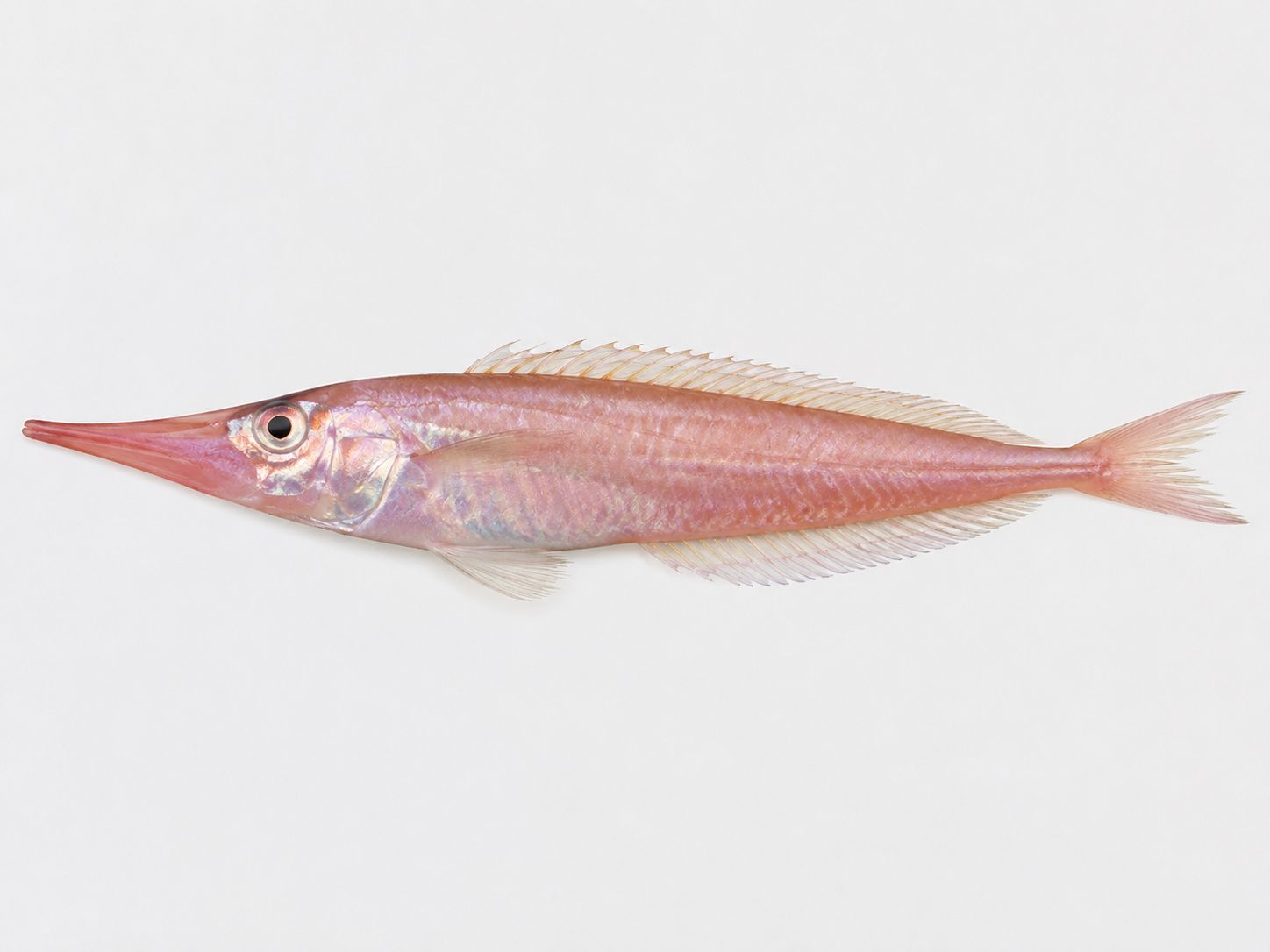
Local species and names include llampuga for mahi-mahi/dolphinfish in season, dorada for gilt-head bream, lubina for sea bass, raor for pearly razorfish where legal and in season, gerret for picarel, calamar for squid, sepia for cuttlefish, pulpo for octopus, gamba roja for red prawn, and rape for monkfish. In Santa Eulària, local events include fish-linked food culture such as the gerret and squid fairs, reflecting the continued local connection to seafood.
Ibiza Balearics
Sailing Guide - Local Cuisine
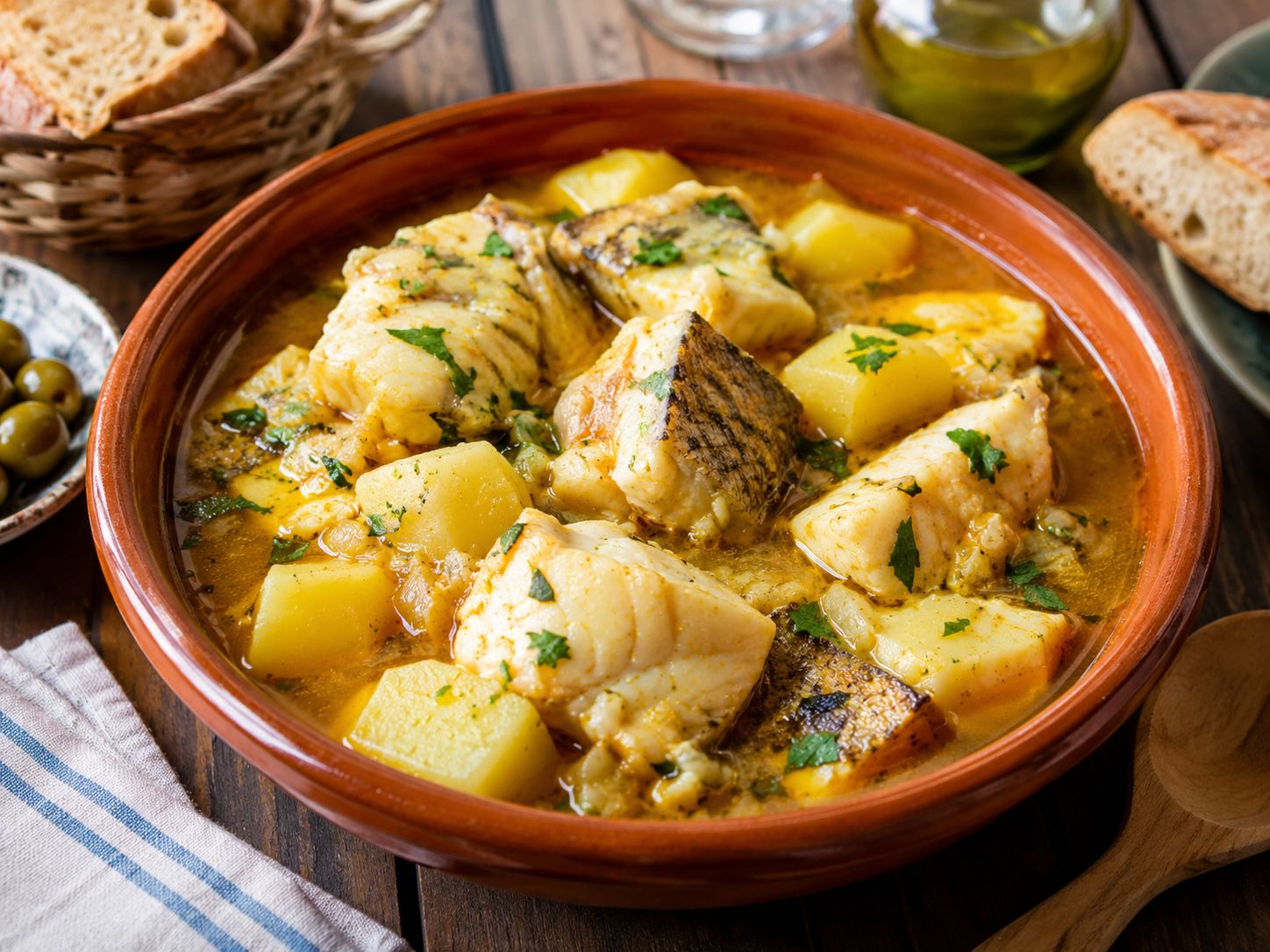
Ibiza’s local cuisine is Pityusic and overlaps with Formentera, but Ibiza has a broader town and port food supply. Relevant dishes for crews include bullit de peix, a fish stew normally followed by rice; arroz a banda, rice cooked from fish stock; guisat de peix, fish stew; borrida de ratjada, skate cooked with almond-based sauce; frita de pulpo, octopus fry; and grilled local fish. These dishes reflect fishing-port supply and island agriculture rather than marina tourism.
Land-based local food includes sofrit pagès, a meat and potato dish; ensalada payesa, country salad often using dried fish; sobrassada, cured paprika sausage; butifarra, local sausage; flaó, a mint and cheese tart; and orelletes, fried sweet pastries. Practical local products include tomatoes, peppers, potatoes, almonds, figs, cheeses, dried fish, olive oil, bread, sobrassada and seasonal fish.
Ibiza Balearic Sailing Guide - Local Beverages
The main local spirit is Hierbas Ibicencas, an anise-based herbal liqueur associated with Ibiza and Formentera. Local bars and supermarkets also carry Balearic herb liqueurs, Ibiza-made or island-branded beers, wine, bottled water, soft drinks and juices. For a yacht, water and non-alcoholic drinks should be treated as bulk stores and provisioned from larger supermarkets, not harbour kiosks.
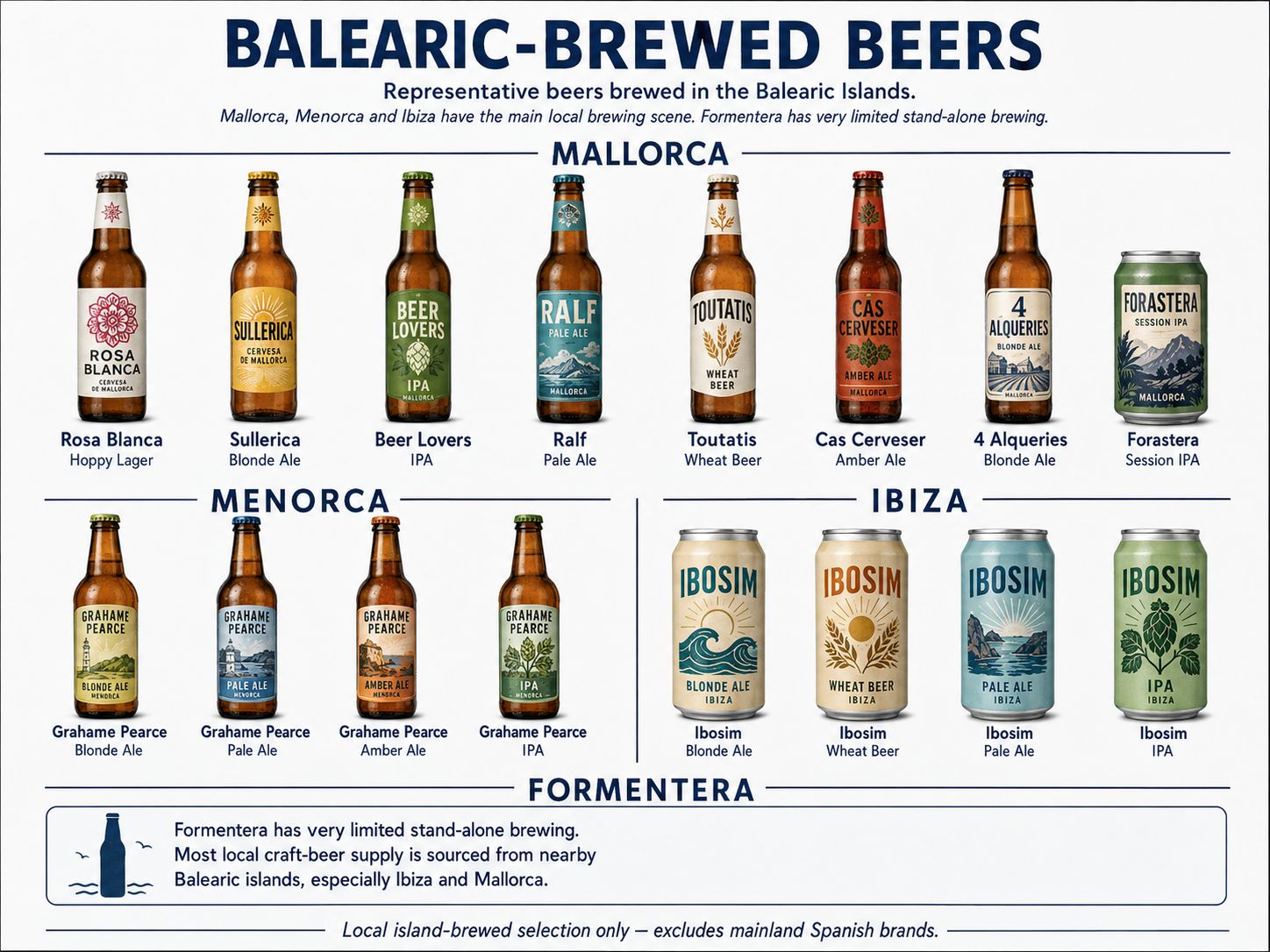
Ibiza has more beverage supply options than Formentera, including specialist shops and delivery services around Ibiza Town. Sant Antoni and Santa Eulària also have adequate supply for provisioning. When planning several nights at anchor, carry enough water for hot weather and allow extra for tender runs, washing and higher consumption in exposed anchorages.

Ibiza Balearic Sailing Guide - Diesel Fuel
Supplies
Diesel is available at the main marina and port centres: Ibiza Town, Sant Antoni and Santa Eulària. Marina Ibiza lists fuel service with high-flow nozzles among its facilities. Ibiza Town fuel is the most suitable for larger yachts, but access is within a busy commercial and marina port. Sant Antoni and Santa Eulària are practical alternatives depending on route and weather. Fuel should be planned with berth access, opening hours, traffic and vessel size in mind. High-season queues can be significant.
Ibiza Balearic Sailing Guide - Water Supplies
Potable water is available at serviced berths in the principal marinas. Marina Ibiza lists berth and harbour services including shower and marina support facilities, and other marina operators in Ibiza Town, Sant Antoni and Santa Eulària provide water and electricity at berths. Water access is normally berth-based, so yachts at anchor should not assume they can come alongside only for water without permission.
Mechanical and Electrical Repairs Resource

Why not get a copy of my book The Marine and Electrical and Electronics Bible 4th Edition. In Australia and New Zealand order a copy through Boat Books. UK and European boats can buy the UK Edition Here. US and Canadian boats can get the US Edition Order Here. Marine systems are my profession so let me help you DIY and save some valuable technician callout rates.
Ibiza Balearic Sailing Guide - Marine Services
Ibiza Town is the island’s primary marine-service centre. Marina Ibiza lists dry dock capacity, repairs and refit for boats up to 10 tonnes, diver service, chandlery, nautical services, bilge and waste services, harbour master service, laundry and reception dock. The wider Ibiza Town port area also has multiple marina operators and service companies for larger yachts. Sant Antoni and Santa Eulària provide additional marina support, chandlery and local technical services.
Ibiza Balearic Sailing Guide - Etiquette
Anchoring etiquette is a legal issue. Do not anchor on Posidonia, and do not allow chain to sweep across seagrass. Use ecological moorings where provided and comply with patrol instructions. The Balearic Posidonia decree prohibits uncontrolled anchoring on Posidonia meadows, and several Ibiza anchorages are being moved toward ecological mooring systems. At crowded calas, allow full swinging room, avoid anchoring over another vessel’s chain, keep music and generator noise down, and use the tender route that avoids swimmers and marked beaches.


Ibiza Balearic Sailing Guide - Summary
Ibiza is a developed cruising island with major marina infrastructure at Ibiza Town, Sant Antoni and Santa Eulària, but its anchorages remain weather-dependent and environmentally controlled. The north coast is exposed in Tramuntana and Gregal, the east coast in Llevant, the south and southeast in Xaloc and southerly swell, and the west coast in Ponent and Mestral. Port d’Eivissa is the principal commercial and yacht port, while Sant Antoni and Santa Eulària are the main alternative harbour bases. The island should be planned around port availability, ferry traffic, wind sector, Posidonia restrictions and the operational detail in this Ibiza Balearic Sailing Guide for all you need to know.