Horta Yacht Cruising
Guide
Horta yacht cruising guide. Horta is the principal harbour of Faial and one of the most important blue‑water ports in the North Atlantic. It sits on the island’s southeastern coast, facing the sheltered waters of the Canal do Faial and protected by engineered breakwaters that maintain workable conditions in most weather. The port is a critical waypoint for yachts crossing between the Caribbean, Bermuda, the Azores and mainland Europe, and its operational value lies in its deep‑water access, predictable approaches, reliable marina infrastructure and concentration of marine services. Horta’s harbour combines a commercial quay, a dedicated marina basin and an outer anchorage, creating a mixed‑use environment that supports both local traffic and the steady flow of ocean‑going yachts. The port’s reputation as a technical and provisioning hub is well established, and its location makes it the natural first landfall for yachts arriving from the western Atlantic.
The marina occupies a sheltered basin inside the main harbour, with floating pontoons and fixed quays providing berths for visiting yachts. The basin is protected by breakwaters that reduce swell and maintain stable conditions, though surge can occur during strong southerly systems. The surrounding town provides comprehensive provisioning, with supermarkets, municipal markets and specialist outlets within walking distance. Marine services include mechanical and electrical workshops, rigging support, sailmaking and marine electronics technicians, supported by the island’s commercial port logistics. Horta’s combination of infrastructure, accessibility and service density makes it the most dependable technical base in the Azores and a key waypoint for yachts completing trans‑Atlantic passages.
Horta Yacht Cruising
Guide - Approaches
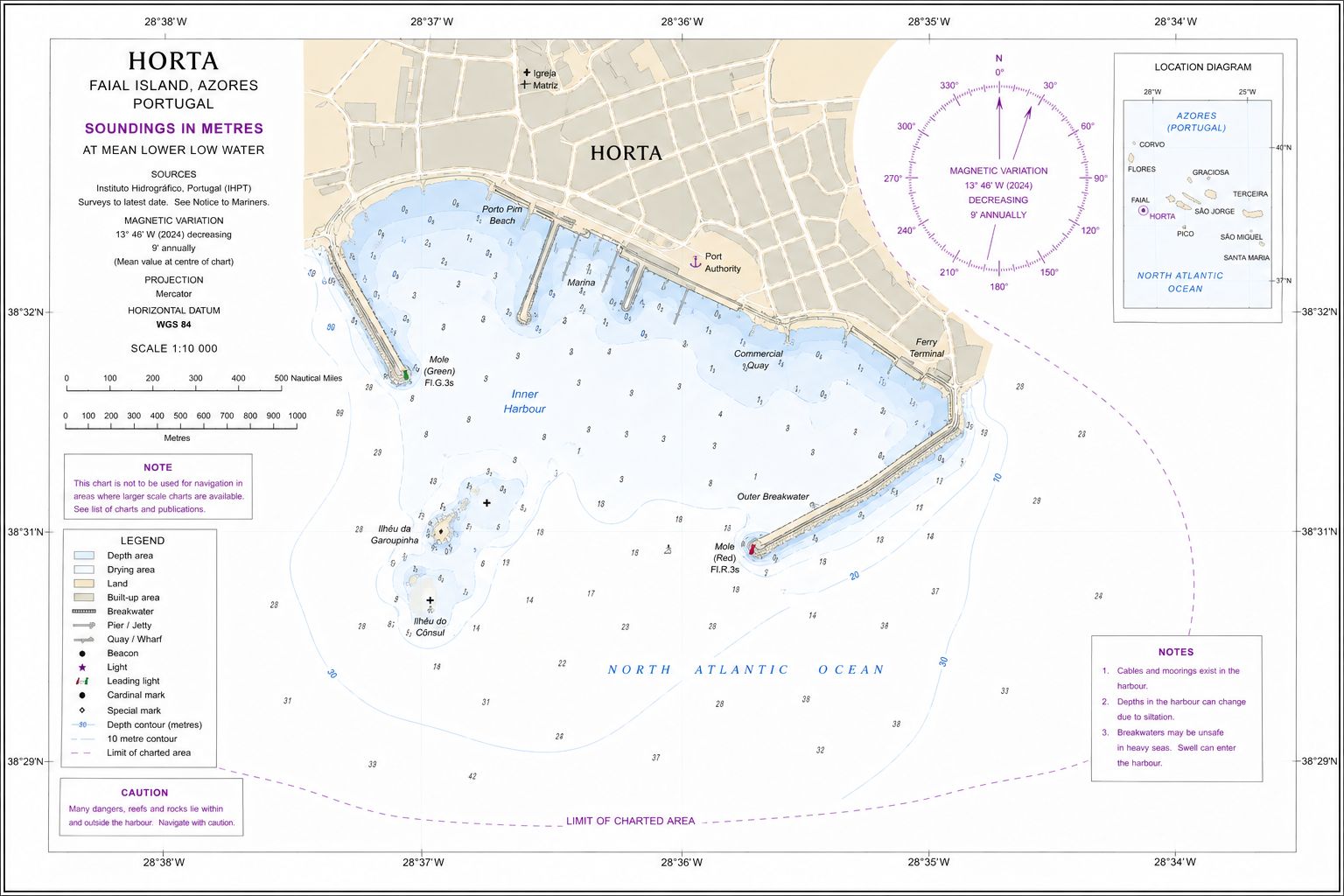
Approaches to Horta are straightforward, with deep water over 40–60 m close to the coast and a clear run‑in from the southeast and south. The channel between Pico and Faial carries 50–100 m and funnels wind in fresh trade conditions, creating acceleration zones and short, steep seas when the breeze is above 20 kn. The harbour entrance is wide with 8–12 m in the outer approach and 6–8 m inside the breakwaters, with predictable access in all weather. Ferry and commercial traffic operate throughout the day, and yachts maintain separation when entering. Southerly swell can wrap into the harbour mouth, but entry remains uncomplicated, and night approaches are reliable with clear leading lights and unobstructed sectors.
Horta Yacht Cruising
Guide - Anchorage
Horta has no viable anchorages due to exposure to Atlantic swell and the steep‑to coastline surrounding Faial. Depths drop rapidly from 20–30 m to over 50 m close to shore, and there are no bays or indentations offering reliable shelter for yachts. The only operational option is the harbour anchorage inside the breakwaters, where depths run 8–15 m over mud and sand with variable holding. Space is limited, movement increases with ferry wash and commercial traffic, and strong southerly swell can make the anchorage uncomfortable. Yachts arriving at Faial proceed directly to Horta Marina, as anchoring outside the harbour is not suitable
Horta Yacht Cruising
Guide - Entry Formalities
Entry procedures follow Portuguese and EU regulations. Yachts report to the marina office with vessel registration, passports and crew list. Schengen rules apply. Pets require EU‑compliant veterinary documentation. Waste‑management rules are enforced, and black‑water containment is required in some areas. Formalities are efficient, and staff are accustomed to handling yachts arriving from trans‑Atlantic passages. The port maintains clear procedures for customs, immigration and harbour control, and visiting yachts are expected to follow instructions precisely.
Horta Yacht Cruising
Guide - Marina Facilities
Horta Marina provides secure berthing with 3–5 m across the pontoons and 6–8 m in the entrance channel, with predictable access in all conditions. Shore power, potable water and Wi‑Fi are available throughout the marina, and fuel is supplied at the harbour fuel berth adjacent to the commercial quay. The marina office manages berth allocation and clearance formalities, and the basin is protected from Atlantic swell by the harbour breakwaters, though ferry wash and commercial traffic create occasional movement. Technical support includes mechanical and electrical workshops, sail repair, rigging services and divers, with chandlery stock covering routine maintenance items and emergency repairs. Haul‑out and hard‑stand facilities are located in the commercial yard, with capacity for yachts undertaking structural, mechanical or antifouling work. Security is controlled through gated pontoon access, and the marina sits within short walking distance of provisioning outlets and marine services.
Horta Yacht Cruising
Guide - Local Weather
Weather in Horta is shaped by the Azores High and the region’s variable Atlantic systems. Summer conditions are generally stable, with moderate winds and manageable sea state. Winter introduces more frequent low‑pressure systems, with strong winds, heavy swell and rapidly changing conditions. Long‑period swell from the south and southwest can affect the harbour, particularly during winter systems, though the breakwaters maintain workable conditions. Fog can occur during periods of high humidity, reducing visibility and affecting approaches. The harbour remains sheltered in most conditions, but surge can develop during strong southerly winds
Horta Yacht Cruising
Guide - Provisioning
Supermarkets. Provisioning in Horta centres on Continente Modelo Horta, which carries fresh produce, dairy, meat, bakery items, dry stores, long‑life goods and frozen products with stable turnover suitable for full restocking. My Auchan Horta provides additional packaged foods, beverages, household items and routine top‑up supplies. Smaller outlets including Supermercado Guarita offer fresh produce, dairy and dry goods for short‑range replenishment. Stock levels across all stores depend on inter‑island freight schedules, with occasional gaps in fresh produce and imported items.
Markets. The Horta Municipal Market supplies vegetables, fruit, herbs, local cheeses, pulses and small‑scale regional produce from Faial and neighbouring islands, with availability varying by season and ferry schedules. Independent produce stalls operate around the town centre with variable stock and irregular hours.
Fish Markets. Fish supply is concentrated at the Horta fish hall near the commercial port, where tuna, bonito, chicharro, grouper, mackerel and seasonal Atlantic species are sold according to daily landings. Availability depends on weather, catch and inter‑island distribution. Informal quayside sales occur when local boats return with small quantities.
Horta Yacht Cruising
Guide - Local Cuisine
Local cuisine in Horta is based on Atlantic fish, Azorean beef and dairy, and island‑grown vegetables. Atum is served grilled or in atum de cebolada with onions, garlic and vinegar. Chicharro frito uses small horse mackerel fried and served with vinegar and onions. Caldeirada combines mixed coastal fish with potatoes, peppers, onions and tomato. Azorean beef appears in stews and grilled cuts, supported by local dairy including cheeses from Faial and neighbouring islands. Polvo guisado uses octopus stewed with wine, garlic and spices. Produce availability depends on inter‑island freight and local supply, and meals often incorporate potatoes, cabbage, onions and preserved staples.
Horta Yacht Cruising
Guide - Fuel Supplies
Fuel is supplied at the harbour fuel berth on the commercial quay, with diesel delivered by pump at predictable flow rates and access maintained in all weather. Queues form during peak season when yachts, fishing vessels and inter‑island craft overlap, and manoeuvring space is limited in cross‑winds. Petrol is available in jerry cans from service stations in town. Surge during strong southerly systems can affect fuelling operations, but the harbour remains operational in most conditions. Supply interruptions are rare due to the port’s commercial logistics.
Horta Yacht Cruising Guide - Water Supplies
Potable water is provided on the marina pontoons through metered outlets with stable pressure, though supply can tighten during periods of high demand or inter‑island freight delays. Water quality is consistent, and hoses are required to be vessel‑supplied. There is no dedicated water berth outside the marina, and yachts anchor‑side must come alongside a pontoon to take on water.
Mechanical and Electrical Repairs
Resource
If you are headed somewhere remote consider the need to expand your knowledge base or have an information resource on board. Why not get a copy of my book The Marine and Electrical and Electronics Bible 4th Edition. By and for yachties, with everything from batteries and charging, solar and wind, diesel engines and marine electronics and so much more. Your complete systems guide. 650 pages of practical advice. In Australia and New Zealand order a copy through Boat Books. UK and European boats can buy the UK Edition Here. US and Canadian boats can get the US Edition Order Here. Marine systems are my profession so let me help you. By a liveaboard boat owner for other boat owners



Horta Yacht Cruising
Guide - Marine Services
sailmaking, marine electronics technicians and chandlery supply. Haul‑out facilities are available in the port, with travel‑lift capacity suitable for a range of vessels. The harbour’s proximity to the commercial port ensures reliable access to parts and materials. Horta is well suited to post‑Atlantic maintenance, and many yachts complete repairs and servicing here before continuing to mainland Europe.
Horta Yacht Cruising
Guide - Local Customs
Harbour operations are structured and predictable, with clear authority control and enforced waste‑management rules. Environmental restrictions apply in protected areas, and compliance checks are routine. Visiting yachts are expected to follow instructions precisely. The harbour maintains a long‑standing tradition of yacht murals, but painting is regulated and restricted to designated areas.
Horta Yacht Cruising
Guide - Summary
Horta is the primary operational base for yachts in the Azores, offering deep‑water access, reliable marina infrastructure, strong provisioning and comprehensive marine services. Approaches are straightforward, anchorages are limited by depth and exposure, and the marina provides the most reliable shelter. The port functions as a key waypoint for yachts completing trans‑Atlantic passages and preparing for onward routes to mainland Europe. The Horta Yacht Cruising Guide is all you need to know.