Gyali Greece Sailing Guide
Gyali Greece Sailing Guide. Gyali lies between Kos and Nisyros and is defined by active extraction of pumice and pozzolan. The island is privately operated and permanently inhabited only by quarry personnel. Shorelines are predominantly steep-to with limited indentations, and large sections of the coast are affected by industrial activity, including loading facilities and restricted zones. The surrounding seabed consists mainly of volcanic sand, pumice fragments, and rock, with depths increasing rapidly off the shoreline.
For a cruising yacht, Gyali is not a destination port but a waypoint with constrained stopping options. There are no public harbour facilities, no provisioning, and no formal berthing. Temporary shelter may be obtained in settled conditions on the lee side, subject to exclusion areas around quarry operations and shipping movements. Holding varies with seabed composition, and exposure to Meltemi conditions is significant, particularly from the north through east sectors. Any approach requires strict attention to commercial traffic, unlit obstructions near industrial works, and avoidance of operational zones.
Gyali Greece Sailing Guide History
Gyali is a small volcanic island formed as part of the South Aegean volcanic arc, associated with nearby Nisyros and Kos. Its geology is dominated by rhyolitic pumice and obsidian, created during explosive volcanic activity in the late Pleistocene. Evidence of prehistoric use exists, primarily linked to the extraction of obsidian, which was a valued material for tools in the Neolithic and Bronze Age Aegean. Finds from Gyali have been identified across the region, indicating it formed part of early maritime trade networks.
Through classical and medieval periods, Gyali remained marginal due to its lack of water, arable land, and secure anchorages. It fell under successive control of regional powers, including Hellenistic states, the Roman and Byzantine Empires, and later the Knights of St John and the Ottomans, generally administered as part of the wider Nisyros–Kos area rather than as a standalone settlement. There is no record of sustained habitation.
In the modern period, the island’s significance is almost entirely industrial. Large-scale quarrying of pumice began in the 20th century and continues today under private ownership. The extracted material is used in construction and industrial applications, and dedicated loading infrastructure has been established on the coast. As a result, Gyali functions as a controlled industrial site rather than a civilian community, with access restricted and maritime activity governed by quarry operations.
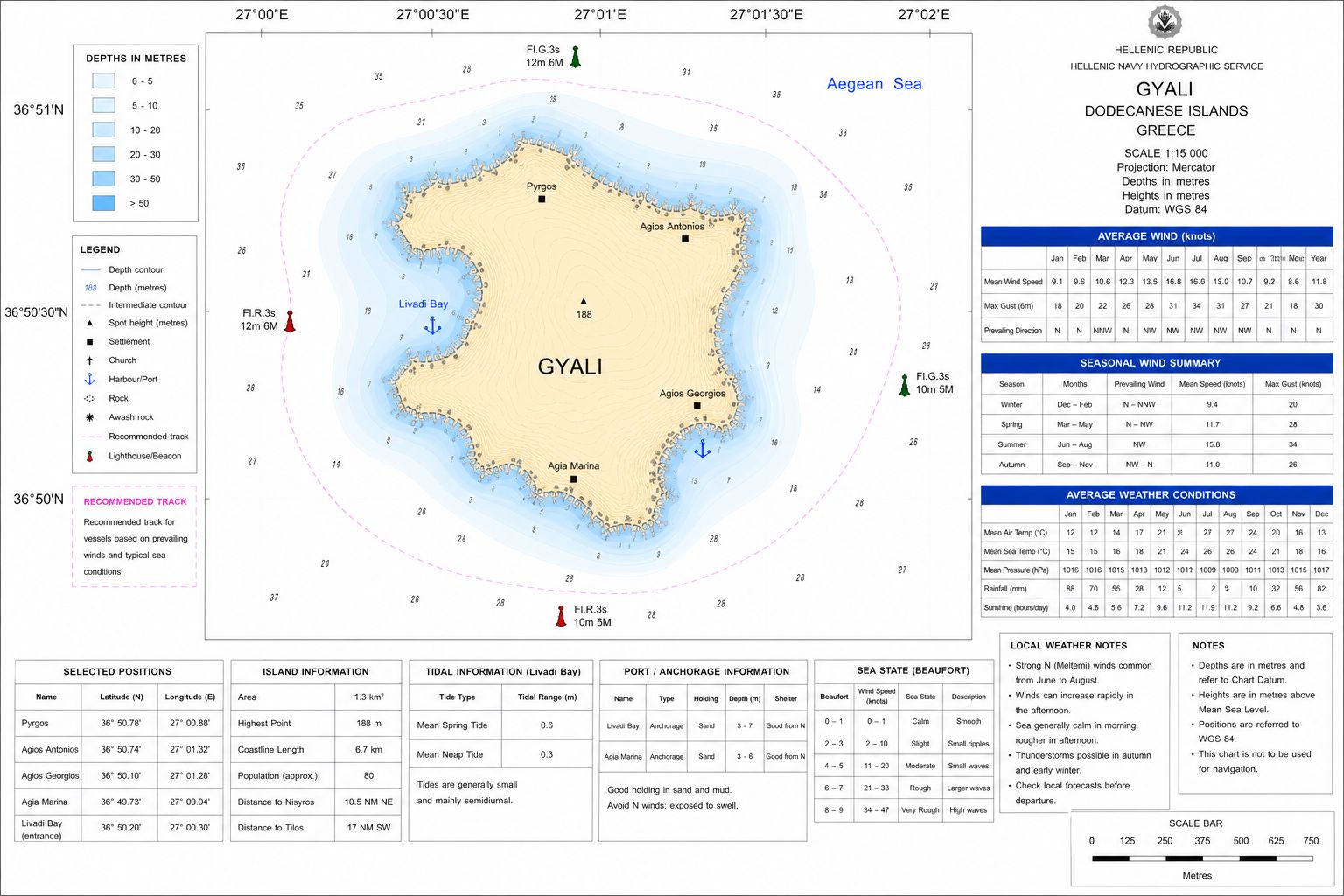
Chart Disclaimer. This chart is a schematic representation for illustrative purposes only and must not be used for navigation. Refer to official hydrographic charts for safe navigation. Be aware ENC charts may differ from official hydrographic charts. Both should be corrected and updated regularly.
Gyali Greece
Sailing Guide - Ocean Currents
and Tidal Flow
Currents at Gyali are wind-driven and locally accelerated, with negligible tidal influence. Tidal range is minimal, typically 0.1–0.3 metres, and does not produce any consistent flood or ebb stream. Under prevailing Meltemi conditions, a south to south-west setting flow develops through the channel between Nisyros and Kos, commonly running at 0.5–1.0 knots.
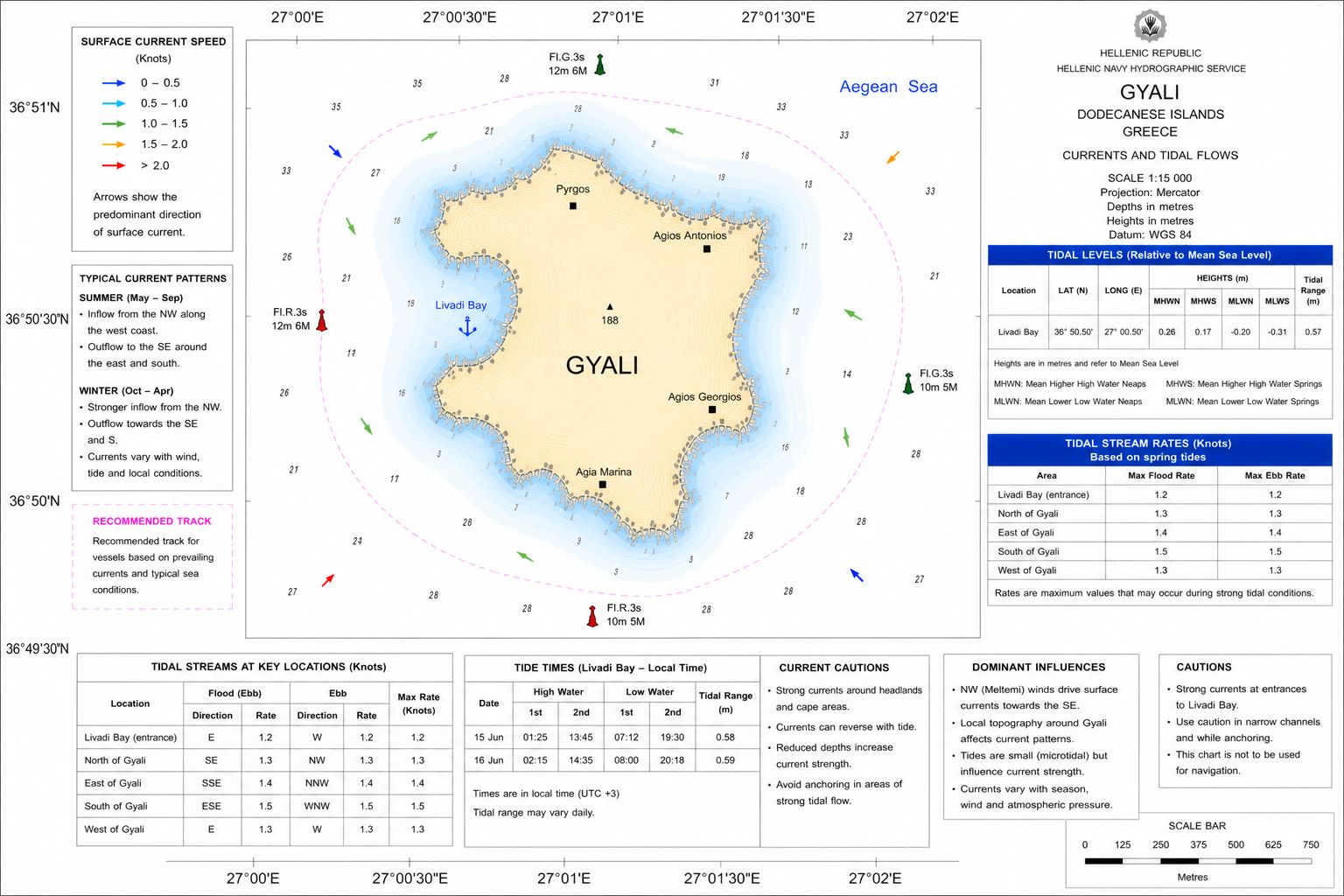
In southerly weather, flow reverses to a north-setting drift, with similar magnitudes depending on wind strength. Local acceleration occurs in the passages and around headlands, with eddies and disturbed water near the island and industrial shoreline. For navigation, currents should be treated as moderate, wind-aligned drift with localised increases, rather than predictable tidal flow.
Gyali Greece
Sailing Guide - Weather
Weather at Gyali is hot, dry, and stable through summer, with persistent high-pressure systems producing clear skies, high visibility, and negligible rainfall. Daytime temperatures typically range from 28–32°C, with higher peaks during heat periods, moderated slightly by exposure to open sea. The dominant feature is the Meltemi, bringing dry northerly airflow and maintaining low humidity but creating sustained wind and sea conditions.
Outside summer, weather becomes variable under passing low-pressure systems, with increased cloud, rainfall, and shifting winds, typically from the south to south-west ahead of fronts and north-west after passage. Rainfall is concentrated in this period and can occur in short, heavy bursts. Winter temperatures remain mild, generally 10–16°C, with good visibility outside of rain and no prolonged cold conditions.
The Marine Electrical and Electronics Bible has a complete list of Greek VHF Radio Channel information and weather forecast times for Greece along with NAVTEX UK and Europe and NAVTEX Mediterranean for 490kHz and 518kHz.
Gyali Greece
Sailing Guide - Local Winds
Wind at Gyali is dominated by the Meltemi, with persistent N to NE winds during summer. Typical strengths are 15–25 knots, with frequent periods of 25–35 knots or higher in July and August. The channel between Nisyros and Kos produces local acceleration, increasing wind speed above open-sea values and generating gusting, particularly near headlands and along the industrial shoreline.
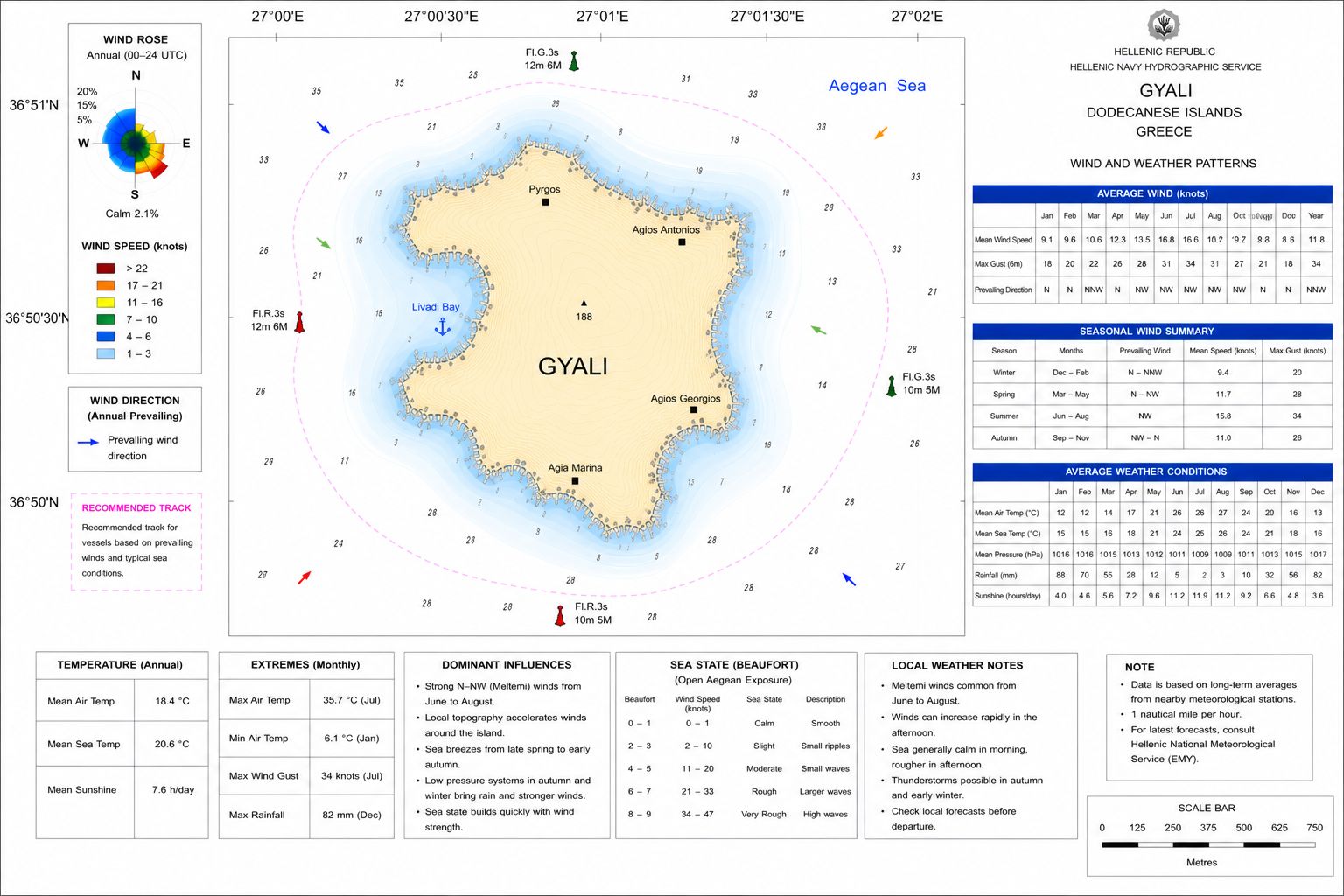
Outside the Meltemi season, winds become variable and synoptic, driven by passing weather systems. Southerly to south-westerly winds develop ahead of fronts and can strengthen rapidly to 20–30 knots, veering west to north-west after passage. Local effects include turbulence, gusting, and short wind shifts around coastal features, with minimal shelter anywhere on the island.
Gyali Greece
Sailing Guide - Approaches
Approaches to Gyali are made in open water with deep, steep-to coastlines and no significant off-lying hazards, allowing close approach in depths typically exceeding 20–40 metres. The island lies within the channel between Kos and Nisyros, where expect wind-driven set and short, steep seas under Meltemi conditions, with local acceleration and turbulence near headlands. Industrial loading areas on the east side require wide clearance due to vessel traffic and unlit structures. Navigation is straightforward by visual reference, with primary considerations being wind strength, sea state, and maintaining separation from operational zones.
Gyali Greece
Sailing Guide - Navigation
There is no public harbour at Gyali and no designated yacht entry channel. The only developed coastal infrastructure is associated with private quarry loading facilities, which are not available for visiting vessels. Any “port” reference relates to these industrial jetties, and they must be treated as restricted operational areas.
Approach to the eastern side of the island brings the quarry installations into view, including loading piers extending into deep water. Depths in the approach remain consistently deep, generally 20–40 metres close to shore, with no dredged channel or defined alignment. There are no leading marks, sector lights, or formal navigation aids specific to entry. Identification is visual, supported by charted positions of the jetties.
Navigation in this area requires maintaining clear separation from all fixed structures and commercial vessels. Bulk carriers and support craft may be manoeuvring or secured alongside, often with limited ability to deviate. Passing distances should be conservative, allowing for prop wash, mooring lines, and submerged equipment. Some structures and work areas may be poorly lit or unlit at night, increasing risk in reduced visibility.
There is no turning basin or sheltered inner harbour. Manoeuvring space is effectively open water adjacent to the installations, fully exposed to prevailing wind and sea. Under Meltemi conditions, strong northerly winds will produce set and drift across the approach, requiring continuous correction. Gusting and turbulence may be encountered near the shoreline and around structures.
No berthing, fuel, water, or harbour services are available, and there is no provision for casual entry or lay-by. Vessels should not attempt to enter or secure within the industrial area unless specifically authorised. For navigation purposes, Gyali should be treated as a coastal transit point only, with avoidance of the port installations forming the primary operational requirement.
Gyali Greece
Sailing Guide - Chart Accuracy
Hydrographic charts provide general accuracy for coastline and offshore depths. However, shoreline modifications from quarry operations may not be fully reflected in chart data. Loading structures, seabed disturbance, and spoil areas may alter nearshore depth contours. Visual confirmation is required when operating in proximity to the island.
Gyali Greece
Sailing Guide - Anchorages
Gyali does not offer established or reliable anchorage areas. The island is predominantly steep-to, with depths increasing rapidly to 20–40 metres close inshore, limiting the availability of suitable anchoring ground. There are no charted anchorages, no mooring buoys, and no protected bays of sufficient scale to provide consistent shelter.
Limited temporary anchoring may be possible on the south to south-western side of the island in settled conditions, where there is partial lee from the prevailing northerly Meltemi. In these areas, depths may reduce sufficiently for anchoring, typically in the range of 10–20 metres, but the seabed is variable, consisting of sand mixed with pumice and rock, resulting in inconsistent holding. Careful anchor set and verification are required.
Exposure remains the primary constraint. Any anchorage around Gyali is open to rapid deterioration with wind shifts. Under Meltemi conditions, even the southern side can experience wrap-around seas and gusting. There is minimal protection from swell, and wind acceleration around the island can affect holding and vessel stability. In southerly weather, all potential anchorages become untenable.
Additional caution is required to remain clear of industrial zones, particularly on the eastern side where quarry loading operations take place. Anchoring near these areas is unsafe and inappropriate due to vessel movements, submerged infrastructure, and exclusion requirements. Operationally, Gyali should be treated as a temporary stop only in benign weather, not as a planned anchorage. Any use requires continuous monitoring of conditions, readiness to depart, and sufficient sea room to avoid commercial activity.
Gyali Greece
Sailing Guide - Entry
Formalities
This is not a designated port of entry for international clearance, and there are no customs or immigration facilities on the island. Vessels arriving from outside Greece or the Schengen Area must first clear into the country at an official port of entry before proceeding to this port. Direct arrival from a non-Schengen country is not permitted. The Greek cruising tax (TEPAI) must be valid and paid, and the vessel’s cruising log (DEKPA for non-EU vessels, or transit log where applicable) should be up to date and available for inspection if requested by port authorities or coastguard.
Gyali Greece
Sailing Guide - Marina
Facilities
Gyali has no public berthing facilities and no infrastructure intended for visiting yachts. The only constructed waterfront consists of private industrial loading jetties used for pumice and aggregate export. These installations are restricted to commercial use, and there is no provision for alongside berthing, mooring, or temporary lay-by for non-operational vessels.
The loading piers extend into deep water and are configured for bulk carriers and support vessels. They are subject to continuous or intermittent operations, including vessel movements, loading activity, and the presence of mooring lines, floating equipment, and submerged hazards. Access is controlled, and vessels should remain well clear at all times. There are no fendered quay walls, no bollard arrangements for visiting craft, and no sheltered basin or harbour enclosure.
There are also no mooring buoys, laid lines, or organised anchoring areas associated with the island. Any attempt to secure a vessel would be in open water and subject to full exposure from prevailing wind and sea conditions. Given the lack of shelter, the steep-to seabed, and the presence of commercial traffic, Gyali does not provide a viable or safe berthing option. Operationally, the island should be treated strictly as a non-berthing location, with passage made offshore and stopping only considered, if at all, as a temporary anchorage in settled conditions and clear of all industrial zones.
Gyali Greece
Sailing Guide - Provisioning
Gyali has no provisioning facilities of any kind. The island is an active quarry site with no civilian settlement, no shops, and no access to food, water, or general supplies. There are no supermarkets, bakeries, produce markets, or fuel outlets, and no informal vendors or seasonal services.
Markets. There is no produce supply or market activity on the island.
Fish Markets. There is no fish supply available for visiting vessels.
Gyali Greece
Sailing Guide - General
- There are no food establishments on Gyali and no availability of prepared food.
- There are no beverage supply points or retail outlets.
- There is no fuel supply available. Fuel must be obtained in Kos or Nisyros prior to transit.
- There is no potable water supply available.
Mechanical and Electrical Repairs
Resource
If you are headed somewhere remote consider the need to expand your knowledge base or have an information resource on board. Why not get a copy of my book The Marine and Electrical and Electronics Bible 4th Edition. By and for yachties, with everything from batteries and charging, solar and wind, diesel engines and marine electronics and so much more. Your complete systems guide. 650 pages of practical advice. In Australia and New Zealand order a copy through Boat Books. UK and European boats can buy the UK Edition Here. US and Canadian boats can get the US Edition Order Here. Marine systems are my profession so let me help you. By a liveaboard boat owner for other boat owners.



Gyali Greece
Sailing Guide - Marine
Services
There are no marine services accessible to visiting vessels. Industrial operations may include mechanical infrastructure, but no support is available for yacht maintenance, repair, or supply. All service requirements must be handled in Kos where full marine support is available.
Gyali Greece
Sailing Guide - Local
Etiquette
Gyali operates as an active industrial extraction site. Access ashore is restricted and not intended for public or recreational use. Vessels should maintain clear separation from loading operations and avoid interference with commercial traffic. Anchoring or lingering within operational zones is not accepted. No waste disposal facilities exist, and all waste must be retained onboard.
Gyali Greece
Sailing Guide - Summary
Gyali is an industrial island within a key transit corridor between Kos and Nisyros. It does not provide harbour, anchorage, or service capability for cruising vessels. Navigation considerations are centred on avoiding industrial zones, managing traffic interaction, and accounting for wind acceleration within the channel. The island is relevant as a passage waypoint rather than a destination, consistent with a Gyali Greece Sailing Guide for all you need to know.