Gouvia Greece Sailing Guide
Gouvia Greece Sailing Guide. Gouvia is located on the east coast of Corfu within the Ionian Sea in Greece at approximately 39°39′N 19°51′E. It lies immediately north of Corfu Town within a semi-enclosed coastal area formed by headlands and offshore shallows. The primary facility is Gouvia Marina, which functions as a major base for charter fleets and private yachts, with associated anchorage areas in Gouvia Bay.
The operating environment is sheltered relative to open Ionian conditions, with reduced sea state inside the bay and negligible tidal range. The surrounding landmass and coastal geometry provide protection from prevailing north-westerly winds, although southerly and easterly winds can affect exposed sectors. Depths are moderate and increase gradually offshore, with areas of shallows and soft seabed within the bay.
Gouvia Greece
Sailing Guide History
The history of Gouvia is closely linked to the maritime and strategic importance of Corfu. In antiquity, the area formed part of the wider Corfiot territory, but its significance grew during the Venetian period (14th–18th centuries), when Gouvia was developed as a naval and shipbuilding centre. The Venetians established a shipyard here, remains of which stone arches and slipways are still visible today, used for building and repairing their fleet in the Ionian.
After the Venetian era, the area passed through French and British administration before becoming part of modern Greece in 1864. Gouvia remained a small coastal settlement until the late 20th century, when it was transformed by the development of Gouvia Marina, now one of the largest and best-equipped marinas in Greece. Today, its identity is defined by this modern yachting infrastructure, layered over its historic role as a naval base.
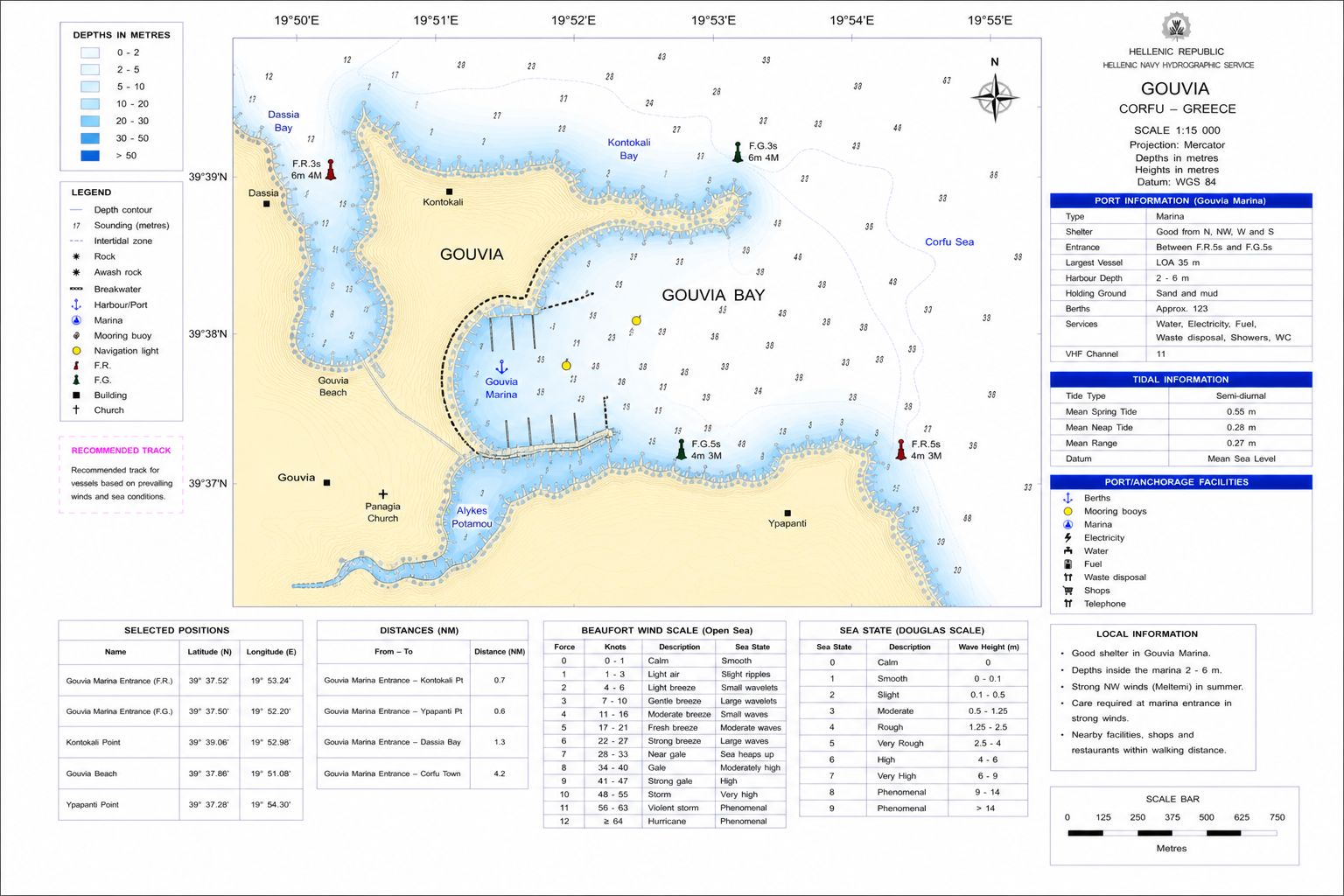
Chart Disclaimer. This chart is a schematic representation for illustrative purposes only and must not be used for navigation. Refer to official hydrographic charts for safe navigation. Be aware ENC charts may differ from official hydrographic charts. Both should be corrected and updated regularly.
Gouvia Greece
Sailing Guide - Approaches
Approach to Gouvia is via the east coast of Corfu in the protected waters of the Ionian Sea. The coastline is low-lying with good visibility, and offshore depths are typically 30–60 m, shoaling gradually to 10–20 m within 0.5–1 NM of the coast. The approach is made into Gouvia Bay, which is wide and clear of major hazards. Depths reduce steadily to 8–12 m in the outer bay, then to 5–8 m approaching the marina entrance.
The marina lies behind a breakwater and is entered through a well-marked opening with depths generally 3–5 m, suitable for most yachts. There are no significant off-lying shoals on the main approach, but care is required to avoid shallow areas toward the edges of the bay and near the shoreline. Traffic can be heavy with charter vessels and local craft, particularly in summer. Winds are generally lighter here than on the west coast, but local gusts can occur. The approach is straightforward in all normal conditions, with good shelter provided by the bay and marina structures. Hazards include local shoal areas, increased traffic density from charter vessels, and reduced manoeuvring margins during peak periods.
Gouvia Greece
Sailing Guide - Navigation
Approach is from the E along the east coast of Corfu into Gouvia Bay in clear water with depths 20–40 m offshore, reducing to 10–15 m in the bay. The bay is wide with no significant off-lying dangers, but shallows exist toward the margins.
Gouvia Marina lies behind a breakwater. Entrance is well marked and approached in 5–8 m, with 3–5 m in the entrance channel and inside the marina. Maintain mid-channel alignment to avoid shallower edges.
Traffic is heavy with charter vessels and local craft; control speed and maintain lookout. Winds are generally moderate but can produce crosswinds on final approach. No major hazards on the direct approach, but accurate positioning is required near the marina entrance and within the basin due to confined space and shallow margins.
Gouvia Greece
Sailing Guide - Chart Accuracy
Charts issued by the Hellenic Navy Hydrographic Service are accurate for approaches, bay contours, and marina layout. ENC data aligns with official charts. Local berth allocations, marina layout changes, and mooring lines are not fully represented and are controlled by marina management.
Gouvia Greece
Sailing Guide - Anchorages
Anchoring is available within Gouvia Bay, outside the marina, in 5–10 m over mud and sand with generally good holding. The most common area is off the marina entrance and along the eastern side of the bay, clear of approach channels. Anchorage space may be limited due to congestion and mooring field expansion Further south toward Kontokali, additional space is available in 6–12 m, also with good holding. Depths increase gradually toward the centre of the bay to 10–15 m. The bay provides good protection from N through E winds, but is exposed to southerlies, which can introduce chop and reduce comfort. Care is required to remain clear of marina traffic lanes and turning areas for charter and service vessels.
Gouvia Greece
Sailing Guide - Entry Formalities
Gouvia operates under Greek national and Schengen procedures. Customs and immigration clearance is available via nearby Corfu Town facilities. Vessel and crew documentation must be available. Harbour and marina authority control applies within port limits. Drones are regulated under Greek aviation rules. Communications equipment must comply with national regulations. Waste discharge is controlled.
Gouvia Greece
Sailing Guide - Marina Facilities
Gouvia Marina is a full-service, purpose-built marina and one of the largest in Greece. Berthing is on finger pontoons and stern-to berths with laid mooring lines, with depths typically 3–5 m throughout the marina, suitable for most cruising yachts. The marina provides full facilities, including reliable water and shore power at all berths, fuel dock, pump-out, security, and reception services. It also supports long-term berthing and winter storage. Comprehensive marine services are available on site, including haul-out with travel lift, repair yards, chandlery, and technical services. The marina is well sheltered in all conditions and offers ample manoeuvring space, though traffic can be heavy in peak charter periods.
Gouvia Greece
Sailing Guide - Local Weather
Weather is typical northern
Ionian Mediterranean, with warm, dry summers and mild, wetter winters.
Summer (May–September) conditions are stable, with temperatures generally 25–33°C,
high sunshine, and minimal rainfall. Winds are lighter than the Aegean, with light
morning airs and NW–W sea breezes 10–20 knots developing in the afternoon.
Rainfall during this period is very low. Annual climate is classified
as Mediterranean, with hot, dry summers and wetter winters, and rainfall
concentrated mainly between October and March.
Winter (November–March) is mild, typically 10–16°C, with the majority of annual rainfall occurring in this season. The region experiences frequent frontal systems with S–SW winds 20–35 knots, bringing rain, reduced visibility, and occasional squalls.
Spring and autumn are transitional, with temperatures 15–25°C and variable winds from both NW and S sectors, along with occasional showers. Overall, sea conditions are slight in summer within Gouvia Bay, becoming moderate during winter weather systems.
The Marine Electrical and Electronics Bible has a complete list of Greek VHF Radio Channel information and weather forecast times for Greece along with NAVTEX UK and Europe and NAVTEX Mediterranean for 490kHz and 518kHz.
Gouvia Greece
Sailing Guide - Local Winds
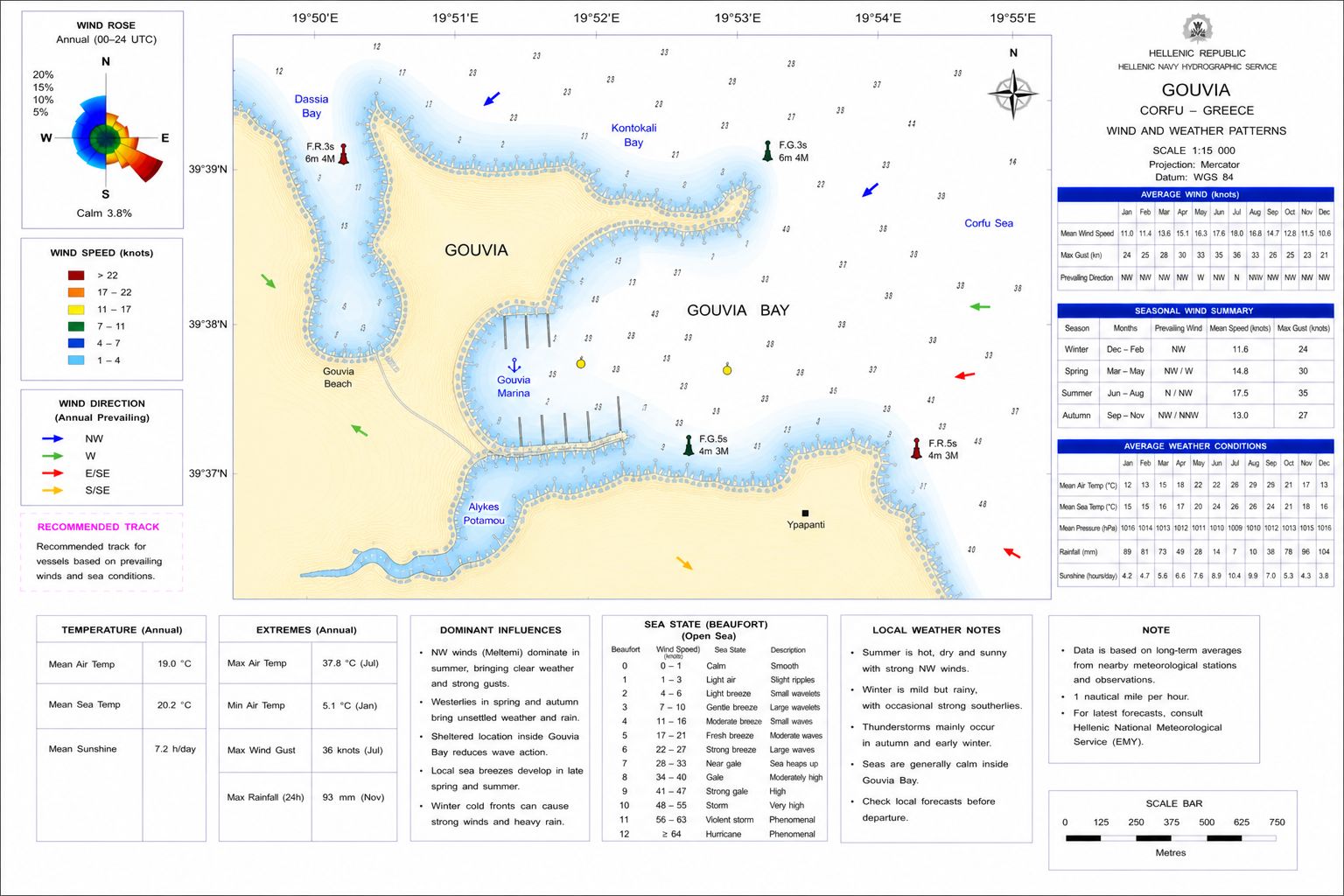
Local winds are dominated in summer by a diurnal NW–W sea breeze, typically 10–20 knots, building late morning and easing after sunset, with light or calm conditions overnight. Morning winds are often weak or variable, occasionally light E–SE land breezes 5–10 knots.
Within Gouvia Bay, wind strength is generally reduced, but NW winds can funnel along the coast, producing gusts near the marina entrance and in the outer anchorage. The east coast of Corfu is comparatively sheltered, so conditions are moderate compared to the west coast.
Outside summer, winds are more variable, with S–SW systems 15–30 knots during frontal passages and occasional stronger NW winds following fronts. Local effects include gusts around headlands and slight acceleration along the coastline.
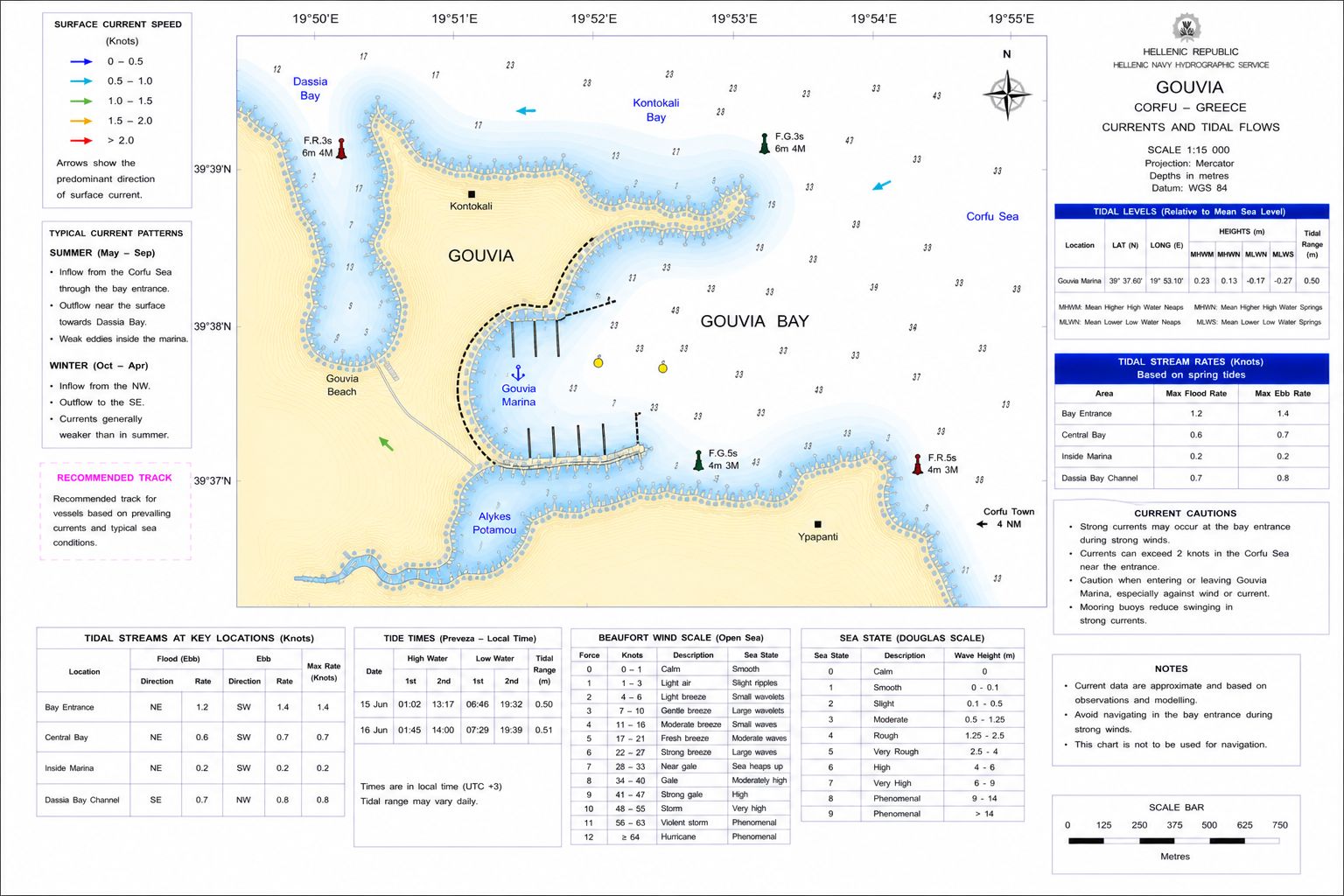
Gouvia Greece Sailing Guide - Currents and Tidal Flows
Currents in Gouvia Bay and along the east coast of Corfu are generally weak and variable, typically 0.1–0.5 knots, and are largely wind-driven rather than tidal.
A slight north–south coastal set may be observed depending on prevailing winds, with NW winds producing a weak south-going drift and southerly winds reversing the flow. Within Gouvia Bay itself, currents are minimal, often negligible, with only minor movement influenced by wind and local circulation.
There are no significant tidal streams, as tidal range in the Ionian is small (~0.2–0.4 m). Any noticeable movement is usually due to wind-induced drift or localised eddies near the marina entrance and along the shoreline.
Gouvia Greece
Sailing Guide - Provisioning
Supermarkets. Provisioning is centred around Gouvia and nearby Corfu Town. Within Gouvia, Dielas Supermarket Gouvia and several medium-sized local supermarkets are located within walking distance of the marina. Larger supermarkets are available nearby, including AB Vassilopoulos Corfu (Ethniki Lefkimis Road area) and Lidl Corfu, both within approximately 5–8 km of the marina and accessible by taxi. These provide full-service provisioning.
Markets. Local produce is available through greengrocers in Gouvia and surrounding areas. A weekly Laiki Agora (farmers’ market) operates in Corfu Town, typically once per week (commonly Saturday, subject to seasonal variation). Local products include olive oil, citrus, vegetables, herbs (oregano, thyme), honey, and regional cheeses.
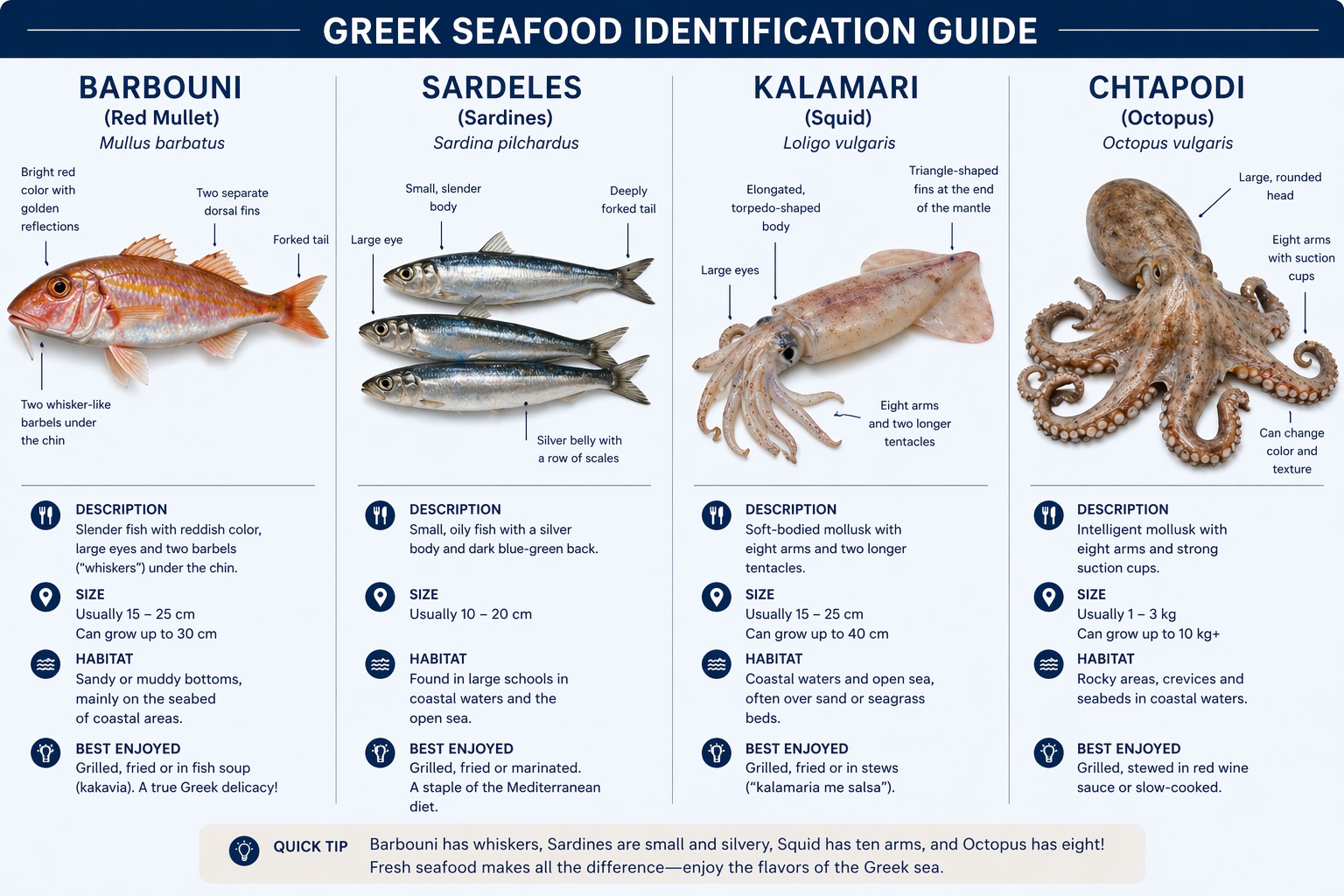
Fish Markets. There is no dedicated fish market in Gouvia. Fresh fish is available from fishmongers in Gouvia and Corfu Town, supplied by daily catch. Common seafood includes tsipoura (gilthead sea bream), lavraki (European sea bass), sardeles (sardines), gavros (anchovies), kalamari (squid), htapodi (octopus), garides (prawns), and barbouni (red mullet). Availability depends on daily catch and weather conditions.
Gouvia Greece
Sailing Guide - Local Cuisine
Cuisine in Gouvia reflects Corfiot and wider Ionian traditions, with strong Venetian influence and a focus on rich sauces, olive oil, and local ingredients. Signature dishes include Pastitsada Corfu – Beef or rooster in spiced tomato sauce with pasta, a defining Corfiot dish. Sofrito Corfu – Veal cooked in garlic, white wine, and light sauce, tender and aromatic. Bourdeto Corfu – Fish in a spicy red sauce with pepper and tomato, distinctive to Corfu. Bianco – Fish cooked in garlic, lemon, and white wine, a lighter local speciality. Fresh grilled fish – Tsipoura (sea bream), lavraki (sea bass), and other local catch. Octopus and squid dishes – Grilled or stewed (htapodi, kalamari). Greek mezze and salads – Olive oil, vegetables, cheese, and herbs. Kumquat products – Local kumquat liqueurs and sweets, unique to Corfu.
Gouvia Greece
Sailing Guide - Beverages
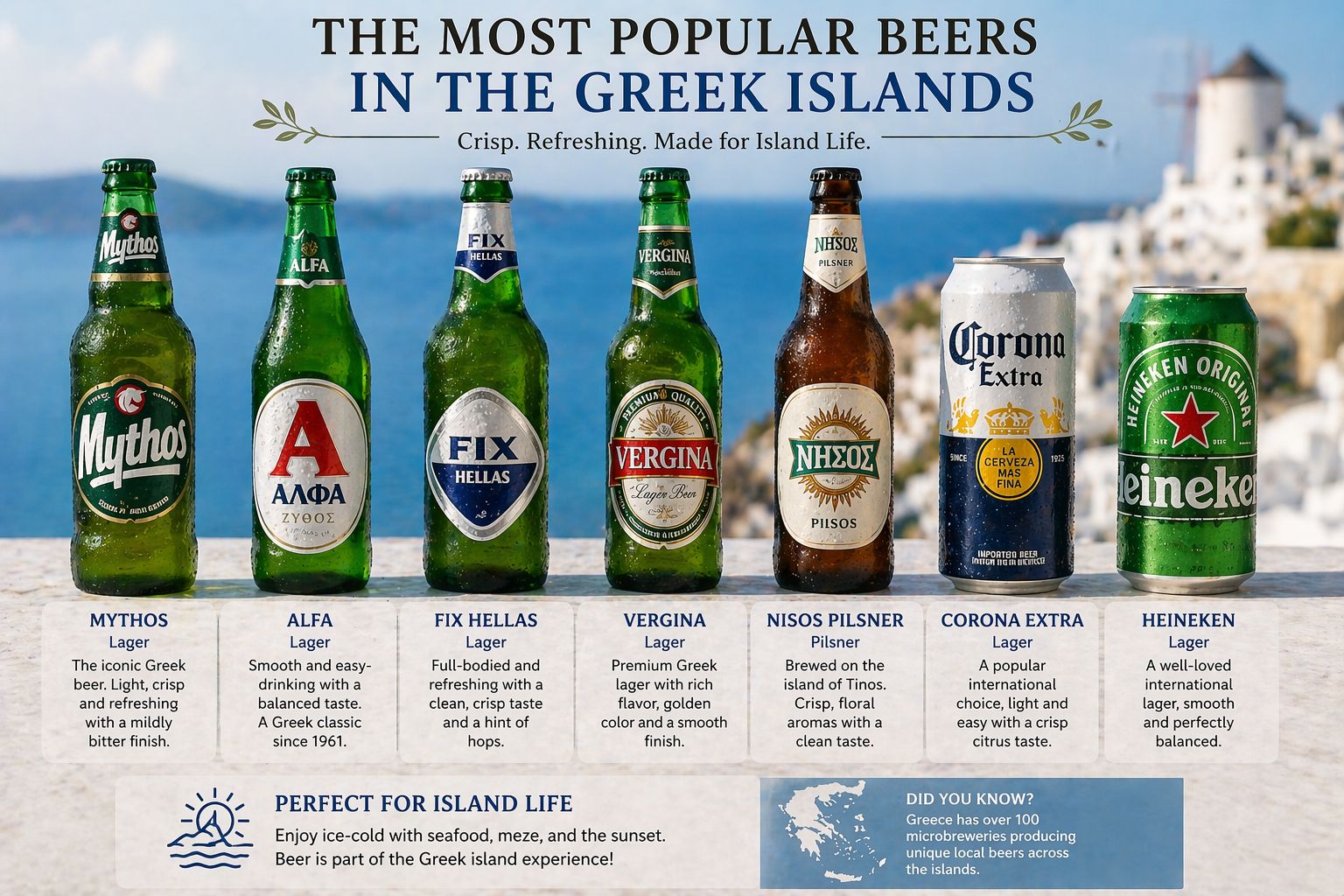
Beer, wine, and spirits across the Greek islands are locally produced and widely available through tavernas, small bars, and provisioning outlets. Beer is predominantly lager, with domestic brands including Mythos, Alfa, Fix, and Vergina alongside imported products; and over 100 microbreweries operate on several islands with limited distribution. Wine is region-specific, with white varieties dominant in the islands, including Assyrtiko, Moschofilero, and Roditis, alongside local table wines served in bulk; retsina remains in circulation as a resin-flavoured wine. Distilled products include ouzo (anise-based), tsipouro (grape marc distillate), raki or tsikoudia (Crete), souma (fig or grape distillate in eastern Aegean islands), and kitron (citrus liqueur from Naxos), with alcohol strength typically in the 37–45% range and higher for unregulated local distillations.
Gouvia Greece
Sailing Guide - Fuel Supplies
Fuel is available directly within Gouvia Marina at a dedicated fuel dock. Diesel and petrol are supplied by hose alongside, with reliable delivery and consistent quality. The fuel berth is located inside the marina basin and is accessible during operating hours; timing may be required during peak charter periods. Additional fuel supply is available by road tanker delivery to berths if required. Overall, Gouvia provides one of the most reliable and convenient refuelling points in the Ionian.
Gouvia Greece
Sailing Guide - Water Supplies
Water is available throughout Gouvia Marina via pressurised shore connections at all berths. Supply is delivered directly to pontoons and quayside pedestals, with vessels connecting using standard hoses and fittings. The supply is reliable and continuous, with good pressure across the marina. Water is potable, though commonly treated onboard for drinking. Availability is not restricted and forms part of standard marina services.
Mechanical and Electrical Repairs
Resource
If you are headed somewhere remote consider the need to expand your knowledge base or have an information resource on board. Why not get a copy of my book The Marine and Electrical and Electronics Bible 4th Edition. By and for yachties, with everything from batteries and charging, solar and wind, diesel engines and marine electronics and so much more. Your complete systems guide. 650 pages of practical advice. In Australia and New Zealand order a copy through Boat Books. UK and European boats can buy the UK Edition Here. US and Canadian boats can get the US Edition Order Here. Marine systems are my profession so let me help you. By a liveaboard boat owner for other boat owners.



Gouvia Greece
Sailing Guide - Marine Services
Gouvia is a major marine service hub in the Ionian. Within Gouvia Marina there are full-service repair facilities, including haul-out with travel lift, hardstand, antifouling, and structural work. Comprehensive technical support is available, including authorised Yanmar and Volvo Penta service agents, along with specialist workshops for diesel engines, generators, and mechanical systems. Electrical and marine electronics services are well established, with Raymarine and other major brands supported by local authorised or regional agents.
Gouvia Greece
Sailing Guide - Local Customs
Interaction is direct and formal on first contact, with a greeting expected before any request or transaction. Conversation tone is measured and transactional, with limited small talk unless initiated locally. Personal space is closer than in northern Europe, but physical contact is minimal unless familiarity is established. Shore behaviour is conservative in non-tourist areas, particularly near churches and village centres where modest dress and low noise are expected.
Gouvia Greece
Sailing Guide - Summary
Gouvia provides sheltered marina conditions with extensive facilities and service capability. Navigation is straightforward but affected by traffic density. Anchorage is available with good holding but limited space. Provisioning and technical services are comprehensive within the marina complex. Gouvia Greece Sailing Guide for all you need to know.