Formentera
Balearics Sailing Guide
Formentera Balearics Sailing Guide. Formentera is the southern island of the Pityusic group and lies south of Ibiza, separated from it by the Es Freus/Ibiza Channel. The island has one principal harbour, La Savina, on the north coast, which is the ferry, commercial and yacht-service port for the island. Yacht movement around Formentera is controlled by shallow coastal shelves, ferry traffic, protected Posidonia areas, exposed roadstead anchorages and the weather in the Ibiza–Formentera channel. La Savina is the only practical all-services harbour for visiting yachts; the remaining stops are anchorages or buoy fields. Skippers should treat Formentera as a low-lying island where visual pilotage, seabed identification and wind direction are more important than harbour choice.
The island is not a tidal-gate cruising area, but it is not free of current effects. The most relevant movement for a yacht is wind-driven set, residual drift and short sea in the channels and around the headlands, especially between Ibiza, Espalmador and La Savina. The north coast and Es Freus area are busy with ferry traffic, fast craft and day boats. The east, south and west coasts provide fair-weather anchorages only, with exposure changing sharply by wind direction. Anchoring must be planned around Posidonia restrictions and the requirement to keep anchor and chain on clear sand.
Formentera
Balearics Sailing Guide - History
Formentera has a long maritime history because its position controls the southern side of the Ibiza–Formentera channel. The island has been used by Phoenician, Roman, Islamic and later Catalan maritime routes, and its low coastline made it both useful and vulnerable for coastal movement. The island’s older settlements were not centred on a large harbour; La Savina developed as the practical port because it gave access to the sheltered northern waters and the route to Ibiza. The salt pans and coastal lagoons, especially around Estany Pudent and Estany des Peix, also shaped local maritime use.
The principal historic navigation and defensive marks are outside the harbour itself. The lighthouses at La Mola, Cap de Barbaria and Punta Prima remain relevant landmarks for coastal recognition, although they should not replace charted navigation. Formentera’s maritime archaeology and heritage are tied to salt extraction, small-scale fishing, coastal watch points and the island’s function as a stopping and transit point between Ibiza and the south-western Mediterranean. For modern cruising, the historic layout matters because there is still only one full harbour and no alternative deep marina on the outer coasts.
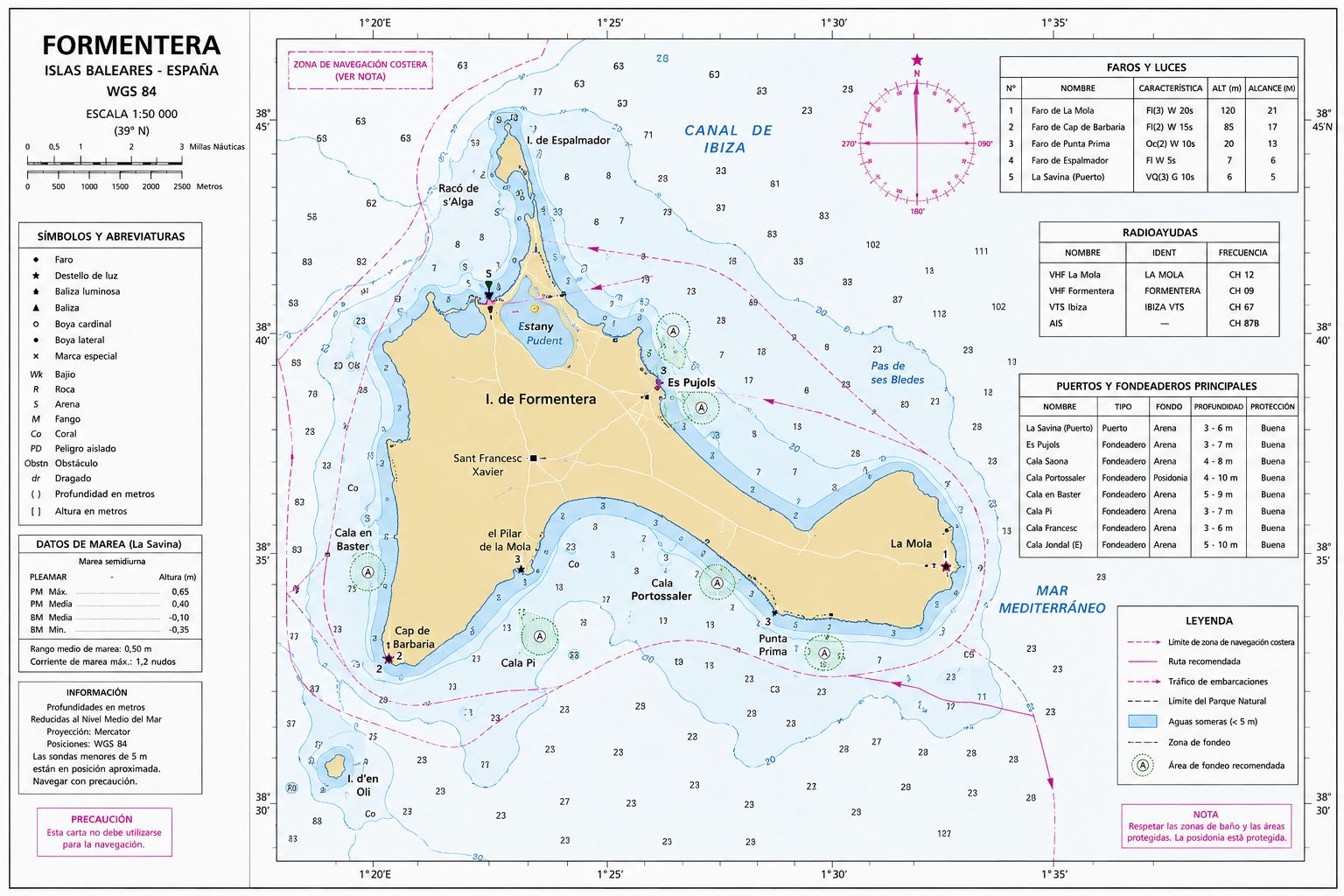
Chart Disclaimer. This chart is a schematic representation for illustrative purposes only and must not be used for navigation. Refer to official hydrographic charts for safe navigation. Be aware ENC charts may differ from official hydrographic charts. Both should be corrected and updated regularly.
Formentera
Balearics Sailing Guide - Currents
and Tidal Flow
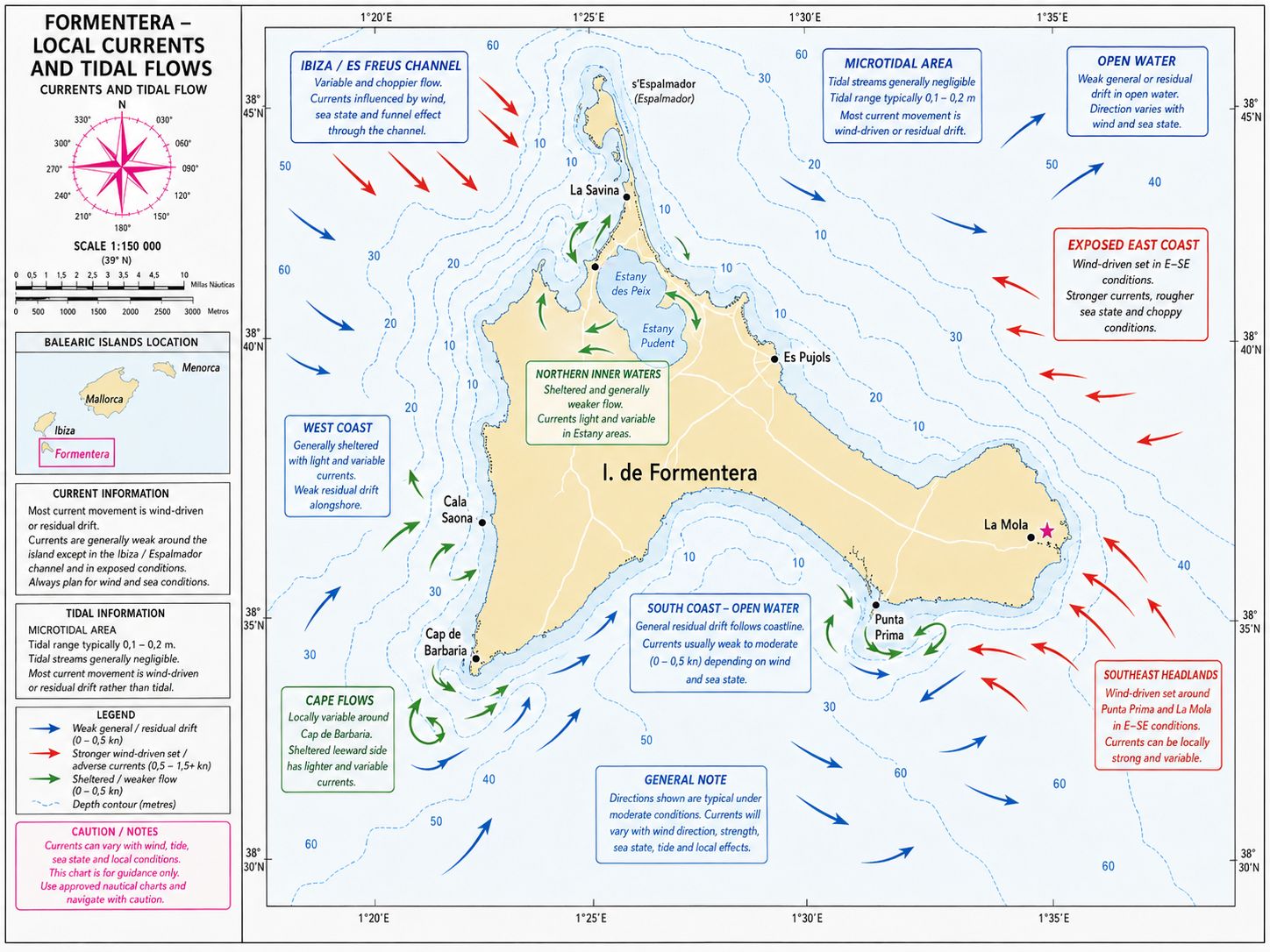
Formentera is microtidal. Around the Balearic Islands, tidal range is small compared with Atlantic cruising grounds, and tidal streams are generally weak; practical current planning is mainly about wind-driven surface movement, residual flow and sea state around headlands and island passages. Tide height should not be used to justify marginal depths in shallow areas around La Savina, Espalmador, Ses Illetes or the east-coast shelves. A skipper should use sounder, chart, light and seabed identification as the controlling inputs.
The most important local current area is Es Freus, between Ibiza, Espalmador and Formentera. Wind direction, ferry wash, local acceleration and residual flow can create chop and variable set in this channel. Around Cap de Barbaria, Punta Prima and La Mola, wind-driven set can be locally stronger and sea state can change quickly when wind opposes residual drift. In settled weather, yacht-scale currents are normally weak, but in fresh wind the set can affect slow-speed pilotage near La Savina, especially with ferry traffic and cross-wind in the approach.
Formentera
Balearics Sailing Guide - Weather
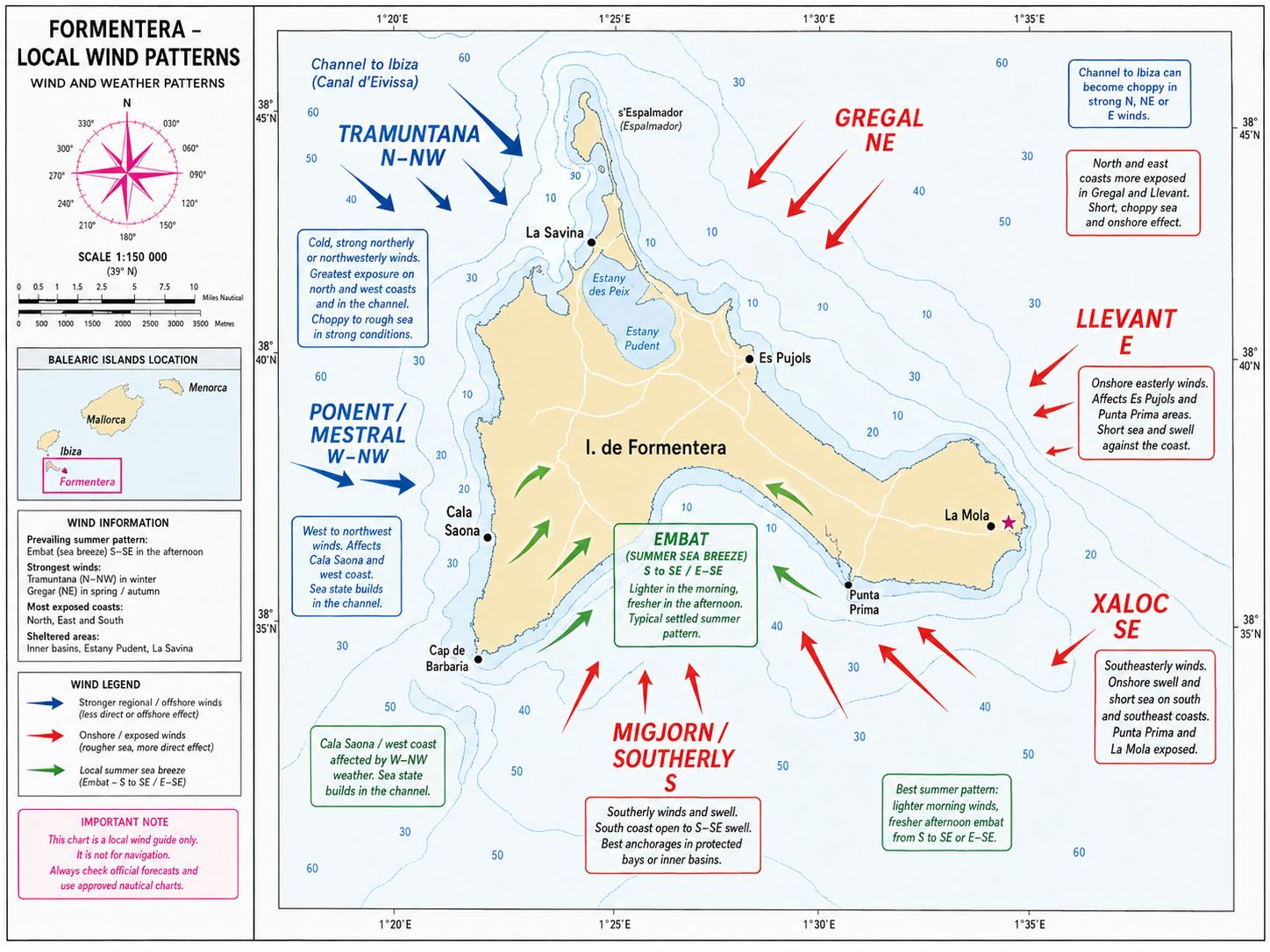
Formentera is low, exposed and has limited harbour choice. La Savina gives the only port refuge, but the approach remains exposed to traffic, channel chop and wind shifts. The island’s roadstead anchorages are direction-dependent and should not be treated as all-weather stops. In settled summer weather, mornings are often lighter and afternoon sea breeze can build from the south through southeast or east, affecting the south and east coasts.
The exposed coasts are most affected by Tramuntana/N–NW, Gregal/NE, Llevant/E, Xaloc/SE, and southerly weather. Northerly and northwesterly systems can make the Ibiza–Formentera channel and the north-western approaches uncomfortable. Easterly and southeasterly winds affect Es Pujols, Punta Prima, La Mola and the eastern side of the island. Southerly swell affects Migjorn, Es Arenals and exposed south-coast anchorages. Weather decisions should be made before leaving shelter because there is no second deep harbour on the outer coast.
The Marine Electrical and Electronics Bible has a complete list of Spanish VHF Radio Channel information and weather forecast times along with NAVTEX UK and Europe and NAVTEX Mediterranean for 490kHz and 518kHz.
Formentera
Balearics Sailing Guide - Local
Winds
The Tramuntana and northwesterly winds affect the north and west sides of Formentera and the Ibiza Channel. In these conditions, the area north of La Savina, Espalmador and Ses Illetes can become choppy, and Cala Saona may be affected by westerly or northwesterly sea. Ponent and Mestral can send swell onto the west coast and create poor holding comfort in Cala Saona despite its sand bottom. A yacht moving between Ibiza and La Savina should expect cross-sea and ferry traffic in these conditions.
The summer Embat, or local sea breeze, often develops from the south through southeast or east in the afternoon. It can make the south coast less settled than it appears in the morning. Llevant and Gregal affect the east and north-east sides, including Es Pujols, Es Caló, Cala Mort and the La Mola sector. Xaloc affects the southeast and south coasts and can make Migjorn and Es Arenals unsuitable. Formentera anchorages should always be selected by wind direction first and scenic preference second.
Formentera
Balearics Sailing Guide - Approaches
Formentera is approached from Ibiza through Es Freus, from the west around Cap de Barbaria, from the south along Migjorn, or from the east around La Mola and Punta Prima. The only port approach is to La Savina on the north coast. Vessels arriving from Ibiza must allow for fast ferry traffic, day-charter traffic, fishing boats, shallow banks and protected seabed areas. The northern waters around Ses Illetes and Espalmador are shallow in parts, with sandbanks and buoyed or regulated anchoring zones.
Depths around the island vary sharply from shallow shelves close in to deeper water outside the 20 m and 30 m contours. The La Savina harbour approach is the only marked port approach, and skippers should not cut across pale water around Ses Illetes, Espalmador, Estany des Peix or Punta Prima without large-scale chart confirmation. The west coast off Cala Saona provides anchoring depths around 4–8 m over sand in settled conditions. South-coast stops such as Migjorn and Es Arenals are generally roadstead anchorages in roughly 4–8 m over sand, exposed to southerly sea. East-coast anchorages near Es Pujols, Es Caló and Cala Mort are more exposed to easterly and northeasterly conditions.
Formentera
Balearics Sailing Guide - Navigation
Entry into Formentera as a harbour destination means entry into La Savina. The harbour lies on the north side of the island and is used by ferries, commercial craft, fishing boats, marina traffic and tenders. The approach must be made with continuous lookout for ferry wash and fast traffic. The harbour should be called before arrival for berth allocation, because the port area contains separate marina operators and commercial zones. Formentera’s official tourism site states that La Savina is the island’s port and that two companies manage more than 150 moorings in the port: Marina La Savina on the west harbour and Port Formentera Marina.
Navigation around the outer coasts is anchorage pilotage rather than port-entry pilotage. Use clear light to identify sand, weed and rock. Do not anchor or motor close over pale patches unless the seabed is confirmed. Around Espalmador and Ses Illetes, buoy fields and protected zones must be checked before stopping. The channel to Ibiza can be short but should not be treated casually; wind-driven chop, ferry traffic and cross-set can make the passage uncomfortable for small yachts and tenders. The east and south coasts have no all-weather escape harbour, so a worsening forecast should be dealt with by returning to La Savina or moving to Ibiza, not by seeking shelter in an exposed cala.
Formentera
Balearics Sailing Guide - Lighthouses
If you like to still practice navigation the “Old way” like me here are the details. The principal coastal lights and landmarks are La Mola Lighthouse on the eastern cliffs, Cap de Barbaria Lighthouse on the southern headland, and Torre de sa Punta Prima, the coastal watchtower on the north-eastern point and these remain useful visual references for coastal navigation if you like to keep your hand in with a hand bearing compass
- La Mola Lighthouse/Far de la Mola, Formentera: Located on the eastern end of Formentera on the La Mola plateau, this is a white tower attached to a white keeper’s building, standing on high cliffs. The Balearic lighthouse authority lists the tower height as 22 m, height above sea level with a focal height as 142 m, nominal range 23 nautical miles, and light pattern as one flash every 5 seconds.
- Cap de Barbaria Lighthouse/Far de Barbaria, Formentera: Located at the southern end of Formentera on the Cap de Barbaria headland, this is a modern remotelighthouse with a plain cylindrical tower. The focal height is 78 m, and nominal range 20 nautical miles. The light characteristic is groups of two white flashes every 15 seconds.
Formentera
Balearics Sailing Guide - Chart
Accuracy
Formentera requires large-scale charting and visual confirmation. Electronic charts are useful for position and contours, but the practical hazards are seabed type, protected Posidonia, buoy zones, swimming areas, ferry routes and shallow shelves. The northern coast between La Savina, Ses Illetes and Espalmador is particularly sensitive because depths, sand patches and protected seabed areas are close together. Charted depths do not confirm that anchoring is lawful or that the seabed is suitable.
Official hydrographic charts, corrected electronic charts and local buoy information should all be used. The Balearic Posidonia framework requires skippers to avoid anchoring on seagrass; many anchorages may have sand close to Posidonia, so chart plotter contours alone are insufficient. Before anchoring, confirm the seabed visually and keep both anchor and chain on clear sand. In poor light, anchorage selection should be conservative.
Formentera
Balearics Sailing Guide - Anchorages
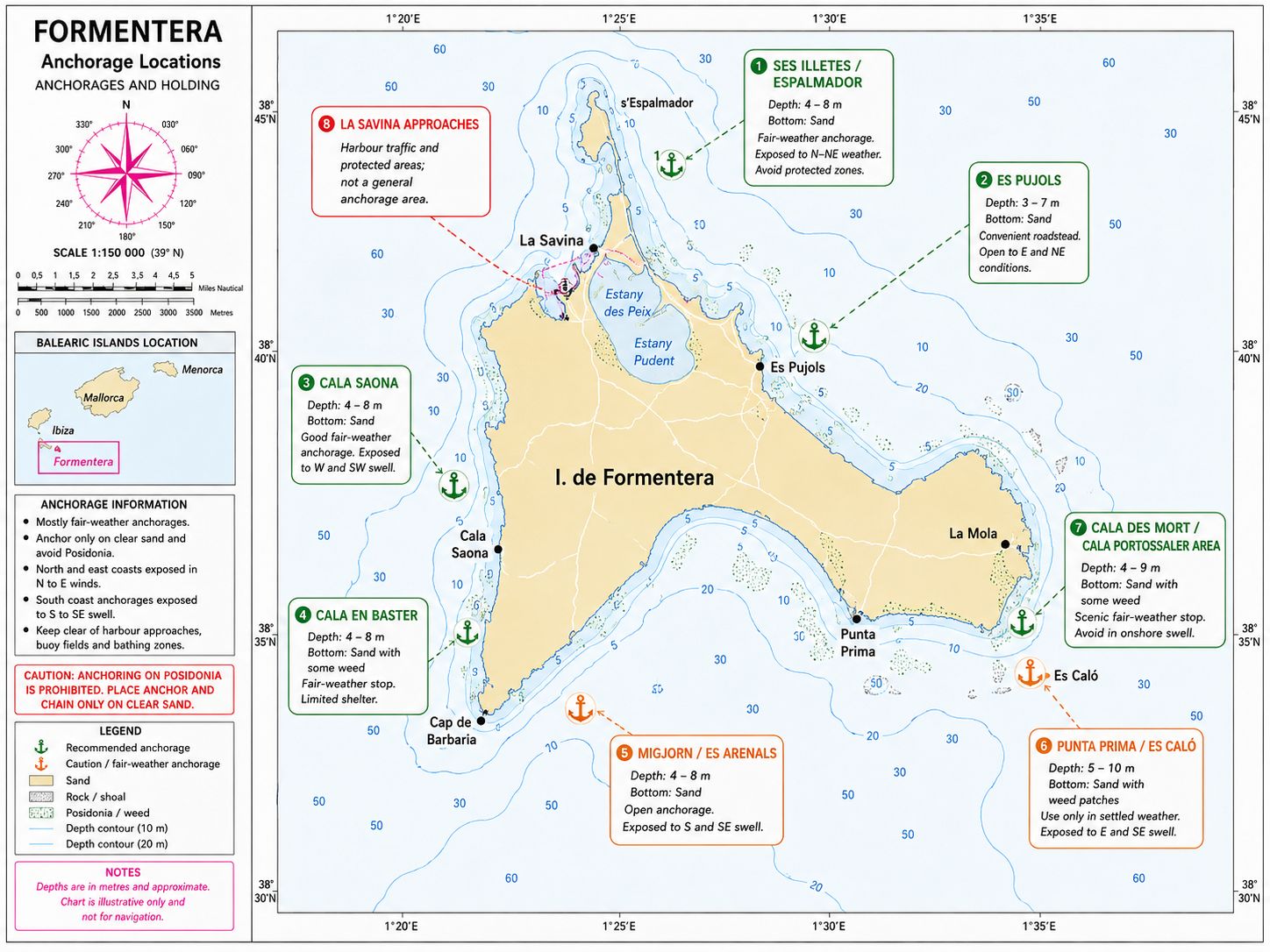
- Ses Illetes/Espalmador. Northern anchorage area, used in settled weather and often controlled by buoy fields or environmental restrictions. Anchor or take buoys in about 4–8 m, with sand in the permitted areas and Posidonia nearby. Holding in sand is good, but the area is exposed to N–NE weather and affected by traffic in the Ibiza–Formentera channel. Use only permitted anchoring areas and avoid Posidonia.
- Es Pujols. East-north-east roadstead anchorage. Anchor in about 3–7 m over sand, with weed patches to avoid. It is open to E and NE conditions and should be used only in settled weather. Holding is good where the anchor is set in clean sand.
- Cala Saona. West-coast anchorage. Anchor in about 4–8 m over sand, with generally good holding. It is affected by W and SW swell and can become untenable with westerly weather. It is not a refuge in Ponent or Mestral.
- Cala en Baster. West to northwest sector, smaller and more confined. Anchor in around 4–8 m where sand can be found, with weed and rock close in. Fair-weather stop only. Use clear light and do not anchor on seagrass.
- Migjorn/Es Arenals. South-coast open-roadstead anchorage. Anchor in about 4–8 m over sand. It is open to S and SE swell and should be used only in settled weather. Holding is good in sand, but the open coast gives little protection.
- Punta Prima/Es Caló sector. East and southeast approach area. Anchor in about 5–10 m where sand is available, with weed patches and rocky ground nearby. The area is exposed to E and SE swell and is not suitable in onshore conditions.
- Cala des Mort/Cala Portossaler area. East of the south coast near La Mola. Anchor in about 4–9 m over sand with weed patches. Use only in settled weather, with good light and careful seabed selection.
- La Savina approaches. Not a general anchorage. Harbour traffic, ferry wash, mooring zones and protected seabed restrict use. Use the port or designated buoy/anchoring areas instead.
Formentera
Balearics Sailing Guide - Entry
Formalities
Spain and the Balearic Islands are within the Schengen Area and the EU customs territory, so yachts arriving from another Spanish or Schengen/EU port normally do not complete full border clearance again. Yachts arriving from a non-Schengen port must clear through an authorised port of entry, for practical yacht clearance, the main Balearic entry ports include Palma, Alcudia, Ibiza, Mahon and La Savina. The usual formalities include crew passports handled by the Frontier Police and vessel/customs formalities handled through the appropriate Spanish authorities. Since 10 April 2026, the EU Entry/Exit System records non-EU short-stay entries and exits electronically rather than by passport stamping. Non-EU visitors remain subject to Schengen short-stay limits, normally 90 days in any 180-day period, unless they hold a visa or residence status allowing longer stay. Non-EU flagged yachts may also need to consider Temporary Admission rules for EU waters, commonly allowing private non-EU yachts used by non-EU residents to remain in EU customs territory for up to 18 months without VAT/import duty being due, provided the conditions are met.
Communications equipment normally used on cruising yachts does not require harbour-specific clearance, but drone use is regulated under Spanish and EU UAS rules. AESA states that drone operators must register in the member state of residence or activity and that the operator registration number must be included on the operator’s drones. Starlink use should be checked against the service plan and local availability; Starlink states that in-motion use in territorial waters requires local government approval and may not be available in all regions.
Formentera
Balearics Sailing Guide - Ports
and Harbours
The only true yacht harbour on Formentera is La Savina, which is the island’s ferry port, marina harbour, fuel point, water point and main service base. All visiting yachts requiring berthing, diesel, potable water, waste disposal, repairs, formal port contact or ferry-port access should treat La Savina as the single harbour reference for the island. The rest of Formentera is an anchorage coast rather than a port coast, with Ses Illetes, Espalmador, Cala Saona, Es Pujols, Migjorn/Es Arenals, Es Caló and the La Mola/Punta Prima sector used only according to wind direction, swell, seabed, Posidonia restrictions and buoy-field rules. These locations should be linked from the hub as anchorage or local cruising guides rather than marina or port
Formentera
Balearics Sailing Guide - Marina
Facilities
La Savina is the only marina and harbour facility for yachts on Formentera. The port has more than 150 moorings managed by Marina La Savina and Port Formentera Marina. Marina La Savina is located on the west harbour, and Port Formentera Marina operates within the same port area.
Marina Formentera Mar/Port Formentera Marina is a small marina with 90 berths, a fuel station, crane and travel lift, plus bilge collection, toilets, showers, laundry, electricity and water at berths. Draft and berth limits should be confirmed directly because published marina limits vary by operator and berth position. The port is busy in season and should not be entered expecting unallocated space.
Formentera
Balearics Sailing Guide - Provisioning
Supermarkets. Formentera’s main provisioning area is La Savina, Sant Francesc Xavier, Sant Ferran and Es Pujols. La Savina Supermarket is at Av. Mediterránea, with a butcher’s shop selling Formentera lamb subject to availability. És Bàsi /Supermercats de Formentera is a local supermarket chain. For yacht provisioning, La Savina is the most practical point because it is adjacent to the port. Sant Francesc and Sant Ferran provide additional grocery options by road. Stock levels and opening hours vary seasonally, especially outside summer.
Markets. Formentera markets include La Savina Market and La Mola Market. La Savina’s market operates in season near the port, from 0:00 until midnight. Local produce may include island vegetables, fruit, cheese, bread, honey, herbs and preserved products when available, but supermarket provisioning is more reliable for a yacht. Sant Francesc and Sant Ferran are the better road-linked villages for food top-ups outside the port.
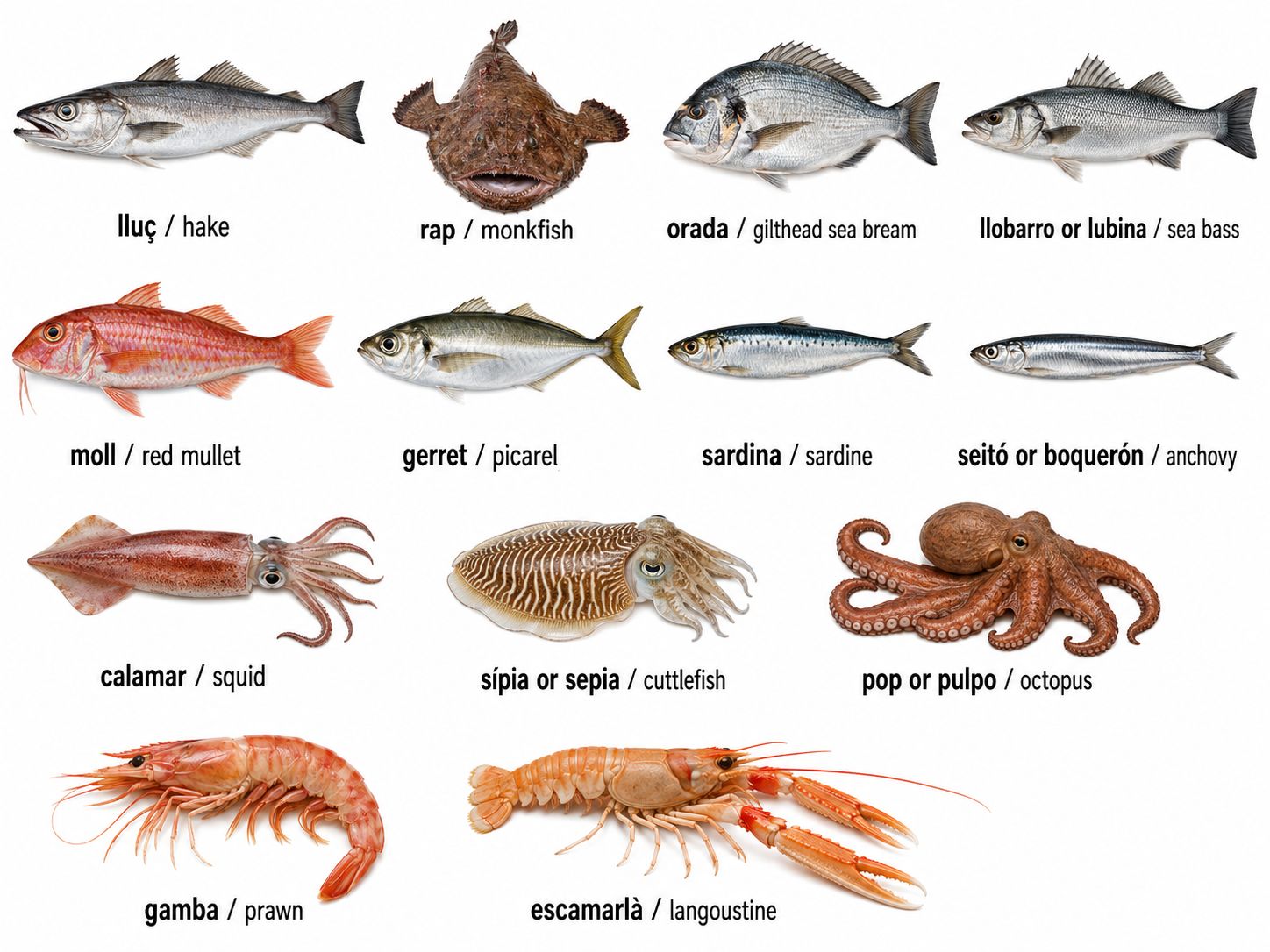
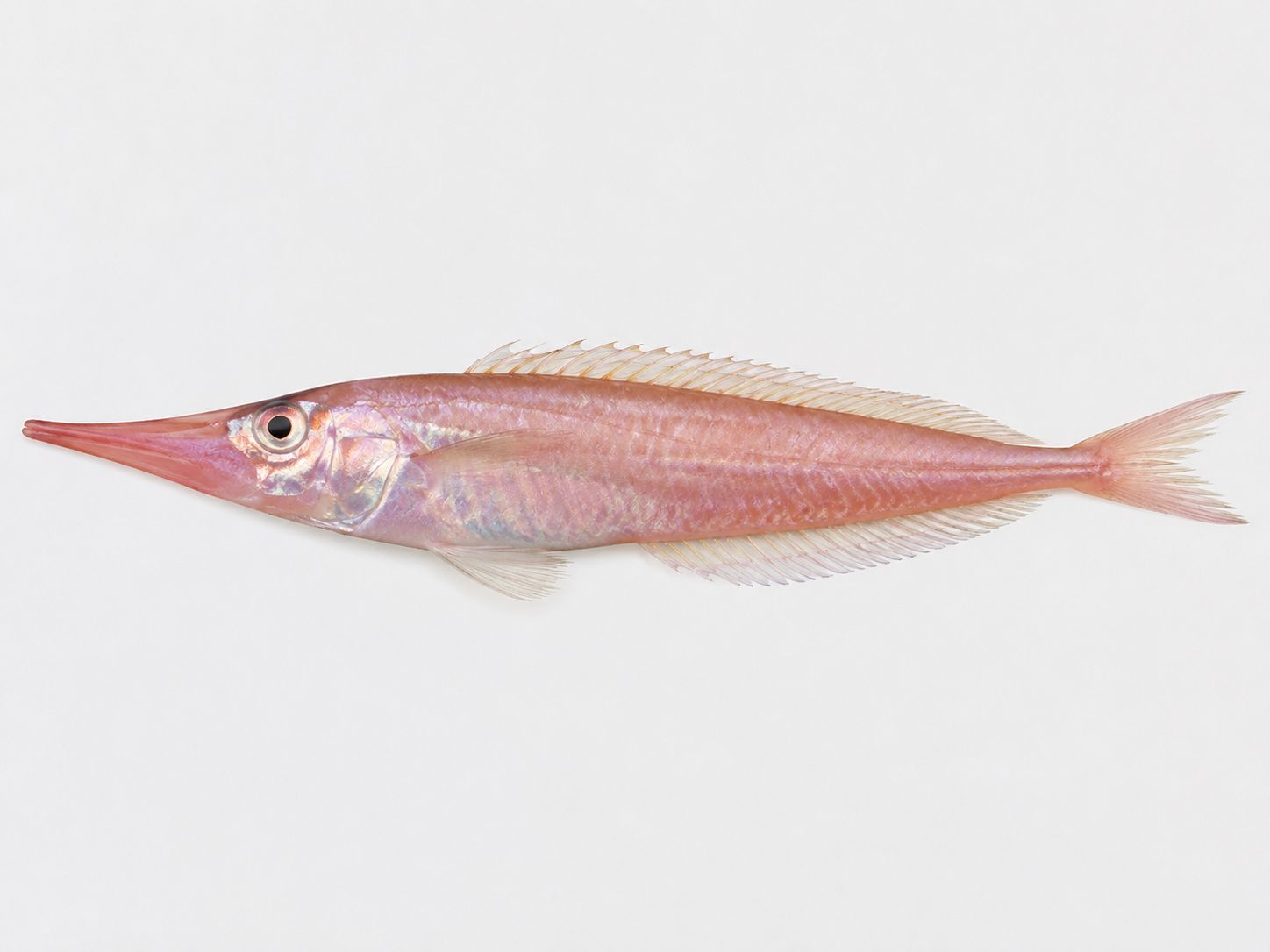
Fish Markets. Formentera does not have a large public fish market. Fish supply is normally through local fishmongers, supermarket counters or direct local contacts when fish is landed. Availability depends on season, fishing conditions and daily supply. Common Balearic and Pityusic seafood names include llampuga for mahi-mahi/dolphinfish in season, dorada for gilt-head bream, lubina for sea bass, raor for pearly razorfish where legally available in season, calamar for squid, sepia for cuttlefish, gamba roja for red prawn, rape for monkfish and pulpo for octopus.
Formentera
Balearics Sailing Guide - Local
Cuisine
Formentera food is based on fish, dried fish, lamb, bread, vegetables, figs, almonds, olive oil and island salt. The island’s most specific dish is ensalada payesa, a country salad often made with dried fish, potato, pepper, onion and bread. Peix sec, or dried fish, is a local Formentera product associated with traditional preservation. Bullit de peix, fish stew, and arroz a banda, rice cooked after fish stock, are common Pityusic and Balearic dishes. Other relevant dishes include sofrit pagès, a meat and potato dish; flaó, a mint and cheese tart associated with Ibiza and Formentera; orelletes, fried sweet pastries; pa amb oli, bread with tomato and olive oil; and grilled local fish. For a yacht galley, local products worth provisioning include Formentera lamb where available, dried fish, island cheese, figs, almonds, olives, bread and seasonal vegetables.
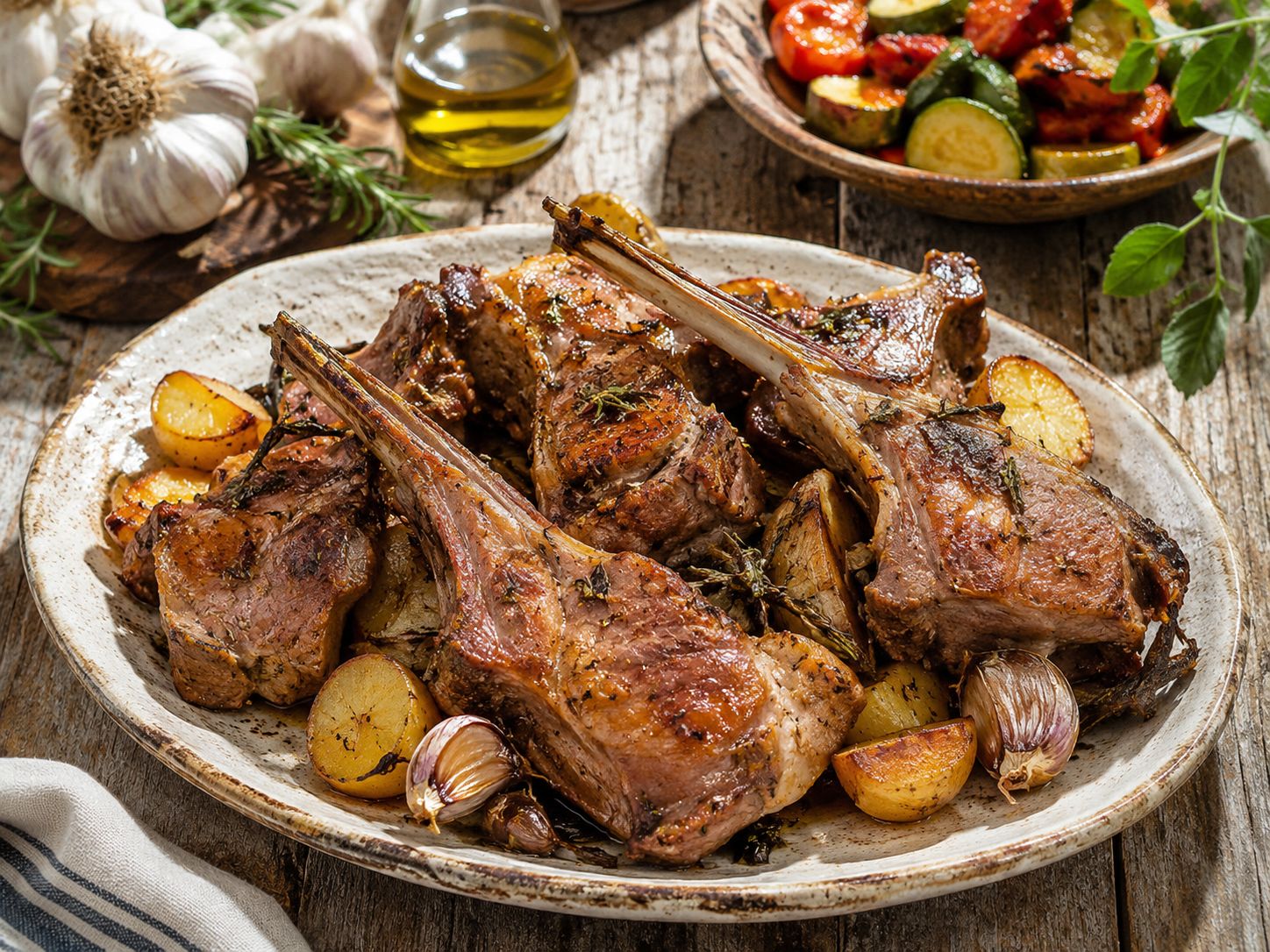
Formentera lamb is a local island product from sheep raised in a dry, low-vegetation environment where grazing is based on scrub, herbs, cereal stubble and sparse pasture rather than rich grass. The meat is typically leaner and more concentrated in flavour than lamb from wetter regions, with a clear saline and herbal character linked to the island’s climate and vegetation. The availability is limited and seasonal, so it is best sourced through local butchers or supermarkets in La Savina, Sant Francesc or Sant Ferran. Reminds me of some of the English salt flat lambs and those in France as well. Worth tasting if you like lamb!
Formentera
Balearics Sailing Guide - Local
Beverages
Local beverages are shared with Ibiza and the wider Balearics. Hierbas Ibicencas is the main local herbal liqueur associated with Ibiza and Formentera, made with anise and local herbs. Mallorcan-style palo and Balearic herb liqueurs may also be found, but Hierbas Ibicencas is the relevant local spirit for the Pityusic islands. Beer, wine, soft drinks, bottled water and ice are available from La Savina and village supermarkets.

Formentera has no large-scale marina provisioning system for beverages outside La Savina. Crews anchoring around the island should buy drinking water, soft drinks and other stores before leaving the port. In summer, high water consumption and limited shore access from some anchorages make water planning more important than food availability.
Formentera
Balearics Sailing Guide - Diesel
Fuel Supplies
Diesel is available at La Savina through the marina/port fuel facilities. Marina Formentera Mar is listed as having a fuel station, and marina booking listings also identify fuel as an available amenity. Fuel should be treated as a port fuel stop rather than an outer-coast service. There are no practical diesel supplies at the anchorages around the island. Fuel access should be confirmed with the marina before arrival because the port is busy with ferries and yachts in season. Skippers should check opening hours, berth depth at the fuel point, payment method and whether petrol is available if required for tenders.
Formentera
Balearics Sailing Guide - Water
Supplies
Potable water is available at La Savina marina berths. Marina Formentera Mar lists water and electricity at berths, and other marina listings identify water among the port amenities. Water is berth-based, so a yacht at anchor should not assume access unless a berth, alongside position or marina instruction has been arranged. Formentera is a small island with high seasonal demand, so yachts should manage water as a limited provisioning item.
Mechanical
and Electrical Repairs Resource
If you are headed somewhere in the Mediterranean or Spain or somewhere more remote consider the need to expand your knowledge base or have an information resource on board. Why not get a copy of my book The Marine and Electrical and Electronics Bible 4th Edition. with everything from batteries and charging, solar and wind, diesel engines and marine electronics and so much more. Your complete systems guide. 650 pages of practical advice. In Australia and New Zealand order a copy through Boat Books. UK and European boats can buy the UK Edition Here. US and Canadian boats can get the US Edition Order Here. Marine systems are my profession so let me help you DIY and save some valuable technician callout rates. This is by a cruising yachtsman and liveaboard boat owner for other boat owners.


Formentera
Balearics Sailing Guide - Marine
Services
Marine services are concentrated at La Savina. Marina Formentera Mar lists a service station for boats, crane, boat ramp, travel lift, winter storage, bilge collection and nautical waste disposal. This indicates basic yacht support and haul/launch capability inside the port. Complex engine, electronics, rigging and specialist repairs may still need to be sourced from Ibiza because Formentera’s service base is smaller.
Formentera
Balearics Sailing Guide - Local
Etiquette
Formentera has strict practical etiquette around anchoring because Posidonia is protected and the island has heavy seasonal pressure. The rule is operational: anchor and chain on sand only, not on seagrass. Anchoring over Posidonia is prohibited and that ecological buoys are used in protected areas. Skippers should use buoy fields where required and should not drag chain across weed margins. Harbour etiquette at La Savina is also important because ferries and commercial traffic have priority. Do not obstruct ferry approaches, fuel access, marina fairways or commercial quays. Keep wash down inside the harbour and around dinghy traffic. At anchorages, keep clear of swimming zones, day-boat lanes and buoy fields. Shore access by dinghy should avoid marked swim areas and protected dunes.
Formentera
Balearics Sailing Guide - Summary
Formentera is a single-port cruising island, with La Savina as the only full harbour and marina base. The outer coast is an anchorage coast, not a port coast, and every stop depends on wind direction, seabed, swell and Posidonia restrictions. The most important operational areas are La Savina, Es Freus, Ses Illetes, Espalmador, Cala Saona, Migjorn, Es Pujols and the La Mola/Punta Prima sector. Formentera should be planned as a shallow, protected-seabed, fair-weather anchoring destination using this Formentera Balearics Sailing Guide for all you need to know.