Ermioni Greece Sailing Guide
Ermioni Greece Sailing Guide. Ermioni is a small coastal port town located on the south-eastern side of the Argolis Peninsula in the eastern Peloponnese. Positioned between the Saronic Gulf and the Argolic Gulf cruising routes, Ermioni functions as an established stopover for yachts transiting between Hydra, Spetses, Porto Heli, and the eastern Peloponnese mainland. The town is built on a narrow peninsula with harbour facilities on both the northern and southern sides, providing a range of anchoring and quay berthing options depending on prevailing weather conditions. The surrounding coastline consists of low hills, rocky points, and sheltered bays with generally good holding conditions in mud and sand.
For cruising yachts Ermioni is primarily valued for its protected harbour approaches, reliable provisioning access, and relatively sheltered overnight stopping conditions in the Saronic region. The northern harbour provides the main town quay and organised berthing area, while the southern side offers additional anchoring space in calmer weather. The area experiences typical eastern Peloponnese summer weather patterns with moderate Meltemi influence, though the surrounding landmass reduces the severity of sea state compared with more exposed Aegean locations. Ermioni maintains year-round local population and commercial activity, with fuel availability, supermarkets, produce suppliers, tavernas, and basic marine services supporting visiting vessels throughout the cruising season.
Ermioni Greece
Sailing Guide - History
The history of Ermioni extends back to antiquity, with the settlement identified as the ancient city of Hermione, an important maritime and trading centre in the eastern Peloponnese. Archaeological evidence indicates habitation from the prehistoric and Mycenaean periods, with the town later developing into an established independent city-state during the Classical era. Its strategic location along sea routes linking the Argolic Gulf, Saronic Gulf, and wider Aegean enabled the growth of shipping, fishing, trade, and maritime industries. Ancient Hermione was particularly known for the production of Tyrian purple dye derived from murex shellfish collected in the surrounding waters, an industry that brought considerable regional importance and commercial wealth.
During the Byzantine, Venetian, and Ottoman periods Ermioni continued as a small coastal settlement supporting fishing, local agriculture, and regional maritime activity. The protected natural harbour and proximity to the islands of Hydra and Spetses maintained its role as a local trading and transport point throughout the centuries. During the Greek War of Independence the area supported naval and supply operations associated with nearby island fleets. In modern times Ermioni developed into a year-round coastal town while retaining its traditional harbour structure and fishing fleet activity. Today the town remains an active cruising stop within the eastern Peloponnese and Saronic Gulf sailing network, combining permanent local infrastructure with seasonal yacht traffic.
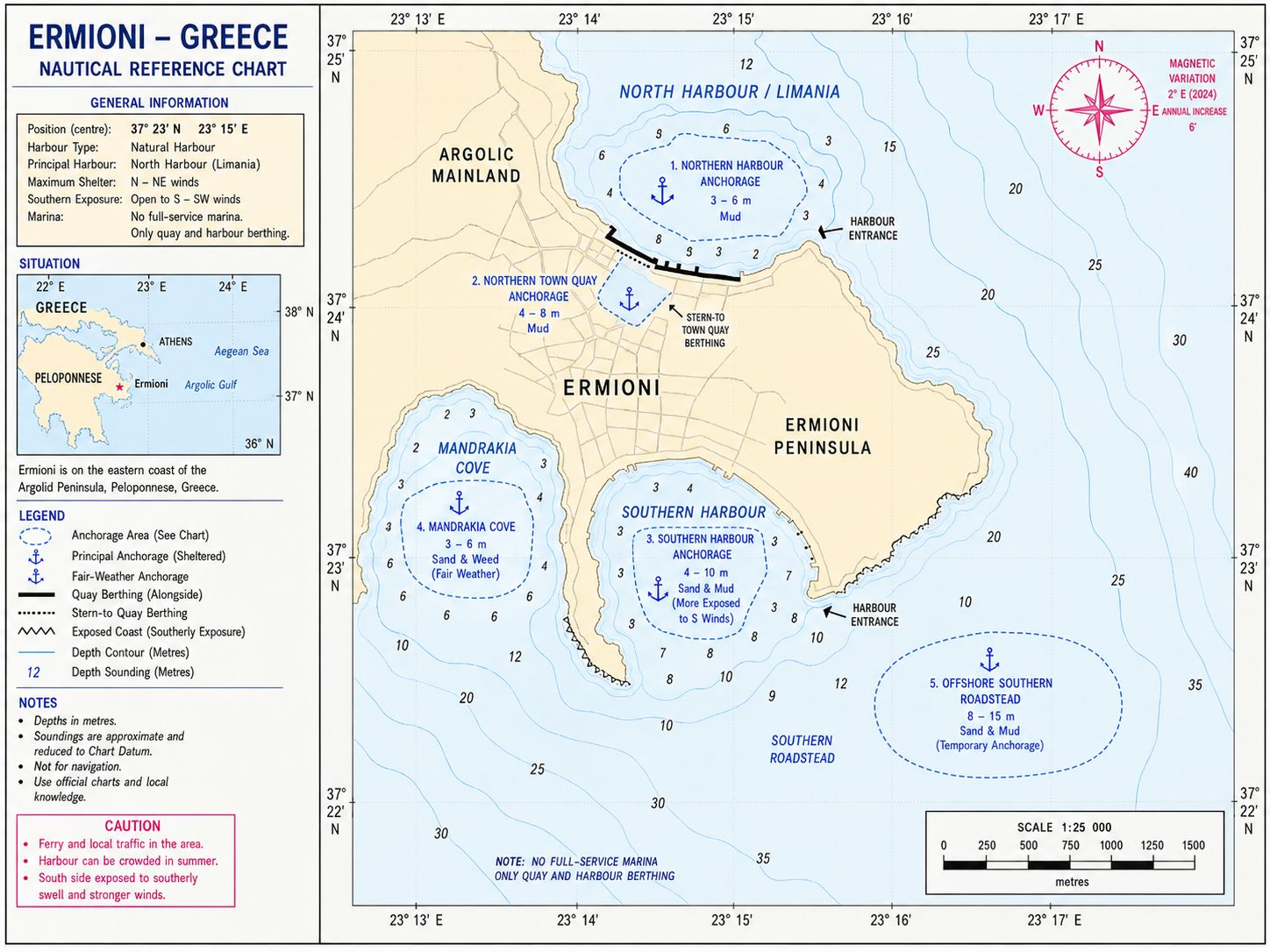
Chart Disclaimer. This chart is a schematic representation for illustrative purposes only and must not be used for navigation. Refer to official hydrographic charts for safe navigation. Be aware ENC charts may differ from official hydrographic charts. Both should be corrected and updated regularly.
Ermioni Greece
Sailing Guide - Ocean Currents and Tidal Flow
The waters surrounding Ermioni are influenced primarily by local wind-driven circulation within the eastern Peloponnese and Saronic Gulf region rather than significant tidal movement. Tidal range is minimal, commonly less than 0.3 metres, and tidal streams are generally weak with little operational impact on yacht navigation, harbour entry, or anchoring. Surface current flow is typically governed by prevailing seasonal wind patterns, local coastal geometry, and pressure-driven circulation between the Argolic Gulf and adjacent Saronic waters. In settled summer conditions currents are usually light and variable, although localized acceleration can occur around headlands and harbour entrances during stronger northerly wind events.
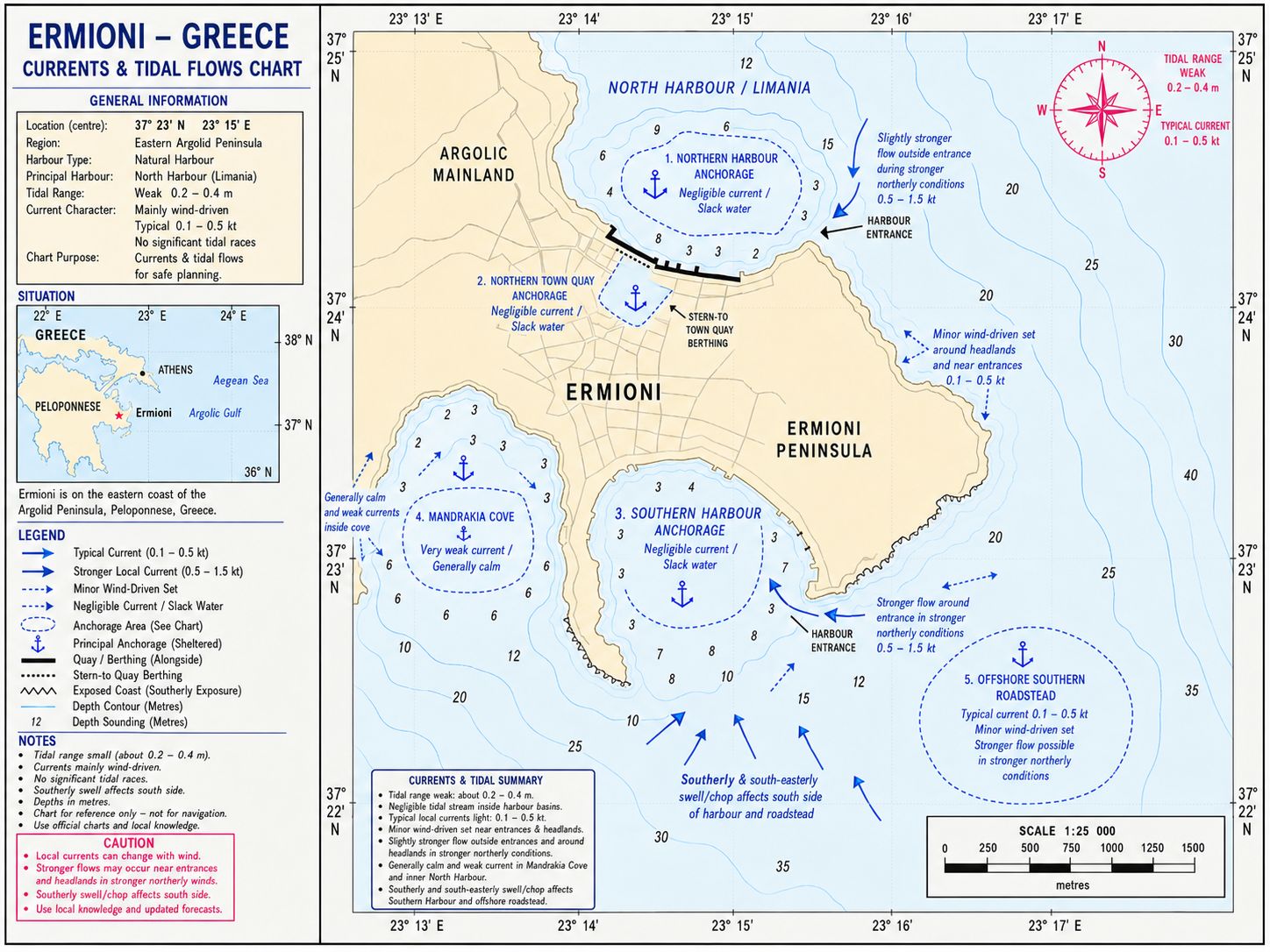
Northerly Meltemi conditions affecting the wider Aegean can generate moderate wind-driven set and short sea development around the exposed coastal sections near Ermioni, particularly outside the shelter of the harbour peninsula. Southerly weather systems occasionally introduce longer-period swell into the surrounding coastal waters, although the harbour areas themselves remain comparatively protected. Minor rebound swell and cross-chop may occur between the northern and southern harbour basins during periods of increased vessel movement or stronger local winds. Offshore depths increase gradually around the approaches, and there are no significant tidal races, overfalls, or hazardous current systems affecting normal cruising yacht operations in the area.
Ermioni Greece
Sailing Guide - Weather
The climate at Ermioni is typically eastern Mediterranean with hot dry summers, mild winters, and relatively low annual rainfall concentrated between late autumn and early spring. During the main cruising season from May through October conditions are generally stable with prolonged periods of clear skies, strong solar exposure, and good visibility. Summer daytime temperatures commonly range between 28°C and 35°C, while sea temperatures remain warm into late autumn. The surrounding hills and peninsulas provide partial protection from more severe open Aegean sea conditions, making Ermioni comparatively sheltered compared with many exposed island locations further east.
Seasonal weather patterns are influenced by northerly Meltemi systems affecting the Aegean during summer, although the strength of these winds is usually moderated by the eastern Peloponnese landmass and nearby islands including Hydra and Spetses. Afternoon sea breezes commonly develop during settled weather and may strengthen local harbour gusts. Winter and transitional seasons bring more variable conditions with passing Mediterranean frontal systems producing southerly winds, rainfall, thunderstorms, and occasional gale conditions. Harbour areas generally remain navigable in most weather, although exposed outer anchorage areas can become uncomfortable during prolonged southerly or easterly sea states.
The Marine Electrical and Electronics Bible has a complete list of Greek VHF Radio Channel information and weather forecast times for Greece along with NAVTEX UK and Europe and NAVTEX Mediterranean for 490kHz and 518kHz.
Ermioni Greece
Sailing Guide - Local Winds
Local wind patterns around Ermioni are influenced by the interaction between regional Aegean weather systems and the surrounding topography of the eastern Peloponnese and nearby islands. During the main summer cruising season prevailing winds are typically from the north to north-east under the influence of the Meltemi circulation affecting the wider Aegean. Wind strengths in the immediate Ermioni area are generally lower than in the more exposed central Aegean islands due to the sheltering effect of the mainland coastline and the islands of Hydra and Spetses. Afternoon sea breezes commonly develop in settled conditions and can strengthen localized gusts within the harbour entrances and around the headlands bordering the town peninsula.
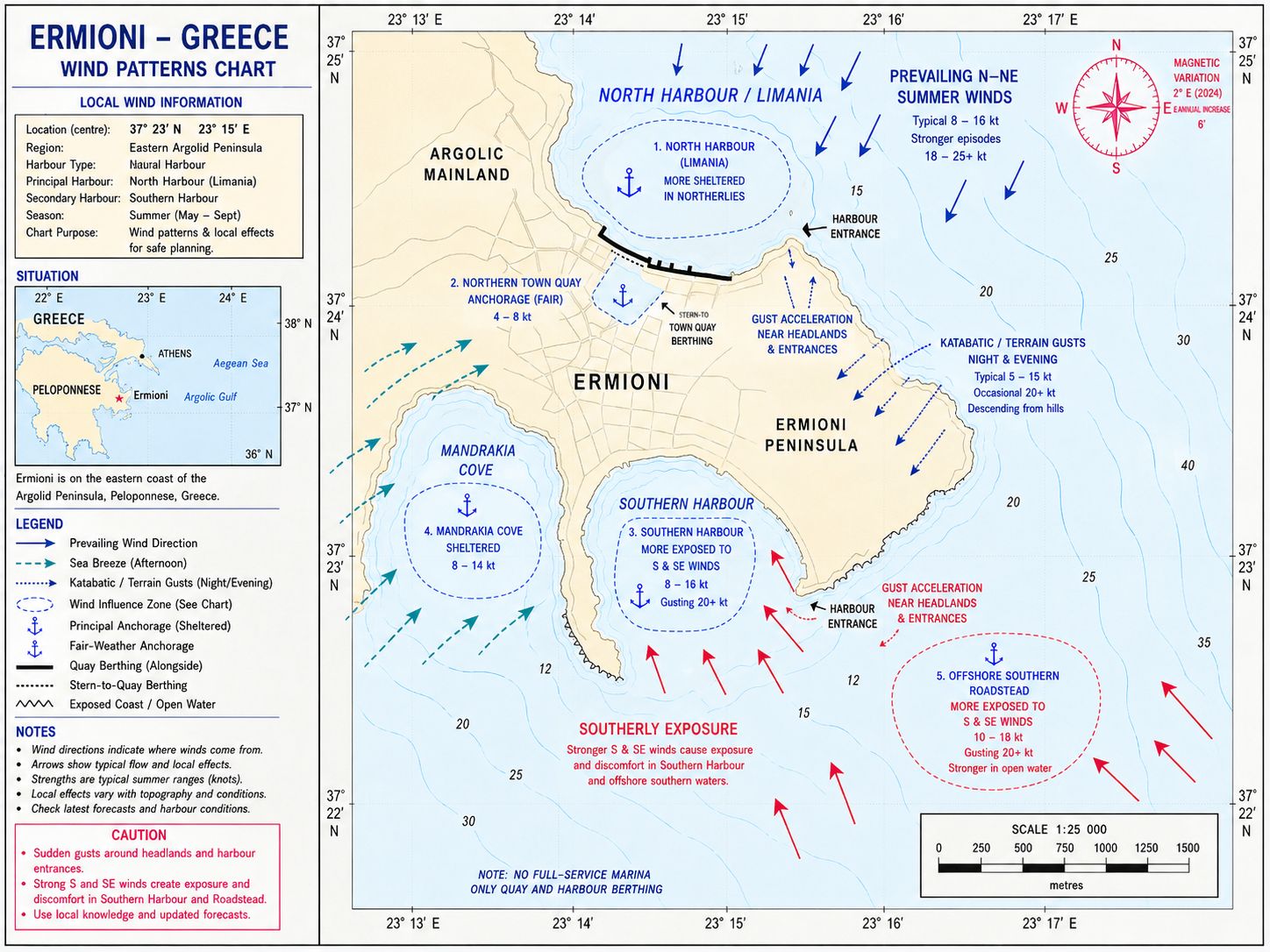
Katabatic and terrain-influenced gusts occasionally descend from the surrounding hills during evening and overnight periods, producing short-duration wind shifts and variable airflow within the harbour basins. Southerly and south-easterly winds occur less frequently but can generate more uncomfortable sea conditions in exposed anchorages outside the harbour protection. During winter and transitional seasons frontal systems moving through the eastern Mediterranean may produce strong easterly or south-westerly winds accompanied by rain and reduced visibility. While the harbour areas remain comparatively sheltered in most conditions, localized turbulence and rebound wave action can develop along the town quays during prolonged strong wind events.
Ermioni Greece
Sailing Guide - Approaches
Approaches to Ermioni are generally straightforward in most weather conditions with well-defined coastal features and good visual references from offshore. The town is situated on a narrow peninsula extending southward from the eastern Peloponnese coastline, with harbour areas located on both the northern and southern sides of the peninsula. Approaching vessels from the Saronic Gulf, Hydra, or Spetses normally encounter deep offshore water with gradual shoaling toward the harbour approaches. Navigation is uncomplicated in daylight, although seasonal ferry traffic, fishing vessels, and local recreational craft require monitoring near the harbour entrances during summer months.
The northern harbour provides the principal yacht and town quay access and is approached through open water with no significant offshore dangers provided reasonable clearance is maintained from the shoreline projections. Depths generally remain adequate for cruising yachts throughout the approach channel, although manoeuvring space can become restricted during peak season due to anchored and berthed vessels. The southern side of the peninsula offers additional anchoring and temporary berthing areas in calmer conditions but may experience greater swell penetration during southerly weather. Strong northerly winds can create gust acceleration around the harbour entrances and headlands, while southerly systems may introduce cross swell and rebound sea state into exposed sections of the anchorage areas. Night approaches are generally practical with town lighting providing clear identification of the harbour area, though caution is required regarding unlit small craft and moored vessels near the waterfront.
Ermioni Greece
Sailing Guide - Navigation
Navigation within Ermioni is centred on the two harbour areas located on either side of the narrow town peninsula. The northern harbour functions as the principal yacht basin and town quay area, providing the most protected and operationally practical berthing location for visiting cruising vessels. Entry is uncomplicated with adequate depths for most yachts, although manoeuvring space may become limited during summer due to heavy seasonal vessel density, laid moorings, anchored craft, fishing boats, and excursion traffic. Depths along sections of the town quay generally range from approximately 2–4 metres, varying according to position and seabed slope. Stern-to and side-to berthing are both used depending on vessel size and congestion levels. Holding in the harbour anchoring areas is predominantly mud with good anchor security where space permits.
The southern side of the peninsula provides additional anchoring and temporary mooring opportunities in more settled weather conditions. This area is more exposed to southerly swell and rebound sea state and is generally less suitable during unstable weather. Careful attention is required to anchor swing radius and crossing anchor chains in both harbour basins due to congestion during peak cruising months. Local ferries and commercial traffic should be given unobstructed manoeuvring room near the quay approaches. Wind gusts accelerated around the peninsula and surrounding hills can affect low-speed manoeuvring, particularly during strong northerly conditions. Fuel delivery, water supply access, and basic yacht services are available within the harbour area, though quay occupancy frequently requires early arrival during the summer season.
Ermioni Greece
Sailing Guide - Chart Accuracy
Hydrographic charts accurately depict coastline and harbour configurations. Electronic charts align with official data. Caution is required for anchor fouling due to debris and moorings. Depth soundings are reliable but should be verified when anchoring close to shore.
Ermioni Greece
Sailing Guide - Anchorages
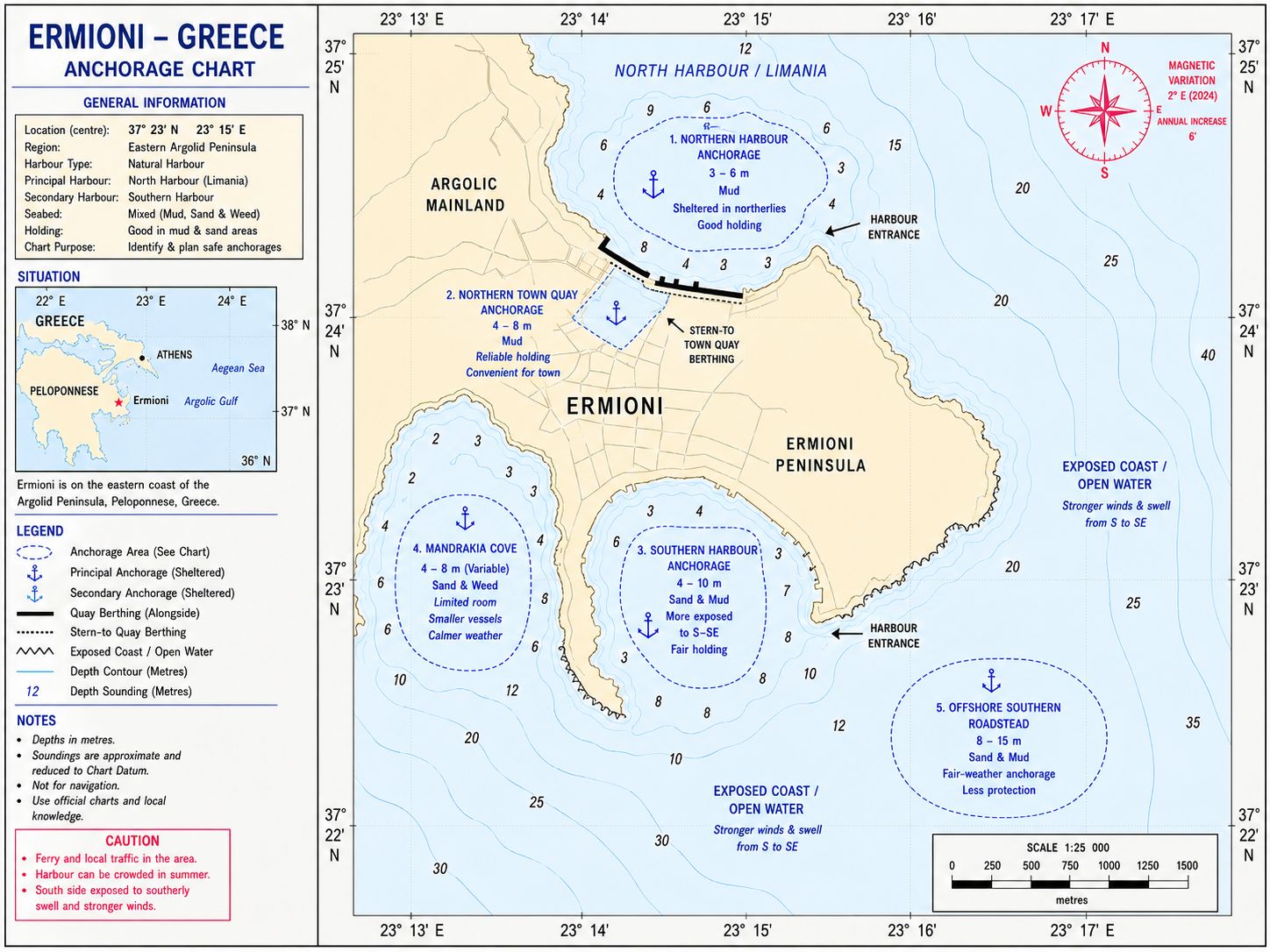
Ermioni anchorage options are limited but operationally useful. There are no all-weather anchorages.
- Northern Harbour Anchorage. The principal anchorage at Ermioni is located within the northern harbour basin adjacent to the main town quay. Depths generally range from 3–6 metres over mud with good holding characteristics. This area provides the best protection from prevailing northerly conditions and is commonly used by cruising yachts waiting for quay space or remaining at anchor overnight. Manoeuvring space can become restricted during peak summer periods due to dense anchoring and laid mooring systems associated with stern-to berthed vessels. Care is required to avoid fouling harbour moorings and crossed anchor chains.
- Northern Town Quay Anchorage. Additional anchoring space exists off the northern town waterfront outside the immediate quay berthing area. Depths gradually increase from approximately 4–8 metres with predominantly mud bottom and reliable holding. This area remains relatively sheltered in normal summer conditions but may experience harbour wash and reflected chop from vessel movement. Access to shore services, provisioning, fuel delivery, and water supply is straightforward from this anchorage position.
- Southern Harbour Anchorage. The southern side of the Ermioni peninsula provides a secondary anchorage area suitable in settled or moderate northerly weather. Depths generally range between 4–10 metres over sand and mud patches with mostly good holding. The anchorage is more open than the northern harbour and can become uncomfortable during southerly or south-easterly conditions due to swell penetration and rebound sea state. This area is often used when northern harbour congestion prevents anchoring or berthing availability.
- Mandrakia Cove. On the south-western side of the peninsula a small cove locally known as Mandrakia provides limited anchoring opportunities for smaller vessels in calm weather. Depths are variable with mixed sand and weed bottom. Space is restricted and manoeuvring can be difficult when local fishing craft are present. Shelter is acceptable in northerly conditions but poor in southerly weather. Primarily suitable for short stays or daytime use rather than extended overnight anchoring.
- Offshore Southern Roadstead. In stable summer weather temporary anchoring is possible further south-east of the peninsula outside the main harbour areas. Depths commonly range from 8–15 metres over sand and mud with reasonable holding. These positions provide less protection from wind and swell but may be useful during periods of heavy harbour congestion. Exposure increases rapidly with any southerly sea state development, and overnight comfort may deteriorate quickly in changing weather conditions.
Ermioni Greece
Sailing Guide - Entry Formalities
Entry formalities follow standard Greece procedures for visiting yachts. This is not a designated port of entry for international clearance, and there are no customs or immigration facilities on the island. Vessels arriving from outside Greece or the Schengen Area must first clear into the country at an official port of entry before proceeding to this port. Direct arrival from a non-Schengen country is not permitted. The Greek cruising tax (TEPAI) must be valid and paid, and the vessel’s cruising log (DEKPA for non-EU vessels, or transit log where applicable) should be up to date and available for inspection if requested by port authorities or coastguard.
Ermioni Greece
Sailing Guide - Marina Facilities
Ermioni does not have a dedicated full-service marina complex, however the town provides extensive public quay berthing and harbour mooring facilities suitable for visiting cruising yachts. The principal berthing area is located along the northern harbour waterfront where yachts berth stern-to or side-to on the town quay. Depths alongside generally range from approximately 2–4 metres depending on location and seasonal silting variations. Quay surfaces are conventional concrete harbour construction with bollards and mooring points distributed along much of the waterfront.
Off Town Quay Anchorage lies immediately off the northern waterfront quay inside Limania. It is an open harbour anchorage, not an enclosed basin. Enter the north harbour from the east, keep clear of the harbour entrance and local craft, then anchor off the town quay in about 4–8 m over mud, allowing room for yachts berthing stern-to along the quay. Do not anchor so close that swinging room, ferry/local boat movement, or stern-to berthing operations are obstructed.
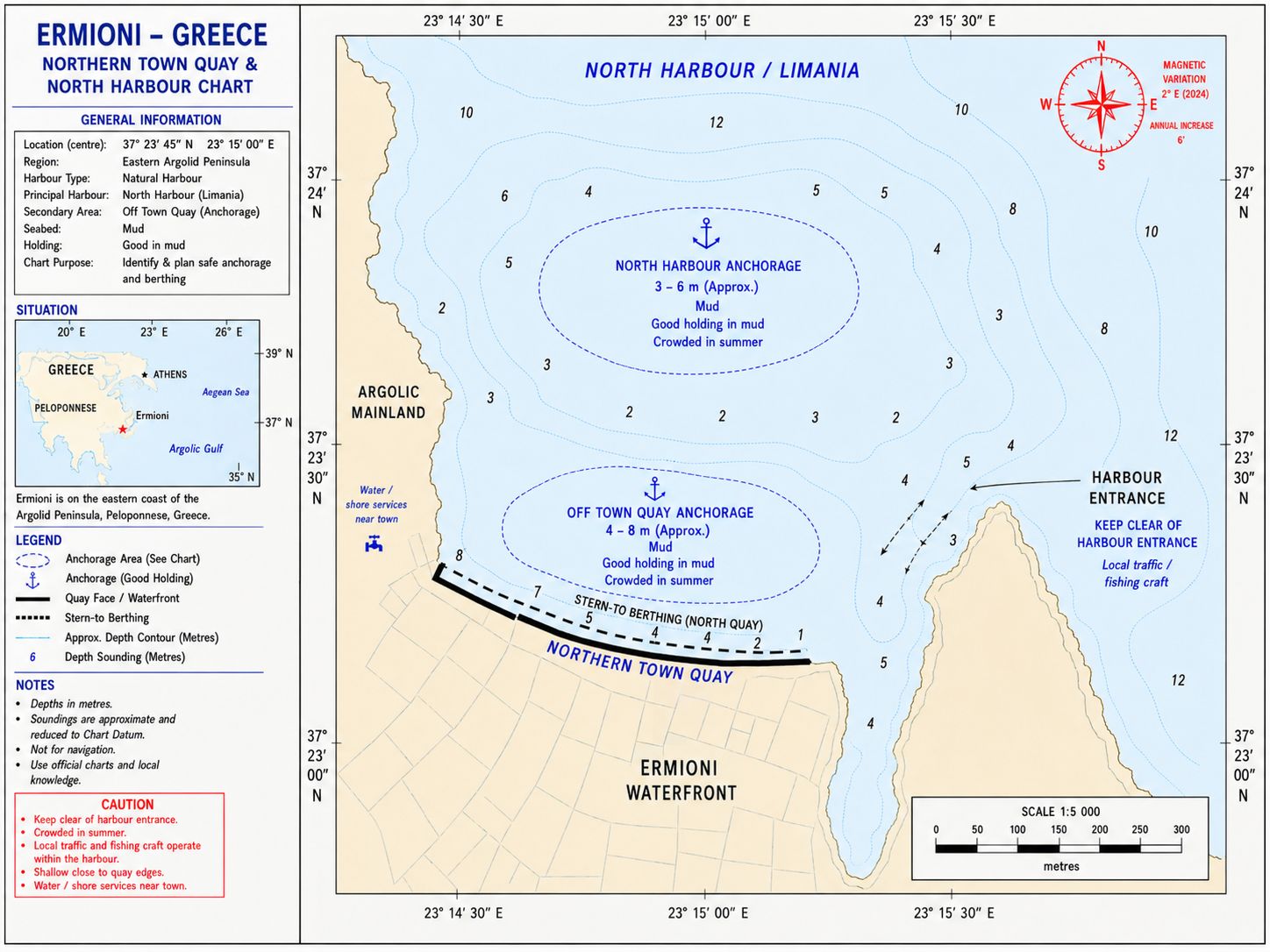
The northern harbour provides the most protected berthing conditions in prevailing summer northerly weather and is the primary operational base for visiting yachts. Harbour occupancy becomes high during peak cruising months, particularly with vessels transiting between Hydra, Spetses, and the eastern Peloponnese. Additional berthing and anchoring opportunities exist on the southern side of the peninsula, though these positions are more exposed to southerly swell and weather changes
Ermioni Greece
Sailing Guide - Provisioning
Supermarkets. Supermarkets in Ermioni include AB Vassilopoulos Supermarket, Kritikos Supermarket, Kritikos Ermioni Port Supermarket, Mini Market Kava, Aslanis Fruit Market and Dimarakis Fruit and Vegetable Market. Most are located within walking distance of the northern harbour and town quay.
Markets. Fresh produce is available through local fruit and vegetable shops, small grocers, and periodic street market trading near the harbour area. Main produce outlets include Aslanis Fruit Market, Dimarakis Fruit and Vegetable Market and local greengrocers along the northern harbour waterfront. Seasonal produce typically includes tomatoes, cucumbers, peppers, onions, potatoes, citrus, melons, grapes, olives, herbs, and locally grown greens from the Argolis region. Limited seasonal street market trading also occurs with locally supplied produce and olive products.
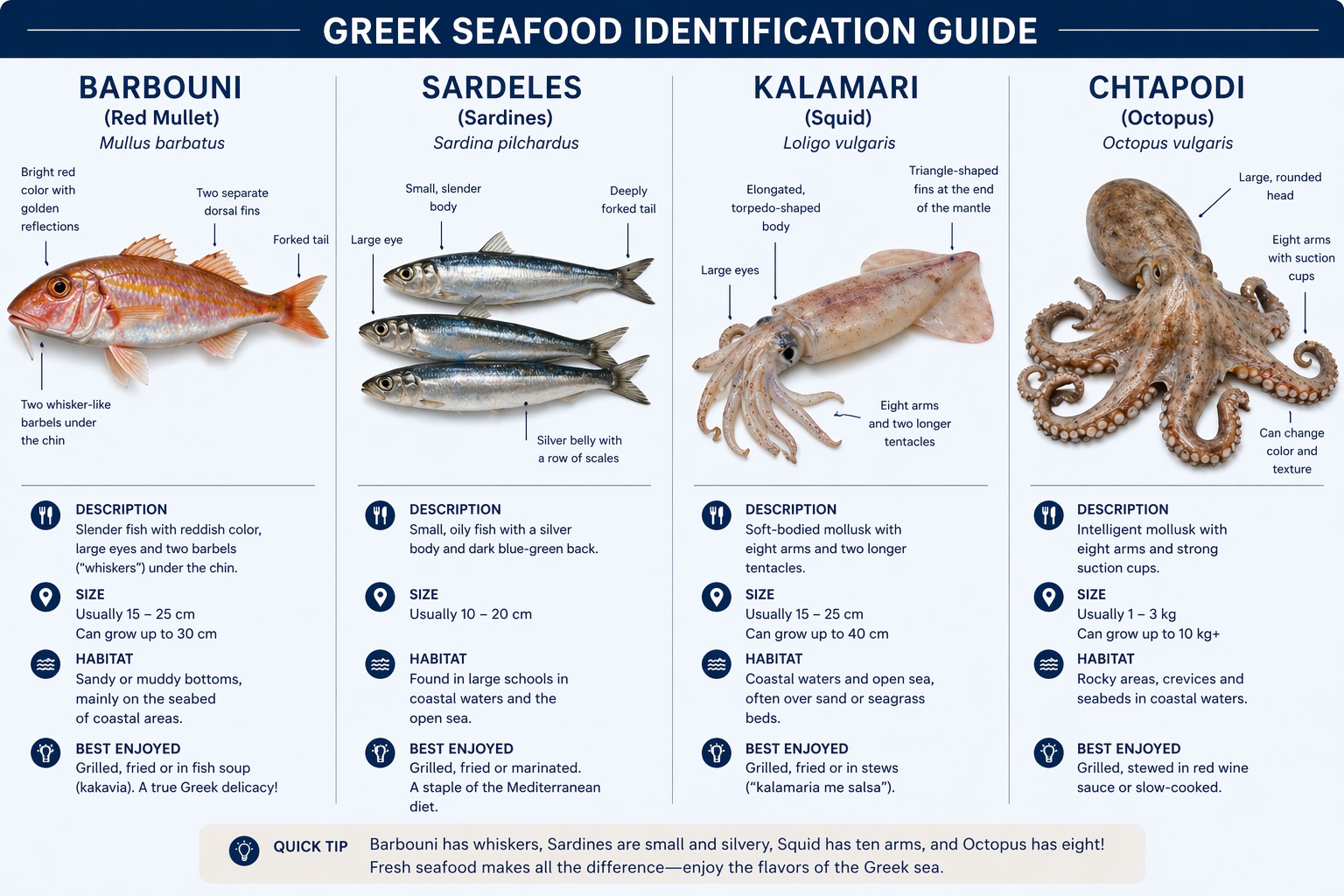
Fish Markets. No dedicated fish market exists. Fish and seafood supplies in Ermioni are sourced through the local fishing fleet operating from the harbour and from small seafood retailers near the waterfront. Daily availability varies with weather and fishing activities. Fresh fish is commonly available directly from fishing vessels in the northern harbour during morning unloading periods. Seafood is also supplied through local tavernas and small fish retailers near the quay area
Ermioni Greece
Sailing Guide - Local Cuisine
Local cuisine in Ermioni is based on Peloponnesian coastal cooking with emphasis on seafood, olive oil, vegetables, legumes, and grilled meats. Common local dishes include grilled octopus, fried calamari, sardines, kakavia fish soup, baked sea bream, and shrimp saganaki prepared with tomato and feta. Meat dishes commonly include souvlaki, lamb cooked with herbs, kokkinisto beef stew, and oven-baked goat. Local olive oil, olives, citrus, and pomegranate products from the Argolis region are widely used.
Traditional Greek dishes regularly available in local tavernas include moussaka, gemista stuffed vegetables, fasolada bean soup, dolmades, spanakopita, and horiatiki village salad. Fresh bread, local cheeses including feta and graviera, and seasonal produce form part of standard meals. Seafood tavernas along the harbour commonly prepare locally landed fish sold by weight according to daily catch availability
Ermioni Greece
Sailing Guide - Local Beverages
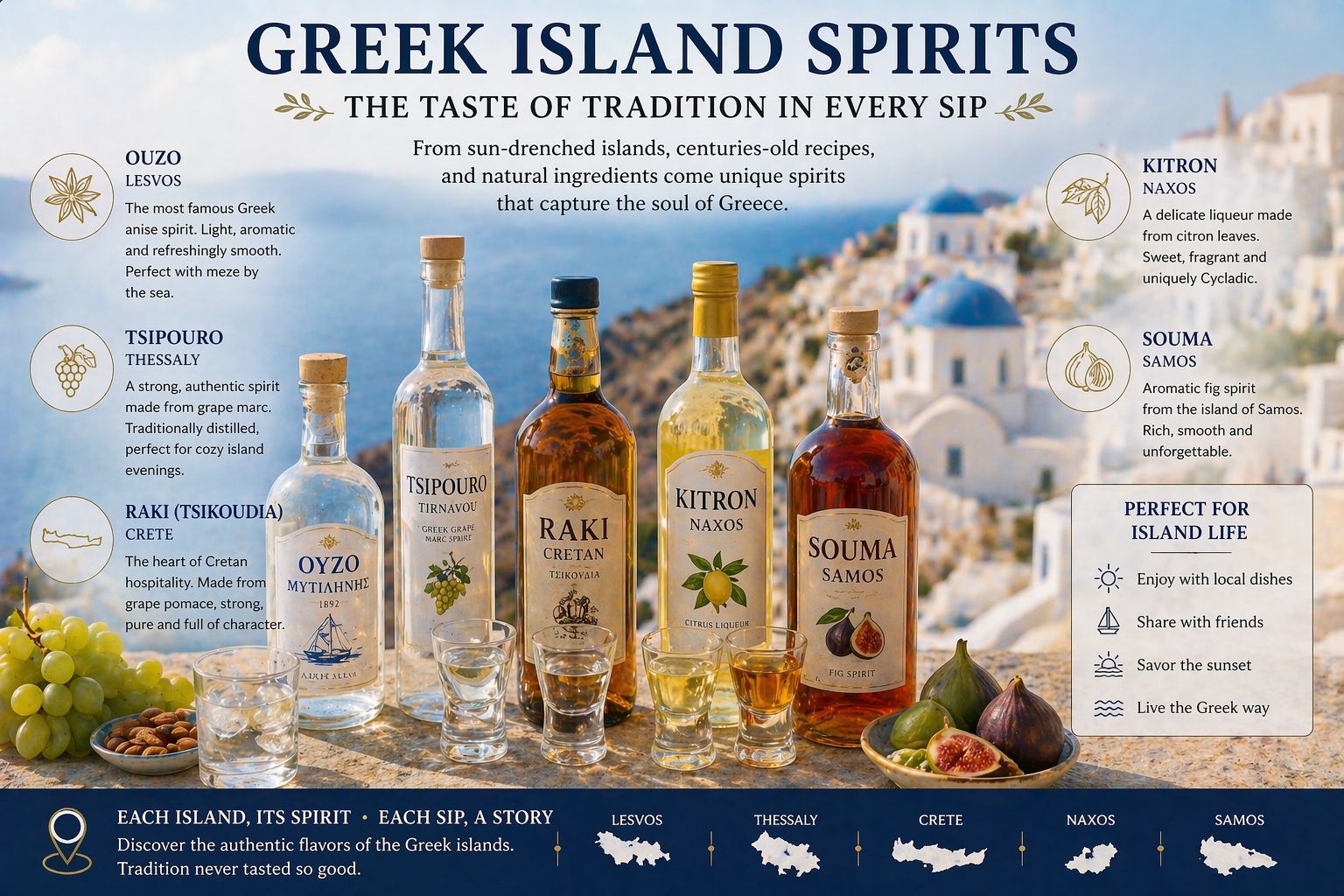
Local beverages in Ermioni include Peloponnesian and Nemea regional wines, ouzo, tsipouro, retsina, and locally produced olive-based liqueurs. Greek coffee, frappé iced coffee, mountain tea, and fresh citrus juices are widely available in harbour cafés and tavernas.
Olive-based liqueurs are alcoholic drinks produced using olives, olive leaves, or olive extracts as part of the flavouring process. In parts of Greece, including the Peloponnese, small producers sometimes make herbal or sweet liqueurs infused with olive leaf, green olive, or olive blossom extracts combined with neutral spirits, tsipouro, or grape alcohol. These are generally niche regional products rather than mainstream commercial beverages. They typically have herbal, slightly bitter, grassy, or briny flavour characteristics and may include additional ingredients such as citrus peel, honey, rosemary, oregano, or local herbs. They are usually served in small quantities as digestifs rather than table drinks.
Ermioni Greece
Sailing Guide - Diesel Fuel Supplies
Diesel fuel supply in Ermioni is available by road tanker delivery to the harbour quays rather than from a dedicated marina fuel dock. Fuel delivery can normally be arranged through local fuel stations servicing visiting yachts berthed along the northern harbour waterfront. Advance arrangement by telephone is commonly required during busy summer periods. Additional fuel stations are located within the town area for jerry can transfer if tanker delivery is unavailable. Larger marina fuel facilities with fixed fuel docks are available nearby at Porto Heli and other major eastern Peloponnese cruising centres.
Ermioni Greece
Sailing Guide - Water Supplies
Potable water supply in Ermioni is available along sections of the northern harbour town quay. Water connections are provided through quay outlets servicing visiting yachts, although availability and hose access may vary depending on berth position and seasonal demand. Usage charges may apply through harbour authority collection or utility token systems.
Mechanical and Electrical Repairs
Resource
If you are headed somewhere remote consider the need to expand your knowledge base or have an information resource on board. Why not get a copy of my book The Marine and Electrical and Electronics Bible 4th Edition. By and for yachties, with everything from batteries and charging, solar and wind, diesel engines and marine electronics and so much more. Your complete systems guide. 650 pages of practical advice. In Australia and New Zealand order a copy through Boat Books. UK and European boats can buy the UK Edition Here. US and Canadian boats can get the US Edition Order Here. Marine systems are my profession so let me help you. By a liveaboard boat owner for other boat owners.



Ermioni Greece
Sailing Guide - Marine Services
Minor mechanical and electrical assistance can usually be arranged through local contractors servicing fishing vessels and recreational craft, although facilities for major repairs are not available within Ermioni itself. Small-scale maintenance support and emergency haul-out coordination may be possible through regional operators, but larger technical work including engine overhauls, sail repairs, fibreglass work, travel lift haul-out, and specialist yacht servicing are normally undertaken at nearby centres including Porto Heli and Nafplio.
Ermioni Greece
Sailing Guide - Local Etiquette
Etiquette in Ermioni is centred around practical harbour conduct and respect for the working waterfront environment. Noise is generally kept low overnight, particularly along the northern waterfront where residential buildings, cafés, and tavernas operate close to the harbour edge. Rubbish should be disposed of only at designated collection points and discharge of waste water inside the harbour is avoided. Casual dress ashore is normal, although swimwear away from the waterfront and harbour areas is generally avoided in town businesses and shops. Courtesy toward harbour staff, fuel suppliers, and local fishing operators is expected, particularly during congested summer conditions.
Ermioni Greece
Sailing Guide - Summary
Ermioni provides two harbour options allowing selection based on wind direction. Protection is dependent on conditions with no all-weather shelter. Infrastructure is adequate with provisioning and services available locally. Navigation is straightforward with minimal hazards. The Ermioni Greece Sailing Guide for all you need to know.