Ereikoussa Greece Sailing
Guide
Ereikoussa Greece Sailing Guide. Ereikoussa lies northwest of Corfu in the Diapontia group within the Ionian Sea. The island is small, low-lying, and more vegetated than many Aegean islands, with a mix of sandy bays and rocky sections along the coastline. The main settlement and port are located on the south coast, forming the primary access point for vessels. Depths around the island are moderate, with more gradual shoaling in some bays compared to the steep-to profiles common elsewhere.
Ereikoussa functions as a minor stop within northern Ionian cruising routes, with limited harbour capacity and a small number of anchorage options. Shelter is conditional on wind direction, with exposure to prevailing north-westerlies in summer and to southerly systems outside the season. Infrastructure is minimal, with restricted provisioning, no dedicated marina facilities, and limited fuel and water availability. The island should be treated as a short-duration stop with basic resupply capability rather than a fully serviced port.
Ereikoussa Greece
Sailing Guide History
Ereikoussa has a history tied to its position on the northwestern approaches to Corfu, with evidence of use from antiquity primarily related to coastal navigation and small-scale settlement. The island did not develop as a major centre but was intermittently inhabited, with activity focused on agriculture, fishing, and support to passing maritime traffic within the Ionian Sea.
During the medieval period and under Venetian control, Ereikoussa formed part of the defensive and administrative network associated with Corfu, though it remained peripheral and sparsely populated. It later passed through periods of French and British administration before being incorporated into Greece in the 19th century. Throughout its history, the island has remained small in population and limited in development, retaining a primarily local and maritime character.
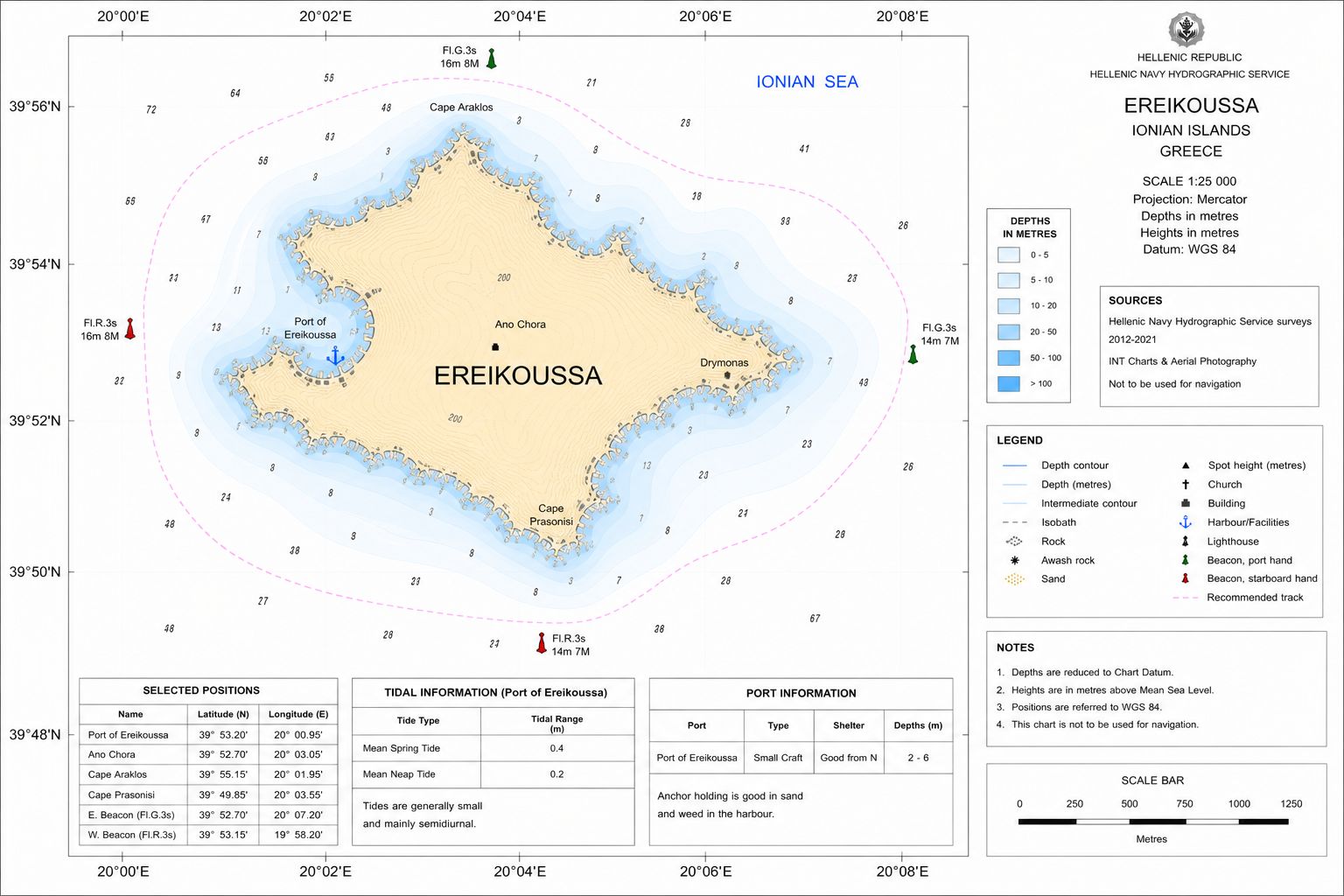
Chart Disclaimer. This chart is a schematic representation for illustrative purposes only and must not be used for navigation. Refer to official hydrographic charts for safe navigation. Be aware ENC charts may differ from official hydrographic charts. Both should be corrected and updated regularly.
Ereikoussa Greece
Sailing Guide Ocean Currents
and Tidal Flow
Local tidal range around Ereikoussa is small but more noticeable than in the Aegean, typically up to 0.3–0.5 m within the northern Ionian Sea. Tidal streams are still weak and generally not a primary factor in navigation. Water movement is driven mainly by wind and broader Ionian circulation patterns.
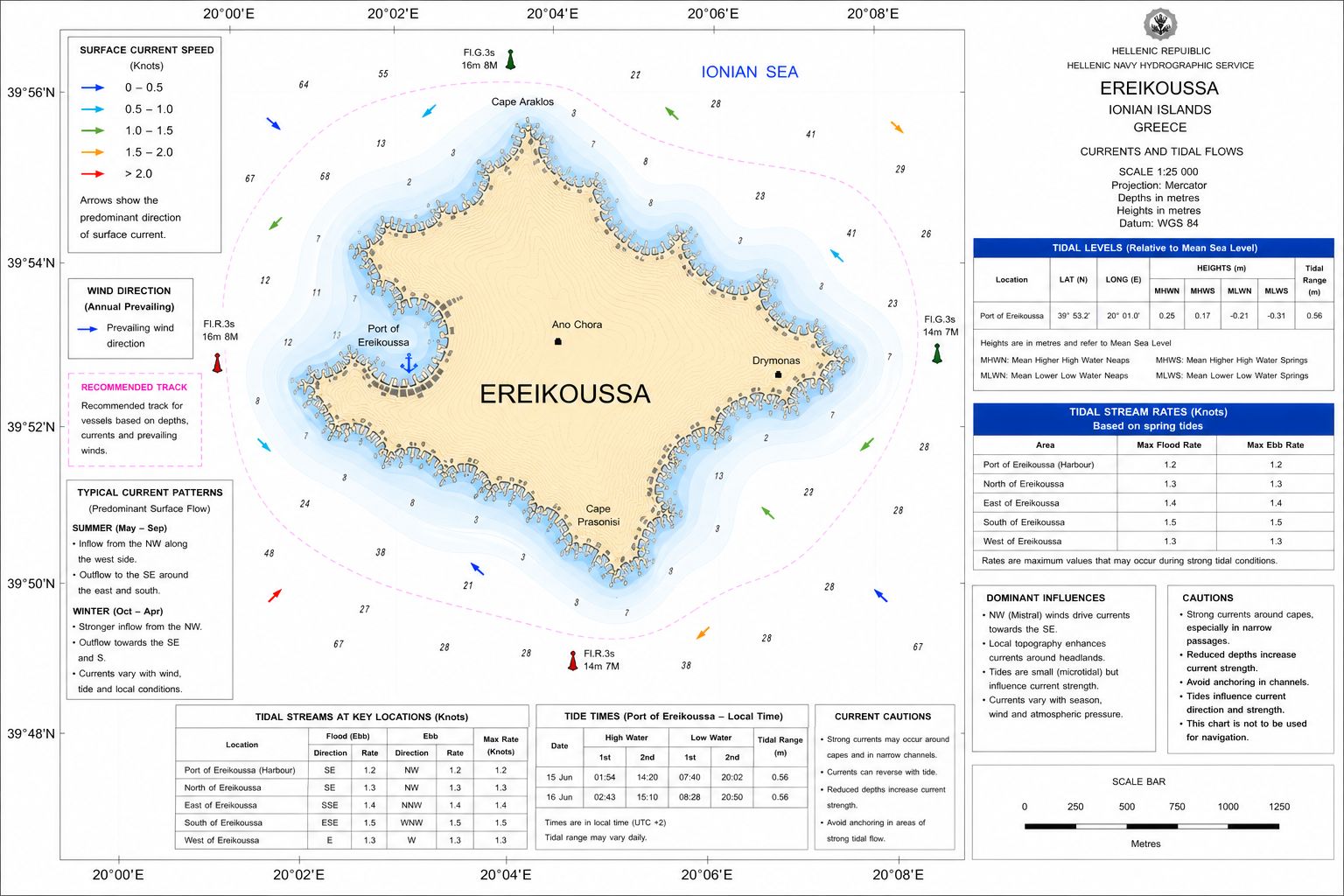
In prevailing north-westerly conditions, a weak south-east setting surface drift can develop, typically 0.2–0.5 kn, with localized acceleration around headlands and between Ereikoussa and nearby islands toward Corfu. In southerly conditions, flow may reverse or become variable. Close inshore and within the harbour area, current is minimal, though light eddies can form due to wind interaction with coastal features. There are no tidal races or overfalls; any noticeable movement is wind-driven and increases with sea state rather than predictable tidal cycles.
Ereikoussa Greece
Sailing Guide Weather
Local weather around Ereikoussa reflects the northern Ionian Sea pattern, with higher humidity and more frequent cloud and precipitation than the Aegean. In summer, conditions are generally stable under high pressure, with good visibility, light to moderate winds, and occasional afternoon cloud build-up. Temperatures are warm but moderated by maritime influence, and short, localized showers can occur, though extended dry periods are common.
Outside the summer season, weather becomes more variable with frequent low-pressure systems moving across the Ionian from the west. Autumn and winter bring increased cloud cover, regular rainfall, and reduced visibility, with winds shifting through southerly sectors ahead of fronts and veering westerly to north-westerly after passage. These systems can produce strong winds and rapid changes in conditions. Compared to the Aegean, the Ionian has more unsettled intervals and higher precipitation, particularly through the winter months.
The Marine Electrical and Electronics Bible has a complete list of Greek VHF Radio Channel information and weather forecast times for Greece along with NAVTEX UK and Europe and NAVTEX Mediterranean for 490kHz and 518kHz.
Ereikoussa Greece
Sailing Guide Local Winds
Local wind patterns around Ereikoussa are governed by the northern Ionian Sea regime rather than the stronger Aegean Meltemi system. In summer, prevailing winds are NW to WNW, typically 10–20 kn, building late morning, peaking in the afternoon, and easing after sunset. A diurnal sea-breeze cycle is common in settled conditions, reinforcing the north-westerly flow. Wind strength is generally moderate but can increase locally around headlands and between islands, producing short gusts above mean wind speed.
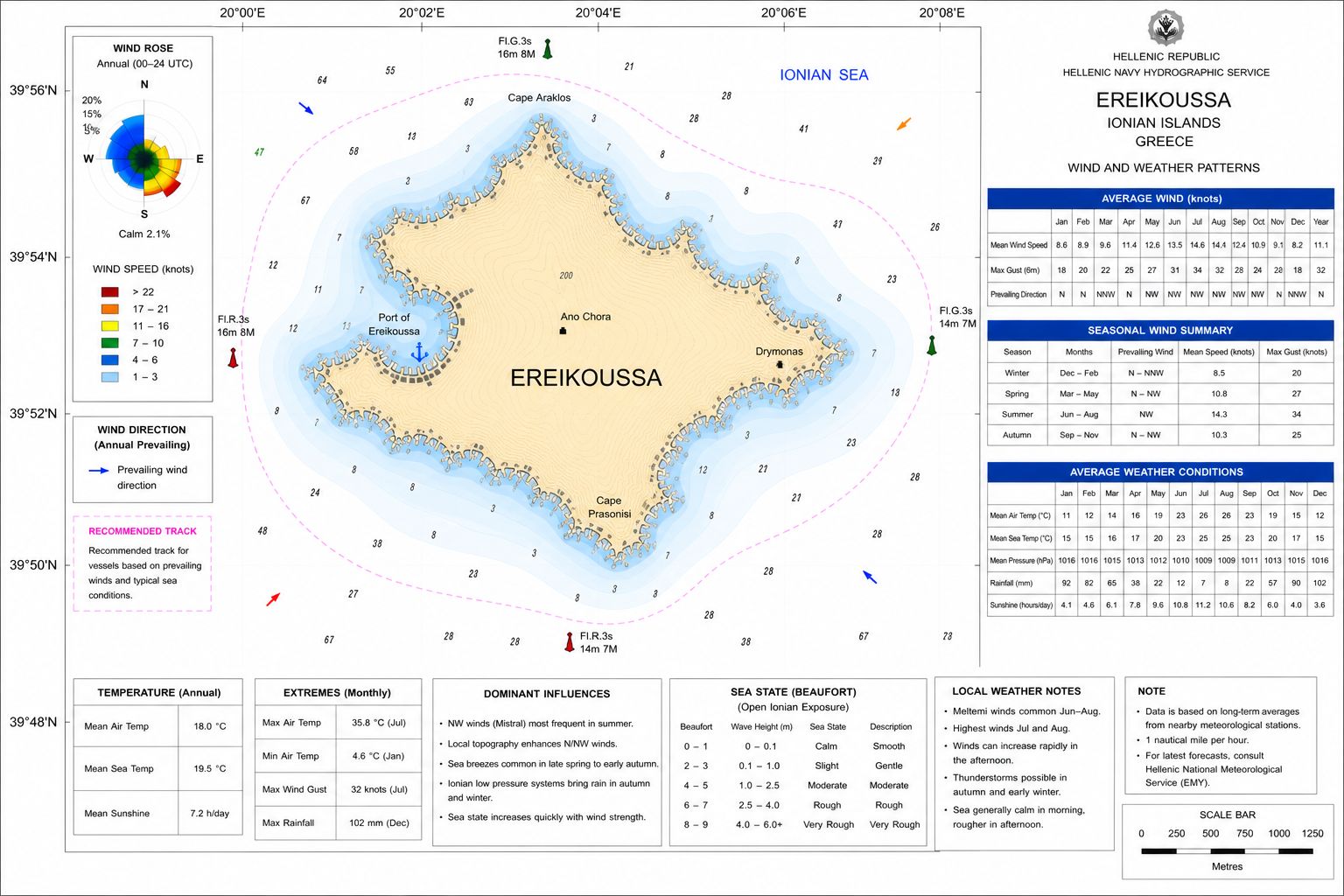
In and around the main harbour on the south coast, northerly and north-westerly winds are partially reduced by the island’s terrain, though gusts can descend off higher ground. Southerly winds, although less frequent in summer, have direct exposure into the harbour and generate more consistent wind pressure and sea state. Outside the summer period, wind direction becomes variable with passing systems, commonly shifting through SE–SW ahead of fronts and W–NW following, with occasional strong winds associated with these systems.
The Meltemi is a strong, dry northerly wind that dominates the Aegean in summer, accelerating through channels and between islands to produce steep, short seas. It is most persistent in July and August, often blowing for several days with little diurnal variation, creating fast north‑to‑south passages and challenging return routes. Its strength is shaped by pressure gradients between the Balkans and Anatolia, with local acceleration zones around major island gaps.
Ereikoussa Greece
Sailing Guide Approaches
Approaches to Ereikoussa are in open water northwest of Corfu with generally good visibility and no major offshore hazards on the main approach lines. The island is low and green compared to Aegean profiles, becoming distinct at moderate range. Depths offshore are moderate to deep, typically 20–50 m, allowing a direct approach without the need for extended offing. The coastline is mixed, with sandy sections and rocky margins; isolated rocks exist close inshore and require normal coastal clearance.
The primary objective is the harbour on the south coast. Approach from seaward on a controlled heading, maintaining mid-bay alignment and avoiding the headlands where depths shoal unevenly. Depths reduce progressively from 15–20 m outside to 5–8 m within the approach area. Under prevailing NW winds, expect reduced sea state on the south coast due to lee conditions, but with localized gusts descending off the island. In southerly winds, the approach becomes exposed with increased sea state. There are no formal leading marks or significant navigational aids; entry is by visual reference in daylight with continuous depth monitoring.
Ereikoussa Greece
Sailing Guide Navigation
Within the harbour at Ereikoussa, manoeuvring space is restricted and vessel control is affected by variable wind in the basin. After passing the entrance, reduce to minimum steerage speed and assess traffic and available berthing or anchoring positions before committing. The turning area is limited; plan the turn early and keep clear of the quay face used by ferries. Depths decrease progressively toward the quay, generally from about 5–8 m to 2–4 m alongside, with uneven patches requiring continuous sounder reference.
Wind inside the harbour is inconsistent. In prevailing NW conditions, the basin is in lee but subject to descending gusts that can push the bow off line during slow-speed manoeuvres. In southerlies, wind and short wave action enter directly, reducing control and increasing stopping distance. Maintain engine readiness at all times, avoid excessive helm inputs, and allow for drift when aligning for berth or anchor drop. Positioning is by visual reference only; there are no transit lines or internal navigation aids.
Ereikoussa Greece
Sailing Guide Chart Accuracy
Hydrographic charts provide accurate coastline and depth representation. Electronic charts align with official data but may lack detail near harbour structures. Visual navigation and your Mark 1 eyeball are required when entering harbour.
Ereikoussa Greece
Sailing Guide Anchorages
Ereikoussa anchorage options are limited. There are no all-weather anchorages. Anchoring at Ereikoussa is centred on the bay off the main harbour on the south coast. Vessels anchor clear of the quay in depths typically 5–8 m, on mixed sand and weed; select sand patches for reliable holding. Swinging room is moderate but reduces with traffic, and care is required to maintain clearance from vessels manoeuvring to and from the quay, particularly ferry movements. Shelter is generally adequate in prevailing NW winds due to lee effect, though gusts can descend into the bay.
Secondary anchorage options are limited. Small bays on the north and west coasts can be used in settled conditions or with southerly winds, but these are exposed to the dominant NW flow and provide little protection from swell. Depths drop off quickly outside the main bay, restricting anchoring to a narrow inshore band with variable holding. There are no all-weather anchorages on the island; all positions are conditional on wind direction and require continuous monitoring with readiness to relocate.
Ereikoussa Greece
Sailing Guide Entry
Formalities
This is not a designated port of entry for international clearance, and there are no customs or immigration facilities on the island. Vessels arriving from outside Greece or the Schengen Area must first clear into the country at an official port of entry before proceeding to this port. Direct arrival from a non-Schengen country is not permitted. The Greek cruising tax (TEPAI) must be valid and paid, and the vessel’s cruising log (DEKPA for non-EU vessels, or transit log where applicable) should be up to date and available for inspection if requested by port authorities or coastguard.
Ereikoussa Greece
Sailing Guide Marina
Facilities
There are no marina facilities on Ereikoussa. Berthing at Ereikoussa is limited to a small quay within the south coast harbour; there is no marina, no pontoons, and no laid mooring system. Vessels berth stern-to or alongside where space permits, using own ground tackle. Depths alongside are generally about 2–4 m but are uneven and should be confirmed by sounder. Bollards are few and irregularly spaced, requiring long lines and careful placement. Capacity is low and priority is given to ferry operations using the main quay section; clear access must be maintained and vessels may need to reposition. Shelter is conditional: in prevailing NW winds the harbour is in partial lee but subject to gusts, while southerlies bring direct exposure and surge alongside.
Ereikoussa Greece
Sailing Guide Provisioning
Supermarkets. Supermarket provisioning on Ereikoussa is limited to a small number of basic mini-markets near the harbour. These stock essential items only: dry goods, bottled water, bread, tinned food, pasta, and a small range of chilled products. Deliveries come via Corfu, so availability depends on supply schedules and stock turnover.
Markets. There is no organised market. Fresh produce on Ereikoussa is limited and there are no dedicated produce markets. Supply is through the small mini-markets near the harbour, with stock dependent on deliveries from Corfu. Availability is variable and tied to delivery timing.
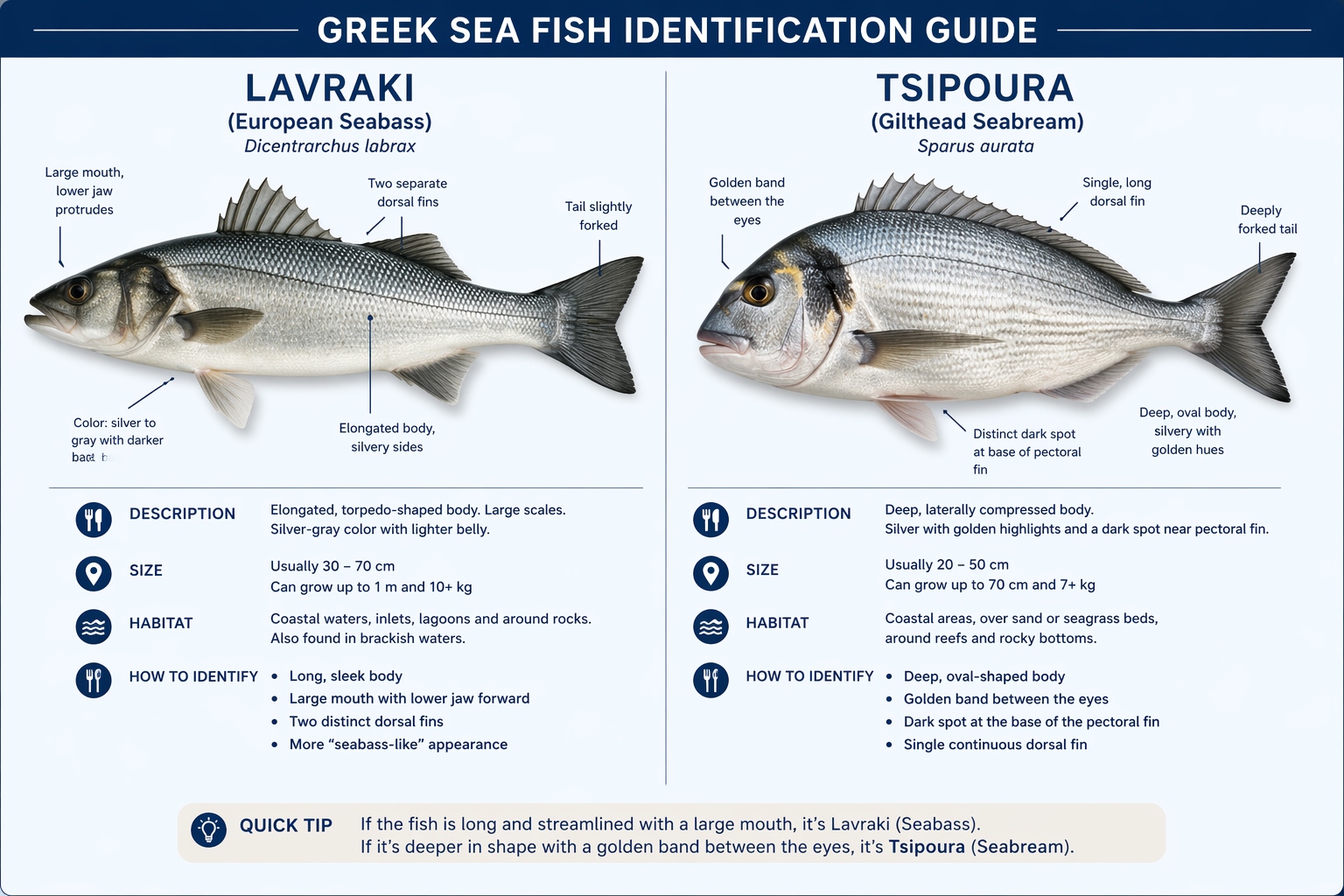
Fish Markets. Fish supply on Ereikoussa is limited and informal, with no dedicated fish market. Availability depends on local fishing activity, with catch occasionally sold directly from small boats or supplied to local tavernas. Supply is irregular and restricted to what is landed on the day, typically small pelagic species and reef fish, with occasional octopus or squid.
Ereikoussa Greece
Sailing Guide Local Cuisine
Cuisine reflects Ionian supply linked to Corfu. Local cuisine on Ereikoussa follows northern Ionian patterns, based on simple preparation of fish, meat, and seasonal produce. Fish is typically grilled or baked depending on daily catch, with octopus and squid appearing when available. Meat dishes include pork, chicken, and lamb, often prepared as oven dishes or stews. Vegetable-based meals are standard, including mixed baked vegetables (briam), legumes, and salads such as horiatiki with tomato, cucumber, onion, and feta. Staples include bread, olive oil, olives, and local cheeses. No dishes are unique to Ereikoussa.
Ereikoussa Greece
Sailing Guide Local
Beverages
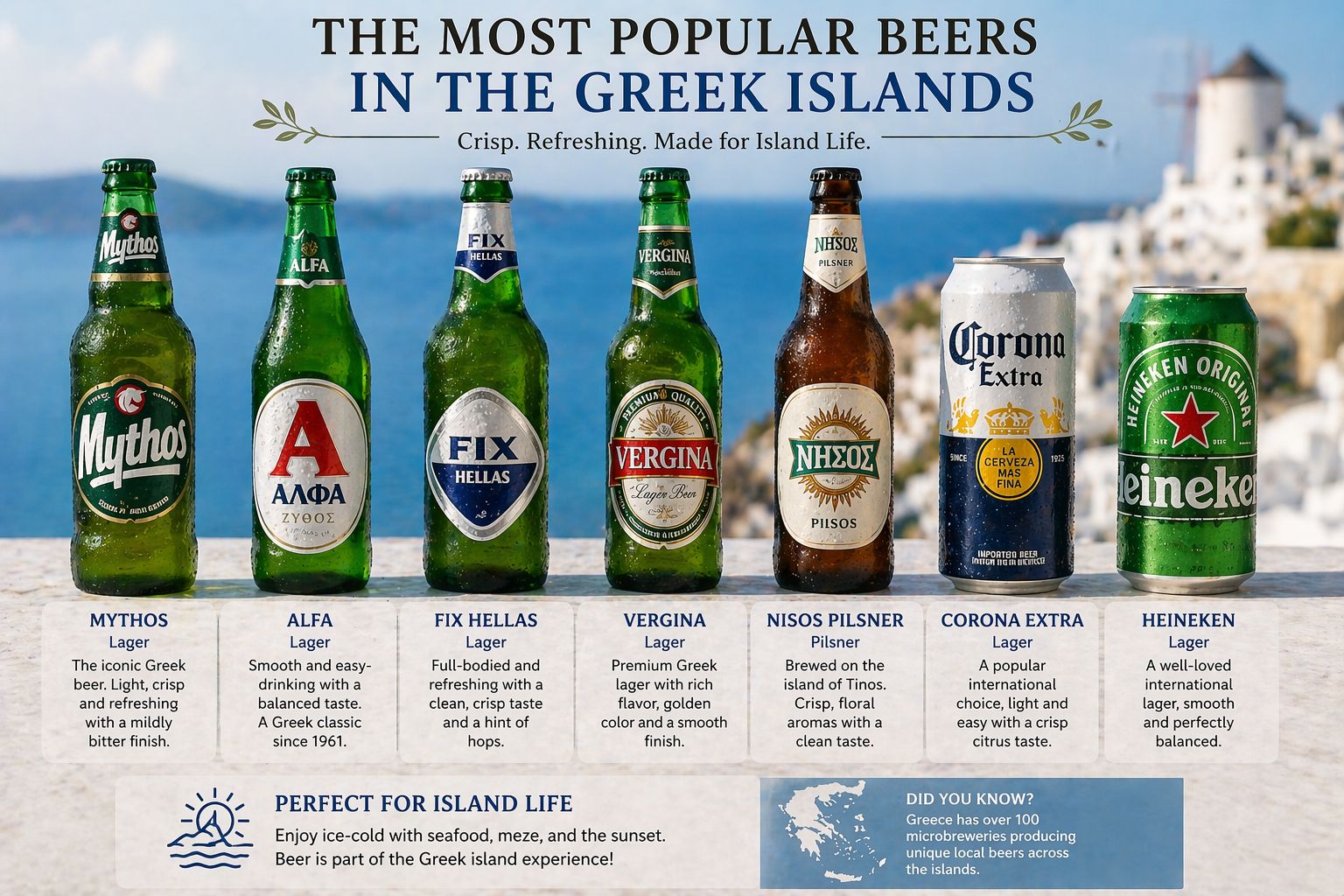
Beer supply includes Alpha, Mythos, and Fix delivered from Corfu. Wine is sourced from mainland Greece and Ionian producers. Spirits include ouzo and tsipouro. No local production exists.
Ereikoussa Greece
Sailing Guide Diesel Fuel
Supplies
Fuel supply on Ereikoussa is very limited and there is no marine fuel dock in the harbour. Diesel is not available alongside. Any fuel must be obtained indirectly, typically by jerry can if local arrangements can be made, but this is not a reliable or routine option. Supply to the island is dependent on deliveries from Corfu, and availability cannot be assumed.
Ereikoussa Greece
Sailing Guide Water Supplies
At the harbour, water may be available at the quay in small quantities by arrangement, typically via hose connection. Pressure and flow are low and inconsistent, and filling tanks can be slow. Supply depends on local storage and delivery from Corfu, so availability can be intermittent, particularly during peak demand
Mechanical and Electrical Repairs
Resource
If you are headed somewhere remote consider the need to expand your knowledge base or have an information resource on board. Why not get a copy of my book The Marine and Electrical and Electronics Bible 4th Edition. By and for yachties, with everything from batteries and charging, solar and wind, diesel engines and marine electronics and so much more. Your complete systems guide. 650 pages of practical advice. In Australia and New Zealand order a copy through Boat Books. UK and European boats can buy the UK Edition Here. US and Canadian boats can get the US Edition Order Here. Marine systems are my profession so let me help you. By a liveaboard boat owner for other boat owners.



Ereikoussa Greece
Sailing Guide Marine
Services
There are no marine service providers on Ereikoussa. No authorised engine or electronics agents are present. Technical support requires relocation to Corfu where full marine service capability exists.
Ereikoussa Greece
Sailing Guide Local
Etiquette
Local etiquette on Ereikoussa is simple and direct: greet on first contact (“kalimera” or “kalispera”), speak at normal volume, and use basic politeness. Dress is standard for a small local community and shirt and footwear expected in all public places. Service is informal; wait to be acknowledged and follow the existing order rather than interrupting. Behaviour is expected to be restrained: avoid loud conversation, impatience, or confrontation. Interactions are straightforward so state requests clearly, confirm details if needed, and accept that timing and availability follow local routine rather than fixed schedules.
Ereikoussa Greece
Sailing Guide Summary
Ereikoussa provides a small harbour environment with limited infrastructure and exposure to Ionian wind conditions. Navigation is straightforward but constrained by harbour size and weather exposure. Anchorage options are limited and dependent on conditions. Provisioning and services are minimal and require planning through Corfu, consistent with an Ereikoussa Greece Sailing Guide for all you need to know.