Elafonisos Greece
Sailing Guide
Elafonisos Greece Sailing Guide. Elafonisos lies off the southeastern coast of the Peloponnese at the entrance to the Laconian Gulf. The island is low-lying with extensive sandy shoreline, notably along its eastern and southern coasts, contrasting with the generally rocky profile of the surrounding mainland. The main settlement and port are located on the north coast, providing the primary access point for vessels. Depths around the island are generally moderate compared to much of the Aegean Sea, with broader areas of sand seabed and more gradual shoaling inshore.
Elafonisos functions as a stopping point on routes between the southern Peloponnese and the western Cyclades, with a mix of harbour berthing and open anchorage options. The island is exposed to prevailing northerly winds but offers some lee areas depending on conditions, particularly along the southern beaches. Infrastructure is limited but more developed than smaller offshore islands, with basic provisioning and services available in the main settlement. It should be treated as a short-stay location with some resupply capability rather than a fully serviced port
Elafonisos Greece
Sailing Guide - History
Elafonisos has a history linked to its position off the southeastern Peloponnese, with evidence of habitation and maritime activity dating back to antiquity. In the Bronze Age, the nearby submerged site of Pavlopetri, one of the earliest known planned settlements in the Aegean Sea which indicates organised coastal occupation and trade in the area. The island itself was likely connected to the mainland in earlier geological periods before separation through seismic activity, contributing to its role in local coastal navigation routes.
Through Classical, Byzantine, and later periods under the Ottoman Empire, Elafonisos remained small and sparsely populated, with activity focused on fishing and limited agriculture. It did not develop into a major port or settlement, remaining secondary to mainland centres in Laconia. In the modern era, it became part of Greece, retaining its small-scale character with gradual development of a permanent settlement and basic harbour facilities.
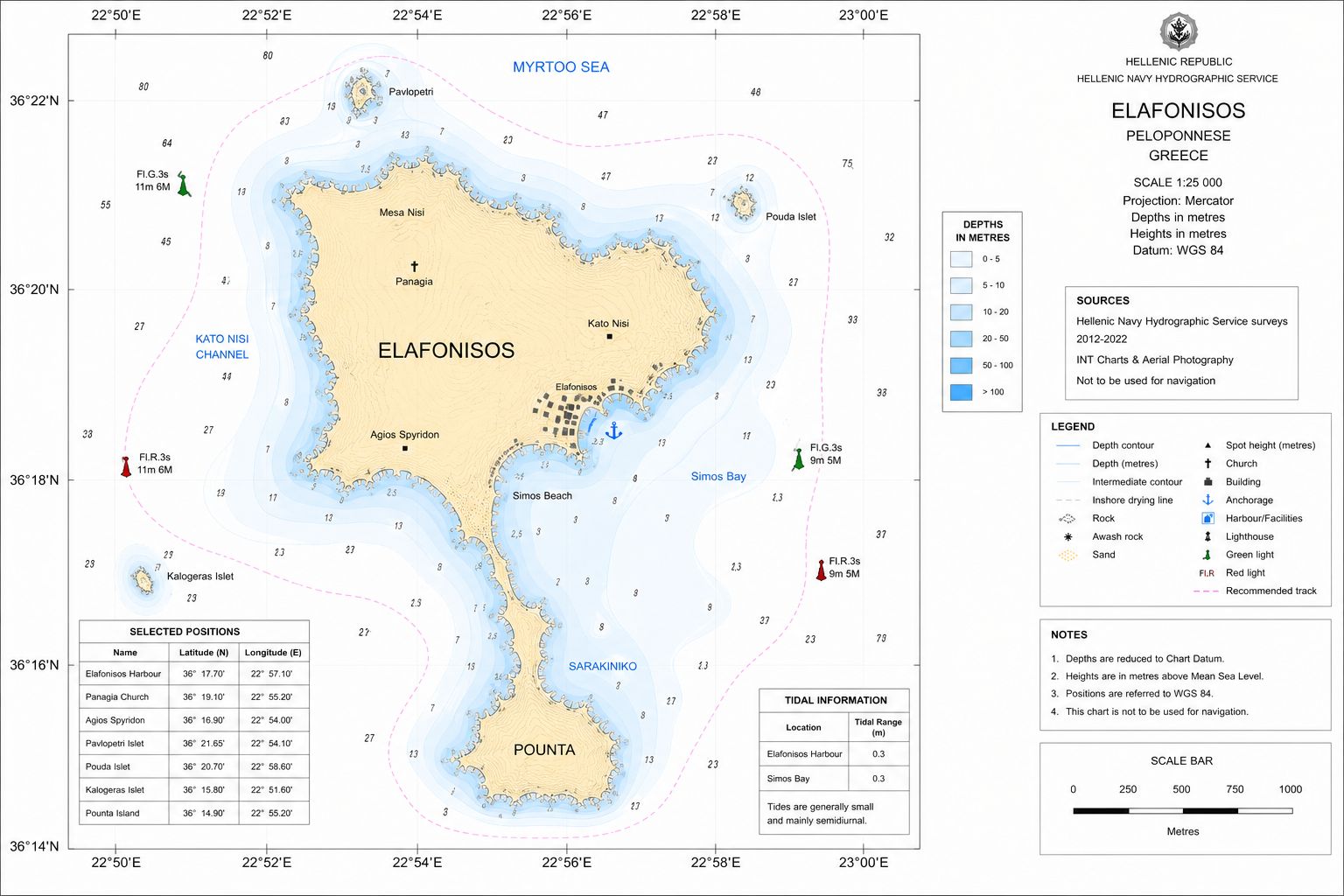
Chart Disclaimer. This chart is a schematic representation for illustrative purposes only and must not be used for navigation. Refer to official hydrographic charts for safe navigation. Be aware ENC charts may differ from official hydrographic charts. Both should be corrected and updated regularly.
Elafonisos Greece
Sailing Guide - Ocean Currents and Tidal Flow
Local tidal range around Elafonisos is minimal, typically less than 0.3 m, and tidal streams are not operationally significant. Water movement is governed primarily by wind forcing and regional circulation at the entrance to the Laconian Gulf within the southern Aegean Sea.
In the strait between Elafonisos and the Peloponnese, localized currents can develop due to wind-driven flow and constriction, typically 0.5–1.0 kn, increasing under strong northerly or southerly winds. Set direction follows prevailing wind, with northerlies producing a south-going surface drift and southerlies reversing flow. Outside the strait, current is generally weaker and variable, though acceleration occurs around headlands and over shallow sandbanks, particularly along the eastern and southern coasts. There are no tidal races or overfalls, but sea state and apparent current can increase quickly under strong wind opposing residual flow, especially in confined areas.
Elafonisos Greece
Sailing Guide - Weather
Local weather around Elafonisos is governed by the southern Aegean Sea pattern, with strong seasonal stability in summer and more variable conditions outside that period. From late spring through early autumn, high-pressure systems dominate, producing clear skies, high visibility, and negligible rainfall. Conditions are dry with low humidity, and weather remains stable over extended periods with minimal cloud development.
Outside the summer season, weather is influenced by passing low-pressure systems tracking west to east across the region. Winds shift through southerly sectors ahead of frontal passages, often bringing cloud, reduced visibility, and rain, before veering westerly to northerly after passage. These systems can produce short periods of strong winds and rapidly changing conditions. Winter remains moderate in temperature but with increased cloud cover and more frequent unsettled intervals compared to the summer pattern.
The Marine Electrical and Electronics Bible has a complete list of Greek VHF Radio Channel information and weather forecast times for Greece along with NAVTEX UK and Europe and NAVTEX Mediterranean for 490kHz and 518kHz.
Elafonisos Greece
Sailing Guide - Local Winds
Local wind patterns around Elafonisos are influenced by its position at the entrance to the Laconian Gulf and exposure to the southern Aegean Sea. In summer, prevailing winds are N to NE under the Meltemi regime, typically 15–25 kn, building from late morning, peaking mid to late afternoon, and easing after sunset. Wind strength can increase locally in the strait between the island and the Peloponnese due to funneling, with gusts exceeding mean wind speed.
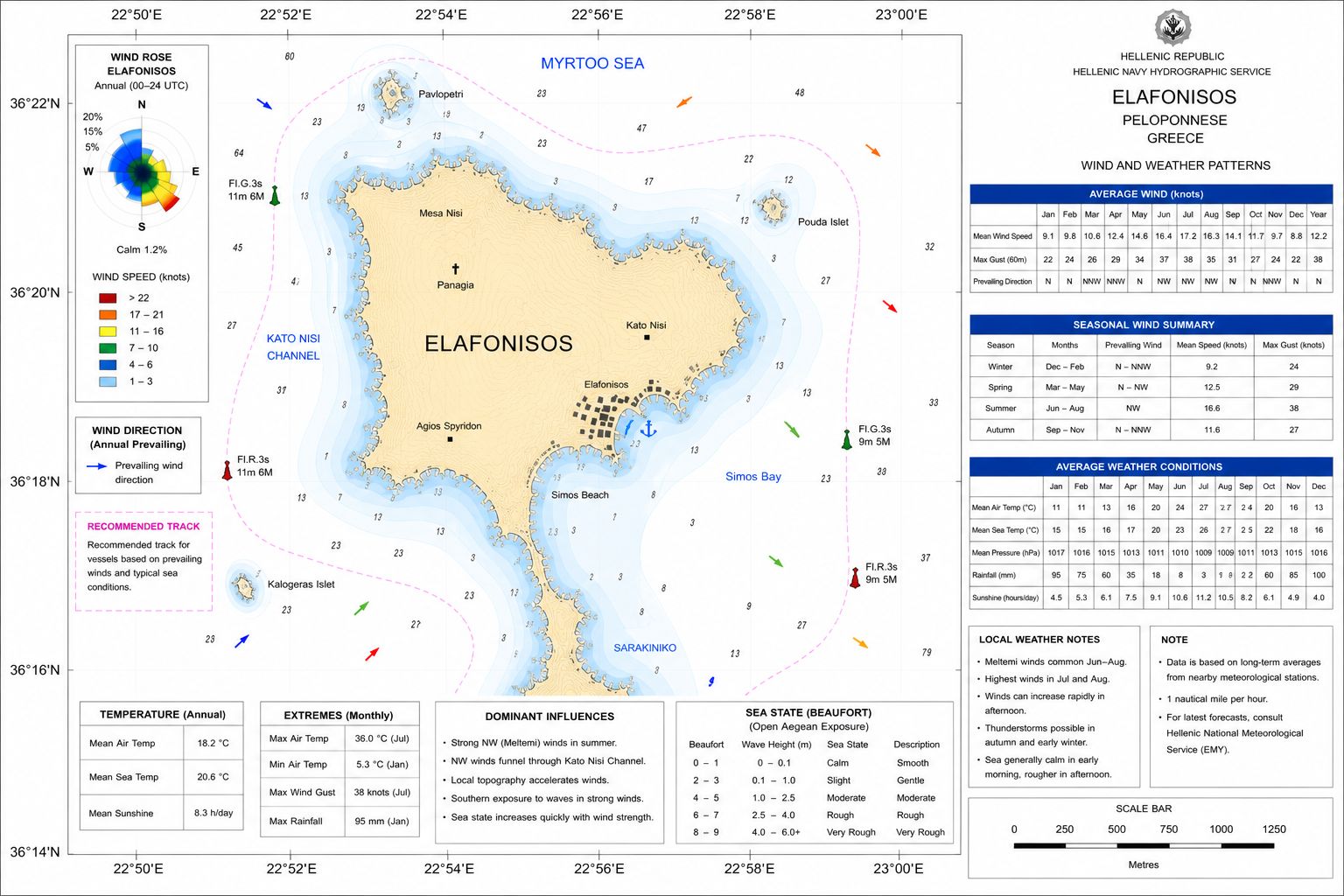
Shelter varies with location: the north coast and harbour area experience partial lee in northerlies but still receive gusts and variable direction due to terrain effects. Southerly winds, although less frequent in summer, have direct fetch across the gulf and produce more consistent pressure and sea state, particularly along the southern and eastern coasts. Outside the summer period, wind direction becomes variable with passing systems, commonly SE–SW ahead of fronts and W–NW following, with occasional short-duration strong winds. Wind behaviour is primarily gradient-driven with localized acceleration in confined area
The Meltemi is a strong, dry northerly wind that dominates the Aegean in summer, accelerating through channels and between islands to produce steep, short seas. It is most persistent in July and August, often blowing for several days with little diurnal variation, creating fast north‑to‑south passages and challenging return routes. Its strength is shaped by pressure gradients between the Balkans and Anatolia, with local acceleration zones around major island gaps.
Elafonisos Greece
Sailing Guide - Approaches
Approaches to Elafonisos are conducted in open water at the entrance to the Laconian Gulf, with generally good visibility and no extensive offshore dangers on the main approach lines. The island is low-lying and becomes visually distinct at moderate range, particularly due to its sandy shoreline. Depths are more gradual than typical Aegean profiles, especially on the eastern and southern sides, where shoaling extends further offshore over sandbanks. Care is required when closing the coast in these areas, as depth reduction is more progressive and less visually apparent.
The principal navigation feature is the strait between Elafonisos and the Peloponnese, which provides the main access route and is used for transit and approach to the harbour on the north coast. This passage is clear but subject to localized current and wind acceleration, particularly under strong northerly or southerly winds. When approaching from seaward, maintain adequate offing until identifying the intended track, then close the island on a controlled heading with continuous depth monitoring. Outside the strait, approaches to anchorages along the east and south coasts require caution due to shallow sand areas and shifting seabed contours, with no formal navigation aids beyond standard chart reference
Elafonisos Greece
Sailing Guide - Navigation
Navigation into the harbour at Elafonisos is via the north coast, approached either from the open sea to the east or through the strait from the west between the island and the Peloponnese. The entrance is open and clearly identifiable, with no formal leading marks; approach is by eye. Depths are generally adequate, reducing from 10–15 m outside to approximately 3–5 m within the harbour area. The seabed is predominantly sand with some patches of weed.
Maintain a central line on entry, keeping clear of the harbour margins where depths shoal unevenly. Speed should be reduced early due to limited manoeuvring space and presence of moored and anchored vessels. Under northerly winds, expect gusts and variable direction within the harbour due to local deflection, while southerly winds can introduce a direct sea into the entrance, affecting control during final approach. The harbour includes a small quay and anchorage area; ferry traffic operates regularly and has priority use of the quay, requiring clear access during manoeuvres. There are limited navigational aids and minimal lighting; night entry should be avoided.
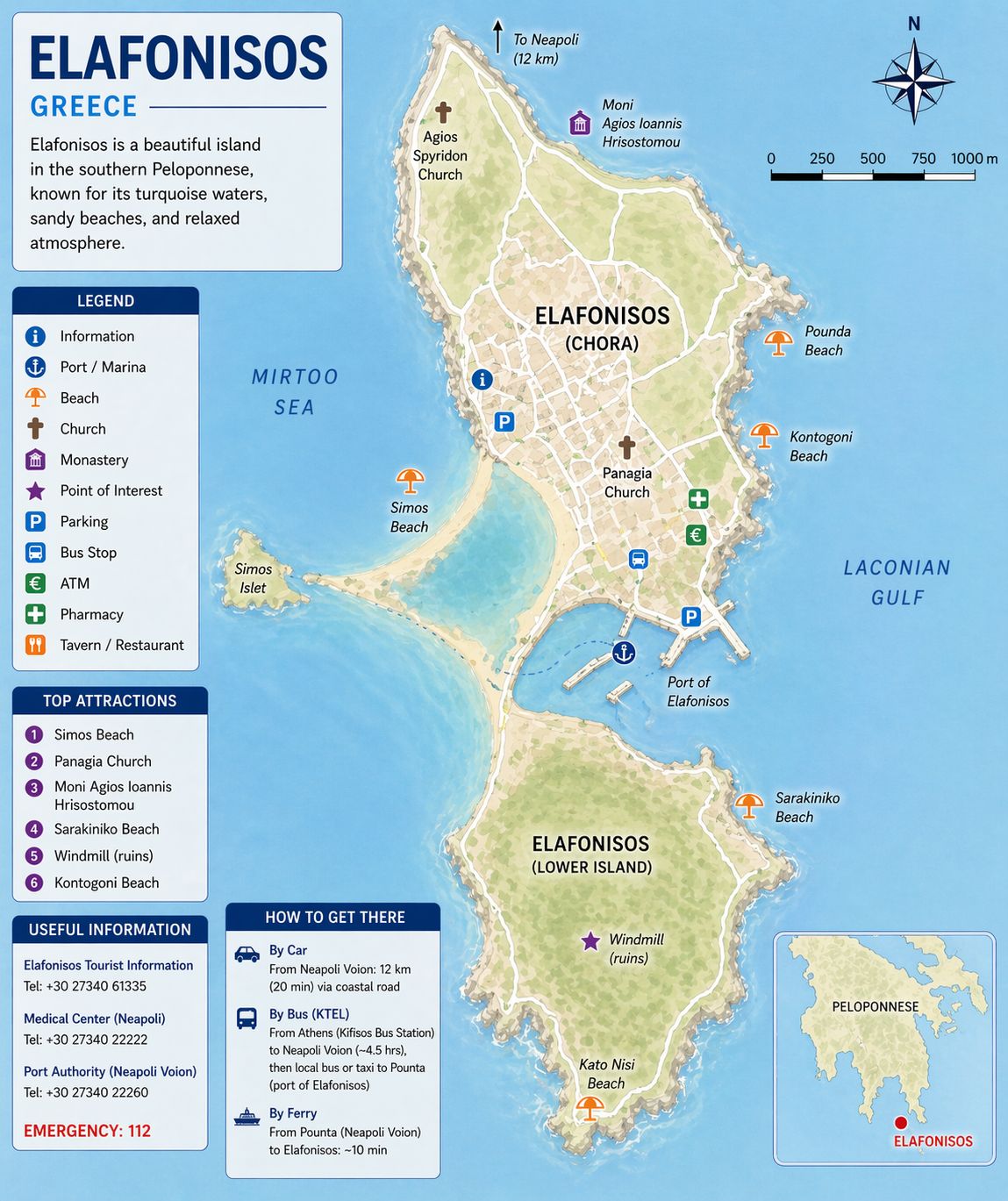
Elafonisos Greece
Sailing Guide - Chart Accuracy
Hydrographic charts provide accurate coastline representation, though shallow sandbanks may shift slightly over time. Electronic charts align with official data but require caution in shallow areas. Visual navigation is required when operating near sandbanks.
Elafonisos Greece
Sailing Guide - Anchorages
Elafonisos anchorage options include both harbour and open bay locations. No anchorage provides full protection under all conditions.
- The harbour area provides anchoring in 3–6 metres over sand with moderate holding.
- Simos Bay on the southeast coast provides anchoring in 3–8 metres over sand with good holding and clear water. The bay is exposed to southerly winds and swell.
- Sarakiniko Bay on the north coast provides anchoring in 4–10 metres over sand with moderate protection from northerly winds.
Elafonisos Greece
Sailing Guide - Entry Formalities
This is not a designated port of entry for international clearance, and there are no customs or immigration facilities on the island. Vessels arriving from outside Greece or the Schengen Area must first clear into the country at an official port of entry before proceeding to this port. Direct arrival from a non-Schengen country is not permitted. The Greek cruising tax (TEPAI) must be valid and paid, and the vessel’s cruising log (DEKPA for non-EU vessels, or transit log where applicable) should be up to date and available for inspection if requested by port authorities or coastguard.
Elafonisos Greece
Sailing Guide - Marina Facilities
Berthing at Elafonisos is limited to quay space within the small harbour on the north coast; there is no purpose-built marina, no pontoons, and no laid mooring system. Vessels berth stern-to or alongside where possible, using own ground tackle. Depths alongside are typically in the range of 2–4 m but are variable and should be confirmed by sounder before committing. Bollards are limited and spacing is irregular, requiring use of long lines and careful positioning.
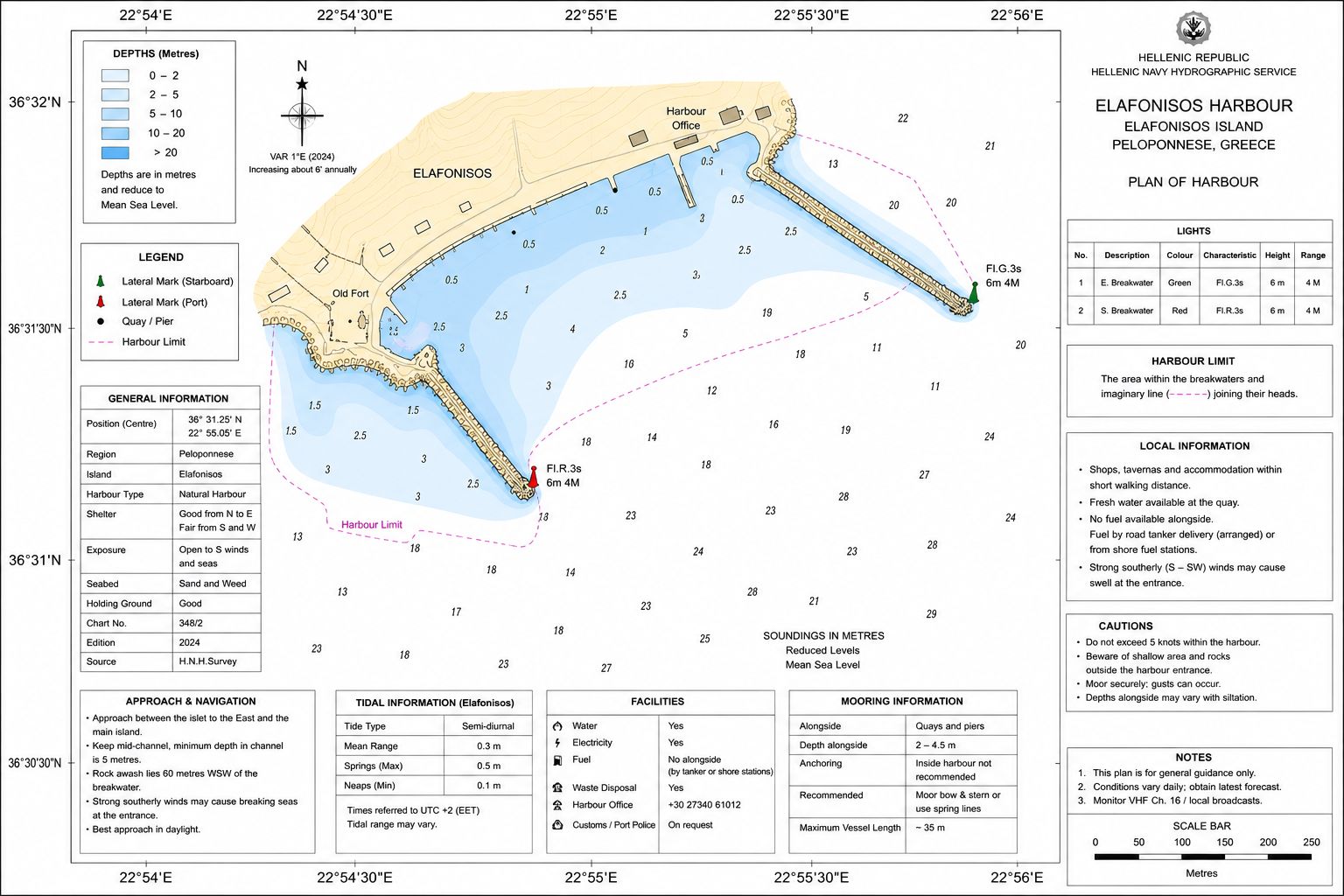
Capacity is restricted and priority is given to ferry operations, which use the main section of the quay and require clear access at all times. Visiting yachts must avoid obstructing ferry berths and be prepared to move if required. Shelter is moderate: the harbour has some protection from northerlies due to its orientation, though gusts can enter, while southerly winds introduce exposure and surge within the basin. Services are basic, with no dedicated fuel dock, no standard shore power, and only limited water availability by arrangement. There are no repair facilities or lift-out capability; berthing should be treated as short-stay with self-sufficiency assumed.
Elafonisos Greece
Sailing Guide - Provisioning
Supermarkets. Provisioning for vessels sailing Elafonisos Greece is available through small supermarkets in Elafonisos town including AB Local Elafonisos and other grocery outlets located within 100–300 metres of the harbour. These supply packaged goods, bread, bottled water, and limited produce. Stock is dependent on deliveries from the mainland at Neapoli Voion.
Markets. Availability of fresh produce is dependent on delivery cycles and demand, with range narrower than mainland centres but generally sufficient for short-term provisioning. There is no dedicated open-air produce market of scale, and selection can reduce quickly during peak periods.
Fish Markets. There is no fish market. There is no formal fish market, but local catch is regularly available either directly from fishing boats in the harbour or through tavernas. Supply varies daily based on conditions, typically including small pelagic species, reef fish, and seasonal items such as octopus or squid
Elafonisos Greece
Sailing Guide - Local Cuisine
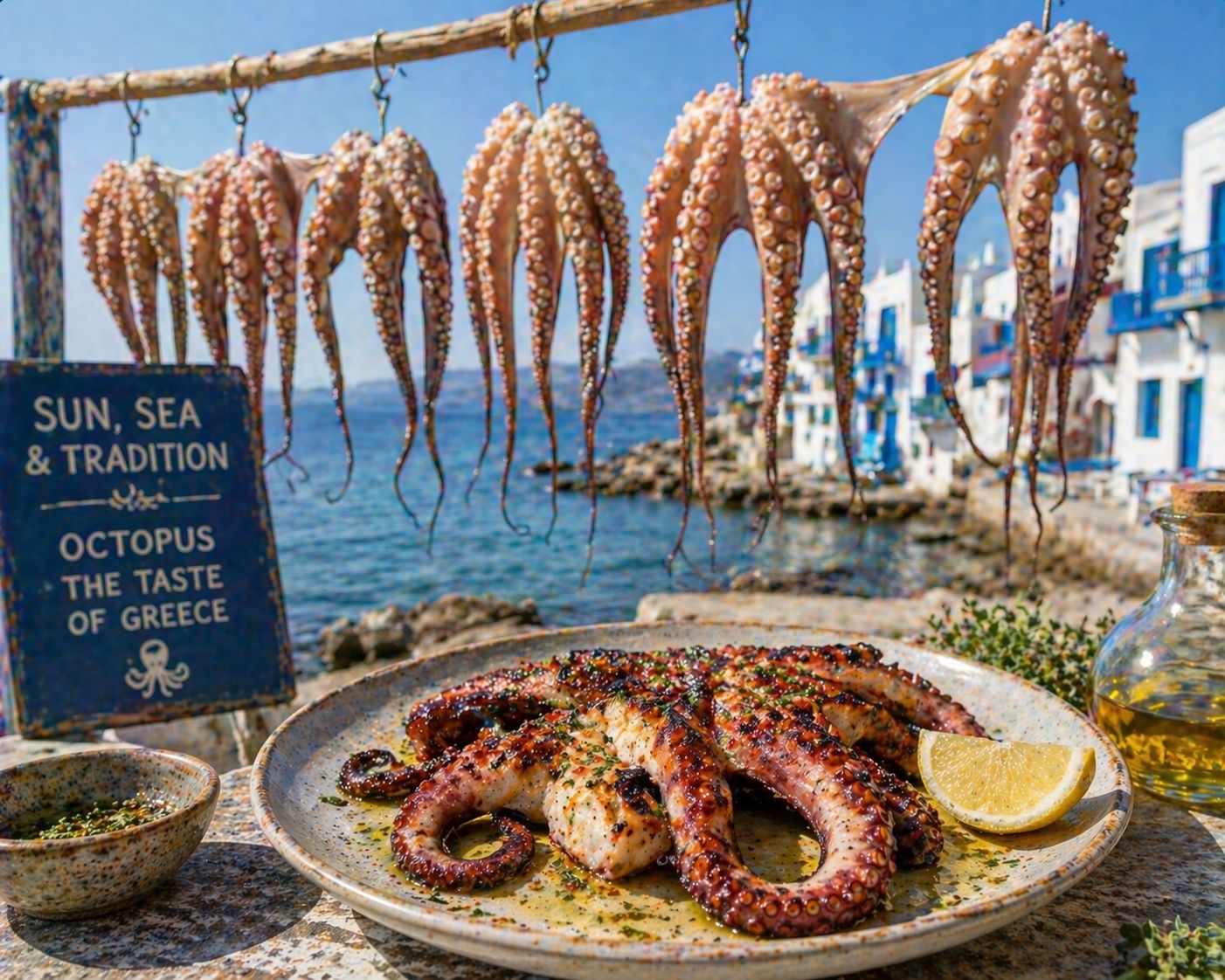
Local cuisine on Elafonisos reflects coastal Peloponnesian cooking, based on simple preparation of locally available fish, meat, and seasonal produce. Fish is typically grilled whole or baked, with common species depending on daily catch, alongside octopus (often dried then grilled) and squid. Meat dishes include lamb or goat, commonly prepared as oven dishes such as kleftiko, or slow-cooked stews. Vegetable-based meals are standard, including briam (baked mixed vegetables), fava (split pea purée), and salads such as horiatiki with tomato, cucumber, onion, and feta. Staples include bread, olives, local cheeses, and olive oil. No dishes are unique to Elafonisos.
Elafonisos Greece
Sailing Guide - Local Beverages
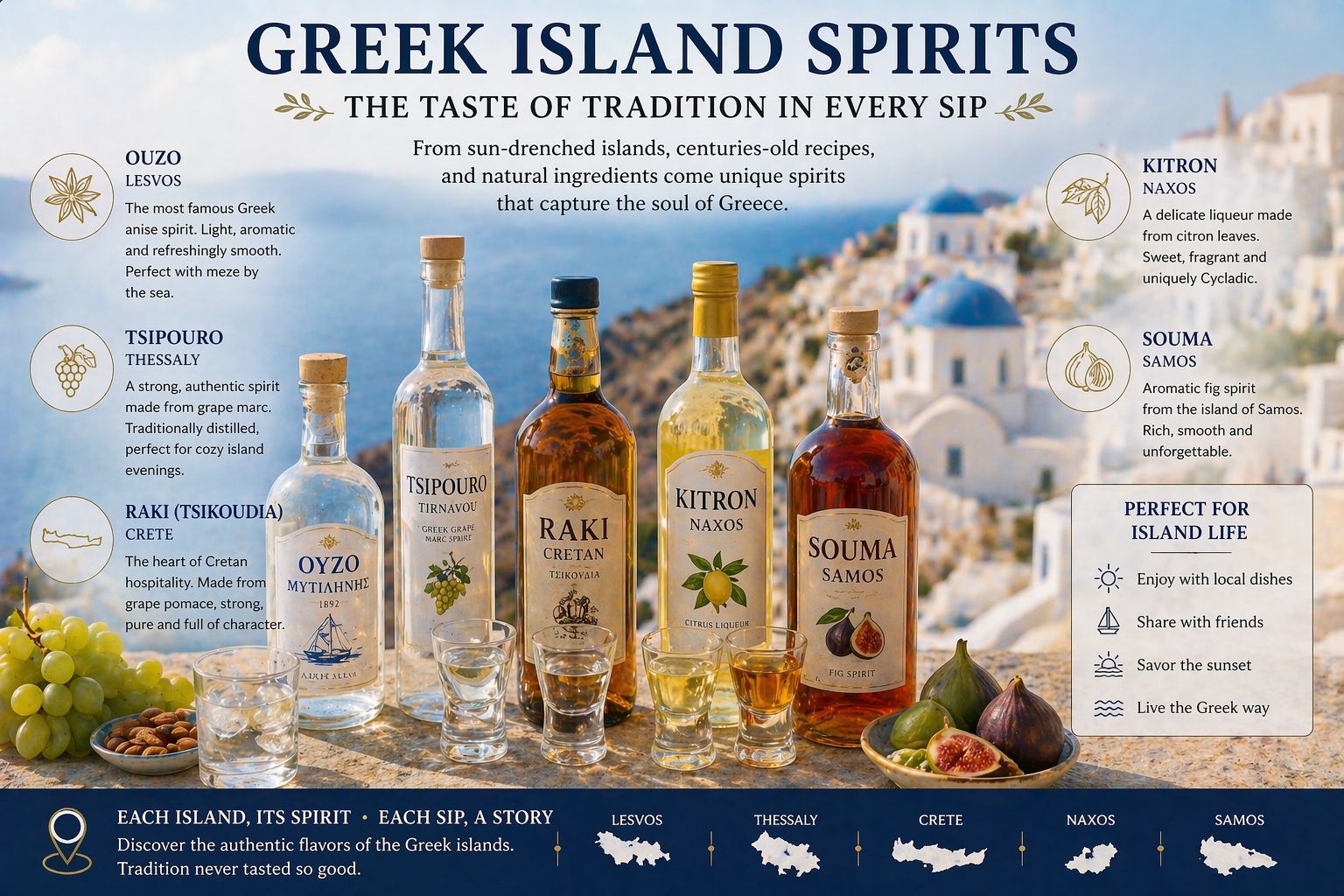
Beer supply includes Alpha, Mythos, and Fix delivered from mainland suppliers. Wine is sourced from Peloponnese and mainland Greece. Spirits include ouzo and tsipouro. No local production exists.
Elafonisos Greece
Sailing Guide - Diesel Fuel Supplies
Fuel supply on Elafonisos is limited and there is no dedicated marine fuel dock within the harbour. Diesel is obtained from a local roadside filling station in the main settlement, with transfer to vessels carried out by jerry can or by arrangement with local delivery where available. This requires manual handling and coordination depending on berth location.
Elafonisos Greece
Sailing Guide - Water Supplies
Fresh water supply on Elafonisos is available but limited in capacity and not provided through a full marina system. At the harbour, water may be accessible at the quay by hose connection, typically arranged locally. Pressure and flow rates are variable, and filling times can be extended, particularly during peak demand
Mechanical and Electrical Repairs
Resource
If you are headed somewhere remote consider the need to expand your knowledge base or have an information resource on board. Why not get a copy of my book The Marine and Electrical and Electronics Bible 4th Edition. By and for yachties, with everything from batteries and charging, solar and wind, diesel engines and marine electronics and so much more. Your complete systems guide. 650 pages of practical advice. In Australia and New Zealand order a copy through Boat Books. UK and European boats can buy the UK Edition Here. US and Canadian boats can get the US Edition Order Here. Marine systems are my profession so let me help you. By a liveaboard boat owner for other boat owners.



Elafonisos Greece
Sailing Guide - Marine Services
There are no formal marine service providers on Elafonisos. Basic mechanical assistance may be available locally but is limited. For technical work, vessels must relocate to mainland facilities at Neapoli Voion or larger ports such as Gythio.
Elafonisos Greece
Sailing Guide - Local Etiquette
Local etiquette on Elafonisos is straightforward: greet on first contact (“kalimera” / “kalispera”), speak at normal volume, and use basic politeness in all interactions. Dress is standard for a small coastal community and shirt and footwear expected in all public places. Service is informal; wait to be acknowledged and follow the existing order rather than interrupting. Behaviour is expected to be restrained: avoid loud conversation, impatience, or confrontational tone. Interactions are direct so state requests clearly, confirm details where needed, and accept that timing and availability follow local routine rather than fixed schedules.
Elafonisos Greece
Sailing Guide - Summary
Elafonisos provides a combination of sheltered harbour and open anchorage environments with significant shallow areas requiring careful navigation. Wind conditions vary between sheltered strait and exposed outer coast. Provisioning and services are limited but available at basic level. The island functions as a secondary stop within Peloponnese cruising routes, consistent with an Elafonisos Greece Sailing Guide for all you need to know.