Double Island Sailing Guide
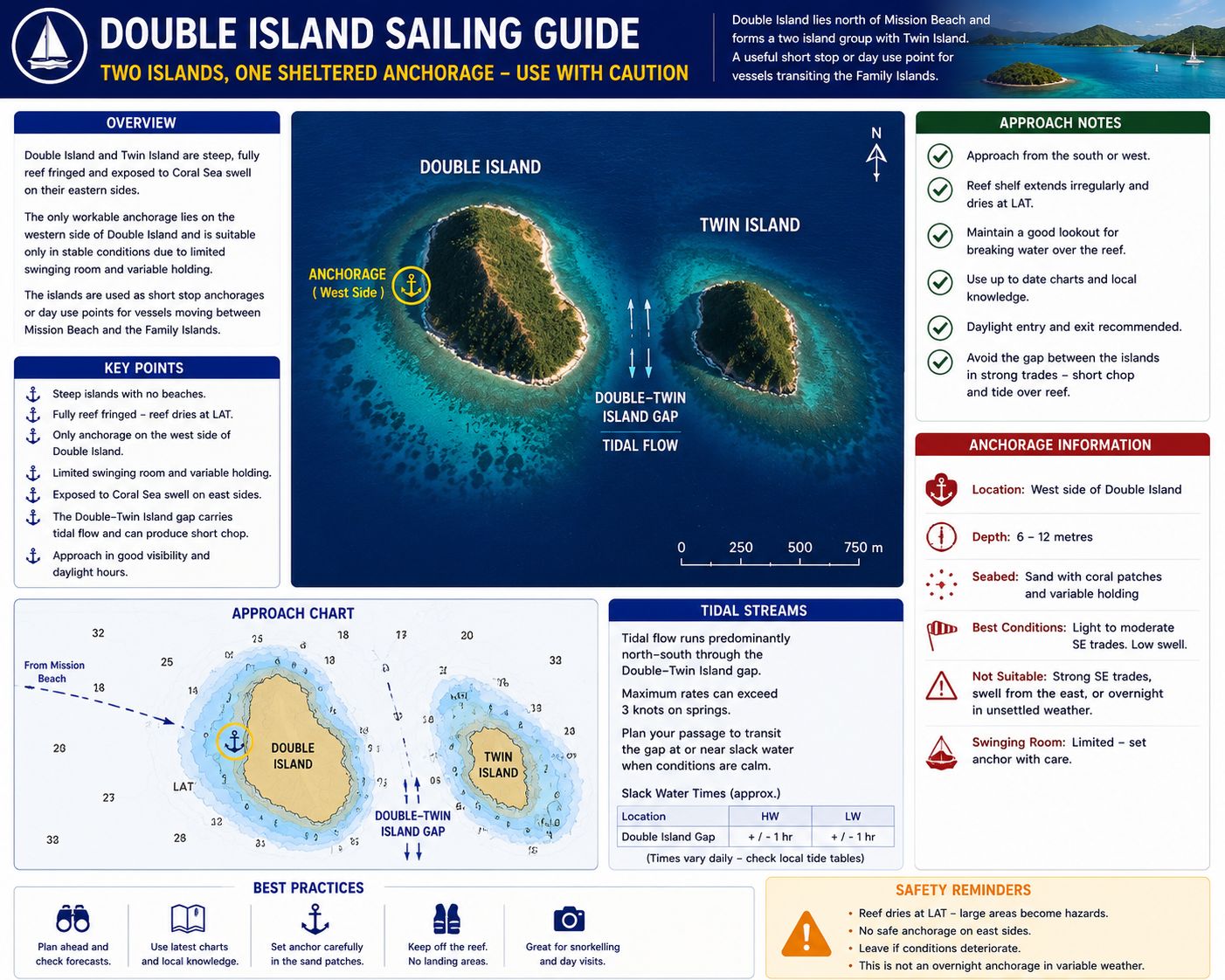
Double Island Sailing Guide. Double Island lies north of Mission Beach and forms a two‑island group with Twin Island. Both islands are steep, fully reef‑fringed, and exposed to Coral Sea swell on their eastern sides. The only workable anchorage lies on the western side of Double Island and is suitable only in stable conditions due to limited swinging room and variable holding. The islands are used as short‑stop anchorages or day‑use points for vessels moving between Mission Beach and the Family Islands.
Approaches are uncomplicated in good visibility, but the reef shelf extends irregularly and dries at LAT. The Double–Twin Island gap carries tidal flow and can produce short chop in trade‑wind conditions. The anchorage requires conservative positioning due to the proximity of reef and the narrow band of workable depth.
Double Island Sailing Guide - Approaches
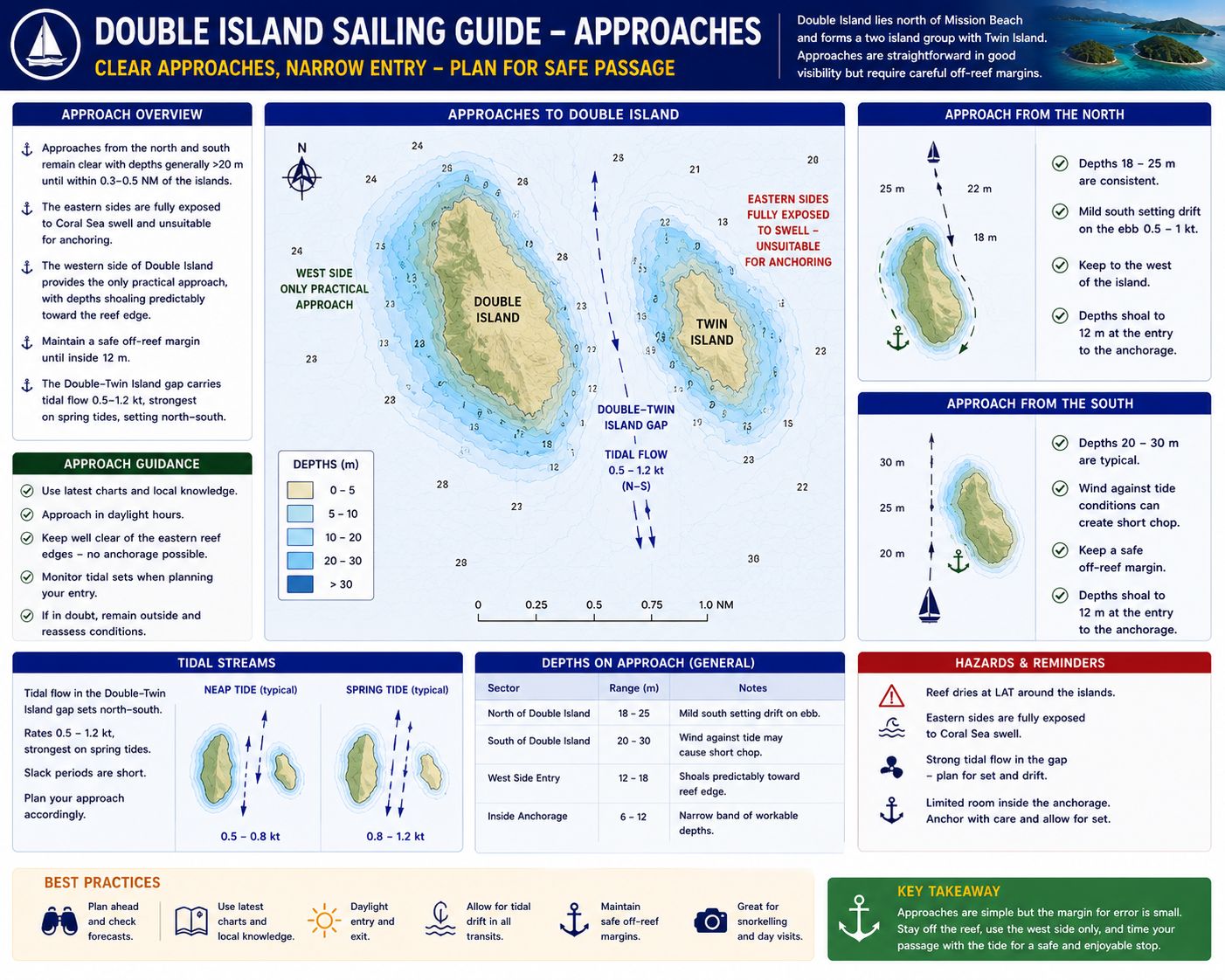
Approaches from the north and south remain clear with depths generally >20 m until within 0.3–0.5 NM of the islands. The eastern sides are fully exposed to swell and unsuitable for anchoring. The western side of Double Island provides the only practical approach, with depths shoaling predictably toward the reef edge.
From the north, depths of 18–25 m are consistent, with a mild south‑setting drift on the ebb at 0.5–1 kt. From the south, depths of 20–30 m are typical, though wind‑against‑tide conditions can create short chop. The western approach is narrow, and maintaining a safe off‑reef margin is essential until inside 12 m. The Double–Twin Island gap experiences tidal flow 0.5–1.2 kt, strongest on spring tides, setting north–south.
Double Island Sailing Guide - Anchorage
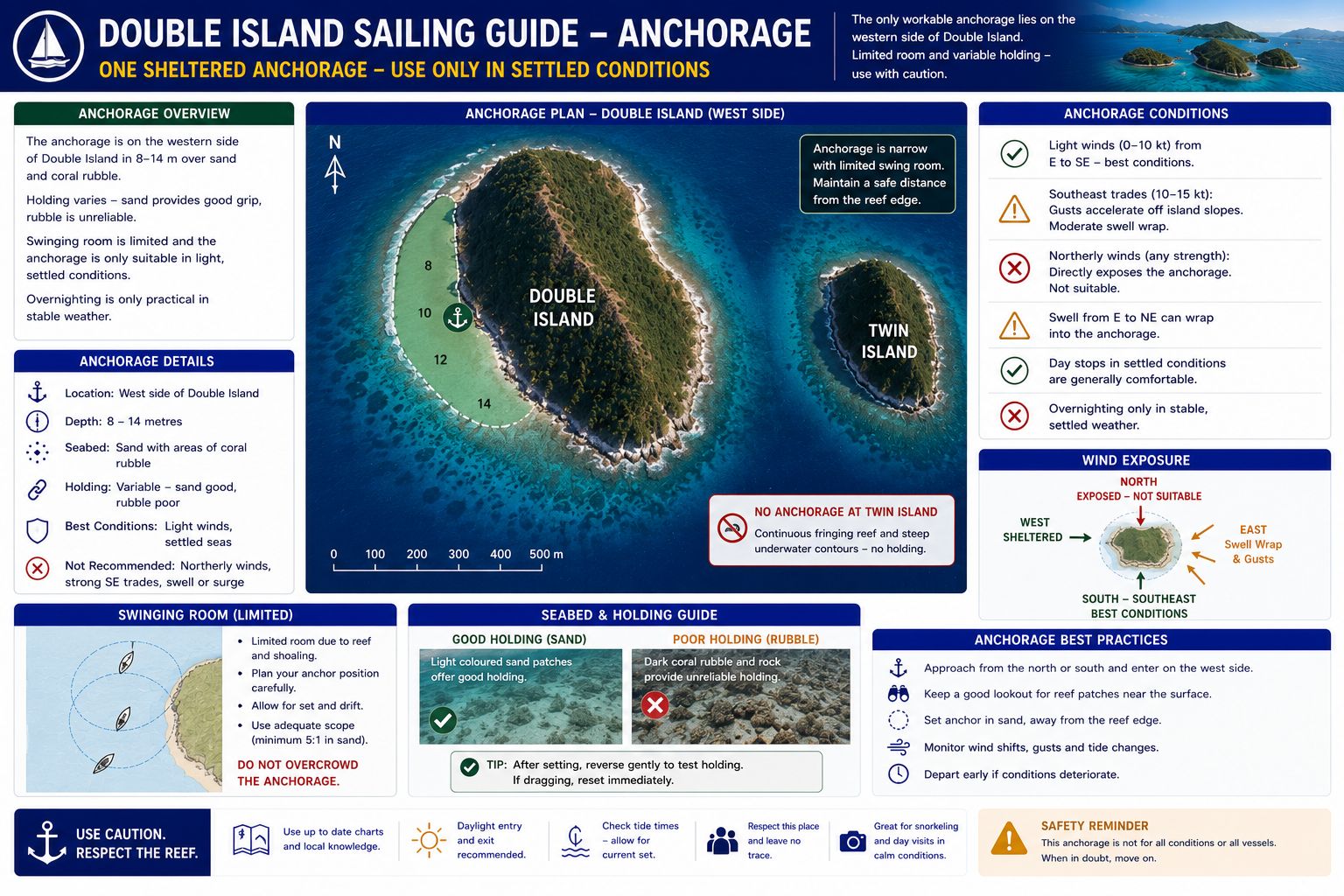
The anchorage lies on the western side of Double Island in 8–14 m over sand and coral rubble. Holding varies, with sand patches providing workable grip and rubble reducing reliability. Swinging room is limited, and the anchorage is only suitable in light, settled conditions. Exposure to northerly winds is the primary limiting factor, and in southeast trade winds the anchorage experiences gust acceleration off the island’s slopes and moderate swell wrap. Overnighting is only practical in stable weather.
Twin Island has no anchorage due to continuous fringing reef and steep underwater contours.
Double Island Sailing Guide - Entry
Formalities
Double Island has no clearance facilities. Vessels arriving from overseas must complete Australian Border Force, Immigration, and Biosecurity entry at designated ports such as Cairns or Townsville. Satellite communications equipment such as Starlink is permitted without local restriction. Firearms must be declared on entry into Australia and cannot be landed on the island.
Double Island Sailing Guide - Marina
Facilities
There are no marinas, jetties, or berthing facilities on Double or Twin Island. All visiting vessels must anchor off the western side of Double Island. The nearest berthing and service points are on the mainland at Mission Beach, with further options at Port Hinchinbrook and Cairns for deeper water and full‑service facilities.
Double Island Sailing Guide - Local
Weather
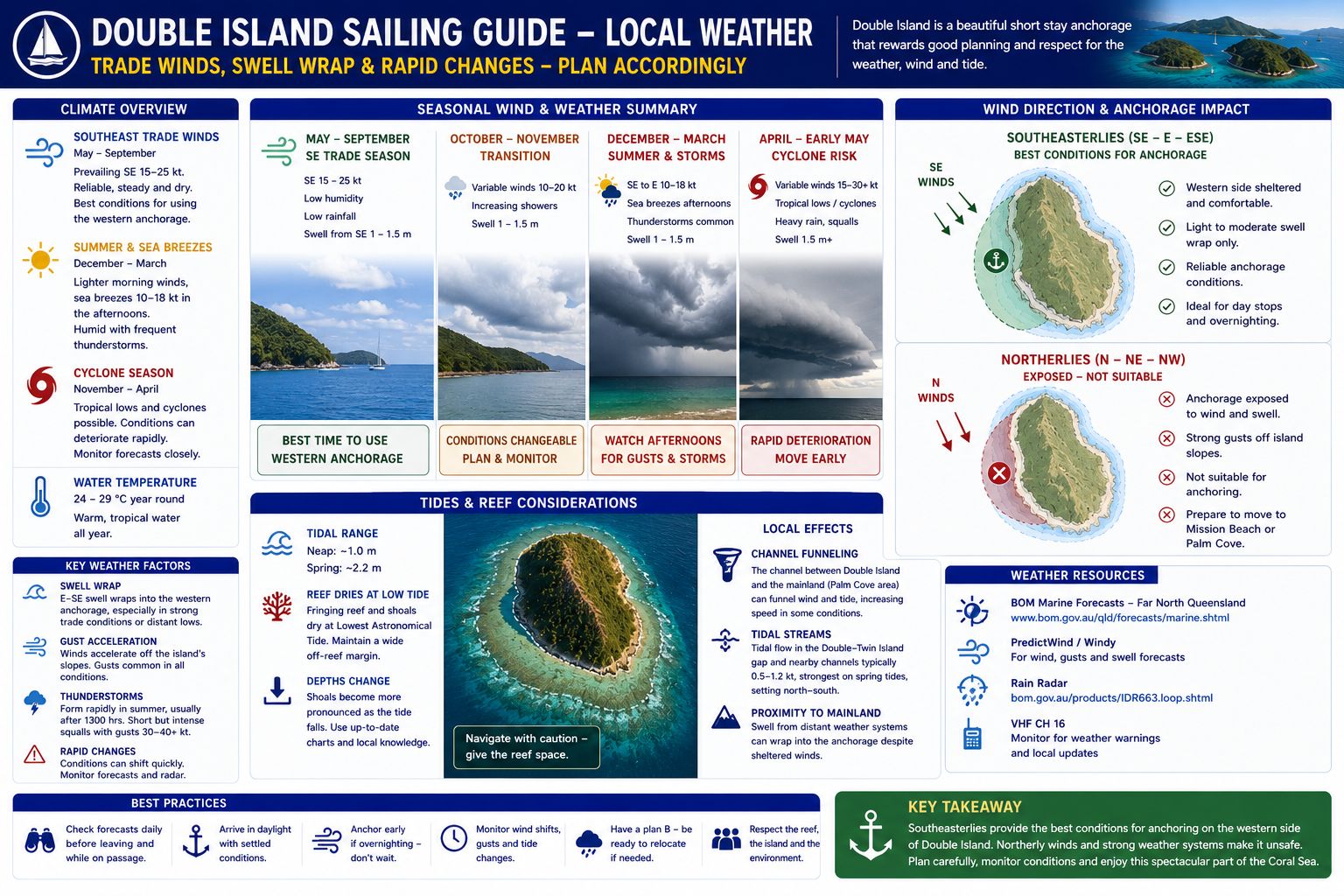
The region is dominated by southeast trade winds from May to September, typically 15–25 kt, which produce consistent swell wrap on the western anchorage. Summer months bring lighter winds, afternoon sea breezes, and higher thunderstorm frequency. Cyclone season runs from November to April, and conditions can deteriorate rapidly.
Double Island is shaped by wind direction. In southeasterlies, the western anchorage is calm and reliable. In northerlies, it becomes exposed, and crews must be prepared to move. The fringing reef requires careful navigation, particularly at low tide, and the shoals become more pronounced as the tide falls.
The island’s proximity to the mainland means that swell can wrap into the anchorage during strong weather systems, and the narrow channel between the island and Palm Cove can funnel wind and tide in certain conditions. Despite these considerations, Double Island remains one of the most enjoyable short‑stay anchorages in the region.
Double Island Sailing Guide - Provisioning
Supermarkets. No provisioning exists on Double Island. Nearest outlets on the mainland: Woolworths Mission Beach. FoodWorks Mission Beach
Markets. Mission Beach Markets (Ulysses Park). Innisfail Central Market
Fish Markets. Innisfail Seafood. - Cardwell Fishermen’s Co‑op
Double Island Sailing Guide - Local
Cuisine
Regional food available on the mainland includes coral trout, barramundi, mud crab, and seasonal tropical fruit such as mango, papaya, rambutan, and lychee.
Double Island Sailing Guide - Local
Fishing
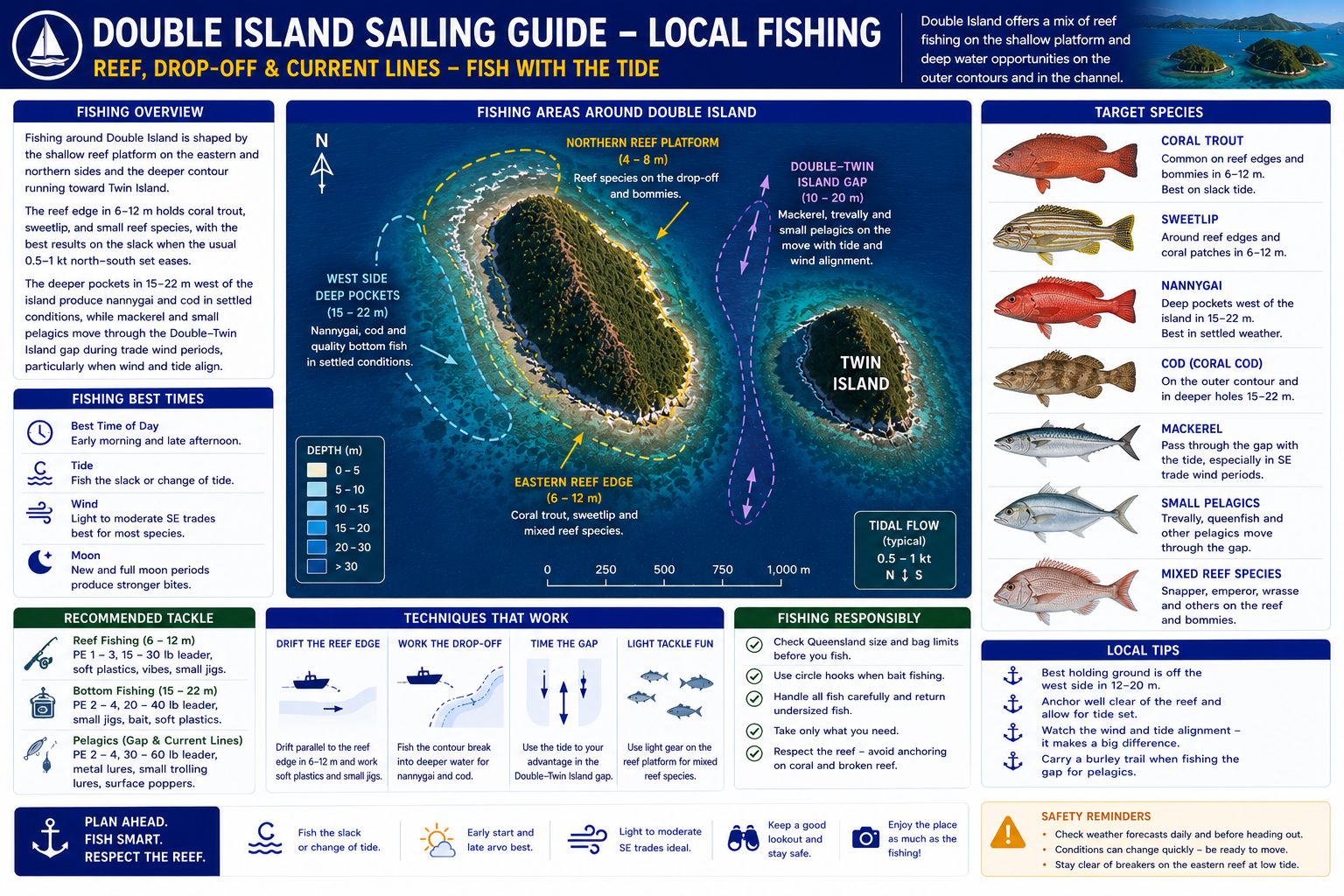
Fishing around Double Island is shaped by the shallow reef platform on the eastern and northern sides and the deeper contour running toward Twin Island. The reef edge in 6–12 m holds coral trout, sweetlip, and small reef species, with the best results on the slack when the usual 0.5–1 kt north–south set eases. The deeper pockets in 15–22 m west of the island produce nannygai and cod in settled conditions, while mackerel and small pelagics move through the Double–Twin Island gap during trade‑wind periods, particularly when wind and tide align.
Double Island Sailing Guide - Fuel
Supplies
No fuel is available on Double Island. Fuel can be taken on the mainland at Clump Point or Cardwell. Jerry‑can transport is required for yachts.
Double Island Sailing Guide - Water
Supplies
No potable water is available on Double Island. Water can be taken at Clump Point or Cardwell Marina.
Mechanical and Electrical Repairs
Resource
If you are headed somewhere remote consider the need to expand your knowledge base or have an information resource on board. Why not get a copy of my book The Marine and Electrical and Electronics Bible 4th Edition. By and for yachties, with everything from batteries and charging, solar and wind, diesel engines and marine electronics and so much more. Your complete systems guide. 650 pages of practical advice. In Australia and New Zealand order a copy through Boat Books. UK and European boats can buy the UK Edition Here. US and Canadian boats can get the US Edition Order Here. Marine systems are my profession so let me help you. By a liveaboard boat owner for other boat owners


Double Island Sailing Guide - Marine
Services
No marine services exist on Double Island. Mission Beach offers limited mobile mechanical and electrical support. Cardwell provides basic marine mechanical services. Cairns offers full‑service marine facilities including Volvo Penta, Yanmar, Cummins, and multiple electronics technicians.
Double Island Sailing Guide - Local Customs
Double Island lies within Djiru traditional lands. Respect applies to cultural sites and wildlife. Landing is discouraged due to environmental sensitivity and lack of safe access.
Double Island Sailing Guide - Summary
Double Island provides a small, weather‑dependent anchorage on its western side with limited holding and restricted swinging room. Twin Island has no anchorage. All provisioning and technical needs must be handled on the mainland. The island group is best used as a short‑stay anchorage in stable conditions. The Double Island Sailing Guide for all you need to know.