Dia Island Greece
Sailing Guide
Dia Island Greece Sailing Guide. Dia Island lies approximately 7 nautical miles north of Heraklion in the central Cretan Sea and is one of the principal offshore cruising destinations along the northern coast of Crete. The island is uninhabited and mountainous, extending east-west with steep rocky coastlines, exposed cliffs, and several deeply indented bays used by visiting yachts. Dia provides important temporary anchorage shelter for vessels operating between the Cyclades, Dodecanese, and Crete, particularly during moderate northerly conditions. The island forms part of a protected environmental zone with limited infrastructure and no permanent harbour settlement.
For cruising yachts, Dia is primarily valued for its accessible anchorages, proximity to Heraklion, and comparatively sheltered bays during settled summer weather. The northern coast of Crete is frequently exposed to Meltemi-driven sea states, and Dia offers some reduction in wave exposure depending on wind direction and anchorage selection. Water depths around the island increase rapidly offshore, while submerged rock shelves and isolated reef areas require careful navigation close inshore. There are no marina facilities, fuel docks, or provisioning services on the island, and all operational support is obtained from Heraklion before departure.
Dia Island Greece
Sailing Guide - History
The history of Dia Island is closely associated with the maritime activity of ancient Crete, particularly during the Minoan period when the waters north of Heraklion formed part of major eastern Mediterranean trade and navigation routes. Archaeological evidence indicates that Dia may have functioned as a sheltering point and maritime staging location for vessels approaching the nearby Minoan centre of Knossos. Ancient shipwreck remains, anchors, pottery fragments, and submerged structures discovered around the island suggest long-term use by merchant shipping and coastal traffic. Some researchers also associate the island with references in classical texts describing a sacred or protected island linked to the worship traditions of ancient Crete.
During later Venetian and Ottoman periods the island remained largely uninhabited and was used intermittently by fishermen, shepherds, and coastal traders operating from the northern Cretan coast. Its isolated position and lack of permanent freshwater sources prevented substantial settlement development. In modern times Dia has become environmentally protected due to its ecological significance, native wildlife habitats, and archaeological importance. The island now falls within a Natura 2000 conservation area, with restrictions applying to construction, environmental disturbance, and certain commercial activities. Today Dia remains primarily a natural reserve and seasonal anchorage destination for recreational and cruising vessels departing from Heraklion.
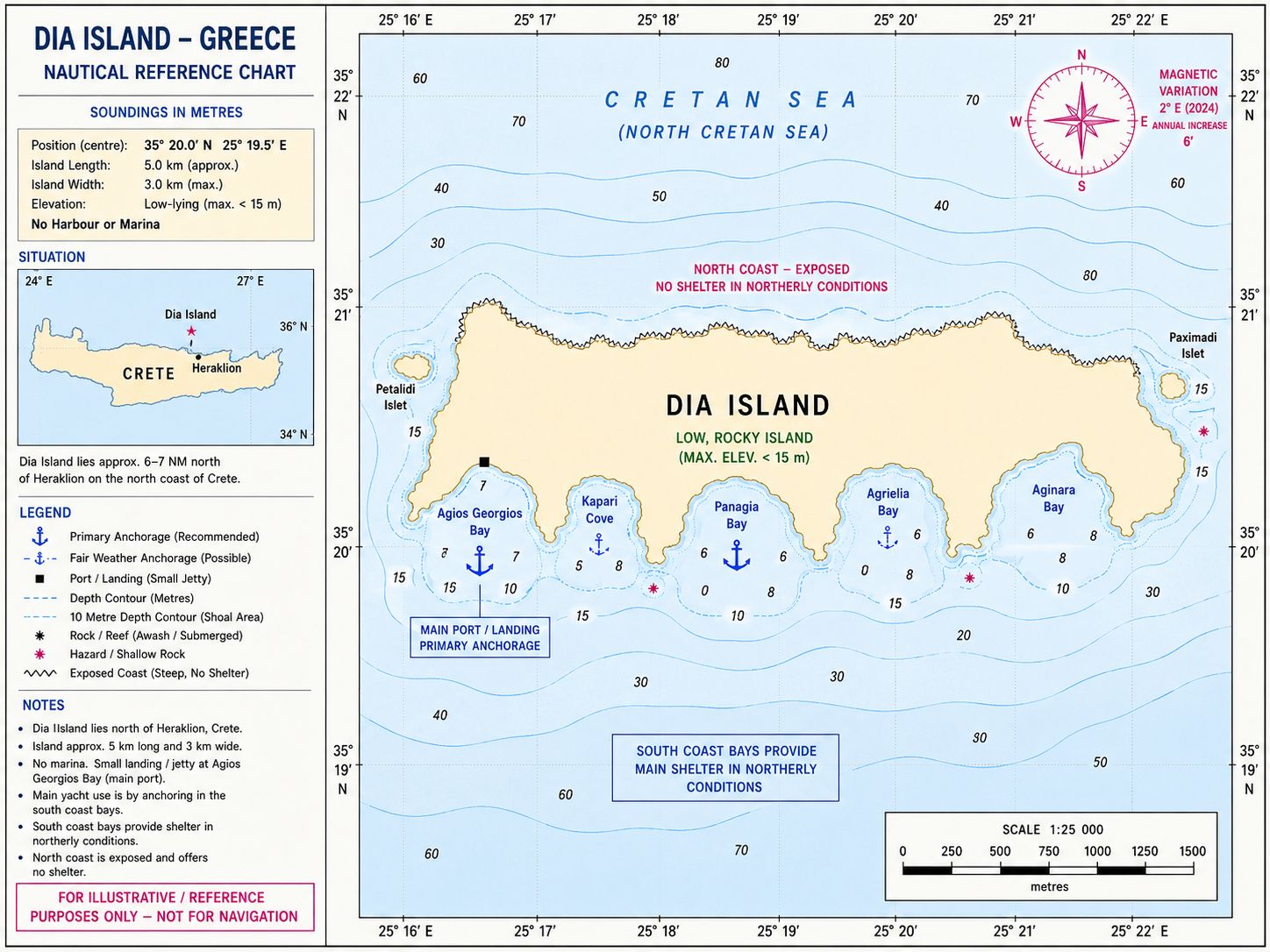
Chart Disclaimer. This chart is a schematic representation for illustrative purposes only and must not be used for navigation. Refer to official hydrographic charts for safe navigation. Be aware ENC charts may differ from official hydrographic charts. Both should be corrected and updated regularly.
Dia Island Greece
Sailing Guide - Ocean Currents and Tidal Flow
The waters surrounding Dia Island are influenced primarily by wind-driven circulation patterns in the Cretan Sea rather than significant tidal exchange. Tidal range in this region is minimal, commonly less than 0.3 metres, and tidal streams generally have little operational effect on yacht navigation or anchoring. Surface current direction is largely controlled by prevailing northerly winds, particularly during sustained Meltemi conditions when a west to east set commonly develops along the northern coast of Crete. Accelerated local flow may occur around headlands and entrances to the island’s bays where wind compression interacts with steep seabed gradients and coastal topography.
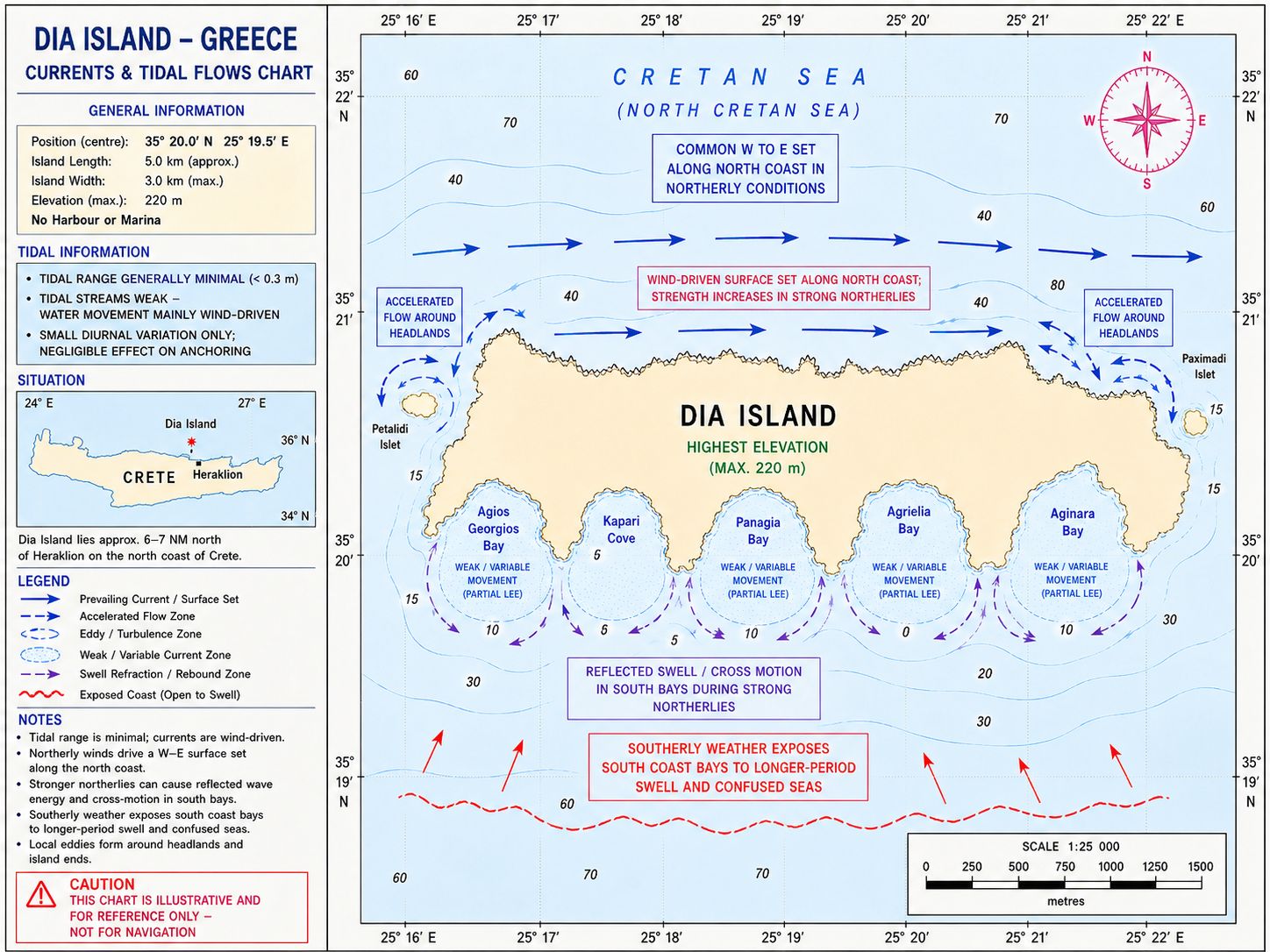
Sea state and local current behaviour can change rapidly during stronger northerly systems, with reflected wave energy and cross swell affecting anchorages on the southern side of Dia despite apparent lee protection. Swell refraction around the eastern and western extremities of the island often creates rolling conditions within otherwise sheltered bays. During southerly weather systems the island becomes exposed to longer-period open-sea swell propagating northward from the Libyan Sea through gaps around Crete, occasionally producing confused seas around the anchorage entrances. Offshore depths increase rapidly around much of the island, allowing wave energy to remain largely unattenuated until close to shore, particularly along the northern and eastern coasts.
Dia Island Greece
Sailing Guide - Weather
The climate around Dia Island is typically eastern Mediterranean with long dry summers, mild winters, and limited annual rainfall. During the primary cruising season from May through October, conditions are generally stable with prolonged periods of clear skies, strong solar exposure, and low precipitation. Summer daytime temperatures commonly range between 28°C and 34°C, while sea temperatures remain warm well into autumn. Visibility is usually excellent, although occasional haze or dust from North Africa may reduce long-range visibility across the Cretan Sea. Due to the island’s exposed offshore position north of Crete, sea conditions are often more energetic than within the sheltered waters closer to the mainland coast.
The dominant seasonal weather influence is the northerly Meltemi pattern affecting the Aegean and Cretan Sea during summer. These winds frequently strengthen during the afternoon and can persist for several consecutive days, producing steep short-period seas around the island and uncomfortable conditions in exposed anchorages. Although the southern bays of Dia provide some lee protection in northerly weather, swell penetration and reflected wave action often continue within the anchorages. Winter and transitional seasons bring more variable weather with frontal systems moving eastward across the Mediterranean, generating strong southerly or south-westerly winds, thunderstorms, and rapidly changing sea states. There is no all-weather harbour on the island, and deteriorating conditions may require immediate departure for the mainland coast of Crete.
The Marine Electrical and Electronics Bible has a complete list of Greek VHF Radio Channel information and weather forecast times for Greece along with NAVTEX UK and Europe and NAVTEX Mediterranean for 490kHz and 518kHz.
Dia Island Greece
Sailing Guide - Local Winds
Local wind patterns around Dia Island are dominated by the regional northerly Meltemi circulation during the main cruising season. Prevailing winds are typically north to north-west and frequently strengthen from late morning through the afternoon before easing overnight. Due to the island’s offshore position north of Crete, Dia is directly exposed to the full fetch of the Cretan Sea and wind strengths around the island commonly exceed conditions observed along the nearby mainland coast. Wind acceleration zones form around the eastern and western headlands, while gust compression can occur at the entrances to the southern anchorages where airflow is funnelled by steep terrain and coastal contours.
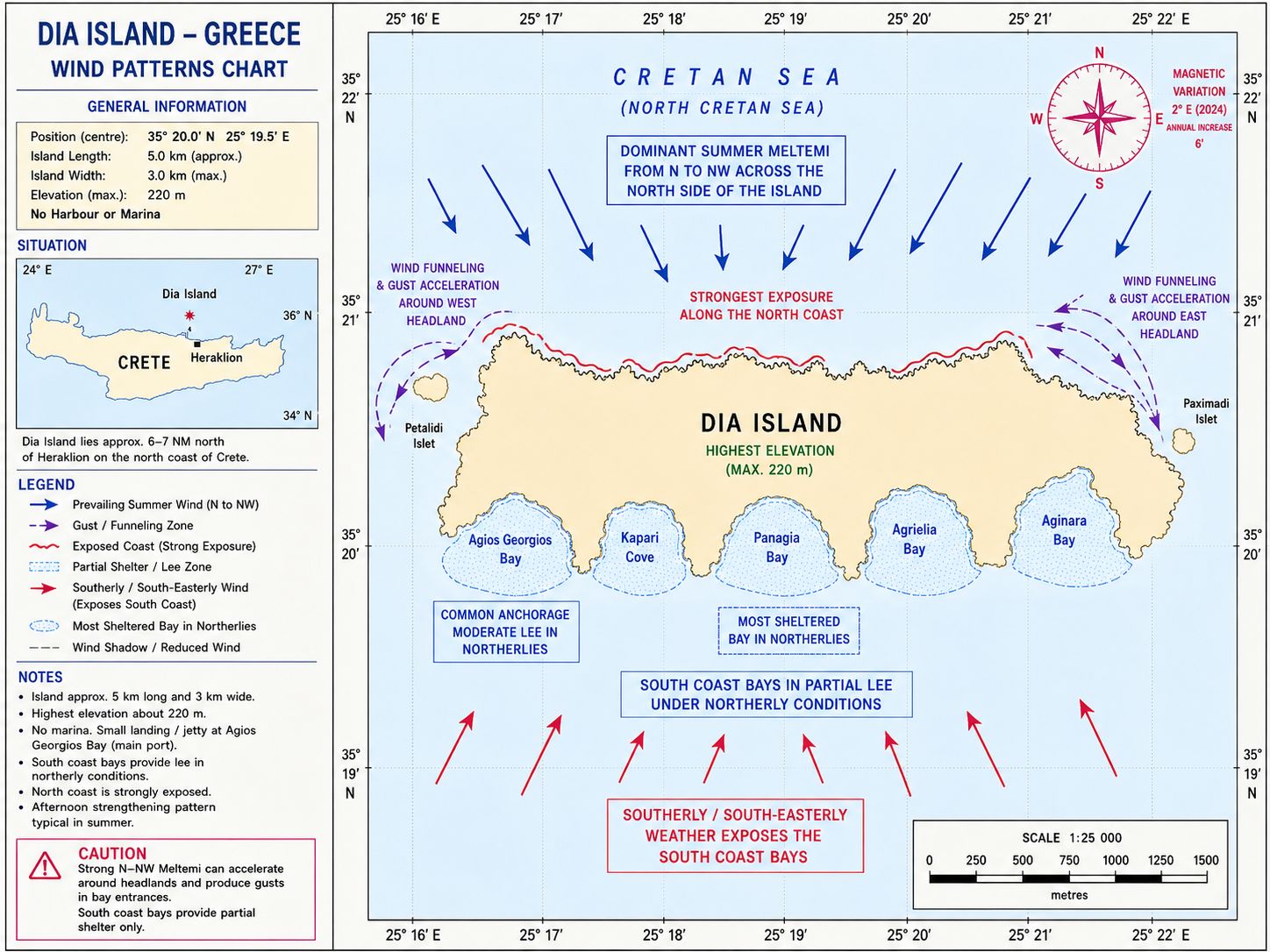
Katabatic effects descending from the mountainous interior of Crete occasionally interact with the prevailing northerly flow, creating sudden gusts and localized wind shifts, particularly during evening and overnight periods. Southerly and south-easterly winds occur less frequently but produce more hazardous anchorage conditions due to limited natural protection and longer open-water swell exposure. During transitional seasons variable winds associated with passing frontal systems may generate rapid directional changes and short-duration squalls. In stronger Meltemi events the sea state around Dia can become steep and confused, with reflected wave action entering otherwise sheltered bays and producing continuous rolling conditions at anchor.
Dia Island Greece
Sailing Guide - Approaches
Approaches to Dia Island are generally uncomplicated in settled weather with good visibility, although the island’s exposed position north of Crete means sea conditions can deteriorate rapidly during strong northerly winds. Most yachts approach from Heraklion on a crossing of approximately 7 nautical miles. Offshore depths around Dia increase quickly to several hundred metres, with steep underwater gradients continuing close to shore in many areas. The island is mountainous and clearly visible from significant distance, providing reliable visual reference during daylight approaches. Navigation after dark is not recommended for first-time arrivals due to limited lighting, unmarked reef areas, and the absence of harbour infrastructure.
The principal yacht approaches are made toward the southern side of the island where the main anchorages are located. Careful visual navigation is required during final approach as isolated rock shelves, submerged reef patches, and steep-to shorelines occur around much of the coastline. Depths in the southern bays generally reduce quickly from offshore water exceeding 40 metres into anchoring depths of approximately 5–12 metres. During strong Meltemi conditions accelerated wind and sea compression may occur off the southern headlands and bay entrances, producing steep short-period seas and difficult anchoring conditions. Wide clearance should be maintained around the eastern and western extremities of the island where swell reflection and localized turbulence are common in unsettled weather.
Dia Island Greece
Sailing Guide - Navigation
Navigation around Dia Island is primarily conducted by visual pilotage supported by accurate charting and continuous depth monitoring. The island has no harbour, marina, or formal port facilities, and all yacht operations are centred on open anchorages along the southern coastline. Water clarity is generally excellent, allowing submerged reef edges, rock shelves, and weed beds to be identified in good overhead light. The coastline is predominantly steep-to with rapid depth changes close offshore, although several southern bays provide workable anchoring depths between approximately 5 and 12 metres over sand and mixed weed bottom. Careful route selection is required when entering the bays due to isolated rocky projections and uneven seabed contours extending from the shoreline.
The principal navigation area for visiting yachts is the southern side of the island where the anchorages provide partial shelter from prevailing northerly conditions. Final approach into the bays should be made at reduced speed as katabatic gusts descending from the island’s higher terrain can create sudden wind shifts and localized acceleration zones. In stronger Meltemi conditions reflected swell and cross-wave motion frequently develop inside the anchorages despite apparent lee protection. The eastern and western headlands of Dia should be rounded with adequate offing due to turbulence, rebound sea state, and submerged rock areas near the shore. There are no navigation lights, fuel facilities, moorings, or protected all-weather berths on the island, and vessels should maintain sufficient sea room and weather awareness at all times.
Dia Island Greece
Sailing Guide - Chart Accuracy
Hydrographic charts accurately depict coastline and bathymetry. Electronic charts align with official data. Caution is required for isolated rocks and seabed variation near shore. Depth soundings should be verified when anchoring.
Dia Island Greece
Sailing Guide - Anchorages
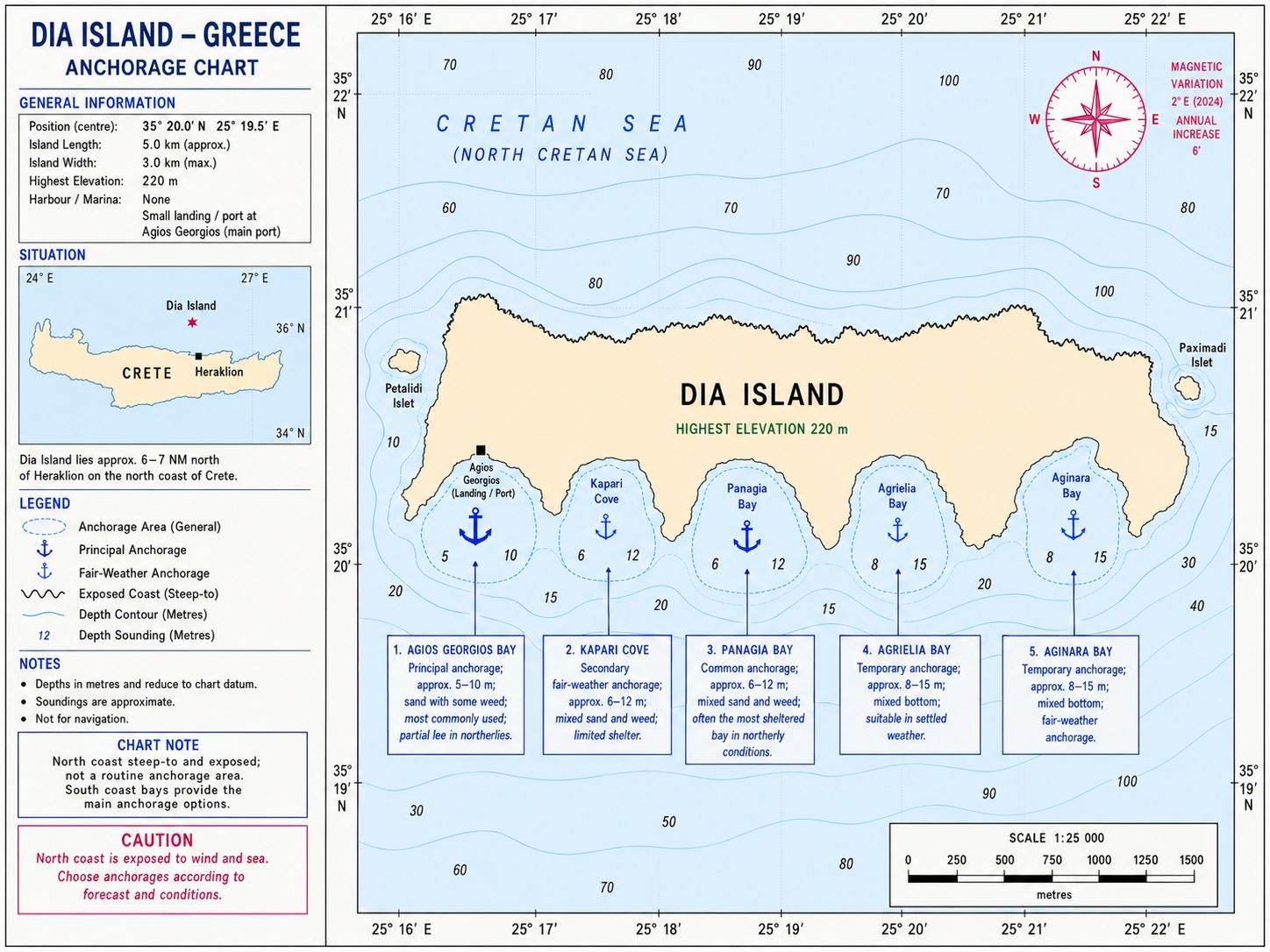
Dia anchorage options are limited but operationally useful. There are no all-weather anchorages.
- Agios Georgios Bay. The principal anchorage at Dia Island is located on the southern coast at Agios Georgios Bay. This is the most commonly used overnight anchorage for cruising yachts arriving from Heraklion. Depths generally range from 5–10 metres over sand with scattered weed patches. Holding is usually reliable in clean sand. The bay provides partial shelter from prevailing northerly Meltemi conditions, although gusts descending from surrounding slopes can be severe at times. Swell reflection and rolling conditions frequently develop during prolonged strong northerlies. The bay contains a small chapel ashore and seasonal excursion vessel activity during summer daylight hours.
- Panagia Bay. Located east of Agios Georgios along the southern coastline, Panagia Bay offers temporary anchoring in approximately 6–12 metres over mixed sand and weed bottom. Shelter is moderate in northerly conditions but the anchorage is more open to easterly swell penetration and rebound wave action from surrounding cliffs. The bay is narrower and deeper than Agios Georgios, with steeper seabed gradients near shore. Careful anchor placement is required to avoid weed-covered bottom areas with reduced holding quality.
- Eastern Southern Cove. Several unnamed coves and recesses exist along the south-eastern coastline of the island which may provide temporary daytime anchoring in calm weather. Depths are commonly 8–15 metres with rapid shoaling toward rocky shorelines. Bottom composition varies between sand, stone, and weed patches. These locations offer limited practical shelter and are generally used only when the main bays are congested or during short daytime visits. Swell reflection from steep coastal terrain often creates uncomfortable motion even in otherwise settled conditions.
- Western Southern Anchorage. Temporary anchoring is possible off sections of the south-western coast in stable northerly weather. Depths are generally deeper than the eastern bays, commonly 10–18 metres, with mixed holding characteristics. These anchorages remain exposed to west and south-west swell development and become untenable in deteriorating weather. Wind acceleration around nearby headlands may produce localized gusts significantly above forecast strength.
- Northern Coast Roadstead. The northern side of Dia is largely unsuitable for routine anchoring due to direct exposure to the Cretan Sea and prevailing northerly Meltemi conditions. Temporary fair-weather anchoring may be possible in isolated pockets during calm periods, but the coastline is steep-to with limited shelter and poor protection from swell. These positions are generally avoided for overnight use due to rapid sea-state deterioration and absence of escape protection in changing weather.
Additional small bays provide anchoring in settled conditions with depths between 5 and 15 metres over mixed seabed. These positions are condition dependent and not suitable in unstable weather.
Dia Island Greece
Sailing Guide - Entry Formalities
Entry formalities follow standard Greece procedures for visiting yachts. This is not a designated port of entry for international clearance, and there are no customs or immigration facilities on the island. Vessels arriving from outside Greece or the Schengen Area must first clear into the country at an official port of entry before proceeding to this port. Direct arrival from a non-Schengen country is not permitted. The Greek cruising tax (TEPAI) must be valid and paid, and the vessel’s cruising log (DEKPA for non-EU vessels, or transit log where applicable) should be up to date and available for inspection if requested by port authorities or coastguard.
Dia Island Greece
Sailing Guide - Marina Facilities
There are no marina or berthing facilities. No harbour infrastructure exists.
Dia Island Greece
Sailing Guide - Provisioning
- Supermarkets. No provisioning facilities exist. Supplies must be obtained from Heraklion.
- Markets. No markets operate. No local produce supply exists.
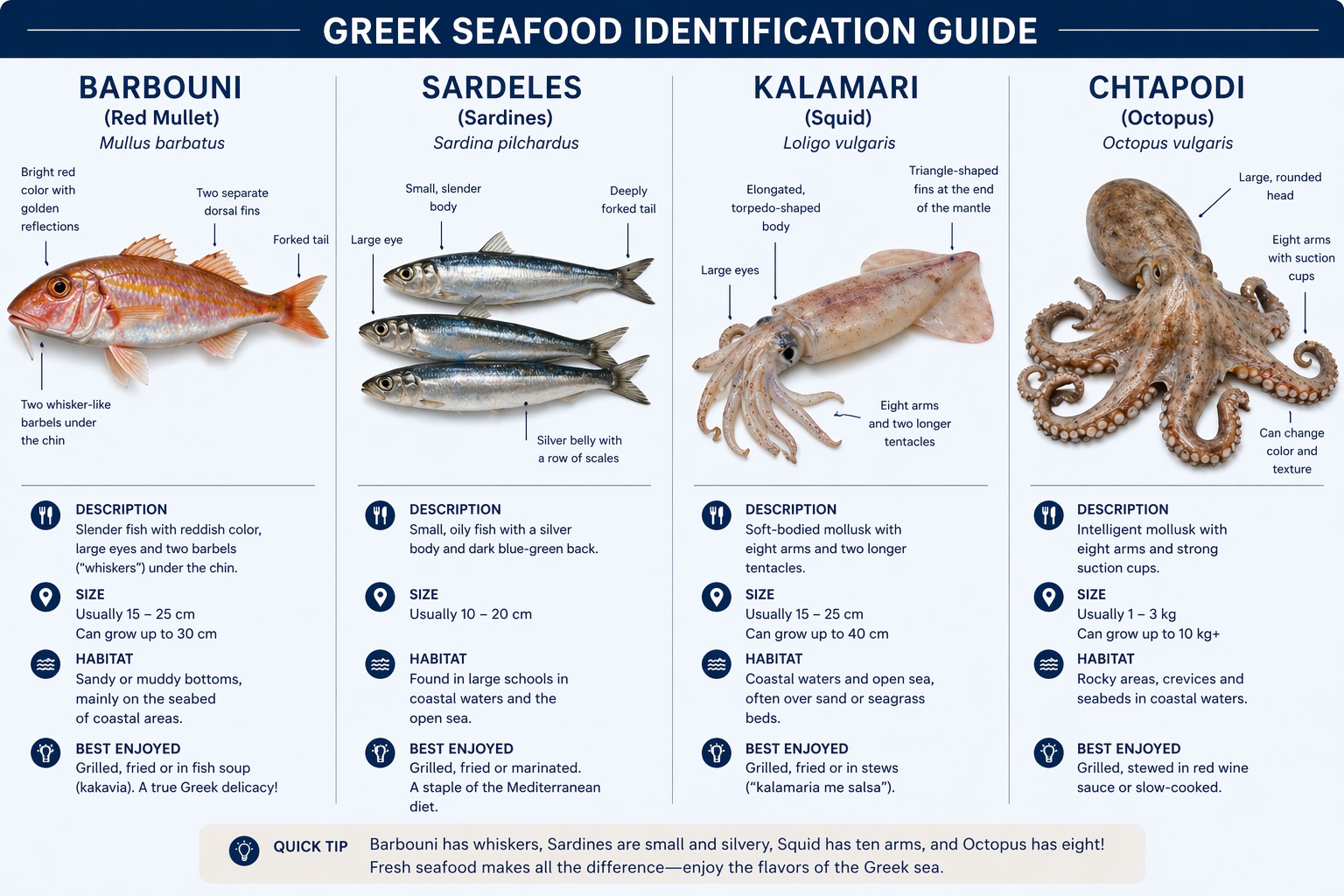
- Fish Markets. No fish market exists. No reliable local supply.
Dia Island Greece
Sailing Guide - Local Cuisine
No cuisine infrastructure exists. The island is uninhabited.
Dia Island Greece
Sailing Guide - Local Beverages
No beverage supply exists. All provisions must be carried onboard.
Dia Island Greece
Sailing Guide - Diesel Fuel Supplies
No diesel supply exists. Fuel must be sourced from Heraklion.
Dia Island Greece
Sailing Guide - Water Supplies
No potable water supply exists. All water must be carried onboard.
Mechanical and Electrical Repairs
Resource
If you are headed somewhere remote consider the need to expand your knowledge base or have an information resource on board. Why not get a copy of my book The Marine and Electrical and Electronics Bible 4th Edition. By and for yachties, with everything from batteries and charging, solar and wind, diesel engines and marine electronics and so much more. Your complete systems guide. 650 pages of practical advice. In Australia and New Zealand order a copy through Boat Books. UK and European boats can buy the UK Edition Here. US and Canadian boats can get the US Edition Order Here. Marine systems are my profession so let me help you. By a liveaboard boat owner for other boat owners.



Dia Island Greece
Sailing Guide - Marine Services
No marine services exist. Full service capability requires transit to Heraklion.
Dia Island Greece
Sailing Guide - Local Etiquette
Dia is a protected natural area. Anchoring should avoid sensitive seabed where possible. General conduct should minimise environmental impact. No facilities exist for waste disposal.
Dia Island Greece
Sailing Guide - Summary
Dia provides accessible anchorage close to Crete with several south coast bays offering shelter from northerly winds. Protection is dependent on wind direction with no all-weather shelter. Infrastructure is absent, requiring full self-sufficiency. Navigation is straightforward with attention to local conditions. The Dia Island Greece Sailing Guide for all you need to know.