Dar es Salaam Yacht
Port Guide
Dar es Salaam Yacht Port Guide. Dar es Salaam is Tanzania’s primary deep‑water commercial port, handling container ships, bulk carriers, tankers, and regional freight for multiple landlocked countries. It is a controlled, high‑traffic harbour with no marina, no pontoons, and no yacht‑specific infrastructure. All yacht movements occur inside a commercial environment governed by TPA.
Yachts use Dar es Salaam for clearance, provisioning, and logistics when moving between Zanzibar, Kenya, Mozambique, Seychelles, and the wider western Indian Ocean. The port is functional but not yacht‑oriented, and operations require commercial‑port discipline. Not a great destination and better elsewhere and more secure.
Dar es Salaam Yacht
Port Guide - Approaches
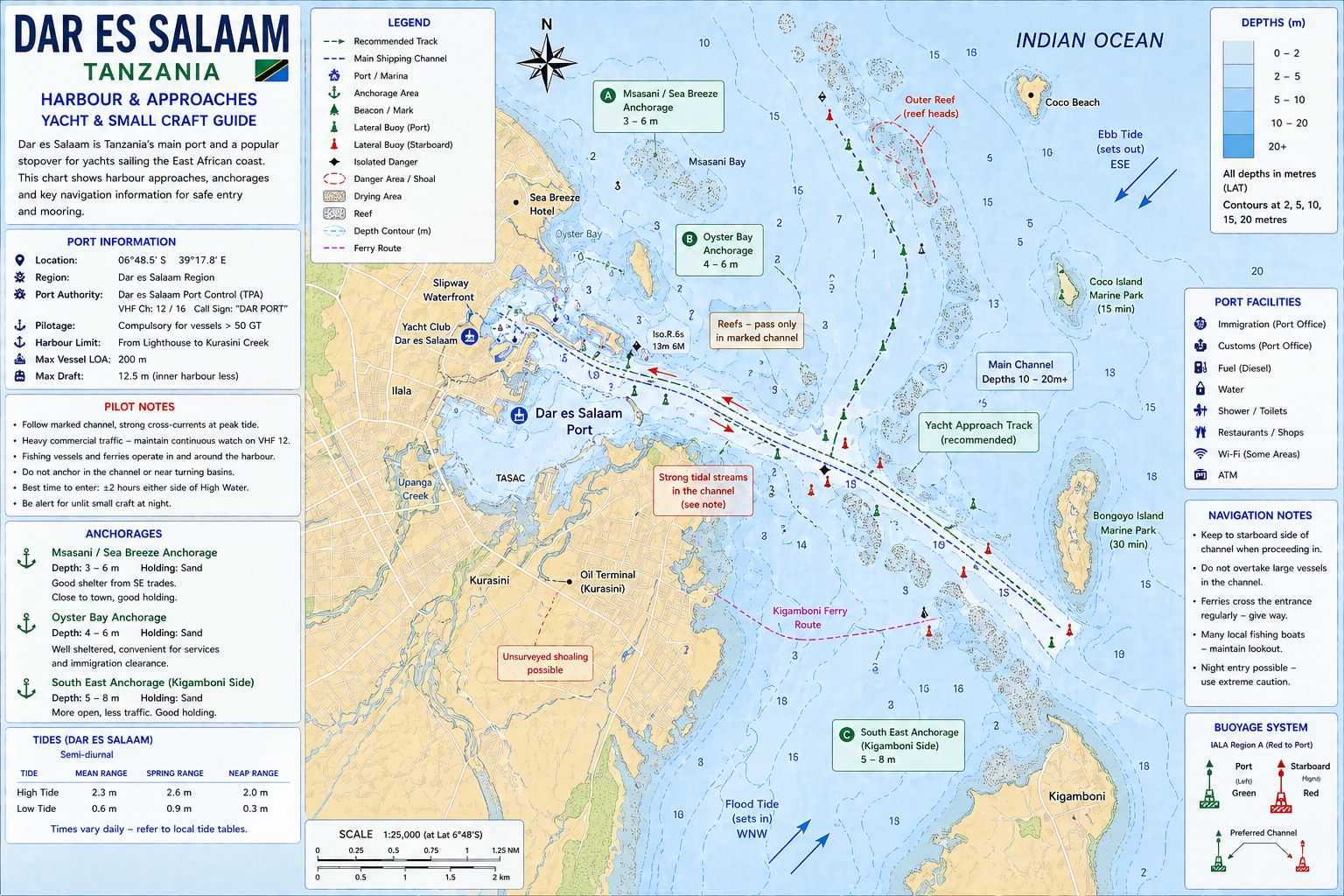
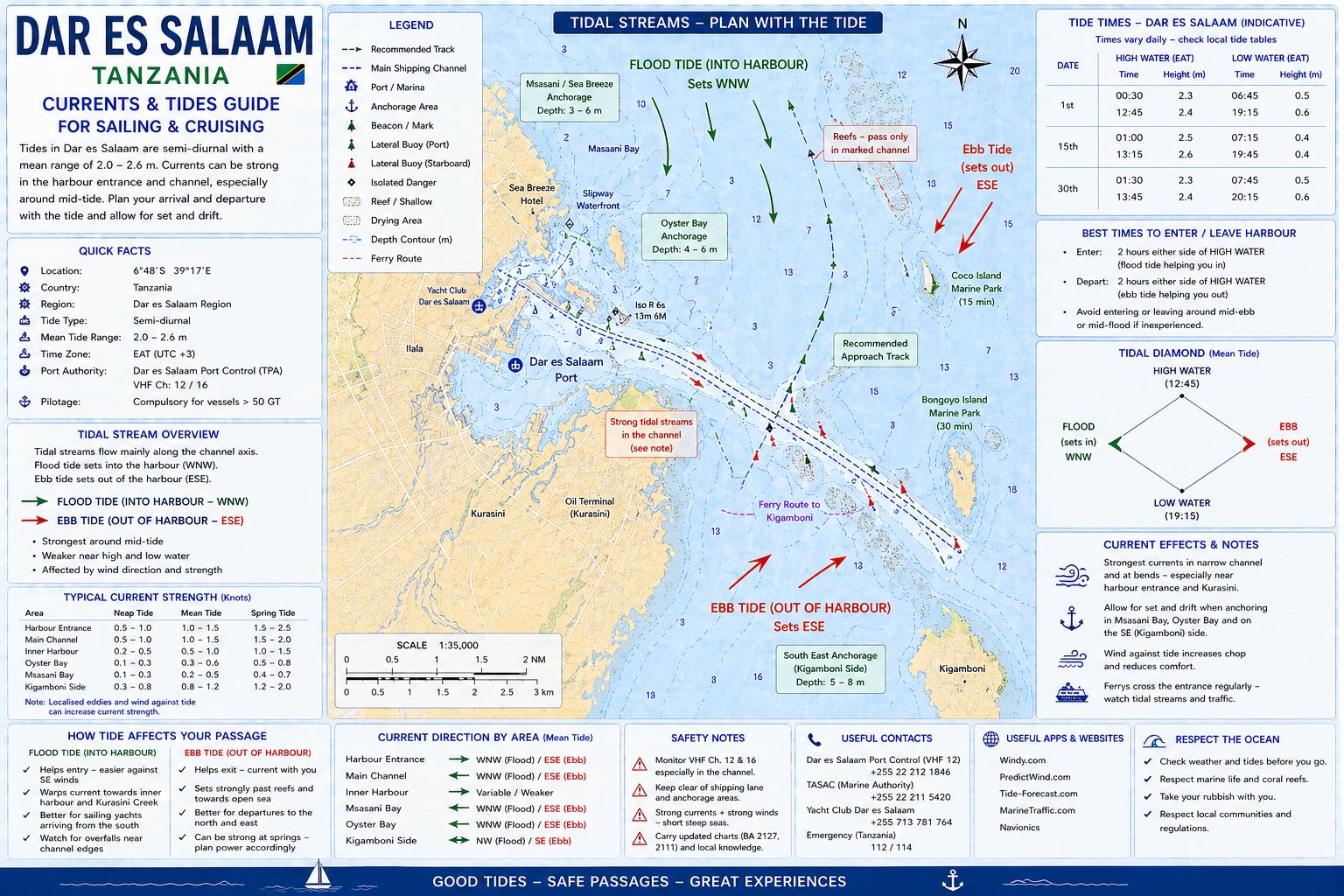
Approaches to the harbour are deep, with 20–40 m outside the entrance and dredged depths of 12–14.5 m in the main channel. The entrance is wide but heavily trafficked by commercial vessels. Yachts must maintain a listening watch on port control channels and follow routing instructions precisely. Tidal flow and cross‑winds influence manoeuvring in the entrance. Inside the harbour, depths remain 10–14 m in the main fairway, reducing to 6–10 m near secondary quays. Yachts must keep clear of container berths, tanker berths, and turning basins.
Dar es Salaam Yacht
Port Guide - Anchorage
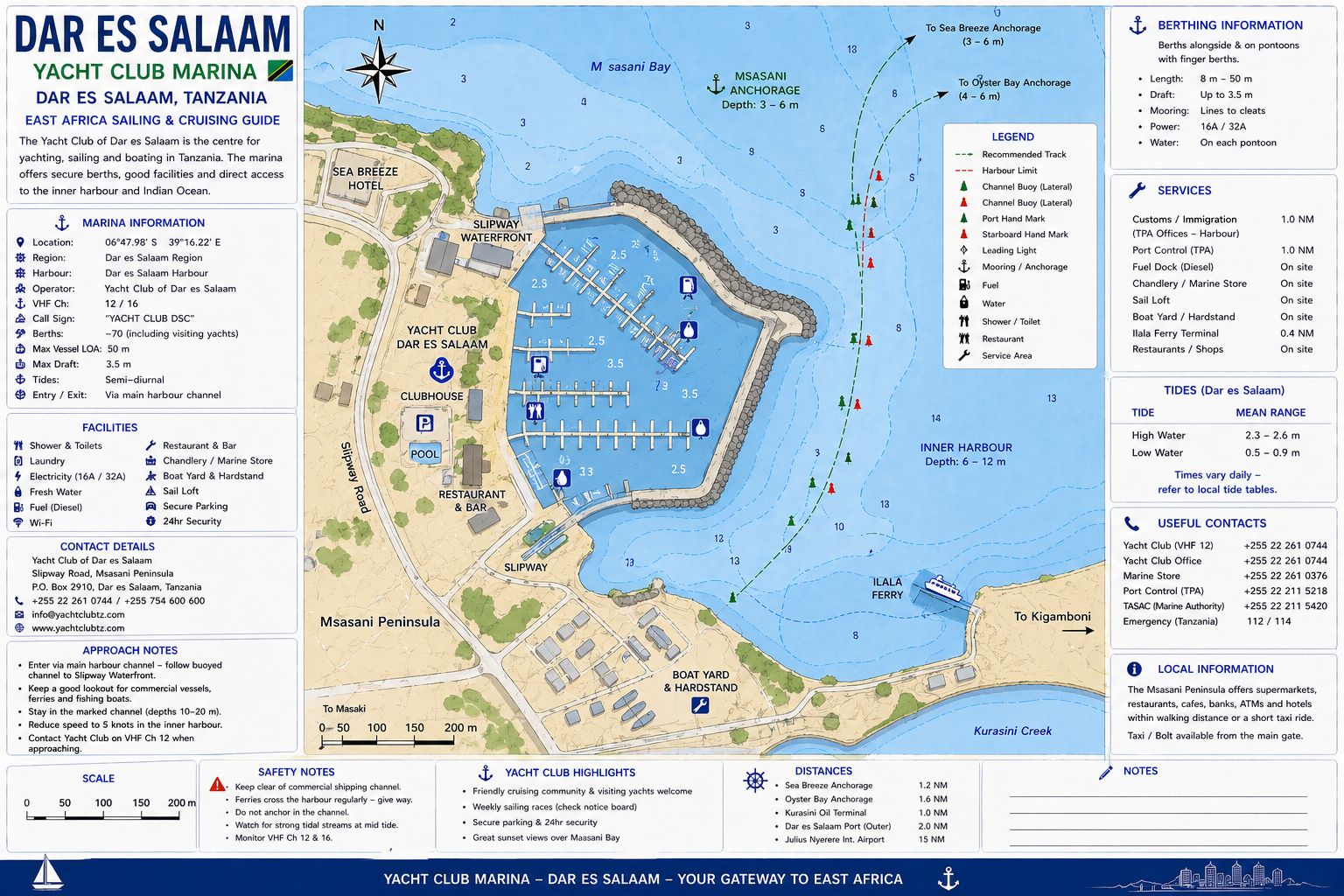
There is no designated yacht anchorage inside Dar es Salaam. Temporary anchoring may be permitted only when directed by TPA and only in specific holding areas used by small commercial craft. Depths in these areas are typically 8–12 m over mud. Wash from tugs and passing ships is constant. Anchoring without explicit permission is not allowed.
Dar es Salaam Yacht
Port Guide - Entry and Clearance
Dar es Salaam is an official port of entry. Yachts must contact TPA before arrival and follow instructions for entering the harbour. Clearance is conducted at port offices inside the commercial zone. Access to quays may require escort or prior arrangement. Documentation includes passports, vessel registration, crew list, last port clearance, and any required visas. Port‑security rules apply throughout the harbour.
Dar es Salaam Yacht
Port Guide - Local Weather
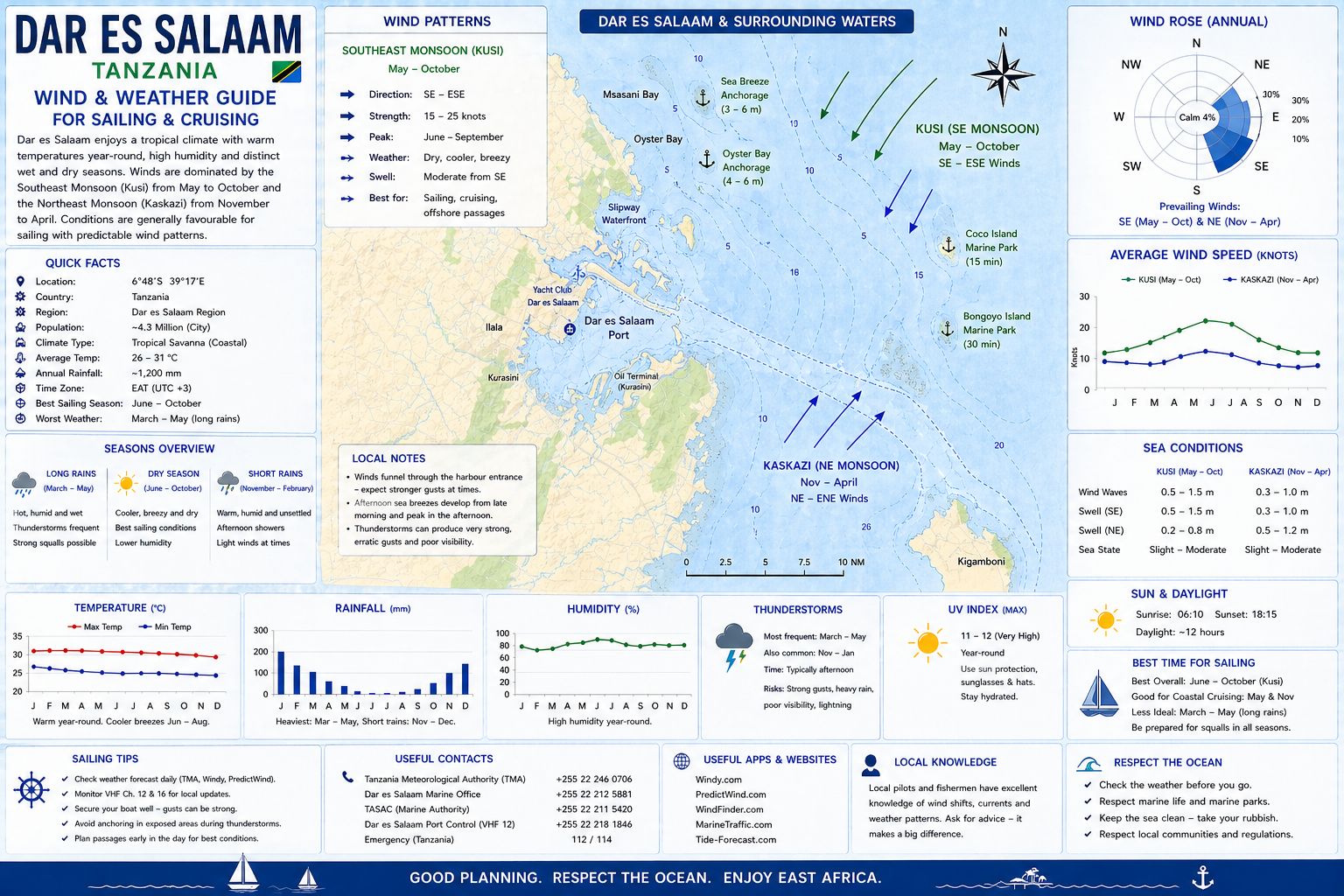
Dar es Salaam is governed by the monsoon cycle.
- NE monsoon (Dec–Mar): lighter winds, calmer seas.
- SE monsoon (May–Oct): stronger winds, rougher offshore conditions, increased swell at the harbour entrance.
Inside the harbour, conditions remain calm year‑round, with tidal currents affecting manoeuvring.
Dar es Salaam Yacht
Port Guide - Provisioning
Supermarkets. Dar es Salaam has full reprovisioning capability through Carrefour, Shoppers Plaza, and Village Supermarket. These supply dry goods, fresh produce, meat, dairy, beverages, and household items.
Markets. The Kariakoo Market and Mchikichini Market provide vegetables, fruit, herbs, spices, and local staples with high turnover and large volumes.
Seafood. Fish is available from the Kivukoni Fish Market, with tuna, kingfish, snapper, and reef species common.
Dar es Salaam Yacht
Port Guide - Local Cuisine
Samaki wa kupaka. fish grilled with coconut and spices. Mchuzi wa samaki — fish cooked in tomato, garlic, and ginger. Pilau — rice cooked with meat and whole spices. Mishkaki — skewered beef or chicken grilled over charcoal. Chapati — flatbread served with stews.
Dar es Salaam Yacht
Port Guide - Fuel Supplies
There is no yacht fuel dock. Fuel is obtained by jerry can from roadside stations near the port. Diesel and petrol quality is reliable. Commercial bunkering exists but is not normally available to yachts.
Dar es Salaam Yacht
Port Guide - Water Supplies
Potable water is available only by arrangement through port services or by jerry can from shore facilities. There are no yacht‑dedicated water points.
Mechanical and Electrical Repairs
Resource
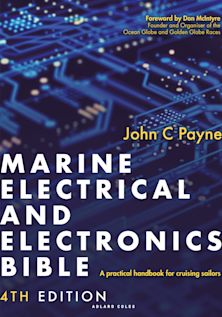
If you are headed somewhere remote consider the need to expand your knowledge base or have an information resource on board. Why not get a copy of my book The Marine and Electrical and Electronics Bible 4th Edition. By and for yachties, with everything from batteries and charging, solar and wind, diesel engines and marine electronics and so much more. Your complete systems guide. 650 pages of practical advice. In Australia and New Zealand order a copy through Boat Books. UK and European boats can buy the UK Edition Here. US and Canadian boats can get the US Edition Order Here. Marine systems are my profession so let me help you. By a liveaboard boat owner for other boat owners
.


Dar es Salaam Yacht
Port Guide - Marine Services
Dar es Salaam has extensive commercial marine infrastructure but limited yacht‑specific services. Mechanical, welding, and fabrication services are available through commercial workshops. Chandlery supply is basic. Haul‑out for yachts is possible only through commercial yards with limited suitability for small craft.
Dar es Salaam Yacht
Port Guide - Local Customs
Dar es Salaam expects polite, direct communication. Portuguese is the primary language used in formal settings. Public behaviour is moderate, and loud or confrontational conduct is discouraged. Photography of port infrastructure requires permission. Security awareness is normal; valuables are kept out of sight, and dinghies are secured when left ashore.
Dar es Salaam Yacht
Port Guide - Security
Security conditions in Dar es Salaam require a high level of situational awareness, with official advisories noting risks linked to violent crime and civil unrest. Guidance for Tanzania highlights the need to exercise caution due to incidents of assault, robbery, and unpredictable demonstrations, particularly in urban centres such as Dar es Salaam. Broader national advisories also flag the possibility of terrorism‑related threats, advising travellers to remain alert in public areas and avoid large gatherings that could escalate without warning. For yacht crews, this translates into controlled movements between the port and known destinations, using taxis rather than walking, securing dinghies and valuables, and avoiding after‑dark travel or crowded areas where opportunistic crime is more common.
Dar es Salaam Yacht
Port Guide - Summary
Dar es Salaam is a functional commercial port with no yacht facilities. Approaches are deep and busy, anchoring is controlled, and clearance is conducted inside a high‑security commercial zone. Provisioning is excellent, fuel and water require jerry‑can logistics, and marine services are industrial rather than yacht‑focused. Yachts calling at Dar es Salaam must operate with commercial‑port discipline and self‑sufficiency. Dar es Salaam Yacht Port Guide for all you need to know