Crete Greece
Sailing Guide
Crete Greece Sailing Guide. Crete is located in the southern Aegean forming the boundary between the Aegean Sea to the north and the Libyan Sea to the south within Greece at approximately 35°15′N to 35°40′N and 23°30′E to 26°20′E. The island extends over 140 NM east–west and forms a continuous exposed coastline with limited natural shelter. The primary operational ports are located on the north coast, with Heraklion functioning as the principal commercial and clearance port, supported by Chania, Rethymno, and Agios Nikolaos.
The operating environment is defined by sustained wind systems and open sea exposure on both coasts. The north coast is directly affected by Meltemi-driven northerly winds producing steep, short-period seas, while the south coast is exposed to long-period swell from the Libyan Sea. Depths increase rapidly offshore with minimal continental shelf. Harbour spacing requires defined passage planning, as intermediate all-weather refuge is limited outside the main ports.
Crete Greece Sailing Guide - History
Crete has a continuous maritime history from the Bronze Age Minoan Civilization through successive control by classical Greek states, Roman administration, Byzantine rule, Venetian occupation, and Ottoman control before union with modern Greece in 1913. Physical remains include large-scale palace complexes at Knossos, Phaistos, and Malia, Venetian fortifications and harbour works at Chania, Rethymno, and Heraklion, Ottoman mosques and civic buildings, and later coastal defence and port infrastructure. These elements remain visible in port towns and inland sites, with harbour layouts, walls, arsenals, and storage structures reflecting continuous adaptation to maritime use.
Crete Greece
Sailing Guide - Approaches
Approach to Crete is from open Aegean or Libyan Sea waters with offshore depths exceeding 100 m, reducing to 20–40 m within several nautical miles of the coast and 5–15 m approaching harbour entrances. There are no offshore barriers restricting approach, but exposure is continuous. North coast approaches are subject to sustained northerly wind and short steep seas. South coast approaches are affected by swell with limited attenuation. Tidal range is 0.2–0.4 m with no operational tidal stream.
Hazards include long exposed sectors with no diversion ports, katabatic gusts descending from high terrain, and limited shelter options in deteriorating conditions.
Crete Greece
Sailing Guide - Navigation
Navigation is structured around primary ports due to exposure and distance between safe havens. Heraklion is the primary entry and operational hub, with continuous ferry and commercial traffic and full harbour infrastructure. Chania and Rethymno provide secondary port options with breakwater protection, while Agios Nikolaos provides a sheltered basin further east.
Harbour entries are direct with breakwater protection and approach depths generally 5–10 m. Manoeuvring is affected by wind and surge at entrances, particularly under Meltemi conditions. Traffic density is highest at Heraklion with continuous ferry movement. Maintain watch on VHF Channel 16 and port working channels. Fishing gear including nets and longlines may be set near shore and around headlands and is not always clearly marked.
Crete Greece
Sailing Guide - Chart Accuracy
Charts issued by the Hellenic Navy Hydrographic Service are accurate for coastal features, harbour layouts, and depth contours. ENC data aligns with official charts. Local anchorage detail and seabed variation are not fully represented. Notices to mariners should be consulted for harbour updates.
Crete Greece
Sailing Guide - Anchorages
Natural anchorages are limited relative to coastline length and are generally directional. North coast anchorages are typically in 5–12 m over sand or sand and weed with moderate holding but exposure to northerly winds. South coast anchorages provide depths of 5–15 m over sand and mixed seabed with improved shelter from northerlies but exposure to southerly swell.
Uninhabited and offshore anchorages including Koufonisi, Chrissi, Gavdos, Dia, Paximadia, Gramvousa, Agioi Theodoroi, and Dionysades provide anchoring in 5–12 m over sand where available. Holding is generally good in clean seabed. Shelter is strictly directional with no all-weather protection. These locations are fully exposed to wind shifts and swell and have no infrastructure or services.
Crete Greece
Sailing Guide - Entry Formalities
Heraklion and Chania function as primary ports of entry. Customs and immigration clearance is available for arrivals from outside Schengen areas. Vessel and crew documentation must be available. Harbour authority control applies within port limits. Drones are regulated under Greek aviation rules. Communications equipment must comply with national regulations. Waste discharge is controlled.
Crete Greece
Sailing Guide - Marina Facilities
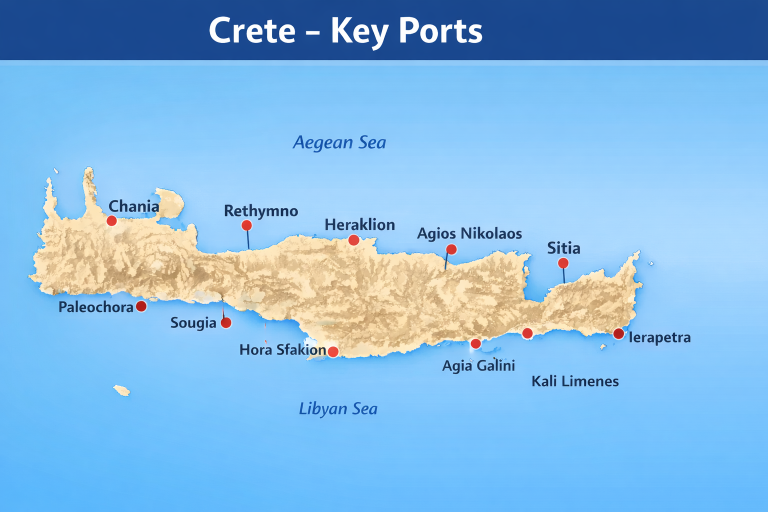
Primary facilities include Heraklion Port as the main operational hub, with additional berthing at Chania Marina, Rethymno Marina, and Agios Nikolaos Marina. Depths alongside are generally 3–6 m with stern-to mooring on laid lines. Facilities include fuel, water, shore power, and varying levels of repair capability. Heraklion provides the highest level of service concentration.
Secondary ports on Crete are those providing usable harbour shelter and quay access but with reduced infrastructure or limited clearance capability compared to Heraklion and Chania.
- Rethymno Port provides a breakwater-enclosed harbour with depths generally 3–6 m and stern-to berthing on laid lines; it is affected by surge in strong northerly winds and has moderate service availability.
- Agios Nikolaos Port provides a well-sheltered basin with depths typically 4–6 m, suitable for yachts with reliable protection from northerly conditions and full quay access.
- Sitia Port on the north-east coast provides a protected harbour with depths of 4–7 m, good shelter from Meltemi, and customs capability for entry.
- Kissamos Port west of Chania provides a commercial harbour with depths of approximately 4–6 m; shelter is adequate but influenced by northerly winds and ferry traffic.
- Paleochora Port on the south coast provides a small harbour with depths of 2–4 m, limited manoeuvring space, and exposure to southerly swell.
- Sfakia Port (Chora Sfakion) provides a small south coast harbour with depths of approximately 3–5 m, usable in settled conditions but exposed to southerly weather.
- Agia Galini Port provides a small enclosed harbour with depths of approximately 3–5 m, limited capacity, and partial shelter depending on wind direction.
These ports provide intermediate refuge and staging options around Crete but remain weather dependent, particularly on the south coast where exposure to the Libyan Sea limits protection.
Crete Greece
Sailing Guide - Local Weather
Crete’s weather regime is controlled by large-scale pressure gradients across the Aegean and eastern Mediterranean, combined with strong topographic effects from the island’s mountainous spine. The island creates its own local acceleration zones, wind shadows, and katabatic flows that materially affect nearshore conditions.
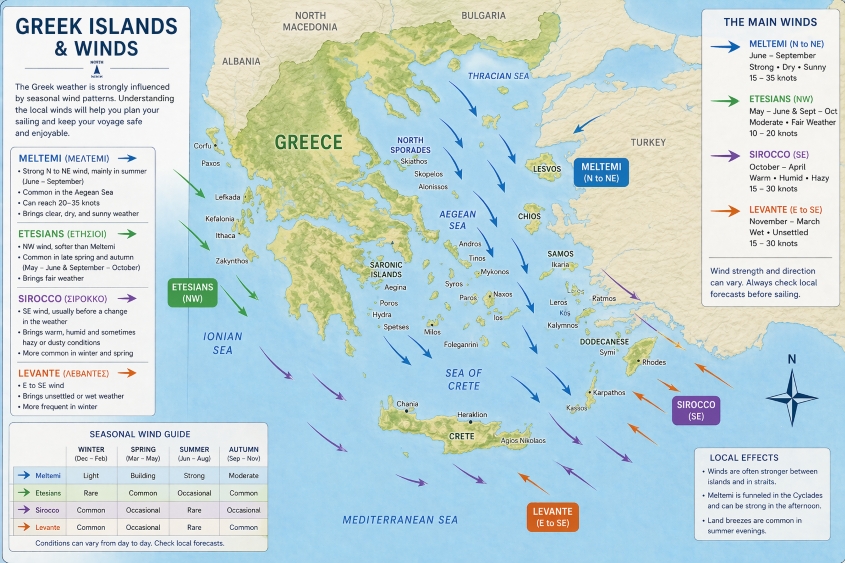
Summer conditions (May–September) are dominated by the Meltemi pattern, producing persistent northerly winds across the Aegean. On Crete’s north coast, this results in sustained winds commonly 20–30 knots with higher gusts, particularly between headlands and across open bays. Sea state builds quickly into short, steep waves due to limited fetch length but continuous wind input. Wave height increases west to east along the north coast depending on alignment with wind direction. Harbour entrances on the north coast are subject to surge and crosswind during strong Meltemi periods.
The south coast operates under a different regime. Under Meltemi conditions, the island provides a lee, reducing wind strength significantly along the Libyan Sea coast. However, this does not eliminate sea state risk. Southerly systems, although less frequent in summer, generate long-period swell that propagates directly onto the south coast with minimal obstruction. This swell can enter otherwise calm anchorages with delayed onset relative to wind shifts.
Transition seasons (April and October) introduce variable wind directions with reduced persistence. Wind strength decreases but becomes less predictable, with alternating northerly and southerly flows. Local convection and pressure changes produce short-duration wind events. Sea state is correspondingly variable, with mixed swell patterns possible.
Winter conditions (November–March) are driven by passing low-pressure systems. Wind direction becomes variable, with strong southerly and south-westerly winds preceding frontal passages. These systems generate significant swell on the south coast and confused seas on the north coast. Rainfall increases and visibility may reduce during frontal activity. Harbour protection becomes critical as anchorage reliability decreases.
Thermal effects are present during summer, particularly in enclosed bays and along the south coast, where daytime heating can generate local onshore breezes. These are generally secondary to the Meltemi but can influence anchorage orientation and vessel swing.
Katabatic winds are a consistent local hazard. The mountainous terrain of Crete produces descending airflows, particularly at night, which can generate sudden gusts exceeding the prevailing wind by significant margins. These gusts are most pronounced near steep coastal slopes and in bays aligned with valleys.
Sea surface temperature differences between the Aegean and Libyan Sea can create localized pressure gradients, contributing to wind variability around the eastern and western extremities of the island.
Operationally, weather on Crete must be assessed by coast, not island wide. North coast conditions under Meltemi can be severe while the south coast remains comparatively calm, and the reverse applies under southerly systems. Anchorage selection, passage timing, and port entry must be aligned with these directional weather patterns.
Crete Greece
Sailing Guide - Local Winds
The Meltemi produces sustained northerly winds across the north coast with strong acceleration zones. Southerly winds generate longer-period swell affecting the south coast. Katabatic winds descend from mountainous terrain producing localized gusts.
The Meltemi is a strong, dry northerly wind that dominates the Aegean in summer, accelerating through channels and between islands to produce steep, short seas. It is most persistent in July and August, often blowing for several days with little diurnal variation, creating fast north‑to‑south passages and challenging return routes. Its strength is shaped by pressure gradients between the Balkans and Anatolia, with local acceleration zones around major island gaps.
The Marine Electrical and Electronics Bible has a complete list of Greek VHF Radio Channel information and weather forecast times for Greece along with NAVTEX UK and Europe and NAVTEX Mediterranean for 490kHz and 518kHz.
Crete Greece
Sailing Guide - Provisioning
Supermarkets. Provisioning is concentrated in the four primary urban centres with consistent supply chains and daily restocking. In Sklavenitis and AB Vassilopoulos, outlets are present in Heraklion, Chania, Rethymno, and Agios Nikolaos, with additional coverage from Lidl in Heraklion and Chania. Stores operate as full-service supermarkets with stable stock turnover and standardised supply across locations. Smaller independent supermarkets and local chains operate in Sitia, Ierapetra, and Kissamos with reduced range but sufficient for routine reprovisioning. Rural and south coast locations rely on small grocery outlets with limited stock and irregular resupply intervals. Also in Heraklion is Supermarket Sofia, Super Market Faistos and Super Market Chalkiadakis and several others.

Markets. The Pateles Central Market in Heraklion is open Thurs and Saturdays, and there is a fish market within. The Central Market operates as the principal produce market with continuous supply of olive oil, olives, citrus, tomatoes, peppers, greens, herbs, cheeses including graviera and mizithra, and dried goods. Chania Municipal Market provides structured indoor and surrounding vendor supply with similar produce availability. Weekly (open-air street markets) operate in all major towns on fixed rotation days, supplying vegetables, fruit, honey, herbs, and local agricultural products with direct producer distribution. South coast towns such as Paleochora and Sfakia have limited market presence with seasonal variability in supply. There is a Farmers
Market or laiki where local’s shop, lots of farm to plate produce. There is a Organic Farmers Market every Mon,
Wed, Fri 12:00-18:00 in Georgiadis Park. There is a really good Central Market
and fish market in Chania. In
Elounda there is a market every Friday morning with loads of seafood.
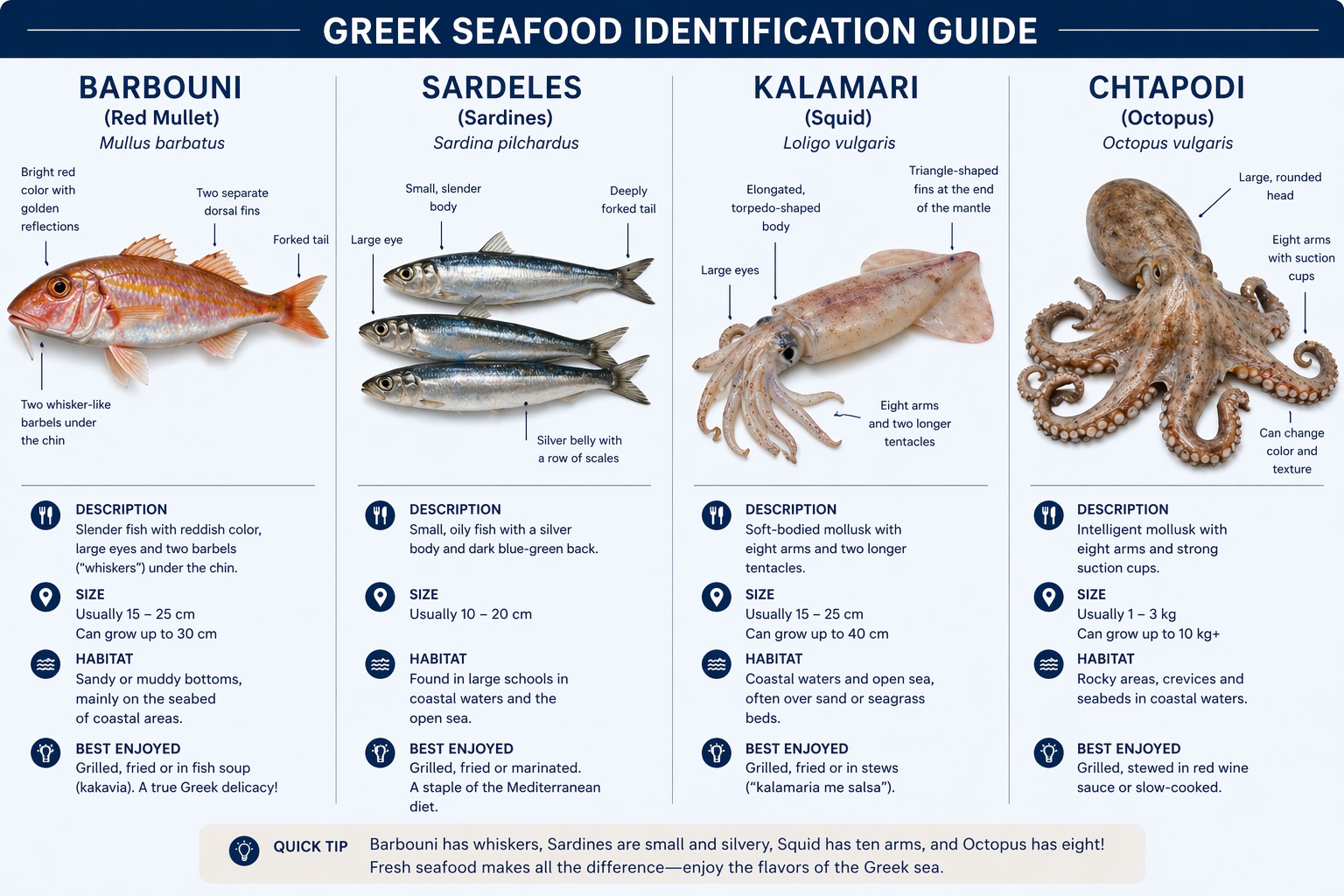
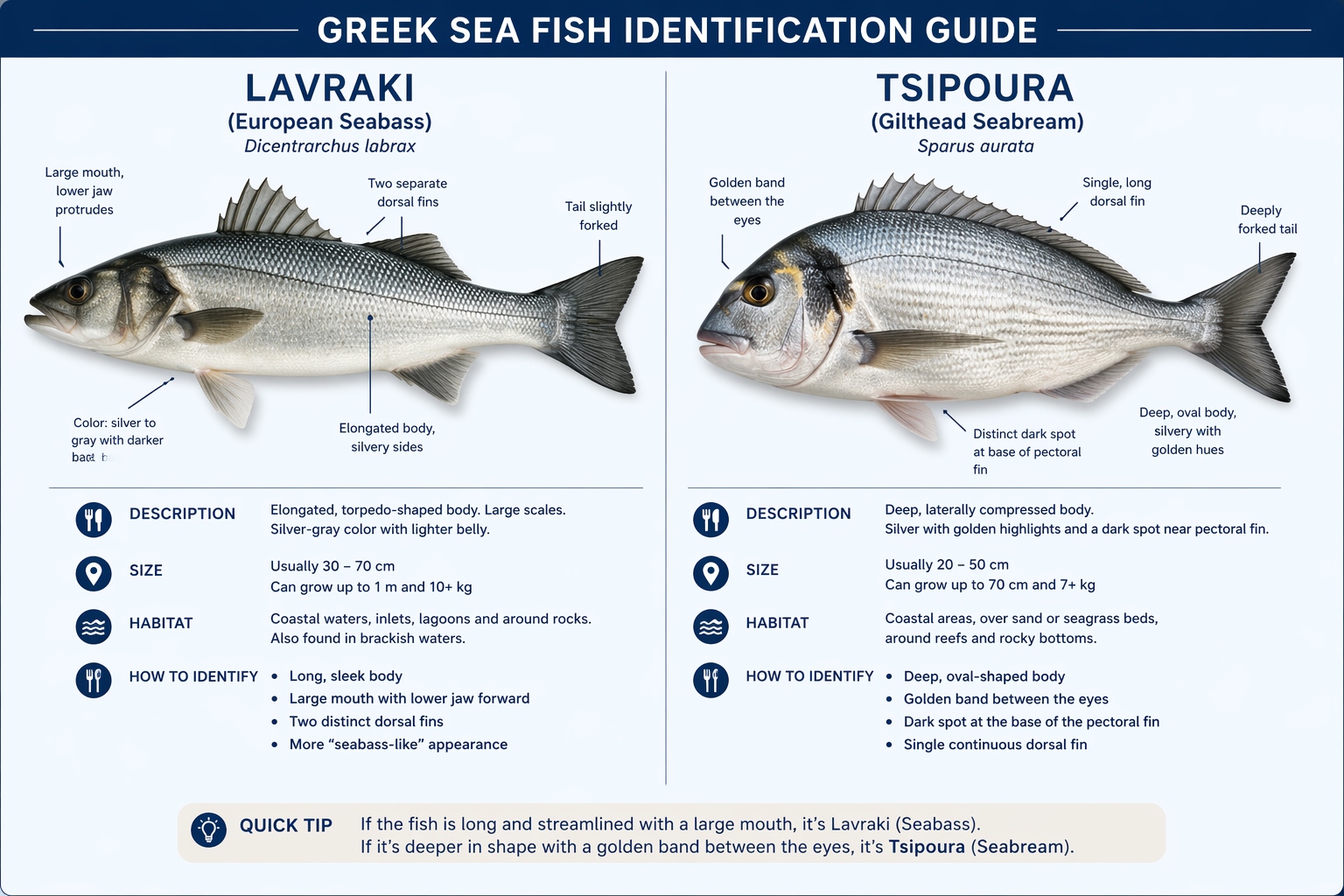
Fish Markets. Heraklion Fish Market and Chania Fish Market provide primary seafood distribution with daily landings. Available species include lavraki (European seabass), tsipoura (gilthead seabream), barbouni (red mullet), sardela (sardine), gavros (anchovy), kalamari (squid), Ochtapodi (octopus), and seasonal pelagic species. Secondary supply is available through local fishmongers in Rethymno, Agios Nikolaos, and Sitia with reduced volume. Availability is dependent on weather conditions affecting fishing operations.
Crete Greece
Sailing Guide - Local Cuisine
Produce is very extensive including a great local honey. They have great cheeses here including feta, Kefalotyri (sheep and goat cheese) and Tiromalama. Cretan cuisine is based on olive oil, with high use of vegetables, legumes, grains, wild greens, and moderate use of meat and seafood. Preparation is simple and typically grilling, baking, or slow cooking. Ingredient sourcing is local and seasonal, with limited use of processed products. Dakos consists of dried barley rusk topped with tomato, olive oil, and mizithra cheese. Kalitsounia are small pastries filled with soft cheese or greens, baked or fried. Gamopilafo is rice cooked in meat broth, typically lamb or goat, finished with fat from the stock. Antikristo is lamb or goat cooked over open fire at distance from heat, using radiant cooking rather than direct flame. Stamnagathi is a wild green served boiled or sautéed with olive oil and lemon.
Seafood preparation includes grilled tsipoura (gilthead seabream) and lavraki (European seabass), octopus (χταπόδι) either grilled or stewed, and kalamari (squid) fried or grilled. Small fish such as sardela (sardine) and gavros ( anchovy) are fried or marinated.
Cheese production includes graviera, a hard sheep or mixed milk cheese, mizithra, a fresh whey cheese, and anthotyro), a soft cheese used in both savoury and sweet preparations. Dairy use is consistent across dishes but not dominant.
Bread is commonly barley-based (paximadi) or wheat loaves. Legumes include fava (split peas), lentils, and chickpeas prepared as stews. Olive oil is used in all cooking stages and as a finishing component.
Meat is primarily lamb, goat, and pork, used in slow-cooked dishes or grilled. Preparation includes combinations with herbs, wine, and olive oil. Smoking and curing are limited compared to mainland regions.
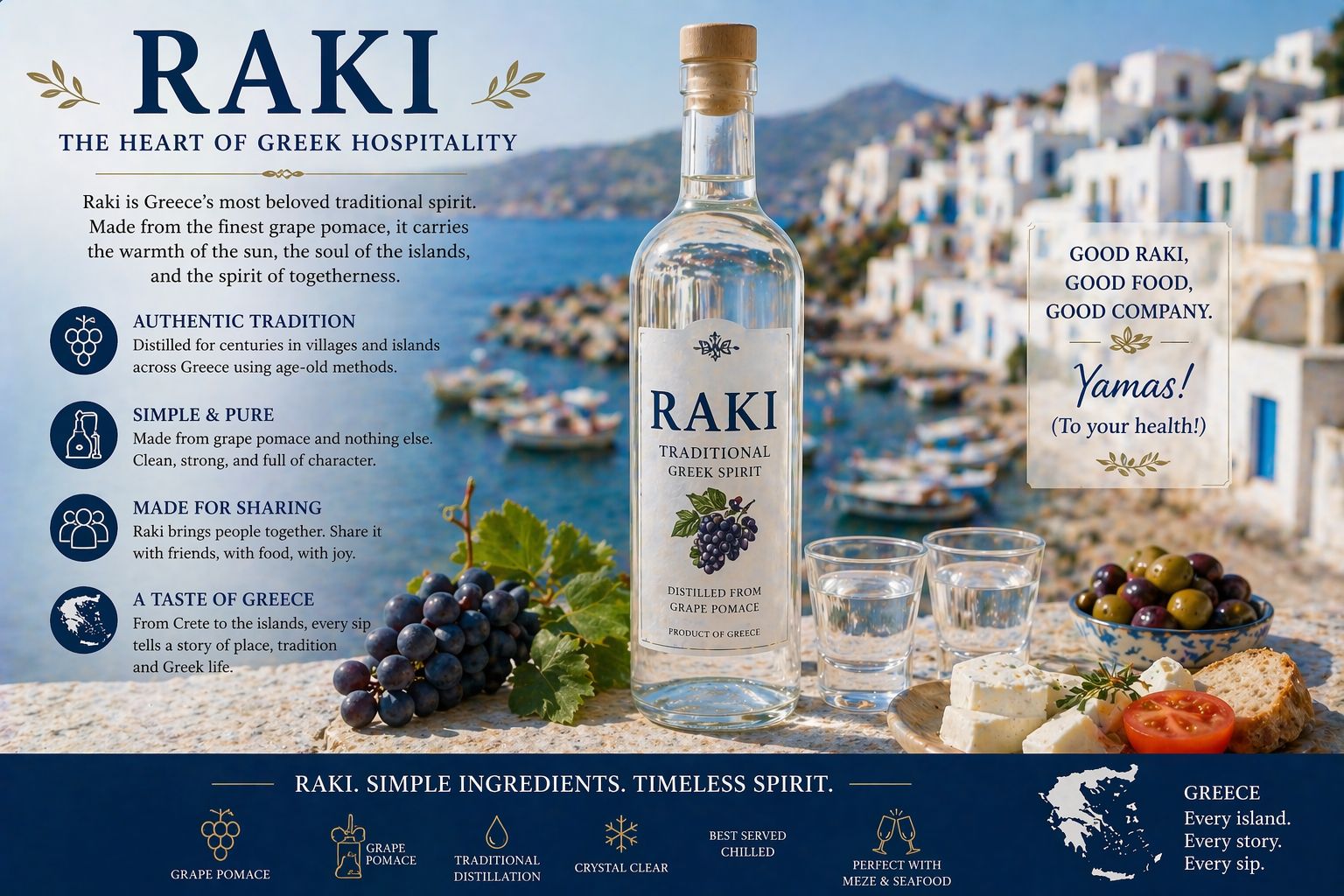
Sweet preparations include honey-based products such as loukoumades (fried dough with honey) and xerotigana (fried pastry with honey and sesame). Raki is produced locally and served as a distilled grape spirit. (Genuine rocket fuel!)
Crete Greece Sailing Guide - Beverages
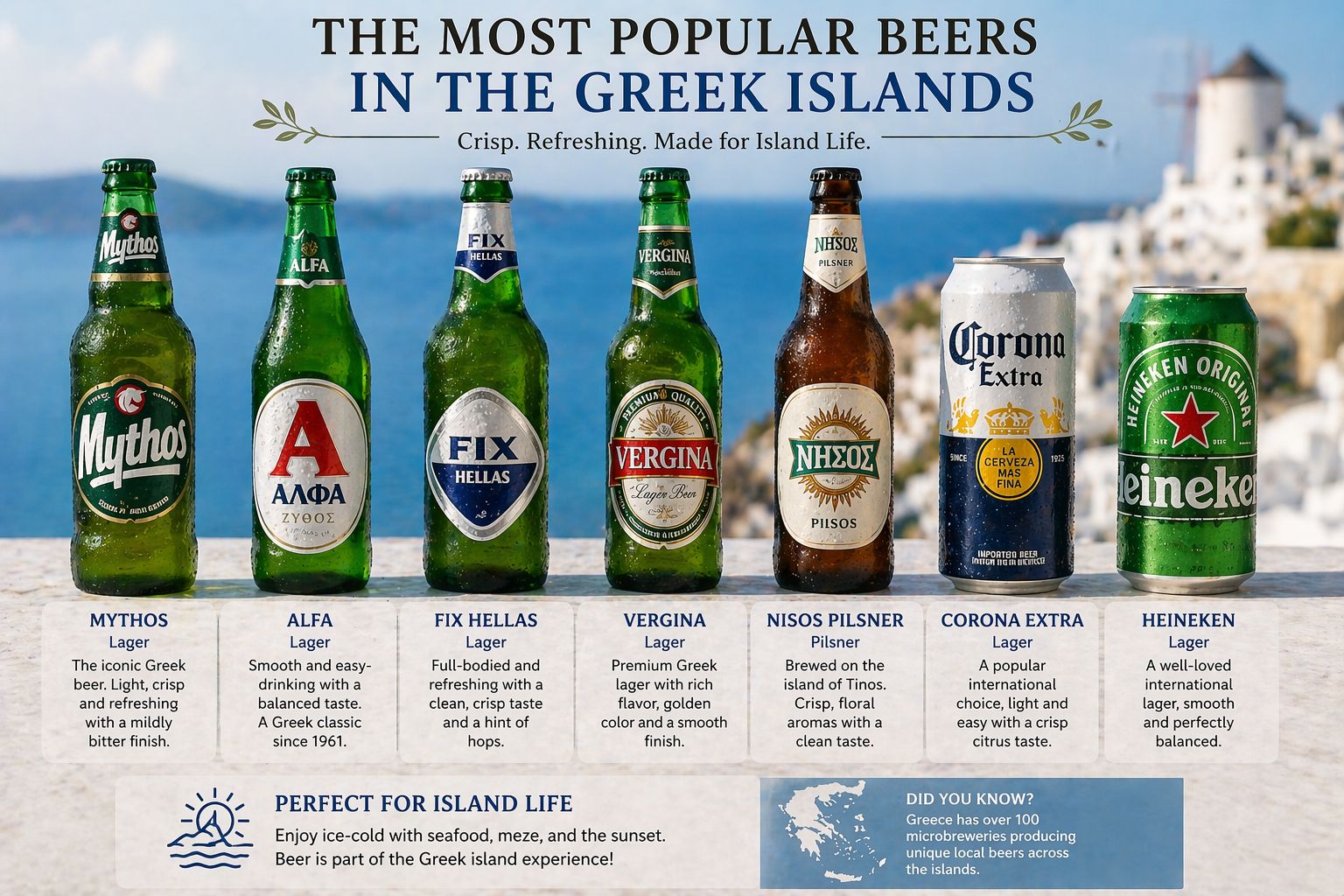
Beer, wine, and spirits across the Greek islands are locally produced and widely available through tavernas, small bars, and provisioning outlets. Beer is predominantly lager, with domestic brands including Mythos, Alfa, Fix, and Vergina alongside imported products; and over 100 microbreweries operate on several islands with limited distribution. Wine is region-specific, with white varieties dominant in the islands, including Assyrtiko, Moschofilero, and Roditis, alongside local table wines served in bulk; retsina remains in circulation as a resin-flavoured wine. Distilled products include ouzo (anise-based), tsipouro (grape marc distillate), raki or tsikoudia (Crete), souma (fig or grape distillate in eastern Aegean islands), and kitron (citrus liqueur from Naxos), with alcohol strength typically in the 37–45% range and higher for unregulated local distillations.
Crete Greece
Sailing Guide - Fuel Supplies
Fuel availability on Crete is concentrated at primary ports with supplementary supply at secondary locations. Marine diesel is the standard fuel available; petrol (unleaded) is available shoreside and may be delivered where required. Fuel quality is consistent with mainland Greece supply chains, sourced through commercial distributors with regular turnover at major ports.
At Heraklion Port fuel is available by road tanker delivery directly to quay or marina berths. Access is arranged via port agents or local fuel suppliers. Berthing depth alongside is generally 4–6 m. Delivery is metered, with quantities confirmed prior to discharge. Traffic density and port control require scheduling of delivery times.
At Chania Port (Souda Bay) fuel supply is also by tanker delivery, coordinated through port authority or marina operators. Souda Bay provides deep water access and sheltered conditions for fuelling operations. Delivery is reliable with commercial-grade fuel.
At Rethymno Port fuel is available via tanker with access dependent on quay space and weather conditions. Depths are typically 3–5 m. Surge in northerly winds may affect fuelling operations alongside.
At Agios Nikolaos Port fuel delivery is arranged by road tanker to the quay or marina. Shelter is generally good, allowing stable transfer conditions. Depths are typically 4–6 m.
At Sitia Port fuel supply is available via tanker delivery with adequate quay access and depths of approximately 4–7 m. This location is commonly used for refuelling on east–west passages.
Secondary ports including Kissamos, Paleochora, Sfakia, and Agia Galini have limited or irregular fuel availability. Supply at these locations is typically by prior arrangement and may require jerry can transfer from road access points. Reliability is not assured and should not be assumed without confirmation.
No fixed marine fuel docks are standard; fuelling is predominantly by tanker delivery. Advance notice is required, typically 12–24 hours, with confirmation of quantity, berth location, and access conditions. Payment is commonly required on delivery.
Fuel transfer is conducted using hoses from tanker to vessel with onboard supervision required. Spill prevention measures are expected. Filters should be used during transfer where possible due to variability in storage and handling outside primary ports.
Crete Greece
Sailing Guide - Water Supplies
Potable water is available at primary ports and marinas with distribution via fixed quay connections. Supply is sourced from municipal systems and is pressurised through dockside outlets. At Heraklion Port water is available along commercial and marina quays with metered supply; connection is typically via standard threaded fittings with variable hose compatibility. At Chania Port (Souda Bay) water is available at marina and naval-adjacent infrastructure with consistent pressure and controlled access. At Rethymno Port and Agios Nikolaos Port supply is provided along quay berths with metering and local authority control. Sitia Port provides similar quay-side access with adequate pressure and routine availability.
Water quality is potable but typically high in mineral content. Treatment by onboard filtration or carbon systems is standard practice for drinking use. Pressure can vary along quay length depending on simultaneous demand and local infrastructure condition.
Secondary ports including Kissamos, Paleochora, Sfakia, and Agia Galini have limited or inconsistent water supply. Availability is dependent on municipal infrastructure and may require prior arrangement. Pressure is variable and not always sufficient for direct tank filling.
No water supply exists at offshore anchorages or uninhabited islands. All replenishment must be conducted at port facilities. Hose lengths must account for quay distance, and fittings may require adapters. Supply is generally charged per cubic metre or per connection.
Mechanical
and Electrical Repairs Resource
If you are headed somewhere remote consider the need to expand your knowledge base or have an information resource on board. Why not get a copy of my book The Marine and Electrical and Electronics Bible 4th Edition. By and for yachties, with everything from batteries and charging, solar and wind, diesel engines and marine electronics and so much more. Your complete systems guide. 650 pages of practical advice. In Australia and New Zealand order a copy through Boat Books. UK and European boats can buy the UK Edition Here. US and Canadian boats can get the US Edition Order Here. Marine systems are my profession so let me help you. By a liveaboard boat owner for other boat owners.



Crete Greece
Sailing Guide - Marine Services
Marine services are concentrated in Heraklion and secondary ports. Diesel engine support for Yanmar and Volvo Penta is available. Marine electronics support including Raymarine is available in main centres.
Crete Greece
Sailing Guide - Local Customs
Dress standards apply in urban areas; swimwear is not worn away from waterfront areas. Churches require covered shoulders and appropriate dress. Stern-to mooring etiquette applies with close spacing at quays. Crete has a continuous resident population with no separate indigenous maritime customs beyond standard Greek norms.
Crete Greece
Sailing Guide - Summary
Crete is an exposed operating area with long coastal passages and limited shelter between ports. Heraklion functions as the primary operational hub with full services. Anchorages are directional and weather dependent. Passage planning must account for sustained wind systems and limited diversion options. Crete Greece Sailing Guide for all you need to know.