Corfu Greece Sailing Guide
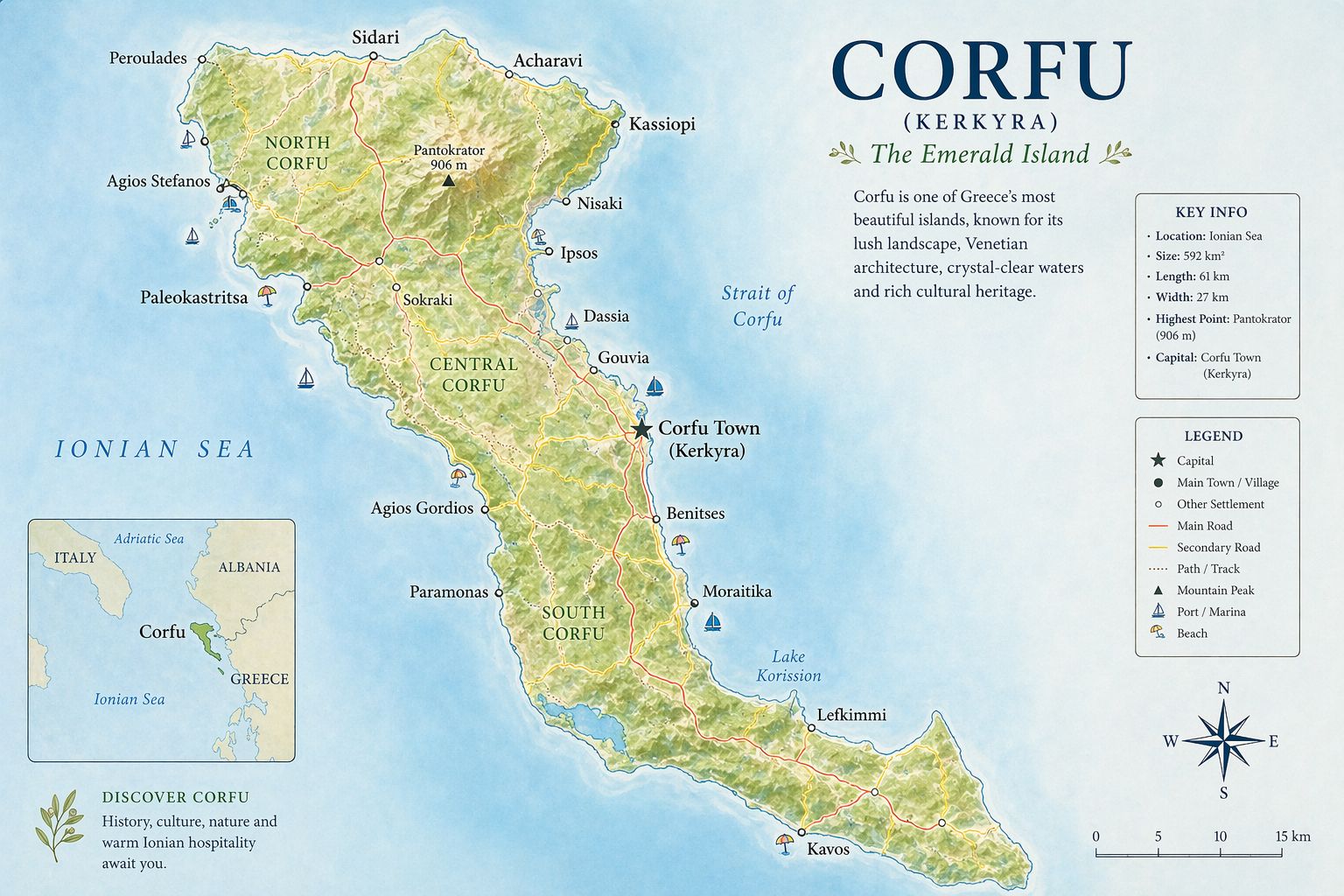
Corfu Greece Sailing Guide. Also known as the Emerald Isle and Kerkira. Corfu is located in the northern Ionian Sea off the north-west coast of Greece at approximately 39°37′N 19°55′E. The island lies parallel to the Albanian coast, separated by a narrow channel to the north and a wider channel to the south. The main port is on the east coast adjacent to Corfu town and forms a primary ferry and commercial harbour.
The area is influenced by Ionian Sea conditions with minimal tidal range and weather systems moving predominantly from the west. The east coast is generally sheltered from prevailing westerlies but exposed to easterly and south-easterly winds. The coastline includes multiple bays and inlets with variable depths and seabed composition.
Kerkira (Corfu) Greece Sailing Guide - History
Corfu has a layered maritime history shaped by Venetian control from the 14th to 18th century, followed by French and British administration before union with Greece in 1864. The island retains fortified harbour structures, including the Old Fortress and New Fortress, constructed to control naval access and defend against Ottoman expansion. The historic centre of Corfu town reflects this period with dense urban planning oriented around the port and defensive works.
Corfu Greece
Sailing Guide - Approaches
Approach to Kerkira (Corfu) from the south is via the channel between the island and mainland Greece, with depths generally exceeding 20–50 m in mid-channel. From the north, approach is via the Corfu Channel between Corfu and Albania, with depths exceeding 30 m but narrowing significantly in places.
Approach to Corfu town harbour is straightforward with marked channels and clear harbour limits. Depths reduce from 20 m to 6–10 m approaching the port.
Sea state is generally moderate due to limited fetch on the east coast. Westerly winds produce reduced sea state in the lee of the island. Easterly winds increase wave development directly onto the east coast. Tidal range is typically 0.2–0.4 m with negligible tidal stream; currents in the Corfu Channel may reach approximately 1 knot under certain wind conditions.
Hazards include commercial ferry traffic, cruise vessels, and fishing activity. Coastal shoals and isolated rocks exist near headlands and require adherence to charted routes.
Corfu Greece
Sailing Guide - Navigation
Corfu harbour is a controlled port with defined traffic patterns. Maintain watch on VHF Channel 16 and port working channels. Commercial traffic has priority, particularly ferries and cruise vessels. The harbour is well marked with lateral buoyage and lit navigation aids. Night entry is supported by sector lights and harbour lighting. Speed restrictions apply within harbour limits. Fishing gear including nets and longlines may be present near shore and within bays and are not always clearly marked.
Corfu Greece
Sailing Guide - Chart Accuracy
Charts issued by the Hellenic Navy Hydrographic Service are reliable for main approaches and harbour areas. ENC data aligns with paper charts for primary navigation features. Caution is required for isolated rocks and shoals in coastal areas, uncharted moorings and laid lines in popular bays
Corfu Greece
Sailing Guide - Anchorages
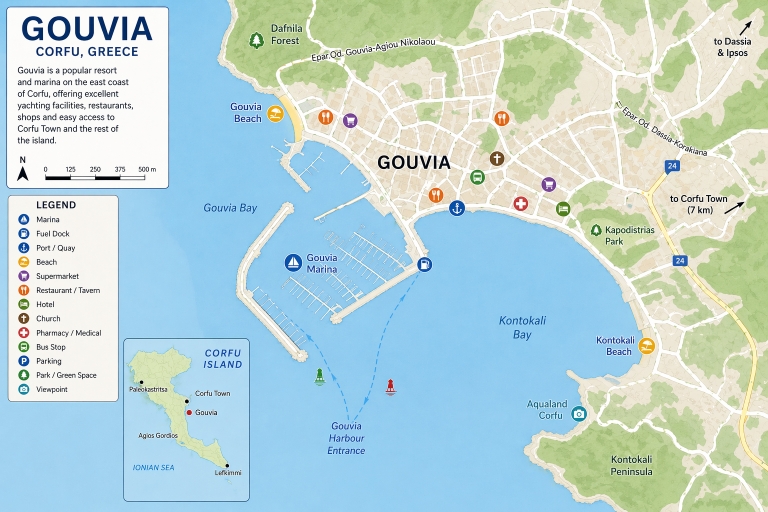
Anchoring is restricted within Corfu town harbour. Outside the harbour, anchorages are available along the east coast. Gouvia Bay provides depths of 4–10 m over mud with good holding and protection from westerly winds but exposure to easterlies. Garitsa Bay south of Corfu town provides depths of 3–8 m over mud with good holding and partial shelter. Kalami Bay to the north-east provides depths of 5–15 m over sand and weed with variable holding. Wind effects are significant. Easterly winds increase exposure along the east coast. Local gusting may occur near terrain.
Corfu Greece
Sailing Guide - Entry Formalities
Corfu is an official port of entry. Customs and immigration procedures apply for arrivals from outside Schengen areas. Harbour master clearance is required. Documentation for vessel and crew is required and may be inspected. Regulations apply to drones under Greek aviation authority rules. Communications equipment must comply with national regulations. Waste disposal is regulated.
Corfu Greece
Sailing Guide - Marina Facilities
Gouvia Marina. Depths alongside are generally 4–6 m. Berthing is stern-to with laid moorings. Fuel is available within the marina. Shore power and potable water are provided. Lift and repair facilities are available. Additional berthing is available at town quays and smaller harbours around the island with variable depths.
Smaller harbours and berthing locations around Corfu with variable depths include Kassiopi Harbour, Kalami Harbour, Agios Stefanos Harbour (NE Corfu), Petriti Harbour, Benitses Harbour, and Paleokastritsa Harbour.
- Kassiopi Harbour is a small harbour on the north-east coast with depths typically 2–5 m, providing limited quay berthing and anchoring space outside the basin. It is exposed to north and north-east conditions with increased surge in those directions.
- Kalami Harbour is an open bay rather than a defined harbour, with depths of 5–15 m over sand and weed. It provides anchoring with variable holding and exposure to easterly winds.
- Agios Stefanos Harbour (NE Corfu) is a small enclosed harbour with depths of approximately 2–4 m and limited quay space. It offers shelter from prevailing north-westerlies but is exposed to easterly winds.
- Petriti Harbour is a fishing harbour on the east coast with depths of 2–4 m and restricted manoeuvring space. Berthing is limited and primarily used by local vessels.
- Benitses Harbour is a small harbour south of Corfu town with depths of 2–4 m and quay berthing. It provides partial shelter but is affected by easterly conditions.
- Paleokastritsa Harbour consists of small coves on the west coast with depths of 5–20 m and limited harbour infrastructure. It is exposed to westerly swell and unsuitable in onshore conditions.
Depths across these locations are not uniform and typically range from approximately 2–6 m within harbour basins, with shallower sections near quay edges and harbour entrances. Seabed composition is generally mud, sand, or mixed sand and weed depending on location, with holding varying accordingly.
Along the Ionian coast, stern-to mooring on laid lines is standard; handling of other vessels’ lines without permission is avoided. Quay spacing is limited and fendering is required. Noise is controlled in marina and quay areas during evening hours.
Corfu Greece
Sailing Guide - Local Weather
Summer conditions are dominated by stable weather with light to moderate winds and good visibility. Winter conditions involve frontal systems with stronger winds and precipitation. Weather systems generally move from west to east. Rapid changes may occur with passing fronts.
The Marine Electrical and Electronics Bible has a complete list of Greek VHF Radio Channel information and weather forecast times for Greece along with NAVTEX UK and Europe and NAVTEX Mediterranean for 490kHz and 518kHz.
Corfu Greece
Sailing Guide - Local Winds
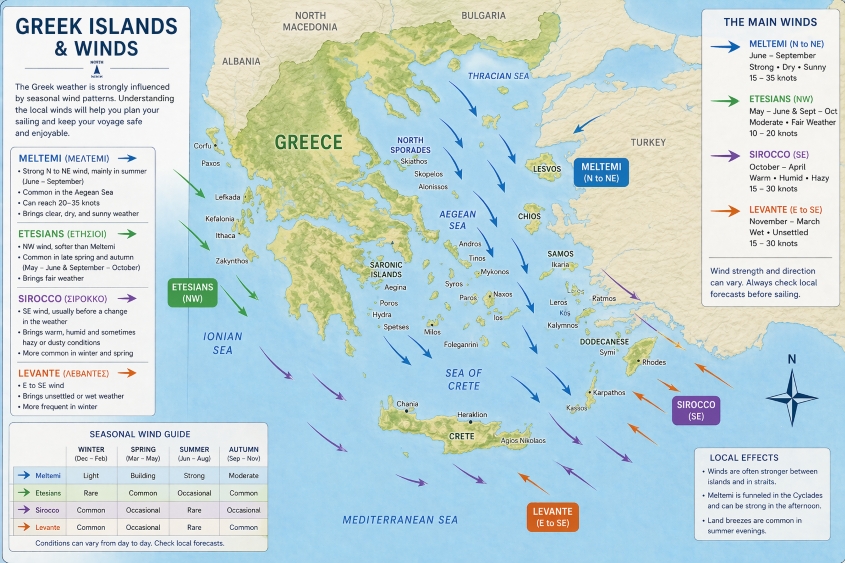
Maistro (NW) is the prevailing summer wind, typically moderate and developing during the day. Easterly winds occur less frequently but can produce increased sea state along the east coast. Southerly winds may accompany frontal systems.
Maistro (Ionian Sea, Greek term) and Maestral (Adriatic, Croatian term) both describe a north-westerly thermal wind driven by daytime land–sea temperature differences. The behaviour is similar: develops late morning, strengthens through the afternoon, and weakens toward evening.
Corfu Greece
Sailing Guide - Provisioning
Supermarkets. Provisioning is centred on Corfu Town and the Gouvia–Kontokali corridor where full-range supply is consistent. Primary outlets include AB Vasilopoulos, Lidl, and Sklavenitis operating with standard mainland stock control and regular resupply. Secondary coverage is provided by Masoutis and Diellas branches across the island. Independent grocers, bakeries, and butchers operate within Corfu Town, Gouvia, Dassia, Ipsos, and Lefkimmi with daily turnover and reliable fresh goods. Chandlery-adjacent minimarkets supply limited packaged provisions in marina areas. There are others including Kladas V Kostas and ENA Cash and Carry.
Markets. There is a farmers’ market, the Corfu Central Market daily from 06:30. Fresh produce is handled through the New Fortress Market (Dimotiki Agora Kerkyras) in Corfu Town with daily operation except Sunday. Supply includes seasonal vegetables, citrus, olives, herbs, and locally produced olive oil. Smaller open-air and roadside markets operate intermittently in Lefkimmi and northern settlements including Acharavi and Kassiopi with reduced range and variable frequency.
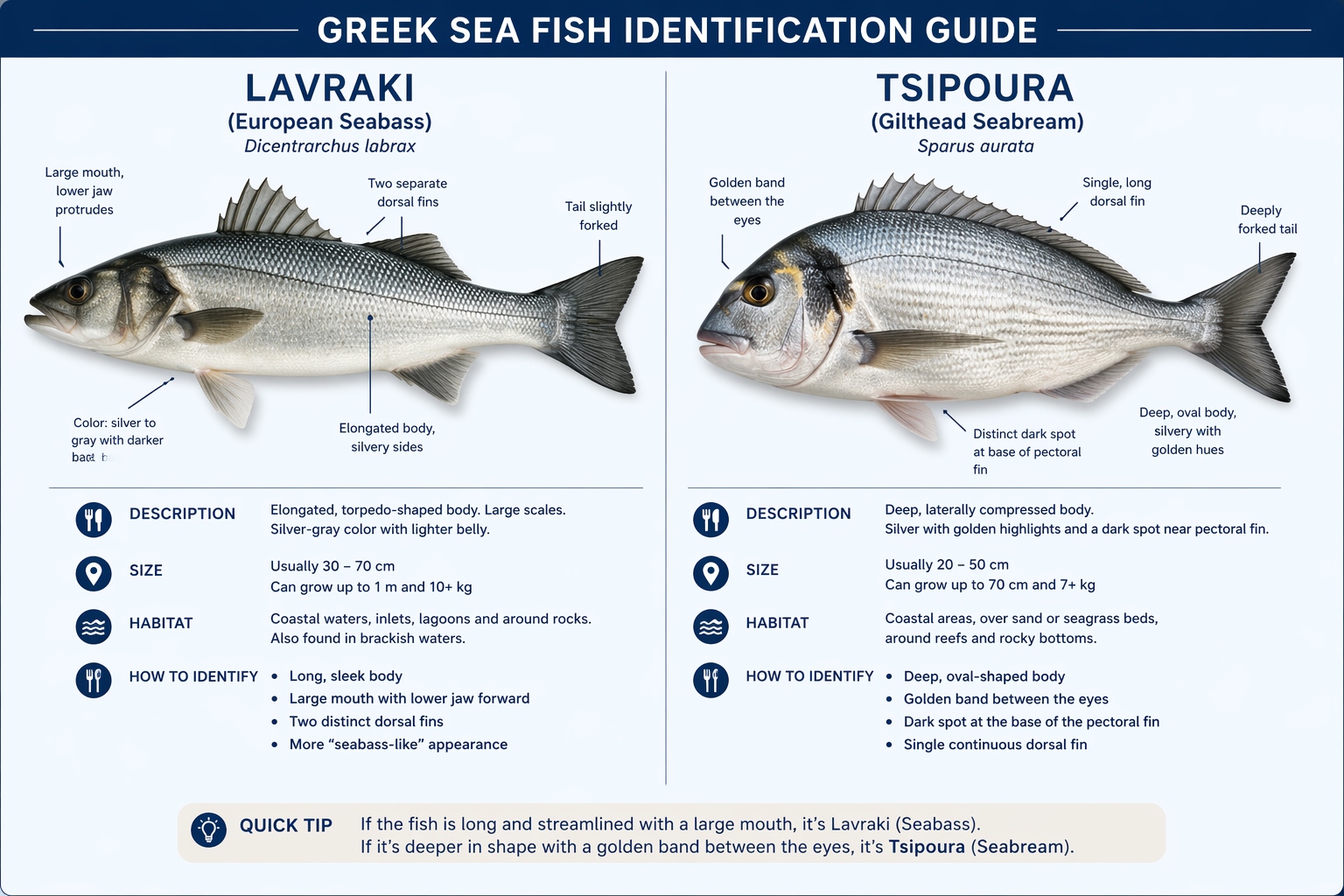
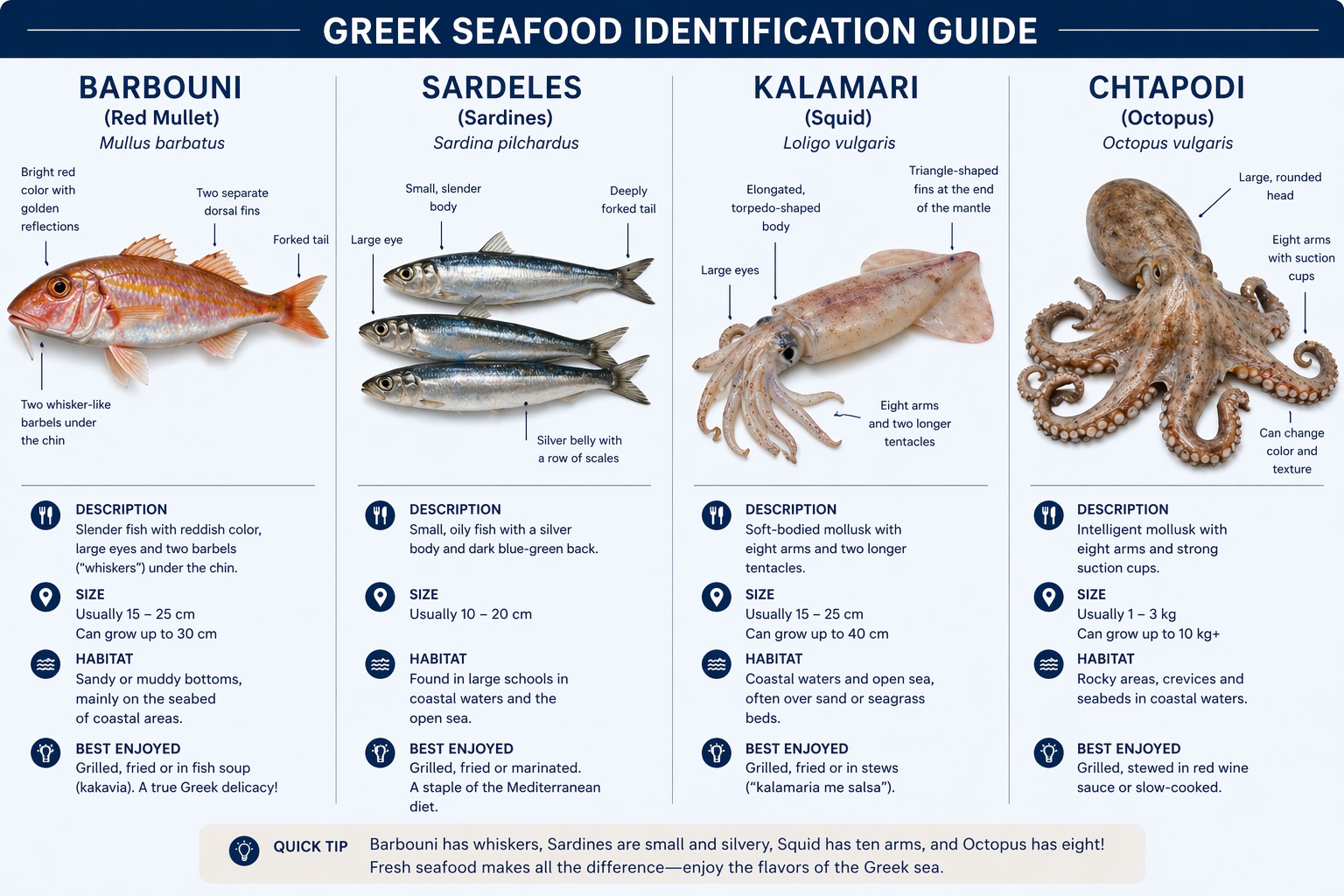
Fish Markets. Fish supply is based at the Corfu Town fish market operating early morning aligned with local landings. Species available include lavraki (European seabass), tsipoura (gilthead seabream), barbouni (red mullet), sardela (sardine), gavros (anchovy), kalamari (squid), and chtapodi (octopus). Additional direct quay-side sales occur in Petriti and Benitses where small fishing fleets land catch with limited consistency and no fixed schedule.
Corfu Greece
Sailing Guide - Local Cuisine
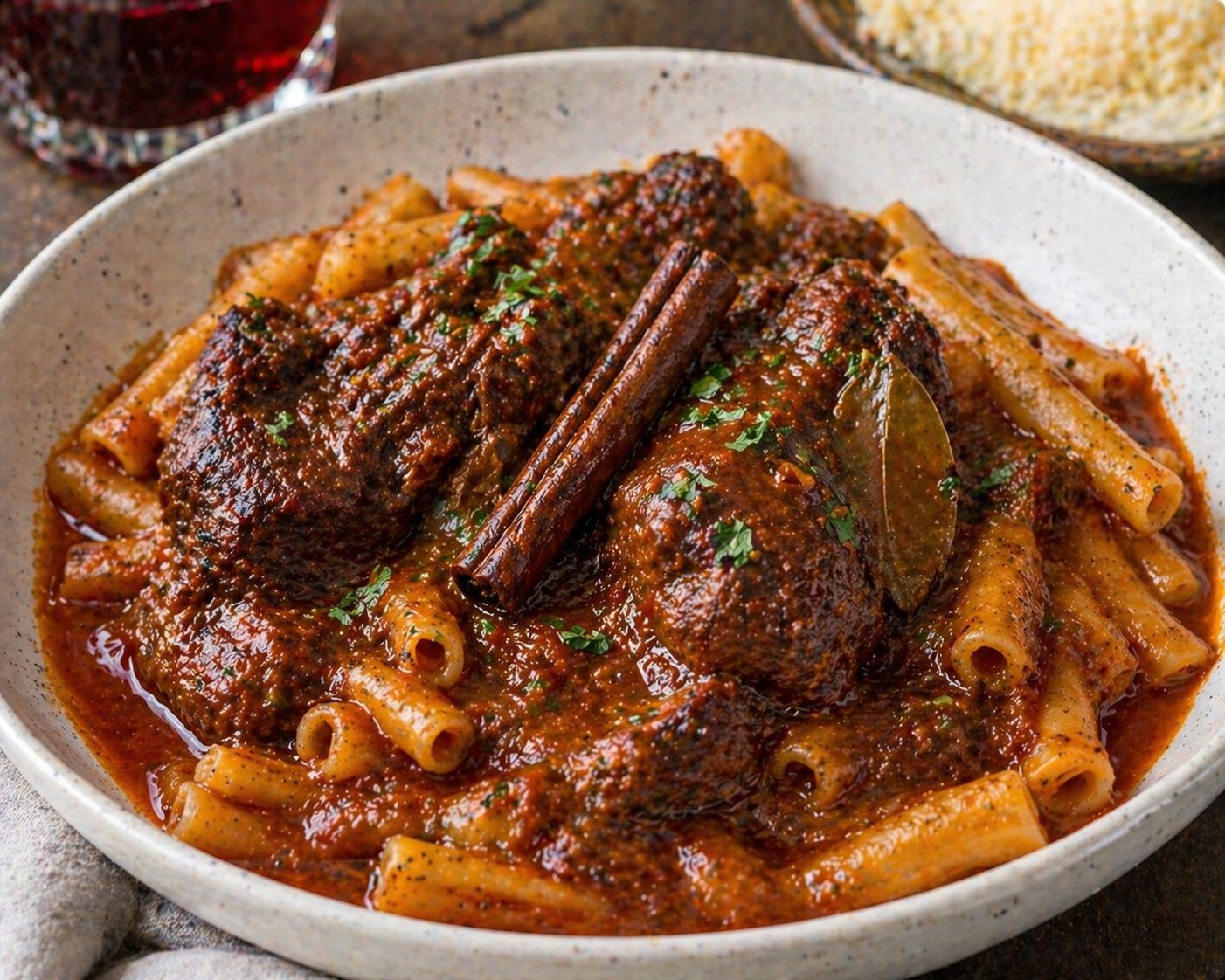
The island is famous for the Kumquat, which is a citrus fruit, and is used in liqueurs, jams and more.. Local dishes include pastitsada, a slow-cooked meat dish in spiced tomato sauce served with pasta, sofrito, veal cooked with garlic and white wine, and bourdeto, fish cooked in a pepper-based sauce. Fish such as tsipoura (gilthead seabream) and lavraki (European seabass) are grilled, and local olive oil is used extensively.
Olive oil is a primary product, with extensive groves across the island producing mild, low-acidity oils. Kumquat is specific to Corfu, used for liqueurs, preserves, and candied products. Wine production includes local varieties such as Kakotrygis (white) and Skopelitiko (red).
Dairy products include local cheeses, and cured meats are present but less regionally distinct than in other parts of Greece. Honey, particularly thyme-based, is produced locally (DO BUY THIS!)

Corfu Greece Sailing Guide - The Beverages
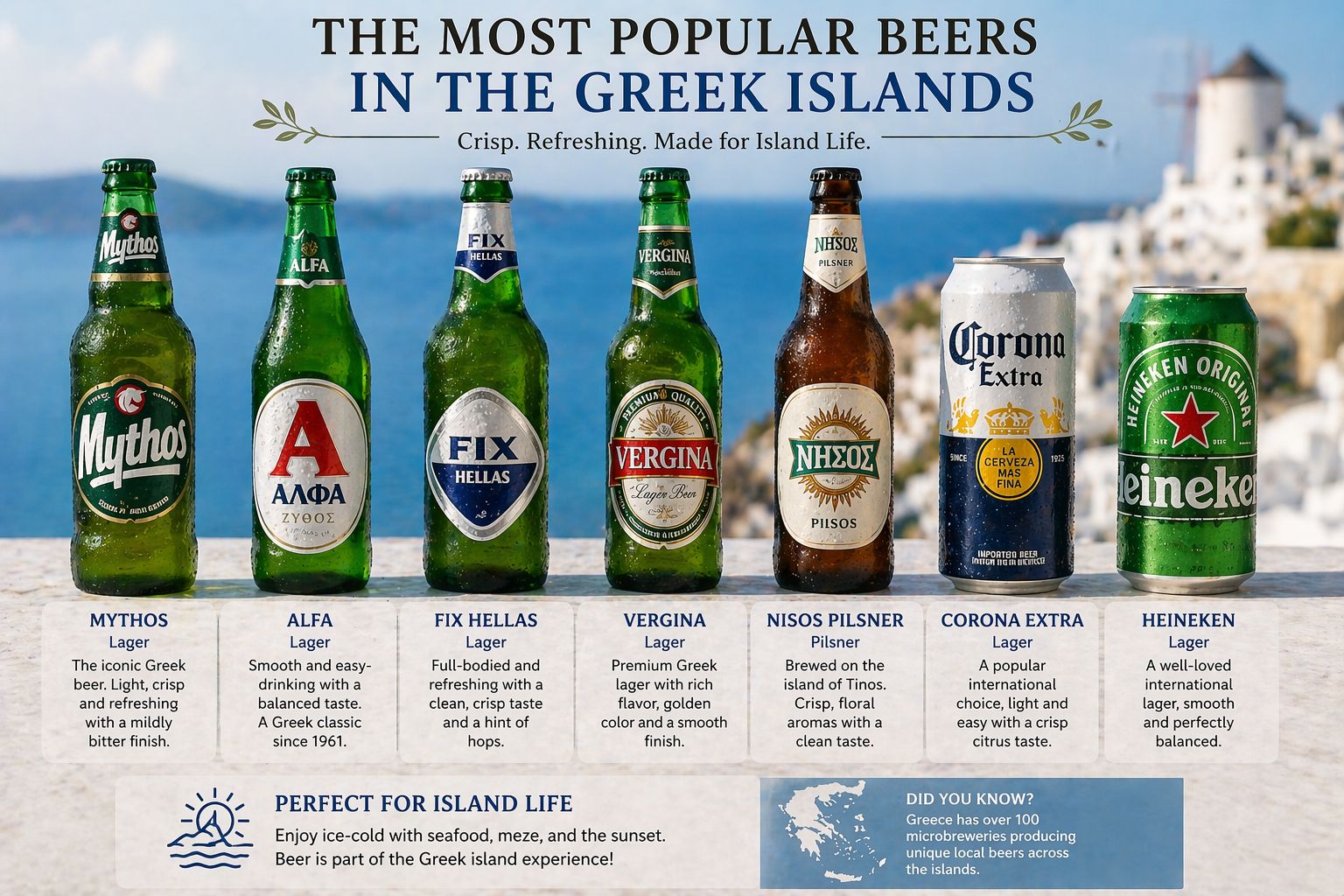
Beer, wine, and spirits across the Greek islands are locally produced and widely available through tavernas, small bars, and provisioning outlets. Beer is predominantly lager, with domestic brands including Mythos, Alfa, Fix, and Vergina alongside imported products; microbreweries operate on several islands with limited distribution. Wine is region-specific, with white varieties dominant in the islands, including Assyrtiko, Moschofilero, and Roditis, alongside local table wines served in bulk; retsina remains in circulation as a resin-flavoured wine. Distilled products include ouzo (anise-based), tsipouro (grape marc distillate), raki or tsikoudia (Crete), souma (fig or grape distillate in eastern Aegean islands), and kitron (citrus liqueur from Naxos), with alcohol strength typically in the 37–45% range and higher for unregulated local distillations.
Corfu Greece
Sailing Guide - Fuel Supplies
Fuel supply for yachts is available at Gouvia Marina via a fixed marina fuel berth dispensing diesel through metered pumps with direct alongside access. Depth alongside is approximately 3.0–4.5 m with stern-to or alongside arrangements depending on berth allocation. Additional supply is available at Corfu Port (Neo Limani) where commercial fuel berths service larger vessels; access requires coordination with port control and traffic clearance. Depths exceed 5.0 m but manoeuvring space is constrained by ferry and commercial movements.
Mobile fuel delivery by road tanker operates across the Gouvia, Kontokali, and Corfu Town areas, supplying diesel directly to quay or marina berths by prior arrangement. Supply is consistent with mainland distribution chains, with no persistent quality issues reported; filtration at transfer is standard practice.
Corfu Greece
Sailing Guide - Water Supplies
Potable water is available at Gouvia Marina via pressurised dockside connections with metered billing. Supply is continuous through the marina network with typical pressures adequate for direct hose filling; depths alongside are 3.0–4.5 m. Municipal water is available on town quays at Corfu Port (Neo Limani) and selected secondary berths where standpipes or hose connections are fitted. Availability is berth-dependent and may require port authority coordination. Water quality is potable and sourced from island reservoirs and mainland-fed systems; mineral content is elevated relative to desalinated water. Filtration is standard practice for onboard use. Seasonal demand increases during summer with occasional pressure reduction at peak periods; no systemic shortages are typical.
Mechanical and Electrical Repairs
Resource
If you are headed somewhere remote consider the need to expand your knowledge base or have an information resource on board. Why not get a copy of my book The Marine and Electrical and Electronics Bible 4th Edition. By and for yachties, with everything from batteries and charging, solar and wind, diesel engines and marine electronics and so much more. Your complete systems guide. 650 pages of practical advice. In Australia and New Zealand order a copy through Boat Books. UK and European boats can buy the UK Edition Here. US and Canadian boats can get the US Edition Order Here. Marine systems are my profession so let me help you. By a liveaboard boat owner for other boat owners.


Corfu Greece
Sailing Guide - Marine Services
Marine services on Corfu are centred on Gouvia Marina, which provides full-service capability including diesel engine servicing, electrical systems, and marine electronics support. Authorised agents for Volvo Penta and Yanmar operate within the Gouvia–Kontokali area, supported by established parts supply networks. Marine electronics services include installation, diagnostics, and repair for major systems including Raymarine through local service providers.
Lift-out and yard facilities are available at Gouvia with travel lift capacity and hardstand for hull maintenance, antifouling, and structural work. Additional engineering and repair services are available in the wider Corfu Town and central Corfu area, supporting both routine servicing and larger repair scope.
Parts supply is consistent through local stock and mainland logistics. Corfu functions as a primary service hub for the northern Ionian with capability for full maintenance, refit, and technical support.
Corfu Greece
Sailing Guide - Local Customs
Dress standards apply in urban and historic areas; swimwear is not worn away from beaches. Churches require covered shoulders and appropriate dress. Conduct ashore is generally formal and reserved. Corfu has a continuous resident population with no distinct indigenous maritime customs separate from national Greek norms. There usually are a LOT OF TOURISTS! Dress down and blend in and not look like a tourist!
Corfu Greece
Sailing Guide - Summary
Corfu is a controlled port with moderate traffic and defined navigation procedures. Approaches are deep with generally sheltered conditions on the east coast. Anchorages are available with good holding but exposure to easterly winds. Full marina, provisioning, fuel, and technical services are available. Corfu Greece Sailing Guide for all you need to know.