Comoros Moroni Cruising Guide
Comoros Moroni cruising guide. Moroni (Grande Comore) is the only port in the Comoros with formal clearance capability for yachts, but it offers limited infrastructure, exposed anchorage conditions, and minimal provisioning depth. The port operates as an open roadstead with a shallow jetty and restricted berthing, and larger vessels work cargo at anchor into small craft. Yachts must remain fully self‑sufficient, as Moroni provides only basic supplies and no marine‑grade services.
Yachts use Moroni primarily as a clearance point when transiting between Madagascar, Mayotte, Tanzania, and Mozambique. All provisioning, fuel loading, and repair work should be completed before arrival, as Moroni cannot support ocean‑departure preparation. The port’s shallow draft limit of 4.5 m and maximum LOA of 80 m reflect its small‑craft orientation and limited operational capacity.
Comoros Moroni Cruising Guide - Approaches
Approaches to Moroni are straightforward in deep water, but the final approach is fully exposed to ocean swell. The port is an open roadstead with no breakwater, and vessels anchor offshore in variable holding. Cargo vessels work cargo at anchor into small boats, and yacht skippers must maintain wide separation from commercial operations. The coastline is volcanic with steep drop‑offs, and reefs are limited but present north and south of the port. Night approaches are not recommended due to unlit small craft and poor shore lighting.
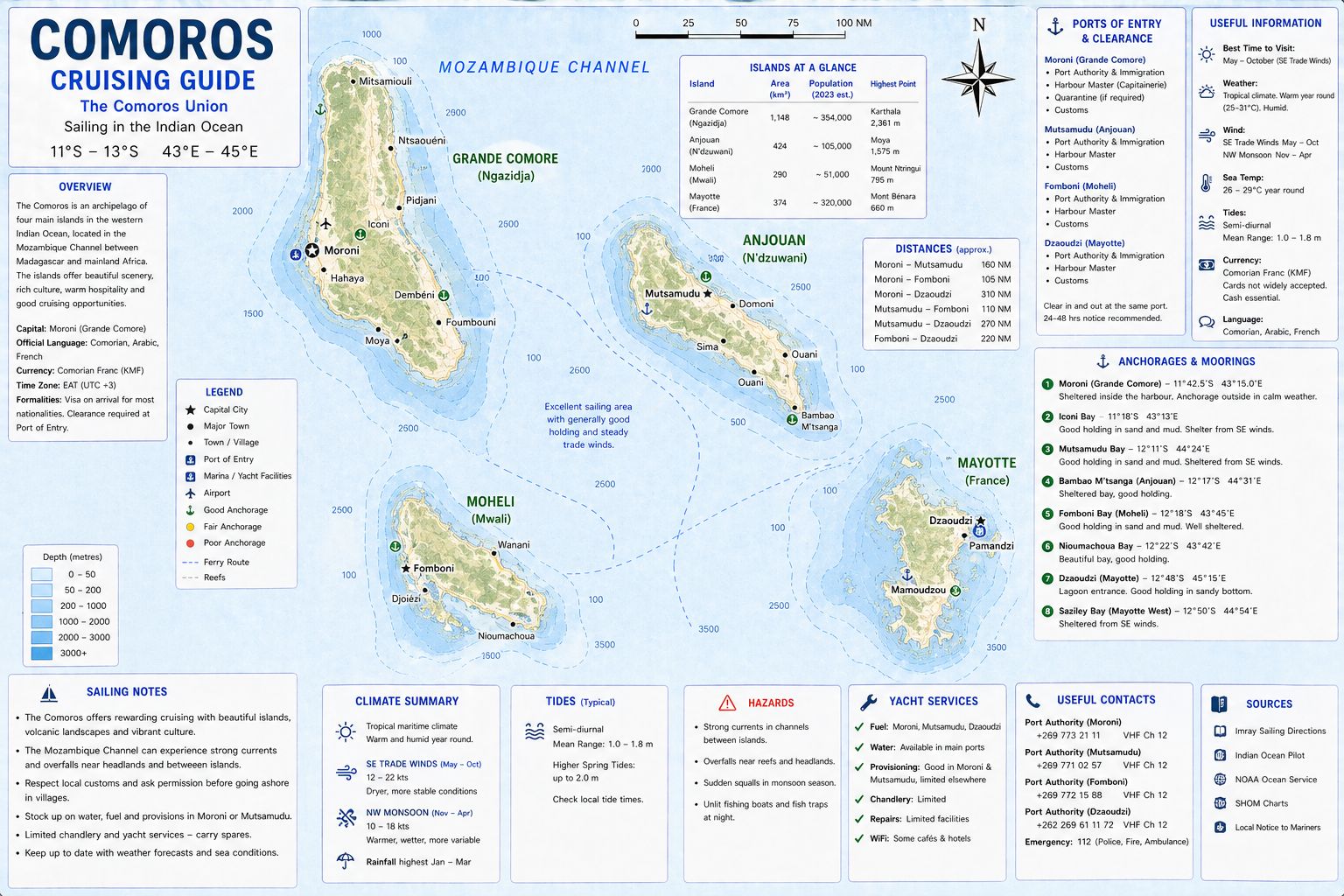
Comoros Moroni Cruising Guide - Anchorage
Anchorage is taken offshore in 15–25 m on mixed sand and rubble with inconsistent holding. The anchorage is exposed to swell from the west and southwest, and rolling is continuous. Depth increases rapidly away from the shoreline due to the volcanic seabed. The port jetty is shallow and cannot accommodate yachts; all movements are by dinghy to the beach or steps near the port. Weather shifts and swell changes require regular anchor monitoring.
Comoros Moroni Cruising Guide - Entry
Formalities
Clearance is completed through Immigration, Customs, Port Authority, and the Gendarmerie. Offices are within the port area but not co‑located. Processing is slow and requires multiple visits. Fees vary and are payable in cash. Biosecurity controls apply to fresh produce. Firearms must be declared. Drone use is restricted. Clearance is mandatory on arrival and departure.
Comoros Moroni Cruising Guide - Marina
Facilities
There is no marina in Moroni. There are no pontoons, no moorings, no haul‑out facilities, and no hard‑stand. The port jetty is shallow and used by local boats only. Dinghy landings are made at the beach or steps near the port. No yacht‑specific facilities exist.
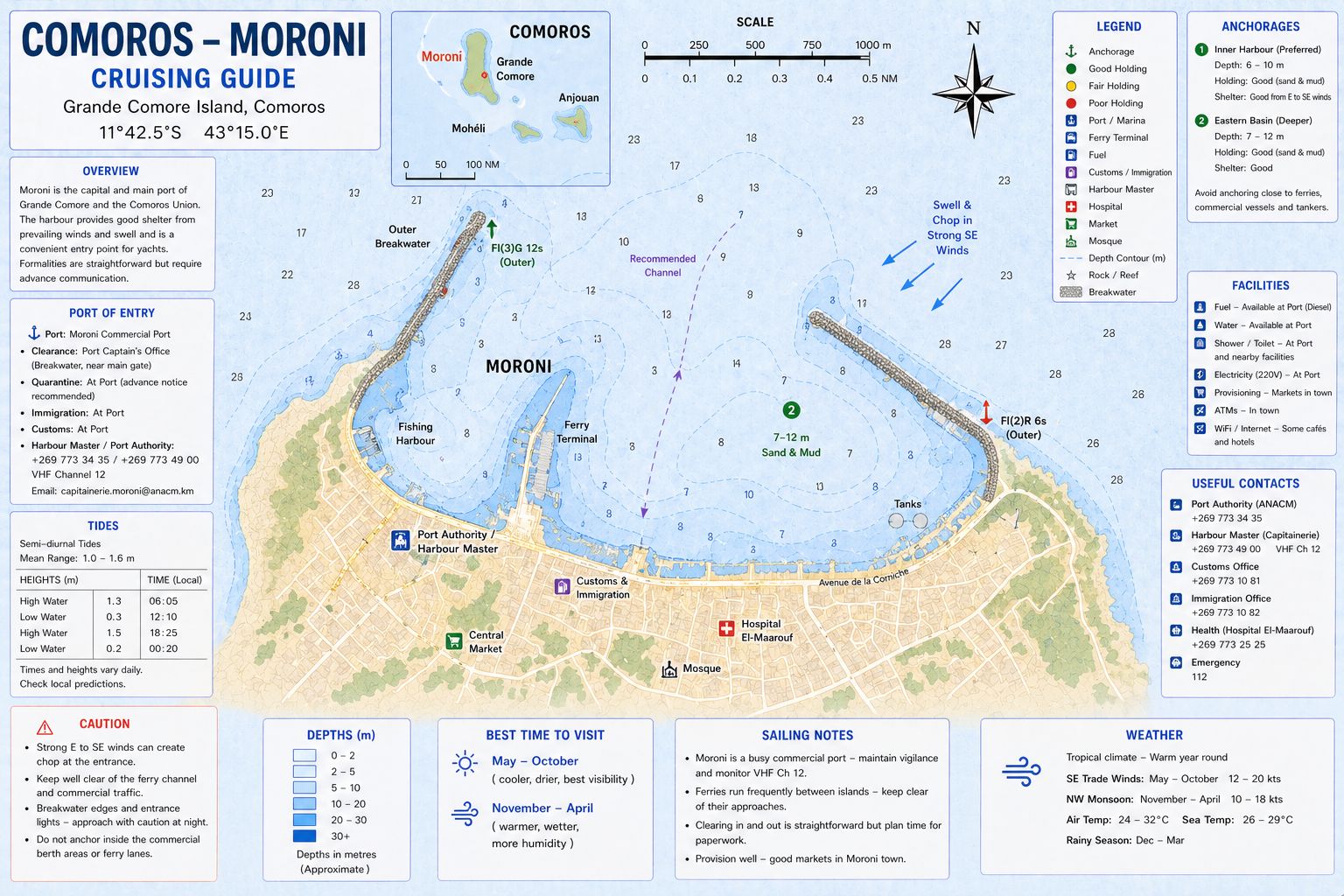
Comoros Moroni Cruising Guide - Local
Weather
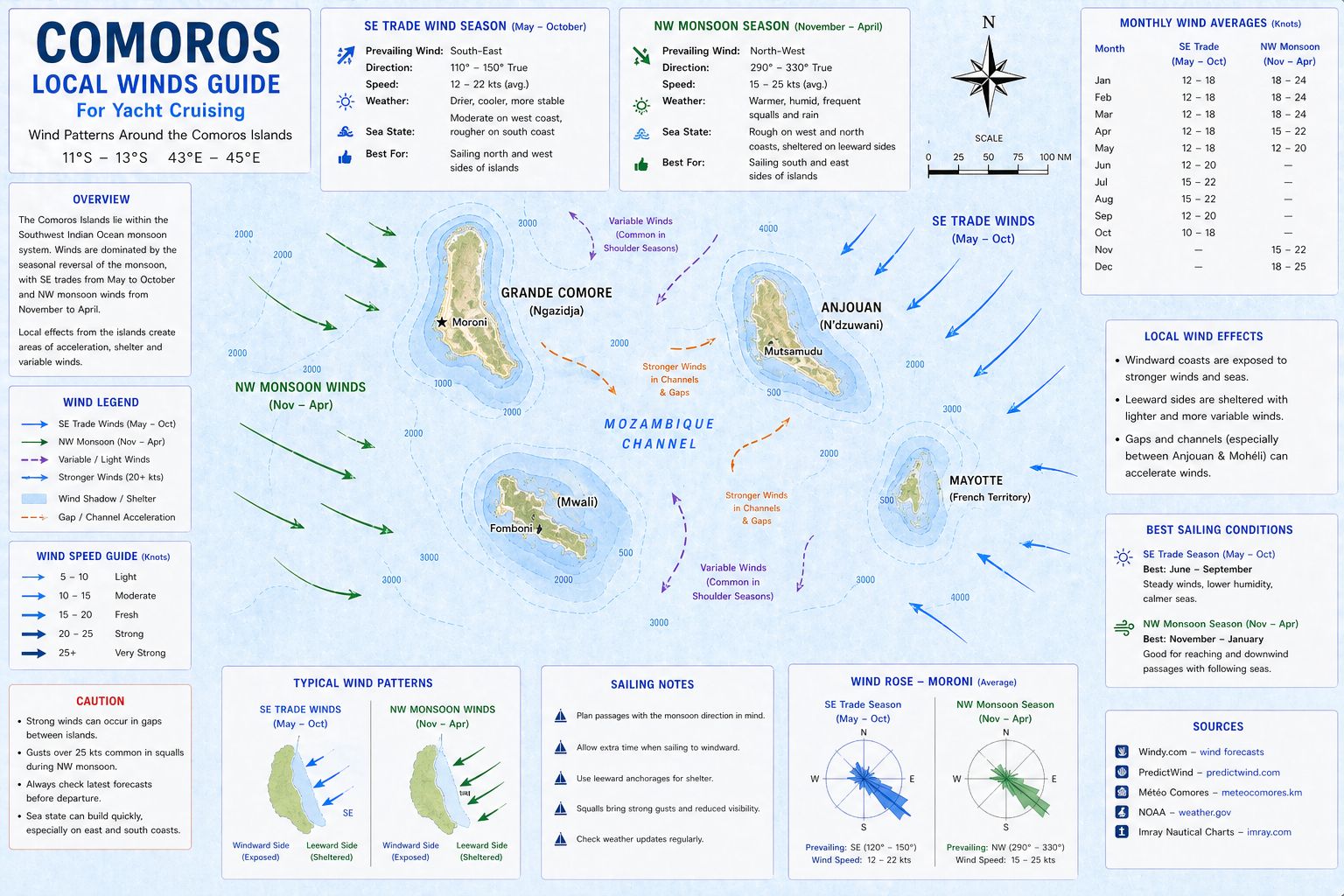
The SE trades dominate from May to October with moderate winds and manageable sea state offshore. From November to April, the NW monsoon brings light winds, heavy rain, and cyclone exposure. Swell from the southwest affects the anchorage year‑round, with increased rolling during monsoon periods. Local sea breezes develop in the afternoons but do not materially improve anchorage comfort.
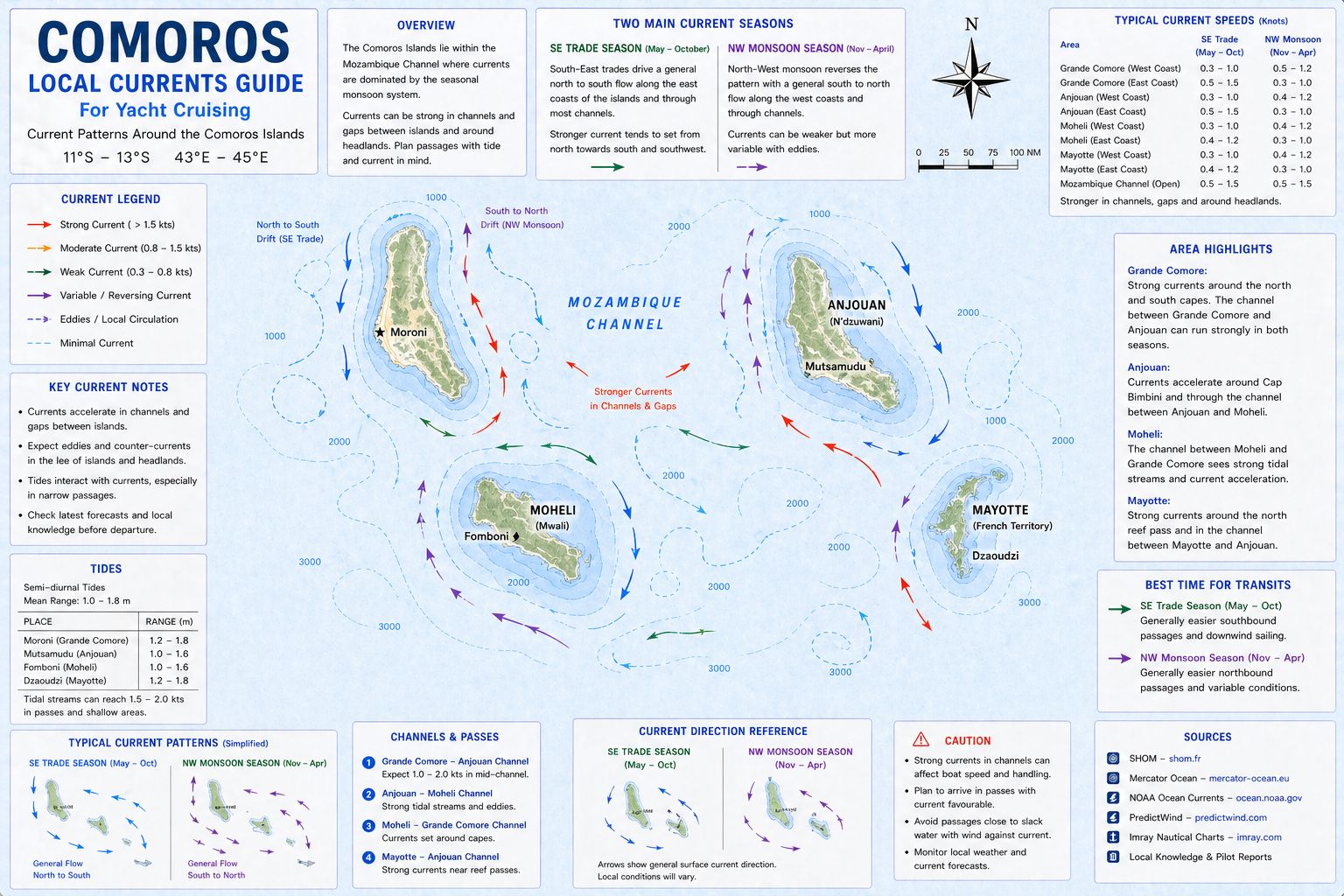
Comoros Moroni Cruising Guide - Ocean Currents
Ocean currents around the Comoros are shaped by the powerful western boundary flow of the Mozambique Current moving southward through the Mozambique Channel. This current is generally warm and can reach 1–3 knots, often forming large eddies and swirling counter-currents as it interacts with the steep volcanic island slopes of Grande Comore, Mohéli, and Anjouan. Around headlands and in the channels between islands, flow acceleration and turbulence are common, while localized eddies can create confused seas and variable set. Seasonal wind shifts tied to the monsoon cycle influence surface drift, with more consistent southward flow during the southeast trade period and increased variability during the northwest monsoon. For yacht navigation, currents are typically weakest close inshore and on the lee sides of islands, but offshore passages in the channel require careful allowance for set and drift, particularly when rounding capes or transiting between islands.
Comoros Moroni Cruising Guide - Provisioning
Supermarkets. Moroni Centre supermarkets. Limited dry goods, rice, pasta, tinned tomatoes, tinned fish, oil, sugar, flour, biscuits, soft drinks, basic frozen chicken, and occasional frozen fish. Small groceries (city centre). Bottled water, eggs, onions, potatoes, bananas, basic fruit, bread, soft drinks. Cold‑chain reliability. Variable; frozen goods require inspection.
Markets. Moroni Central Market. Tomatoes, onions, garlic, ginger, leafy greens, aubergine, okra, beans, bananas, papaya, citrus, herbs, spices, fresh chillies, coconuts. Perimeter stalls. Additional fruit and vegetables with inconsistent supply. Staples. Local rice, lentils, beans, dried maize.
Fish Markets. Port‑side fish sellers. Tuna, trevally, kingfish, reef species, squid.
Cold Chain Storage Issues
Cold storage is limited on most islands. Frozen goods are common, but freezer reliability varies, power outages happen and cold chain is inconsistent. Inspect frozen items carefully before purchasing. Visual signs of product that has partially thawed and refrozen are ice crystals inside packaging: Indicates moisture loss and refreezing. Discolored patches such as grey, brown, or greenish areas suggest oxidation or bacterial growth. Frost burn or dry edges: Caused by repeated freezing cycles. Uneven coloration: May signal partial thawing and refreezing. Give it the smell test. A sour or ammonia-like odor is a clear sign of spoilage. Any “Off” smell even when frozen: Indicates bacterial activity during thawing. Do a texture check, mushy or slimy surface is due to cell breakdown from thawing. Sticky or tacky feel indicates early spoilage, especially in poultry. Excess liquid in packaging suggests previous thawing. Frozen chicken-specific Red Flags are a pale or translucent skin: Indicates moisture loss. Blood pooling or dark spots which may signal partial thawing. Bone darkening is often seen in refrozen chicken.
Indian Ocean
Crossing Deaths
A distress call in the Mozambique Channel led authorities to a yacht where two highly experienced sailors, 67‑year‑old Australian Deirdre Sibly and French sailor Pascal Mahé, were found dead aboard their 50‑foot catamaran during a passage from Réunion to Durban. Their deaths occurred on 27 November 2025, and the case has since been widely reported as a suspected food‑poisoning event, although investigations are still ongoing. Initially the media in their usual misguided and fact challenged way made it all a big story about piracy.
The couple departed Réunion Island bound for Durban, South Africa, a common westbound Indian Ocean transit route. While sailing between Madagascar and Mozambique, a distress alert was received. Responding vessels located the yacht adrift and found both sailors deceased onboard. Both were described as experienced blue‑water cruisers with extensive passage‑making history.
Cause of death. Authorities have not released a final forensic determination, but reporting indicates the working hypothesis is fatal food poisoning, consistent with the circumstances and absence of struggle or trauma. No official confirmation has been published regarding the specific toxin or food source. Although the exact toxin has not been publicly identified, the region is known for risks such as Ciguatera from reef fish (a well‑documented marine toxin illness), Marine biotoxins associated with algal blooms, which have caused other fatal food‑poisoning investigations in the region. These are consistent with the type of sudden, severe onset that can incapacitate a crew at sea.
Operational relevance for Indian Ocean sailors. This incident underscores several practical risks. Reef‑fish consumption in the western Indian Ocean carries non‑zero ciguatera risk, especially species like barracuda, trevally, grouper, and amberjack. Symptoms can be rapid and severe, and treatment options offshore are extremely limited. A two‑person crew is particularly vulnerable if both are affected simultaneously. Food‑handling, fish‑selection, and toxin‑avoidance protocols are critical on long passages.
Food‑Related Risk
on Indian Ocean Passages
Marine‑toxin food poisoning is a recognised hazard across the western Indian Ocean, particularly on long passages where crews rely on self‑caught fish or locally sourced reef species. Toxins such as ciguatoxin occur naturally in reef ecosystems and are not destroyed by cooking, freezing, or cleaning. Illness can develop rapidly and incapacitate an entire crew if the same fish is consumed. Two‑person crews are especially vulnerable because simultaneous onset leaves the vessel unmanned.
High‑Risk Species. Reef‑associated predatory fish carry the highest toxin load. The following species are consistently identified as high‑risk in the western Indian Ocean, Barracuda, Grouper (all large species), Trevally, Amberjack, Snapper (large reef species) and Moray eel. These species should be avoided entirely on ocean passages. Pelagic species such as tuna, wahoo, and mahi‑mahi carry significantly lower risk and are the preferred option when fishing offshore.
Geographic Hotspots. Ciguatera risk is elevated around Madagascar’s west and northwest reefs. Comoros archipelago, Mayotte lagoon and fringing reefs, Mozambique Channel islands and banks. Seychelles outer islands. Risk increases near shallow reefs, coral rubble zones, and areas with algal growth following storms or warm‑water events.
Onboard Risk‑Reduction Protocols. These are operational guidelines, not medical instructions. Avoid all reef fish caught within 20–30 nm of land. Prioritise pelagic species caught in deep water. Do not consume fish if the flesh has an unusual smell, texture, or colour. Do not consume large or old fish; toxin load increases with size and age. Do not consume fish liver, roe, or head meat, where toxins concentrate. If one crew member becomes unwell after eating fish, all remaining portions should be discarded immediately.
Two‑Person Crew Vulnerability. A two‑person crew is at highest operational risk because: Both typically eat the same meal. Onset can be rapid, leaving no functional watchkeeper. Passage planning for two‑person crews should assume zero tolerance for reef‑fish consumption.
Passage‑Planning Implications. Provision sufficient protein to avoid reliance on reef fishing. Treat all reef‑caught fish as unsuitable for consumption. Maintain a conservative fishing policy offshore: pelagic species only. Ensure the vessel can maintain course and speed under autopilot if both crew are incapacitated. Maintain regular check‑ins with shore contacts during long legs.
Relevance to the Recent Fatalities
The suspected food‑poisoning deaths of two experienced sailors in the Mozambique Channel highlight the operational reality: marine toxins can incapacitate a crew without warning, and a yacht at sea cannot rely on medical intervention. The case reinforces the need for strict fish‑selection protocols and conservative food‑safety practices on long passages.
Comoros
Moroni Cruising Guide - Local Cuisine
Langouste grille. Grilled spiny lobster with lime and salt. Pilaou. Rice cooked with meat or fish, spices, and tomato. Mataba. Cassava leaves cooked in coconut milk. Poulet au coco. Chicken simmered in coconut milk. Poisson à la vanille. Fish cooked with vanilla and mild aromatics. Sambusa. Fried pastry filled with minced meat or fish.
Comoros Moroni Cruising Guide - Fuel
Supplies
Diesel and petrol are available at roadside fuel stations and must be transported by jerry can. Diesel quality is variable and should be filtered. There is no fuel dock and no direct vessel refuelling.
Comoros Moroni Cruising Guide - Water
Supplies
Water is available only by jerry can from local taps or vendors. Potability is inconsistent; onboard filtration or treatment is required.
Mechanical and Electrical Repairs
Resource
If you are headed somewhere remote consider the need to expand your knowledge base or have an information resource on board. Why not get a copy of my book The Marine and Electrical and Electronics Bible 4th Edition. By and for yachties, with everything from batteries and charging, solar and wind, diesel engines and marine electronics and so much more. Your complete systems guide. 650 pages of practical advice. In Australia and New Zealand order a copy through Boat Books. UK and European boats can buy the UK Edition Here. US and Canadian boats can get the US Edition Order Here. Marine systems are my profession so let me help you. By a liveaboard boat owner for other boat owners


Comoros Moroni Cruising Guide - Marine
Services
Moroni has no yacht‑specific marine services. There are no sailmakers, riggers, chandlers, or marine mechanics. Local workshops can perform basic metalwork or carpentry but are not marine‑grade. No spare parts are available.
Comoros Moroni Cruising Guide - Local
Customs
Transactions are cash‑based. Prices in markets may be negotiated. Photography of people requires permission. Dress standards are conservative; shoulders and knees should be covered in town. Friday prayer times reduce business activity. Port areas require direct communication and clear intent when moving through controlled zones.
Comoros Moroni Cruising Guide - Summary
Moroni provides clearance but lacks the infrastructure required for provisioning, repairs, or comfortable anchoring. It is an exposed roadstead with limited supplies, no marine services, and no yacht facilities. Yachts should arrive fully prepared and treat Moroni as a clearance stop only, not a provisioning or departure base. Comoros Moroni Cruising Guide for all you need to know.