Cocos Keeling Cruising
Guide
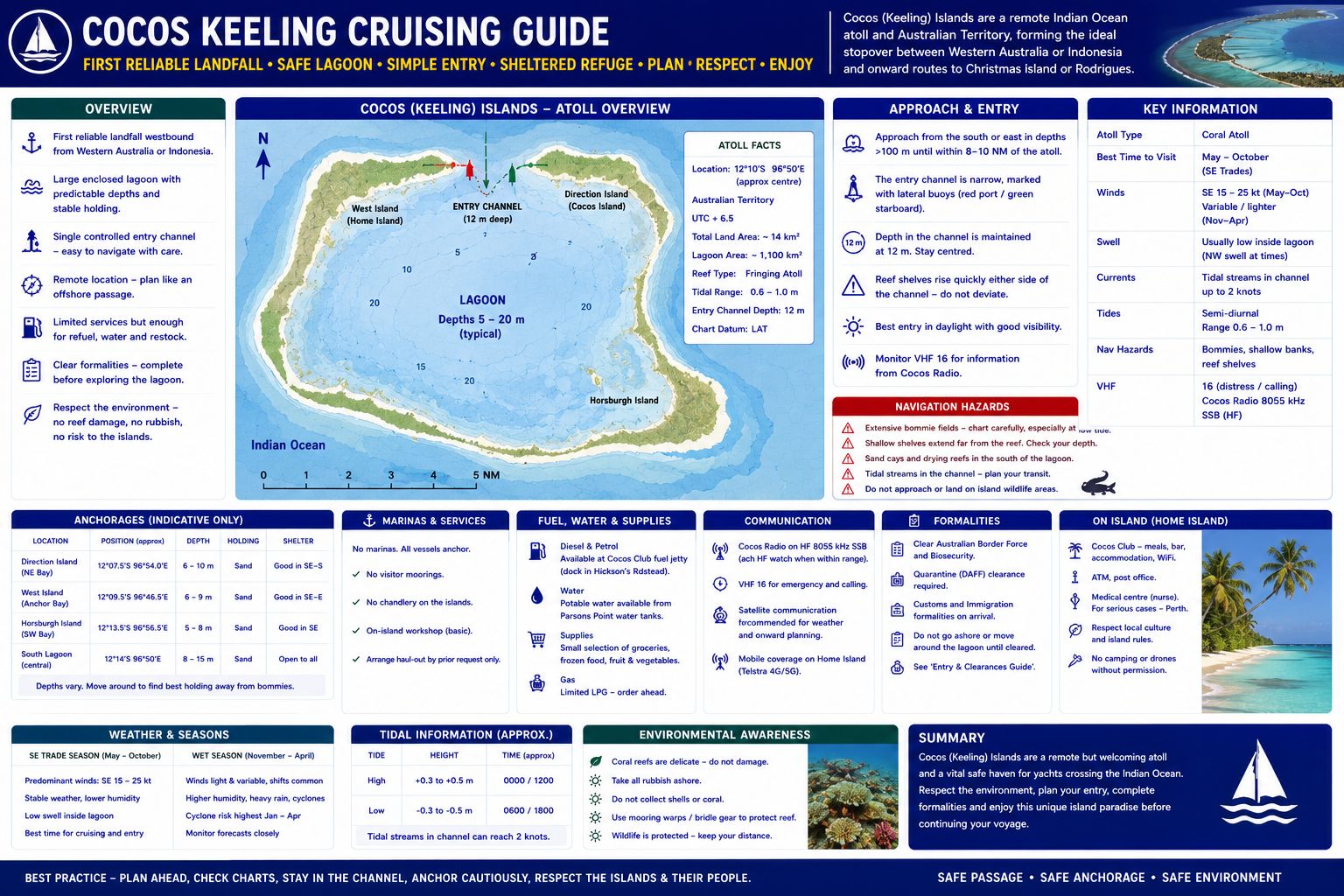
Cocos Keeling Cruising Guide. Cocos (Keeling) Islands form the first reliable landfall for yachts departing Western Australia or Indonesia on a westbound Indian Ocean transit. The atoll provides a large, enclosed lagoon with predictable depths, stable holding, and a single controlled entry channel. The location is remote, so all approach, anchoring, and provisioning decisions must be made with offshore‑passage logic rather than coastal cruising assumptions.
The atoll has limited services but offers sufficient shelter, fuel, water, and basic supplies for onward routing to Rodrigues or Christmas Island. Navigation inside the lagoon requires attention to chart accuracy, bommie fields, and shallow shelves. Formalities are straightforward but must be completed before moving freely within the lagoon.
Cocos Keeling Cruising
Guide - Approaches
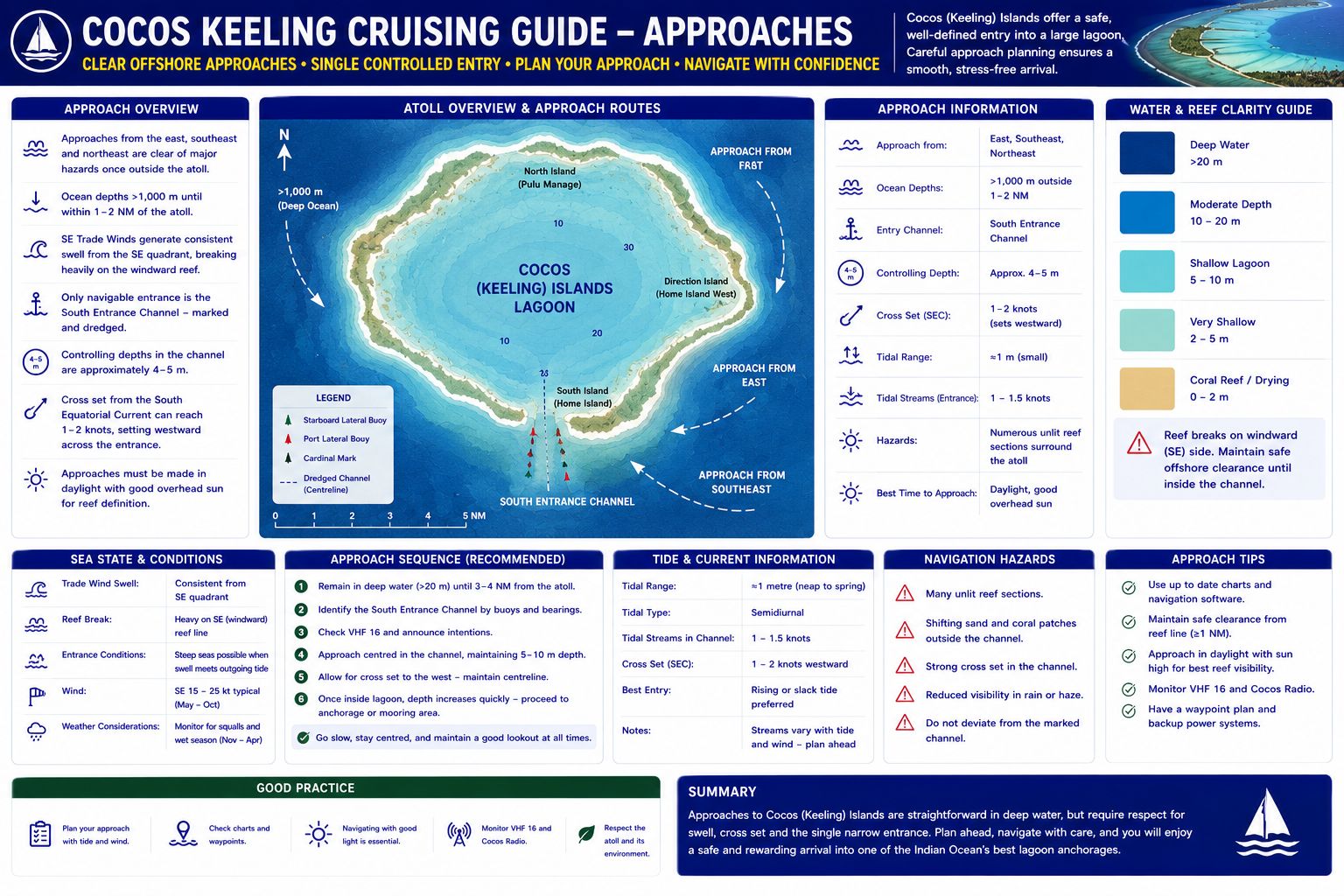
Approaches from the east, southeast, and northeast are clear of major hazards once past the outer reef line, with ocean depths of >1,000 m until within 1–2 NM of the atoll. The South‑East Trade Winds generate consistent swell from the SE quadrant, which breaks heavily on the windward reef. The only navigable entrance is the South Entrance Channel, marked and dredged, with controlling depths of approximately 4–5 m. Cross‑set from the South Equatorial Current can reach 1–2 kn, setting westward across the entrance.
Sea state outside the entrance can be steep when trade‑wind swell meets outgoing tidal flow. Tidal range is small (≈1 m), but tidal streams in the entrance can reach 1–1.5 kn. Numerous unlit reef sections surround the atoll; approaches must be made in daylight with good overhead sun for reef definition.
Cocos Keeling Cruising
Guide - Anchorage
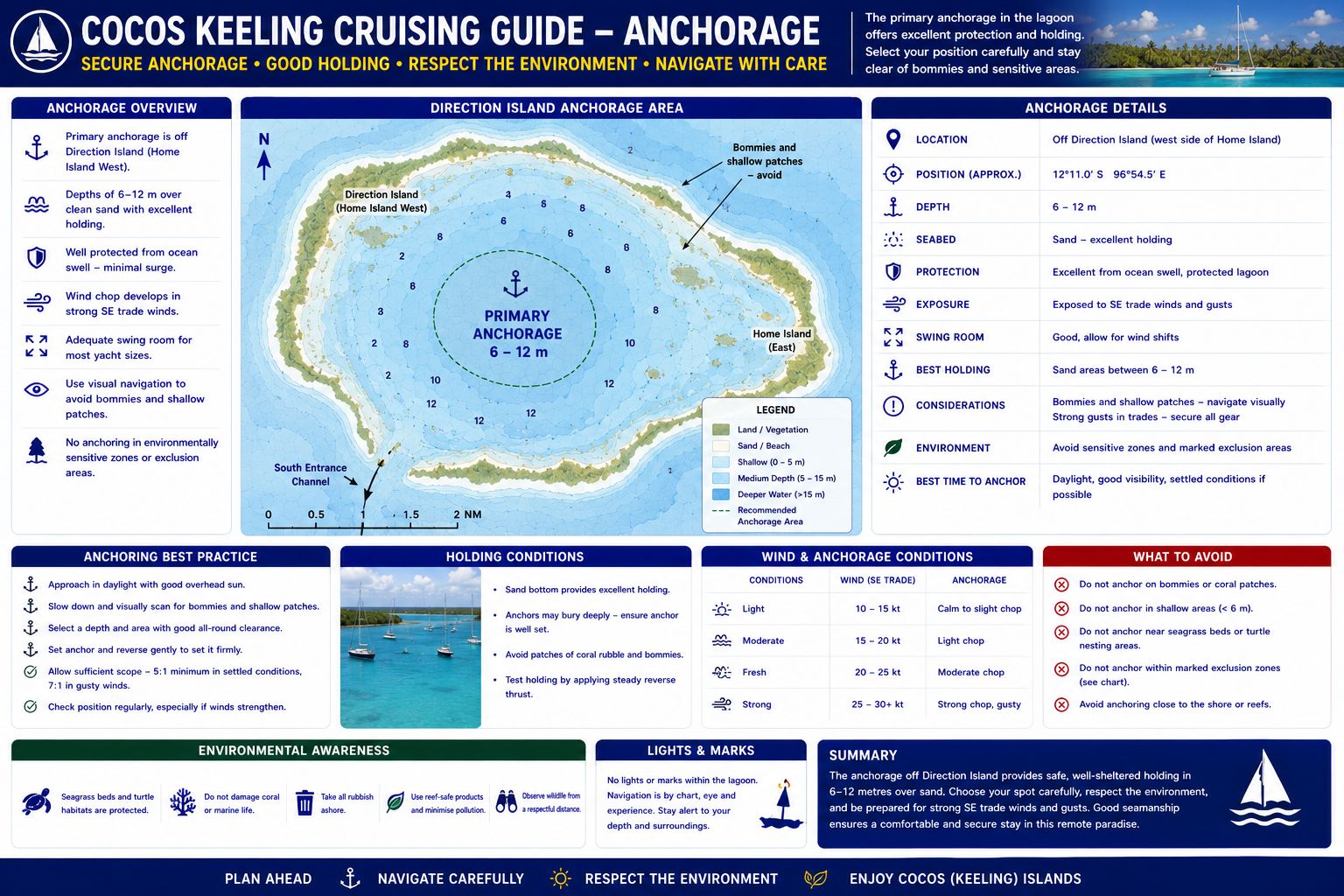
The primary anchorage is in the lagoon off Direction Island, in depths of 6–12 m over sand with excellent holding. The lagoon is well protected from ocean swell, though wind chop develops in strong SE trades. Swing room is adequate, but bommies and shallow patches require visual navigation when selecting a position. The anchorage is exposed to strong gusts in trade‑wind conditions but remains structurally safe. No anchoring is permitted near environmentally sensitive zones or within marked exclusion areas.
Cocos Keeling Cruising
Guide - Entry Formalities
All yachts must proceed directly to Home Island for Customs, Immigration, and Quarantine clearance. Advance notice via email is required. Officers may board the vessel or conduct clearance ashore depending on operational conditions. Biosecurity rules apply to fresh produce, meat, and seeds. Firearms must be declared and secured as directed. Starlink and other satellite communications equipment are permitted but must not interfere with local frequencies. Drone use is restricted and requires approval.
Cocos Keeling Cruising Guide - Marina Facilities
There is no marina. Yachts anchor in the lagoon and use dinghy landings at Direction Island or Home Island. Depths at dinghy landings are 1–2 m depending on tide. No berthing, haul‑out, or hard‑stand facilities exist. Moorings may be available on a limited basis for official use only.
Cocos Keeling Cruising
Guide - Local Weather
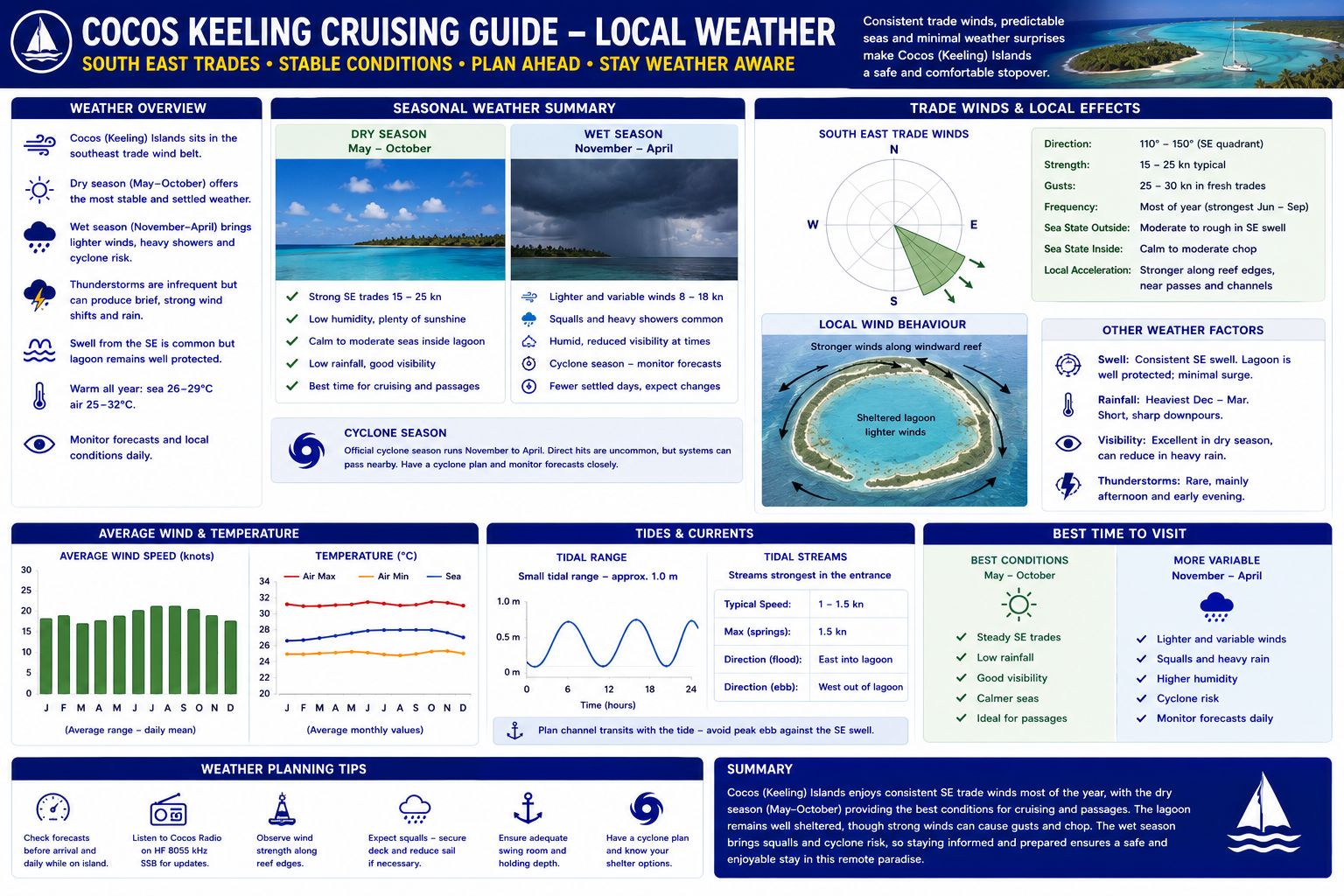
Weather is dominated by the South‑East Trade Winds for most of the year, typically 15–25 kn. The dry season (May–October) provides the most stable conditions. The wet season (November–April) brings lighter winds, squalls, and occasional cyclone risk, though direct hits are uncommon. Localised acceleration occurs along the reef edges in strong trades. Thunderstorms are infrequent but can produce short‑lived wind shifts.
Cocos Keeling Cruising
Guide - Provisioning
Not a cheap place to provision as most everything is imported from Australia, and although sometimes a jump off point heading south it is best to store up elsewhere.
Supermarkets. Basic provisioning is available on Home Island and West Island through small community stores. Stock includes dry goods, limited fresh produce, frozen meat, and essential household items. No large supermarkets exist. Specialty items are limited and should not be relied upon.
Markets. There are no formal produce markets. Occasional local supply may be available depending on shipping schedules.
Fish Markets. No dedicated fish market operates. Local fishers may sell catch informally, subject to availability.
Cocos Keeling Cruising
Guide - Local Cuisine
Local cuisine reflects Malay and Australian influences. Common dishes include nasi goreng (fried rice), mee goreng (fried noodles), and simple grilled fish. Supplies for these dishes are available in local stores, though selection varies with freight deliveries.
Cocos Keeling Cruising
Guide - Fuel Supplies
Diesel is available on Home Island via jerry cans from the community fuel facility. Petrol availability varies. No fuel dock exists, and all transfers require dinghy transport. Supply reliability depends on tanker schedules.
Cocos Keeling Cruising
Guide - Water Supplies
Potable water is available from public taps on Home Island and West Island. Water must be transported by jerry can. Supply is treated and generally reliable, though consumption should be conservative due to the island’s limited production capacity.
Mechanical and Electrical Repairs
Resource
If you are headed somewhere remote consider the need to expand your knowledge base or have an information resource on board. Why not get a copy of my book The Marine and Electrical and Electronics Bible 4th Edition. By and for yachties, with everything from batteries and charging, solar and wind, diesel engines and marine electronics and so much more. Your complete systems guide. 650 pages of practical advice. In Australia and New Zealand order a copy through Boat Books. UK and European boats can buy the UK Edition Here. US and Canadian boats can get the US Edition Order Here. Marine systems are my profession so let me help you. By a liveaboard boat owner for other boat owners


Cocos Keeling Cruising
Guide – Marine Services
Marine services are minimal. No diesel mechanics, riggers, or sailmakers are based on the islands. Minor electrical or mechanical assistance may be available through local contractors, but yachts should be fully self‑sufficient. The nearest full‑service marine support is in Mauritius or Réunion, or Perth and Darwin.
Cocos Keeling Cruising
Guide - Local Customs
Cocos Malay communities observe Islamic customs. Modest dress is expected on Home Island, especially near community areas and during prayer times. Alcohol consumption is restricted to designated areas on West Island. Respectful behaviour at mosques and community facilities is essential. Photography of people should be requested politely.
Cocos Keeling Cruising
Guide – Summary
Cocos (Keeling) Islands provide a secure lagoon anchorage and a straightforward, single‑channel entry for yachts crossing the eastern Indian Ocean, with depths, holding, and shelter suitable for staging the long leg to Rodrigues or other western landfalls. Formalities are centralised on Home Island, services are minimal, and all fuel, water, and provisioning are handled at small‑scale community level, so vessels must arrive largely self‑sufficient. The atoll’s trade‑wind weather, limited infrastructure, and cultural setting make it a functional but strictly operational stop rather than a refit or reprovisioning hub, best used to reset, refuel, and confirm weather before committing to the next ocean leg. Cocos Keeling Cruising Guide for all you need to know.