Chalki Greece Sailing Guide
Chalki Greece Sailing Guide. Chalki lies west of Rhodes in the southern Aegean Sea and forms part of the Dodecanese group. The island is low-lying with a generally barren profile, limited vegetation, and a predominantly rocky coastline. The primary settlement and port is Nimborio on the east coast, which serves as the sole point of entry, berthing, and services for visiting vessels. The harbour is enclosed but open to easterly influence, with depths increasing rapidly outside the entrance and limited alternative shelter options elsewhere on the island.
Chalki is sparsely populated and infrastructure is minimal, with no marina development and only basic quay berthing available. The island has a long history linked to sponge diving and maritime trade, though present-day activity is limited in scale. For cruising yachts, Chalki functions as a transit stop or short-duration anchorage rather than a service hub, with constrained provisioning, fuel, and water availability. Its position within the Dodecanese places it on common passage routes between Rhodes and smaller regional islands, with exposure to prevailing summer northerlies (Meltemi) and relatively low protection outside the main harbour.
Chalki Greece Sailing Guide History
Chalki has a continuous habitation record from antiquity, with early settlement linked to its strategic position along coastal trade routes in the southern Aegean Sea. The island came under successive control of Hellenistic rulers, the Roman Empire, and later the Byzantine Empire, before being occupied by the Knights of Saint John in the 14th century, who established fortifications above the present settlement. It was incorporated into the Ottoman Empire in the 16th century, during which time sponge diving and small-scale maritime trade became the primary economic activities. In the early 20th century Chalki passed to Italian administration following the Italo-Turkish War, before being ceded to Greece in 1947. Population decline through the mid-20th century reduced activity significantly, leaving the existing harbour settlement at Nimborio as the focal point of what remains a small, locally oriented maritime community
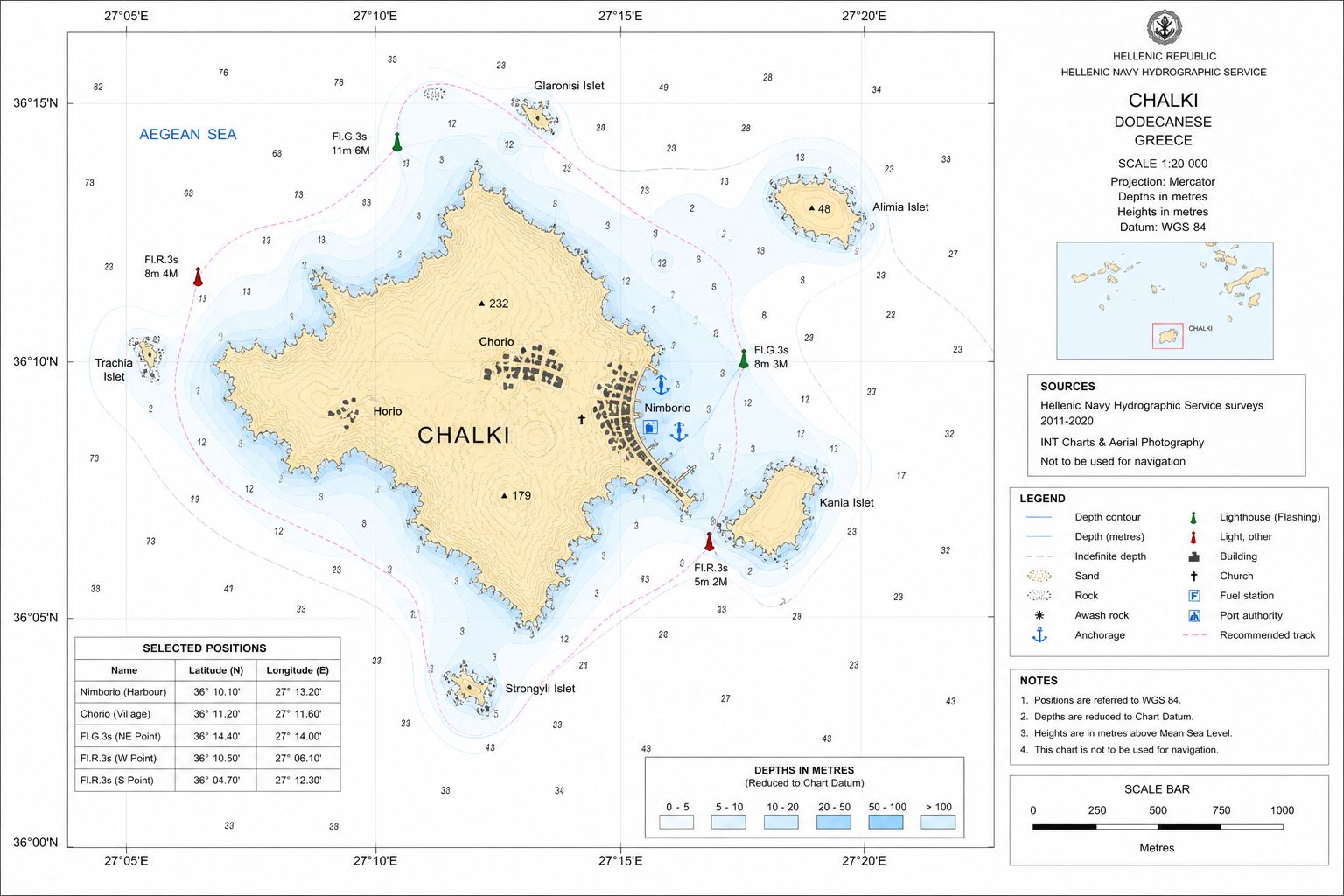
Chart Disclaimer. This chart is a schematic representation for illustrative purposes only and must not be used for navigation. Refer to official hydrographic charts for safe navigation. Be aware ENC charts may differ from official hydrographic charts. Both should be corrected and updated regularly.
Chalki Greece Sailing Guide Ocean
Currents and Tidal Flow
Around Chalki, tidal range is negligible, typically less than 0.3 m, and tidal streams are not a controlling factor in navigation. Water movement is driven primarily by regional wind forcing across the southern Aegean Sea. During prevailing summer northerlies (Meltemi), a weak but persistent south-setting surface drift can be present, generally in the order of 0.2–0.5 kn in open water, increasing locally where flow is compressed between Chalki and nearby landmasses, particularly toward the channels east toward Rhodes. In lighter conditions or outside the Meltemi period, current is variable and often indeterminate, with short-period reversals influenced by local wind shifts.
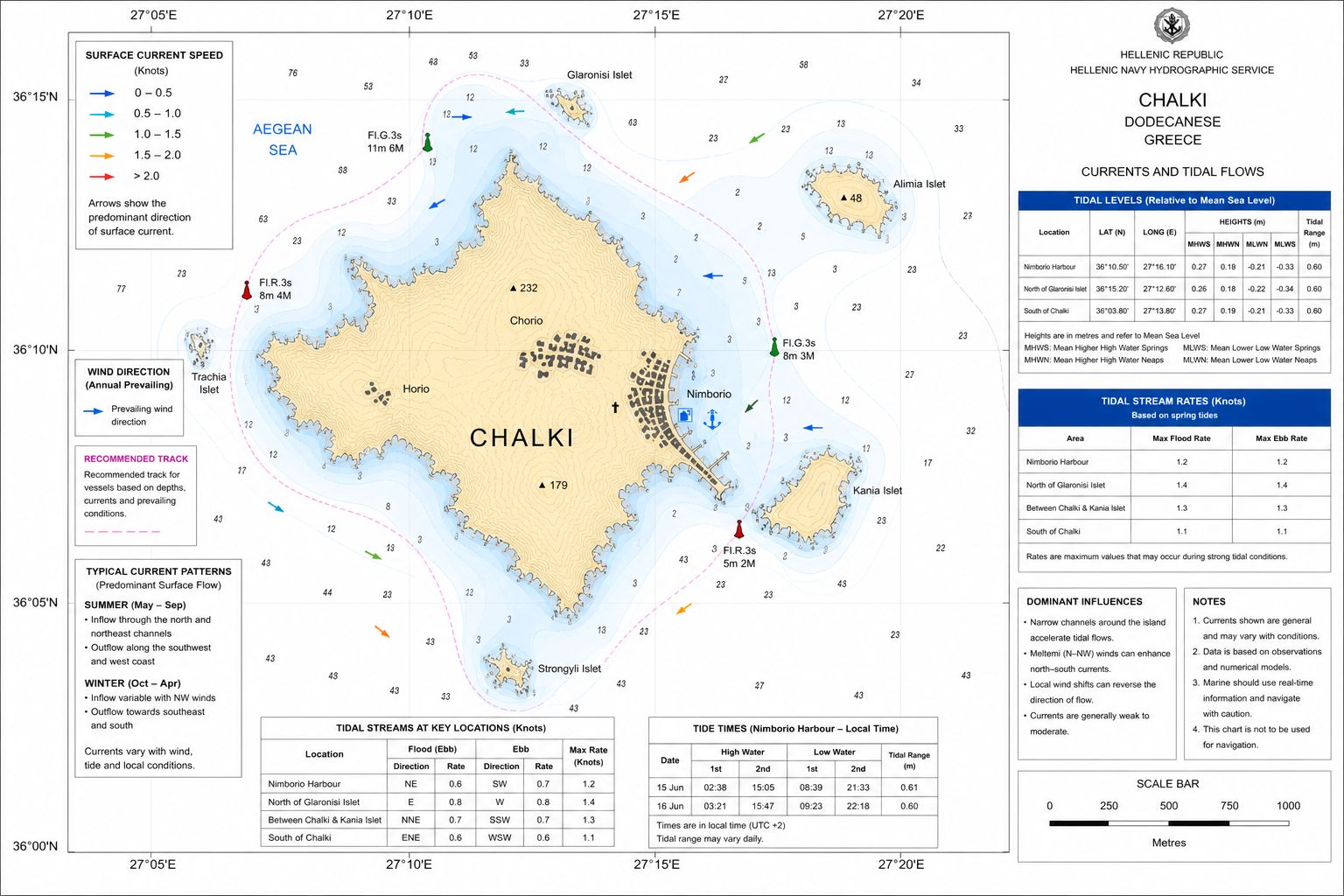
At Nimborio harbour entrance, current is minimal under most conditions, but wind-driven set can be evident on approach, especially with fresh northerlies or easterlies where surface drift aligns across the entrance. There are no significant tidal races or standing overfalls in the immediate vicinity, but localized acceleration and eddying can occur off headlands and in the narrow passages around the island where seabed contours rise sharply. Swell wrap from the northeast or east can introduce additional surface movement near the harbour approaches, though this is a wave effect rather than true current. Overall, currents around Chalki are secondary to wind and sea state and should be treated as a minor but variable influence on boat handling rather than a predictable tidal system.
Chalki Greece Sailing Guide Weather
Local weather around Chalki follows the broader southern Aegean Sea regime, with strong seasonal contrast. From late spring through early autumn, conditions are dominated by the Meltemi, a persistent northerly to north-westerly airflow driven by pressure gradients between the Balkans and the eastern Mediterranean. This typically establishes as a diurnal cycle, building through the morning, peaking mid-afternoon at 15–25 kn with higher gusts, and easing after sunset, though multi-day periods of sustained strength are common. Skies are generally clear with high visibility, low humidity, and minimal precipitation. Wind acceleration and gusting can occur off the island’s higher ground and along headlands, producing localized variability in strength and direction.
Outside the Meltemi season, autumn and winter bring more variable synoptic systems with frontal passages moving west to east across the region. Winds shift through southerly and easterly quadrants ahead of fronts, often accompanied by reduced visibility, rain, and short-period sea states, before veering westerly or north-westerly post-frontal. Low pressure systems can generate brief but strong gale conditions with rapid onset. Winter temperatures remain moderate but with increased cloud cover and unsettled intervals. In transitional months, light and variable winds are common, with localized sea breezes developing under stable conditions, typically onshore during the afternoon and weakening in the evening. Overall, weather patterns are wind-driven and predictable on a seasonal scale but require attention to short-term synoptic changes outside the summer period.
The Marine Electrical and Electronics Bible has a complete list of Greek VHF Radio Channel information and weather forecast times for Greece along with NAVTEX UK and Europe and NAVTEX Mediterranean for 490kHz and 518kHz.
Chalki Greece Sailing Guide Local
Winds
Local wind behaviour around Chalki is dominated by the regional Meltemi regime in summer, with prevailing flow from the N to NW. Wind strength typically increases rapidly from mid-morning, reaching peak velocities during the afternoon, commonly 15–25 kn with higher gusts in exposed areas. The island’s low but irregular terrain produces localized acceleration zones off headlands and funneling effects in channels, particularly toward the passages between Chalki and Rhodes. Gust structure is uneven, with short-duration increases of 5–10 kn above mean wind speed common near coastal relief and in lee transition zones.
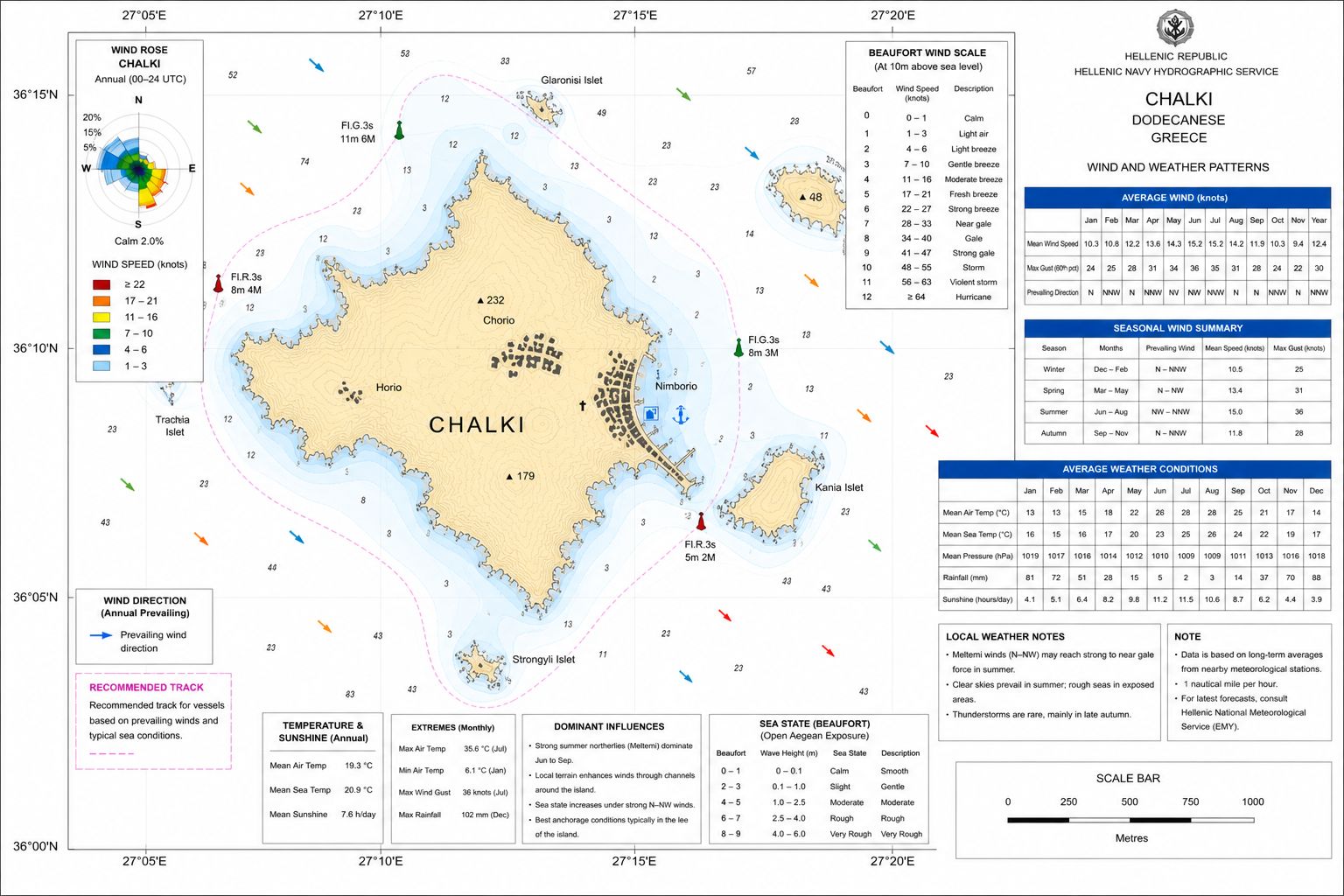
At Nimborio harbour on the east coast, the Meltemi is partially shielded by surrounding land, resulting in reduced mean wind strength within the harbour but with intermittent gust penetration over the ridgelines. Northerly winds can curve into the bay as NE–NW depending on gradient strength and local deflection. In contrast, easterly and south-easterly winds, though less frequent, have a direct fetch into the harbour and produce more consistent pressure and sea state at the entrance. Outside the summer period, wind direction becomes variable with synoptic systems, commonly shifting through SE–SW ahead of fronts and W–NW following passage, with less predictable local modification but generally lower sustained speeds between systems.
The Meltemi is a strong, dry northerly wind that dominates the Aegean in summer, accelerating through channels and between islands to produce steep, short seas. It is most persistent in July and August, often blowing for several days with little diurnal variation, creating fast north‑to‑south passages and challenging return routes. Its strength is shaped by pressure gradients between the Balkans and Anatolia, with local acceleration zones around major island gaps.
Chalki Greece Sailing Guide Approaches
Approaches to Chalki are conducted visually in generally clear water with good visibility typical of the southern Aegean Sea. The primary objective is the harbour of Nimborio on the east coast, which is the only practical landfall. From seaward, the island presents a low, rocky profile with limited distinguishing features until closer range, when the harbour settlement becomes visible as a cluster of buildings at the head of a recessed bay. There are no off-lying dangers of significant extent on the direct approach to Nimborio, but isolated rocks and uneven seabed contours exist close inshore along both northern and southern headlands. Depths outside the bay increase rapidly to 20–40 m and then to deeper water, allowing a direct approach line to be maintained until reducing speed for harbour entry.
The harbour entrance is wide and unobstructed, with depths generally in excess of 5–10 m through the approach channel, shoaling gradually toward the inner harbour. Under Meltemi conditions (N–NW), a wind-driven set may be experienced across the entrance, with gusts descending from surrounding slopes causing localized variability in heading control. In easterly conditions, a direct sea and swell can develop into the bay, increasing motion on final approach. There are no leading marks or formal transit alignments; entry is by eye, maintaining mid-channel and avoiding proximity to the rocky margins on either side. Night entry is not recommended due to limited lighting and absence of navigational aids beyond basic harbour lights. Traffic is typically low but can include ferries operating on scheduled runs, requiring awareness during final approach and manoeuvring within the harbour.
Chalki Greece Sailing Guide Navigation
Navigation into the harbour at Chalki (Nimborio) is straightforward in daylight and good visibility, with a wide, open entrance and no charted obstructions in the fairway. Maintain a central approach line on entry, keeping clear of the rocky margins extending off both headlands. Depths are generally 5–10 m in the entrance, reducing progressively toward the inner basin. The seabed is irregular in places, and sounder monitoring is required when closing the quay or selecting an anchoring position. There are no formal leading marks or transit lines; navigation is by visual reference to shoreline geometry and harbour layout.
Under prevailing Meltemi conditions (N–NW), expect gusts descending into the harbour, producing intermittent yaw and short-period wind shifts during final approach. These gusts can be strongest abeam of the entrance and along the lee of surrounding slopes. In easterly conditions, a direct onshore set and wave action can develop into the harbour, affecting speed control and stopping distance. Vessel traffic is limited but includes scheduled ferries using the main quay; maintain clear separation and allow for prop wash and manoeuvring space. Turning room inside the harbour is adequate for typical cruising yachts, but space reduces quickly with occupancy, and approach speed should be kept low with immediate readiness for engine response. Night entry is not recommended due to minimal lighting and lack of navigational aids.
Chalki Greece Sailing Guide Chart
Accuracy
Hydrographic charts provide accurate coastline and depth information for Chalki. Electronic charts align with official data but may lack detail near quay structures. Visual navigation is required when manoeuvring in confined harbour space.
Chalki Greece Sailing Guide Anchorages
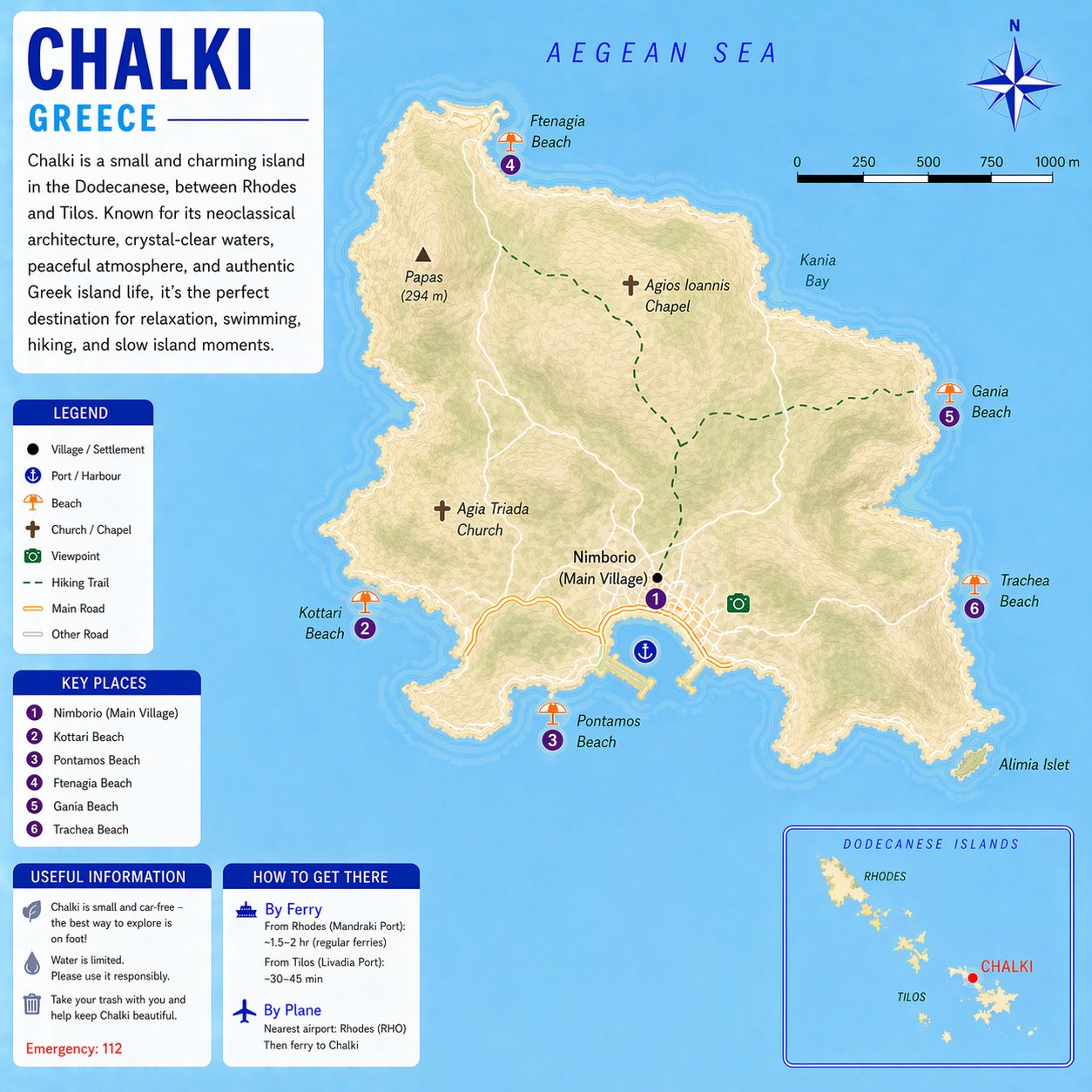
Anchorage at Chalki is centred on Nimborio harbour on the east coast, which provides the only consistently usable shelter. Within the bay, vessels may anchor off the main quay in depths typically 5–10 m, increasing toward the entrance. The seabed is mixed sand and patches of weed, with generally moderate holding; anchor placement should target lighter sand areas where possible, with allowance for variable holding across short distances. Swinging room is limited, particularly in peak season when visiting yachts and local traffic increase density. Care is required to avoid crossing other anchor chains and to maintain adequate clearance from the quay used by ferries and commercial vessels.
Outside Nimborio, anchorage options are limited and exposed. Small indentations along the north and west coasts offer temporary shelter in settled conditions only, with depths dropping off rapidly and poor protection from prevailing northerlies and easterlies. There are no all-weather anchorages elsewhere on the island. In Meltemi conditions, open anchorages become untenable due to fetch and wind acceleration around headlands. Any use of secondary anchorages should be treated as short-duration stops with continuous monitoring of wind shifts and sea state, and readiness to relocate back to the main harbour if conditions deteriorate.
Chalki Greece Sailing Guide Entry
Formalities
Entry formalities at Chalki follow standard Greece procedures for visiting yachts. Chalki is not a designated port of entry for international clearance, and there are no permanent customs or immigration facilities on the island. Vessels arriving from outside Greece or the Schengen Area must first clear into the country at an official port of entry such as Rhodes before proceeding to Chalki. Direct arrival from a non-Schengen country is not permitted. The Greek cruising tax (TEPAI) must be valid and paid, and the vessel’s cruising log (DEKPA for non-EU vessels, or transit log where applicable) should be up to date and available for inspection if requested by port authorities or coastguard.
Chalki Greece Sailing Guide Marina
Facilities
Marina infrastructure at Chalki is limited to quay berthing within Nimborio harbour; there is no purpose-built marina, no pontoons, and no laid mooring system. Berthing is conducted stern-to or bows-to along the main town quay, using own ground tackle. Depths alongside are generally in the range of 2.5–4.5 m but are variable along the quay, requiring verification by sounder before committing. The quay face is vertical masonry in most sections, with limited provision of bollards and no consistent spacing; long lines may be required. Holding for anchors laid off the quay is mixed sand and weed, with variable reliability, and careful setting is required to avoid dragging or fouling other ground tackle in confined space.
Operational constraints are defined by ferry movements, which have priority use of the principal quay section and require clear approaches and manoeuvring room. Visiting yachts must avoid designated ferry berths and be prepared to vacate or shift if directed. Shelter within the harbour is generally adequate in prevailing northerlies due to surrounding topography, though gusts can descend into the basin. In easterly conditions, the harbour becomes exposed, with increased surge and movement alongside
Chalki Greece Sailing Guide Provisioning
Supermarkets. Provisioning on Chalki is limited and centred on small-scale retail within Nimborio harbour. There are a few mini-markets operating near the quay, typically family-run, supplying basic dry goods, bottled water, UHT milk, bread, tinned foods, pasta, rice, snacks, and limited chilled items. Fresh produce availability is inconsistent and dependent on ferry deliveries from Rhodes, usually once or twice weekly; selection is narrow and can be depleted quickly during peak season. There are no full-service supermarketson ferry deliveries from Rhodes. Bulk provisioning is conducted in Rhodes.
Markets. Fresh produce availability on Chalki is limited and there are no dedicated open-air produce markets or permanent fruit and vegetable stalls. Supply is handled through the small mini-markets in Nimborio harbour, where seasonal fruit and vegetables are stocked in small quantities. Availability is directly tied to ferry deliveries from Rhodes, typically once or twice weekly,
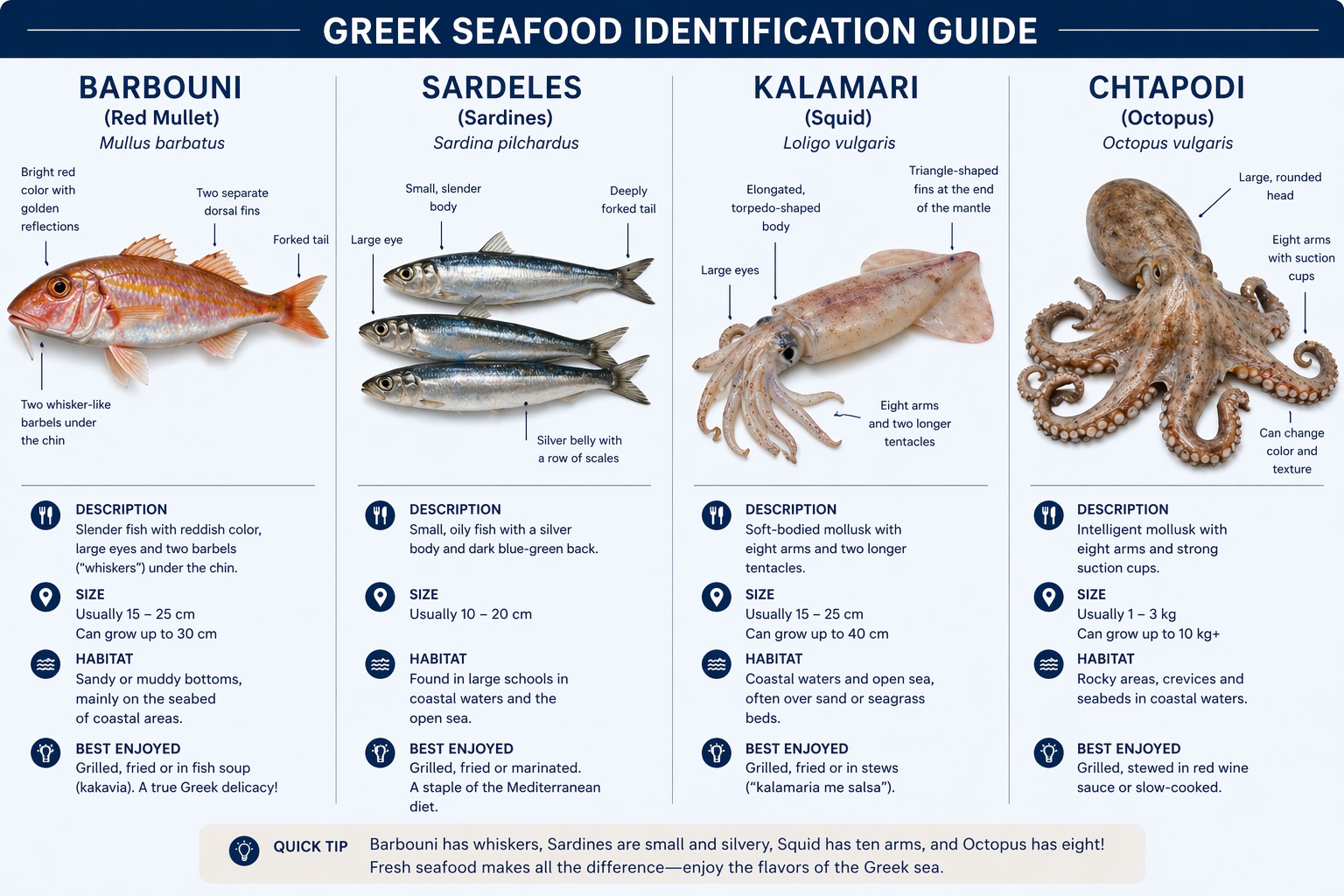
Fish Markets. There is no fish market. Seafood supply on Chalki is small-scale and opportunistic. Availability is based on local fishing activity, with catch occasionally sold directly from small boats or through local tavernas. Product is limited to what is landed on the day, typically including species such as small pelagics, reef fish, and occasionally octopus or squid. There is no guarantee of daily supply, and quantities are low and variable.
Chalki Greece Sailing Guide Local
Cuisine
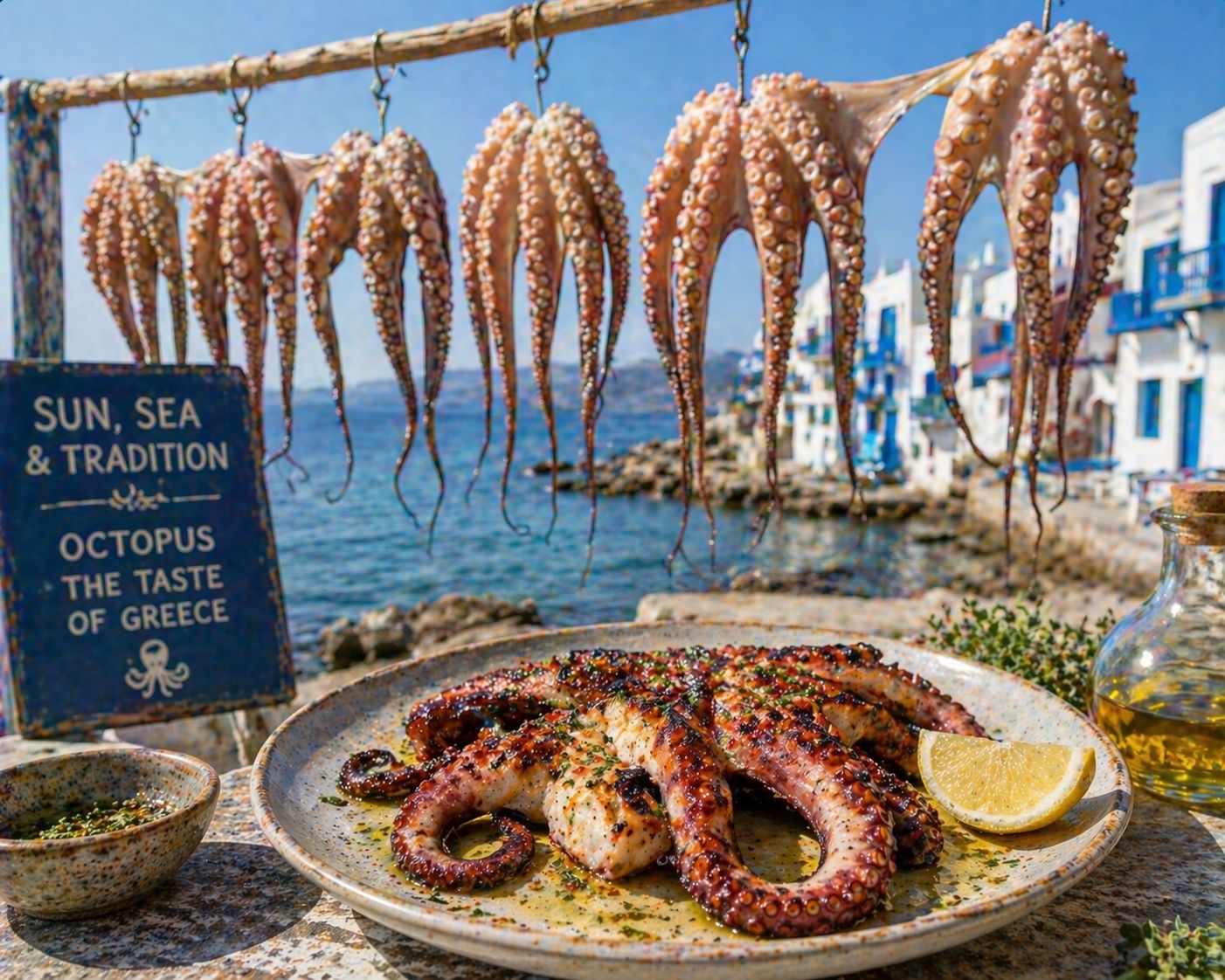
Local cuisine on Chalki is aligned with the wider Dodecanese and coastal Greek diet, based on simple preparation of locally available ingredients. Typical dishes include fresh fish when available (grilled whole or baked), octopus (often sun-dried then grilled), and calamari. Meat dishes are limited but include lamb or goat prepared as slow-cooked stews such as kleftiko or oven-baked cuts with potatoes. Vegetable-based dishes are common, including briam (mixed baked vegetables), fava (split pea purée), and salads such as horiatiki (tomato, cucumber, onion, feta, olive oil). Staples include bread, olives, local cheeses, and olive oil as the primary fat. There are no distinct island-specific signature dishes of scale; cuisine reflects supply constraints and reliance on imports from Rhodes combined with seasonal local catch
Chalki Greece Sailing Guide Local
Beverages
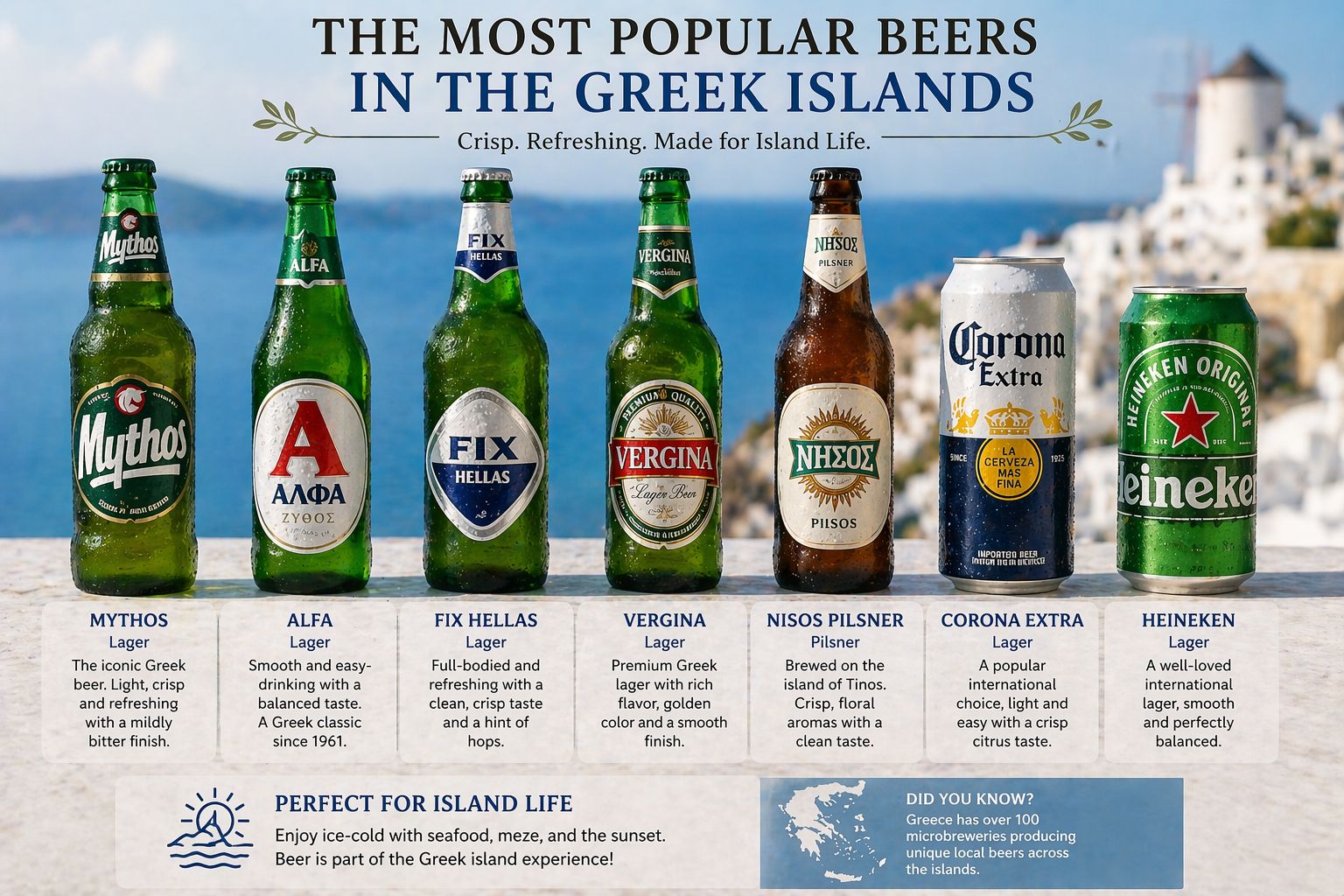
Beer, wine, and spirits across the Greek islands are locally produced and widely available through tavernas, small bars, and provisioning outlets. Beer is predominantly lager, with domestic brands including Mythos, Alfa, Fix, and Vergina alongside imported products; and over 100 microbreweries operate on several islands with limited distribution. Wine is region-specific, with white varieties dominant in the islands, including Assyrtiko, Moschofilero, and Roditis, alongside local table wines served in bulk; retsina remains in circulation as a resin-flavoured wine. Distilled products include ouzo (anise-based), tsipouro (grape marc distillate), raki or tsikoudia (Crete), souma (fig or grape distillate in eastern Aegean islands), and kitron (citrus liqueur from Naxos), with alcohol strength typically in the 37–45% range and higher for unregulated local distillations.
Chalki Greece Sailing Guide Diesel
Fuel Supplies
There is no alongside bunkering facility in Nimborio harbour. Fuel is obtained indirectly through a local roadside filling station located above the harbour area, with transfer to vessels arranged by jerry can or, in some cases, by delivery using small transport. This requires manual handling and coordination, and access logistics depend on quay position and availability of local assistance. Supply is limited in volume and subject to delivery schedules from Rhodes, so availability cannot be assumed, particularly during peak periods
Chalki Greece Sailing Guide Water
Supplies
There are no permanent, high-capacity water points along the quay at Nimborio harbour. Water may be available in small quantities via local connections or delivery by arrangement, typically using hoses from nearby premises or transported containers. Pressure and flow rates are inconsistent, and supply is not suitable for rapid tank filling
Mechanical and Electrical Repairs
Resource
If you are headed somewhere remote consider the need to expand your knowledge base or have an information resource on board. Why not get a copy of my book The Marine and Electrical and Electronics Bible 4th Edition. By and for yachties, with everything from batteries and charging, solar and wind, diesel engines and marine electronics and so much more. Your complete systems guide. 650 pages of practical advice. In Australia and New Zealand order a copy through Boat Books. UK and European boats can buy the UK Edition Here. US and Canadian boats can get the US Edition Order Here. Marine systems are my profession so let me help you. By a liveaboard boat owner for other boat owners.



Chalki Greece Sailing Guide Marine
Services
There are no formal marine service providers on Chalki. No authorised engine or electronics service agents are present. Basic mechanical assistance may be available locally but is limited. For technical work, vessels must relocate to Rhodes where full marine service capability exists.
Chalki Greece Sailing Guide Local
Etiquette
On Chalki, culturally acceptable behaviour is direct and restrained: greet people on first contact (“kalimera” or “kalispera”), maintain normal speaking volume, and use polite forms such as “please” and “thank you.” Dress is modest in public and shirt and footwear expected. Service interactions are straightforward: wait to be acknowledged, do not interrupt, and accept that pace may be slower than urban centres. Personal space is respected but less formal than northern Europe; brief eye contact and simple acknowledgment are standard. Public behaviour should avoid loudness, confrontation, or overt displays of impatience.
Chalki Greece Sailing Guide Summary
Chalki provides a single harbour environment with limited infrastructure and exposure dependent on wind direction. Navigation is straightforward but constrained by harbour space and vessel traffic. Anchorage options are limited outside the main harbour. Provisioning and services are minimal and require planning through Rhodes, consistent with a Chalki Greece Sailing Guide for all you need to know.