Chagos BIOT Cruising Guide
Chagos BIOT cruising guide. The Chagos Archipelago lies in the central Indian Ocean and forms the British Indian Ocean Territory (BIOT). The atolls are remote, uninhabited, and controlled under a strict permit system that governs all yacht entry, movement, anchoring, and duration of stay. There are no services, no facilities, and no support infrastructure. All yacht operations must be fully self‑sufficient, and all movements must comply with BIOT regulations.
Yachts use Chagos as a staging point between the Maldives, Seychelles, Mauritius, and Rodrigues. The atolls provide sheltered anchorages inside the lagoons, but the approaches are reef‑bound, the channels are narrow, and depths vary sharply. The environment is pristine and tightly regulated, and all yacht activity is monitored under the BIOT permit framework.
Chagos BIOT Cruising
Guide - Approaches
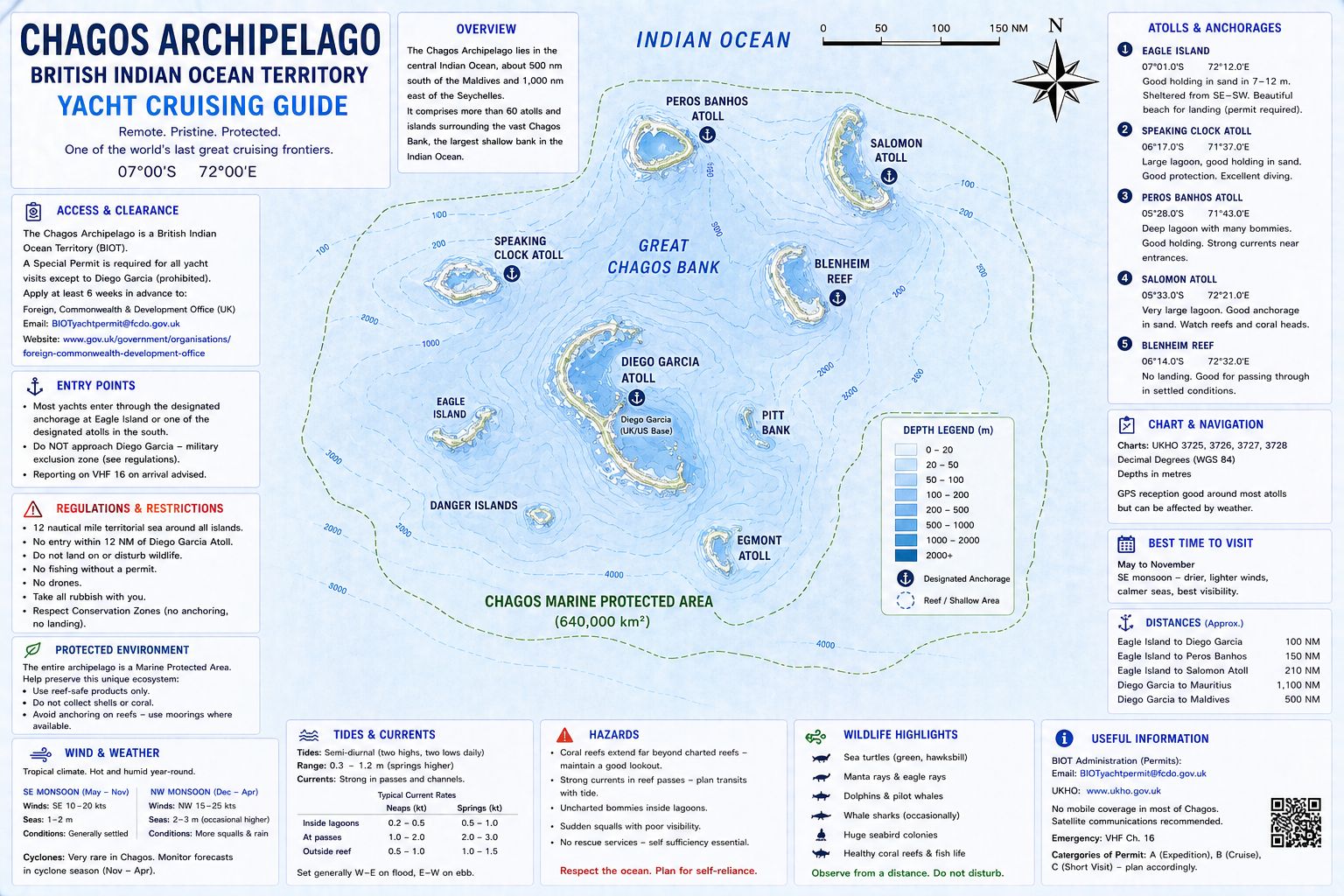
Approaches to the atolls remain deep until close to the reef edges, with depths above 40–50 m before shoaling abruptly on the outer reef slopes. Passes into Salomon and Peros Banhos are narrow and carry 10–20 m in the deeper sections, reducing to 6–12 m inside the lagoon channels. Coral heads are present throughout the lagoons, and visibility is essential for safe entry. Daylight entry is mandatory under BIOT permit conditions. Yachts must follow the approved approach routes specified in the permit documentation.
Chagos BIOT Cruising
Guide - Anchorage
Anchoring is restricted to BIOT‑approved sites only. Salomon Atoll and Peros Banhos each have designated anchorage zones with depths typically 10–20 m over sand. Anchoring outside these zones is prohibited. Holding is generally good, but coral heads are scattered throughout the lagoons, and careful placement is required to avoid coral contact. Yachts must remain within the approved anchorage area for the duration of their stay unless the permit specifies otherwise.
Chagos BIOT Cruising Guide - Entry and Clearance
Chagos / BIOT — 2026 Update. BIOT announced in 2025 that cruising permits for Chagos would not be issued after April 2026. Verify current status with BIOT (biot.fcdo.gov.uk) before including Chagos in passage planning, access rules have been subject to significant change. A BIOT permit is mandatory before entering the territorial waters of Chagos. Entry without a permit is an offence under BIOT law and may result in fines, prosecution, or vessel impoundment. The permit defines the authorised atoll, anchorage, dates of stay, and movement restrictions. Yachts must carry the permit onboard and present it on request. There is no clearance office in Chagos; all documentation is handled electronically before arrival. Yachts must proceed directly to the authorised anchorage and comply with all permit conditions, including waste management, movement limits, and reporting requirements. Departure must occur on or before the authorised date.
March 2026. The BIOT Administration has officially confirmed that yacht permit processing is to resume temporarily for Spring 2026. Be warned that permits are to be restricted to only designated mooring sites in the Salomon Islands. There is no access permitted to Peros Banhos and a maximum limitation of eight yachts at any one time permitted. Albeit a temporary measure it does offer Indian Ocean crossing yachts to have access and it is an important safety stopover point. Applications are processed on a first-come-first-served basis.
Chagos Security Explained
The core security reasoning behind Chagos (BIOT) restrictions is that the territory hosts a major UK–US military installation on Diego Garcia, which is considered strategically essential for Indo‑Pacific defence and power projection. This single factor drives the entire security posture of the archipelago. Multiple authoritative sources describe Diego Garcia as vital to UK and allied defence operations, forming a forward operating hub for naval, air, and intelligence activity across the Indian Ocean and Indo‑Pacific. The archipelago is described as a “security fault line” because control of access, sovereignty, and base operations directly affects regional stability, maritime surveillance, and long‑range military reach. Analyses emphasise that Diego Garcia’s position allows the UK and US to project power across the Indian Ocean, monitor sea lanes, and respond rapidly to regional threats. Any weakening of control is viewed as strategically detrimental. Because the islands are uninhabited and remote, the military base is the only permanent installation. Civilian access is tightly restricted to prevent interference with operations and to maintain security integrity. This is why BIOT enforces a permit system, limits anchoring, and monitors yacht movements. How this translates into yacht‑specific restrictions to control who enters BIOT waters, and to prevent uncontrolled movement near sensitive areas. No access to Diego Garcia, the military zone is completely off‑limits. Enforcement powers include fines, prosecution, or vessel impoundment for unauthorised entry.
Chagos BIOT Cruising
Guide - Local Weather
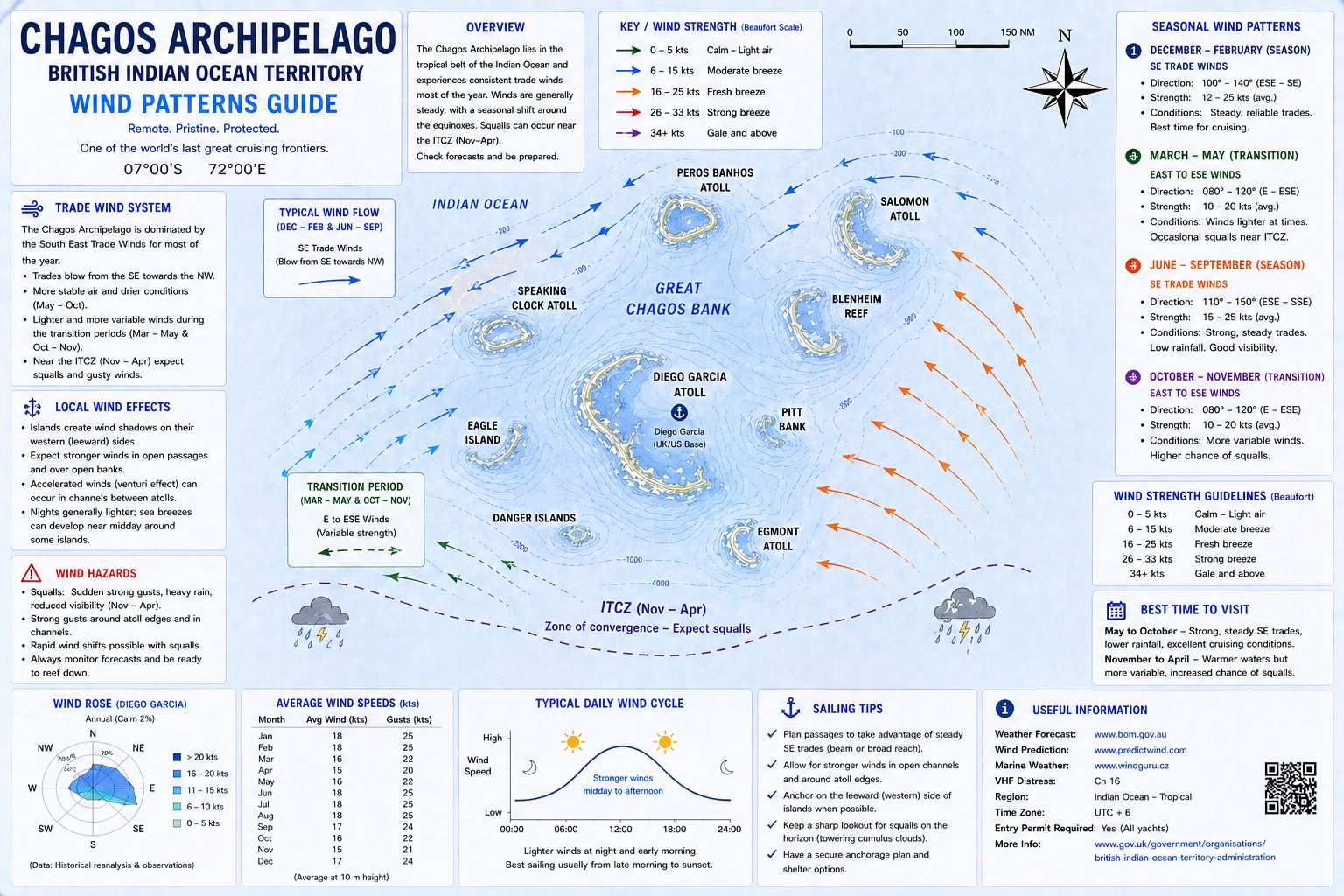
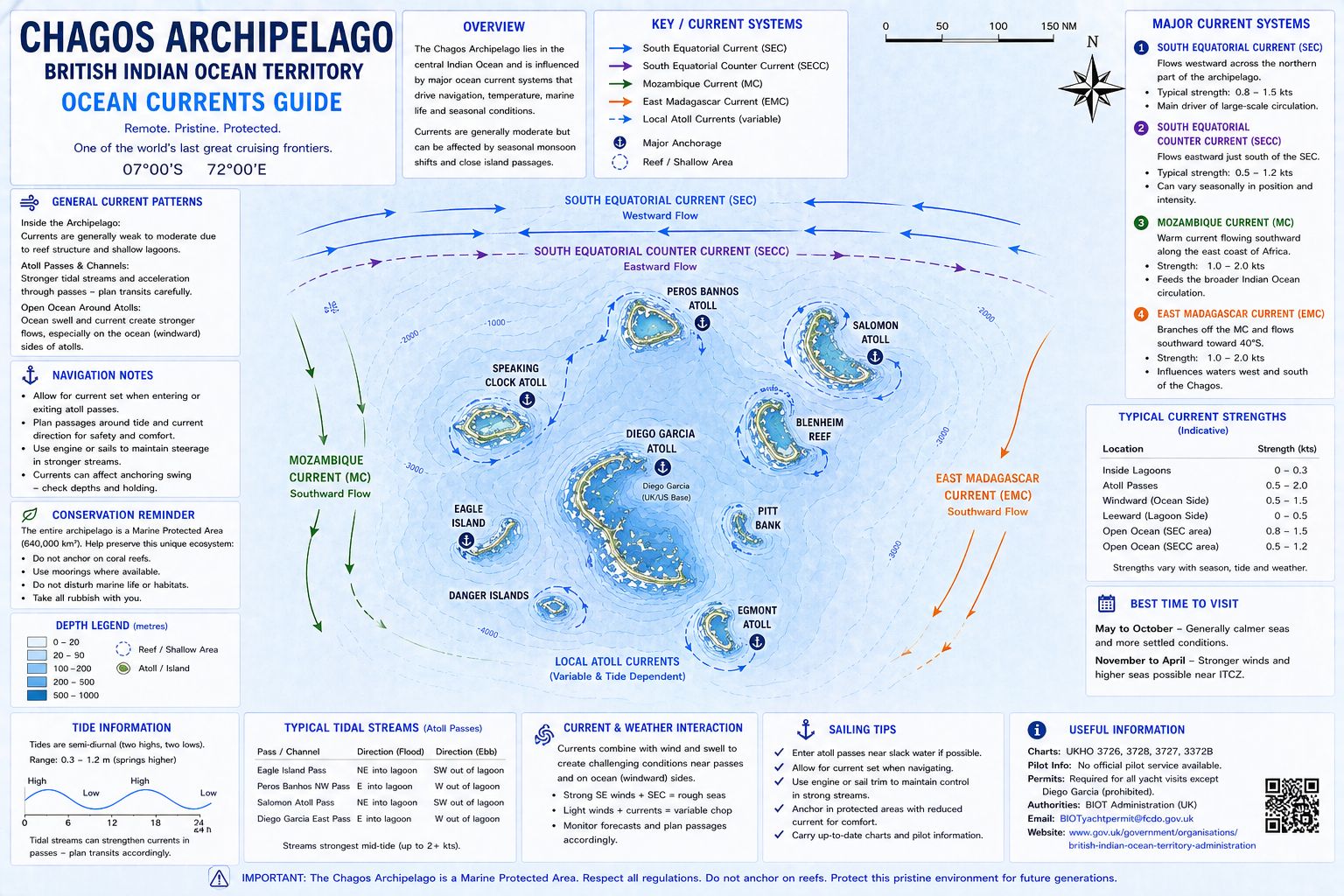
Chagos lies in the central Indian Ocean trade‑wind belt. From May to October, winds are predominantly south‑east at 15–25 kn, with moderate seas outside the atolls and calm conditions inside the lagoons. From November to April, winds are lighter and more variable, with increased convection and the possibility of cyclonic activity. Squalls can produce short‑lived gusts and reduced visibility. The lagoons remain sheltered in most conditions, but reef entrances can be hazardous in strong winds or swell.
Chagos BIOT Cruising
Guide - Provisioning
Supermarkets. There are no supermarkets, shops, or retail outlets in Chagos. Yachts must arrive fully provisioned for the entire stay and onward passage.
Markets. There are no markets or local produce sources. No food of any kind is available.
Seafood. Fishing is regulated under BIOT permit conditions. Some permits allow limited, non‑commercial fishing for personal consumption; others prohibit it entirely. Yachts must comply strictly with the conditions stated on their permit.
Chagos BIOT Cruising
Guide - Local Cuisine
There is no local cuisine. The atolls are uninhabited, and all food consumed by yachts is carried onboard.
Chagos BIOT Cruising
Guide - Fuel Supplies
There is no fuel available in Chagos. All fuel must be carried onboard, and yachts must plan reserves for the entire stay and onward passage.
Chagos BIOT Cruising
Guide - Water Supplies
There is no potable water available. Water makers can be used in clean offshore water outside the lagoons. Inside the lagoons, water maker use depends on local conditions and skipper assessment. All water for drinking and domestic use must be carried or produced onboard.
Mechanical and Electrical Repairs
Resource
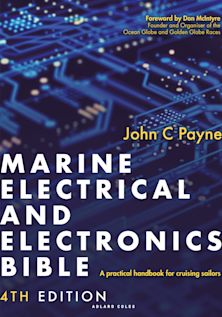
If you are headed somewhere remote consider the need to expand your knowledge base or have an information resource on board. Why not get a copy of my book The Marine and Electrical and Electronics Bible 4th Edition. By and for yachties, with everything from batteries and charging, solar and wind, diesel engines and marine electronics and so much more. Your complete systems guide. 650 pages of practical advice. In Australia and New Zealand order a copy through Boat Books. UK and European boats can buy the UK Edition Here. US and Canadian boats can get the US Edition Order Here. Marine systems are my profession so let me help you. By a liveaboard boat owner for other boat owners


Chagos BIOT Cruising
Guide - Marine Services
There are no marine services, no repair facilities, no haul‑out capability, and no hardware supply. Yachts must be fully self‑sufficient and capable of managing all maintenance and repairs independently.
Chagos BIOT Cruising
Guide - Local Customs
There is no resident population. BIOT regulations govern all yacht activity, and compliance with permit conditions is mandatory. Waste must be retained onboard and removed from the territory. Access to islands is restricted and defined by the permit. Movement outside authorised areas is prohibited.
Chagos BIOT Cruising
Guide - Summary
Chagos offers sheltered anchorages inside Salomon and Peros Banhos but operates under one of the strictest regulatory frameworks in the Indian Ocean. A BIOT permit is required before entry, anchoring is restricted to approved sites, and all yacht activity is governed by defined conditions. There are no services, no supplies, and no support infrastructure. Yachts must be fully self‑sufficient and prepared for remote operations. For well‑prepared vessels, Chagos provides a secure and predictable stop between the central and western Indian Ocean routes. Chagos BIOT Cruising Guide for all you need to know.