Canet en
Roussillon Sailing Guide
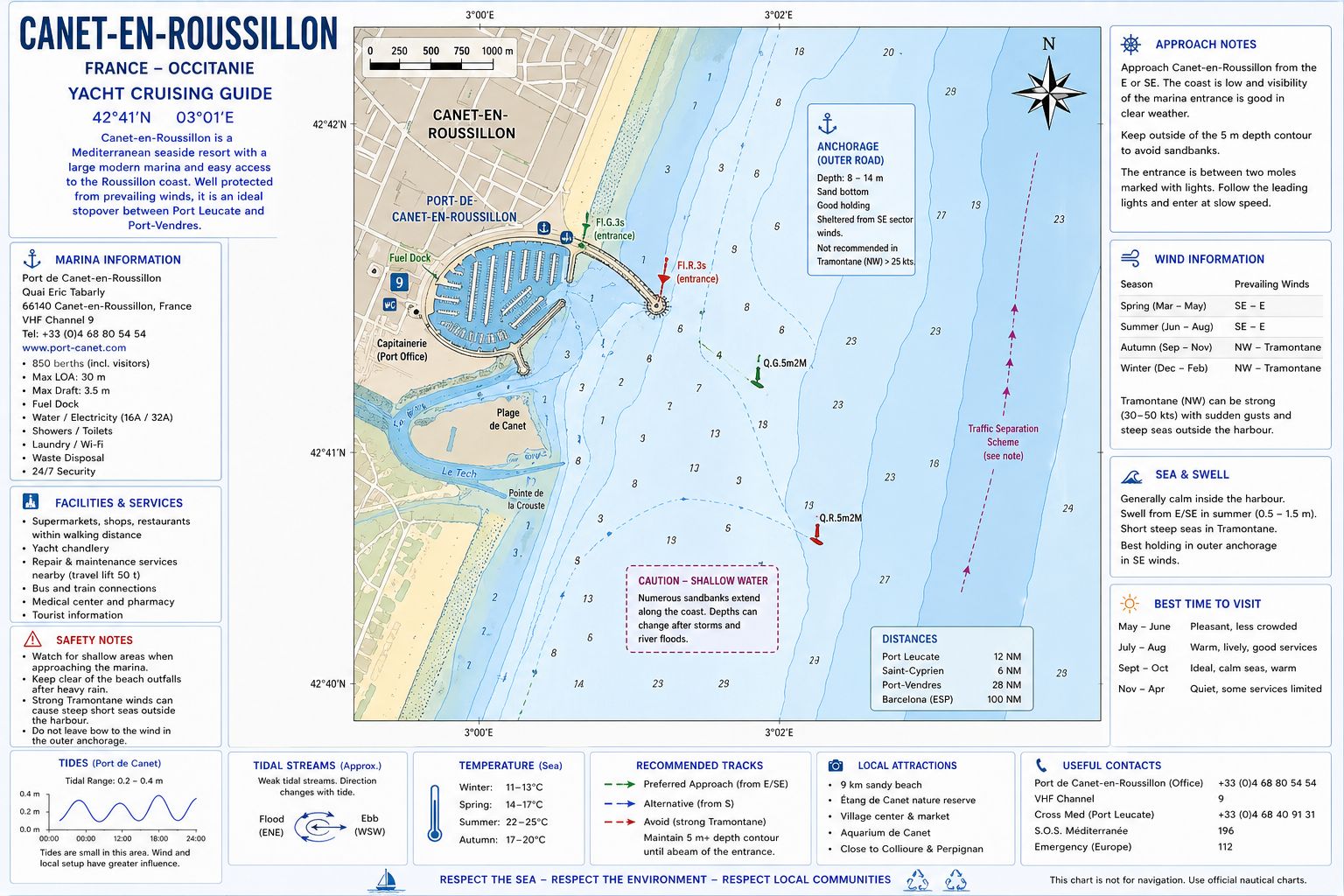
Canet en Roussillon sailing guide. Canet‑en‑Roussillon is a purpose‑built marina and harbour complex on the Roussillon coast, north of Perpignan. The port sits behind a long, low‑lying sandy coastline with uniform depth gradients and minimal natural shelter. The marina is fully artificial, protected by breakwaters with controlled entrances and consistent depths. The surrounding seabed is predominantly sand, with no significant underwater obstructions in the approach sector.
The port functions as a regional yacht base with predictable access, stable depths, and full marina services. It is used by yachts routing along the Gulf of Lyon between Port‑Leucate and Saint‑Cyprien, and as a staging point for weather windows across the mistral‑affected sector. The harbour is operational year‑round, with minimal tidal influence and straightforward pilotage in settled conditions.
Canet en
Roussillon Sailing Guide - Approaches
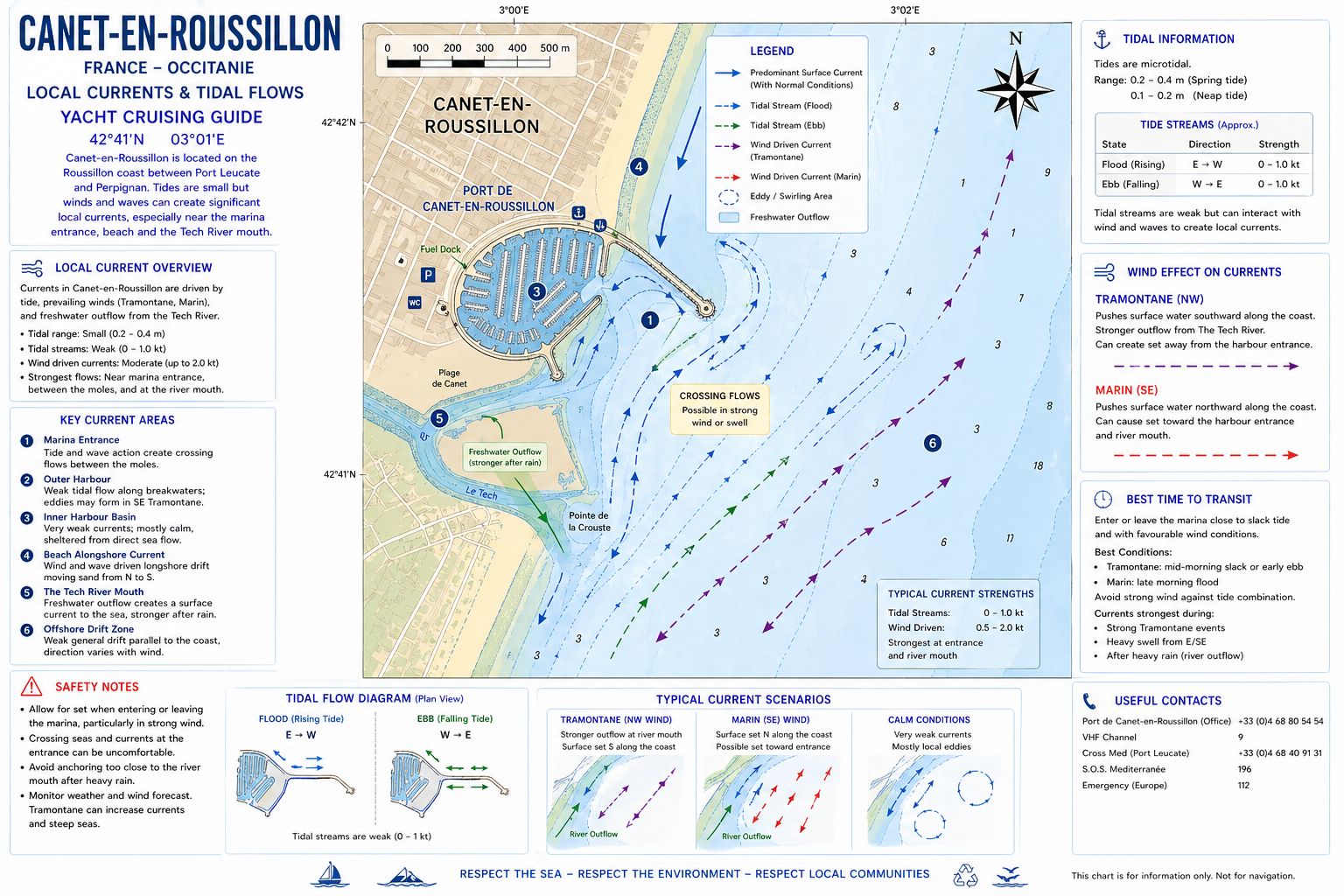
Approaches to Canet‑en‑Roussillon are direct from open water. Depths outside the entrance are 8–12 m, reducing gradually to 5–6 m within 0.5 NM of the breakwaters. The seabed is uniform sand with no charted hazards. The entrance channel is dredged to 3.5–4.5 m, though swell can reduce effective depth during strong Tramontano or easterly conditions. The entrance is aligned roughly east–west and can experience cross‑set from wind‑driven surface drift.
Sea state is the primary factor. Strong Tramontano from the northwest produces short, steep seas that can break across the entrance in severe conditions. Easterly swell can refract into the entrance and affect control during final approach. Tidal range is <0.4 m with negligible tidal current. Visibility is generally good, with clear leading lines and strong harbour lighting supporting night approaches.
Canet en
Roussillon Sailing Guide - Navigation
Navigation inside the port is straightforward. Depths in the main basin are 3–4 m, with 2.5–3.5 m in secondary basins. The marina layout consists of multiple pontoons arranged in parallel rows with adequate turning space for yachts up to moderate length. Manoeuvring is affected by crosswinds during Tramontano events, particularly in the outer basin. The inner basins offer more shelter but require precise alignment when entering narrow fairways.
There are no underwater obstructions within the marina. Speed limits are enforced due to high density of small craft. The port is compact, and all basins are accessible without crossing commercial zones.
Canet en
Roussillon Sailing Guide – Chart Accuracy
Official French hydrographic data provides accurate depth and harbour layout information. Navionics aligns closely with official data and reflects dredged depths reliably. C‑Map uses slightly more conservative depth shading in the entrance channel. Garmin BlueChart generally matches Navionics but may lag in reflecting recent dredging cycles. Satellite imagery is reliable for identifying breakwaters, entrance geometry, and sediment patterns. All electronic charts should be cross‑checked against visual references and updated notices.
Canet en
Roussillon Sailing Guide - Anchorage
Anchoring off Canet‑en‑Roussillon is not recommended due to exposure, swell, and poor holding in fine sand. Depths outside the harbour are 8–12 m with no natural protection. The coastline offers no indentation or lee. The port is effectively a marina‑only destination for overnight stays.
Canet en
Roussillon Sailing Guide - Entry
Formalities
Canet‑en‑Roussillon is within the EU and Schengen. Yachts arriving from non‑Schengen ports must complete immigration and customs procedures at designated regional ports of entry such as Port‑Vendres or Sète. Canet does not function as a primary clearance port. There are no restrictions on Starlink or similar equipment for private yachts. Firearms must be declared at a designated entry port. Local harbourmaster procedures are limited to berth allocation and port dues.
Canet en
Roussillon Sailing Guide - Marina
Facilities
The marina provides berths with depths of 2.5–4 m depending on basin. Shore power, potable water, waste disposal, and Wi‑Fi are available at all pontoons. Visitor berths are concentrated near the entrance for ease of access. The marina supports haul‑out via a travel‑lift suitable for most cruising yachts, with hard‑stand space for maintenance. Fuel is available at a dedicated berth near the entrance. Access to technical contractors is available within the marina precinct.
Canet en
Roussillon Sailing Guide - Local Weather
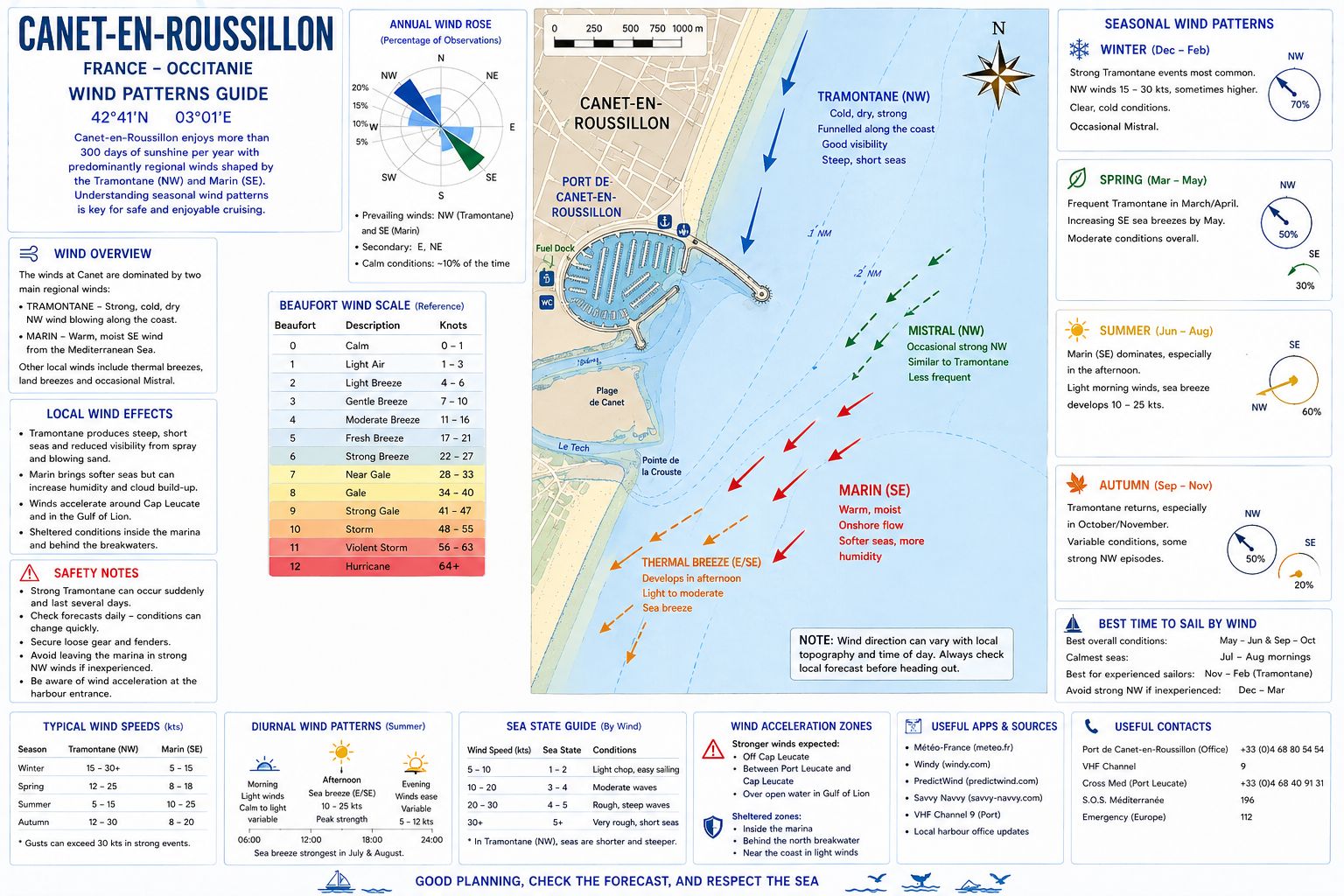
The Gulf of Lyon is strongly influenced by the Tramontano and mistral systems. Tramontano produces strong northerlies with steep seas and rapid onset. Easterly systems generate swell that affects the entrance. Summer conditions are generally stable with light to moderate sea breezes. Winter introduces stronger frontal systems with variable winds and reduced visibility. Local sea breezes are predictable but can be overridden by regional wind events.
The Marine Electrical and Electronics Bible has a complete list of French VHF Radio Channel information and weather forecast times for France along with NAVTEX UK and Europe and NAVTEX Mediterranean for 490kHz and 518kHz.
Canet en
Roussillon Sailing Guide - Provisioning
Supermarkets. Carrefour Market Canet‑en‑Roussillon on Avenue de la Méditerranée, Intermarché Super Canet on Avenue de la Côte Vermeille, and Lidl Canet on Avenue de Perpignan provide the main supermarket provisioning capacity for the town.
Markets. The Marché de Canet‑en‑Roussillon operates in the town centre and seafront areas depending on the season. A seasonal market also operates in Canet‑Plage during summer.
Fish Markets. Poissonnerie du Port near the harbour and Poissonnerie Canetoise in the town centre.
Canet en
Roussillon Sailing Guide - Local Cuisine
Local cuisine in Canet‑en‑Roussillon is based on Catalan and Roussillon dishes including boles de picolat (meatballs in tomato and olive sauce), escalivada (roasted peppers, aubergine, and onions), suquet de peix (fish stew), brandade de morue (salt‑cod emulsion), pa amb tomàquet (bread with tomato), cargols a la llauna (grilled snails), allioli (garlic emulsion), roustes (fried pork strips), sardinade (grilled sardines), anchois de Collioure (salt‑cured anchovies), bourride (white fish stew with garlic), ragoût d’escargots (snail stew), omelette aux pignons (pine‑nut omelette), and cremat (rum‑flamed coffee). These dishes reflect the coastal Catalan‑Roussillon food tradition found across the Côte Vermeille and surrounding plains
Canet en
Roussillon Sailing Guide - Fuel Supplies
Fuel is available at a dedicated berth near the marina entrance. Fuel is dispensed via fixed pumps with standard flow rates. Access is straightforward in settled conditions but can be affected by crosswinds during Tramontano events. Fuel quality is consistent due to regular turnover.
Canet en
Roussillon Sailing Guide - Water
Supplies
Potable water is available at all pontoons through municipal connections. Pressure is stable and supply is reliable year‑round. Water is dispensed via standard dockside fittings with no quantity restrictions.
Mechanical and Electrical Repairs
Resource
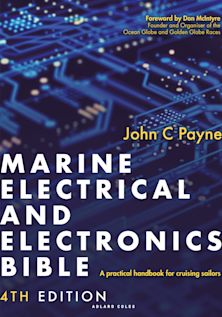
If you are headed somewhere remote consider the need to expand your knowledge base or have an information resource on board. Why not get a copy of my book The Marine and Electrical and Electronics Bible 4th Edition. By and for yachties, with everything from batteries and charging, solar and wind, diesel engines and marine electronics and so much more. Your complete systems guide. 650 pages of practical advice. In Australia and New Zealand order a copy through Boat Books. UK and European boats can buy the UK Edition Here. US and Canadian boats can get the US Edition Order Here. Marine systems are my profession so let me help you. By a liveaboard boat owner for other boat owners.


Canet en
Roussillon Sailing Guide - Marine
Services
Marine services include mechanical, electrical, and basic electronics support within the marina precinct. Haul‑out is available via a travel‑lift. More specialised services, including advanced electronics, rigging, and engine dealerships (Volvo Penta, Yanmar), are located in Perpignan or Port‑Vendres.
Canet en
Roussillon Sailing Guide - Local Customs
Local customs follow standard French maritime norms. English is understood in marina operations. Behaviour around fishing vessels and working areas is regulated. There are no indigenous cultural protocols relevant to visiting yachts.
Canet en
Roussillon Sailing Guide - Summary
Canet‑en‑Roussillon is a purpose‑built marina port with straightforward approaches, stable depths, full provisioning, and reliable technical support. It is a practical stop for yachts transiting the Roussillon coast or staging for Gulf of Lion weather windows. Canet en Roussillon Sailing Guide for all you need to know