Busan Yacht Cruising Guide
The Busan yacht cruising guide. Busan functions as South Korea’s primary deep‑water gateway, handling commercial traffic, ferries, and visiting yachts through a network of controlled harbors and designated marina facilities. The port operates year‑round with reliable pilotage, clear approach channels, and well‑marked traffic separation zones. Foreign vessels typically use the yacht‑appropriate berths at Busan North Port or Suyeong Bay Yacht Center, both offering fuel, water, basic repairs, and straightforward access to customs and immigration.
The city surrounding the port supports marine operations with shipyards, chandlers, technical contractors, and efficient transport links to the rest of the country. Provisioning is simple due to large retail hubs near the waterfront, and spare parts can be sourced quickly through local suppliers or courier networks. Busan’s location on the southeast coast makes it a practical staging point for onward routes to Japan, the Korea Strait, and the southern approaches to the Yellow Sea.
Busan Yacht Cruising Guide - Arrival
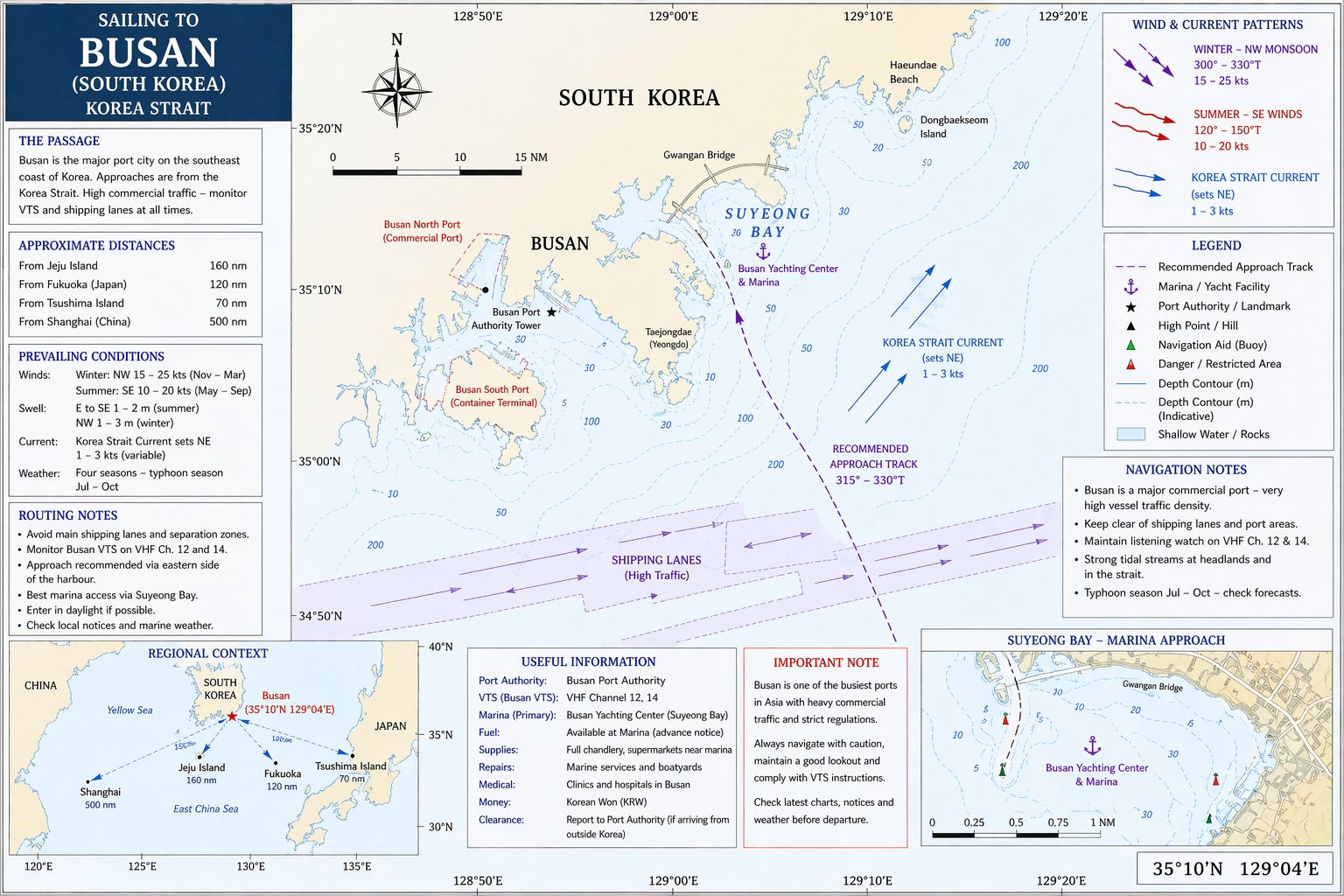
Busan is South Korea’s largest port and a high‑traffic commercial harbor, so yacht entry requires disciplined navigation and strict compliance with Busan VTS regulations. The city’s primary yacht facility is the Suyeong Bay Yacht Marina, currently undergoing a major redevelopment that will expand berthing capacity and modernize infrastructure. Busan sits on Korea’s southeast coast with multiple port complexes: North Port, Gamman, Busan New Port, and Suyeong Bay.
Busan Yacht Cruising Guide -
Approaches
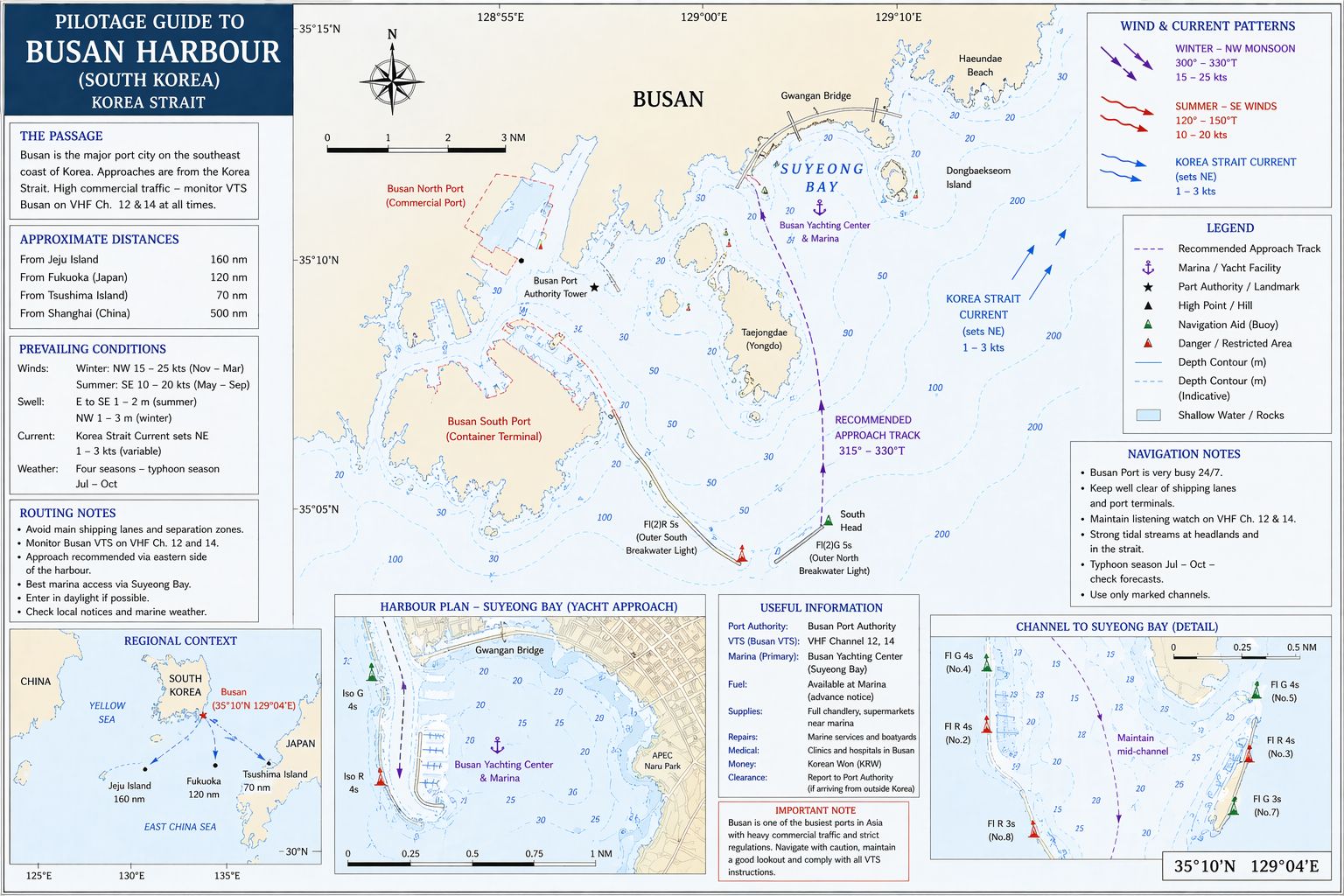
Approaches are deep and well‑marked but extremely busy with container ships, ferries, and tugs. Relevant Charts are Admiralty Chart 1065 – Approaches to Masan, Busan, Busan New Port and Okpo Hang covers the entire approach system. VTS Requirements (Mandatory). Busan Port Authority regulations VHF Ch. 12/16 monitoring required. AIS must be active for vessels >500 GT (not applicable to most yachts, but good practice to keep your AIS transmitting), they see you and you see them.
Fog is common in spring and early summer. Swell from the Korea Strait can affect outer approaches during strong southerlies. Cross‑currents near breakwaters and harbor mouths require early helm correction. Maintain clear separation and follow VTS routing instructions.
Busan Yacht Cruising Guide - Clearance
Procedures
Foreign yachts must clear with Immigration, Customs, and the Coast Guard. Suyeong Bay Yacht Center coordinates appointments. Advance notice is recommended, especially outside standard office hours. Required documents include crew list, passports, vessel registration, last port clearance, and safety equipment list. The Coast Guard may conduct a brief onboard inspection focusing on safety gear and AIS status. Domestic movement after clearance is unrestricted, but marinas may request a copy of the arrival paperwork.
Busan Yacht Cruising Guide - Practical
Yacht Routes
North Port (Main Commercial Basin) is the primary entrance for commercial shipping. Not recommended for yachts except when directed by VTS. Busan New Port is a large container complex southwest of the city with no o facilities for yachts; and is transit only. Suyeong Bay (Yacht Basin) is the primary Yacht Entry and located east of central Busan, near Haeundae. Approached is via a protected inlet with moderate depths. Yacht Facilities in Busan are the Suyeong Bay Yacht Marina (Haeundae District) which is Busan’s main yacht harbor, originally built for the 1986 Asian Games and 1988 Seoul Olympics. Undergoing a major redevelopment in 2025, with 567 berths with modern pontoons. Public waterfront facilities, upgraded infrastructure. This will become Korea’s largest and most modern yacht marina. Visiting yachts can usually berth with advance coordination. Busan is not anchorage‑friendly due to traffic and restrictions.
Busan Yacht Cruising Guide -Provisioning
Yacht provisioning in Busan is a study in contrasts, from ultra‑modern supermarkets and global supply chains sitting right alongside centuries‑old traditional markets. The country’s infrastructure is highly developed, taxis are inexpensive, and most stores accept international cards, making logistics surprisingly smooth even for foreign vessels. What sets South Korea apart is the sheer quality and freshness of its ingredients. Seafood arrives at markets within hours of being caught, vegetables are locally grown and seasonal, and Korean staples, kimchi, tofu, noodles, sauces are available everywhere. At the same time, major urban centers stock a wide range of imported goods.
Supermarkets: E‑Mart. South Korea’s largest hypermarket chain; strong for bulk goods, produce, meat, and general provisioning. Homeplus is a large hypermarket with broad selection of imported goods. Lotte Mart is a major chain with good produce, packaged goods, and household supplies. I tended to use Homeplus a lot.
Markets. Gukje Market is one of Busan’s largest and most historic markets. Offers produce, dry goods, household items, and general provisions. Haeundae Traditional Market is a major traditional market noted among Busan’s biggest and busiest.
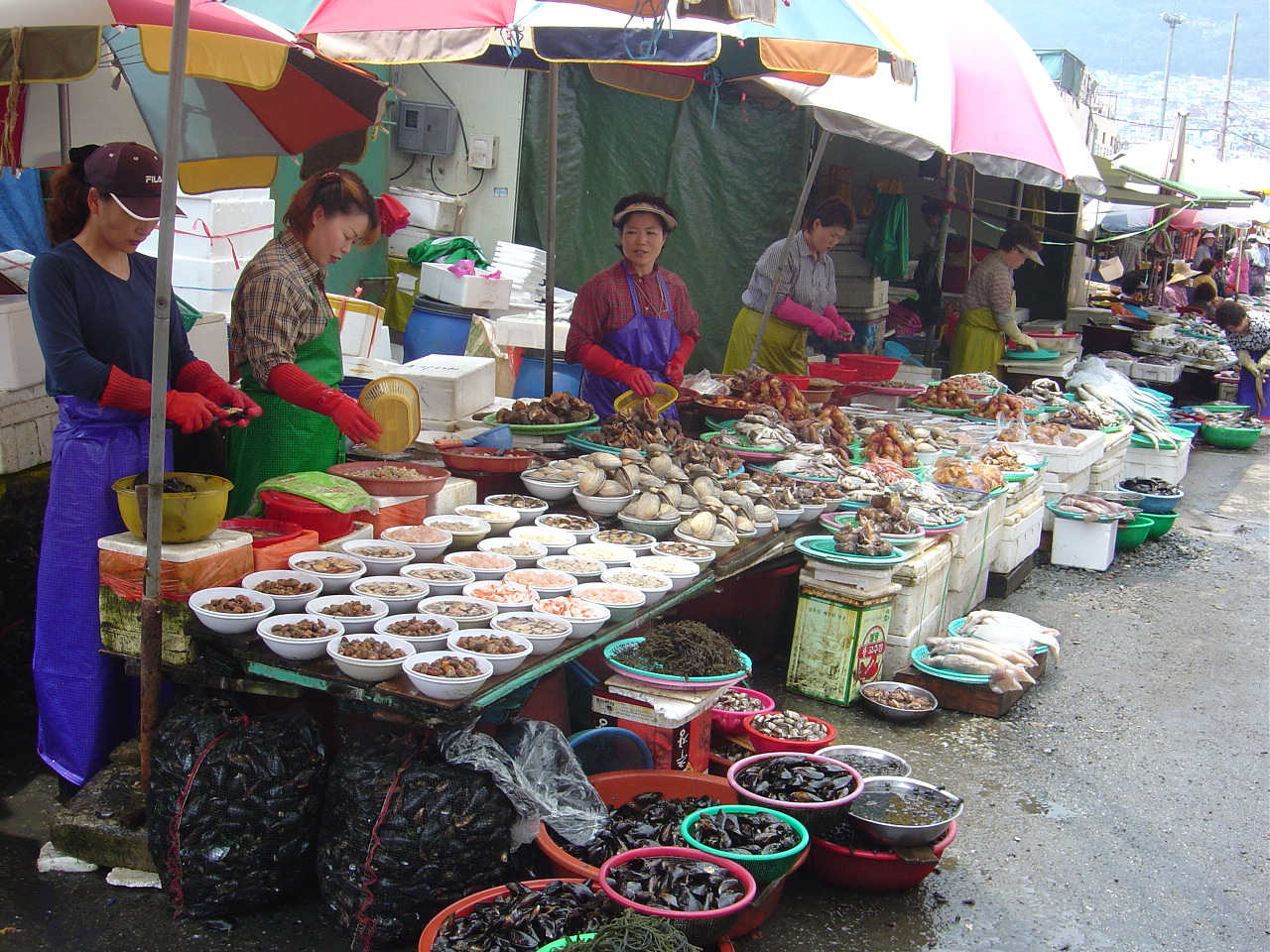
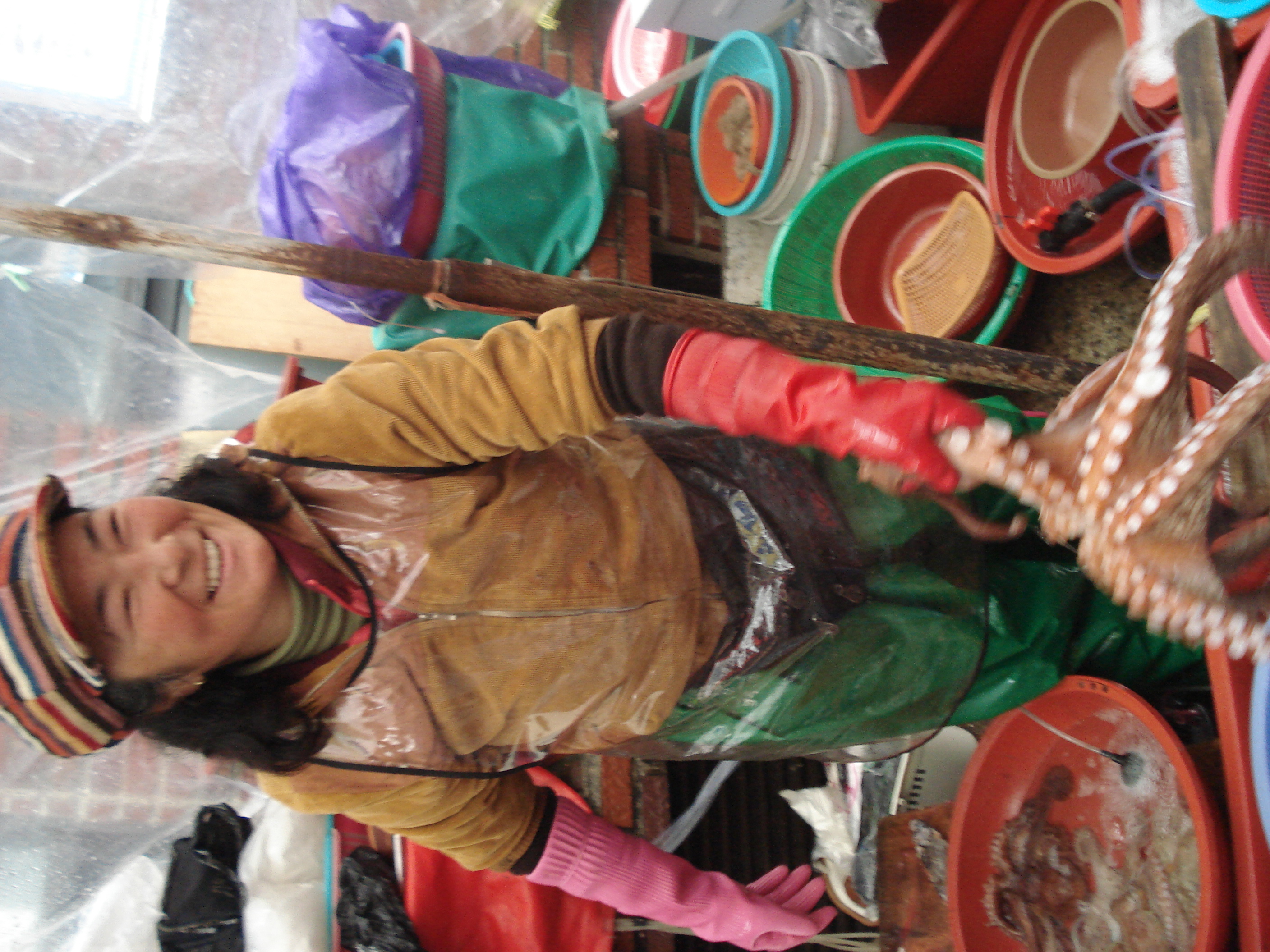
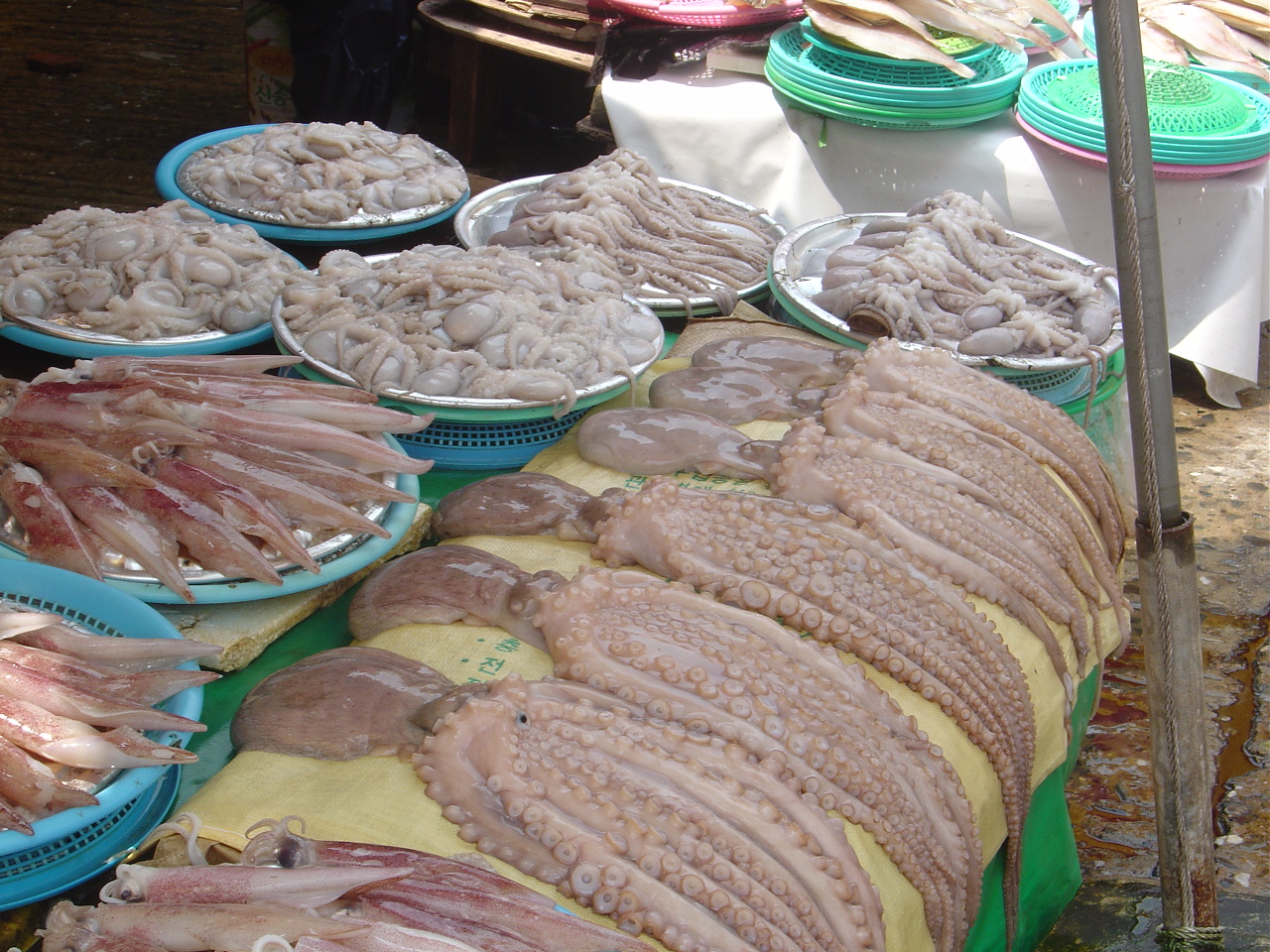
Fish Markets. Busan is South Korea’s primary maritime city, and fish markets are a major provisioning strength. Jagalchi Fish Market. The largest and most famous fish market in Busan and is a “must‑visit” and one of the city’s biggest markets. Offers a full range of fresh fish, shellfish, and seafood directly from the East Sea. I worked in shipyards not far from Busan and regularly visited this market. A kilometer and more of stalls. Absolutely visit this market!
Busan Yacht Cruising Guide -Local Cuisine
South Korea ultimately offers a provisioning environment that’s both dependable and surprisingly rewarding for visiting yachts. From the efficiency of its modern supermarkets to the character and freshness of its traditional markets, crews can source everything they need with minimal friction and plenty of local flavor. Common dishes include the following; all are somewhat addictive:
- Kimchi: Considered the national food, many types and if the standard cabbage variety is too much try some of the water and raddish types.
- Bibimbap: A mixed rice dish (“bibim” = mixed, “bap” = rice) served with sautéed vegetables, often including spinach, bean sprouts, mushrooms, carrots, and zucchini and usually includes beef, topped with a fried egg or sometimes a raw egg yolk and flavored with gochujang, sesame oil, and toasted sesame seeds
- Gamajatang: (my favorite). Gamjatang simmers pork spine, potatoes, and chilies into a rich, rustic stew. The broth turns deep and comforting, the meat falls from the bone, and the whole bowl feels like pure Korean warmth. At the end they add rice into some of the remaining broth, and some kimchi and spices then cook it with a lovely crunchy base under it.
- Haemul Sundubu‑jjigae: (also my favorite). is a spicy bubbling Korean soft‑tofu stew made with silky ultra soft custard like unpressed tofu (sundubu) and a mix of seafood such as clams, mussels, shrimp, and squid. It’s served boiling hot in an earthenware pot and is one of the most popular variations of sundubu‑jjigae. A spicy, bubbling stew built on gochugaru (Korean chili flakes) and gochujang (chili paste) and often finished with a raw egg cracked on top just before serving
- Samgyetang: A famous Korean ginseng chicken soup made with a whole young chicken stuffed with glutinous rice, garlic, jujube, and ginseng. It’s a restorative, herbal soup traditionally eaten in summer.
- Haemul Ttukbaegi: Another favorite. This is a bubbling seafood stew served in a traditional earthenware pot. It usually contains Clams, Mussels, Shrimp, Squid, sometimes small crab or mixed seafood packs, Vegetables (zucchini, onion, spring onion), Gochugaru (chili flakes), Gochujang (chili paste) and Anchovy or kelp stock
- Seafood stews: Haemul Jjigae is a mixed‑seafood stew loaded with shellfish, squid, shrimp, and vegetables. Bright, spicy, and aromatic. Maeuntang is Korea’s classic spicy fish stew, usually made with rockfish, snapper, cod, or whatever was caught that morning. Served bubbling with vegetables and gochugaru. Agujjim / Agu‑tang is Monkfish stew (or braised version). Spicy, rich, and famous in Busan and Masan. Kkot‑getang blue crab stew, sweet, spicy, and intensely flavorful. A specialty along the west and south coasts. Nakji‑tang Octopus stew, which is chewy and spicy. Often served with noodles or rice.
- Korean barbecue: Korean barbecue is a dining style where you grill your own meat, usually beef, pork, or chicken, right at the table, surrounded by banchan (side dishes such as pickle, kimchi and so on), sauces, and shared plates. The table‑top grilling uses gas, charcoal, or built‑in grills. Premium cuts like Wagyu, marinated beef, pork belly, and short ribs are common. Samgyeopsal (pork belly), Bulgogi (marinated beef), Galbi (short ribs)
- Alcoholic Beverages: Soju is the standard local spirit available in every marina district, sold in uniform 360 ml bottles with consistent alcohol levels, there are many special varieties worth trying. For beer, yachts will find the main national brands, Cass and Hite stocked in all convenience stores and supermarket chains near the waterfront.
Busan Yacht Cruising Guide - Diesel
Fuel
Suyeong Bay Yacht Center provides the most straightforward refueling option for visiting yachts. Fuel is delivered by truck on request, arranged through the marina office. Busan North Port can supply diesel through commercial bunkering services, but procedures are formal and may require advance notice, vessel documentation, and coordination with port control. Fuel quality is consistent with South Korean commercial standards, and supply is rarely constrained. Self‑service dock pumps for yachts are not common, so plan for scheduled delivery rather than casual top‑ups.
Busan Yacht Cruising Guide - Water
Supply
Potable water is available at both Suyeong Bay Yacht Center and Busan North Port yacht berths. Water pressure is reliable, and hoses/fittings are standard, but crews should still use inline filters due to variable dockside plumbing. Supply is metered or included in berth fees depending on the marina; Suyeong typically includes basic consumption, while North Port may charge for higher volumes. Water availability is year‑round with no seasonal restrictions.
Busan Yacht Cruising Guide - Shore
Power
Standard marina supply at Suyeong Bay Yacht Center is 220V, 50Hz, with common plug types available through the office. Busan North Port provides shore power on designated yacht pontoons; amperage varies, so adapters may be required. Power reliability is high, but voltage fluctuations can occur during peak commercial load periods. Long‑stay vessels should consider surge protection and check pedestal condition before connecting.
Busan Yacht Cruising Guide - Waste
Disposal
General waste bins are available at both Suyeong and North Port, with disposal included in berth fees. Recycling is mandatory in South Korea; marinas provide separate bins for plastics, cans, paper, and glass. Oil and bilge water disposal must be arranged through the marina office; handled by licensed contractors only. Blackwater pump‑out is not widely available. Most yachts manage holding tanks until offshore discharge is permitted.
Mechanical and Electrical Repairs
Resource
If you are headed somewhere remote consider the need to expand your knowledge base or have an information resource on board. Why not get a copy of my book The Marine and Electrical and Electronics Bible 4th Edition. By and for yachties, with everything from batteries and charging, solar and wind, diesel engines and marine electronics and so much more. Your complete systems guide. 650 pages of practical advice. In Australia and New Zealand order a copy through Boat Books. UK and European boats can buy the UK Edition Here. US and Canadian boats can get the US Edition Order Here. Marine systems are my profession so let me help you. By a liveaboard boat owner for other boat owners.


Busan Yacht Cruising Guide – Mechanical
Services
Busan provides a broad range of marine services suitable for visiting yachts, concentrated around Suyeong Bay Yacht Center, Busan North Port, and the surrounding industrial districts. Electrical contractors handle shore‑power issues, battery replacements, inverter/charger faults, and general wiring work, with most jobs arranged through marina offices or nearby marine workshops. Mechanical support is readily available due to Busan’s commercial shipyard network; services include diesel engine maintenance, cooling‑system repairs, fuel‑system troubleshooting, and fabrication of small metal parts. Local suppliers stock common filters, belts, and lubricants, while specialist components can be sourced quickly through Korea’s courier system.
Busan Yacht Cruising Guide – Marine Electronics Service
South Korea has no single, centralized yacht‑electronics hub in Busan, but several national distributors and regional agents cover the major brands and can support yachts transiting through the port. Most work is arranged via service calls, not walk‑in retail. Major Marine Electronics Brands & Their South Korea Agents include Raymarine, which are represented in South Korea through regional distributors and authorized service technicians based in the greater Busan–Gyeongnam industrial zone. Work is typically arranged through marina offices, who contact approved contractors for installation, diagnostics, and warranty support. Furuno has the strongest presence in South Korea due to its commercial‑shipping dominance. Multiple authorized service centers operate in Busan, supporting radar, sounders, AIS, and navigation systems for both commercial and yacht‑class vessels. Garmin marine products are supplied through Korean electronics distributors with technicians available for onboard installation in Busan. Stock is usually ordered in rather than held locally. Simrad / B&G are supported by Navico’s Korean partners, with technicians available for autopilot, chart plotter, and sailing‑instrument systems. Service is typically mobile and scheduled in advance. Contact Suyeong Bay Yacht Center or Busan North Port office. They arrange Raymarine, Garmin, Simrad/B&G, or Furuno technicians depending on the system. Most parts are couriered overnight from Seoul or Incheon if not in stock.
Busan Yacht Cruising Guide – Summary
Busan is South Korea’s primary operational hub for visiting yachts, offering structured entry procedures, reliable marina infrastructure, and access to technical services through its commercial maritime network. Suyeong Bay Yacht Center provides the most practical berthing, with fuel delivery, potable water, shore power, and contractor access for mechanical, electrical, and electronics work. Busan North Port offers additional yacht berths with direct links to customs and immigration. Provisioning, spare‑parts sourcing, and repairs are straightforward due to the city’s industrial supply chain, making Busan an efficient staging point for onward routes to Japan, the Korea Strait, and the southern approaches to the Yellow Sea. The Busan Yacht Cruising Guide has many answers to questions.