Arkoi Greece Sailing Guide
Arkoi Greece Sailing Guide. Arkoi is a small island group in the northern Dodecanese, located east of Patmos and close to the Turkish mainland. The coastline is irregular with numerous inlets, islets, and reef areas, providing several potential anchorages but requiring accurate navigation. The main settlement and harbour lie on the south-west side, offering the only organised landing point, with limited infrastructure and basic facilities.
The area is exposed to Aegean conditions, with the Meltemi dominating during the summer months. Northerly winds accelerate through the channels between Arkoi and surrounding islands, generating short, steep seas and localised gusting. Shelter is available in selected bays depending on wind direction, but conditions can change rapidly with shifts in strength or direction. Navigation is generally straightforward in clear weather, though attention is required for numerous unlit rocks and shoals in the approaches and between adjacent islets.
Arkoi Greece Sailing Guide - History
Arkoi has a long history of intermittent habitation, linked to its proximity to Patmos and its position along local maritime routes in the eastern Aegean. Archaeological evidence indicates activity from antiquity, though the island did not develop as a major settlement or trading centre. Its small size, limited resources, and exposed position restricted permanent population growth, and it functioned primarily as a minor outlying community within the wider Dodecanese region.
During the medieval period, Arkoi fell under the control of the Knights of Saint John, followed by incorporation into the Ottoman Empire. In the early 20th century it came under Italian administration before being transferred to Greece after the Treaty of Paris (1947). Throughout these periods, the island remained sparsely populated, with residents engaged in fishing, small-scale agriculture, and limited maritime activity, and it has not developed beyond a small permanent community.
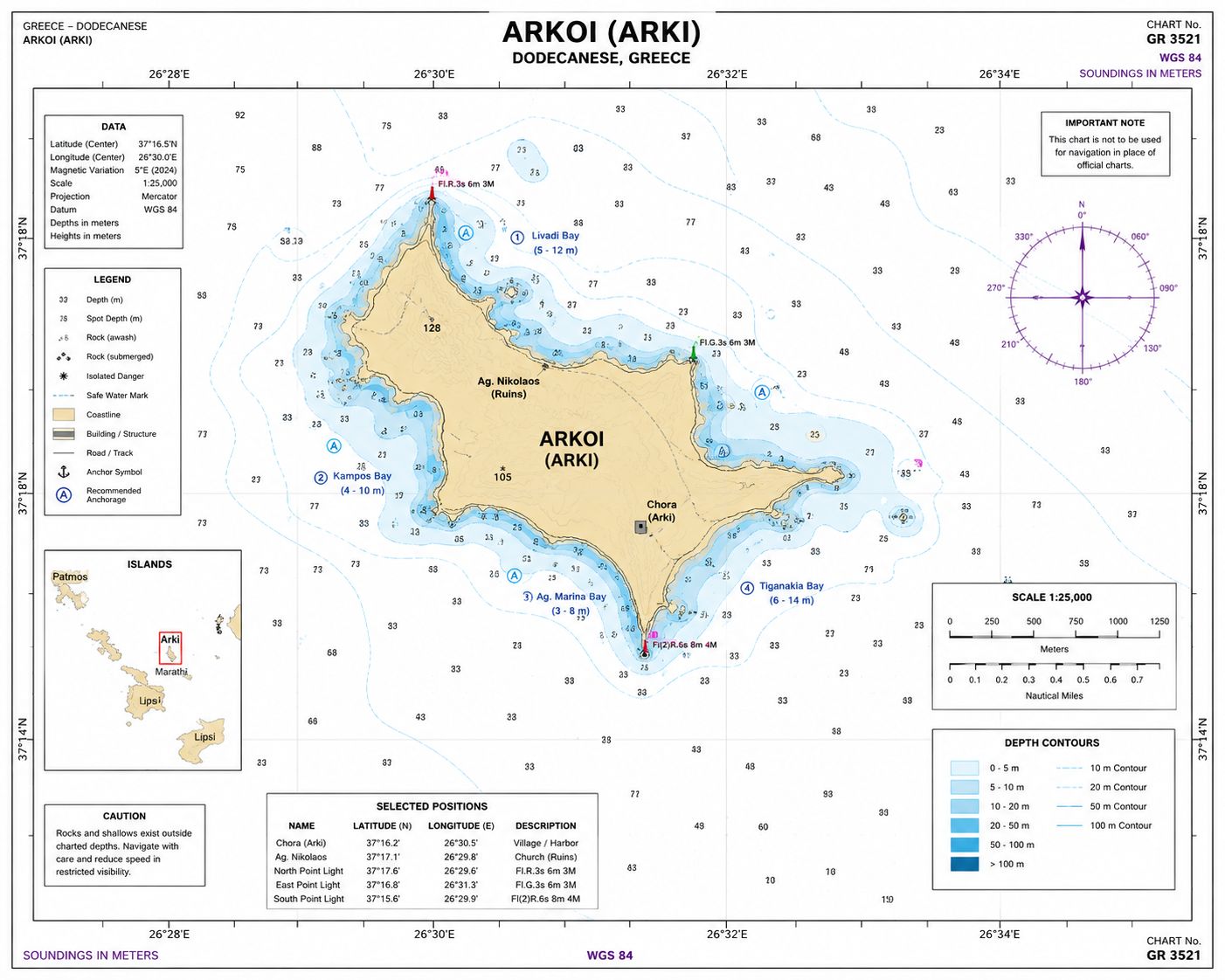
Chart Disclaimer. This chart is a schematic representation for illustrative purposes only and must not be used for navigation. Refer to official hydrographic charts for safe navigation. Be aware ENC charts may differ from official hydrographic charts. Both should be corrected and updated regularly.
Arkoi Greece Sailing Guide - Ocean
Currents and Tidal Flow
Arkoi lies within a confined island group where current patterns are strongly influenced by local topography and wind forcing rather than tidal movement. In light conditions, residual flow is weak, generally less than 0.5 knots, with variable direction across the area between Patmos and the nearby Turkish mainland. Under sustained northerly winds, particularly during the Meltemi, a consistent south to south-west set develops, with acceleration through the narrow channels between Arkoi and surrounding islets.
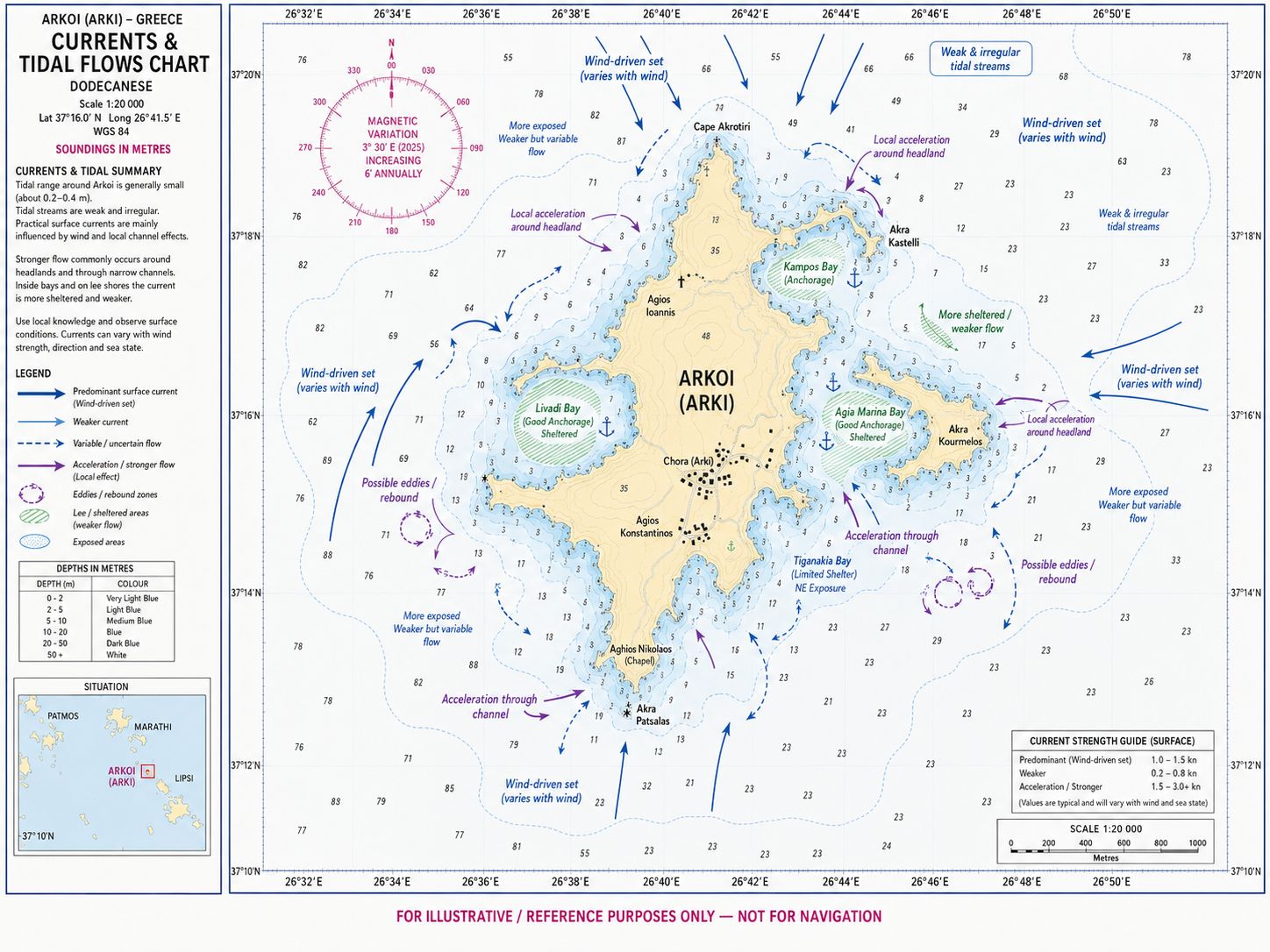
In these confined passages, current rates can increase to 1–2 knots, with localised eddies and turbulent flow around headlands and reef areas. Wind-against-current conditions produce short, steep seas, especially where flow is constricted. Tidal range is negligible, typically less than 0.3 metres, and does not generate meaningful tidal streams. Within bays and anchorages, current is minimal but can become irregular under strong gusting conditions. Passage planning should account for wind strength and channel acceleration rather than tidal timing.
Arkoi Greece Sailing Guide - Weather
Arkoi lies within the eastern Aegean weather system, characterised by dry, stable summers and more variable winter conditions. During the main cruising season (May to September), high-pressure systems dominate, producing clear skies, low humidity, and consistent visibility. Outside this period, particularly from late autumn through early spring, low-pressure systems move through the area bringing increased cloud cover, rainfall, and short-duration squalls with rapidly changing conditions.
The primary operational feature is the Meltemi, which establishes from the north to north-east and can persist for several days. In the Arkoi area, wind strength is frequently increased by funneling between Patmos and the nearby Turkish coast, with sustained winds of 20–30 knots common and higher gusts in exposed channels. Sea state builds quickly with short, steep waves, particularly in confined waters between islands. Transitional seasons bring more variable wind patterns, often shifting to southerly sectors ahead of frontal systems, requiring close monitoring due to rapid onset and changes in direction and intensity.
The Marine Electrical and Electronics Bible has a complete list of Greek VHF Radio Channel information and weather forecast times for Greece along with NAVTEX UK and Europe and NAVTEX Mediterranean for 490kHz and 518kHz.
Arkoi Greece Sailing Guide - Local
Winds
Local wind patterns at Arkoi are dominated by the northerly Meltemi, which establishes as a N to NE flow and strengthens from late morning, peaking during the afternoon before easing overnight. The island group sits within a constricted area between Patmos and the Turkish mainland, producing consistent acceleration above general forecasts. Sustained winds of 20–30 knots are common in summer, with stronger gusts in exposed channels and around headlands.
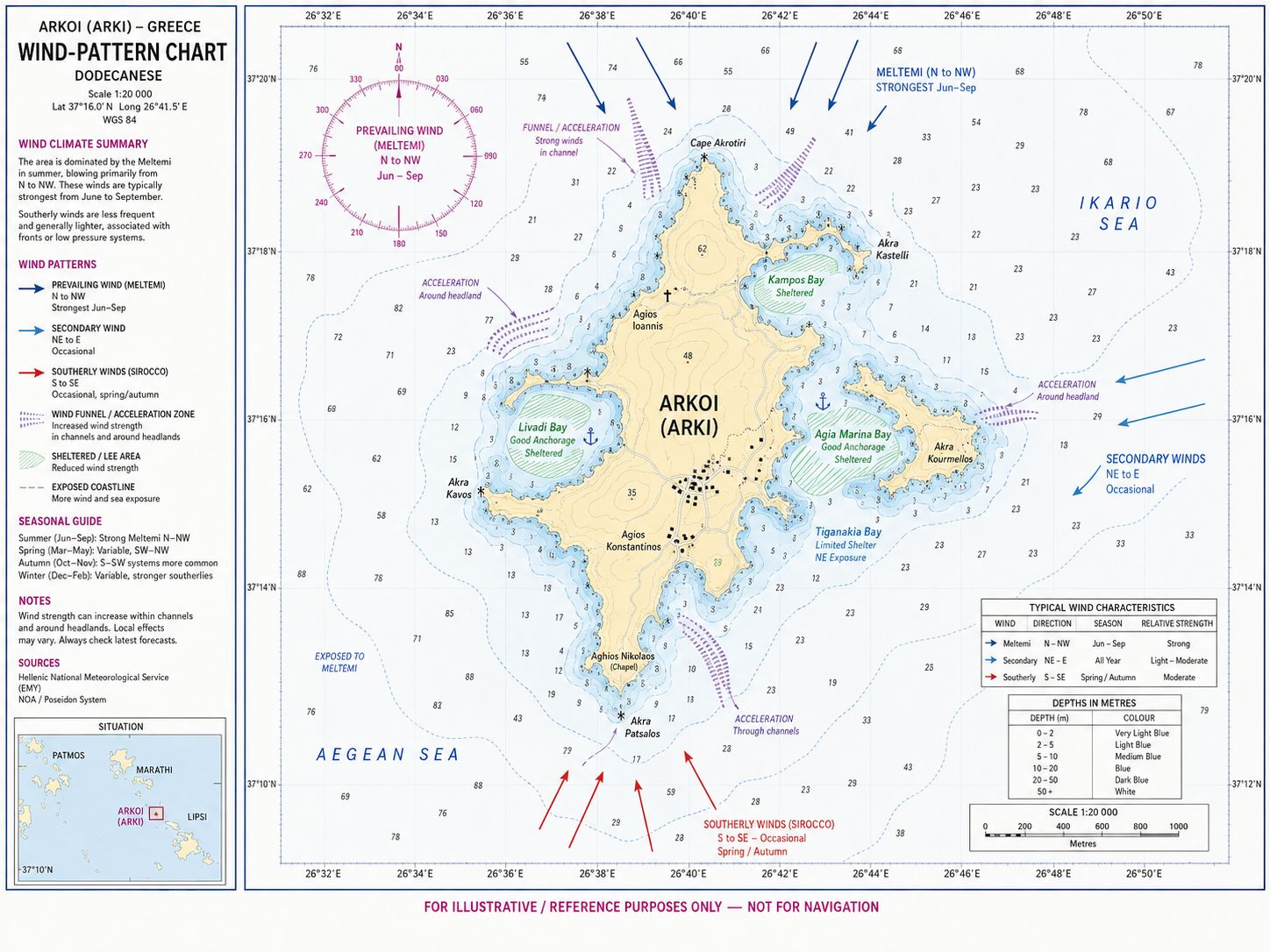
Marked local variation occurs due to the complex coastline and numerous islets. Strong acceleration zones form in the passages between Arkoi and adjacent rocks, with gusting and turbulence generated by wind deflection over low terrain. Partial lee can be found in selected south and south-west facing bays, though gust penetration remains significant under strong northerly flow. Outside Meltemi periods, winds become variable, often shifting to S or SE ahead of frontal systems, bringing short-duration but stronger and less predictable conditions with confused seas.
Arkoi Greece Sailing Guide - Approaches
Approaches to Arkoi are through an island group with numerous islets, rocks, and reef patches, requiring accurate chart use and continuous visual navigation. The main approach is from the west or south-west, typically routing from Patmos toward the principal harbour on the south-west side of Arkoi. Offshore depths are generally 30–60 m, remaining deep until close inshore, where the seabed rises rapidly with scattered hazards in the final approach sectors.
The area between Arkoi and surrounding islets is confined and requires careful pilotage. Several narrow passages exist, with irregular depths and unlit rocks not always clearly visible in moderate sea states. Under Meltemi conditions, northerly winds accelerate through these channels, producing strong gusts and short, steep seas, particularly in constricted gaps. Approaches from the north are more exposed to these effects, while southern approaches offer reduced sea state but still require hazard awareness.
There are no leading marks, buoys, or lit navigation aids; all approaches are by GPS supported by visual identification of land and hazards. Depths typically shoal within the final 100–200 metres, with rock outcrops and reef areas close to the shoreline. Daylight entry is recommended. Traffic is light but includes local fishing vessels and small inter-island traffic, often operating at speed within the channels.
Arkoi Greece Sailing Guide - Navigation
Navigation into the harbour at Arkoi is from the south-west, entering a small, enclosed bay used by local vessels and visiting yachts. The entrance is narrow but clear when correctly identified, with depths remaining in excess of 10–15 m on the approach before reducing to 5–8 m within the harbour area and approximately 3–5 m alongside the quay. The seabed is predominantly sand and mud with some patches of rock near the margins.
The harbour is partially sheltered from northerly winds, but under the Meltemi, gusts descend into the entrance and inner basin, producing crosswind effects and occasional surge. The final approach requires alignment with the entrance while avoiding nearshore rocks on either side, which are not always conspicuous in moderate sea states. There are no leading marks, sector lights, or lit navigation aids; entry is conducted by GPS positioning supported by visual reference.
Manoeuvring space inside the harbour is limited, particularly when vessels are berthed along the quay. Berthing is typically stern-to using own anchor or alongside where space permits. Local fishing vessels occupy sections of the quay, and their movements should be anticipated. Night entry is not recommended due to limited lighting and poor definition of harbour limits and hazards
Arkoi Greece Sailing Guide - Chart
Accuracy
Hydrographic charts accurately depict coastline and major features. Electronic charts are generally reliable but may not show all rocks and shoals in detail. Caution is required when navigating between islets and close to shore. Depth soundings should be verified when anchoring.
Arkoi Greece Sailing Guide - Anchorages
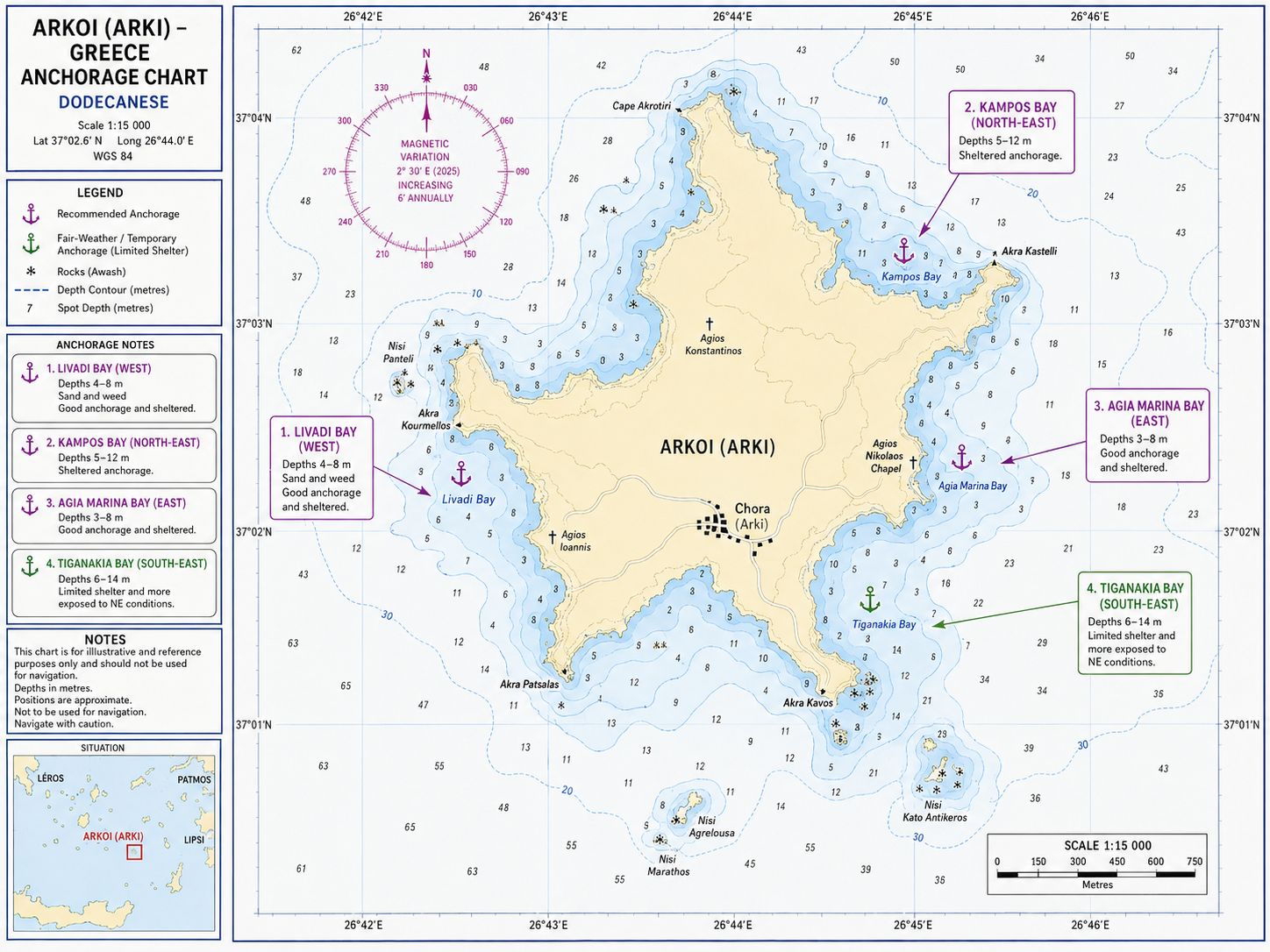
Anchorage options at Arkoi are varied but constrained by exposure and seabed conditions. Selection is dependent on wind direction, with no all-weather shelter.
- Port Augusta (main harbour, SW coast). Primary anchorage within and immediately outside the harbour. Depths 5–10 m over mud and sand with generally good holding. Space is limited due to quay berthing and local vessels. Provides partial shelter from northerlies, though gusts descend into the basin under Meltemi conditions. Open to S–SW swell outside the harbour limits.
- Tiganakia Bay (E of main harbour). Small, clear-water bay with depths 4–8 m over sand, offering good holding in settled conditions. Provides some lee from N–NW winds but is affected by gust penetration and swell wrap. Limited swinging room. Not suitable in E–SE winds.
- Marathos Channel (between Arkoi and Marathos). Sheltered anchoring area in 6–12 m over sand, depending on position within the channel. Good holding in sand with protection from northerlies, though strong gusts and acceleration occur through the channel. Suitable in Meltemi with careful positioning. Exposed to S winds.
- South coast bays (general). Several small indentations along the south coast provide temporary anchorage in 6–12 m over mixed sand and weed. These offer lee from northerlies but are open to any shift into S or SE. Holding varies and can be reduced in weed. No protection from swell reflection.
- North coast (not recommended). Fully exposed to prevailing northerly winds with steep-to depths and limited holding areas. Subject to continuous swell and wind exposure. Not suitable for anchoring except in calm conditions.
All anchorages are subject to gusting, swell wrap, and rapid changes in conditions. Careful assessment of forecast wind direction and strength is required, with readiness to relocate if exposure increases.
Arkoi Greece Sailing Guide - Entry
Formalities
Entry formalities follow standard Greece procedures for visiting yachts. This is not a designated port of entry for international clearance, and there are no customs or immigration facilities on the island. Vessels arriving from outside Greece or the Schengen Area must first clear into the country at an official port of entry before proceeding to this port. Direct arrival from a non-Schengen country is not permitted. The Greek cruising tax (TEPAI) must be valid and paid, and the vessel’s cruising log (DEKPA for non-EU vessels, or transit log where applicable) should be up to date and available for inspection if requested by port authorities or coastguard.
Arkoi Greece Sailing Guide - Marina
Facilities
Arkoi has no marina infrastructure; all berthing is at the small harbour of Port Augusta on the south-west coast. The harbour consists of a simple quay used by local fishing vessels and visiting yachts, with no laid moorings and no organised berth allocation. Depths on approach exceed 10–15 m, reducing to approximately 5–8 m within the harbour and 3–5 m alongside the quay, suitable for small to medium-draft vessels. Berthing is stern-to using own anchor or occasionally alongside where space permits.
Shelter is partial from northerly winds, but under the Meltemi, gusts enter the basin and can produce surge along the quay. Manoeuvring space is limited, particularly when multiple vessels are present or during local traffic movements. Services are minimal to non-existent: no fuel berth, no reliable shore power, limited or no water supply, and no repair or technical facilities. There are no alternative berthing locations elsewhere in the Arkoi group; the harbour should be treated as a basic stopover only.
Arkoi Greece Sailing Guide - Provisioning
Supermarkets. Provisioning at Arkoi is extremely limited and should be treated as basic top-up only. A small mini-market operates near the harbour at Port Augusta, supplying essential dry goods, bottled water, bread, and a narrow range of tinned and packaged items. Fresh produce is limited, irregular, and dependent on delivery schedules from nearby centres such as Patmos, with stock levels varying significantly.
Markets. Arkoi has no formal produce markets. Fresh fruit and vegetables are available only in small quantities through the mini-market near the harbour at Port Augusta, with supply dependent on periodic deliveries from Patmos.
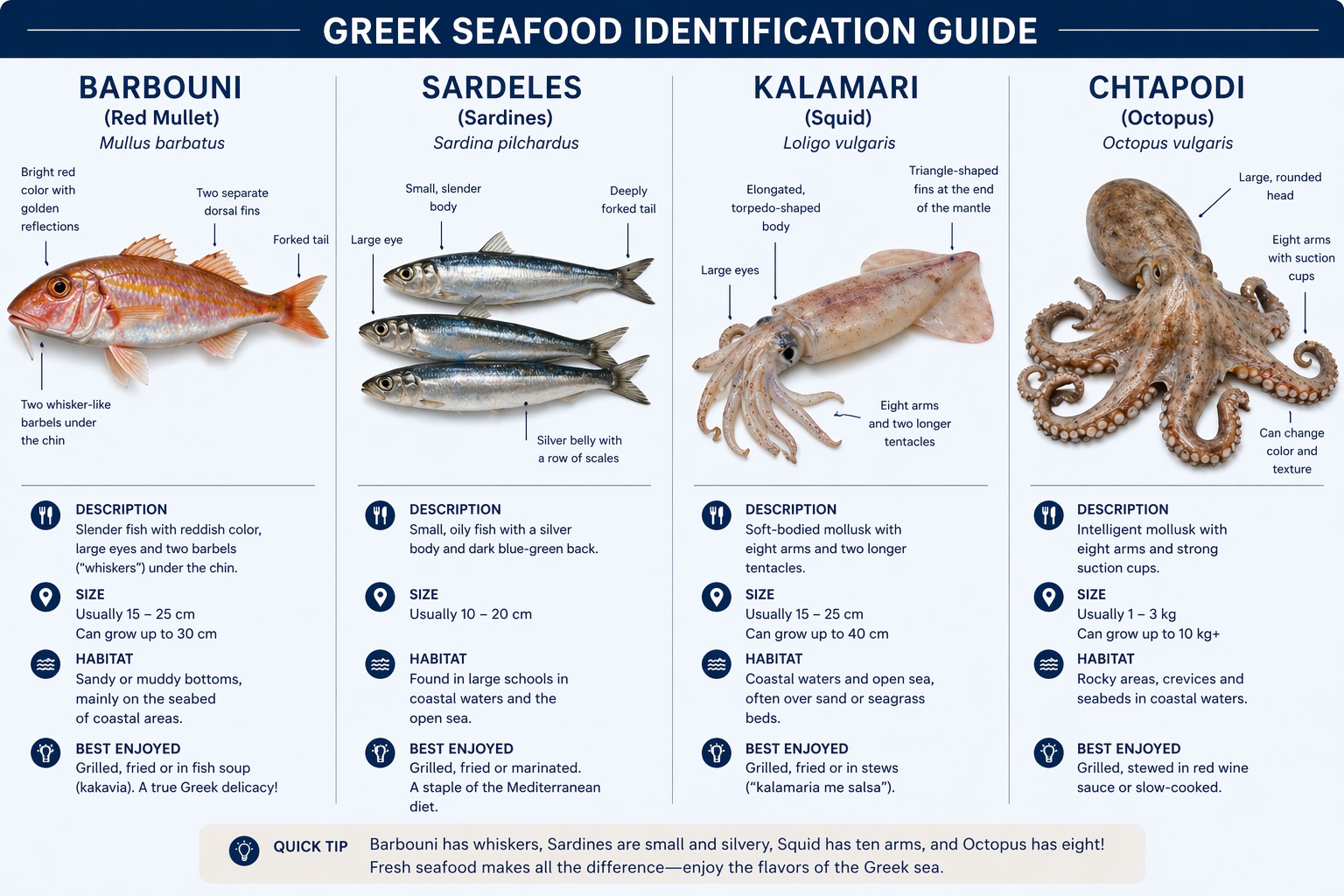
Fish Markets. Fish supply on Arkoi is small-scale and based on local fishing activity operating from Port Augusta harbour. There is no fish market, no auction system, and no fixed retail outlet. Availability depends entirely on daily catch and weather conditions; when conditions permit, small quantities of fresh fish, squid, and occasionally octopus may be available directly from fishermen on the quay or through local tavernas.
Arkoi Greece Sailing Guide - Local
Cuisine
Local cuisine on Arkoi is limited and based on small-scale fishing and restricted supply deliveries. Food is served through a small number of tavernas around Port Augusta harbour, with menus dependent on daily availability rather than fixed offerings. Typical dishes include grilled fish (psari sta karvouna), fried small fish, octopus (htapodi) grilled or stewed, and squid when available. Meat options are limited but may include goat or lamb (katsiki, arni), usually slow-cooked or roasted, accompanied by simple sides such as potatoes, bread, and salads.
Arkoi Greece Sailing Guide - Local
Beverages
Local beverages are limited to basic supplies, beer, bottled wine, and spirits such as ouzo are delivered via ferry from nearby centres including Patmos, with no local production or specialised offerings
Arkoi Greece Sailing Guide - Diesel
Fuel Supplies
Diesel fuel is not available from a dedicated fuel berth on Arkoi; supply is arranged informally at Port Augusta harbour, typically by jerry can delivery to the quay. Availability is limited and dependent on prior notice, local stock, and delivery schedules from Patmos.
Arkoi Greece Sailing Guide - Water
Supplies
Potable water on Arkoi is limited and should not be relied upon for full tank replenishment. At Port Augusta harbour, water may be available at the quay via local supply points, but pressure and volume are inconsistent and subject to demand. Supply interruptions are common, particularly during peak summer periods, and there are no dedicated marina-grade connections
Mechanical and Electrical Repairs
Resource
If you are headed somewhere remote consider the need to expand your knowledge base or have an information resource on board. Why not get a copy of my book The Marine and Electrical and Electronics Bible 4th Edition. By and for yachties, with everything from batteries and charging, solar and wind, diesel engines and marine electronics and so much more. Your complete systems guide. 650 pages of practical advice. In Australia and New Zealand order a copy through Boat Books. UK and European boats can buy the UK Edition Here. US and Canadian boats can get the US Edition Order Here. Marine systems are my profession so let me help you. By a liveaboard boat owner for other boat owners


Arkoi Greece Sailing Guide - Marine
Services
No marine service facilities exist on Arkoi. Minor assistance may be possible locally. Full service capability requires transit to Patmos.
Arkoi Greece Sailing Guide - Local
Etiquette
The harbour is adjacent to a very small settlement; noise, generator use, and lighting should be minimised, especially at night. Waste disposal should be limited to available bins ashore, with no discharge within harbour limits. Water and any available services are limited and should be used conservatively. General conduct is informal and cooperative, reflecting the absence of infrastructure and reliance on shared use of basic facilities.
Arkoi Greece Sailing Guide - Summary
Arkoi provides multiple anchorage options across a complex island group with protection dependent on wind direction. Infrastructure is minimal with reliance on nearby islands for services. Navigation requires attention to hazards but is manageable. There are no all-weather anchorages. The Arkoi Greece Sailing Guide for all you need to know.