Antipsara Greece Sailing Guide
Antipsara Greece Sailing Guide. Antipsara is a small, uninhabited island in the northern Aegean, located west of Psara and north-west of Chios. The coastline is rugged with limited indentation, offering only a small number of usable anchorages and no developed harbour infrastructure. The island has no permanent population, no services, and no facilities, and should be treated as a remote anchorage location rather than a port of call.
The island lies fully exposed to northern Aegean conditions, with the prevailing Meltemi dominating during the summer months. Northerly winds accelerate across the open water between Psara and the mainland, generating short, steep seas and rapid changes in local conditions. Shelter is limited and highly dependent on wind direction, with only partial lee available in select bays. Navigation is straightforward in clear weather but requires attention to inshore rocks and the absence of aids to navigation.
Antipsara Greece Sailing Guide - History
Antipsara has no significant record of permanent settlement and has remained largely uninhabited throughout its history. Its proximity to Psara meant it functioned primarily as an outlying landmass used intermittently for grazing, fishing, and as a temporary refuge by local inhabitants rather than as a developed community. Archaeological evidence in the wider area indicates ancient maritime activity, but Antipsara itself did not evolve into a structured settlement or port.
During periods of regional control by larger powers, including the Ottoman Empire, the island held no administrative or strategic role. It remained peripheral even during significant events affecting nearby islands, such as the Destruction of Psara in the Greek War of Independence, when the focus remained on Psara itself. In modern times, Antipsara continues as an uninhabited island with no infrastructure, used only occasionally by fishermen and visiting vessels, with no transition into permanent habitation or economic development.
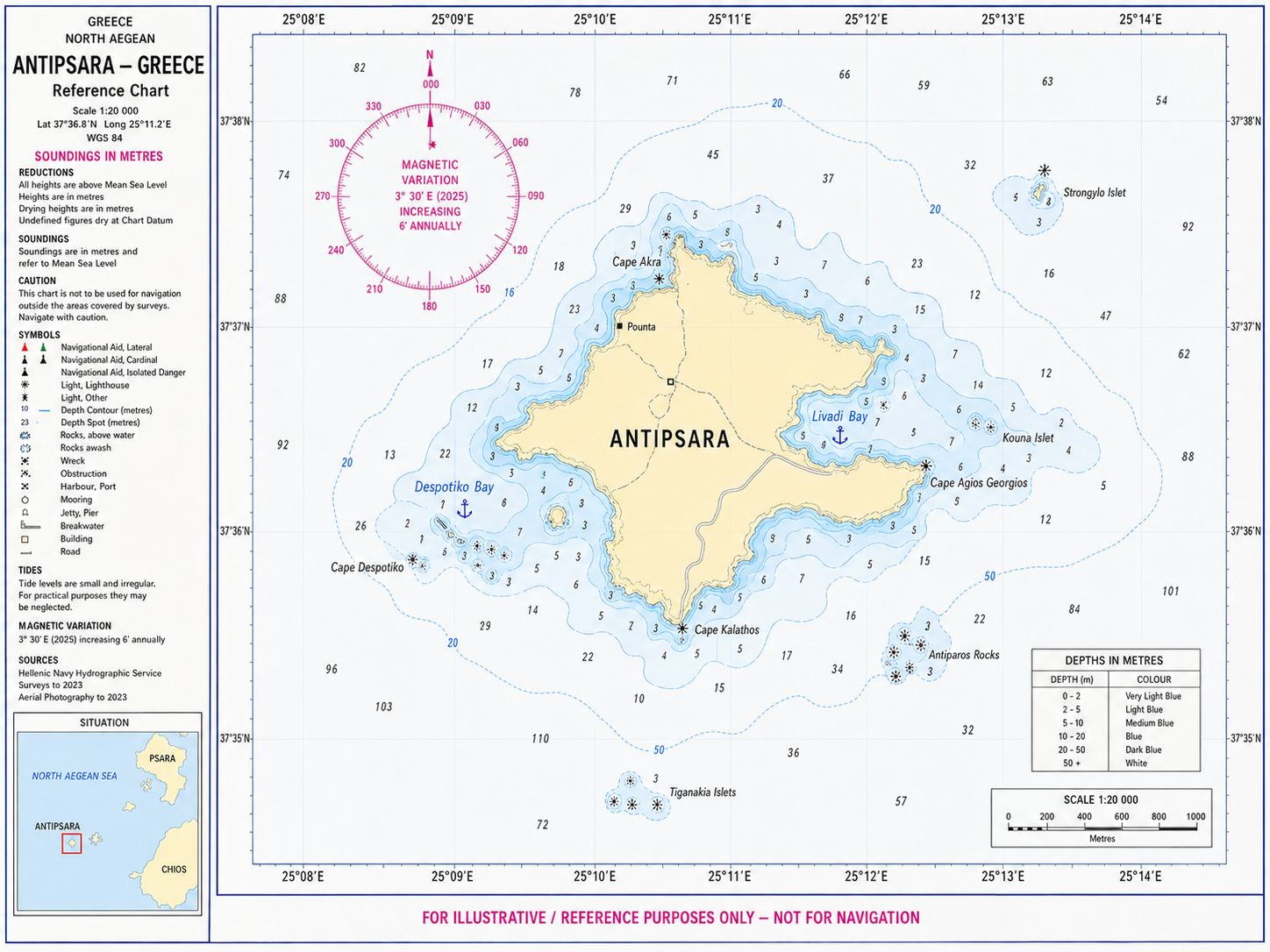
Chart Disclaimer. This chart is a schematic representation for illustrative purposes only and must not be used for navigation. Refer to official hydrographic charts for safe navigation. Be aware ENC charts may differ from official hydrographic charts. Both should be corrected and updated regularly.
Antipsara Greece Sailing Guide - Ocean
Currents and Tidal Flow
Antipsara lies in open northern Aegean waters where current patterns are dominated by wind forcing rather than tidal movement. In light conditions, residual flow is weak, generally less than 0.5 knots, with variable direction influenced by the broader circulation between Psara and Chios. Under sustained northerly winds, particularly during the Meltemi, a consistent south-going set develops, strengthening with wind duration and fetch. In the channels between Antipsara and Psara, local acceleration can produce currents of 1–2 knots, with short, steep wind-against-current seas.
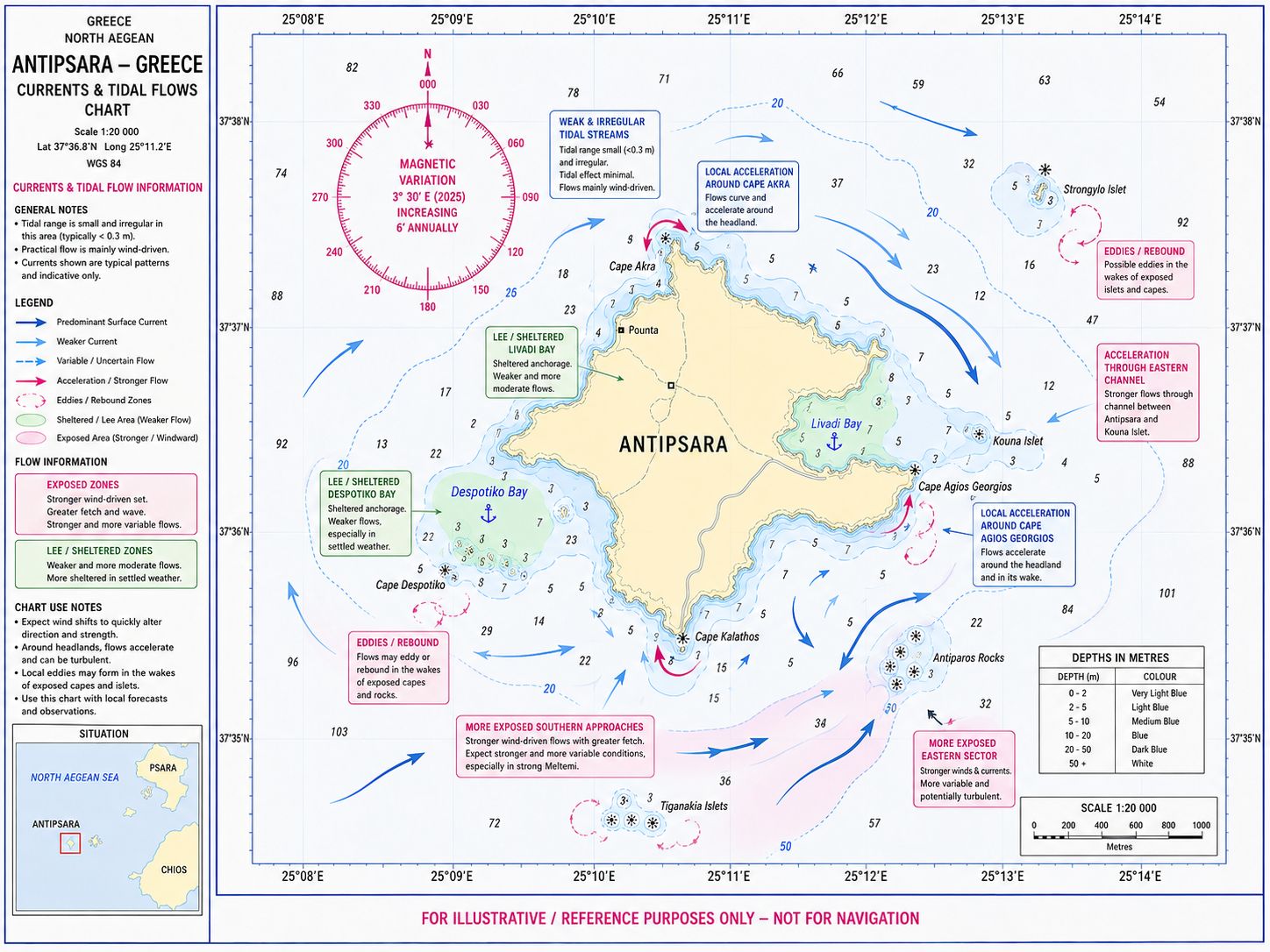
Tidal influence is negligible, with a range typically less than 0.3 metres and no meaningful tidal streams. Any observed movement is wind-driven or the result of local pressure gradients. Around headlands and in narrow passages, eddies and turbulent flow are common when winds are strong, and anchorages may experience slight but variable set depending on exposure. Passage planning should be based on wind conditions rather than tidal timing, with allowance for increased current and sea state in confined waters.
Antipsara Greece Sailing Guide - Weather
Antipsara lies in the open northern Aegean and is fully exposed to regional weather systems, with no terrain or surrounding landmass providing meaningful protection. During the main cruising season (May to September), conditions are dominated by stable high-pressure systems, producing clear skies, low humidity, and excellent visibility. Outside this period, particularly from late autumn through early spring, passing low-pressure systems bring increased cloud cover, rainfall, and short-duration but sharp weather changes.
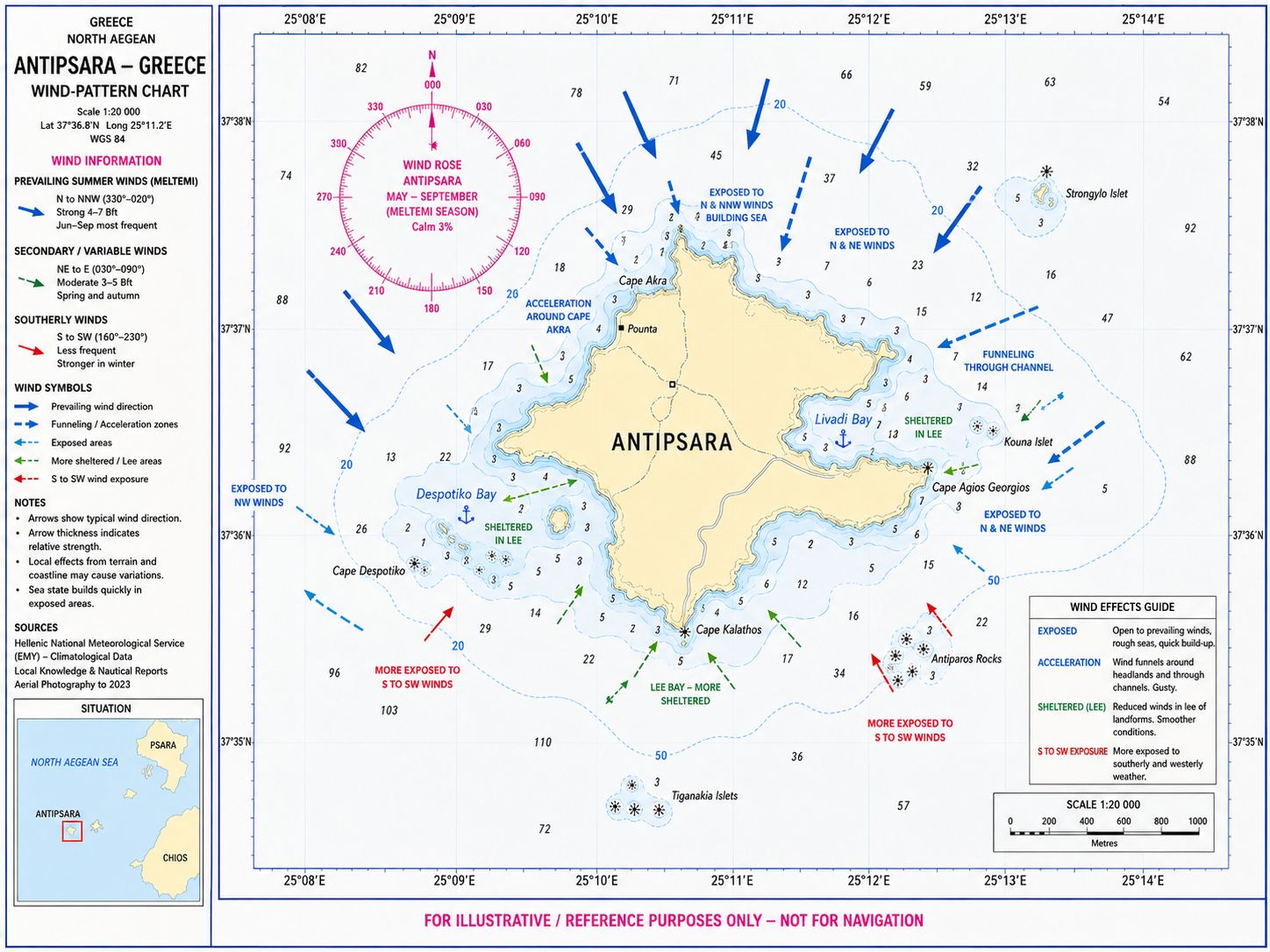
The dominant feature is the Meltemi, which establishes from the north to north-east and can persist for several days. In the exposed waters around Antipsara, wind strength is often higher than forecast, with sustained 20–30 knots common and stronger gusts in open fetch. Sea state builds rapidly with short, steep waves and significant spray, particularly in the channel between Psara and Antipsara. There is no effective shelter from northerly sectors, and conditions deteriorate quickly with increasing wind strength. Transitional seasons bring more variable winds, often shifting to southerly sectors ahead of frontal systems, requiring close monitoring due to rapid changes in direction and intensity.
The Marine Electrical and Electronics Bible has a complete list of Greek VHF Radio Channel information and weather forecast times for Greece along with NAVTEX UK and Europe and NAVTEX Mediterranean for 490kHz and 518kHz.
Antipsara Greece Sailing Guide - Local
Winds
Local wind patterns at Antipsara are dominated by the northerly Meltemi, which establishes as a N to NE flow and strengthens through the day, typically peaking in the afternoon before easing overnight. The island is fully exposed with no terrain to reduce wind strength, and sustained winds of 20–30 knots are common in summer, with higher gusts in open water.
Acceleration effects are pronounced in the channel between Antipsara and Psara, where wind speeds increase above general area forecasts and produce steep, short-period seas. Around headlands and in confined bays, gusting and turbulence are common due to wind deflection over low relief terrain. There is minimal lee available anywhere around the island, and even south-facing anchorages experience gust penetration and reflected chop under strong northerly flow.
Outside Meltemi periods, winds are more variable and can shift rapidly, particularly to S or SE ahead of frontal systems. These events can produce short-duration but strong winds with confused sea states, and with no sheltered fallback, require conservative anchoring decisions and continuous monitoring.
Antipsara Greece Sailing Guide - Approaches
Approaches to Antipsara are from open northern Aegean waters with no defined channels or navigation aids. The island lies immediately west of Psara and north-west of Chios, with multiple approach routes available depending on conditions. Offshore depths are generally in excess of 40–60 m, remaining deep until close inshore, where the seabed rises rapidly. There are no major off-lying shoals in the main approach sectors, but numerous isolated rocks and reef patches exist around the coastline, particularly on the eastern and southern sides.
The channel between Antipsara and Psara is a primary transit route but is subject to significant wind and sea effects. Under Meltemi conditions, northerly winds accelerate through the gap, producing steep, short-period seas and localised overfalls. Approaches from the north and west are fully exposed with long fetch, while approaches from the south may offer slightly reduced sea state in northerlies but remain open to swell wrapping around the island.
Navigation requires accurate chart use and continuous visual observation for unlit hazards close inshore. Depths shoal quickly within the final 100–200 metres, with rock outcrops not always visible in moderate sea conditions. There are no leading marks, buoys, or lights; all approaches should be conducted in daylight with GPS positioning supported by visual navigation. Traffic is minimal and limited to fishing vessels and occasional transiting yachts.
Antipsara Greece Sailing Guide - Navigation
There is no harbour or defined entry point. Navigation is conducted by selecting suitable coves based on prevailing conditions. Depths reduce rapidly near shore from over 20 metres to less than 10 metres in anchorage areas. Manoeuvring space is unrestricted in open areas. Close-in navigation requires caution due to rocks and depth variation. No navigation aids are present.
Antipsara Greece Sailing Guide - Chart
Accuracy
Hydrographic charts accurately depict coastline and general bathymetry. Electronic charts align with official data but may lack detailed seabed composition. Caution is required for isolated rocks and steep depth gradients nearshore. Depth soundings should be verified when anchoring.
Antipsara Greece Sailing Guide - Anchorages
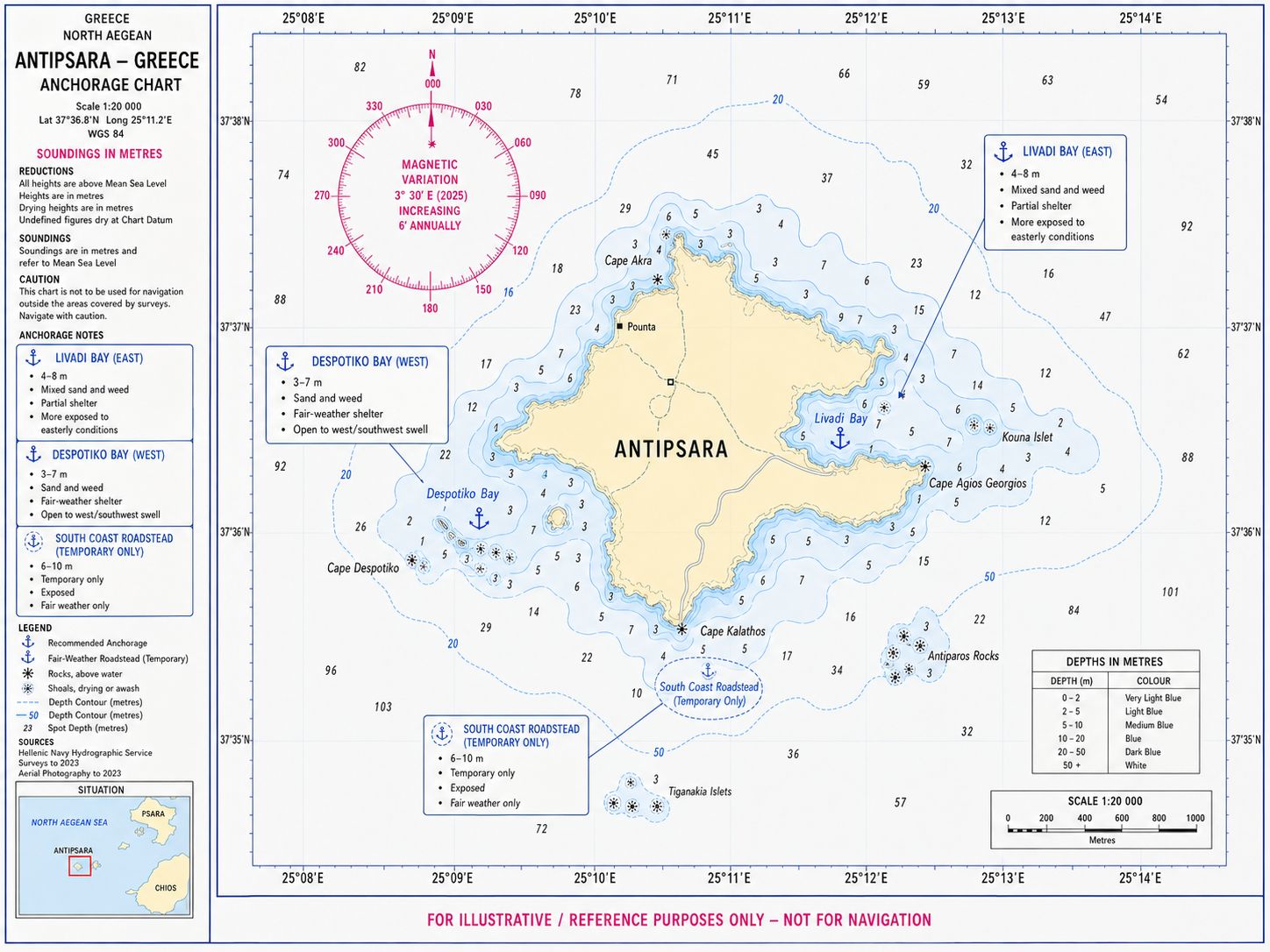
Viable anchorages at Antipsara are few and entirely dependent on stable wind direction. There is no all-weather shelter; all locations are open to swell and require continuous monitoring.
- Apidies Bay (SE coast). Primary anchorage and the most commonly used. Indentation on the south-east side of the island offering lee from N–NW winds. Depths typically 5–10 m over sand with generally good holding. Limited swinging room. Gusts penetrate from the north in strong Meltemi conditions, with some swell wrap entering the bay. Untenable in S–E winds.
- South coast open bays (general). Several small indentations along the south coast allow anchoring in 6–12 m over sand and patches of weed. These provide partial shelter from northerlies but are exposed to any shift into S or SE. Holding varies depending on seabed composition, with reduced reliability in weed. No protection from swell reflection off the shoreline.
- West coast temporary lee. In stable northerlies, temporary anchoring is possible off the west coast in 8–15 m where seabed permits. This area provides limited lee from N winds but is exposed to W swell and becomes uncomfortable quickly with any increase in sea state. No defined bays or secure holding areas.
- North and east coasts (not suitable). These sectors are fully exposed to prevailing northerly winds and open Aegean fetch. Depths are generally steep-to with limited holding areas. Not suitable for anchoring except in calm conditions.
All anchorages on Antipsara are weather-dependent with no secure refuge. Rapid deterioration occurs with any wind shift, particularly into southerly sectors. There are no facilities, no assistance, and no fallback options on the island; anchoring decisions must be conservative with readiness to depart if conditions change
Antipsara Greece Sailing Guide - Entry
Formalities
Entry formalities follow standard Greece procedures for visiting yachts. This is not a designated port of entry for international clearance, and there are no customs or immigration facilities on the island. Vessels arriving from outside Greece or the Schengen Area must first clear into the country at an official port of entry before proceeding to this port. Direct arrival from a non-Schengen country is not permitted. The Greek cruising tax (TEPAI) must be valid and paid, and the vessel’s cruising log (DEKPA for non-EU vessels, or transit log where applicable) should be up to date and available for inspection if requested by port authorities or coastguard.
Antipsara Greece Sailing Guide - Marina
Facilities
Antipsara has no marina, harbour, or berthing facilities of any kind. The island is uninhabited and offers no quay, jetty, mooring systems, or protected basin. There are no laid moorings, no shore access infrastructure, and no services available.
All use of the island is by anchorage only, with vessels remaining at anchor offshore in suitable conditions. Any landing, where possible, is by tender onto undeveloped shoreline with no formal landing points. There is no shelter from infrastructure, no support services, and no capacity for alongside berthing.
Antipsara Greece Sailing Guide - Provisioning
Provisioning on Antipsara is not possible. The island is uninhabited with no shops, no food supply, no water sources, and no services of any kind. There are no opportunities for resupply, including fuel, provisions, or spare parts.
Antipsara Greece Sailing Guide - Local
Cuisine
No cuisine infrastructure exists. The island is uninhabited. Best bring out your cookbook and get busy in the galley.
Antipsara Greece Sailing Guide - Local
Beverages
No beverage supply exists. All provisions must be carried onboard. A cold Greek beer goes down well
Antipsara Greece Sailing Guide - Diesel
Fuel Supplies
No diesel supply exists. Fuel must be sourced from Chios.
Antipsara Greece Sailing Guide - Water
Supplies
No potable water supply exists. All water must be carried onboard.
Mechanical and Electrical Repairs
Resource
If you are headed somewhere remote consider the need to expand your knowledge base or have an information resource on board. Why not get a copy of my book The Marine and Electrical and Electronics Bible 4th Edition. By and for yachties, with everything from batteries and charging, solar and wind, diesel engines and marine electronics and so much more. Your complete systems guide. 650 pages of practical advice. In Australia and New Zealand order a copy through Boat Books. UK and European boats can buy the UK Edition Here. US and Canadian boats can get the US Edition Order Here. Marine systems are my profession so let me help you. By a liveaboard boat owner for other boat owners.


Antipsara Greece Sailing Guide - Marine
Services
No marine services exist. Full service capability requires transit to Chios.
Antipsara Greece Sailing Guide - Local
Etiquette
The island is uninhabited. Anchoring should be conducted with care to avoid environmental impact. General conduct should reflect the remote and undeveloped nature of the location.
Antipsara Greece Sailing Guide - Summary
Antipsara provides very limited anchorage options with minimal shelter and no infrastructure. Protection is highly dependent on wind direction and weather conditions. The island is suitable only for short stays in settled conditions. Navigation is straightforward but exposed. The Antipsara Greece Sailing Guide for all you need to know.