Antikythira Greece Sailing
Guide
Antikythira Greece Sailing Guide. Located between the Peloponnese and western Crete, Antikythira lies in an exposed position along the main passage linking the Ionian and Aegean seas. The island is remote, sparsely populated, and surrounded by deep water with limited coastal indentation. Approaches are generally clear offshore, but the lack of natural shelter and the presence of isolated rock outcrops near the coast require accurate navigation when closing land. The surrounding waters are open to long fetch from multiple directions, with sea state building rapidly under prevailing winds.
For a cruising yacht, Antikythira is a weather-dependent stop with minimal infrastructure. Berthing is confined to a small harbour facility, with limited quay space and restricted manoeuvring area. Additional anchoring options are few and exposed, with holding conditions varying over mixed seabed. Protection is highly directional, offering some shelter under specific wind conditions but leaving the island vulnerable to both northerly and southerly systems. Passage planning must account for limited fallback options and the need to arrive in suitable conditions for safe entry and departure.
Antikythira Greece
Sailing Guide - History
The history of Antikythira is defined by its position on a key maritime route between the Peloponnese and Crete, where vessels transited between the Ionian Sea and the Aegean Sea. Archaeological evidence indicates habitation from prehistoric periods, with the island used as a staging point and lookout for passing traffic. Its strategic location made the surrounding waters a focal point for maritime movement, including trade routes and naval activity across successive Greek periods.
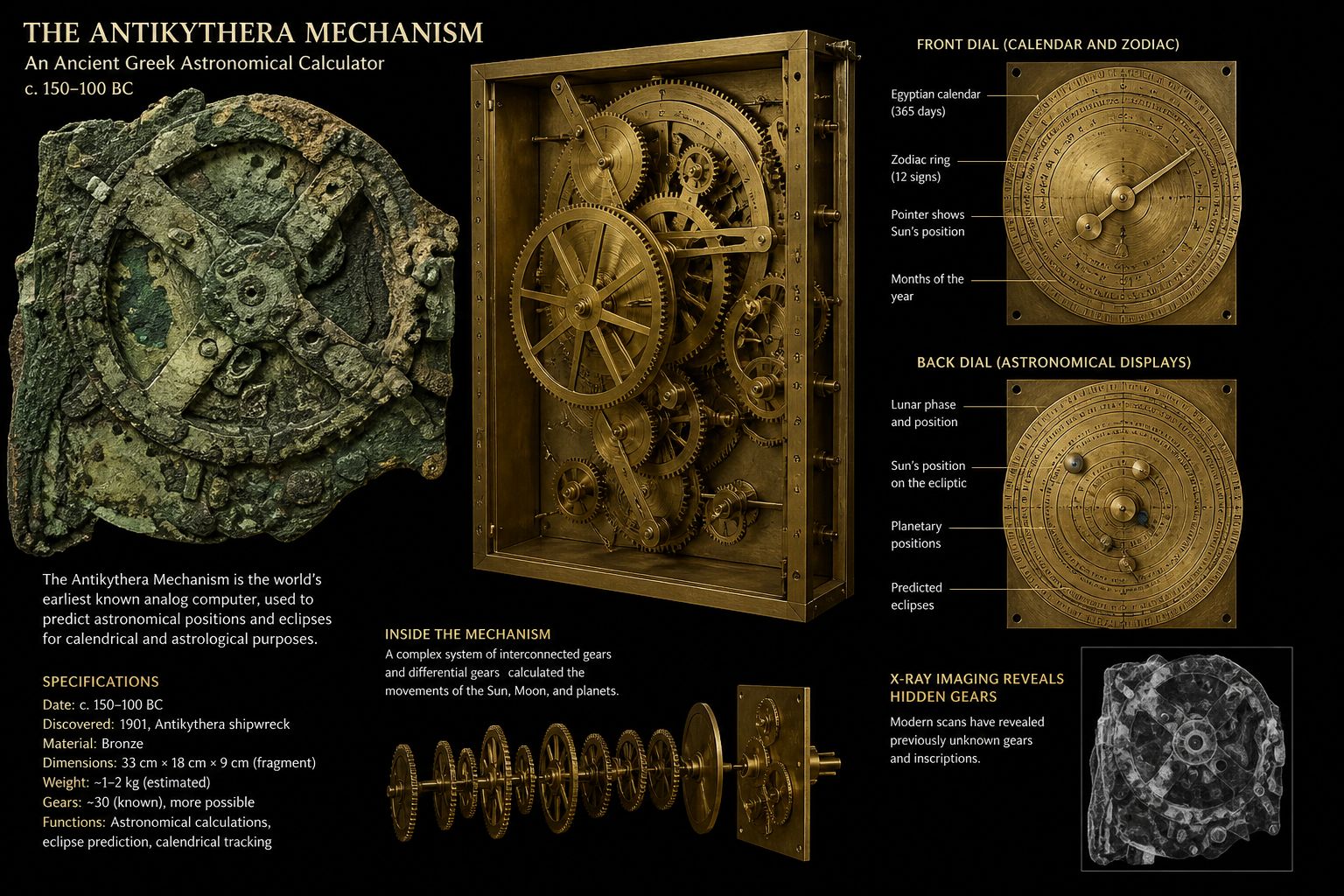
Antikythira is most notably associated with the Antikythera shipwreck, discovered in 1900, which yielded the Antikythera Mechanism which is a complex geared instrument dating to the 2nd century BC used for astronomical calculation. During later periods under the Roman Empire and Byzantine Empire, the island remained lightly populated, serving mainly as a waypoint and lookout. Control passed through Venetian and then Ottoman Empire administration, with limited development due to its isolation. Integration into the modern Greek state occurred in the 19th century, and the island has since remained a small, remote settlement with minimal infrastructure, retaining its historical association with maritime passage rather than port activity.
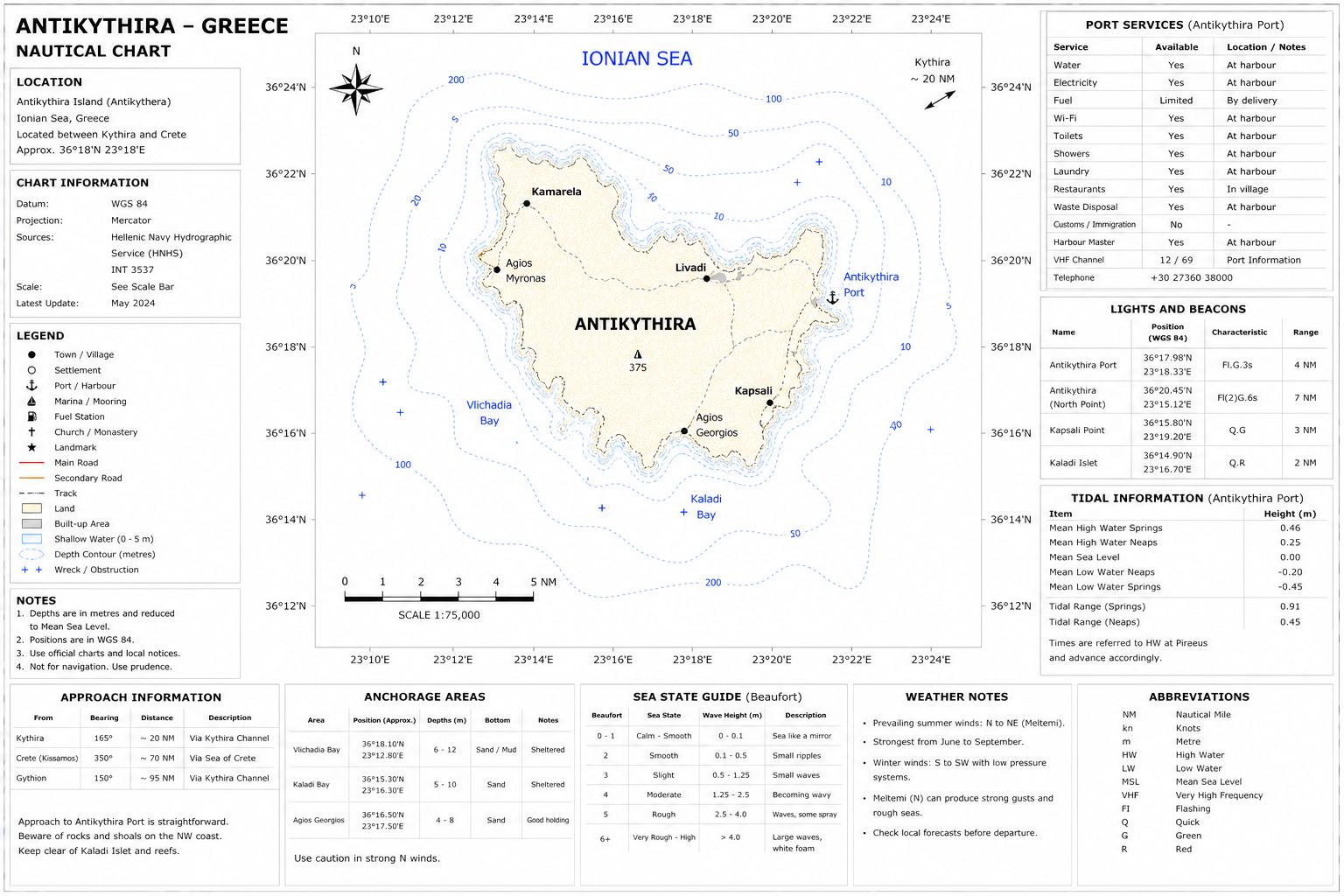
Chart Disclaimer. This chart is a schematic representation for illustrative purposes only and must not be used for navigation. Refer to official hydrographic charts for safe navigation. Be aware ENC charts may differ from official hydrographic charts. Both should be corrected and updated regularly.
About the Antikythera Mechanism
The Antikythera Mechanism is a complex geared instrument recovered from the Antikythera shipwreck near Antikythira, dating to the 2nd century BC. Constructed from bronze with an arrangement of interlocking gears, it was used to model and predict astronomical cycles, including the positions of the sun and moon, lunar phases, eclipses, and possibly planetary movements. Operated by a hand-driven input, the mechanism translated rotational motion into calibrated outputs displayed on dials. Its level of mechanical sophistication indicates advanced understanding of mathematics, astronomy, and engineering in the Hellenistic period, with no comparable device known from antiquity.
Antikythira Greece
Sailing Guide - Ocean Currents
and Tidal Flow
Currents around Antikythira are influenced by its position between the Ionian Sea and the Aegean Sea, where regional water exchange occurs through the intervening passages. There is no fixed directional current; flow is variable and largely driven by prevailing winds and broader basin circulation. Under sustained northerly winds, a south to southwest set can develop through the channel, while southerly systems may produce a north to northeast drift. Local acceleration is common around headlands and in constricted passages, where current speed can increase and create areas of turbulence and overfalls, particularly when opposing wind and sea conditions are present.
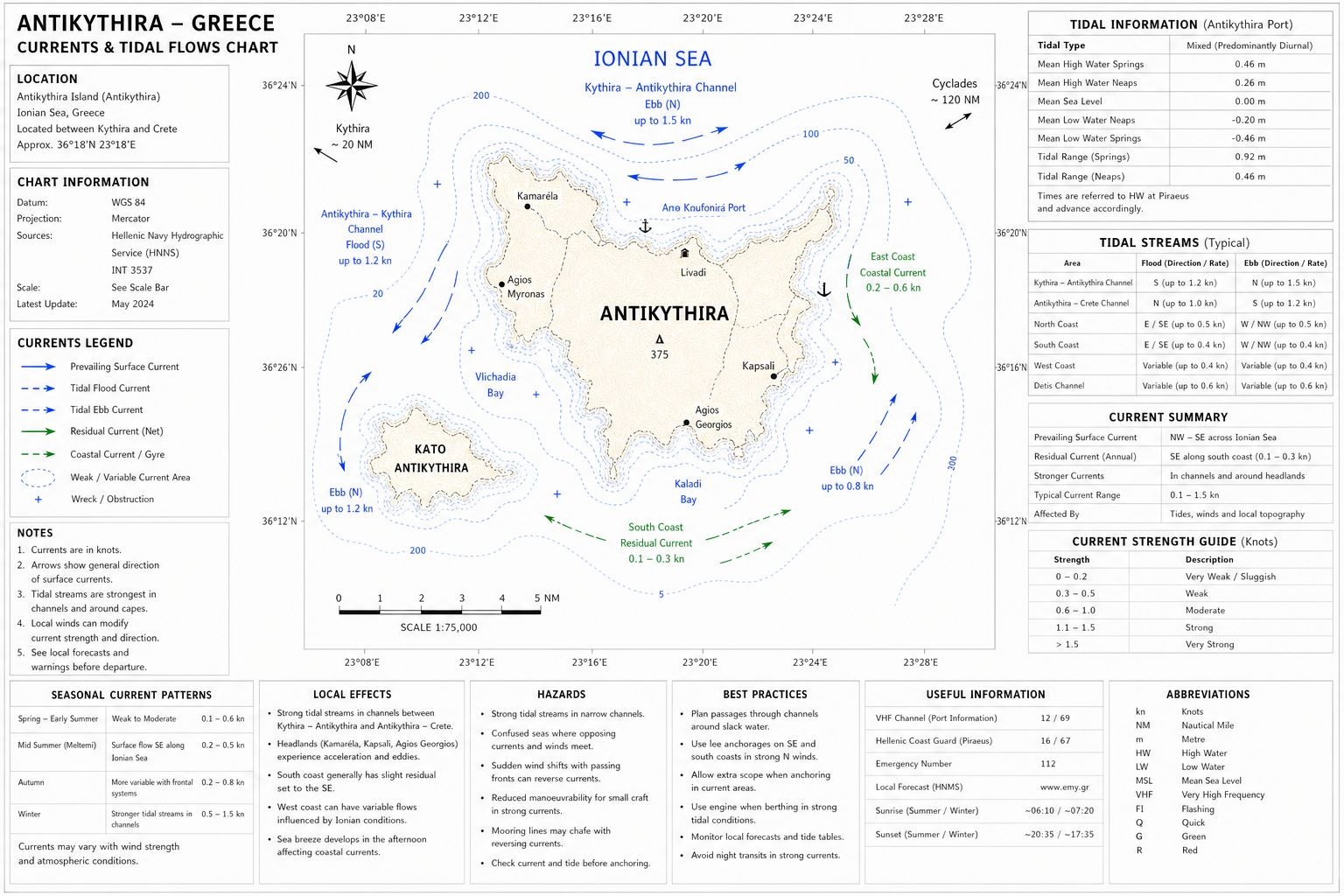
Tidal influence is negligible, with a microtidal range typically less than 0.3 m and no established tidal streams affecting navigation. Water level variation is primarily governed by wind setup and atmospheric pressure changes rather than tidal forcing. In coastal areas and near harbour entrances, current effects are minimal, but wind-driven surge and reflected wave action can create movement alongside and at anchor. For passage planning and coastal navigation, wind direction and strength remain the primary factors controlling current behaviour and sea state in the vicinity of the island.
Antikythira Greece
Sailing Guide - Weather
Weather at Antikythira is governed by its exposed position between the Ionian Sea and the Aegean Sea, with direct influence from regional pressure systems and no significant land shelter. Summer conditions are typically dry, with prevailing northerly winds extending from the Aegean Meltemi system into the area. These winds can be sustained and fresh to strong, often exceeding 20 knots, producing continuous sea state and significant wind-driven swell, particularly along exposed northern and eastern coasts.
Outside summer, conditions become more variable and often more severe. Autumn and winter are characterised by passing low-pressure systems moving through the Ionian and across southern Greece, bringing strong southerly winds ahead of fronts, followed by shifts to westerly or northerly flow after passage. These systems generate longer-period swell from the south and west, combined with reduced visibility, rain, and unstable conditions. Spring presents transitional patterns with alternating wind directions and periods of squally weather. For navigation, the key factor is the island’s full exposure to multiple weather systems, with rapid sea state development and limited shelter in all conditions.
The Marine Electrical and Electronics Bible has a complete list of Greek VHF Radio Channel information and weather forecast times for Greece along with NAVTEX UK and Europe and NAVTEX Mediterranean for 490kHz and 518kHz.
Antikythira Greece
Sailing Guide - Local Winds
Local wind patterns at Antikythira are dominated by its position in an open channel between the Ionian Sea and the Aegean Sea, with little terrain-induced shelter. In summer, the northerly Meltemi extends into the area, typically as a north to northwest flow. Wind speeds are frequently in the 15–25 knot range and can increase beyond this during stronger episodes. Acceleration occurs over and around the island, with gusting and turbulence along headlands and in the lee, particularly where airflow descends toward the southern coast.
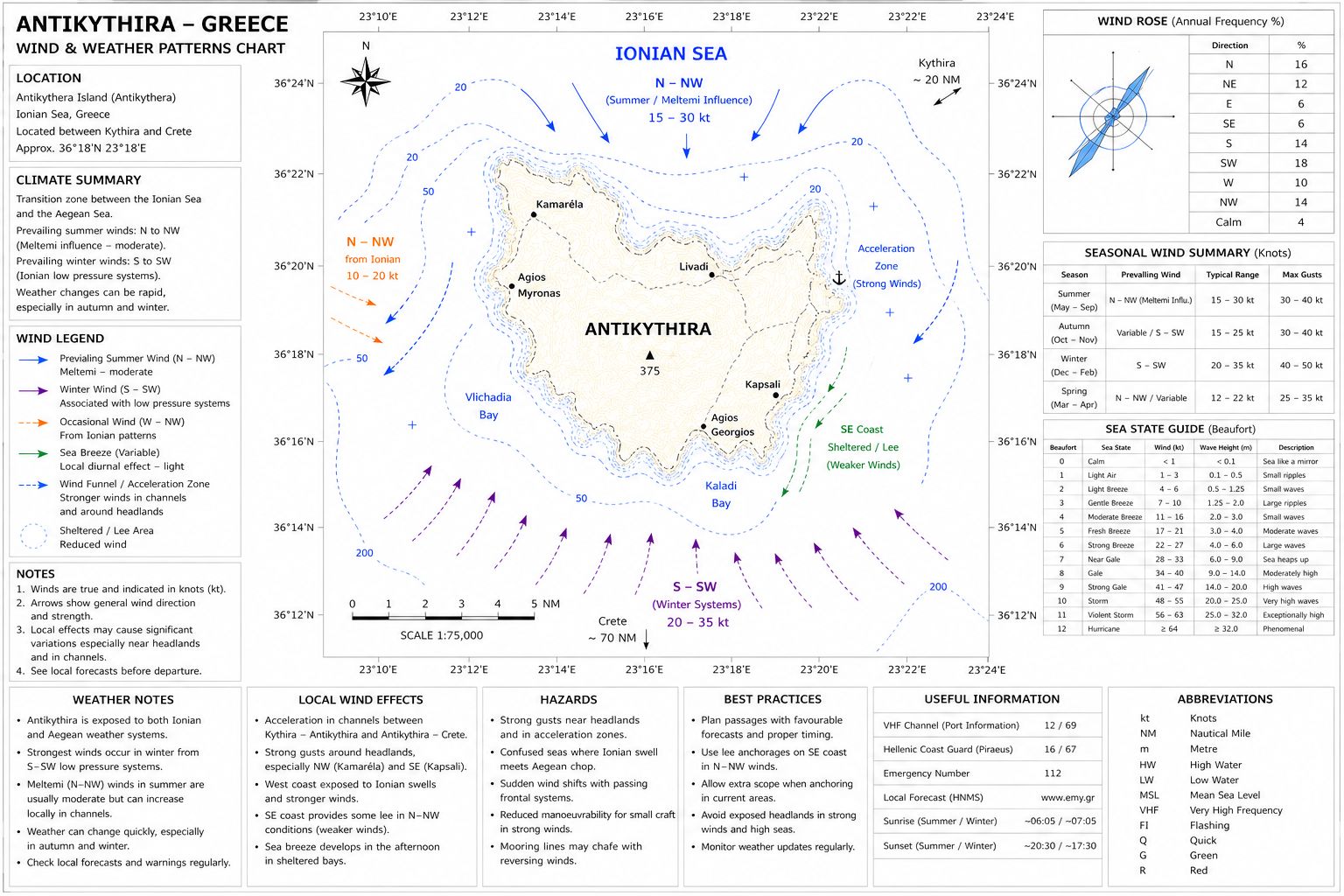
Unlike more enclosed islands, diurnal variation is limited. The Meltemi remains established day and night with only minor easing overnight. In the absence of this pattern, light and variable winds may occur, but these conditions are often short-lived due to the island’s exposure to broader regional gradients. Outside summer, wind direction becomes highly variable. Southerly and southwesterly winds ahead of passing low-pressure systems can build rapidly and are often stronger and less predictable, with higher gust factors. Following frontal passage, winds typically shift to west or northwest, sometimes increasing further before easing.
Local effects are primarily related to wind acceleration and deflection rather than shelter. There are no significant valleys or enclosed basins to modify flow; instead, winds tend to maintain strength close to the surface with abrupt gusts near the coastline. For navigation and berthing, wind direction relative to available protection is critical, as the island offers limited lee in most conditions and wind strength can increase quickly with little warning.
The Meltemi is a strong, dry northerly wind that dominates the Aegean in summer, accelerating through channels and between islands to produce steep, short seas. It is most persistent in July and August, often blowing for several days with little diurnal variation, creating fast north‑to‑south passages and challenging return routes. Its strength is shaped by pressure gradients between the Balkans and Anatolia, with local acceleration zones around major island gaps.
Antikythira Greece
Sailing Guide - Approaches
Approach to Antikythira from the north via Kythira involves open water with depths exceeding 100 metres. Wind acceleration occurs between the islands, producing short steep seas under northerly conditions.
Approach from the south via Crete presents long fetch and developed sea state under southerly winds. From the west, approach from the Ionian introduces swell conditions under westerly systems.
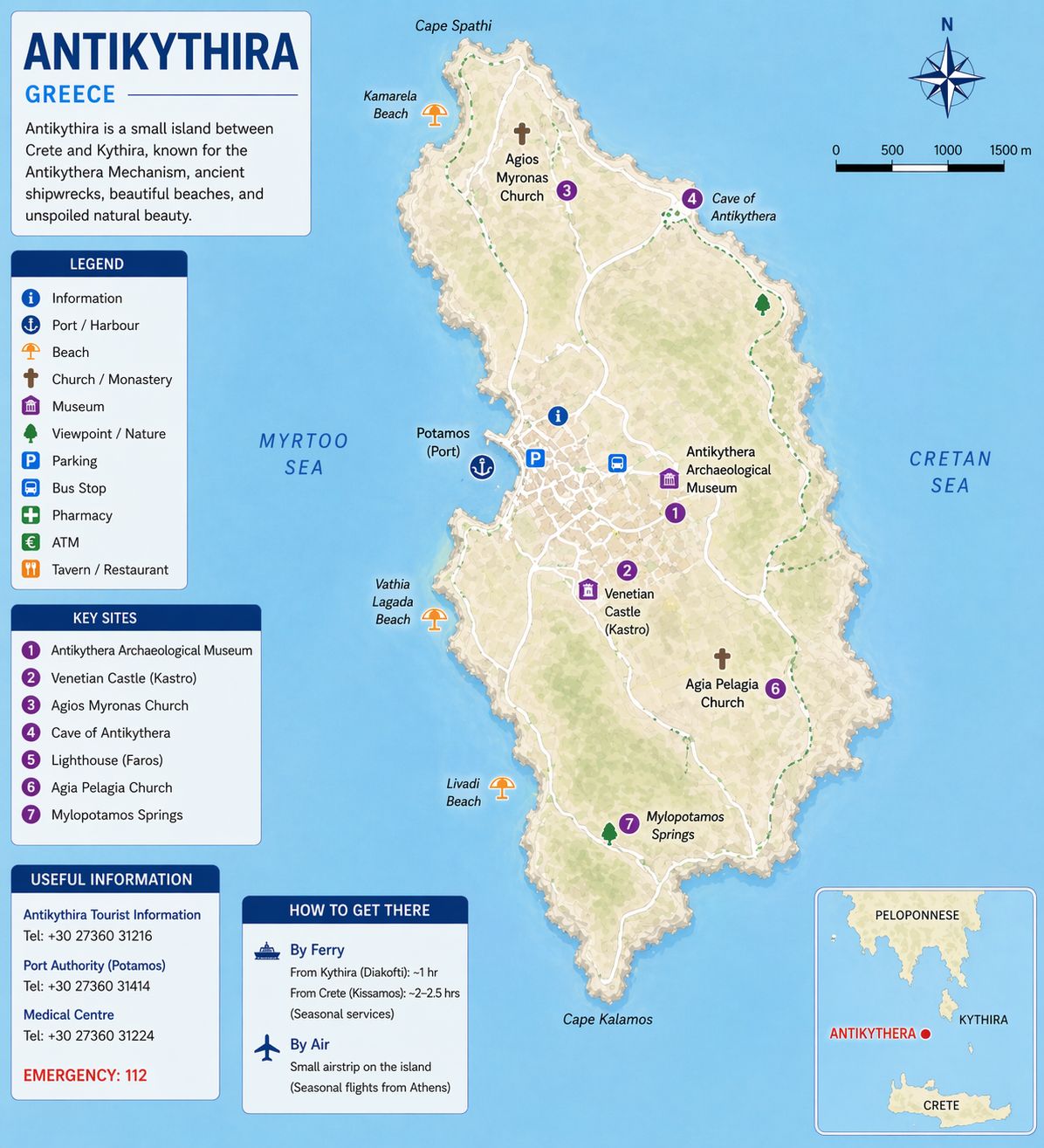
The approach to Potamos harbour requires rounding exposed headlands with gusting wind and variable sea state. Depths reduce rapidly from over 50 metres to less than 10 metres near the harbour.
Antikythira Greece
Sailing Guide - Navigation
The principal harbour at Potamos is small and constrained, with a narrow entrance and limited turning space. There is no defined dredged channel; depths are adequate in the entrance but reduce unevenly toward the inner basin and quay. Entry should be made with full control and prior assessment of wind direction, as crosswinds and surge can affect manoeuvrability. Berthing is along a short quay, typically stern-to or alongside where space permits, often requiring anchor use due to the absence of laid moorings. Ferry movements have priority and can generate significant wash and turbulence within the basin. Potamos harbour is entered from the northeast. Depths reduce from approximately 8–10 metres to 3–4 metres near the quay. Wind gusts affect approach control, particularly under northerly flow. Sea state at the entrance can be confused due to reflected swell.
Antikythira Greece
Sailing Guide - Chart Accuracy
Hydrographic charts provide accurate coastline and depth representation for Antikythira. Electronic charts align with official data but may lack detail in nearshore areas. Harbour depth soundings may vary due to sediment movement. Visual confirmation is required when manoeuvring close to quay structures.
Antikythira Greece
Sailing Guide - Anchorages
Antikythira anchorage options are limited. There are no all-weather anchorages.
- Potamos provides anchoring in depths of approximately 5–10 metres over sand and mud with moderate holding. The location offers some protection from northerly winds but remains exposed to easterly and southerly conditions.
- Additional anchoring is possible in small bays along the east coast in settled weather with depths between 6 and 15 metres over mixed seabed. These locations provide limited protection and are weather-dependent.
Antikythira Greece
Sailing Guide - Entry
Formalities
Entry formalities at Antikythira are not conducted locally, as the island is not a designated port of entry. All clearance procedures for arrival into Greece must be completed at an official port of entry such as Kythira or Chania prior to proceeding to Antikythira.
Antikythira Greece
Sailing Guide - Marina
Facilities
Marina facilities at Antikythira are absent. Berthing is limited to the small harbour at Potamos, which serves ferries and local vessels. The harbour consists of a short quay with no pontoons, no laid moorings, and no organised marina management. Depths alongside are generally adequate for moderate-draft yachts but vary along the quay and reduce toward the inner basin, requiring careful selection of berth and continuous depth awareness during approach. Potamos harbour provides quay berthing with depths between approximately 3.0 m and 4.5 m.
Berthing is typically stern-to using the anchor, or occasionally alongside where space permits. Manoeuvring room is restricted, and ferry operations take priority, requiring clear access to the quay and potential relocation of visiting yachts. Wash and propeller turbulence from ferry movements can be significant within the confined basin, affecting control and mooring loads.
Antikythira Greece
Sailing Guide - Provisioning
Supermarkets. On Agistri these are small-scale and concentrated in the main settlements, primarily Skala and Megalochori, with supply based on local demand and mainland deliveries rather than large retail infrastructure. The main outlets include Supermarket Nargos in Skala, which functions as one of the island’s primary grocery stores, carrying basic provisions, fresh produce, and packaged goods. Supporting this are smaller shops such as Victoria Mini Market and Mini Market Athanasiou, which provide convenience-level supply including dry goods, drinks, and limited fresh items.
Markets. There is no organised market. Produce availability is limited and dependent on delivery schedules. There are no organised markets, no street vendors, and no local agricultural supply chain capable of supporting visiting yachts. Any locally grown produce appears only in small, seasonal quantities and cannot be relied upon.
Fish Markets. There is no fish
market. Enquiry at
the harbour area in Potamos or with local residents may yield access to fresh
fish if a catch has recently been landed, but quantities are low and selection
is limited to what is available on the day.
Antikythira Greece
Sailing Guide - Local Cuisine
Local cuisine on Antikythira is simple and based on limited local production and infrequent supply, with meals reflecting traditional Greek island food adapted to availability. There are few tavernas, and menus are short, relying on staple ingredients such as olive oil, legumes, grains, and preserved or periodically delivered goods. Dishes are prepared in basic form without variation, consistent with the island’s small population and restricted logistics.
Common foods include slow-cooked legumes (fasolia, revithia), simple meat dishes when available (often goat or lamb), and basic preparations such as omelettes, salads, and bread with olive oil. Seafood appears only when locally caught and is not consistently available. Dairy products, including feta-style cheeses and yoghurt, are present in limited quantities depending on supply. There is no developed restaurant sector, no specialist cuisine, and no variation beyond what can be supported by local and delivered provisions. No dishes are unique to Antikythira.
Antikythira Greece
Sailing Guide - Local
Beverages
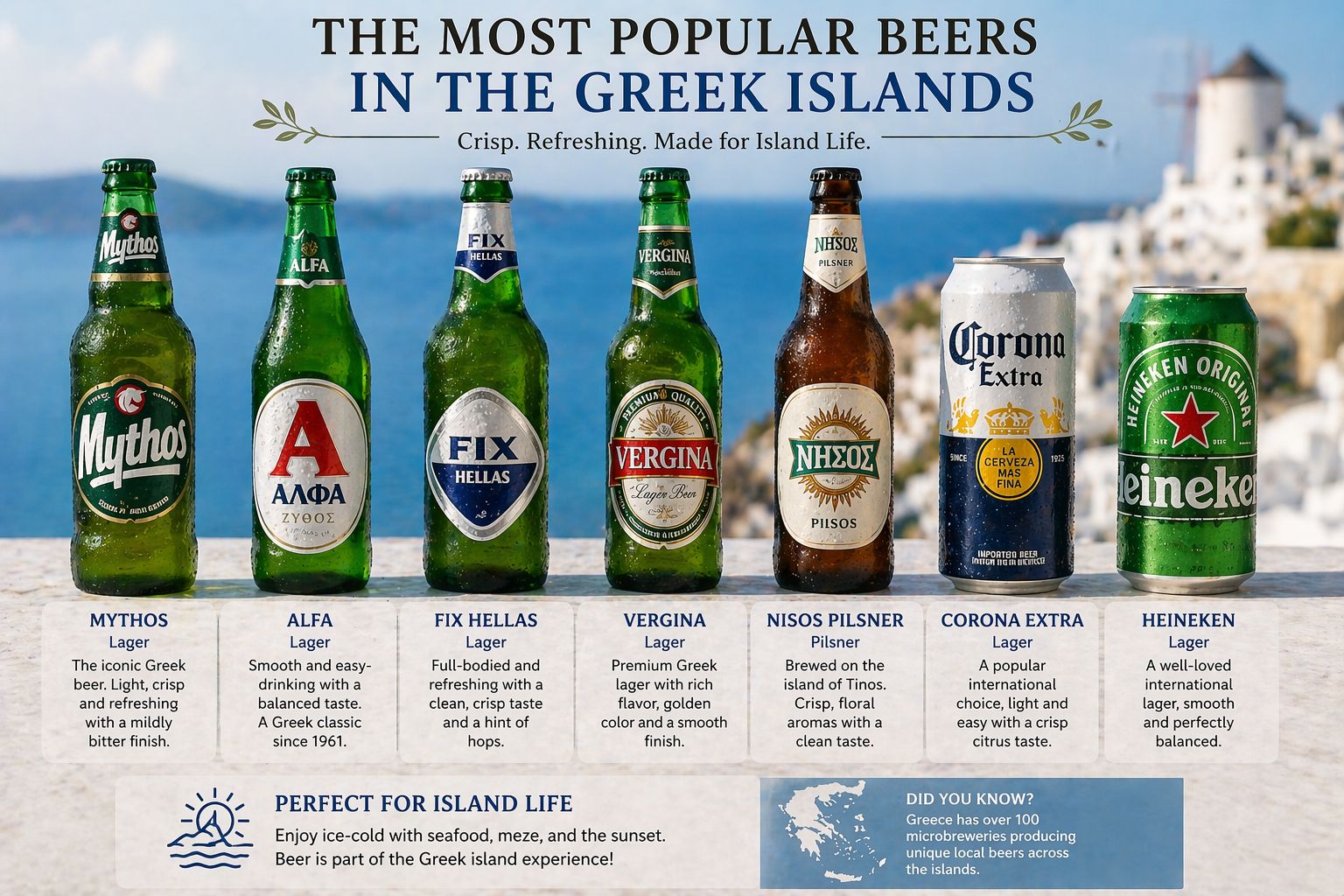
Beer supply includes Alpha, Mythos, and Fix delivered from Kythira or Crete. Wine is sourced from mainland Greece and Crete. Spirits include ouzo and tsipouro. No local production exists.
Antikythira Greece
Sailing Guide - Diesel Fuel
Supplies
Any fuel access, if possible, is ad hoc and small-scale, typically involving local arrangements using jerry cans from limited shore supply. This cannot be relied upon for quantity, availability, or quality, and should not be considered a viable option for passage planning.
Antikythira Greece
Sailing Guide - Water Supplies
The island relies on restricted local resources and delivered supply, with priority given to residents. Public or municipal taps, if present, are not intended for bulk yacht use and may be intermittent or unavailable.
Mechanical and Electrical Repairs
Resource
If you are headed somewhere remote consider the need to expand your knowledge base or have an information resource on board. Why not get a copy of my book The Marine and Electrical and Electronics Bible 4th Edition. By and for yachties, with everything from batteries and charging, solar and wind, diesel engines and marine electronics and so much more. Your complete systems guide. 650 pages of practical advice. In Australia and New Zealand order a copy through Boat Books. UK and European boats can buy the UK Edition Here. US and Canadian boats can get the US Edition Order Here. Marine systems are my profession so let me help you. By a liveaboard boat owner for other boat owners.


Antikythira Greece
Sailing Guide - Marine
Services
No marine service facilities exist on Antikythira. No authorised engine or electronics agents are present. Technical support requires relocation to Kythira or Crete where marine service infrastructure is available.
Antikythira Greece
Sailing Guide - Local
Etiquette
Local etiquette reflects a small, isolated community environment. Dress standards in settlement areas are conservative. Behaviour in public spaces is expected to align with residential norms. Taverna service is table-based with ordering required when seated. Religious sites require appropriate conduct and dress. Waste disposal is conducted at designated collection points ashore.
Antikythira Greece
Sailing Guide - Summary
Antikythira presents an exposed offshore operating environment with minimal harbour infrastructure and limited shelter. Navigation is influenced by both Aegean and Ionian wind systems, requiring careful planning for approach and anchorage. Provisioning and services are minimal and must be arranged through nearby islands. The location functions as a remote stop requiring self-sufficiency, consistent with an Antikythira Greece Sailing Guide for all you need to know.