Anafi Greece Sailing Guide
Anafi Greece Sailing Guide. Situated in the southeastern Cyclades, east of Santorini, Anafi is an exposed, sparsely developed island with limited harbour infrastructure and a predominantly open coastline. The island lies directly within the Aegean wind system, with long, unobstructed fetch in multiple directions. Approaches are generally clear of hazards in open water, but the absence of natural shelter requires accurate wind assessment prior to arrival, as sea state can build rapidly with little attenuation.
For a cruising yacht, Anafi functions as a weather-dependent stop rather than a secure harbour. Berthing is confined to a small quay facility, with additional anchoring possible in adjacent bays over sand and rock substrates. Protection is limited and highly directional, with most locations exposed to the prevailing summer northerlies and any southerly systems. Holding can be variable depending on seabed composition, and swell penetration is common, particularly in open road steads. Arrival and departure planning must account for wind strength, available swinging room, and the lack of alternative sheltered options nearby.
Anafi Greece Sailing Guide - History
Anafi has been inhabited since antiquity with early settlement linked to maritime routes between the Cyclades and Crete. Archaeological remains include ancient harbour activity associated with Agios Nikolaos and religious structures on elevated ground inland. Maritime use historically consisted of small-scale coastal transport and fishing.
During Byzantine and later periods, Anafi remained isolated with limited strategic maritime value due to lack of natural harbours. Modern harbour construction at Agios Nikolaos provides basic ferry access and cargo landing capability. There is no historical development of large-scale port infrastructure.
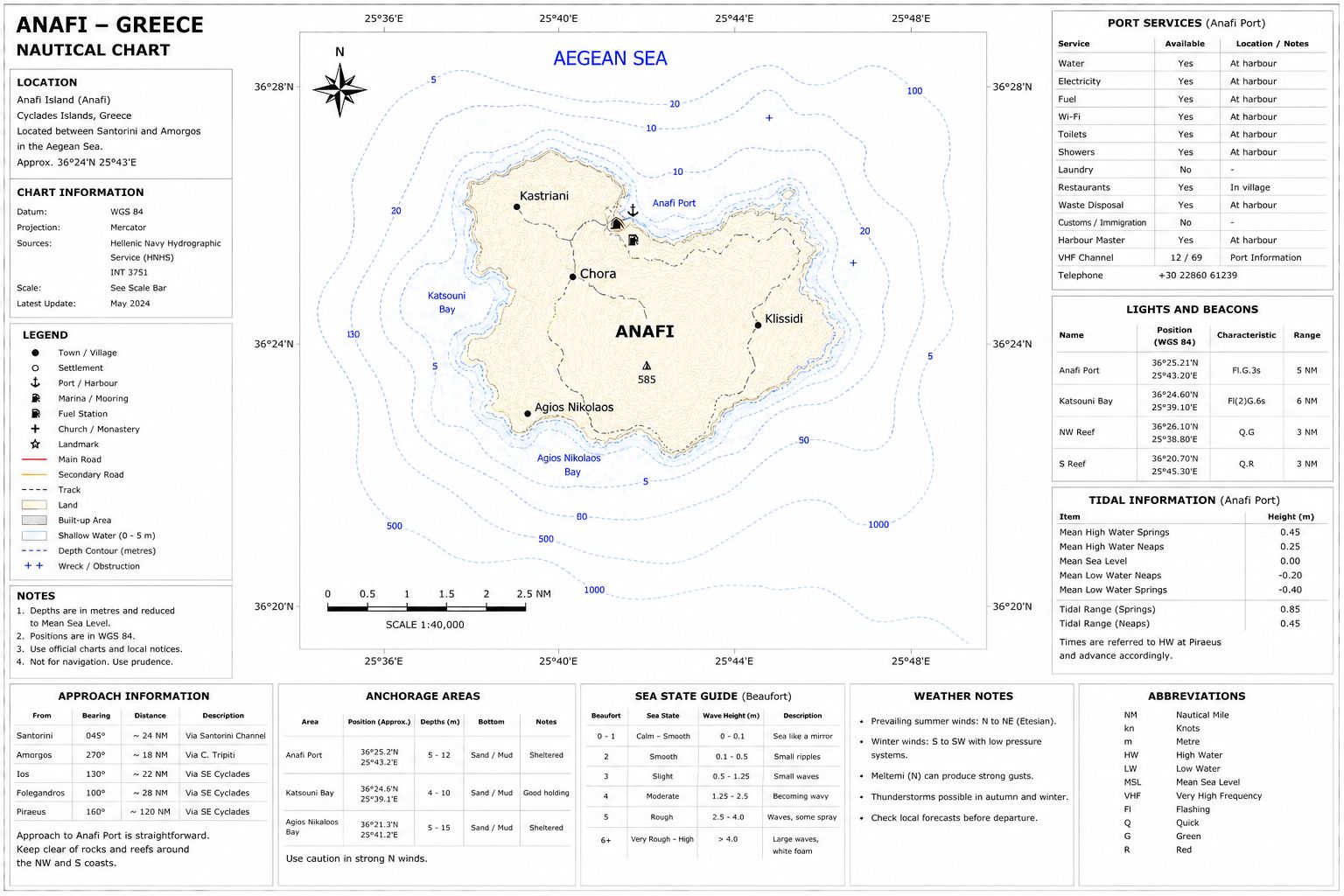
Chart Disclaimer. This chart is a schematic representation for illustrative purposes only and must not be used for navigation. Refer to official hydrographic charts for safe navigation. Be aware ENC charts may differ from official hydrographic charts. Both should be corrected and updated regularly.
Anafi Greece Sailing Guide - Ocean
Currents and Tidal Flow
Currents around Anafi are weak and primarily wind-driven, with no consistent set or drift pattern independent of prevailing conditions. The island lies in open Aegean water east of Santorini, and current behaviour reflects regional circulation rather than localised tidal streams. In settled conditions, surface movement is negligible and variable. Under sustained northerly winds, a general south to southwest set may develop along the island’s exposed coasts, while southerly systems can produce a reverse north to northeast drift. These flows are typically low velocity but can become operationally relevant when combined with fresh winds and sea state.
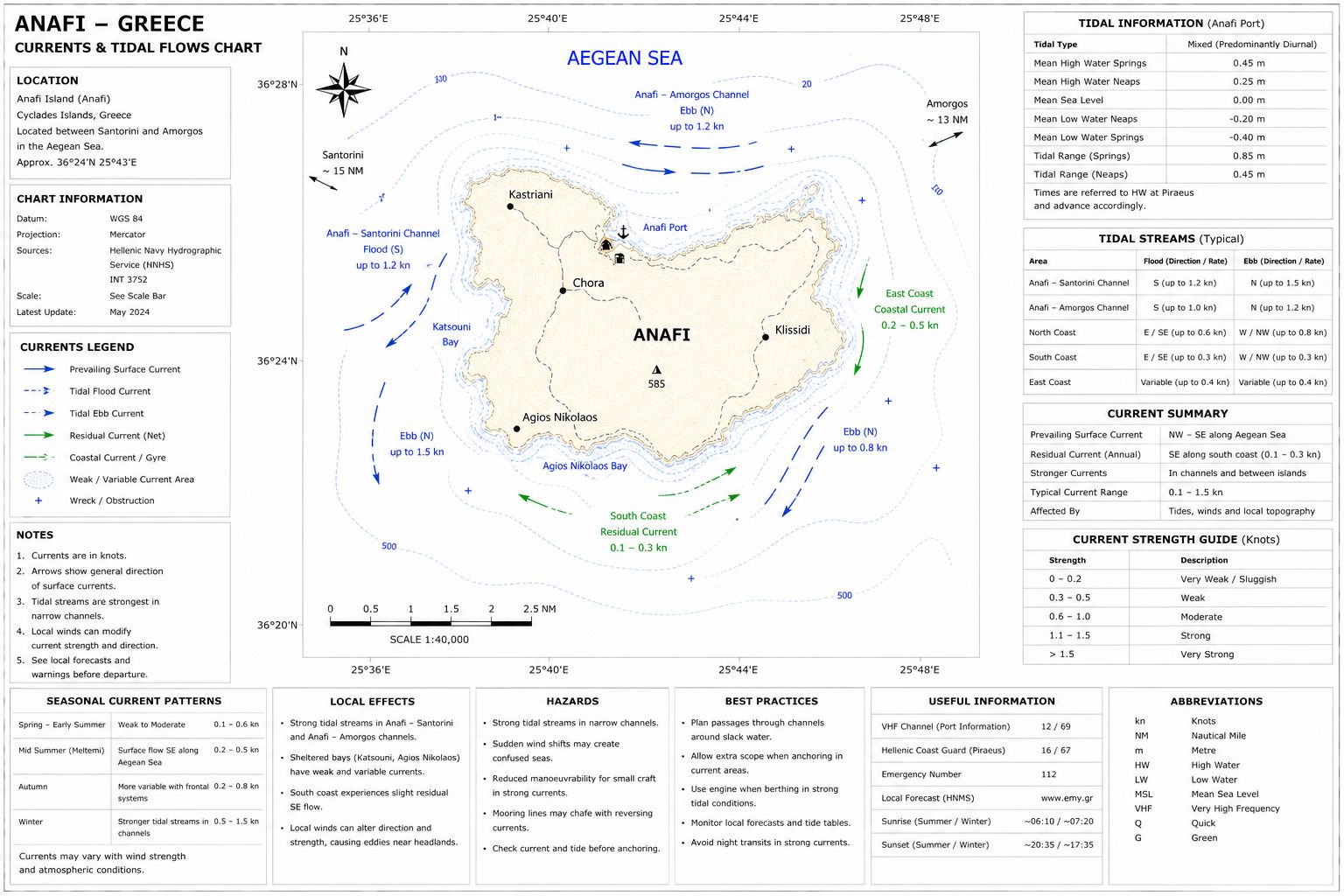
Tidal influence is minimal, with a microtidal range typically less than 0.3 m and no defined tidal streams affecting navigation. Water level variation is instead influenced by wind setup and barometric pressure changes. Prolonged strong winds can create localised elevation or set-down along specific shorelines, altering effective depths at quays and anchorages. In confined areas near the main harbour, minor current effects may occur due to surge, wave reflection, and vessel movement, but these are intermittent and not predictable. For navigation and anchoring, wind direction and resulting sea state are the controlling factors rather than tidal or current considerations.
Anafi Greece Sailing Guide - Weather
Weather at Anafi is dominated by its exposed position in the southeastern Cyclades, with direct influence from Aegean synoptic systems and minimal local sheltering effects. Summer conditions are typically dry, with persistent northerly winds (Meltemi regime) frequently in the 15–25 knot range and higher during stronger episodes. These winds are often sustained over multiple days, producing continuous sea state and significant wind-driven swell, particularly along the northern and eastern coasts. Visibility is generally good, with minimal haze.
Outside the summer period, conditions become more variable. Spring and autumn bring transitional systems with alternating northerly and southerly flows, often accompanied by rapid wind shifts, squalls, and reduced visibility in rain bands. Southerly winds ahead of low-pressure systems can build quickly and generate heavier sea states due to longer fetch from the open Aegean. Winter conditions are characterised by passing frontal systems, with periods of strong winds from multiple directions, lower temperatures, and increased precipitation. For navigation and berthing, wind strength and direction are the primary operational factors, with limited protection available anywhere around the island.
The Marine Electrical and Electronics Bible has a complete list of Greek VHF Radio Channel information and weather forecast times for Greece along with NAVTEX UK and Europe and NAVTEX Mediterranean for 490kHz and 518kHz.
Anafi Greece Sailing Guide - Local Winds
Local wind patterns at Anafi are dominated by exposure to the open Aegean, with minimal topographic shelter and limited land-induced moderation. The primary regime in summer is the northerly Meltemi, which establishes as a persistent gradient wind rather than a diurnal cycle. It typically sets from the north to northwest and can remain established for several consecutive days, commonly in the 15–25 knot range and stronger during peak events. Wind acceleration occurs over headlands and through gaps in the terrain, producing localised gusting and turbulence, particularly along the western and southern coasts where flow descends and wraps around the island.
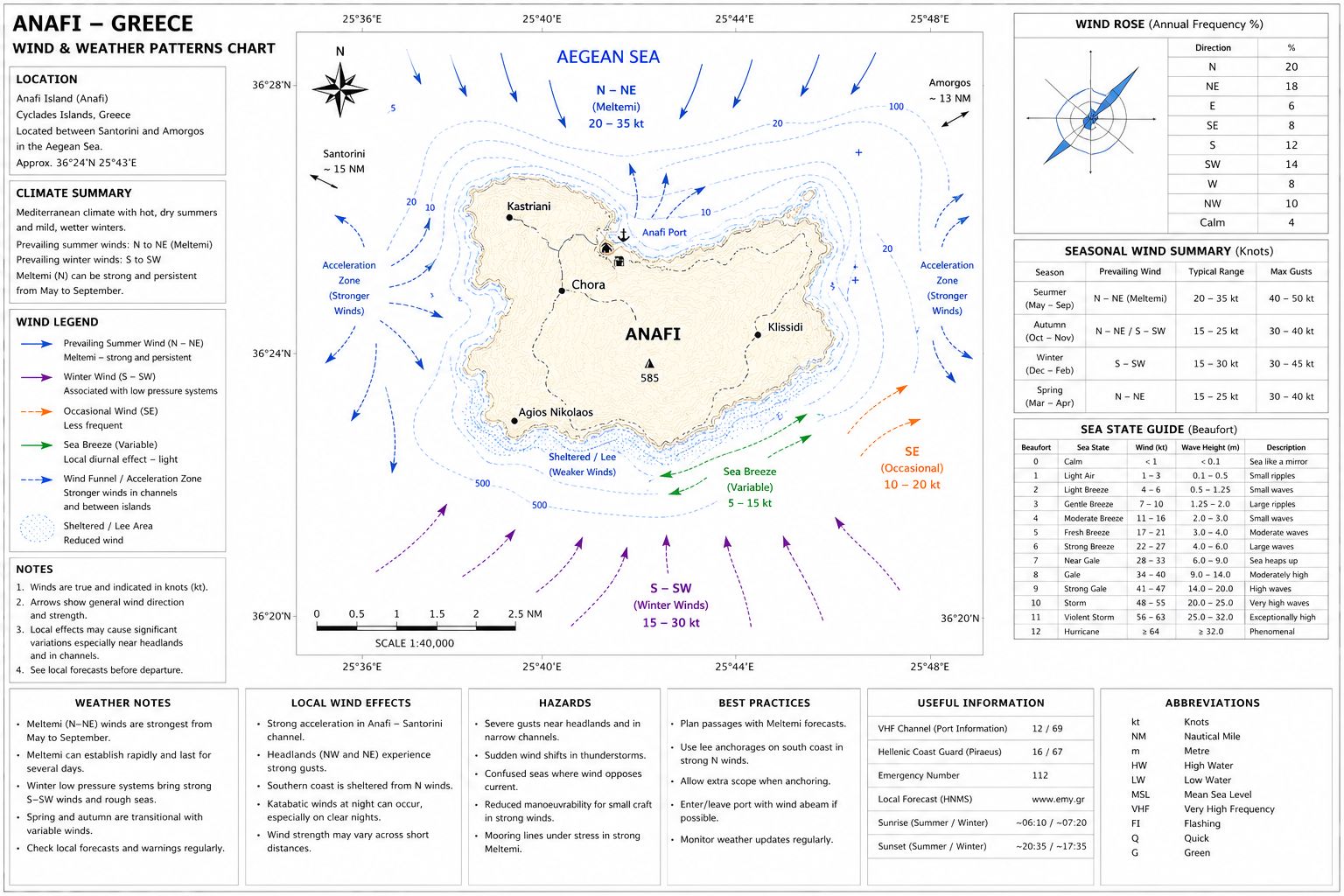
Diurnal effects are secondary and weak. Overnight winds may ease slightly but rarely drop out completely under a Meltemi pattern. In the absence of strong synoptic flow, light and variable conditions can occur, with minor sea breeze development from the south to southeast during midday, generally below 10 knots and short-lived. Outside summer, wind direction becomes variable with passing systems. Southerly winds ahead of fronts can build rapidly and are often less predictable, with stronger gust factors and increased moisture, followed by a shift back to northerly or northwesterly flow after frontal passage. In all cases, wind direction relative to available shelter is the controlling factor, as the island offers limited protection from any quadrant.
The Meltemi is a strong, dry northerly wind that dominates the Aegean in summer, accelerating through channels and between islands to produce steep, short seas. It is most persistent in July and August, often blowing for several days with little diurnal variation, creating fast north‑to‑south passages and challenging return routes. Its strength is shaped by pressure gradients between the Balkans and Anatolia, with local acceleration zones around major island gaps.
Anafi Greece Sailing Guide - Approaches
Approach to Anafi from the west via Santorini presents open Aegean conditions with depths exceeding 100 metres until close to the coast. Meltemi winds produce steep seas opposing southbound movement. From the east, approach from Amorgos presents similar open-water conditions with strong wind acceleration zones between islands. The approach to Agios Nikolaos harbour on the south coast requires rounding exposed headlands where gusting winds and confused seas occur under Meltemi conditions. Depths reduce rapidly from over 50 metres to less than 10 metres within short distance from shore. Hazards include rock-bound coastlines and limited safe approach corridors.
Anafi Greece Sailing Guide - Navigation
Local navigation at Anafi is conducted in open, exposed waters with limited fixed aids and minimal harbour infrastructure. Coastal approaches are generally clear in deep water, but the shoreline is indented with isolated rock outcrops, reef extensions, and abrupt depth changes close inshore. Water clarity is typically good, allowing visual identification of hazards in settled conditions; however, reliance on visual navigation alone is not sufficient in reduced light or sea state. Electronic and charted navigation should be cross-checked continuously, particularly when closing the coast.
The principal harbour area at Agios Nikolaos is small, with constrained manoeuvring space and variable depths alongside the quay. Entry should be made with full awareness of wind direction, as crosswinds and surge can affect control during approach. There is no defined dredged channel; depths reduce irregularly toward the harbour, and turning space is limited once inside. Berthing is typically stern-to or alongside where space permits, often requiring anchor assistance. Holding outside the harbour is variable over sand and rock, and swell penetration can affect both anchorage and quay conditions.
Around the island, there are no significant tidal streams, and current effects are negligible; however, wind-driven set and sea state are the primary navigation factors. Northerly winds generate steep seas on exposed coasts, while southerlies create uncomfortable conditions in otherwise usable anchorages. Lee shore conditions can develop rapidly with wind shifts, and there are few alternative shelters within short distance. Passage planning should account for exit options and timing relative to prevailing wind, as conditions can deteriorate quickly with limited scope for relocation once committed.
Anafi Greece Sailing Guide - Chart
Accuracy
Hydrographic charts for Anafi provide accurate coastline and depth representation. Electronic charts align with official data but may lack detail in nearshore areas. Harbour depth data may vary due to sediment movement. Visual confirmation is required when manoeuvring close to quay.
Anafi Greece Sailing Guide - Anchorages
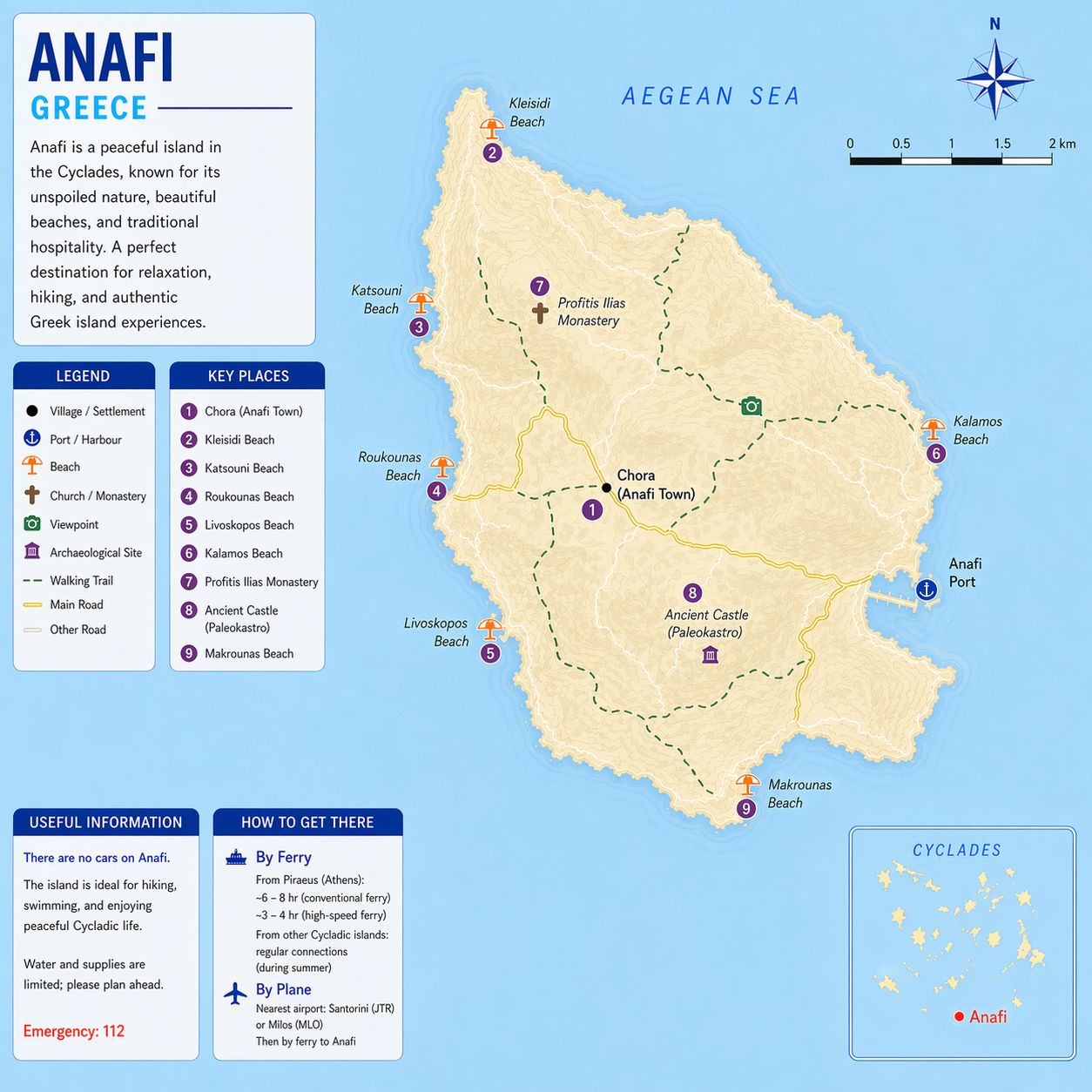
Anafi anchorage options are limited. There are no all-weather anchorages on Anafi.
- Agios Nikolaos provides anchoring in depths of approximately 5–10 metres over sand and mud. Holding is generally reliable. The location is sheltered from northerly winds but exposed to southerly systems.
- Kleisidi Beach offers limited anchoring in settled conditions with depths between 6 and 12 metres over sand. Exposure to northerly swell limits use.
Anafi Greece Sailing Guide - Entry
Formalities
Anafi is not an entry port. Clearance must be completed at Santorini or another designated port of entry.
Anafi Greece Sailing Guide - Marina
Facilities
There are no marinas on Anafi. Agios Nikolaos harbour provides quay berthing with depths between approximately 2.5 m and 4.0 m. Berthing is stern-to or bows-to using own anchor. The seabed is sand and mud with adequate holding for anchor-assisted berthing. Quay space is limited and shared with ferry operations. Wash from ferries is moderate compared to larger ports but still affects vessels alongside. There are no pontoons, no managed berthing system, and no lifting or repair facilities.
Available space is limited and subject to ferry movements, which take priority and dictate clearance requirements within the basin. Manoeuvring room is restricted, and approach should be made with full control of speed and heading, particularly under crosswind conditions. Depths alongside are variable but generally suitable for moderate-draft yachts, with caution required due to uneven seabed and potential obstructions near the quay edges.
Anafi Greece Sailing Guide - Provisioning
Supermarkets. Provisioning is limited. Small grocery outlets operate near Agios Nikolaos and inland in Chora supplying packaged goods, bread, and limited produce. Bread is available from local bakeries, typically in the morning hours. These outlets operate daily with variable hours and depend on ferry deliveries from Santorini. There are no large supermarkets. Bulk provisioning is conducted in Santorini prior to arrival.
Markets. There is no organised market. Fresh produce availability on Anafi is limited and there are no formal produce markets. Supply is handled through a small number of general stores in Chora, where fruit and vegetables are stocked in low volume alongside other provisions. Selection is seasonal and dependent on ferry deliveries, with irregular restocking intervals and variable quality. Locally grown produce appears in small quantities when in season, but this does not provide a consistent supply. Access from the harbour at Agios Nikolaos requires transport or an uphill walk.
Fish Markets. There is no fish market. Fish supply at Anafi is informal and limited, with no dedicated fish market or consistent commercial outlet. Availability depends on small-scale local fishing activity, with catches brought ashore in low volume and sold directly or through local tavernas. There is no guaranteed daily supply, and selection varies according to season, weather, and fishing effort. Purchasing is typically arranged by enquiry at waterfront tavernas near Agios Nikolaos or within the main settlement. In some cases, local fishermen may sell directly from the quay on return, but this is irregular and not scheduled.
Anafi Greece Sailing Guide - Local Cuisine
Local cuisine on Anafi is simple and based on limited local production, with dishes reflecting traditional Cycladic food adapted to small-scale supply. Ingredients centre on olive oil, grains, legumes, and locally available meat, particularly goat and lamb, with preparation focused on slow-cooked and baked foods. Common dishes include chickpea stews (revithia), fava (split pea puree), and oven-cooked meats, along with basic salads using seasonal vegetables when available. A characteristic local item is rustic bread and simple pies made with local cheese and herbs, produced in small quantities. Dairy products such as fresh cheeses and yoghurt are present but limited. Fish is prepared as psari psito using available species. Small fish are served as gavros tiganitos when available. Baked fish is prepared as psari sto fourno. Meat dishes include souvlaki, gyro, and kontosouvli, with slow-cooked dishes such as kokkinisto and stifado. Vegetable dishes include horiatiki salata, gemista, and briam. Bread is served as psomi. There are no dishes unique to Anafi.
Anafi Greece Sailing Guide - Local
Beverages
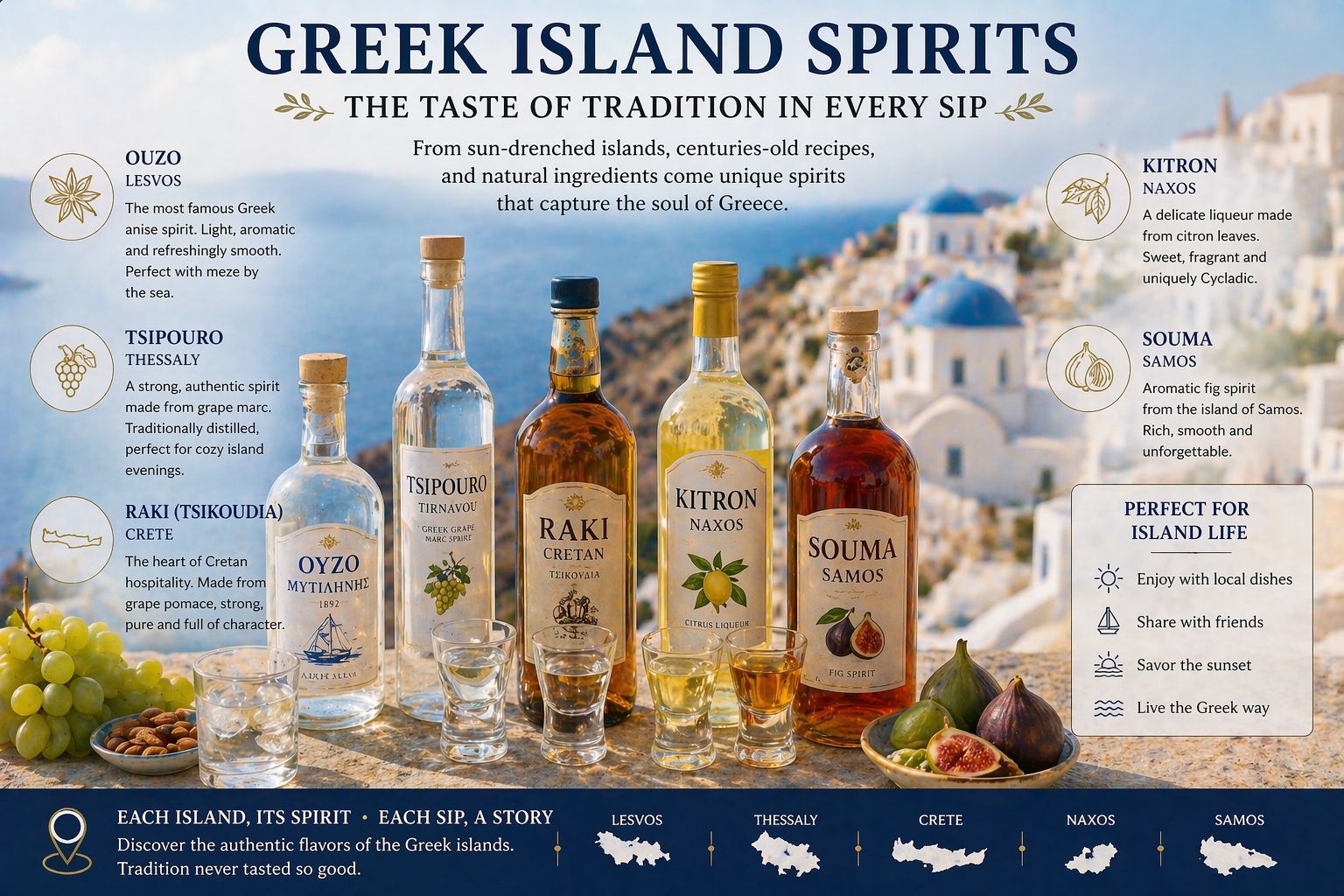
Alcoholic options are typical of small Greek islands, with bottled beers from mainland breweries, basic table wines, and a narrow selection of spirits. Locally produced or regionally sourced items such as house wine and simple distilled spirits may be available through tavernas, but there is no dedicated retail outlet for specialised or premium products. There are no bulk purchase options or dockside supply services. Beer supply includes Alpha, Mythos, and Fix delivered from Santorini. Wine is sourced from Cyclades and mainland Greece. Spirits include ouzo and tsipouro. No local production exists.
Anafi Greece Sailing Guide - Diesel Fuel
Supplies
There is no fuel dock on Anafi. Diesel supply is by road tanker delivery arranged through local contacts. Delivery is dependent on ferry schedules and must be planned in advance.
Anafi Greece Sailing Guide - Water
Supplies
Potable water is available at Agios Nikolaos harbour through municipal supply points. Pressure is variable and supply is limited during peak demand.
Mechanical and Electrical Repairs
Resource
If you are headed somewhere remote consider the need to expand your knowledge base or have an information resource on board. Why not get a copy of my book The Marine and Electrical and Electronics Bible 4th Edition. By and for yachties, with everything from batteries and charging, solar and wind, diesel engines and marine electronics and so much more. Your complete systems guide. 650 pages of practical advice. In Australia and New Zealand order a copy through Boat Books. UK and European boats can buy the UK Edition Here. US and Canadian boats can get the US Edition Order Here. Marine systems are my profession so let me help you. By a liveaboard boat owner for other boat owners.


Anafi Greece Sailing Guide - Marine
Services
No marine service providers are located on Anafi. No authorised engine or electronics agents are present. Technical support requires relocation to Santorini where marine service capability exists.
Anafi Greece Sailing Guide - Local
Etiquette
Local etiquette relates to conduct within a small and isolated island community. Dress standards in Chora and village areas are conservative. Behaviour in public spaces is expected to align with residential norms, particularly during evening hours. Taverna service is table-based with ordering expected when seated. Religious sites require appropriate conduct and dress. Waste disposal is conducted at designated locations ashore.
Anafi Greece Sailing Guide - Summary
Anafi presents an exposed Aegean operating environment with minimal harbour infrastructure and limited anchorage options. Navigation is straightforward but constrained by wind strength and exposure. Provisioning and services are minimal and require prior planning through Santorini. The island functions as an isolated stop within Cycladic routes, consistent with an Anafi Greece Sailing Guide for all you need to know.