Agistri Greece Sailing Guide
Agistri Greece Sailing Guide. Located in the Saronic Gulf southwest of Athens, Agistri is a small, low-lying island with indented coastline and multiple accessible inlets suitable for small craft. The island sits within short sailing distance of major mainland ports and established cruising routes, making it a frequent stop for coastal passages. Approaches are straightforward in settled conditions, with generally good water clarity, defined shoreline features, and depths that reduce predictably toward the coast, though care is required around isolated shoal patches and reef extensions.
For a cruising yacht, Agistri offers a mix of quay berthing and open anchorage in several bays, with conditions highly dependent on wind direction within the Saronic Gulf. The primary harbour areas provide stern-to mooring with laid lines or anchor assistance, while surrounding bays offer anchoring over sand and weed in moderate depths. Exposure varies by location, with protection typically available from the prevailing summer northerlies but increased vulnerability to southerly winds, which can generate short fetch seas and surge in open anchorages.
Agistri Greece Sailing Guide -
History
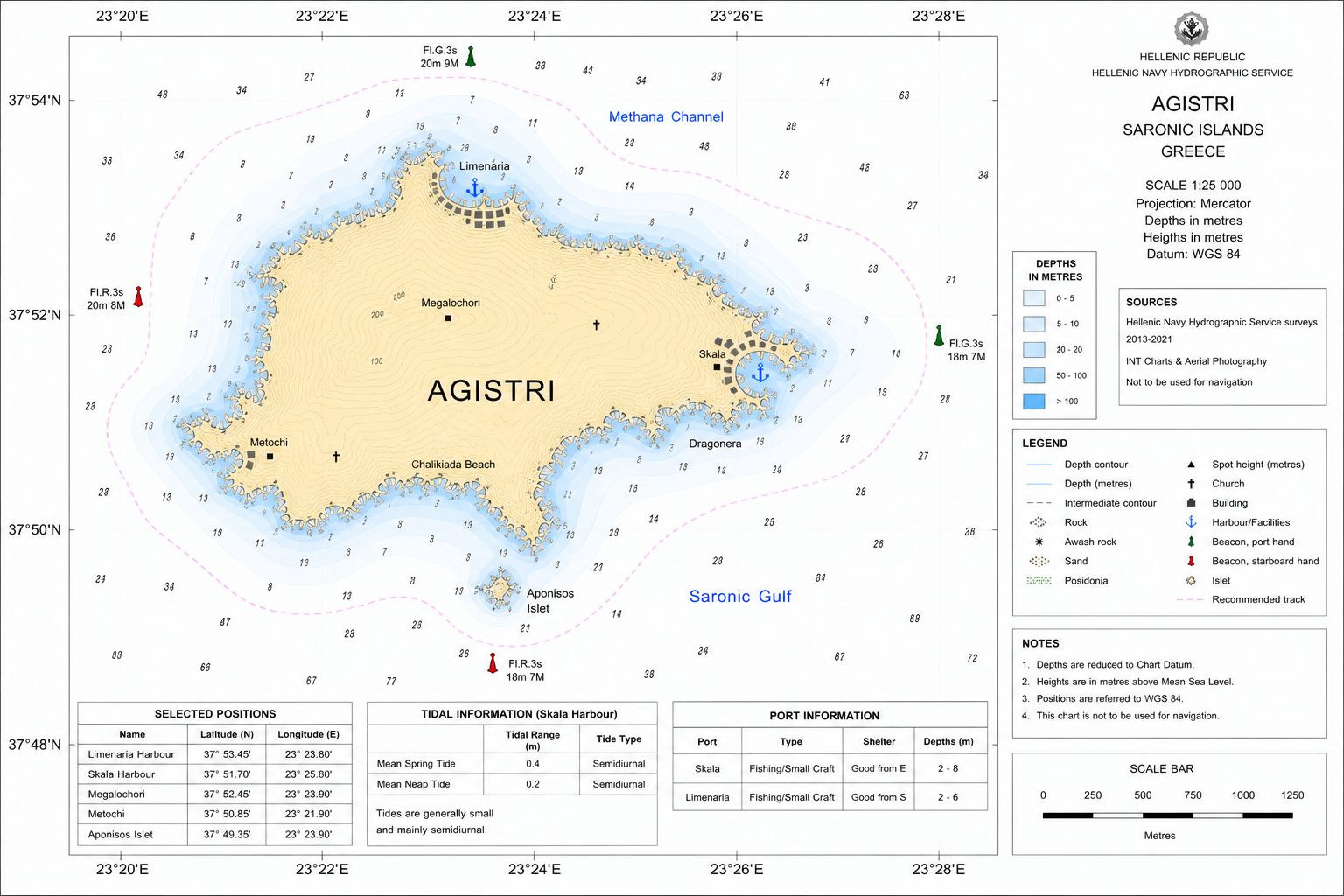
Agistri developed as a minor maritime satellite to Aegina, which operated as a major naval and commercial centre during the classical period. Harbour use on Agistri was limited to small-scale coastal movement and fishing activity, with settlements located at naturally sheltered landing points rather than engineered ports.
During Byzantine and Ottoman periods, the island retained limited maritime importance and was not developed as a strategic harbour. Modern harbour construction at Skala and Megalochori reflects ferry access requirements rather than commercial shipping. No significant maritime infrastructure legacy influences current Agistri navigation or harbour configuration.
Agistri Greece Sailing Guide -
Ocean Currents and Tidal Flow
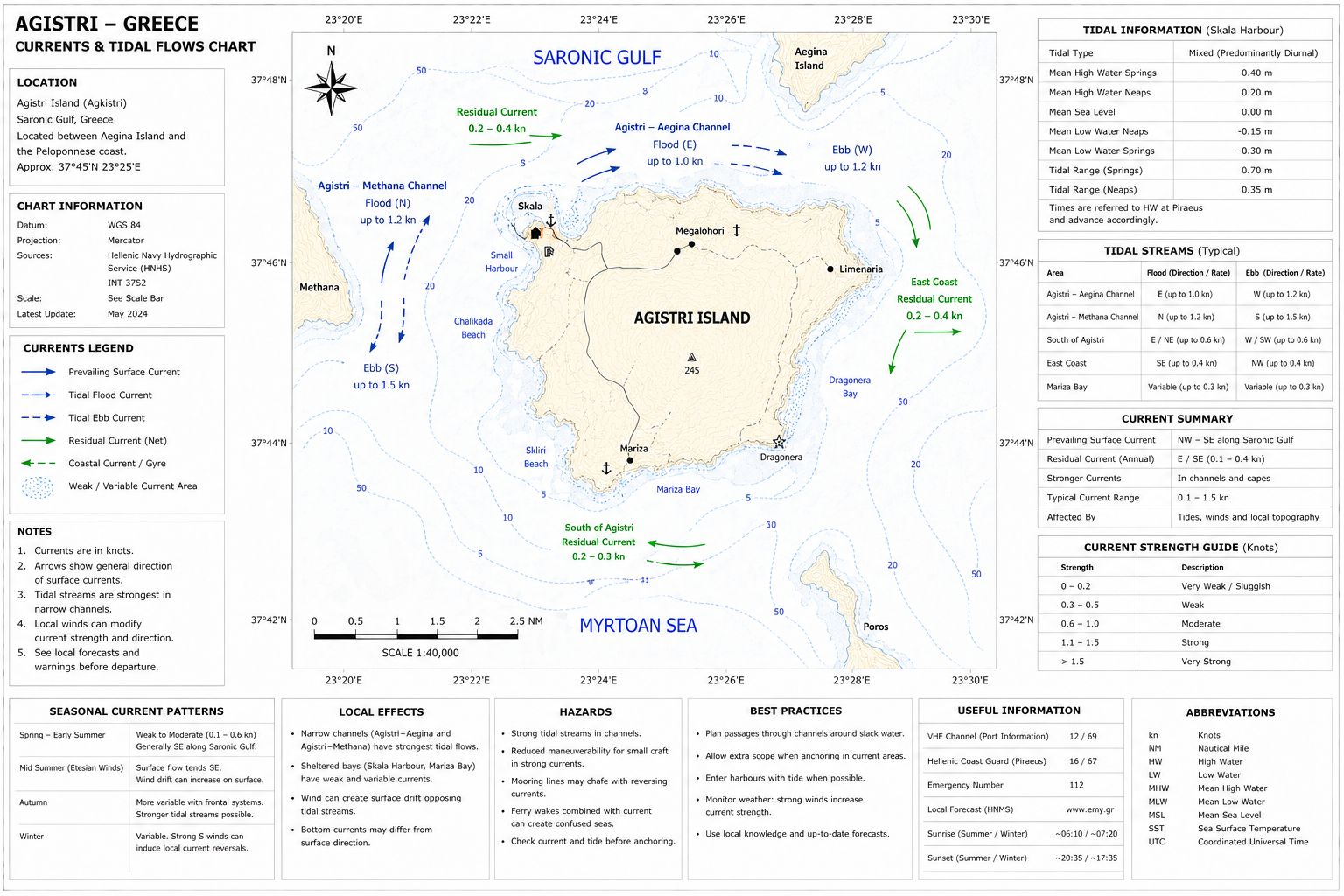
The Saronic Gulf is microtidal with a tidal range typically below 0.3 metres. Tidal streams are negligible and do not affect Agistri navigation, harbour entry, or anchoring. No tidal planning is required. Surface movement is wind-driven. Under NW wind conditions, a SE-setting drift of approximately 0.2 to 0.6 knots is observed across Agistri anchorage areas and approach routes. Under southerly conditions, this reverses to a NW-setting drift. Localised eddies occur around headlands and within the Agistri–Aegina channel. No current races, overfalls, or tidal anomalies are present.
Agistri Greece Sailing Guide -
Weather
Weather affecting sailing Agistri Greece operations follows a Mediterranean seasonal regime. Summer conditions are stable with extended dry periods, high visibility, and consistent wind patterns. Wind is the primary operational factor. Winter introduces low pressure systems producing S–SW winds, rainfall, and reduced visibility. These systems affect Agistri harbour exposure and anchorage suitability through increased sea state. Transitional periods present variable wind conditions with reduced predictability. Weather impact on Agistri anchorage and navigation is governed by wind direction and duration rather than temperature or precipitation.
Agistri Greece Sailing Guide -
Local Winds
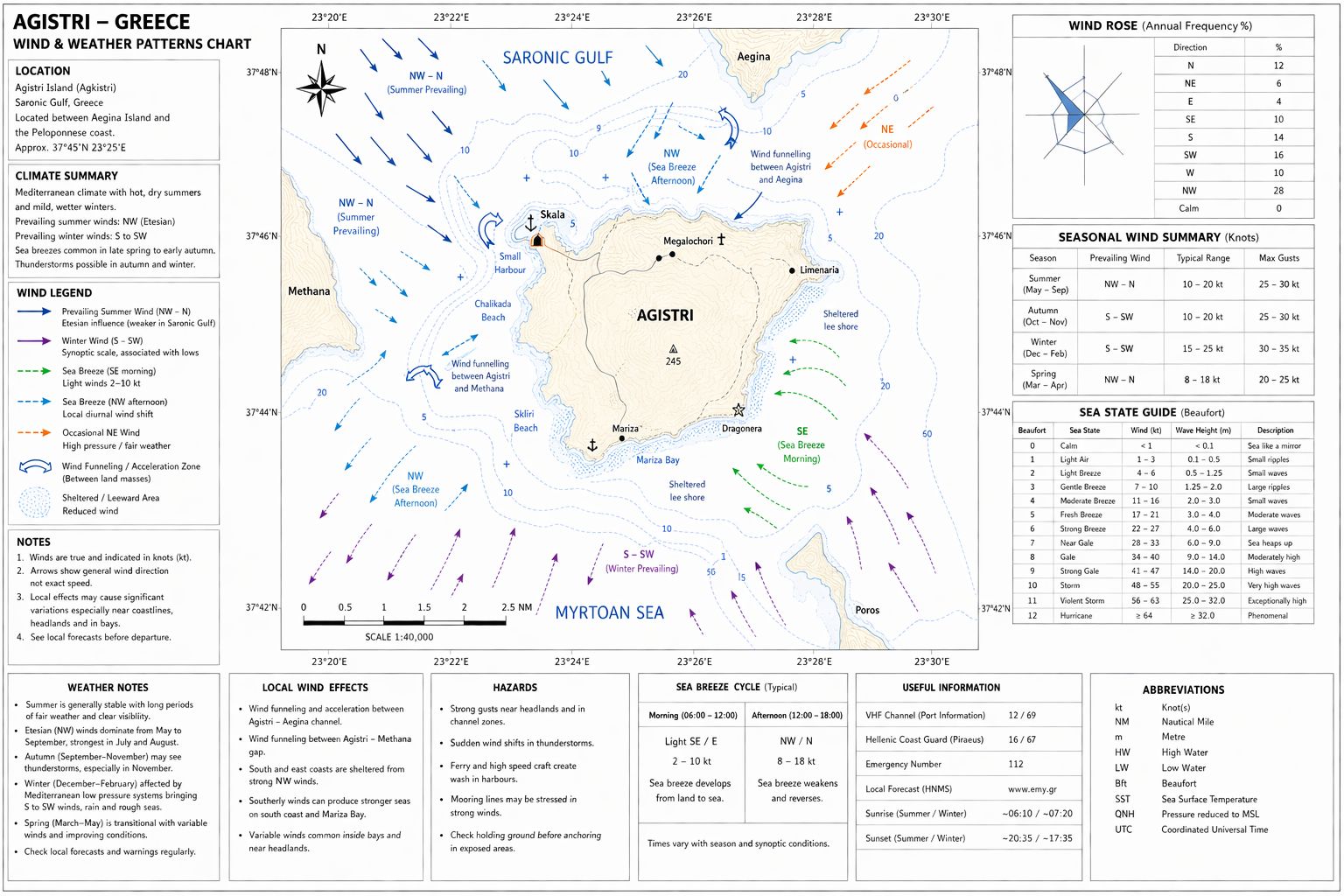
The Meltemi wind system dominates summer conditions, producing N to NW winds typically between 10 and 20 knots within the Saronic Gulf. Although reduced compared to the Cyclades, it remains the controlling factor for Agistri navigation. Wind acceleration occurs between Agistri and Aegina and around exposed headlands, increasing local wind strength above forecast values. This affects anchorage holding and harbour manoeuvring. Winter wind patterns consist of S to SW flow between 15 and 30 knots associated with passing low pressure systems. These generate longer fetch and increased sea state affecting southern anchorages.
Agistri Greece Sailing Guide -
Approaches
Approach from the north via the Aegina channel provides depths between 20 and 50 metres, reducing to approximately 10 metres within 1 NM of the coast. This route is heavily trafficked by ferries, and vessels must account for crossing traffic and wake. Approach from the west via Methana presents open water with depths exceeding 50 metres and localised wind acceleration near headlands. From the south, approach across open Saronic waters produces developed sea state under southerly winds. Hazards include isolated rock projections near coastal extremities and high-speed ferry routes intersecting approach tracks.
Agistri Greece Sailing Guide -
Navigation
Skala harbour entry is direct from the north with depths reducing from approximately 8–10 metres to 3 metres near the quay. The harbour is exposed to ferry wash which affects vessel control during approach and while berthed. Megalochori harbour is entered from the northwest with depths reducing from 4–6 metres to approximately 2–3.5 metres. Manoeuvring space is restricted and crosswinds influence approach. Navigation around Agistri requires maintaining clearance from rock-bound shorelines due to rapid depth change and limited shallow water margins.
Agistri Greece Sailing Guide -
Chart Accuracy
Hydrographic charts provide accurate coastline and depth information for Agistri. Electronic chart systems align with official data but may omit minor shoreline features relevant to close navigation. Harbour depth soundings may vary due to silting and unreported changes. Visual verification is required when operating close to quay structures.
Agistri Greece Sailing Guide -
Anchorages
Agistri anchorage options are limited and exposure-dependent.
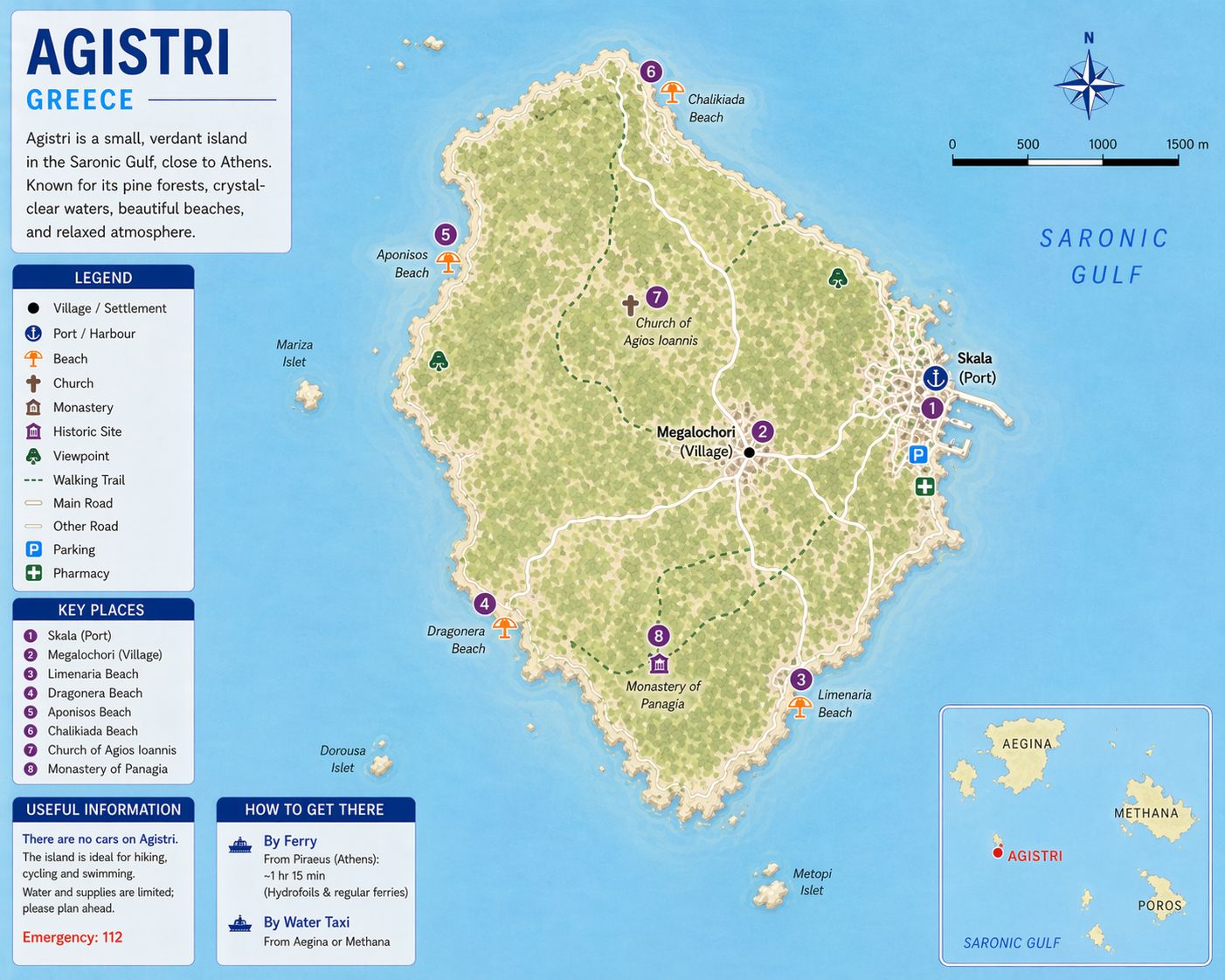
- Skala Bay provides anchoring in 5–12 metres over sand and mud with reliable holding but is exposed to NW winds and ferry wash.
- Megalochori outer areas provide anchoring in 4–8 metres over sand with moderate holding. Mariza Bay on the south coast provides anchoring in 4–10 metres over sand with shelter from NW winds but exposure to southerlies.
- Dragonera Bay provides anchoring in 6–14 metres over mixed seabed where holding varies depending on sand coverage and exposure to SE winds.
Agistri Greece Sailing Guide -
Entry Formalities
Agistri is not an entry port. Clearance must be completed at Piraeus or another designated port of entry.
Agistri Greece Sailing Guide -
Marina Facilities
There are no marina facilities on Agistri. All berthing is quay-based. Skala Harbour provides berthing along the inner quay with depths ranging from approximately 2.0 m to 4.0 m. Berthing is conducted stern-to or bows-to using own anchor. The seabed consists of mud with debris present. Ferry movements generate continuous wash within the harbour, requiring secure mooring arrangements and sufficient chain scope. Electrical and water connections are available along sections of the quay. Megalochori Harbour provides berthing with depths between 2.0 m and 3.5 m. The basin is smaller with limited manoeuvring space and soft mud seabed. Berthing is conducted using own ground tackle. The harbour is less exposed to northerly winds but remains subject to wake. No pontoons, fuel docks, lifting facilities, or managed berthing systems exist.
Agistri Greece Sailing Guide -
Provisioning
Supermarkets. Provisioning is centred in Skala through Bazaar Supermarket Skala and Kontis Supermarket, both located within 150–300 metres of the harbour. These outlets operate daily with extended hours and receive stock via ferry from Piraeus. Product range includes packaged goods, refrigerated items, bread, bottled water, and limited produce. Myli Market in Megalochori operates within approximately 200 metres of the harbour with reduced stock range. Bulk provisioning is conducted in Aegina or Piraeus.
Markets. There is no organised market. Produce supply on Agistri is limited and handled through small supermarkets and local grocery shops rather than formal markets. Fresh fruit and vegetables are available in modest quantities, with stock dependent on regular ferry deliveries from the mainland and supplemented by small amounts of seasonal local produce. Selection and quality vary, particularly outside peak season, and there is no bulk or wholesale purchasing capacity. For a cruising yacht, Agistri serves as a top-up location only, with full fresh provisioning more reliably undertaken at nearby centres such as Aegina or Athens. .
Fish Markets. There is no fish market. Fish is sold directly by fishermen at Skala quay when available. Fish and seafood availability on Agistri is limited and informal, with no dedicated fish market or consistent retail supply. Availability depends on small-scale local fishing activity, with catch distributed through tavernas or occasionally sold in small quantities via local shops.
Agistri Greece Sailing Guide -
Local Cuisine
Cuisine reflects Saronic supply chains linked to Aegina and Piraeus. Fish is prepared as psari psito using tsipoura and lavraki when available. Small fish are served as gavros tiganitos and sardeles tiganites depending on supply. Baked fish is prepared as psari sto fourno. Meat dishes include souvlaki, gyro, and kontosouvli, with slow-cooked preparations such as kokkinisto and stifado. Vegetable dishes include horiatiki salata, gemista, and briam. Bread is served as psomi. No dishes are specific to Agistri.
Agistri Greece Sailing Guide -
Local Beverages
Beer is predominantly lager, with domestic brands including Mythos, Alfa, Fix, and Vergina alongside imported products; and over 100 microbreweries operate on several islands with limited distribution. Wine is region-specific, with white varieties dominant in the islands, including Assyrtiko, Moschofilero, and Roditis, alongside local table wines served in bulk; retsina remains in circulation as a resin-flavoured wine. Distilled products include ouzo (anise-based), tsipouro (grape marc distillate), raki or tsikoudia (Crete), souma (fig or grape distillate in eastern Aegean islands), and kitron (citrus liqueur from Naxos), with alcohol strength typically in the 37–45% range and higher for unregulated local distillations.

Agistri Greece Sailing Guide -
Diesel Fuel Supplies
Supply is typically arranged from local roadside fuel stations, with delivery to the quay by jerry can or small vehicle where possible. There is no guaranteed dockside service, and availability depends on local arrangements and operating hours.
Agistri Greece Sailing Guide -
Water Supplies
Water can typically be accessed at quay points in Skala and Megalochori, though pressure, flow rate, and availability vary, particularly during peak season when demand is high. Supply is drawn from restricted local resources supplemented by mainland delivery, and interruptions can occur.
Mechanical and Electrical Repairs
Resource
If you are headed somewhere remote consider the need to expand your knowledge base or have an information resource on board. Why not get a copy of my book The Marine and Electrical and Electronics Bible 4th Edition. By and for yachties, with everything from batteries and charging, solar and wind, diesel engines and marine electronics and so much more. Your complete systems guide. 650 pages of practical advice. In Australia and New Zealand order a copy through Boat Books. UK and European boats can buy the UK Edition Here. US and Canadian boats can get the US Edition Order Here. Marine systems are my profession so let me help you. By a liveaboard boat owner for other boat owners.


Agistri Greece Sailing Guide -
Marine Services
No marine service facilities exist on Agistri. No authorised agents for Volvo, Yanmar, Beta Marine, Vetus, Raymarine, B&G, or Simrad are present. Technical support requires relocation to Aegina or Piraeus where full service capability exists.
Agistri Greece Sailing Guide -
Local Etiquette
Local etiquette relates to conduct ashore and interaction within a small residential island environment. Dress standards in village areas are conservative relative to beach zones. Behaviour in public areas is expected to align with residential norms, particularly during evening hours. Taverna service is table-based and requires ordering when seated. Payment is made at the table. Religious sites require appropriate dress and conduct. Waste disposal is conducted at designated shore facilities and disposal outside these areas is not accepted.
Agistri Greece Sailing Guide -
Summary
Agistri provides limited harbour infrastructure within the Saronic Gulf and operates as a secondary stop with dependency on nearby ports for supply and service. Navigation is straightforward with constraints arising from ferry traffic and wind-driven conditions. Anchorage and harbour use are determined by exposure to prevailing winds and available space. Operational planning requires integration with Aegina and Piraeus, consistent with an Agistri Greece Sailing Guide for all you need to know.