Agios Efstratios Greece Sailing Guide
Agios Efstratios Greece Sailing Guide. Agios Efstratios is a small, isolated island in the northern Aegean, located south-west of Lemnos and north-west of Lesbos. The coastline is largely exposed with limited natural shelter, and the primary harbour on the north-west coast provides the only viable landing point for yachts. The island has minimal infrastructure, with a single settlement clustered around the harbour and no alternative ports or developed anchorages.
The island lies fully exposed to northern Aegean weather systems, with strong northerly winds and open sea conditions dominating during the summer months. There is no significant topographical protection, and sea states build quickly in fresh winds. Agios Efstratios should be treated as a weather-dependent stop, with limited refuge options and no fallback harbours in deteriorating conditions. Navigation in the area is straightforward in clear weather, but the lack of shelter and services requires advance planning and conservative passage timing.
Agios Efstratios Greece Sailing Guide
- History
Agios Efstratios has a recorded history dating to antiquity, though it remained a minor and sparsely populated island within the northern Aegean. Its name derives from Saint Eustratius, who, according to tradition, was exiled to the island in the 9th century during the period of Byzantine iconoclasm. Under the Byzantine Empire, the island functioned as a remote outpost with limited strategic or commercial importance, a status that continued through subsequent periods of control.
Following incorporation into the Ottoman Empire, Agios Efstratios remained isolated with a small population engaged in fishing and subsistence agriculture. In the 20th century, it was used by successive Greek governments as a place of internal exile for political dissidents, particularly during periods of instability before and after the Greek Civil War. The island was significantly affected by a major earthquake in 1968, which destroyed much of the original settlement and led to reconstruction in its current form. Today, it remains lightly populated with a limited economic base and minimal development.
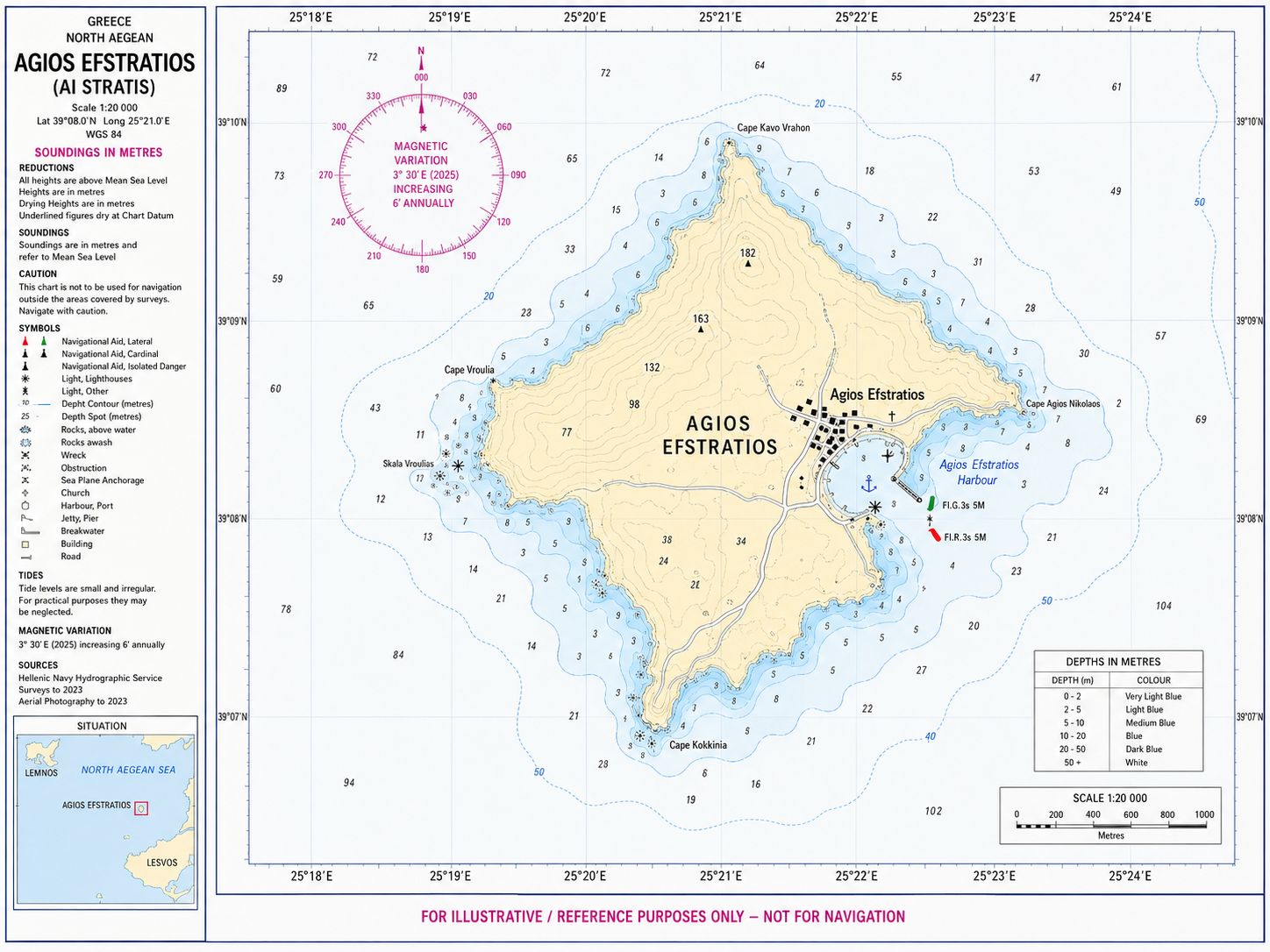
Chart Disclaimer. This chart is a schematic representation for illustrative purposes only and must not be used for navigation. Refer to official hydrographic charts for safe navigation. Be aware ENC charts may differ from official hydrographic charts. Both should be corrected and updated regularly.
Agios Efstratios Greece Sailing Guide
- Ocean Currents and Tidal Flow
Agios Efstratios lies within the open northern Aegean circulation, where current patterns are dominated by wind forcing rather than tidal movement. In settled conditions, residual set is generally weak, typically less than 0.5 knots, with variable direction influenced by the broader flow between Lemnos and Lesbos. When northerly winds establish, particularly during the Meltemi, a consistent south to south-west set develops, increasing in strength with wind duration and fetch. Rates of 1 knot or more can be encountered in exposed waters, with higher localised flows around headlands.
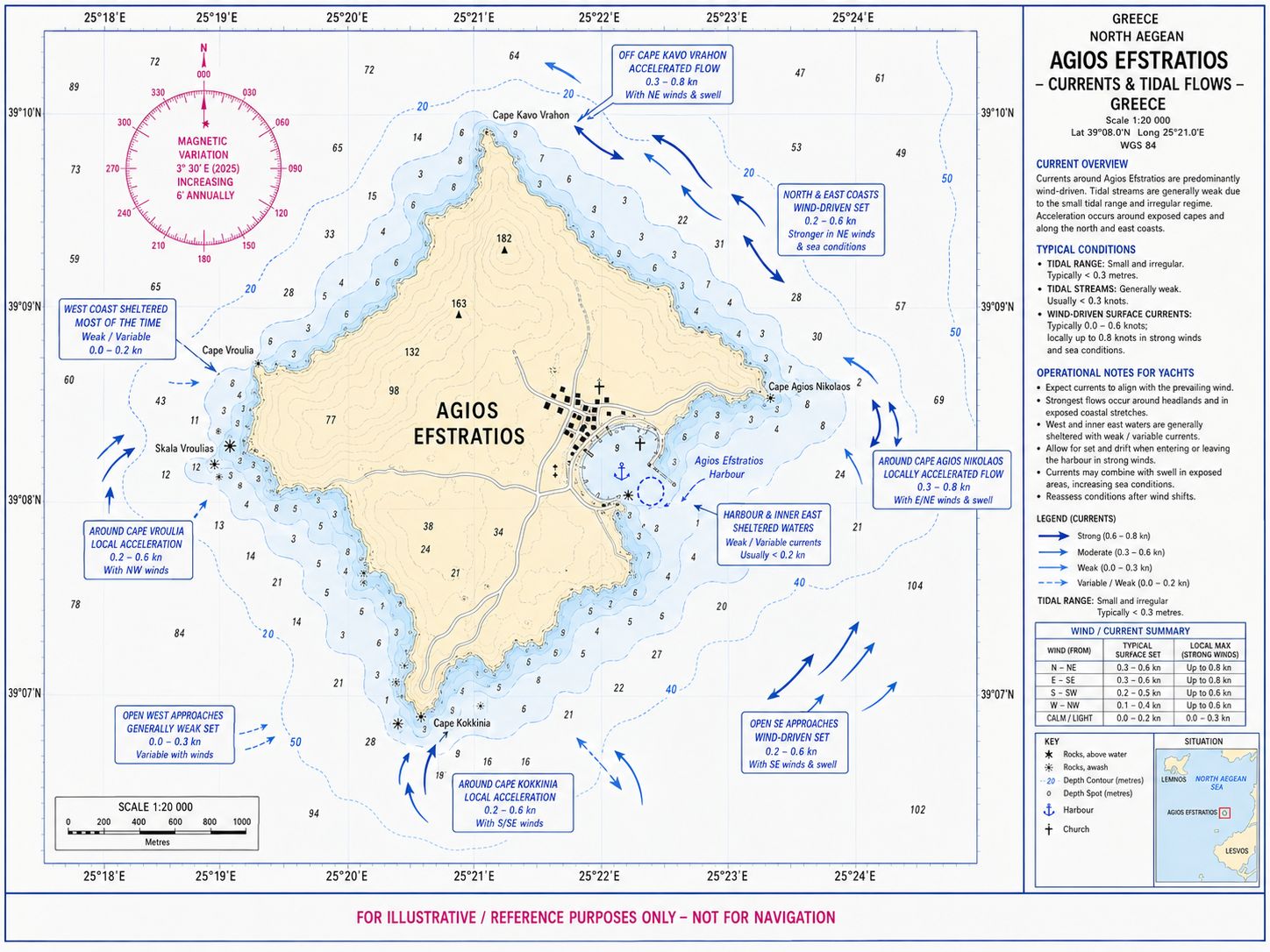
Tidal range is negligible, generally less than 0.3 metres, and does not produce significant tidal streams. Any observable current within bays or harbour approaches is the result of wind-driven circulation and short-term pressure effects. In strong northerlies, wind-against-residual conditions can generate steep, confused seas, particularly off exposed coasts. Within the harbour area, flow is minimal but can become erratic under gusting conditions, producing short-period surges and minor eddies near the entrance. There are no predictable tidal windows; passage planning should be based entirely on wind strength, duration, and exposure.
Agios Efstratios Greece Sailing Guide
- Weather
Agios Efstratios lies fully exposed to northern Aegean weather systems, with conditions dominated by dry, stable summers and more variable winter patterns. During the main cruising season (May to September), high-pressure systems prevail, producing clear skies, low humidity, and consistent visibility. Outside this period, particularly from late autumn through early spring, passing low-pressure systems bring increased cloud, rainfall, and short-duration but sharp weather changes, including squalls and shifting winds.
The primary operational feature is the Meltemi, which establishes from the north to north-east and can persist for several days. Due to the island’s exposed position between Lemnos and Lesbos, wind strength is often higher than regional forecasts, with sustained 20–30 knots common and stronger gusts in open water. Sea state builds rapidly with short, steep waves and significant spray. There is no effective shelter from northerly sectors, and harbour conditions can become uncomfortable in prolonged Meltemi events. Transitional seasons bring more variable wind directions, often associated with frontal systems, requiring close monitoring due to rapid onset and changes in conditions.
The Marine Electrical and Electronics Bible has a complete list of Greek VHF Radio Channel information and weather forecast times for Greece along with NAVTEX UK and Europe and NAVTEX Mediterranean for 490kHz and 518kHz.
Agios Efstratios Greece Sailing Guide
- Local Winds
Local wind patterns at Agios Efstratios are dominated by the northerly Meltemi, which establishes as a N to NE flow and strengthens through the day. The island sits in open exposure between Lemnos and Lesbos, with no significant terrain to reduce wind strength, resulting in sustained winds frequently exceeding forecast values. Typical summer conditions produce 20–30 knots with higher gusts, particularly in the afternoon peak.
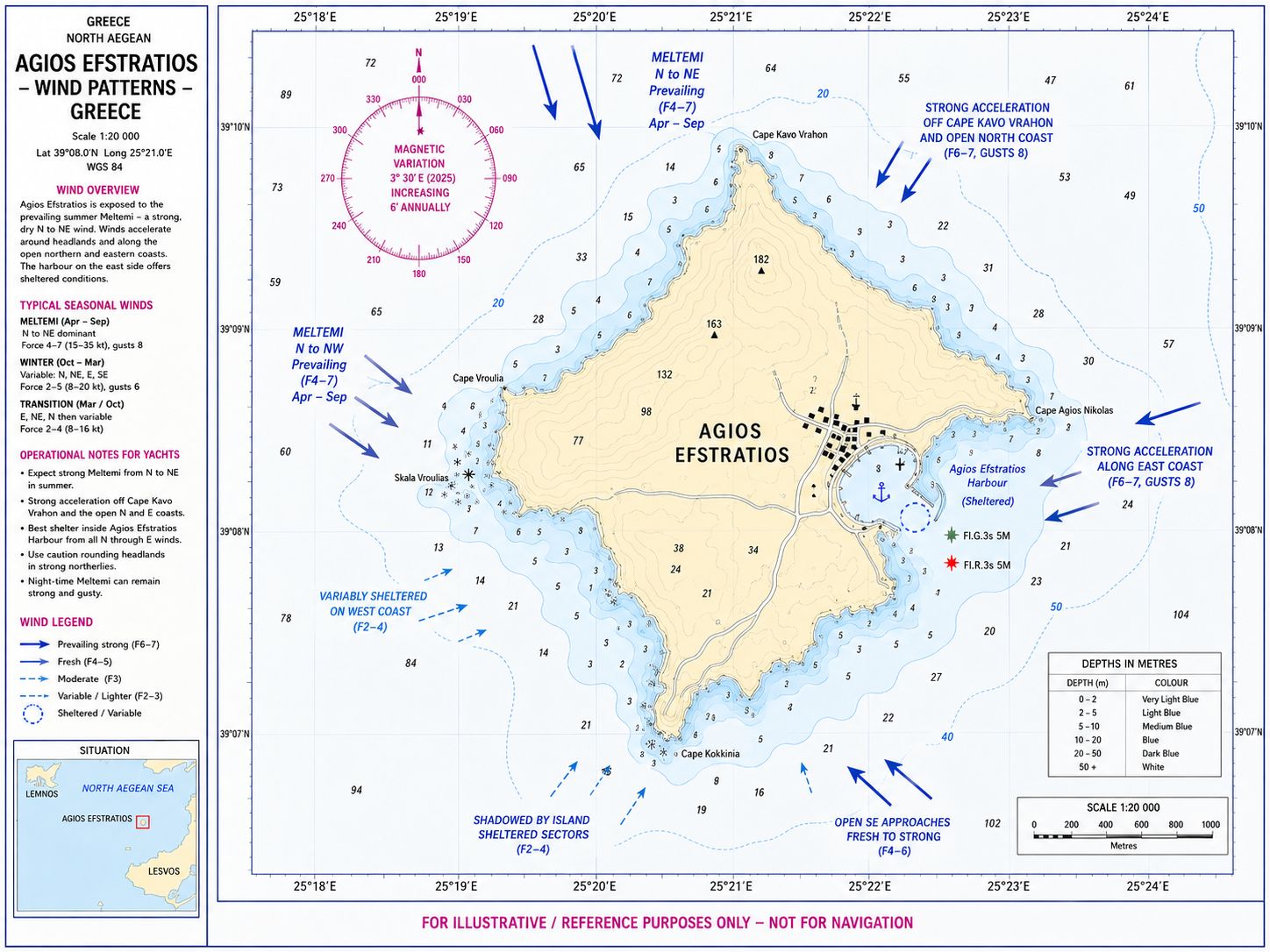
Wind behaviour is relatively uniform offshore due to the lack of topographic shelter, but localised acceleration and turbulence occur around headlands and the harbour entrance. Gusting can be severe where wind spills over low ridgelines, and there is limited lee anywhere around the island. During non-Meltemi periods, winds are more variable, often shifting to S or SE ahead of frontal systems; these can arrive rapidly with short-duration strong winds and confused seas. There are no consistent diurnal land/sea breeze effects of operational significance due to the dominance of gradient wind.
Agios Efstratios Greece Sailing Guide
- Approaches
Approaches to Agios Efstratios are from open northern Aegean waters with no coastal shelter and no secondary harbours. The island lies south-west of Lemnos and north-west of Lesbos, with the principal approach made toward the main harbour on the north-west coast. Offshore depths are generally deep, exceeding 50 m, with a clean seabed free of major off-lying dangers in the main approach sectors. The coastline becomes clearly defined on closing, with depths shoaling rapidly within the final 200–300 metres.
Exposure to northerly winds is complete. Under Meltemi conditions, approaches from the north and west encounter sustained headwinds and short, steep seas. There are no significant islands or landmasses to reduce fetch, and sea state builds quickly. The approach from the south offers slightly reduced sea state in northerlies but remains exposed to swell wrapping around the island. There are no controlled channels, leading marks, or formal navigation aids beyond standard charted references.
Navigation requires attention to isolated rocks and minor reef areas close inshore, particularly along the western coastline near the harbour approaches. These hazards are not always conspicuous in moderate sea conditions. Entry should be conducted in daylight with visual confirmation of position supported by GPS. Traffic is minimal but includes ferries and local fishing vessels, which operate on fixed schedules and may have priority in the harbour approach.
Agios Efstratios Greece Sailing Guide
- Navigation
Navigation into the harbour at Agios Efstratios is direct from the north-west, with no formal approach channel or leading marks. The harbour is identified visually by the main settlement and quay, with the entrance open to the north and west. Depths remain in excess of 15–20 m on the approach, shoaling progressively to 5–8 m within the harbour limits and 3–5 m alongside the quay. The seabed is predominantly mud and sand with areas of rock near the margins.
The entrance is exposed to northerly conditions, and under the Meltemi, crosswinds and gusts can be significant on final approach. Short-period chop and surge may be present within the basin, affecting low-speed control. There are no lit navigation aids, sector lights, or guiding marks; entry relies on GPS positioning and visual reference. Night entry is not recommended due to limited lighting and poor definition of harbour limits and inshore hazards.
Manoeuvring space is restricted by quay layout and local traffic. Ferries operate regularly and have priority; vessels should remain clear of the entrance during arrivals and departures. Berthing is typically stern-to or alongside depending on space, with anchors deployed clear of adjacent vessels. Allowance should be made for drift and rapid wind shifts during final positioning, particularly in strong northerly conditions.
Agios Efstratios Greece Sailing Guide
- Chart Accuracy
Hydrographic charts accurately depict coastline and harbour layout. Electronic charts align with official data. Caution is required for isolated rocks near shore and possible harbour debris. Depth soundings are reliable but should be verified when anchoring.
Agios Efstratios Greece Sailing Guide
- Anchorages
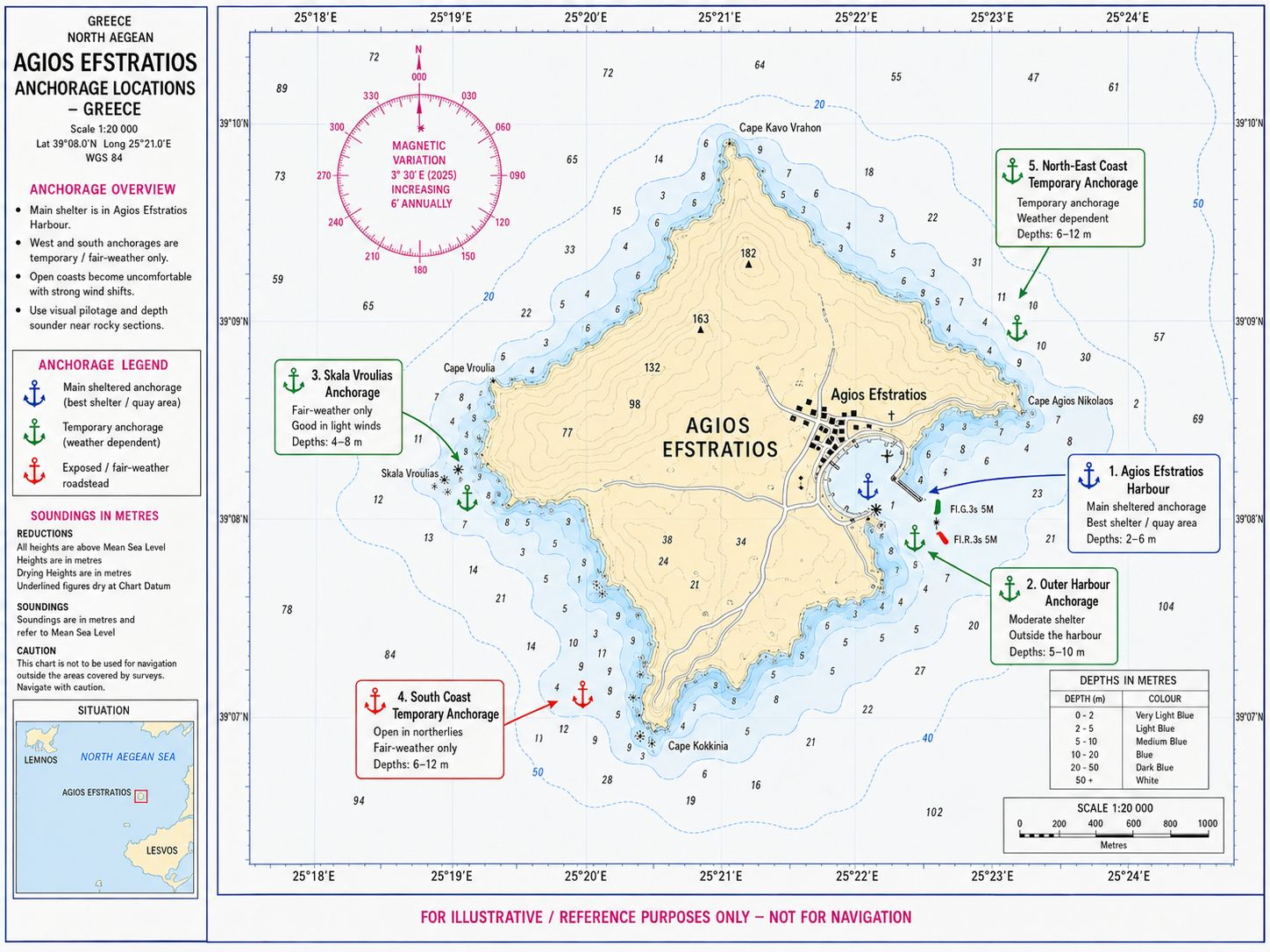
Viable anchorage options at Agios Efstratios are limited and entirely dependent on wind direction. There is no all-weather shelter; all locations should be treated as conditional and monitored continuously.
- Agios Efstratios Harbour (NW coast). Primary anchorage area within or immediately outside the harbour. Depths 5–10 m over mud and sand with generally good holding. Limited space due to quay operations and ferry movements. Provides partial shelter from northerlies but remains affected by surge and chop under strong Meltemi conditions. Open to W–NW swell.
- Alonitsi Bay (N coast). Broad, open bay north of the main harbour. Depths 8–15 m over sand and patches of weed. Offers some protection from southerly sectors but fully exposed to N and NE winds. Holding variable in weed. Suitable only in settled weather or light southerlies.
- Trygaria Bay (SW coast). Open indentation on the south-west coast with depths 10–20 m over mixed sand and rock. Provides limited lee in northerly conditions but is exposed to W and SW swell. No protection from southerlies. Useable as a temporary stop in stable Meltemi with careful anchor placement.
- South coast open anchorages (general). Sections of the south coast allow temporary anchoring in 10–20 m over sand where available. These areas provide lee from northerlies but are open to any shift into S or SE. No defined bays or protection from swell wrap. Holding varies with seabed composition.
- East coast (not recommended). The east coast is largely exposed with no defined anchorages and depths dropping steeply offshore. Subject to swell and wind exposure from multiple sectors. Not suitable for anchoring except in exceptional calm conditions.
All anchorages on Agios Efstratios are weather-dependent with limited security. Rapid deterioration occurs with any change in wind direction or strength, and there are no alternative sheltered locations on the island. Continuous monitoring of conditions is required, with readiness to depart if exposure increases.
Agios Efstratios Greece Sailing Guide
- Entry Formalities
Entry formalities follow standard Greece procedures for visiting yachts. This is not a designated port of entry for international clearance, and there are no customs or immigration facilities on the island. Vessels arriving from outside Greece or the Schengen Area must first clear into the country at an official port of entry before proceeding to this port. Direct arrival from a non-Schengen country is not permitted. The Greek cruising tax (TEPAI) must be valid and paid, and the vessel’s cruising log (DEKPA for non-EU vessels, or transit log where applicable) should be up to date and available for inspection if requested by port authorities or coastguard.
Agios Efstratios Greece Sailing Guide
- Marina Facilities
Agios Efstratios has no marina and all berthing is within the single harbour on the north-west coast, consisting of a quay in the basin used by ferries, fishing vessels, and visiting yachts. Depths on approach exceed 15–20 m, reducing to approximately 5–8 m within the harbour area. Along the quay, depths are limited and variable: sections on the south, west, and north sides are generally less than 3 m, while the deeper eastern side provides approximately 2.9–4.6 m alongside.
Berthing is alongside or stern-to using own anchor; there are no laid moorings. The most protected positions are in the inner section near the fishing harbour entrance, with a small number of more exposed berths available depending on conditions. Manoeuvring space is constrained, particularly with ferry movements, and depth limitations restrict access for deeper-draft vessels. Shelter is partial from northerlies but the harbour remains open to W–NW swell, with surge present in stronger conditions. Services are basic, with limited or remote electricity points, inconsistent or absent water supply, and no dedicated fuel berth or repair capability.
Agios Efstratios Greece Sailing Guide
- Provisioning
Supermarkets. Provisioning at Agios Efstratios is limited to small-scale outlets within the harbour settlement. There are no full supermarkets; supplies are obtained from one or two mini-markets carrying basic dry goods, bottled water, bread, tinned items, and a restricted range of fresh produce. Stock levels are dependent on ferry deliveries from nearby centres such as Lemnos and Lesbos, and can be inconsistent, particularly during periods of high demand or disrupted transport.
Markets. Agios Efstratios has no formal produce markets. Fresh fruit and vegetables are supplied in small quantities through the local mini-markets within the harbour settlement, with availability dependent on ferry deliveries from Lemnos and Lesbos. Typical stock is limited to basic seasonal items such as tomatoes, cucumbers, onions, potatoes, and a small range of fruit, with little variation.
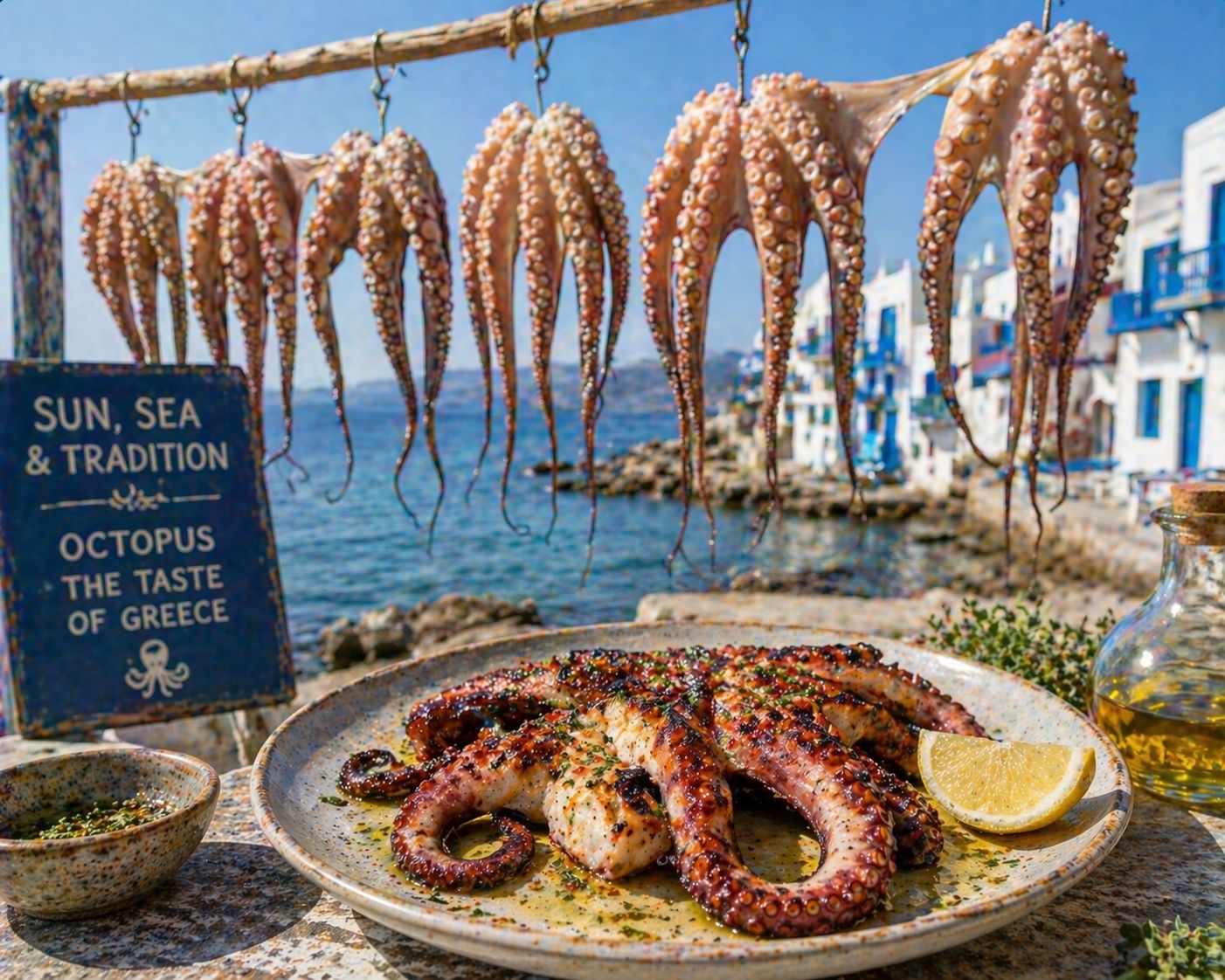
Fish Markets. Fish supply on Agios Efstratios is small-scale and based on local fishing activity operating from the harbour. There is no fish market, no auction system, and no fixed retail outlet. Availability depends entirely on daily catch and weather conditions; when conditions allow, small quantities of fresh fish, squid, and occasionally octopus may be available directly from fishermen on the quay or through local tavernas
Agios Efstratios Greece Sailing Guide
- Local Cuisine
Local cuisine on Agios Efstratios is limited and based on what can be sourced locally or delivered via ferry. Food is served through a small number of tavernas around the harbour, with menus dependent on daily availability rather than fixed offerings. Typical dishes include grilled fish (psari sta karvouna), fried small fish, octopus (htapodi) grilled or stewed, and squid when available. Meat options are restricted but may include goat or lamb (katsiki, arni), usually slow-cooked or roasted, with simple sides such as potatoes, bread, and salads.
Agios Efstratios Greece Sailing Guide
- Local Beverages
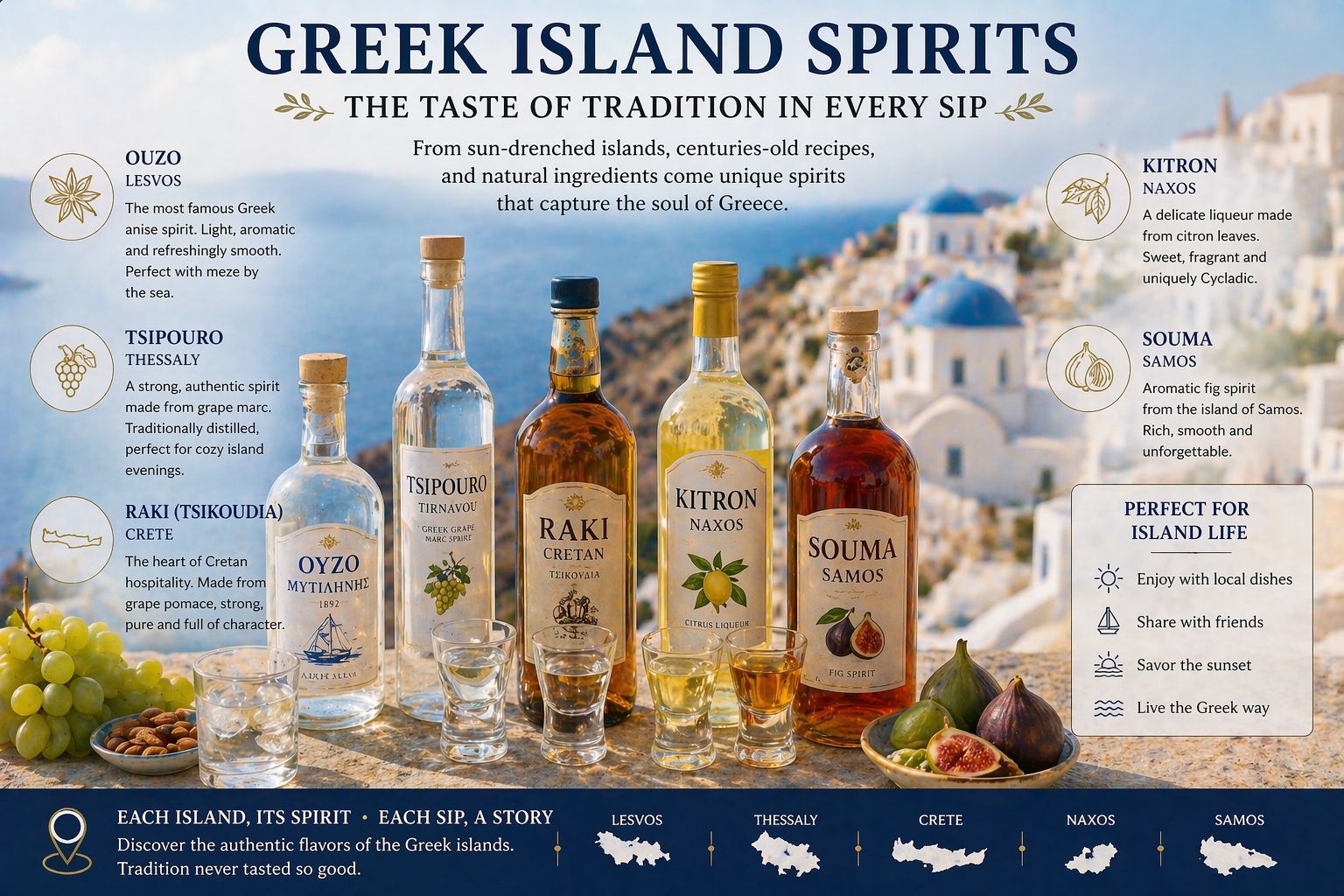
Local beverages are limited to basic supplies, beer, bottled wine, and spirits such as ouzo are delivered via ferry from nearby centres including Lemnos, with no local production or specialised offerings.
Agios Efstratios Greece Sailing Guide
- Diesel Fuel Supplies
Diesel fuel is not available from a dedicated fuel berth at Agios Efstratios; supply is arranged on request via local vendors at the harbour, typically by jerry can delivery to the quay. Availability is intermittent and dependent on prior notice, delivery schedules, and stock levels. There are no high-capacity refuelling facilities and no guarantee of immediate supply on arrival
Agios Efstratios Greece Sailing Guide
- Water Supplies
Potable water at Agios Efstratios is limited and should not be relied upon for full tank replenishment. Water may be available at the harbour quay via municipal supply points, but pressure and volume are inconsistent and subject to local demand. Supply interruptions are common, particularly during peak summer periods, and there are no dedicated marina-grade connections. Water is sourced from local storage and tanker delivery, resulting in constrained availability and variable pressure. Quality is generally acceptable for tank use but may be brackish at times; onboard treatment is recommended where fitted.
Mechanical and Electrical Repairs
Resource
If you are headed somewhere remote consider the need to expand your knowledge base or have an information resource on board. Why not get a copy of my book The Marine and Electrical and Electronics Bible 4th Edition. By and for yachties, with everything from batteries and charging, solar and wind, diesel engines and marine electronics and so much more. Your complete systems guide. 650 pages of practical advice. In Australia and New Zealand order a copy through Boat Books. UK and European boats can buy the UK Edition Here. US and Canadian boats can get the US Edition Order Here. Marine systems are my profession so let me help you. By a liveaboard boat owner for other boat owners.


Agios Efstratios Greece Sailing Guide
- Marine Services
Marine services at Agios Efstratios are minimal and should be considered non-existent beyond basic harbour use. Minor assistance may be obtained informally through local fishing operators, but this is limited to basic tools or ad hoc support and should not be relied upon.
Agios Efstratios Greece Sailing Guide
- Local Etiquette
Interaction is informal and direct. Space is limited, so efficient mooring, minimal wake, and controlled use of engines and generators are expected, particularly during evening hours. The harbour is immediately adjacent to a small residential settlement; noise and lighting should be kept to a minimum at night. Waste disposal should be limited to designated bins ashore, with no discharge within harbour limits.
Agios Efstratios Greece Sailing Guide
- Summary
Agios Efstratios provides a single harbour with very limited anchorage options. Protection is dependent on wind direction with exposure to northern Aegean conditions. Infrastructure is minimal with reliance on Lemnos for services. Navigation is straightforward but exposed. The Agios Efstratios Greece Sailing Guide is all you need to know.