Sailing to the Solomon Islands - A
Practical Guide for Cruisers
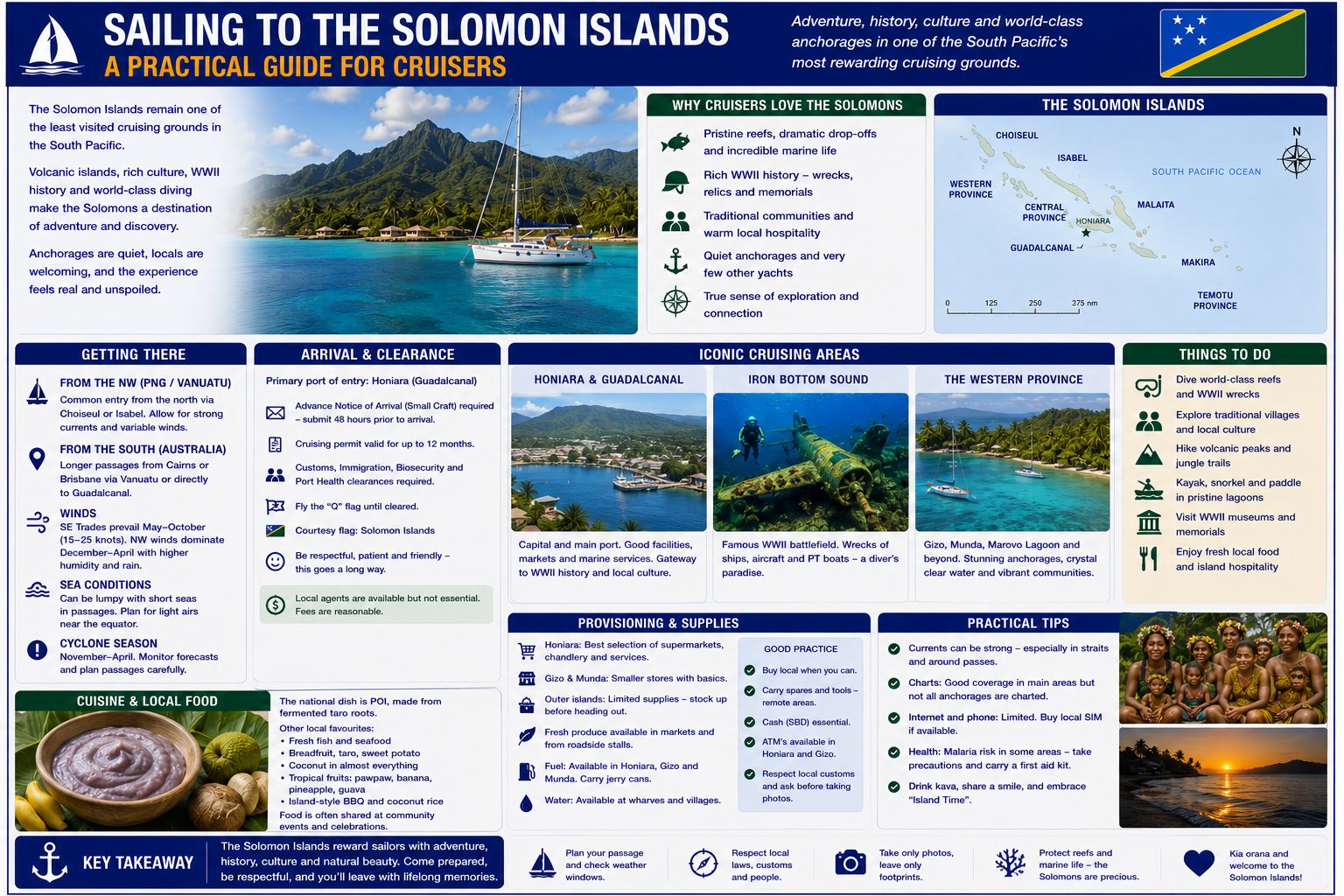
Sailing to the Solomon Islands remains one of the most rewarding and least‑visited cruising grounds in the South Pacific, a place where volcanic peaks rise from deep water, WWII history lies scattered across lagoons, and traditional village life continues largely unchanged. For sailors arriving from Vanuatu, Papua New Guinea, Australia, or even farther afield, the Solomons offer a rare blend of adventure, cultural immersion, and remote anchorages that feel untouched by time. This guide provides a practical overview of passage planning, arrival procedures, and what to expect once you drop anchor in this remarkable archipelago.
The Solomons stretch across more than 900 islands and
atolls, forming a long chain of volcanic peaks, coral lagoons, and dense
rainforest. Cruisers come for the diving, the history, the warm and welcoming
communities, and the sense of exploration that’s increasingly rare in the
Pacific. Unlike Fiji or French Polynesia, the Solomons see relatively few
yachts each season, which means anchorages are quiet, interactions with locals
are genuine, and the cruising experience feels deeply personal. The region is
also rich in WWII history, Honiara, Iron Bottom Sound, and the Western Province
are dotted with wrecks, relics, and memorials. For divers, the Solomons are
world‑class: pristine reefs, dramatic drop‑offs, and some of the best macro
life in the Pacific. It is some years since I visited Honiara, Yandina and
Gizo. The national dish is Poi made from
fermented taro roots.
Sailing to the Solomon Islands
- Arrival and Clearance Procedures
Clearing into the Solomon Islands is straightforward, but it does require preparation. According to the Solomon Islands Immigration Division, yacht masters and crew arriving by sea must apply for the Yacht Person Visa, which is valid for 60 days and can be extended up to 180 days. The visa requires a passport with six months’ validity, proof of funds, and an onward plan.
Sailing to the Solomon Islands
- Documents to Prepare in Advance
A Solomon Islands yacht agent recommends sending the following documents ahead of arrival to streamline clearance:
- Itinerary and expected arrival date
- Last port of clearance
- Ship’s particulars
- Crew list
Immigration also provides two forms that can be completed in advance and handed to officials on arrival:
- Form 1: Yacht and crew details
- Form 2: Yacht particulars
These can be emailed to Immigration before arrival to speed up processing.
Sailing to the Solomon Islands
- Ports of Entry
Recommended ports of entry for yachts include:
- Taro (Choiseul Island)
- Noro (New Georgia Island, Western Province)
- Honiara is also a common entry point, though it can be busy and less cruiser‑friendly than the Western Province.
Sailing to the Solomon Islands
- Visa Information
Most yacht crew will apply for the Yacht Person Visa, which includes:
- Administration fee: USD $50
- Application fee: USD $200
- Validity: 60 days, extendable to 180 days
- Multiple entry: Not available
- Work rights: Not permitted
Tourist visas issued on arrival typically range from 45–90 days depending on nationality, with extensions available up to 12 months for a fee.
Sailing to the Solomon Islands
- Biosecurity, Customs & Health
Biosecurity officers may inspect fresh produce, meat, and other organic materials. The Solomons are generally less strict than New Zealand or Australia, but it’s wise to arrive with clean lockers and clear declarations.
Health officials may also board the vessel. The Solomon Islands have ongoing issues with mosquito‑borne illnesses such as malaria and dengue, so cruisers should take precautions and carry appropriate repellents and medications.
Cruising Conditions and Seasonal Weather
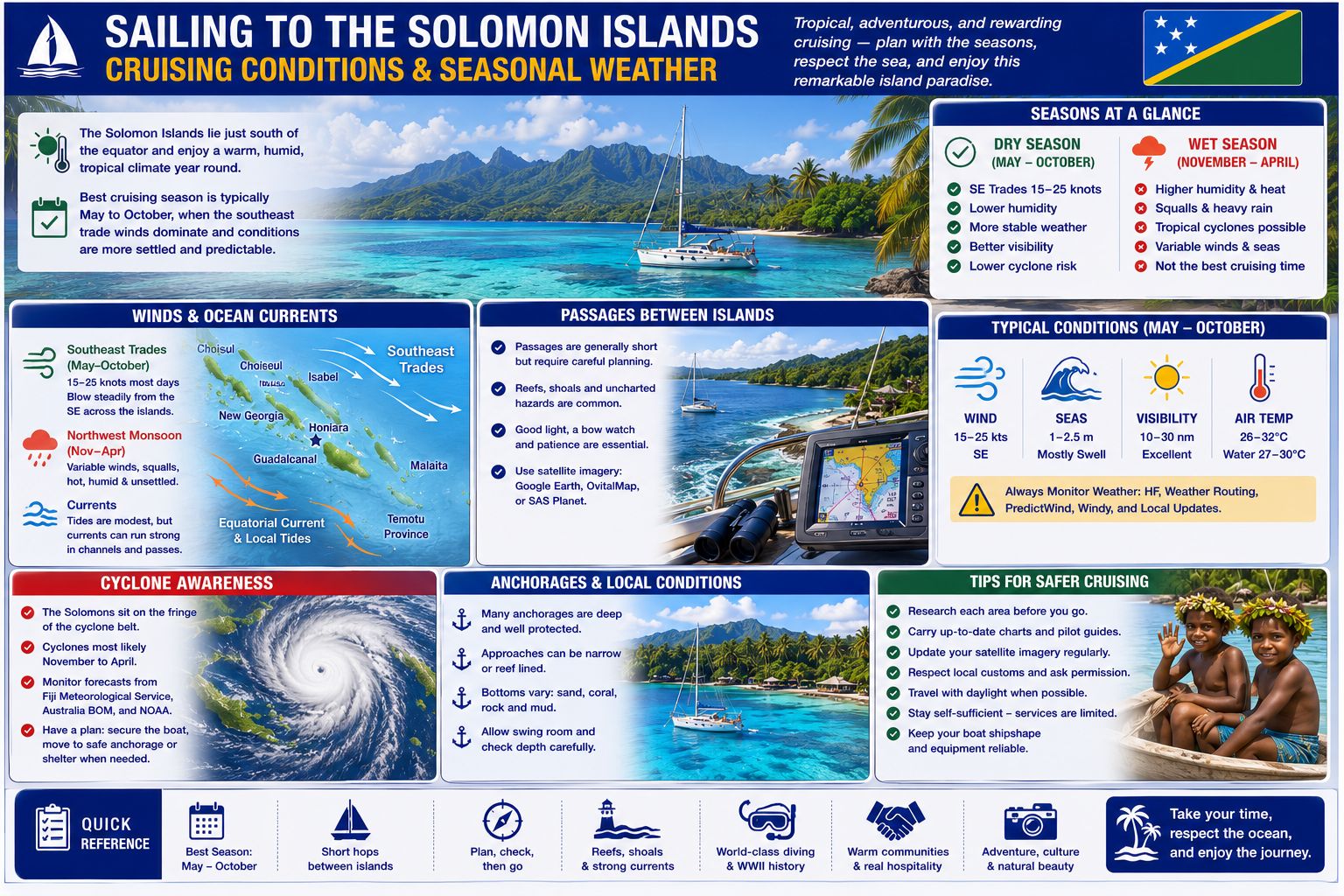
Check out the Solomon Islands Cruising Guide. The Solomon Islands lie just south of the equator, giving them a warm, humid, tropical climate year‑round. The best cruising season is typically May to October, when the southeast trades dominate and conditions are more settled. The wet season (November to April) brings higher humidity, squalls, and the possibility of tropical cyclones, though the Solomons sit on the fringe of the cyclone belt.
Passages between islands are generally short, but reefs, shoals, and uncharted hazards require vigilance. Good light, a bow watch, and satellite imagery (Google Earth, OvitalMap, or SAS Planet) are essential tools.
Navigation and Safety Considerations
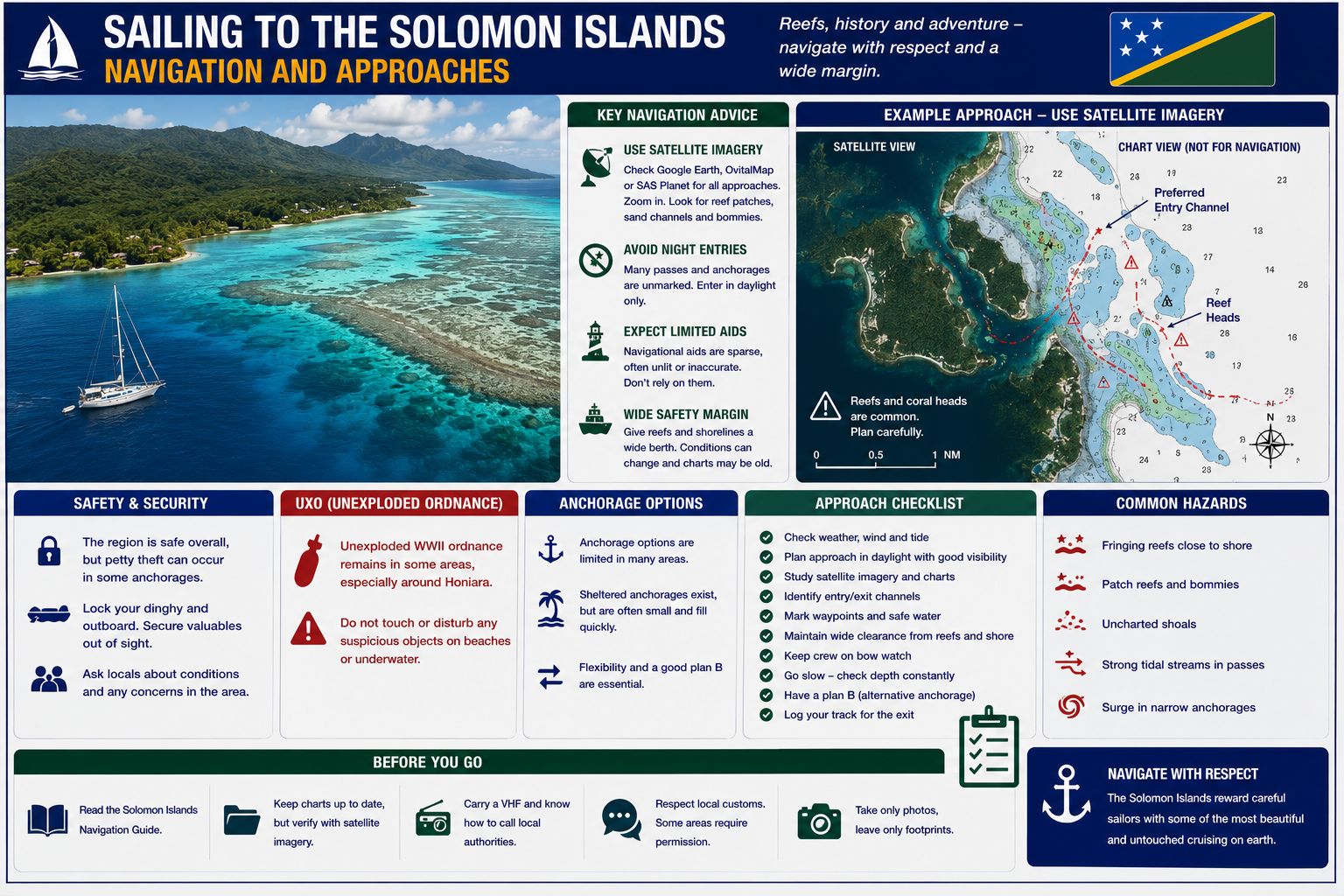
Reefs and coral heads are common when entering Solomon Island Anchorages. Cruisers should check out the Solomon Islands Navigation Guide and use the following advice:
- Use satellite imagery for all approaches
- Avoid night entries
- Expect limited navigational aids
- Maintain a wide safety margin in reef‑strewn areas
The region is safe overall, but petty theft can occur in some anchorages. Lock your dinghy, secure valuables, and ask locals about conditions if unsure.
Unexploded WWII ordnance remains in some areas, especially around Honiara. Avoid disturbing any suspicious objects on beaches or underwater.
Sailing to the Solomon Islands
- Provisioning, Fuel, and Services
Supermarkets. The Plaza Supermarket is a good source of provisions and another is the Panatina Plaza and the Wings MiniMart in downtown Honiara. Outside Honiara the only viable provisioning stop is in Noro and Gizo. Noro is the Solomon Island fishing fleet base and there is the Noro Market. Muzi Boku, or the Blue Container shop has imported Australian products. Gizo has a good produce market. The market is known for cheap and very fresh fish and there is seaweed (ime) stall selling four types and very popular, open 3 days a week.
Markets. The Honiara Central Market has most everything and is open daily and has some 1,000 vendors.
Mechanical
and Electrical Repairs Resource
If you are headed somewhere remote consider the need to expand your knowledge base or have an information resource on board. Why not get a copy of my book The Marine and Electrical and Electronics Bible 4th Edition. By and for yachties, with everything from batteries and charging, solar and wind, diesel engines and marine electronics and so much more. Your complete systems guide. 650 pages of practical advice. In Australia and New Zealand order a copy through Boat Books. UK and European boats can buy the UK Edition Here. US and Canadian boats can get the US Edition Order Here. Marine systems are my profession so let me help you. By a liveaboard boat owner for other boat owners

Sailing to the Solomon Islands
- Culture and Etiquette
The Solomon Islands are culturally diverse, with more than 70 languages spoken across the archipelago. Villages are welcoming, but customs vary. Always remember the following:
- Ask permission before anchoring near a village
- Request approval before going ashore
- Dress modestly
- Offer small gifts (rice, sugar, school supplies) when appropriate
- Respect for local chiefs and community leaders goes a long way.
Communications & Connectivity in the
Solomon Islands
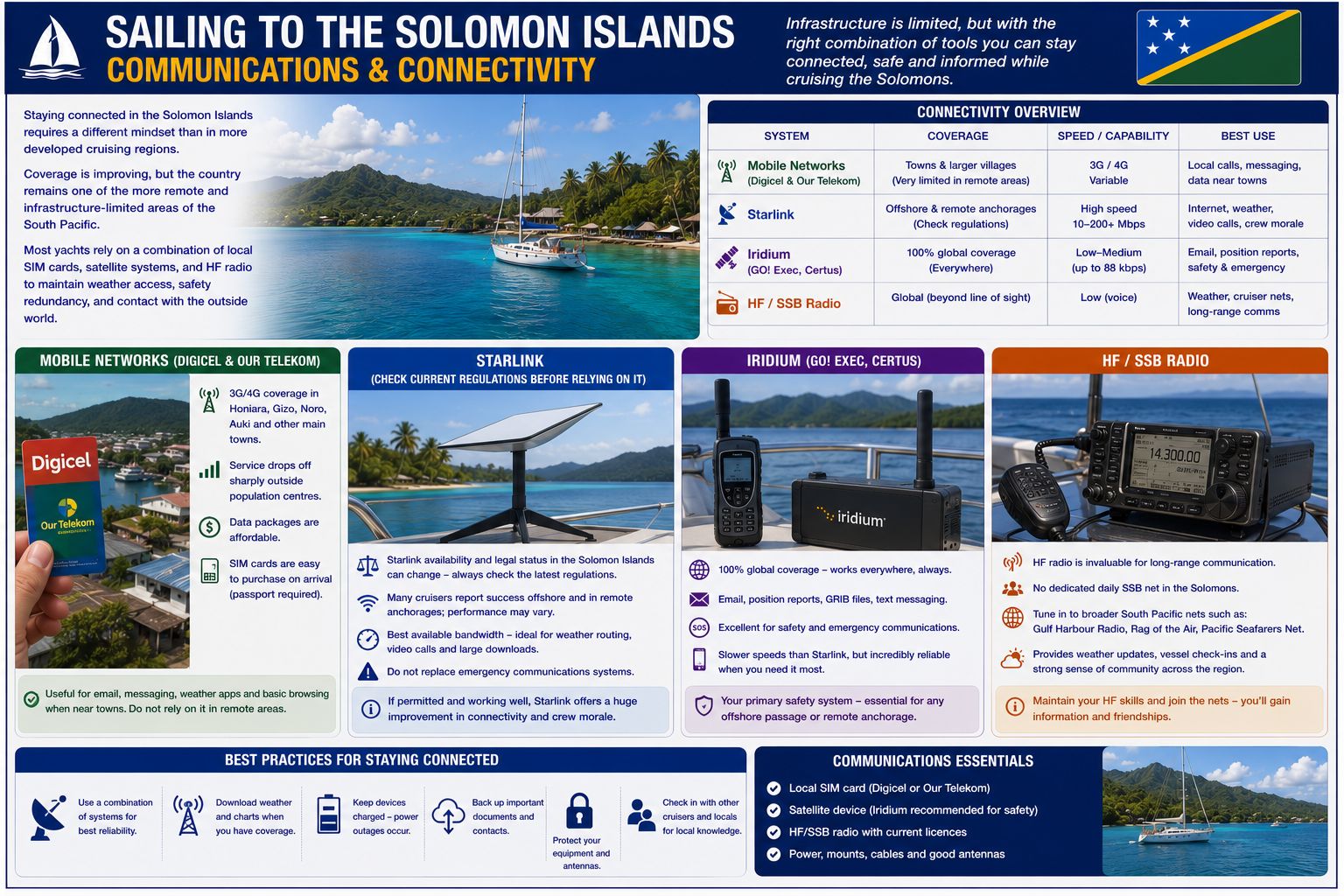
Staying connected in the Solomon Islands requires a different mindset than in more developed cruising regions. Coverage is improving, but the country remains one of the more remote and infrastructure‑limited areas of the South Pacific. Most yachts rely on a combination of local SIM cards, satellite systems, and HF radio to maintain weather access, safety redundancy, and contact with the outside world. Below is a clear overview of what works, what doesn’t, and how cruisers typically stay connected while exploring the Solomons.


Mobile Networks (Digicel & Our
Telekom)
The two primary mobile providers. Digicel and Our Telekom, offer 3G/4G coverage in major towns such as Honiara, Gizo, Noro, and Auki. Speeds vary widely, and reliability drops sharply outside population centres. In remote anchorages, you should expect little to no signal. Data packages are affordable, and SIM cards are easy to purchase on arrival, making them a useful supplement for email, messaging, and basic browsing when near towns.
Starlink (Check Current Regulations
Before Relying on It)
Starlink is rapidly expanding across the Pacific, but official approval status in the Solomon Islands has been fluid. Some cruisers report using Starlink successfully offshore and in remote anchorages, while others note regulatory uncertainty or inconsistent performance near populated areas. Before relying on Starlink as your primary system, verify the latest rules and coverage. If permitted, Starlink offers the best bandwidth by far, ideal for weather routing, video calls, and crew morale, but it should never replace your emergency communications systems.
Iridium (GO! Exec, Certus)
Iridium remains the most reliable and safety‑critical communications tool for yachts in the Solomons. Its global satellite coverage works everywhere, offshore, in deep anchorages, and throughout the island chain. While speeds are slow compared to Starlink, Iridium excels
HF/SSB Radio
HF radio remains a valuable tool in the Solomon Islands, especially for long‑range communication and participation in regional cruiser nets. While the Solomons do not operate a dedicated, daily SSB net of their own, yachts in the region commonly tune into broader South Pacific nets such as Gulf Harbour Radio, Rag of the Air, and the Pacific Seafarers Net. These nets provide weather updates, vessel check‑ins, and a sense of community across the region.
Sailing to the Solomon Islands Summary
Sailing to the Solomon Islands is a journey into one of the Pacific’s last great frontiers. With thoughtful preparation, respect for local customs, and an adventurous spirit, cruisers will find an unforgettable blend of natural beauty, cultural richness, and remote exploration. Whether you’re diving WWII wrecks, trading with villagers, or navigating through emerald lagoons, the Solomons offer a cruising experience unlike anywhere else in the world.