Sailing to
Kiribati: A Practical Guide for Yachts Navigating the Gilbert Islands
Sailing to Kiribati is unlike visiting any other nation in the Pacific and it some years since my last visit here. Spread across a vast area of ocean, the country’s atolls are remote, low‑lying, and culturally rich, with communities that have lived in harmony with the sea for centuries. For yachts, Kiribati offers a rare combination of challenge and reward: difficult navigation, limited provisioning, and bureaucratic quirks balanced by warm welcomes, traditional culture, and a sense of stepping far outside the usual cruising circuit. This guide focuses on the Gilbert Islands, where most yachts make landfall, and provides the practical detail needed for a safe and successful visit.
Sailing to Kiribati (pronounced Kiribas) spans an enormous swath of the central Pacific, but the land itself is minimal, narrow strips of coral sand, coconut palms, and villages strung along the edges of lagoons. The Gilbert Islands, including Tarawa, Abaiang, Abemama, and Butaritari, are the most accessible for yachts. Tarawa is the administrative and population center, while the outer islands remain deeply traditional and far less developed. The geography shapes everything, there are no mountains, no rivers, no natural harbors, and no deepwater anchorages except inside lagoon passes. Life is lived at absolute sea level, and the ocean is both a provider and a threat. For sailors, this means careful navigation, self‑sufficiency, and respect for local customs.
A Potted
History
Kiribati’s islands have been inhabited for at least two thousand years by Micronesian voyagers who mastered the art of navigating vast ocean distances using stars, swells, and bird patterns. Over centuries, the atolls developed tightly knit village societies shaped by scarcity, communal governance, and deep respect for the sea. European contact began in the 18th century, followed by the 19th‑century whaling era and eventual British colonial rule as the Gilbert and Ellice Islands. Kiribati became independent in 1979, uniting its scattered atolls into a single nation. Kiritimati Island (Line Islands), Fanning Island (Line Islands), Butaritari Island (Gilbert Islands) and Kanton (Phoenix Islands Protected Area) are not commonly visited cruising locations.
Entry
Procedures: Clearing Into Tarawa
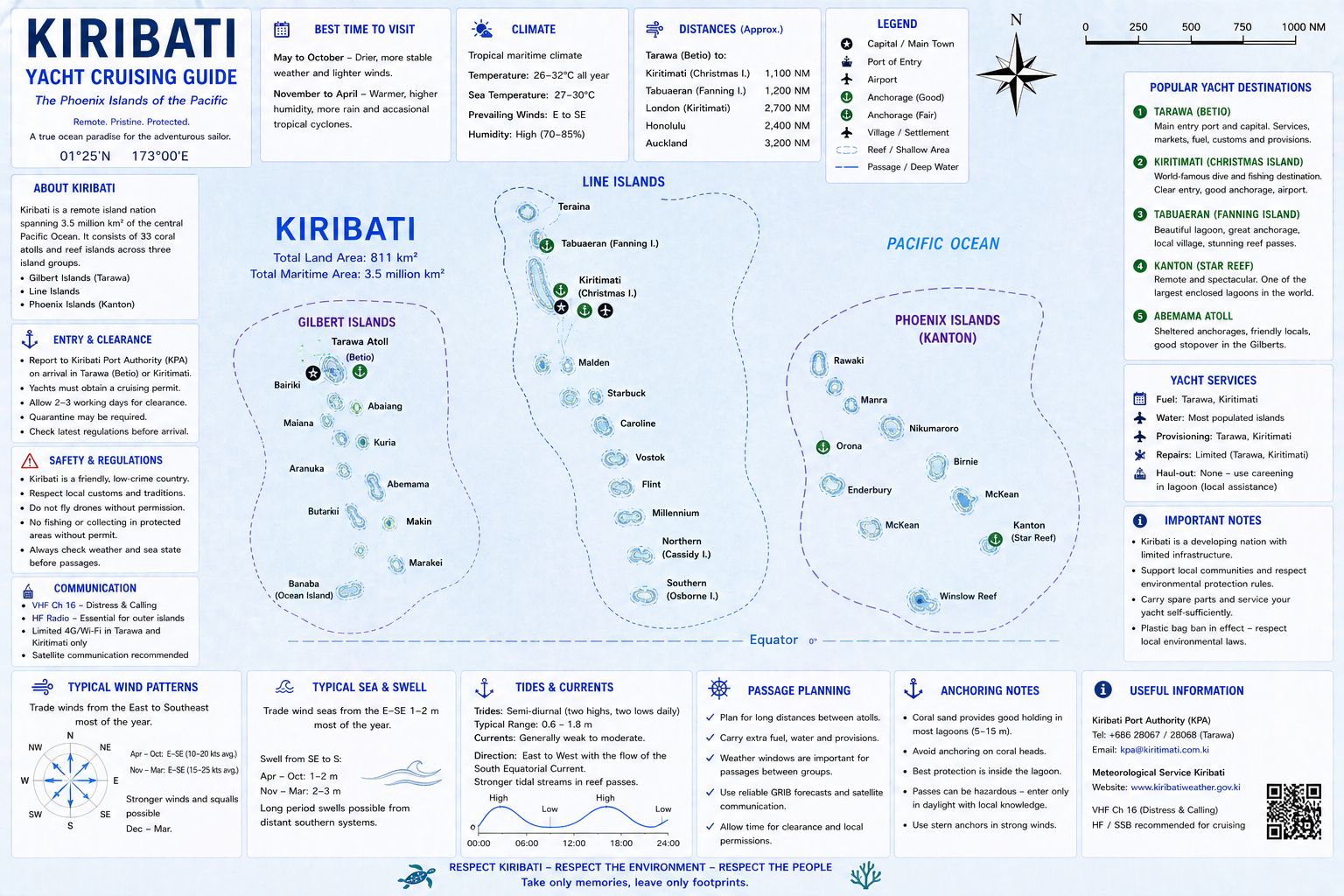
When sailing to Kiribati all yachts must clear into Tarawa, usually at Betio (pronounced Beso), the main port. Advance notice is recommended, though not always strictly enforced. Emailing the Port Authority and Customs with your ETA, vessel details, and last port helps smooth the process.
Approaching Tarawa requires attention. The atoll’s lagoon is large, but the passes are narrow and affected by strong tidal flows. Most yachts enter through the Betio passage, which is well‑used by inter‑island ferries, trawlers and cargo ships. Enter only in daylight, ideally with the sun behind you, as coral heads and shoals are common.
Once anchored off Betio or Bairiki, you’ll be instructed to remain aboard until officials arrive. As usual fly a yellow Q Flag and the correct courtesy flag. Clearance typically involves all the usual, customs, immigration, biosecurity, health and Port Authority. The process can take several hours, depending on staffing and local schedules. Kiribati operates on “island time,” and patience is essential. Fees vary but are generally modest. Immigration usually grants a one‑month stay, extendable in Tarawa. Politeness and respect go a long way. Again, as stated elsewhere, have every single bit of paper ready, multiple copies of all documents.
Sailing to Kiribati - Biosecurity
Kiribati’s biosecurity rules are designed to protect fragile atoll ecosystems. Expect inspections of all your onboard fresh produce, meat and dairy, seeds and plants, honey and bee products, wood items and waste and garbage storage. Fresh fruits and vegetables may be confiscated, especially if unlabeled or from high‑risk regions. Commercially packaged meat is usually allowed if sealed and clearly marked. Honey is often prohibited. As always, declare everything, Kiribati officers appreciate honesty and are generally reasonable. Don't try and hide anything!
Sailing to Kiribati - Navigation
Challenges
Sailing to Kiribati and through the Gilbert Islands demands a level of attention and seamanship that surprises even experienced Pacific cruisers. Kiribati’s atolls are beautiful but unforgiving, shaped by reefs, shifting sands, and lagoon systems that offer little margin for error. Navigation here is less about following charts and more about reading the water, the light, and the sea’s subtle cues the same skills the I‑Kiribati have relied on for centuries.
When sailing to Kiribati the first major challenge is simply seeing the islands. Kiribati’s atolls are extremely low‑lying, often invisible until you’re within a few miles. Palm tops and the white line of surf on the outer reef are usually the first signs of land. Approaches should always be made in daylight, ideally with the sun behind you, because the reefs rise abruptly from deep water and give little warning. Many charts are based on older surveys, and while major features are generally accurate, depths, "bommies", and lagoon contours often differ from what’s shown.
Kiribati Navigation
Hazards: Reefs, Passes
Reef passes are the defining hazard of the region. Some, like the main entrance into Tarawa, are wide enough for inter‑island ferries and cargo ships, but even these can have strong tidal flows, cross‑sets, and swirling eddies that push a yacht off line. Others, particularly in outer islands like Abaiang, Abemama, and Nonouti are narrow, shallow, or poorly marked. A pass that looks manageable on a chart may be impassable in swell, and many atolls have no safe entry at all. Timing is everything, slack water is short, and the combination of ocean swell and outgoing lagoon flow can create steep, confused seas at the entrance.
Inside the lagoons, the hazards multiply. Coral heads, or bombies, are everywhere some charted, many not. They rise like pillars from the lagoon floor, often just below the surface, and can appear suddenly in otherwise deep water. The colour shifts are subtle, and late‑afternoon light can make them nearly invisible. A bow watch is essential whenever the boat is moving, and even then, progress should be slow and deliberate. Depths can change rapidly, and sandbanks shift with storms and currents.
Bommies is a common cruising term (especially in the Pacific and Australia) referring to isolated coral heads that rise abruptly from the seabed, often from deep water to just below, or just above, the surface. Bommies are one of the biggest navigational hazards in reef environments because they can be hard to see in poor light, they are scattered unpredictably across lagoon floors, they are steep‑sided, rising from 20–30 m to 1 m in seconds, they are uncharted or inaccurately charted. A single bommie can ruin a keel, rudder, or prop and also ruin your voyage.
Kiribati Navigation
Hazards Continued
Tarawa’s lagoon is large but deceptively complex. Channels between Betio, Bairiki, and Bikenibeu are used daily by local boats, and they weave through shoals and coral patches that require careful attention. Wrecks, remnants of World War II and more recent groundings, add to the complexity, especially near Betio. Outside Tarawa, lagoons are quieter but far less predictable. Some have deep basins with good holding while others are shallow, muddy, or filled with coral outcrops that make anchoring difficult.
The outer coasts of the atolls present their own risks. The fringing reefs drop steeply into deep water, and swell can wrap around the atoll, creating unexpected breakers even on the lee side. Anchoring outside the reef is rarely comfortable and often unsafe. Many cruisers choose to remain offshore overnight rather than risk a marginal anchorage.
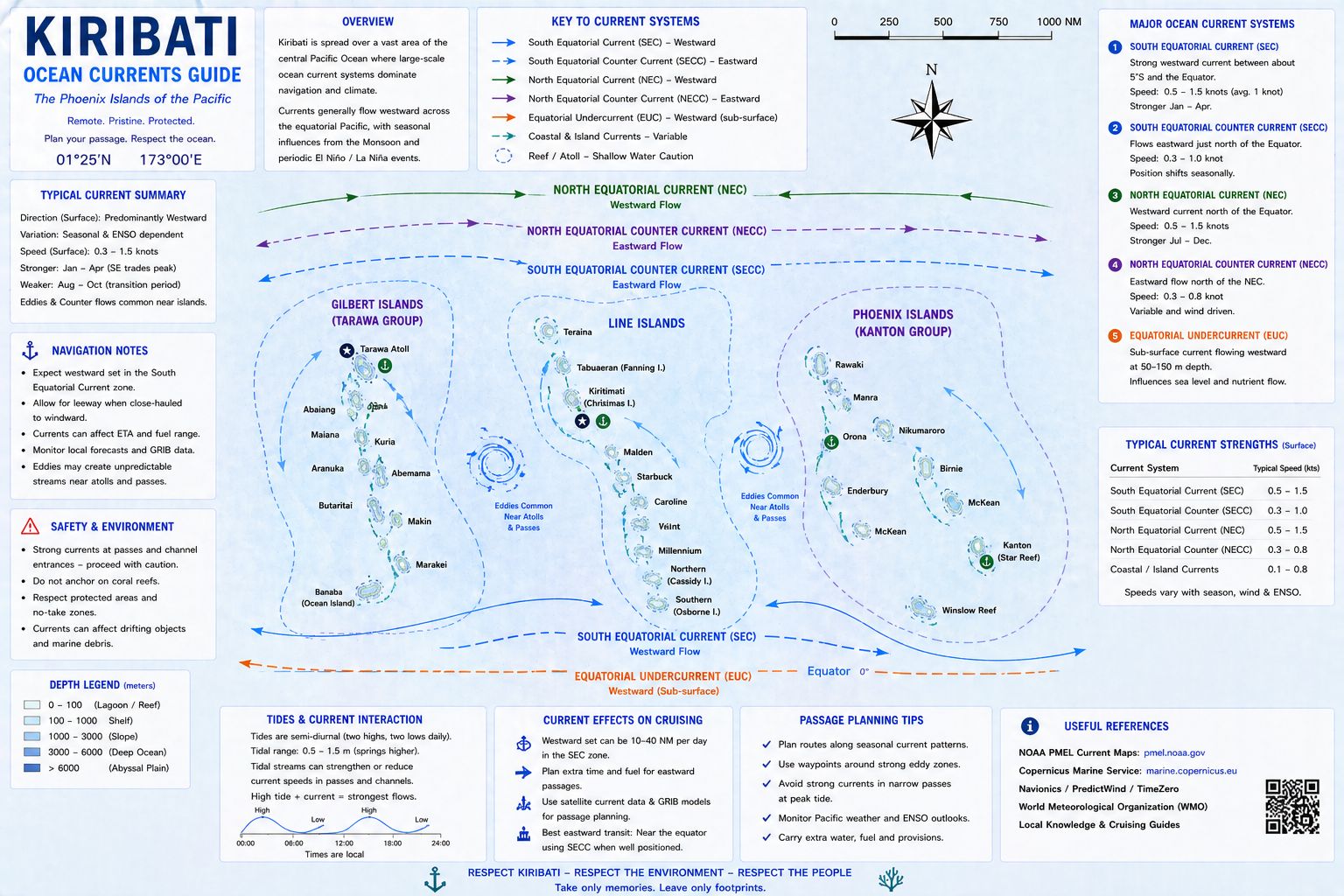
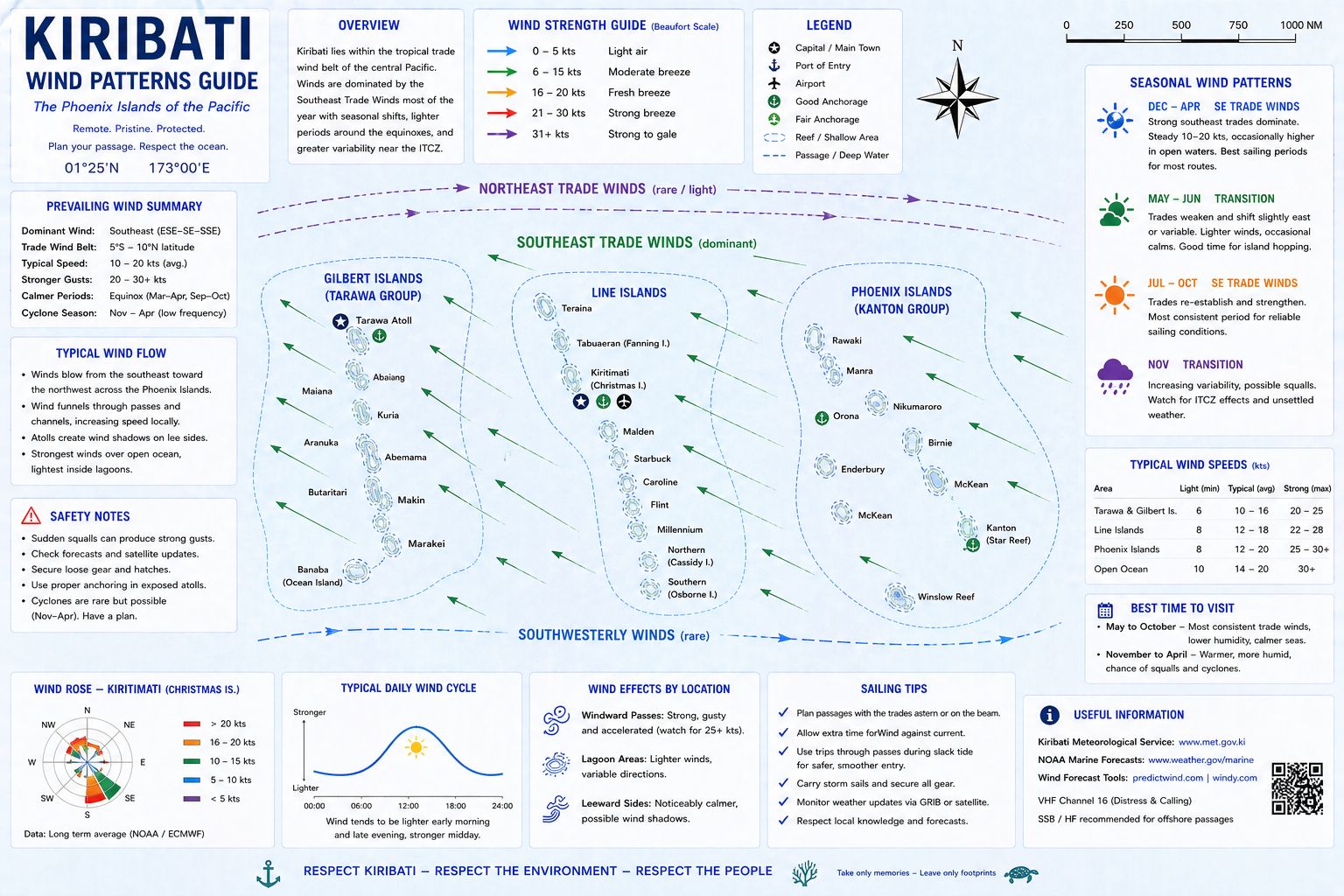
Weather adds another layer of complexity. The trades are generally steady, but squalls can arrive quickly, reducing visibility and making reef spotting impossible. During the westerly season, swell can close passes entirely. Tides are modest but matter enormously in narrow entrances, where even a small difference in height can determine whether a yacht can enter safely.
Navigation Hazards: Reefs, Passes, and Poor Charting
Sailing to Kiribati is one of the most challenging navigation environments in the Pacific. Every atoll is ringed by a reef, and lagoon passes vary from well‑marked to barely visible. Many charts are based on older surveys, and depths may not match reality. Kiritimati Island (Line Islands), Fanning Island (Line Islands), Butaritari Island (Gilbert Islands) and Kanton (Phoenix Islands Protected Area) are not commonly visited cruising locations. Key hazards include:
- Fringing reefs with steep drop‑offs
- Unmarked coral heads inside lagoons
- Strong tidal currents in passes
- Poorly charted areas, especially in outer islands
- Low visibility hazards, the atolls are almost invisible until close
- Wrecks near passes and lagoon edges
Tarawa’s lagoon is large but shallow in places, with numerous bombies. A bow watch is essential when moving inside. Outer islands such as Abaiang and Abemama have passes that can be tricky or dangerous in swell. Some atolls have no safe entry for yachts at all. For most cruisers, the safest strategy is:
- Enter only in good light
- Avoid moving inside lagoons at low sun angles
- Keep well offshore when transiting between islands
- Treat all charted depths with caution
Sailing to Kiribati - Shipwrecks
There is no official, consolidated count of shipwrecks across the Line, Gilbert, and Phoenix Islands, but historical, archaeological, and maritime‑record evidence suggests well over 100 documented wrecks, and likely hundreds more unrecorded. Because these atolls sit across major 19th–20th‑century shipping lanes and because they are low, poorly charted, and surrounded by steep drop‑offs they accumulated wrecks for centuries. Probable real total (including unrecorded 19th‑century losses) is around 200+. This makes Kiribati one of the most shipwreck‑dense regions in the Pacific. Estimated Shipwrecks by Island Group
Phoenix Islands. As it is extremely remote, poorly charted, and surrounded by steep reefs. The known wrecks include Nikumaroro: at least 6–8 documented wrecks (including the SS Norwich City). McKean has multiple tuna longliners + older iron‑hulled wrecks. Enderbury has several 19th‑century wrecks + a riveted iron hull. Rawaki has multiple 19th‑century whaling losses. The estimated total: 20–30+ wrecks.
Line Islands. A major hazard zone for 19th‑century whalers and copra ships. Known examples are Fanning (Tabuaeran): several wrecks including the MV Lindenbank (1975). Washington (Teraina) has multiple 19th‑century whaling losses. Kiritimati also known as the Bay of Wrecks is named for dozens of 1800s wrecks. The estimated total is around 40–60+ wrecks.
Gilbert Islands. They have fewer natural hazards than the Line/Phoenix groups, but Tarawa and Makin contain dozens of WWII wrecks (ships, landing craft, aircraft). Pre‑WWII trading schooners and copra vessels also lost on reefs. The estimated total: 40–50+ wrecks.
World War 2 - History
The Battle of Tarawa (20–23 November 1943) was one of the fiercest early amphibious assaults of the Pacific War. U.S. Marines landed on Betio, a heavily fortified islet in Tarawa Atoll, defended by roughly 4,500 entrenched Japanese troops. Unexpectedly low tides stranded many landing craft on the reef, forcing Marines to wade hundreds of metres under intense fire. After three days of brutal, close‑quarters fighting, the U.S. secured the island, with almost the entire Japanese garrison killed and more than 1,000 Americans dead. Tarawa proved the cost of assaulting fortified atolls and reshaped U.S. amphibious strategy for the rest of the Pacific campaign. When I visited here, I made a trip to these battle locations. Warning. Don't pick up or handle any unexploded ordinance.
Sailing to Kiribati - Provisioning
It is some years since I visited Tarawa. Provisioning in Kiribati is more challenging than in Tuvalu or Samoa. Tarawa has the only meaningful shops, and even there, supplies depend entirely on irregular cargo ships. The national dish of Kiribati is Palusami.
Supermarkets. South Tarawa has many small, scattered shops, mostly Chinese‑run minimarts, local family stores, and a few larger supermarkets. South Tarawa (Betio, Bairiki, Bikenibeu the only real option. This is where all shops, markets, and small supermarkets are located. Even here, selection is limited and unpredictable. The main grocery stores are the Coral Ace Supermarket at the Bairiki Super Mall, Corals Ace Store in Temwaiku. NEMBS Enterprise in Eita. Moel Trading in Betio. Te Uri Store in Bairiki. - Betio Mini Market in Betio. Wishing Star Supermarket in Betio. Antebuka Store (LMTA) in Antebuka, Tarawa and the Uan Store in Bairiki. There are handicraft shops in South Tarawa selling pandanus baskets, fans, necklaces, coconut crafts, and shark‑tooth swords. The Fern Store is a popular place locally for pies and wine. Outer Islands (Abaiang, Abemama, Butaritari, etc.). Provisioning is essentially non‑existent. You may find coconuts, breadfruit (seasonal), fish and occasional homegrown produce. There is nothing resembling a shop or reliable supply. Yachts should arrive fully stocked and treat Kiribati as a top‑up stop only. Markets. There are no produce markets.
Commonly available staples include rice, flour, noodles, canned fish and meat and frozen chicken (variable quality). Rare or unreliable are fresh fruit and vegetables, dairy products, bread (available some days), fresh meat. Don’t expect availability of marine hardware items, spare parts, high‑quality frozen goods, fresh herbs or greens.
Where to Buy Seafood & Fish in Tarawa. Tabiang Fish Market in Tarawa’s and is the largest fish market in Kiribati, offering a wide range of fresh fish, crabs, lobster, and other seafood. It’s busy, colourful, and the closest thing Tarawa has to a central seafood market. One thing to sample are the locally prepared dishes (grilled fish, fish soup). Choose tuna, wahoo, mahi‑mahi for safety (lower ciguatera risk). Roadside Fish Vendors (South Tarawa) have been around a long time. The government is now upgrading these into high‑tech fish vending units with refrigerated displays and solar lighting. These units are located in Teaoraereke and serve local artisanal fishermen. Produce includes freshly caught lagoon and ocean fish, best in afternoon sales when boats return. These are excellent for buying fish directly from fishermen in a more organised setting. Buy direct from Fishermen (Betio, Bairiki, Teaoraereke). Best times late afternoon when boats return and located near Betio wharf, Bairiki causeway, and Teaoraereke village. As a note Kiribati Fish Ltd operates a large tuna processing facility in Tarawa, exporting high‑quality tuna and employing over 200 people.
Frozen goods are common, but freezer reliability varies, power outages happen and cold chain is inconsistent. Inspect frozen items carefully before purchasing. Visual signs of product that has partially thawed and refrozen are ice crystals inside packaging: Indicates moisture loss and refreezing. Discolored patches such as grey, brown, or greenish areas suggest oxidation or bacterial growth. Frost burn or dry edges: Caused by repeated freezing cycles. Uneven coloration: May signal partial thawing and refreezing. Give it the smell test. A sour or ammonia-like odor is a clear sign of spoilage. Any “Off” smell even when frozen: Indicates bacterial activity during thawing. Do a texture check, mushy or slimy surface is due to cell breakdown from thawing. Sticky or tacky feel indicates early spoilage, especially in poultry. Excess liquid in packaging suggests previous thawing. Frozen chicken-specific Red Flags are a pale or translucent skin: Indicates moisture loss. Blood pooling or dark spots which may signal partial thawing. Bone darkening is often seen in refrozen chicken.
Fuel, Water: Scarce and Variable - Repairs Sometimes Possible
Diesel. Fuel in Kiribati is a study in scarcity and improvisation. In Tarawa, the only place where yachts can reliably refuel, diesel arrives by tanker on an irregular schedule and is stored in aging island tanks that serve everyone from power stations to inter‑island ferries. When the supply ship is late, the entire atoll feels it, stations shorten hours, rationing begins, and queues form before dawn. Yachts collect fuel by jerry can from roadside pumps or the Betio wharf, filtering every drop because water and sediment are common after long storage. Outside Tarawa, there are no fuel options at all, reinforcing the need for self‑sufficiency and careful passage planning. CAUTION: Diesel fuel comes from old tanks, will be contaminated with particles and possibly water. Pour into tanks using a Baja Filter or Mr Filter Funnel and as usual monitor your prefilters (if you haven't got many spare filters best get some)
Water. Kiribati has no natural freshwater sources. All water is rain‑harvested, stored in household tanks and very limited during droughts. Yachts should arrive with full tanks and avoid relying on shore water except in emergencies. Always filter or boil any water. Makes the case of having a water maker on board.
Repairs. Tarawa hosts the only functioning shipyard in Kiribati, used by foreign tuna fleets for repairs and maintenance. Tarawa Shipyard Company is operated in partnership with Silla (a Korean fishing company) and a Philippine shipyard operator, both of which bring limited professional technical expertise into Kiribati. If you have issues with an engine or something else you might be able to get help. If you have alternator or engine starter issues, there is a full auto repair shop to visit and request help. Best is LMTA which is Full Automotive Workshop (Antebuka, South Tarawa).
Mechanical
and Electrical Repairs Resource
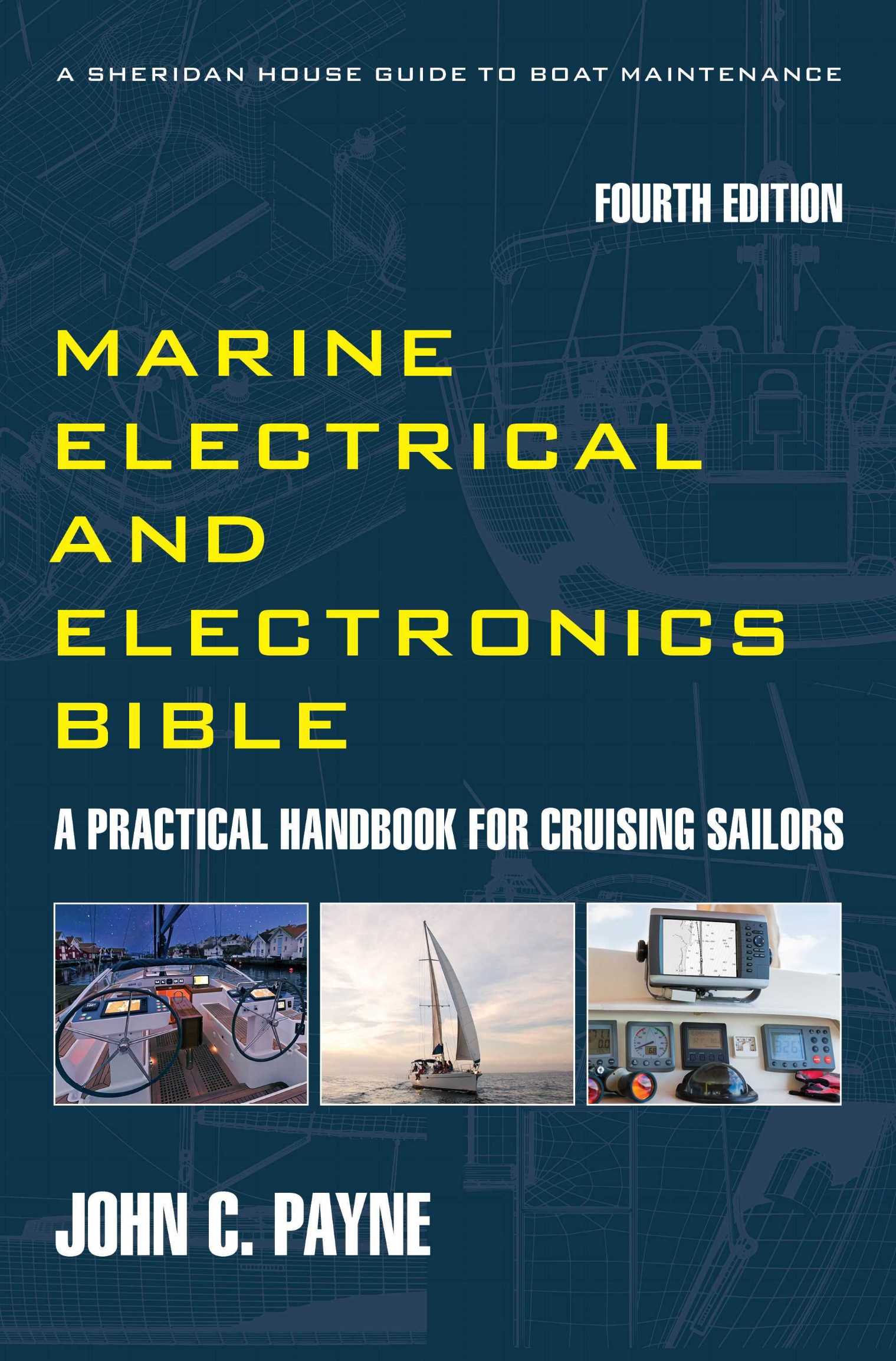
If you are headed somewhere remote consider the need to expand your knowledge base or have an information resource on board. Why not get a copy of my book The Marine and Electrical and Electronics Bible 4th Edition. By and for yachties, with everything from batteries and charging, solar and wind, diesel engines and marine electronics and so much more. Your complete systems guide. 650 pages of practical advice. In Australia and New Zealand order a copy through Boat Books. UK and European boats can buy the UK Edition Here. US and Canadian boats can get the US Edition Order Here. Marine systems are my profession so let me help you. By a liveaboard boat owner for other boat owners


Culture:
Respect, Modesty, and Community
Kiribati culture is warm, communal, and deeply rooted in tradition. Visitors who approach with humility are welcomed generously. Key cultural points:
- Modest dress is expected, especially outside Tarawa
- Sundays are sacred. Please avoid work or loud activities
- Land is private. Always ask before walking inland
- Elders hold authority. Respect goes a long way
- Photos. They should only be taken with permission
- Gifts (small, practical items, for schools etc). These are appreciated in outer islands
Sailing to
Kiribati
Despite these challenges, sailing to Kiribati is navigable for well‑prepared sailors. The key is patience, waiting for the right light, the right tide, and the right conditions. Local knowledge is invaluable, and speaking with fishermen or island council members before attempting a pass can make all the difference. The I‑Kiribati have an intimate understanding of their waters, and they are generous with advice when approached respectfully. Kiribati is not an easy cruising ground. Navigation is demanding, provisioning is limited, and infrastructure is basic. But for sailors who arrive prepared, patient, and respectful, the country offers something rare: authenticity, cultural depth, and a sense of voyaging far beyond the usual routes. The Gilbert Islands reward those who take the time to understand them and they leave a lasting impression on anyone who makes the journey.