Cruising Kiribati Outer
Islands - Line, Gilbert & Phoenix Groups
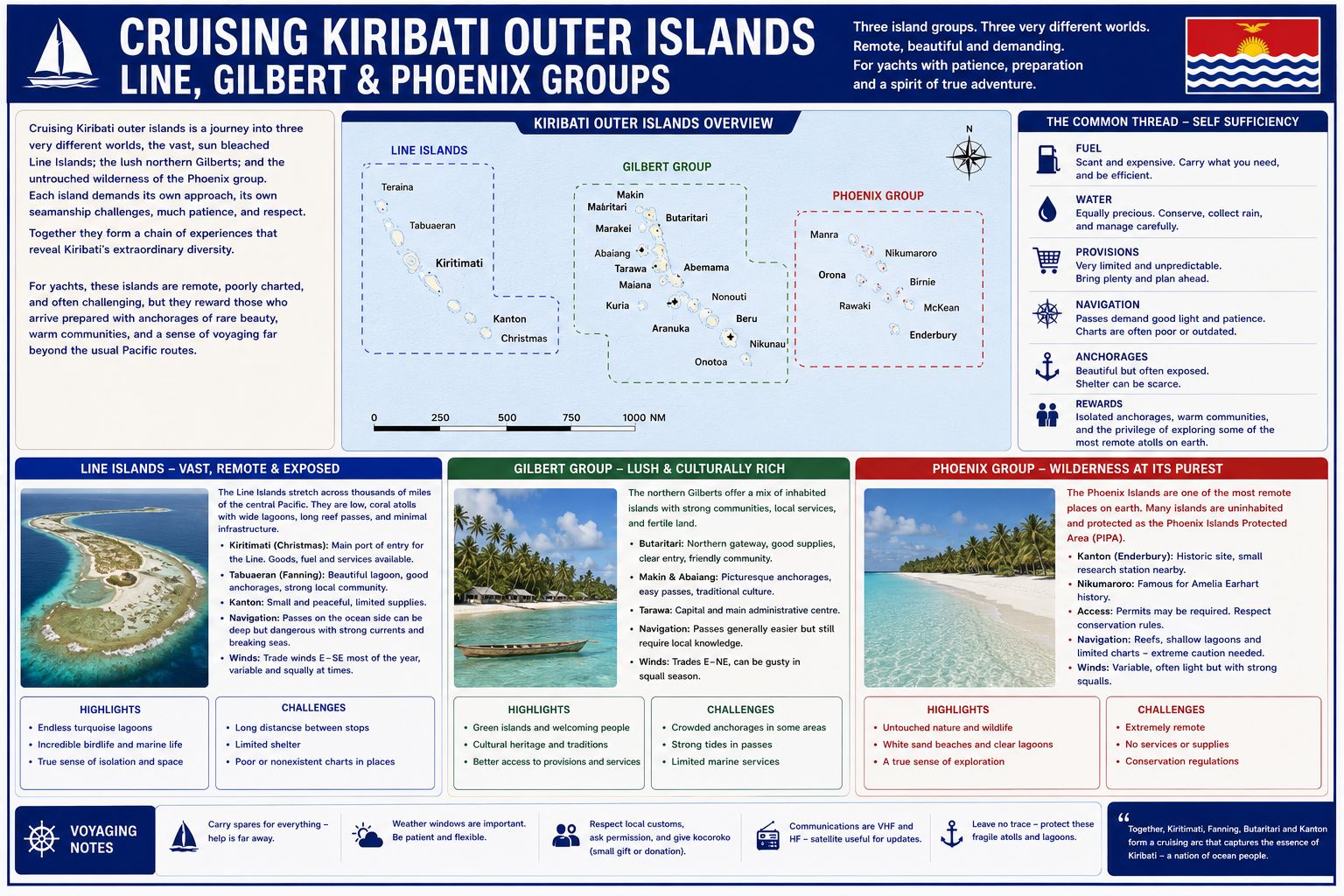
Cruising Kiribati outer islands is a journey into three very different worlds, the vast, sun‑bleached Line Islands; the lush northern Gilberts; and the untouched wilderness of the Phoenix group. Each island demands its own approach, its own seamanship challenges, much patience, and respect. Together they form a chain of experiences that reveal Kiribati’s extraordinary diversity. For yachts, these islands are remote, poorly charted, and often challenging, but they reward those who arrive prepared with anchorages of rare beauty, warm communities, and a sense of voyaging far beyond the usual Pacific routes.
Cruising Kiribati outer islands and for yachts venturing here, the common thread is self‑sufficiency. Fuel is scarce, water is equally precious, and provisioning very limited and unpredictable. Passes demand good light and patience; lagoons require careful navigation; and anchorages, while beautiful, often offer little shelter from variable winds. The rewards are immense, quiet and isolated anchorages under big bluet skies, encounters with communities that still live by the tides, and the rare privilege of exploring some of the most remote atolls on earth. Together, Kiritimati, Fanning, Butaritari, and Kanton form a cruising arc that captures the essence of Kiribati, who are a nation of ocean people.
Cruising Kiribati Outer Islands - Kiritimati Island
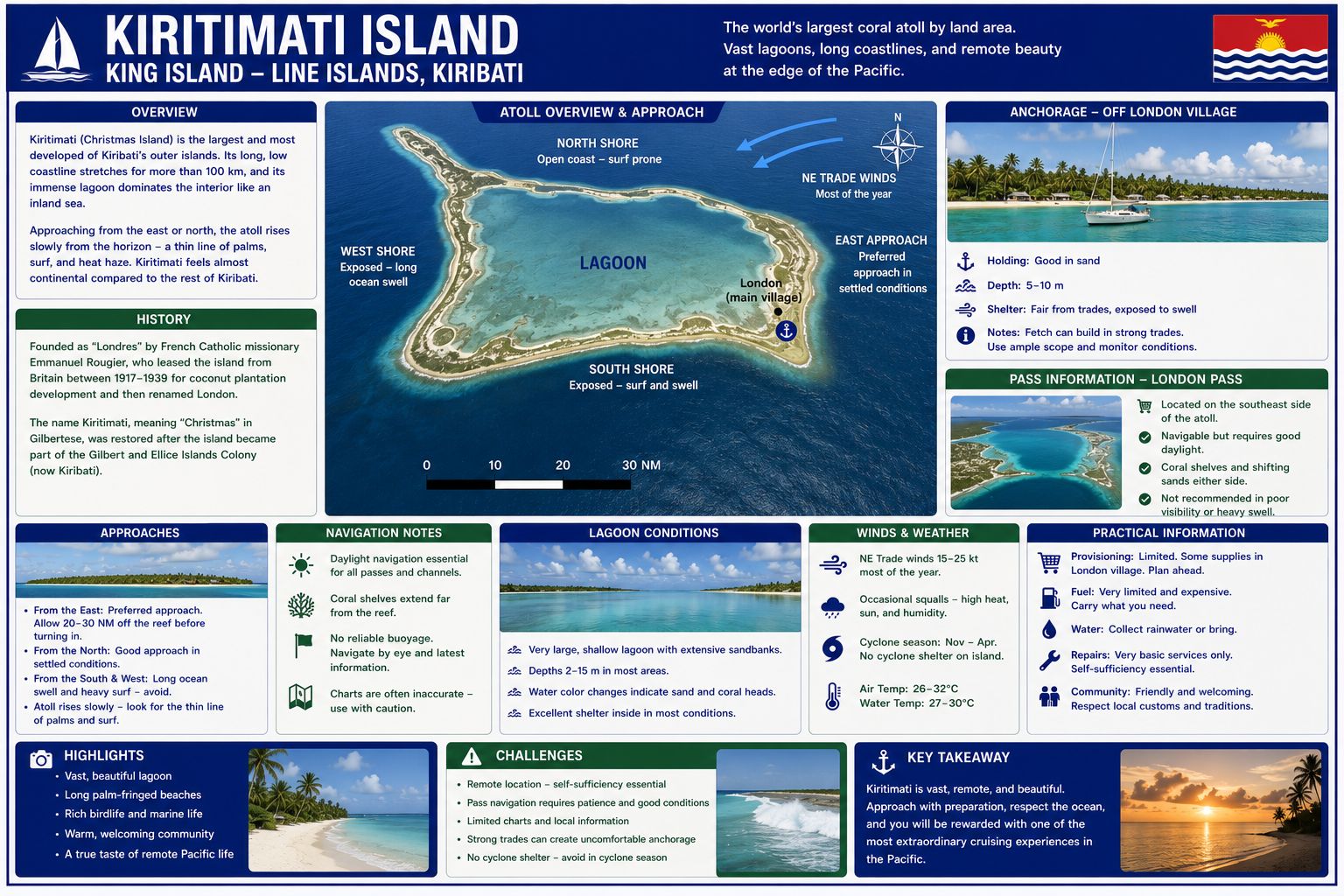
Kiritimati, the world’s largest coral atoll by land area, feels almost continental compared to the rest of Kiribati. Its long, low coastline stretches for more than a hundred kilometres, and its immense lagoon dominates the interior like an inland sea. Approaching from the east or north, the atoll rises slowly from the horizon, a thin line of palms, surf, and heat haze. The main anchorage off London village offers reasonable holding in sand, though the fetch can build in strong trades. The pass into the lagoon is navigable but requires good light; coral shelves and shifting sands make it unsuitable in poor visibility or heavy swell. Founded as “Londres” by French Catholic missionary Emmanuel Rougier, who leased the island from Britain between 1917–1939 for coconut plantation development and then renamed London.
Kiritimati Island — Entering
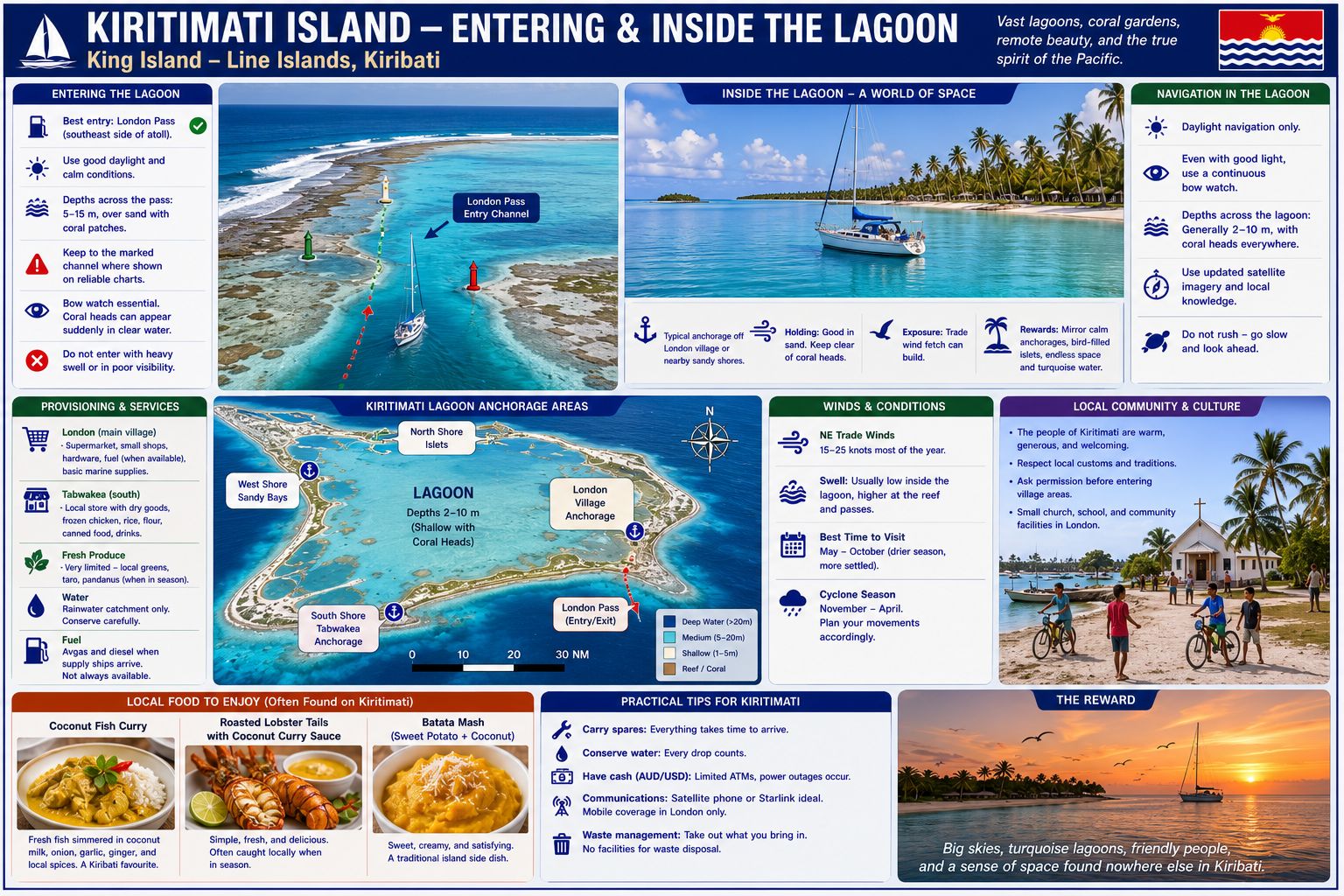
Once inside, the lagoon opens into a vast, shallow expanse dotted with coral heads. Navigation is strictly a daylight exercise, and even then, a bow watch is essential. Yachts typically anchor off London’s lagoon shore, with good holding in sand but exposure to trade wind fetch. The rewards are worth it, mirror‑calm anchorages, bird‑filled islets, and a sense of space found nowhere else in Kiribati. Provisioning is better here than in most outer island’s small shops in London and Tabwakea carry dry goods, frozen chicken, and basic supplies, though fresh produce remains scarce. Water is limited to rain tanks, and fuel availability depends on the timing of supply ships. While not specific to Kiritimati, these dishes appear in the national cuisine and are often prepared on the island. Coconut fish curry, roasted lobster tails with coconut curry sauce, Batata mash (sweet potato + coconut).
Cruising Kiribati Outer Islands - Fanning Island
(Tabuaeran)
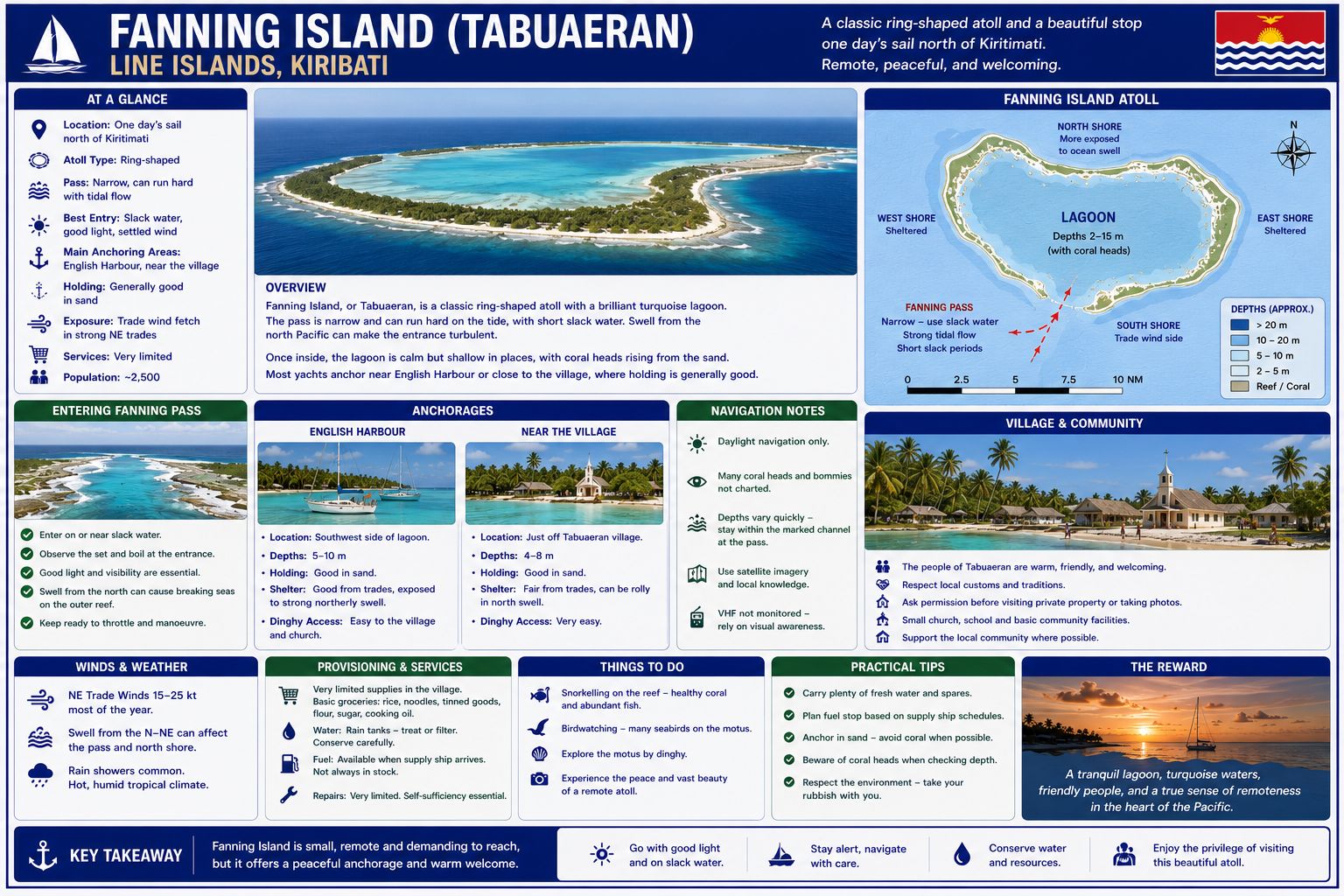
A day’s sail north of Kiritimati lies Tabuaeran, known to most cruisers as Fanning Island. It is a classic ring-shaped atoll, smaller and more intimate than Kiritimati, with a lagoon that glows turquoise in the morning sun. The pass is narrow and can run hard with tidal flow; slack water is short, and swell from the north Pacific can make the entrance turbulent. Once inside, the lagoon is calm but shallow in places, with coral heads rising abruptly from the sandy floor. Most yachts anchor near English Harbour or close to the main village, where holding is generally good.
Fanning Island
(Tabuaeran) Food
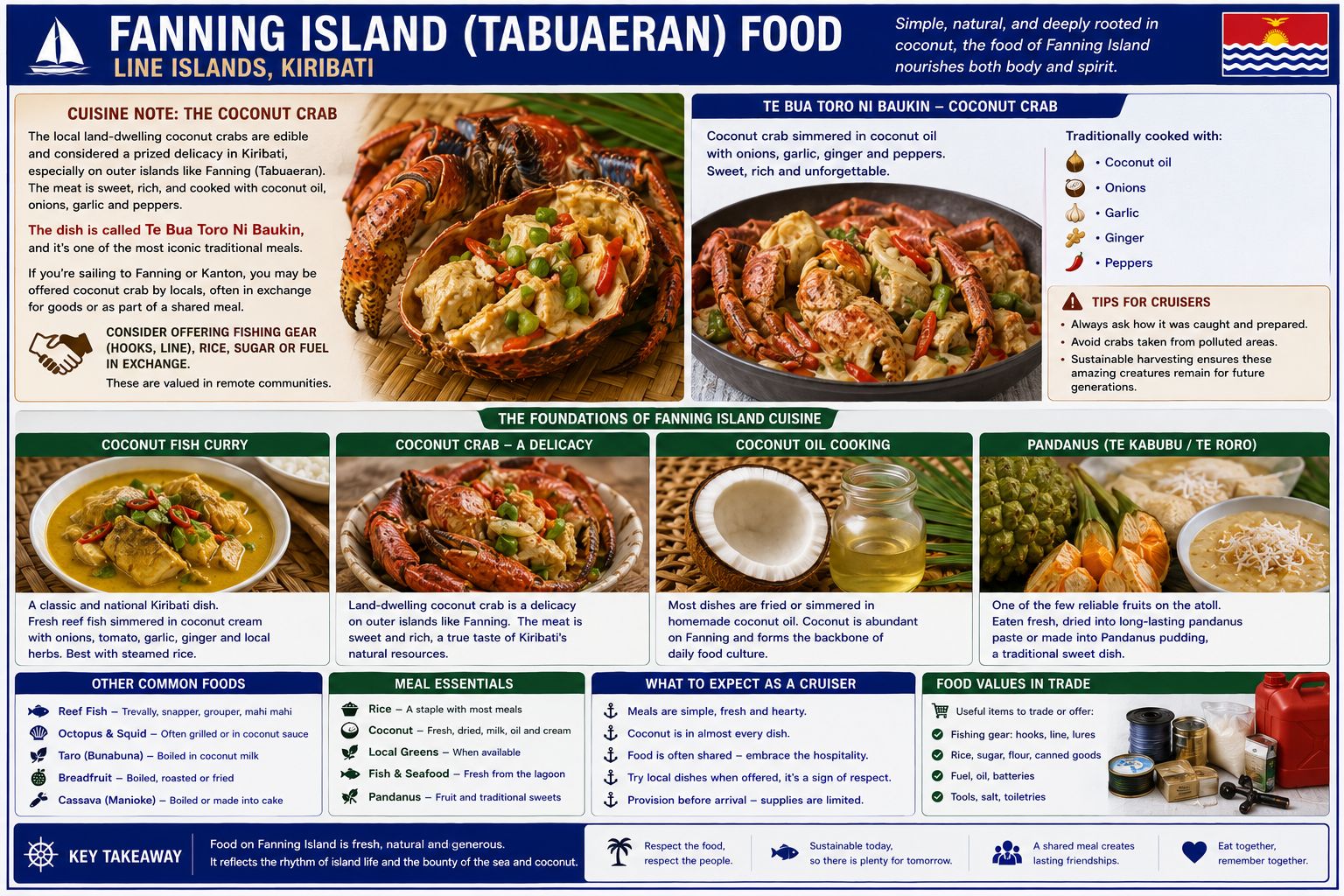
Cruisine Note: The local land-dwelling coconut crabs are edible and considered a prized delicacy in Kiribati, especially on outer islands like Fanning (Tabuaeran). The meat is sweet, rich, and cooked with coconut oil, onions, garlic and peppers. The dish is called Te Bua Toro Ni Baukin, and it’s one of the most iconic traditional meals. If you’re sailing to Fanning or Kanton, you may be offered coconut crab by locals, often in exchange for goods or as part of a shared meal. Always ask how it was caught and prepared, and avoid crabs taken from polluted areas. Consider offering fishing gear (hooks, line), rice, sugar or fuel in exchange, these are valued in remote communities. Coconut is the foundation of nearly every meal Coconut Fish Curry, is a classic and National Kiribati dish made with fresh reef fish simmered in coconut cream. Coconut crab is a delicacy on outer islands like Fanning. Coconut oil cooking where most dishes are fried or simmered in homemade coconut oil. Coconut is abundant on Fanning and forms the backbone of daily food culture. Pandanus (Te Kabubu / Te Roro) is one of the few reliable fruits on the atoll. It is eaten fresh, dried into long‑lasting pandanus paste or made into Pandanus pudding, a traditional sweet dish.
Cruising Kiribati Outer Islands - Fanning Island
(Tabuaeran) Life
Life on Fanning is simple and deeply traditional. There is no power grid, no formal shops, and no regular supply chain. Provisioning is limited to coconuts, fish, and whatever small produce families grow in their gardens. The island receives only a handful of supply ships each year, so yachts must arrive fully stocked. The people are warm and welcoming, and cruisers often find themselves drawn into village life sharing meals, attending church, or trading small goods for fresh fish. Fanning is a reminder of what Pacific voyaging once was, quiet, communal, and shaped by the sea.
Fanning Island
(Tabuaeran) Marine History
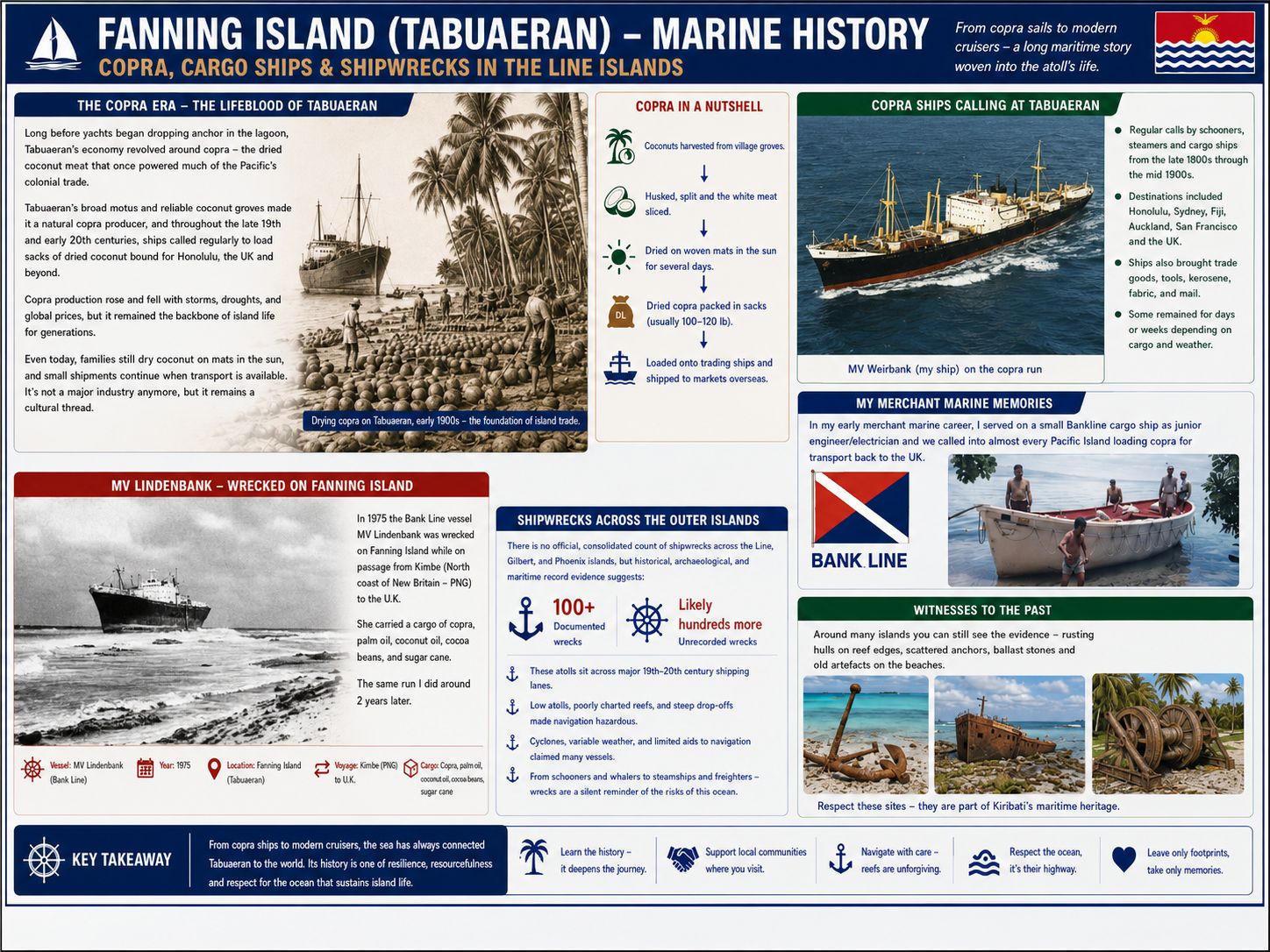
In my early merchant marine career, I served on a small Bankline cargo ship as engineer/electrician and we called into to almost every Pacific Island loading copra for transport back to the UK. Long before yachts began dropping anchor in the lagoon, the atoll’s economy revolved around copra, the dried coconut meat that once powered much of the Pacific’s colonial trade. Tabuaeran’s broad motus and reliable coconut groves made it a natural copra producer, and throughout the late 19th and early 20th centuries, ships called regularly to load sacks of dried coconut bound for Honolulu, UK and beyond. Copra production rose and fell with storms, droughts, and global prices, but it remained the backbone of island life for generations. Even today, families still dry coconut on mats in the sun, and small shipments continue when transport is available. It’s not a major industry anymore, but it remains a cultural thread. In 1975 the Bank Line vessel MV Lindenbank was wrecked on Fanning Island while on passage from Kimbe (North coast of New Britain – PNG) to the U.K. with a cargo of copra, palm oil, coconut oil, cocoa beans, and sugar cane. The same run I did around 2 years later.
There is no official, consolidated count of shipwrecks across the Line, Gilbert, and Phoenix Islands, but historical, archaeological, and maritime‑record evidence suggests well over 100 documented wrecks, and likely hundreds more unrecorded. Because these atolls sit across major 19th–20th‑century shipping lanes and because they are low, poorly charted, and surrounded by steep drop‑offs, they accumulated wrecks for centuries.
Cruising Kiribati Outer Islands - Butaritari
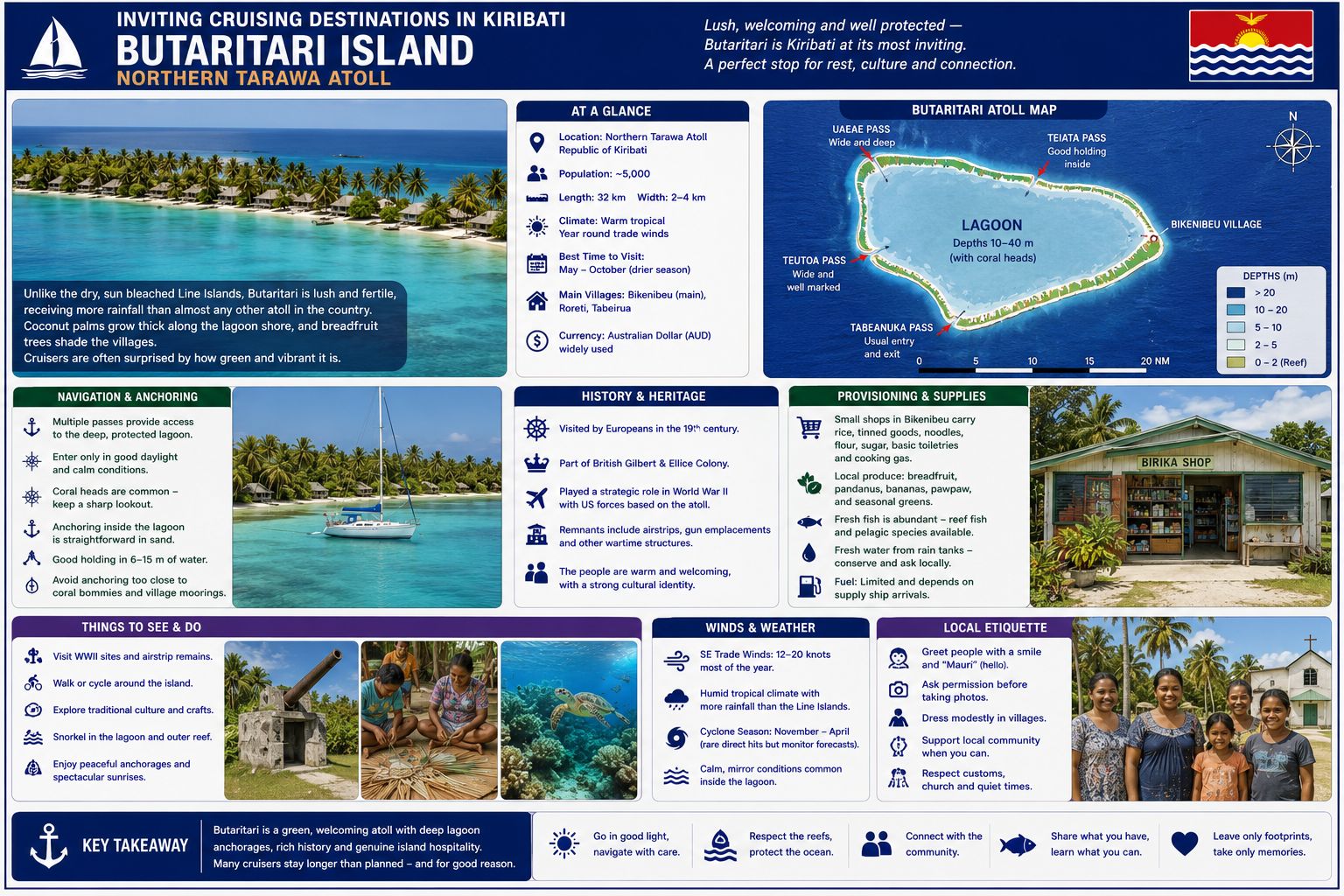
Far to the west, in the northern Gilbert Islands, Butaritari stands out as one of the most inviting cruising destinations in Kiribati. Unlike the dry, sun‑bleached Line Islands, Butaritari is lush and fertile, receiving more rainfall than almost any other atoll in the country. Coconut palms grow thick along the lagoon shore, and breadfruit trees shade the villages. The lagoon itself is deep and well protected, with multiple passes that are generally wider and more forgiving than those in the Line Islands. Even so, good light is essential, coral heads are common, and the lagoon floor shifts subtly with storms and currents.
Anchoring inside the lagoon is straightforward, with sandy patches offering good holding. The villages are friendly, and the island’s history from early European contact to its role in World War II adds depth to any visit. Provisioning is better here than in most outer islands: small shops carry dry goods, and local produce such as breadfruit, pandanus, and bananas may be available depending on the season. Fish is abundant, though reef species should be chosen with care due to ciguatera risk. Butaritari feels like a place where time moves gently, and cruisers often stay longer than planned.
Cruising Kiribati Outer Islands - Butaritari - Navigation
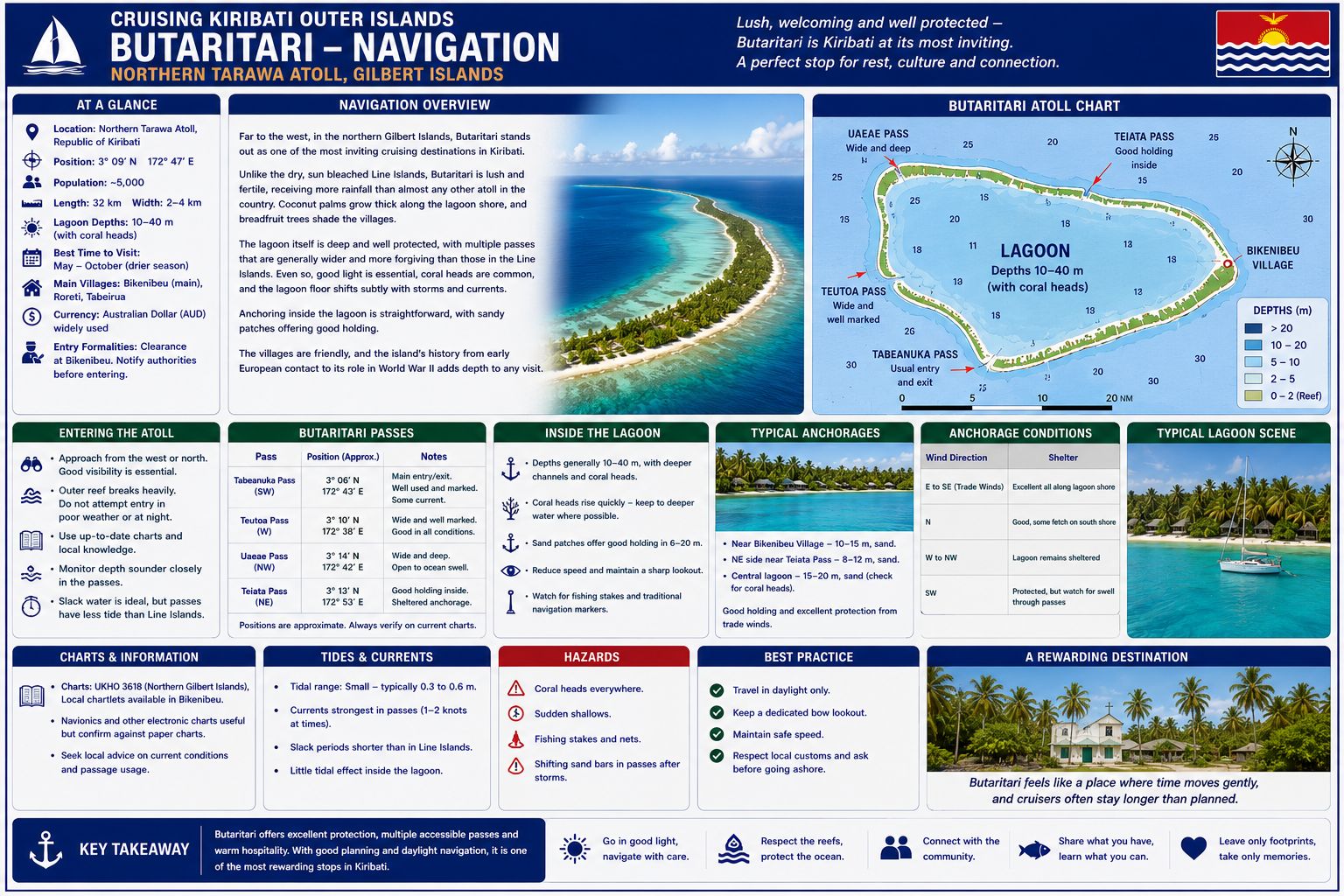
Far to the west, in the
northern Gilbert Islands, Butaritari stands out as one of the most inviting
cruising destinations in Kiribati. Unlike the dry, sun‑bleached Line Islands,
Butaritari is lush and fertile, receiving more rainfall than almost any other
atoll in the country. Coconut palms grow thick along the lagoon shore, and
breadfruit trees shade the villages. The lagoon itself is deep and well protected,
with multiple passes that are generally wider and more forgiving than those in
the Line Islands. Even so, good light is essential, coral heads are common, and
the lagoon floor shifts subtly with storms and currents. Anchoring inside the lagoon is
straightforward, with sandy patches offering good holding. The villages are
friendly, and the island’s history from early European contact to its role in
World War II adds depth to any visit.
Butaritari - Food and Provisioning
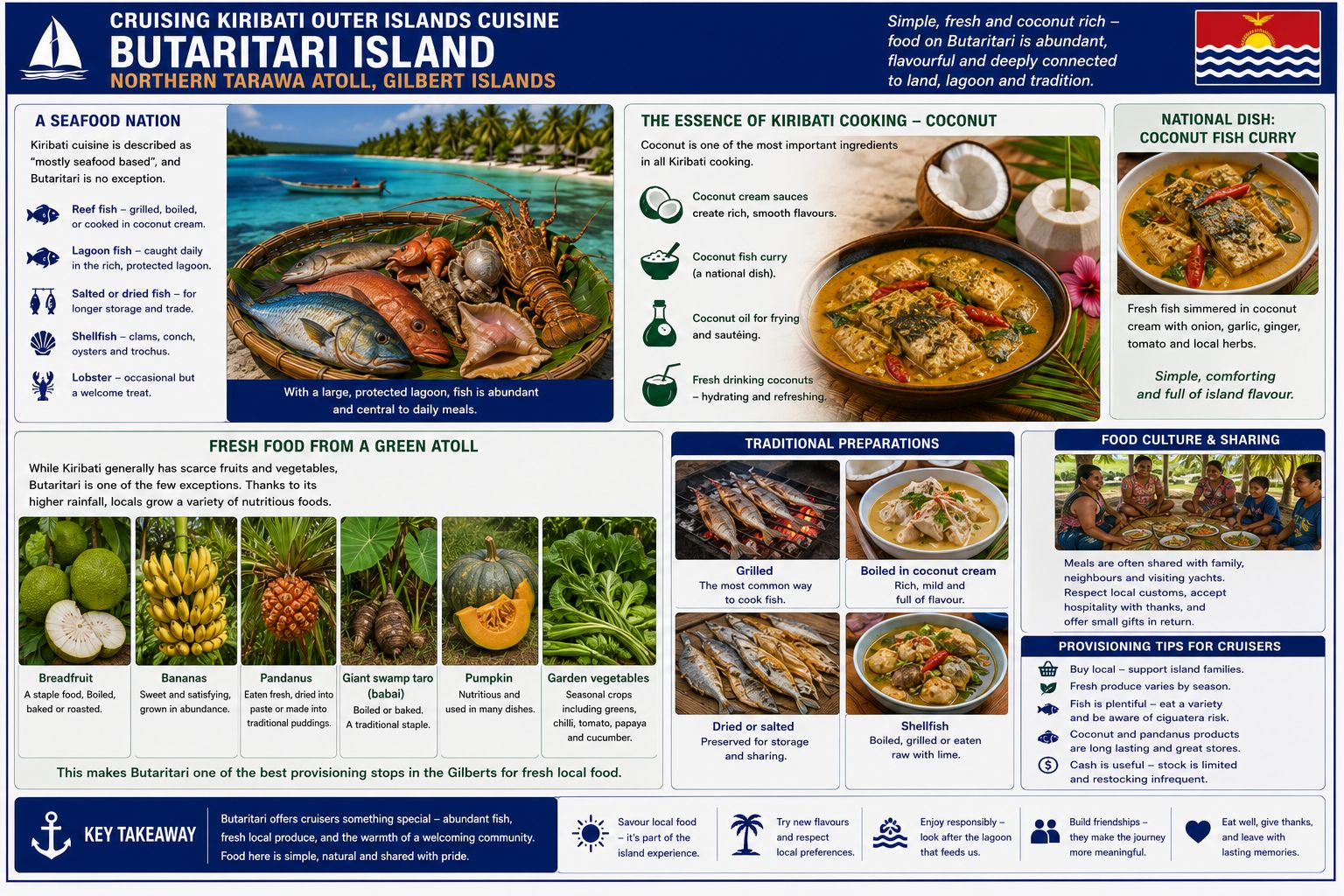
Provisioning is better here than in most outer islands: small shops carry dry goods, and local produce such as breadfruit, pandanus, and bananas may be available depending on the season. Fish is abundant, though reef species should be chosen with care due to ciguatera risk. Butaritari feels like a place where time moves gently, and cruisers often stay longer than planned.
Kiribati cuisine is described as “mostly seafood‑based”, and Butaritari is no exception. Common foods include Reef fish (grilled, boiled, or cooked in coconut cream), Lagoon fish, Salted or dried fish for storage, Shellfish and occasional lobster. Because Butaritari has a large, protected lagoon, fish is abundant and central to daily meals. Coconut is one of the most important ingredients in all Kiribati cooking, from Coconut cream sauces, Coconut fish curry (a national dish), Coconut oil for frying and fresh drinking coconuts. While Kiribati generally has scarce fruits and vegetables, Butaritari is one of the few exceptions. Thanks to its higher rainfall, locals grow Breadfruit, Bananas, Pandanus, Giant swamp taro (babai) and pumpkin and small garden vegetables (seasonal). This makes Butaritari one of the best provisioning stops in the Gilberts for fresh local food.
Cruising Kiribati Outer Islands - Kanton — Phoenix Islands
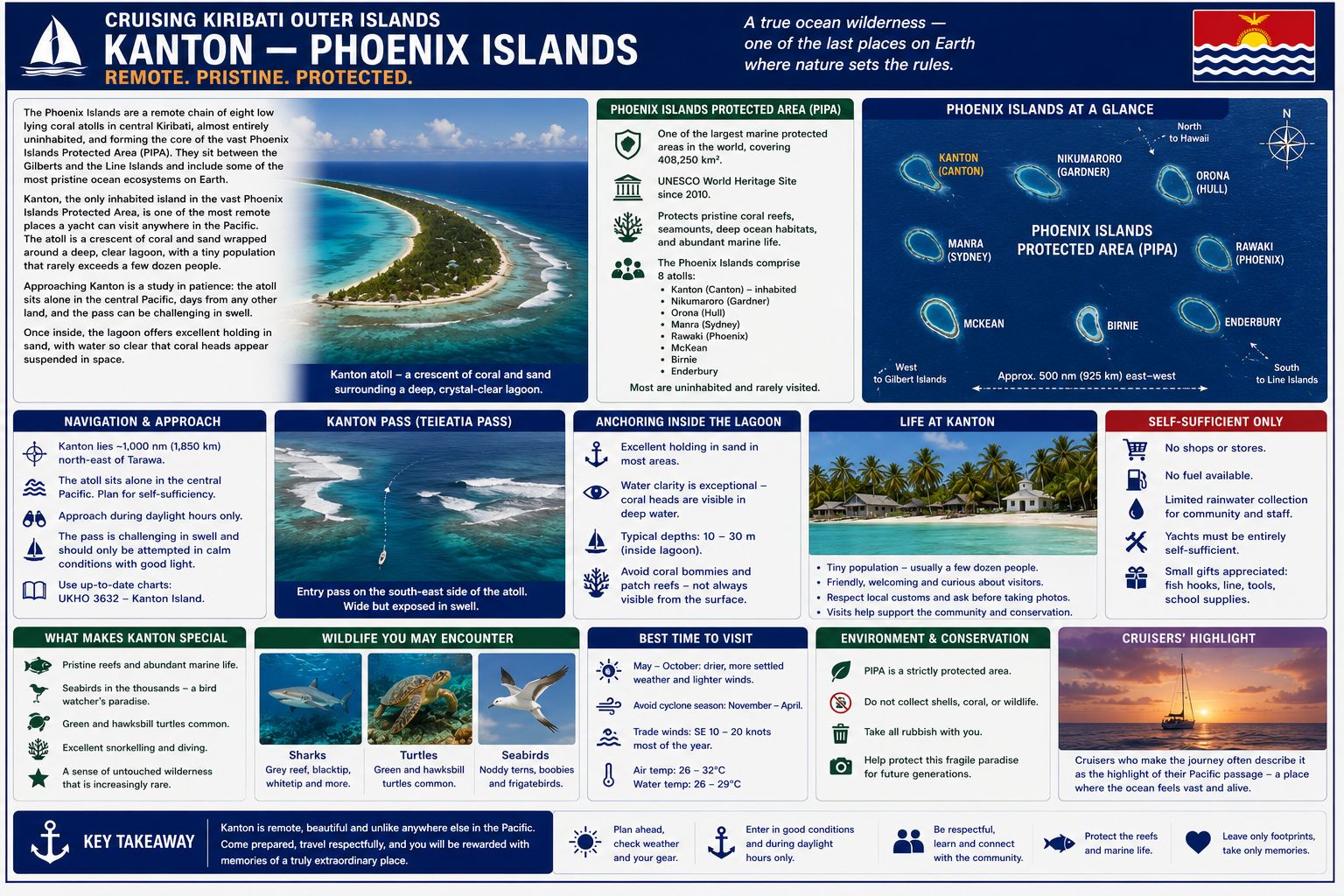
The Phoenix Islands are a remote chain of eight low‑lying coral atolls in central Kiribati, almost entirely uninhabited, and forming the core of the vast Phoenix Islands Protected Area (PIPA). They sit between the Gilberts and the Line Islands and include some of the most pristine ocean ecosystems on Earth. Kanton, the only inhabited island in the vast Phoenix Islands Protected Area, is one of the most remote places a yacht can visit anywhere in the Pacific. The atoll is a crescent of coral and sand wrapped around a deep, clear lagoon, with a tiny population that rarely exceeds a few dozen people. Approaching Kanton is a study in patience: the atoll sits alone in the central Pacific, days from any other land, and the pass can be challenging in swell. Once inside, the lagoon offers excellent holding in sand, with water so clear that coral heads appear suspended in space. Phoenix Islands Protected Area (PIPA) is one of the largest marine protected areas in the world, covering 408,250 km². A UNESCO World Heritage Site since 2010 and protects pristine coral reefs, seamounts, deep‑ocean habitats, and abundant marine life. The islands comprise Kanton (Canton), Nikumaroro (Gardner), Orona (Hull), Manra (Sydney), Rawaki (Phoenix), McKean, Birnie and Enderbury. Most are uninhabited and rarely visited.
Kanton’s isolation is profound. There are no shops, no fuel, and only limited rainwater collected by the small community and conservation staff. Yachts must be entirely self‑sufficient. Yet the island’s beauty is extraordinary, pristine reefs, abundant sharks, seabirds wheeling overhead, and a sense of untouched wilderness that is increasingly rare. Cruisers who make the journey often describe it as the highlight of their Pacific passage, a place where the ocean feels vast and alive.
Kanton Navigation
Notes
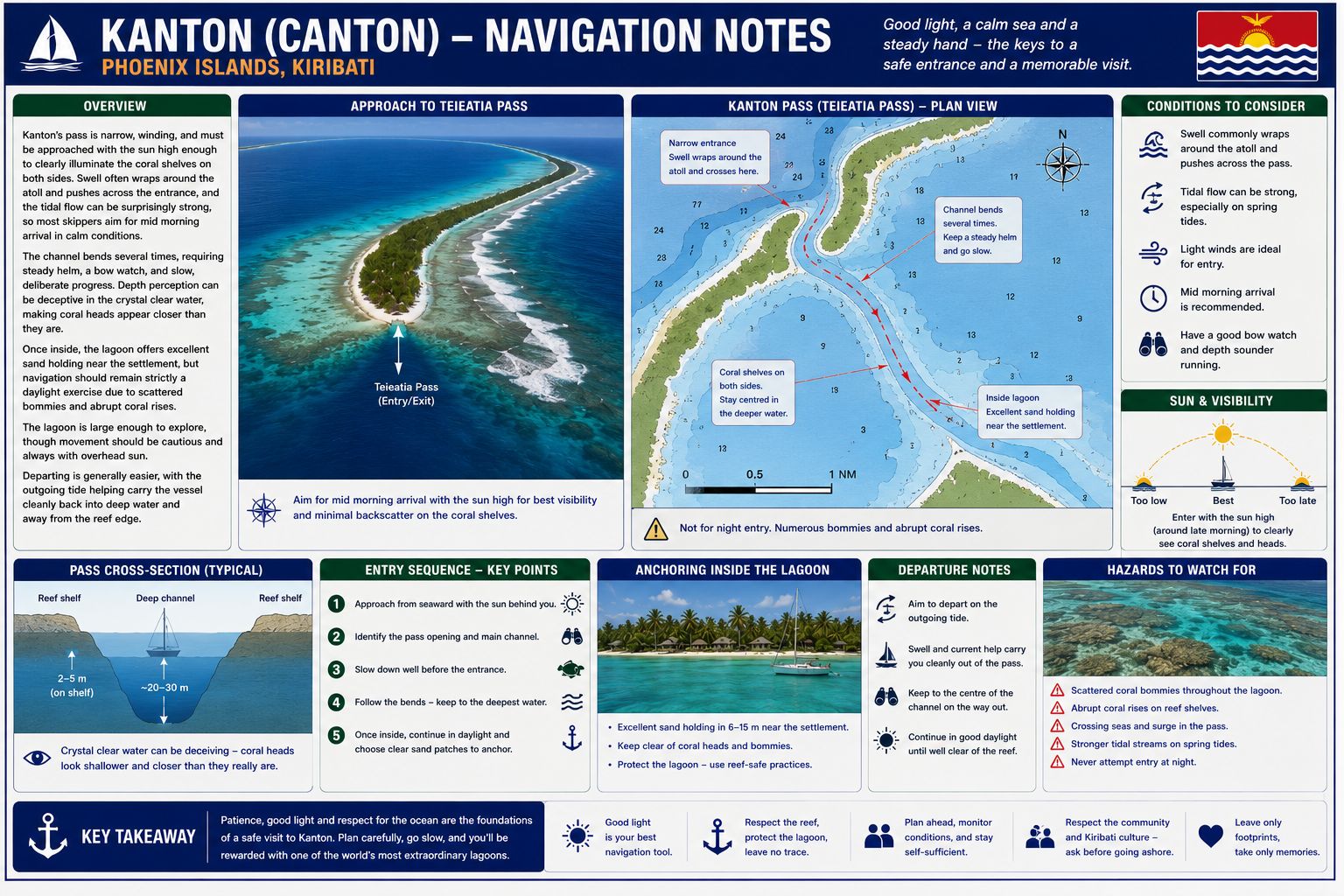
Kanton’s pass is narrow, winding, and must be approached with the sun high enough to clearly illuminate the coral shelves on both sides. Swell often wraps around the atoll and pushes across the entrance, and the tidal flow can be surprisingly strong, so most skippers aim for mid‑morning arrival in calm conditions. The channel bends several times, requiring steady helm, a bow watch, and slow, deliberate progress. Depth perception can be deceptive in the crystal‑clear water, making coral heads appear closer than they are. Once inside, the lagoon offers excellent sand holding near the settlement, but navigation should remain strictly a daylight exercise due to scattered bommies and abrupt coral rises. The lagoon is large enough to explore, though movement should be cautious and always with overhead sun. Departing is generally easier, with the outgoing tide helping carry the vessel cleanly back into deep water and away from the reef edge
Kanton Anchoring
and Arrival
After anchoring near the settlement on the western side of the lagoon, the first task is to make yourself known to the community. There is no formal port authority, but the island’s senior representative, usually the island officer or council leader, keeps a record of all visiting vessels. You go ashore by dinghy, present your passports and vessel details, and they will note your arrival in the island log. You’ll be briefed on local expectations: where you may anchor, where you may go ashore, and any conservation restrictions in place. Because Kanton sits inside a protected area, they may remind you about fishing limits, waste management, and lagoon movement. There are no fees, no customs, and no immigration processing here, just a simple check‑in with the community so they know who is on the island and for how long.
Mechanical
and Electrical Repairs Resource
If you are headed somewhere remote consider the need to expand your knowledge base or have an information resource on board. Why not get a copy of my book The Marine and Electrical and Electronics Bible 4th Edition. By and for yachties, with everything from batteries and charging, solar and wind, diesel engines and marine electronics and so much more. Your complete systems guide. 650 pages of practical advice. In Australia and New Zealand order a copy through Boat Books. UK and European boats can buy the UK Edition Here. US and Canadian boats can get the US Edition Order Here. Marine systems are my profession so let me help you. By a liveaboard boat owner for other boat owners


Cruising Kiribati Outer Islands
Cruising Kiribati outer islands and sailing between these islands reveals the full spectrum of Kiribati’s character. The Line Islands feel raw and expansive, shaped by wind, sun, and the long fetch of the Pacific. The Gilberts are more intimate, more lived‑in, with lagoons that shelter villages and histories stretching back centuries. The Phoenix Islands are something else entirely, a protected wilderness where the ocean dominates and humans are temporary guests.