Marine Diesel Fuel Consumption
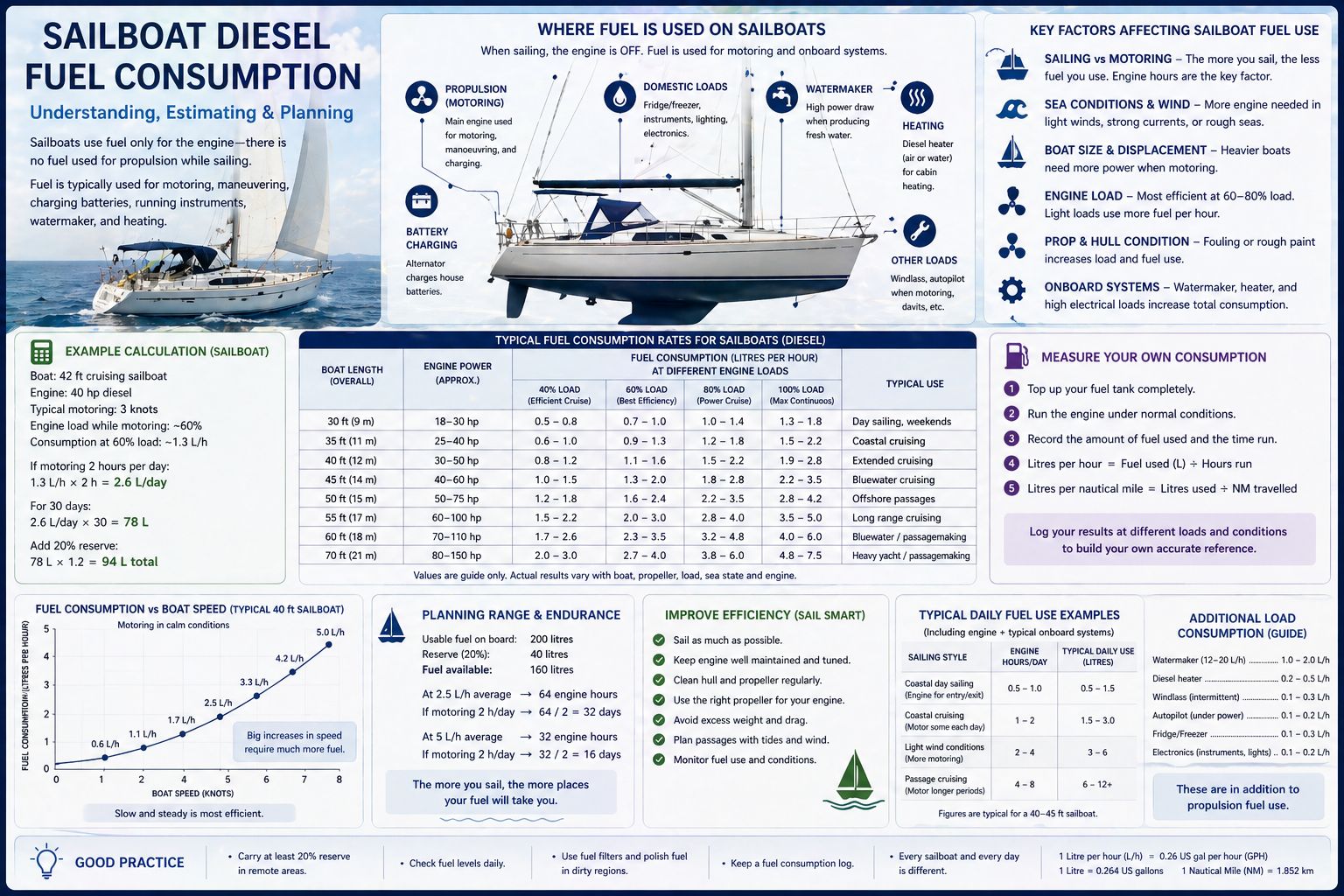
Marine diesel fuel consumption is an important subject. Small marine diesel engines, the kind found on cruising yachts up to roughly 100 hp are remarkably well-engineered but surprisingly tricky to predict when it comes to fuel burn. Manufacturers publish fuel-consumption curves (usually litres/hour vs RPM or speed) and specific fuel consumption (SFC) maps (g/kWh or mg/J). Those data are useful starting points, but real-world consumption frequently differs sometimes substantially. This article explains why, shows where manufacturer curves fall short, and lists the practical factors that change Marine diesel fuel consumption on a typical sailing yacht.
What manufacturers publish (and what it assumes). Manufacturers typically provide Brake specific fuel consumption (BSFC or SFC) maps in g/kWh across load and RPM, derived on test benches under controlled conditions. Fuel-consumption curves (L/hr) often given at specific RPMs and sometimes plotted against vessel speed. Fuel consumption at maximum continuous rating (MCR) and at common cruising RPMs (e.g., 2,000 rpm).
Marine Diesel Fuel Consumption
Key Assumptions
Key assumptions behind those numbers are that the engine is new or fully broken in, properly tuned, and running on the test fuel specified. Their tests were based on an engine running on a dynamometer, with no transmission, no shafting, no propeller slip, and no hull interaction. Ambient conditions (temperature, pressure) are standardised. The engine ran at steady state with ideal intake and exhaust systems. Those controlled conditions reduce variables so the manufacturer can report repeatable numbers but they remove many factors that increase real Marine diesel fuel consumption on a boat.
Marine Diesel Fuel Consumption
Why reality usually differs from those curves. Consider the following as they affect every boat owner.
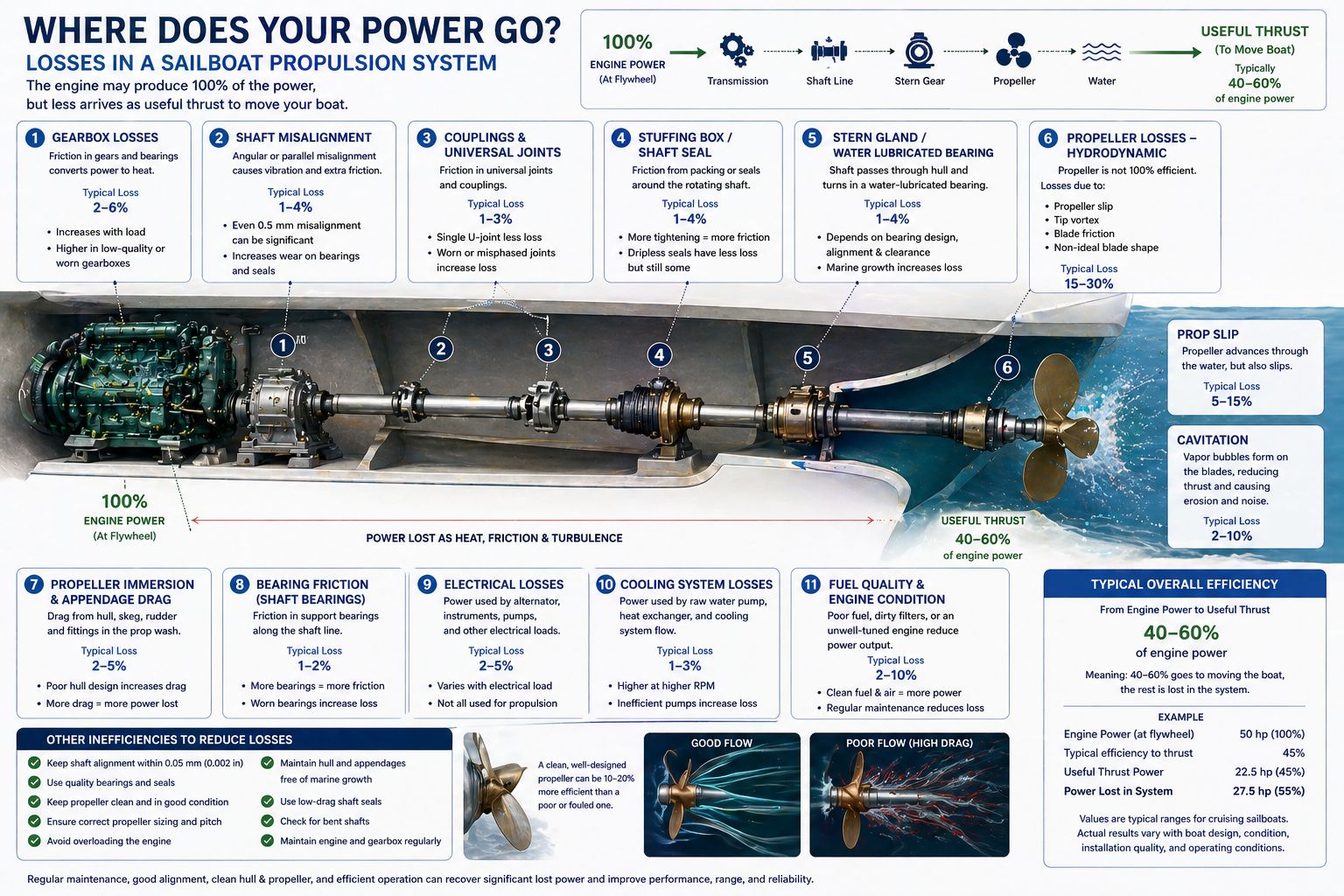
Propulsion train losses. Real propulsion systems include gearbox losses, shaft misalignment, stuffing boxes and stern glands, universal joints, and propeller inefficiencies (prop slip, cavitation). Together these reduce delivered propulsive efficiency so the engine must produce more power (and burn more fuel) to achieve a given boat speed than the engine bench figures imply.
Propulsion Train Losses
Why reality usually differs from those curves. Consider the following as they affect every boat owner.
Propulsion train losses. Real propulsion systems include gearbox losses, shaft misalignment, stuffing boxes and stern glands, universal joints, and propeller inefficiencies (prop slip, cavitation). Together these reduce delivered propulsive efficiency so the engine must produce more power (and burn more fuel) to achieve a given boat speed than the engine bench figures imply.
Propeller Slip
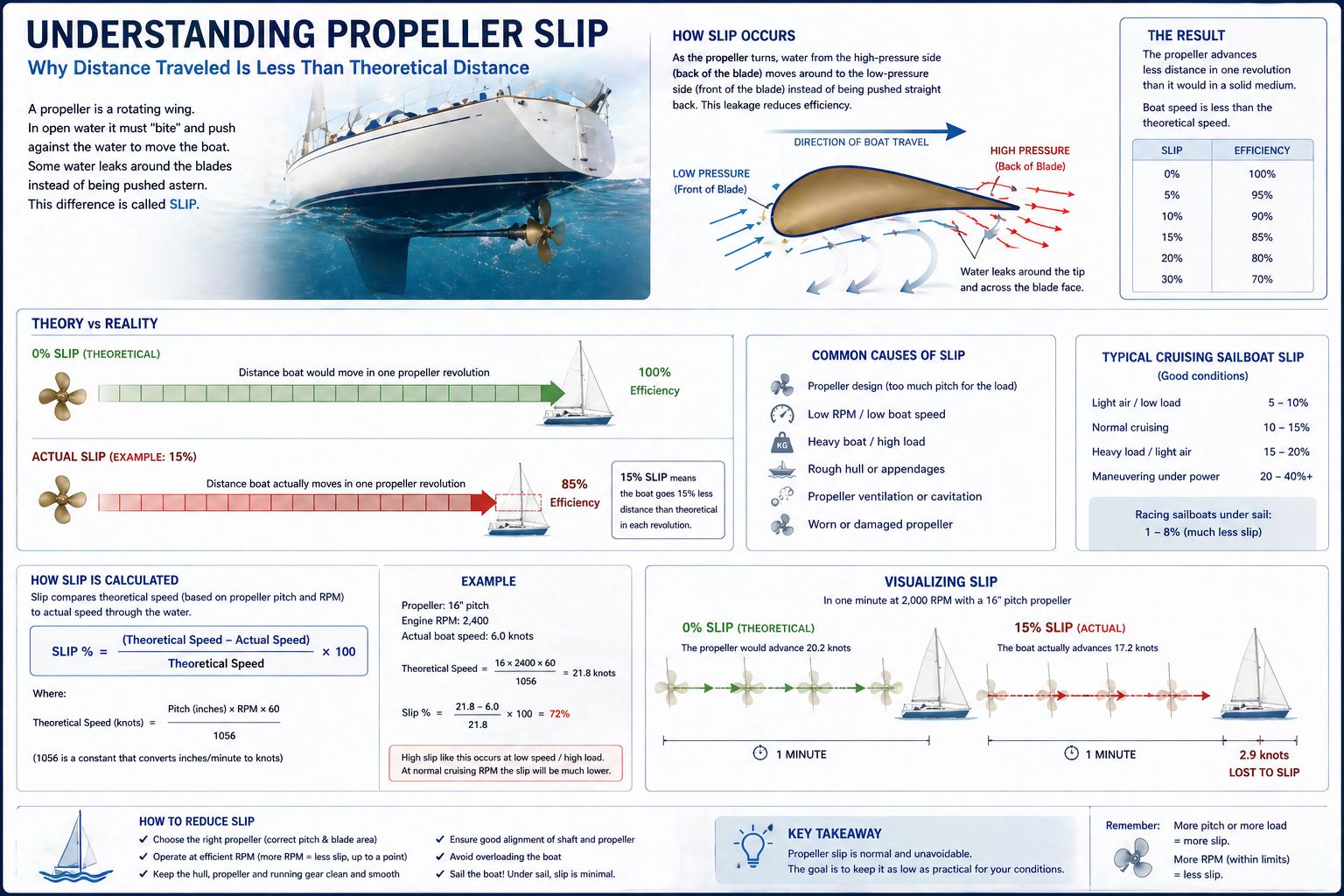
My old Chief Engineers on the ships I served on used to calculate this daily. Propeller slip is the difference between how far a propeller theoretically should move through the water in one revolution and how far it actually moves. It’s a normal and unavoidable part of how propellers work in a fluid. Theoretical advance is based on propeller pitch. If a propeller has a 12-inch pitch, its blades would theoretically push the boat forward 12 inches per revolution in a solid medium. Actual advance is how far the boat really moves per revolution, based on boat speed and shaft RPM. Because water is not solid, the propeller screws forward less distance than its pitch this loss is the slip. Slip occurs because water yields and flows around the blades. Propeller blades create thrust by accelerating water aft, not by “grabbing” a solid medium. Cavitation, turbulence, and wake patterns reduce effective thrust. Hull and appendages disturb inflow water. The propeller’s angle of attack changes with load and speed. Slip values vary widely, but for small marine diesels on sailing yachts these are typical values
- Clean hull, well-matched prop, cruising speed has a typical slip range of 10-25%
- Dirty hull with worn or damaged prop has a typical slip range of 20-35%
- High thrust/low speed such as punching into waves has a typical slip range of 30-60%
- Maximum RPM/top speed has a typical slip range of 5-20% depending on hull form
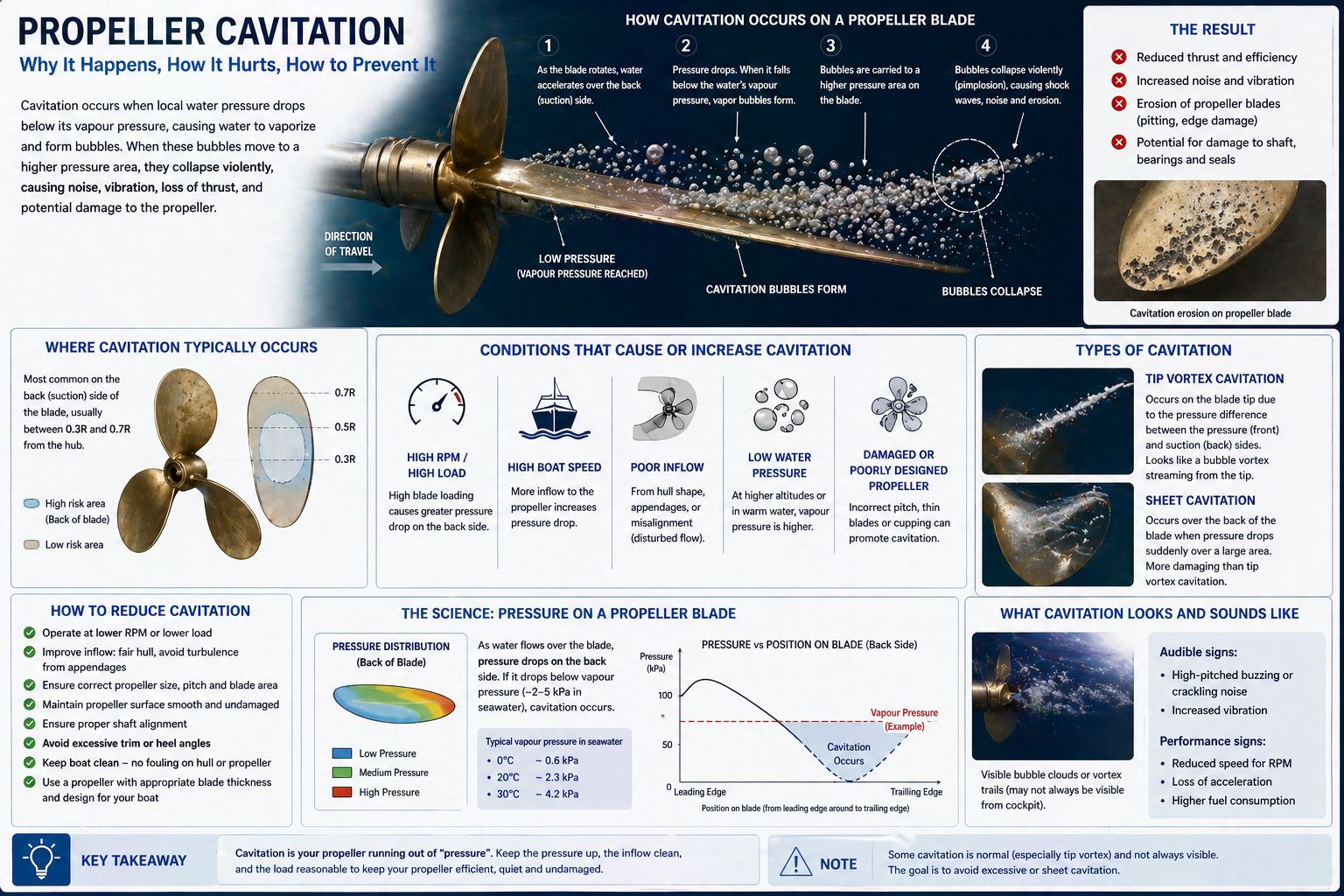
Propeller Cavitation
Propeller cavitation occurs when pressure on the blade’s surface drops low enough for water to vaporize, forming bubbles that collapse violently. These bubbles reduce the blade’s effective surface area and disrupt smooth water flow, decreasing thrust and increasing drag. As a result, the propeller advances less distance per revolution, raising slip. Persistent cavitation worsens efficiency, increases vibration, and can erode blade surfaces, further elevating slip and degrading overall propulsion performance
Hull Resistance and Sea State
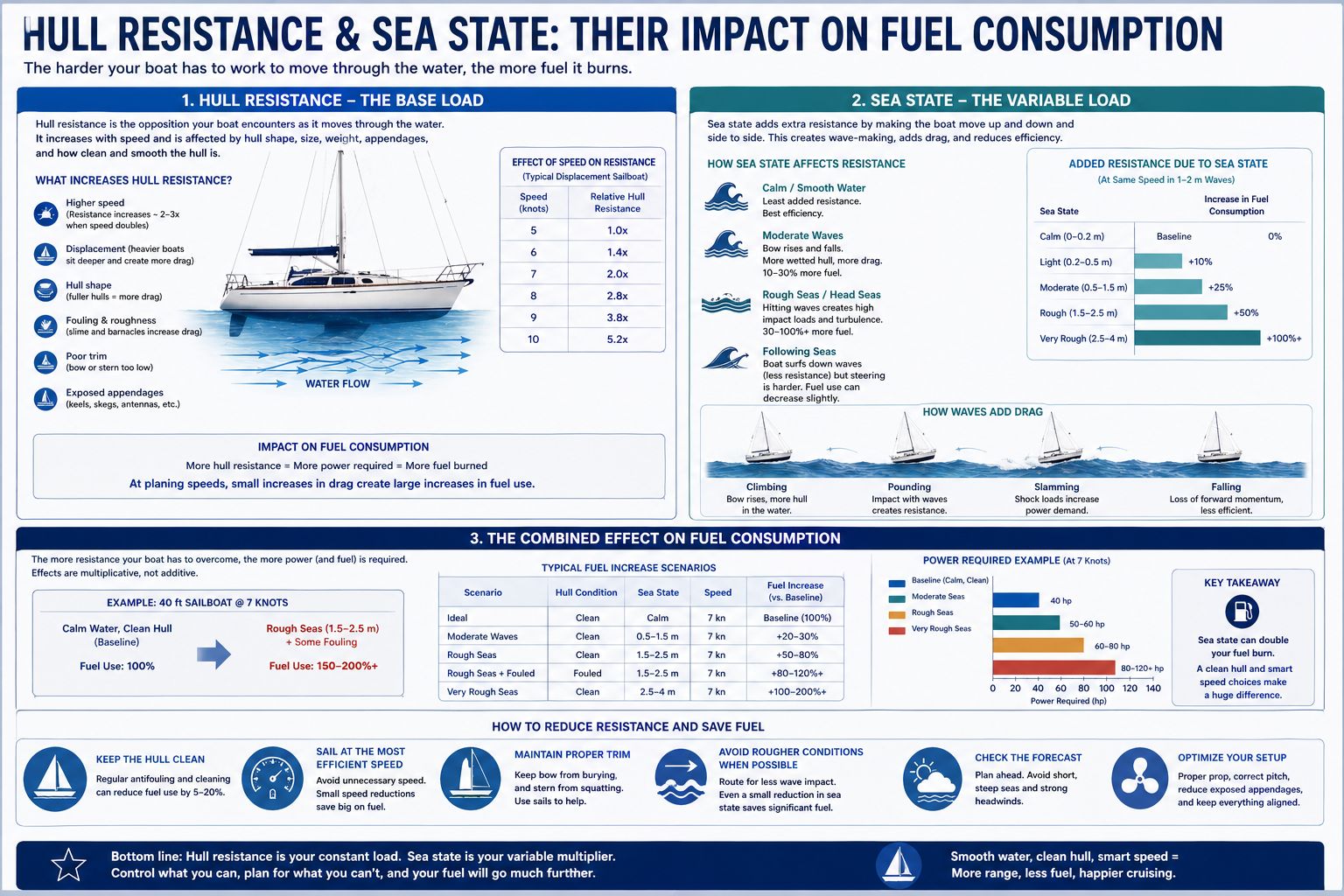
Manufacturer “speed vs fuel” curves often assume a clean hull and calm water. Fouling, biofilm, or epoxied repair lines raise resistance. Waves, current, and wind can easily change required shaft power by tens of percent. Hull resistance increases as fouling, surface roughness, or added weight make the boat push more water, forcing the engine to deliver higher power for the same speed and thus burn more fuel. Sea state amplifies this effect: waves, chop, and adverse swell repeatedly slow the hull, requiring extra throttle to regain speed. Headwinds and currents add additional resistance. Together, these factors can raise required shaft power dramatically, causing fuel consumption to spike even at constant RPM.
Mechanical
and Electrical Repairs Resource
If you are headed somewhere remote consider the need to expand your knowledge base or have an information resource on board. Why not get a copy of my book The Marine and Electrical and Electronics Bible 4th Edition. By and for yachties, with everything from batteries and charging, solar and wind, diesel engines and marine electronics and so much more. Your complete systems guide. 650 pages of practical advice. In Australia and New Zealand order a copy through Boat Books. UK and European boats can buy the UK Edition Here. US and Canadian boats can get the US Edition Order Here. Marine systems are my profession so let me help you. By a liveaboard boat owner for other boat owners

Propeller Mismatch
and Condition
A propeller chosen for top speed or economy in ideal conditions often underperforms in the boat’s typical load cases. Propeller condition and sizing strongly influence fuel consumption. A worn, pitted, or fouled prop reduces hydrodynamic efficiency, increasing slip and requiring more engine power to achieve the same boat speed. Mismatched props, too much pitch, too little diameter, or inadequate blade area force the engine to operate outside its optimal load range. Over-pitched props overload the engine, raising fuel burn and limiting RPM, while under-pitched props cause excessive slip and poor thrust. In both cases, inefficiency rises, making even small imperfections or sizing errors costly in fuel use.
Marine Diesel Fuel Consumption and Prop Blade
Coatings
There is a growing body of evidence that applying foul-release or antifouling coatings (like Propspeed) to propeller blades can improve fuel efficiency by reducing surface roughness and biofouling, which otherwise degrade hydrodynamic performance. On sailing yachts, the same principles that apply to commercial vessels also apply — just at a smaller scale. The propeller still produces thrust by accelerating water aft, so any increase in surface roughness or fouling directly reduces efficiency, increases slip, and raises the engine power (and fuel) needed to reach a given speed. Here’s how it translates specifically to sailing yachts. Commercial ship trials showed a 7.5% fuel consumption reduction when Propspeed was applied. Propeller coatings designed to resist fouling can improve efficiency by keeping the surface smooth, thereby reducing fuel usage. Another study found that biofouling (even thin slime) significantly increases propeller resistance; for instance, medium to heavy fouling can reduce efficiency by up to ~30%, which would raise fuel consumption. Older research (e.g., naval model basin tests) suggested that increasing surface roughness of a propeller can lower efficiency by around 10% compared to a smooth propeller. The conclusion is there is credible evidence that foul-release and smooth antifouling coatings on propellers can reduce fuel burn by improving surface smoothness and thereby reducing drag and power demand. For a sailing yacht, applying such a coating could offer measurable benefits, especially if you operate in fouling-prone waters or go long periods between prop cleaning. The impact of coatings on fuel burn depends on factors such as fouling pressure (warm, nutrient-rich waters benefit the most), hull type (displacement yachts see larger percentage changes); Prop type (folding props show bigger efficiency drops when fouled), Engine horsepower (smaller engines feel small inefficiencies more severely). As an example a 25–40 ft yacht with a 2- or 3-blade folding prop may lose up to 1 knot from moderate fouling. Cleaning or coating that same prop can restore speed and reduce fuel burn by noticeable margins, the difference between 2.2 L/hr and 1.9 L/hr at cruising RPM is typical.
Marine Diesel Fuel Consumption Installation
effects
Restrictions in air intake, exhaust backpressure, heat soak, and poor cooling reduce engine efficiency tests use optimised intake/exhaust and cooling systems. Fuel quality and density such as fuel with contaminants, different density or cetane, or with water content will change SFC. Real fuel obtained in marina bunker stations is not always the same quality as lab fuel used for test data. Exhaust backpressure forces a small marine diesel to work harder to expel combustion gases, reducing volumetric efficiency and limiting fresh air intake. This leads to incomplete combustion, higher exhaust temperatures, and reduced power output per cycle. To maintain the same shaft power and boat speed, the operator must apply more throttle, increasing fuel delivery. Common causes include long exhaust runs, waterlock restrictions, fouling, or poorly sized mufflers. Even moderate backpressure can noticeably raise fuel consumption and accelerate engine wear.
Load Profile and Transient Operation
Sailing yachts either run at long steady-state hours at constant RPM; or short times just maneuvering in a marina, anchoring, short bursts, or idling, Variable throttle operation changes average consumption. Engines are least efficient under low-load idling and highly transient use. The optimum speed for an average small marine diesel is typically achieved at 60–80% of maximum rated RPM, where specific fuel consumption is lowest and engine load is efficient. At this range, the engine delivers good torque, stable combustion, and the best balance between fuel economy, reliability, and overall performance.
Auxiliary loads
Onboard systems (air conditioning, winch motors, refrigeration, electric heating, hydraulic pumps) may be powered by the engine through alternators or a PTO, increasing fuel burn beyond the propulsion-only figures. For an example a 150 A alternator on a 12 V system can cost roughly 3.6–3.8 hp of engine power and about 0.7–0.8 L/hr extra fuel on a 50 hp engine.
Maintenance and Age
Poor maintenance significantly increases fuel consumption in small marine diesels. Compression loss from worn rings or valves reduces combustion pressure and power, forcing higher throttle settings. Injector wear leads to poor atomisation, uneven fuel delivery, and incomplete combustion, raising fuel burn and exhaust temperatures. Turbocharger deterioration—from carbon buildup, bearing wear, or damaged turbine blades—reduces boost, lowering air supply and engine efficiency. Clogged air or fuel filters restrict flow, causing rich mixtures, reduced power, and higher specific fuel consumption. Together, these issues compound, making the engine work harder for the same shaft output.
Manufacturers often publish SFC in the region of 180–240 g/kWh for modern marine diesels at or near peak efficiency. For small, older or poorly tuned diesels that figure can rise to 260–300 g/kWh or worse. Translated to litres/hour for a 50–100 hp engine. At 50 hp (≈37 kW) with SFC 200 g/kWh → fuel ≈ 7.4 L/hr (diesel density ≈0.84 kg/L: 37 kW × 0.2 kg/kWh = 7.4 kg/hr → ÷0.84 = 8.8 L/hr). These are optimized numbers and highly sensitive to SFC, which is dependent on load and RPM. Expect real world burn rates to be 5–30% higher than manufacturer “best case” figures unless the installation and hull are optimised.
Measuring Real Consumption
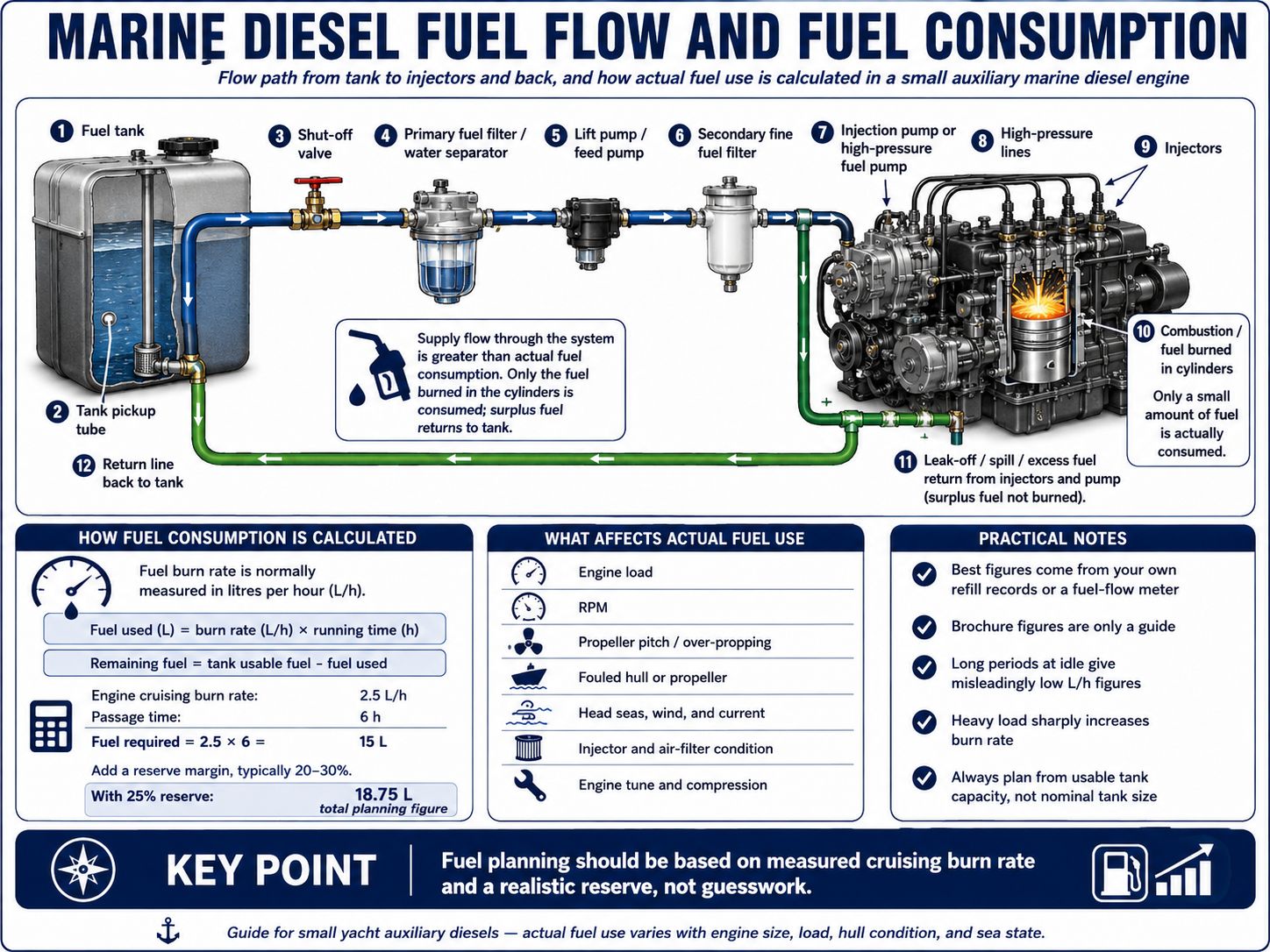
To close the gap between published curves and reality you can install an inline fuel flow meter (positive displacement or turbine) and log L/hr along with GPS speed and RPM. Calibrate the meter against tank dip measurements. Track fuel mass by tank gauging and periodic reconciliations for long passages. Log environmental and operational parameters (sea state, wind, RPM, throttle position, engine hours) so you can build empirical consumption curves for your vessel. Where possible, operate the engine on the most efficient part of the SFC map (often mid-range where specific consumption is lowest), and avoid prolonged low-load idling.
Marine Diesel Fuel Consumption
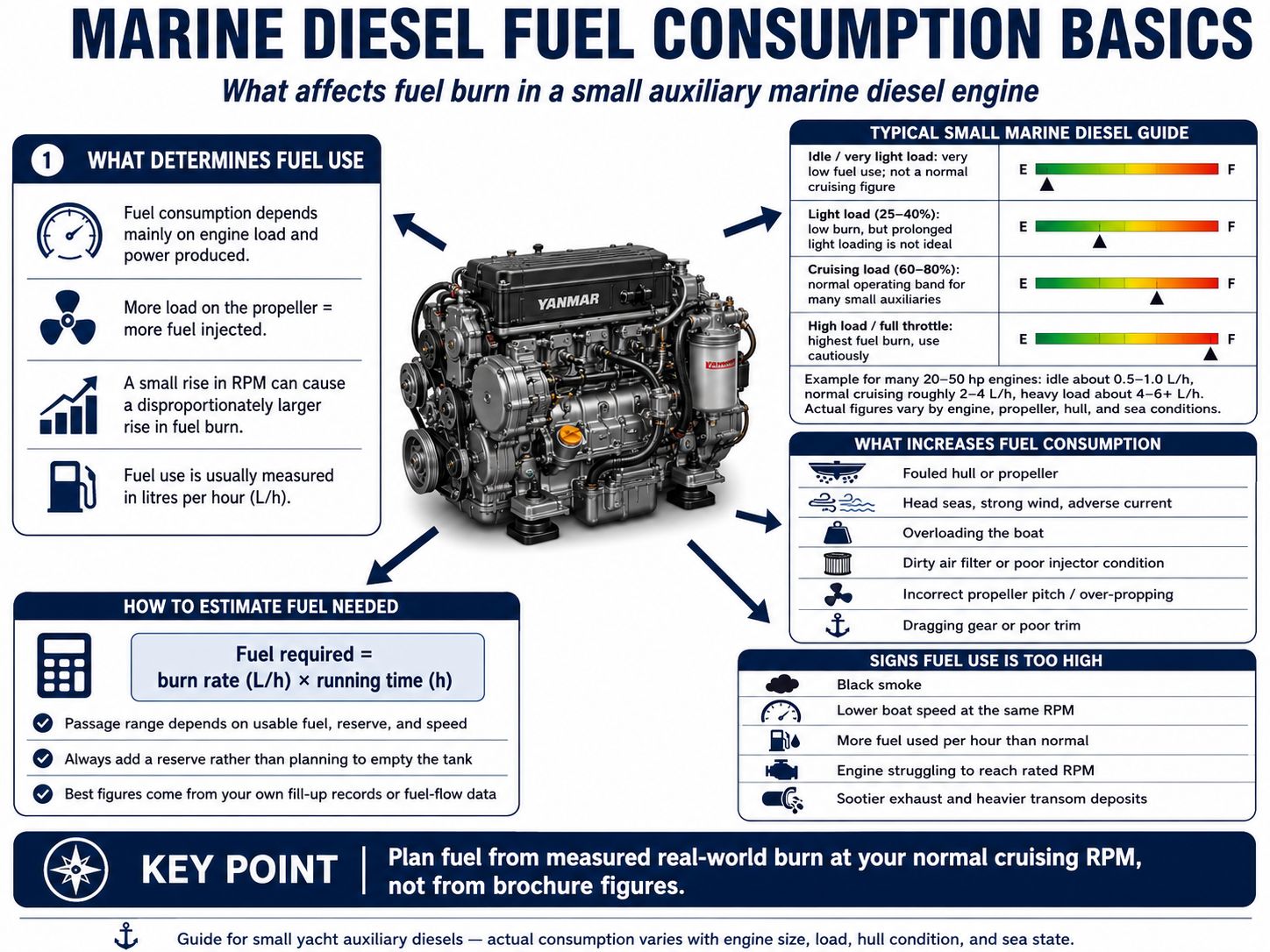


Manufacturer curves are indispensable baseline data, but they represent ideal, repeatable test conditions. On a sailing yacht with its propeller, hull resistance, installation idiosyncrasies, and variable operating profile real fuel consumption will almost always diverge. The pragmatic response is to measure your boat’s own fuel behaviour with a flow meter and careful logs, then optimise hull, propeller, installation and operational practices to bring reality closer to the published ideal. Marine Diesel Fuel Consumption involves many factors.