Boat Plumbing Fittings
Boat plumbing fittings in marine plumbing systems, both freshwater and seawater, depend on a network of hoses, valves, connectors, manifolds, and fittings engineered to withstand vibration, corrosion, pressure cycling, and the harsh saltwater environment. The reliability of these fittings is critical, as plumbing failures can compromise potable water quality, disable essential onboard systems, or cause dangerous flooding.
Boat plumbing fittings vary widely in materials, design, and function, but they share a unifying requirement, they must provide long-term durability in a dynamic, corrosive, and often inaccessible environment. Understanding the function, characteristics, and correct application of each type of fitting is essential for safe and efficient installation and maintenance.

Boat Plumbing Fittings -
Bronze
The choice of fitting material depends on whether the system carries fresh water or saltwater, the pressure involved, and its location relative to the waterline. Marine bronze is the gold standard for below-waterline seawater applications, including thru-hulls, seacocks, tails, and elbows. The advantages are:
- Excellent corrosion resistance
- Resistant to dezincification (when true marine bronze is used)
- High strength and longevity
Typical Uses are:
- Seacocks
- Raw-water strainers
- Pump inlet/outlet fittings
- Manifolds for AC cooling and watermaker intakes

Boat Plumbing Fittings -
Composite
Composite (Glass-Reinforced Polymer, e.g., Marelon, TruDesign). Composite fittings offer corrosion immunity and are increasingly used as alternatives to bronze. The advantages are:
- Immune to galvanic corrosion
- Lightweight
- Long service life
- Smooth internal surfaces
Limitations
- Sensitive to overtightening
- Requires compatible hose clamps and mounting hardware
Typical Uses are:
- Thru-hulls
- Seacocks
- Hose connectors

Boat Plumbing Fittings –
Stainless
316 stainless steel is used in some freshwater fittings but is less reliable below the waterline due to crevice corrosion. The advantages are:
- Strong, clean appearance
- Good for potable water systems
- Ideal for high-pressure freshwater manifolds
Limitations
- Not preferred for raw seawater intake
- Can pit under stagnant conditions
Boat Plumbing Fittings -
Brass
Brass is NOT recommended for seawater. Some non-marine brass is mistakenly installed on boats. Brass fittings dezincify rapidly in seawater, leading to sudden failure. I have seen many times where a cheap brass fitting has been purchased from a hardware store and it fails. The appropriate uses are:
- Only in freshwater systems
- Above the waterline
- When labeled DZR brass (dezincification-resistant)
Boat Plumbing Fittings -
Plastic
Plastics (Nylon, Polypropylene, Acetal, PVC). Used extensively for freshwater plumbing and light-duty fittings. The advantages are:
- Non-corrosive
- Ideal for potable systems
- Compatible with push-fit or barb connectors
Limitations
- Not suitable for engine spaces
- Limited UV and heat resistance
- Must never be used below the waterline unless certified marine-grade. Agricultural fittings should be used with great caution.
Boat Plumbing Fittings –
Hose Barbs
Hose Barb Fittings. Barb fittings are the most common in marine applications due to their simplicity and secure sealing properties. They feature the following:
- Multi-ribbed barbs grip hose interior
- Require double stainless clamps in seawater systems
- Available in straight, 90-degree, and 45-degree configurations
The typical applications include:
- Freshwater pumps
- Washdown systems
- Toilet intake/discharge lines
- Water makers
- Bilge plumbing

Mechanical and Electrical Repairs
Resource
If you are headed somewhere remote consider the need to expand your knowledge base or have an information resource on board. Why not get a copy of my book The Marine and Electrical and Electronics Bible 4th Edition. By and for yachties, with everything from batteries and charging, solar and wind, diesel engines and marine electronics and so much more. Your complete systems guide. 650 pages of practical advice. In Australia and New Zealand order a copy through Boat Books. UK and European boats can buy the UK Edition Here. US and Canadian boats can get the US Edition Order Here. Marine systems are my profession so let me help you. By a liveaboard boat owner for other boat owners

Boat Plumbing Fittings –
Compression
Compression fittings use an internal ferrule that compresses onto a tube or hose. The advantages are:
- Highly reliable leak-free joints
- Suitable for PEX and semi-rigid tubing
- Easy to disassemble
The typical applications include:
- Freshwater distribution manifolds
- Hot-cold domestic water lines

Boat Plumbing Fittings –
Push Fit
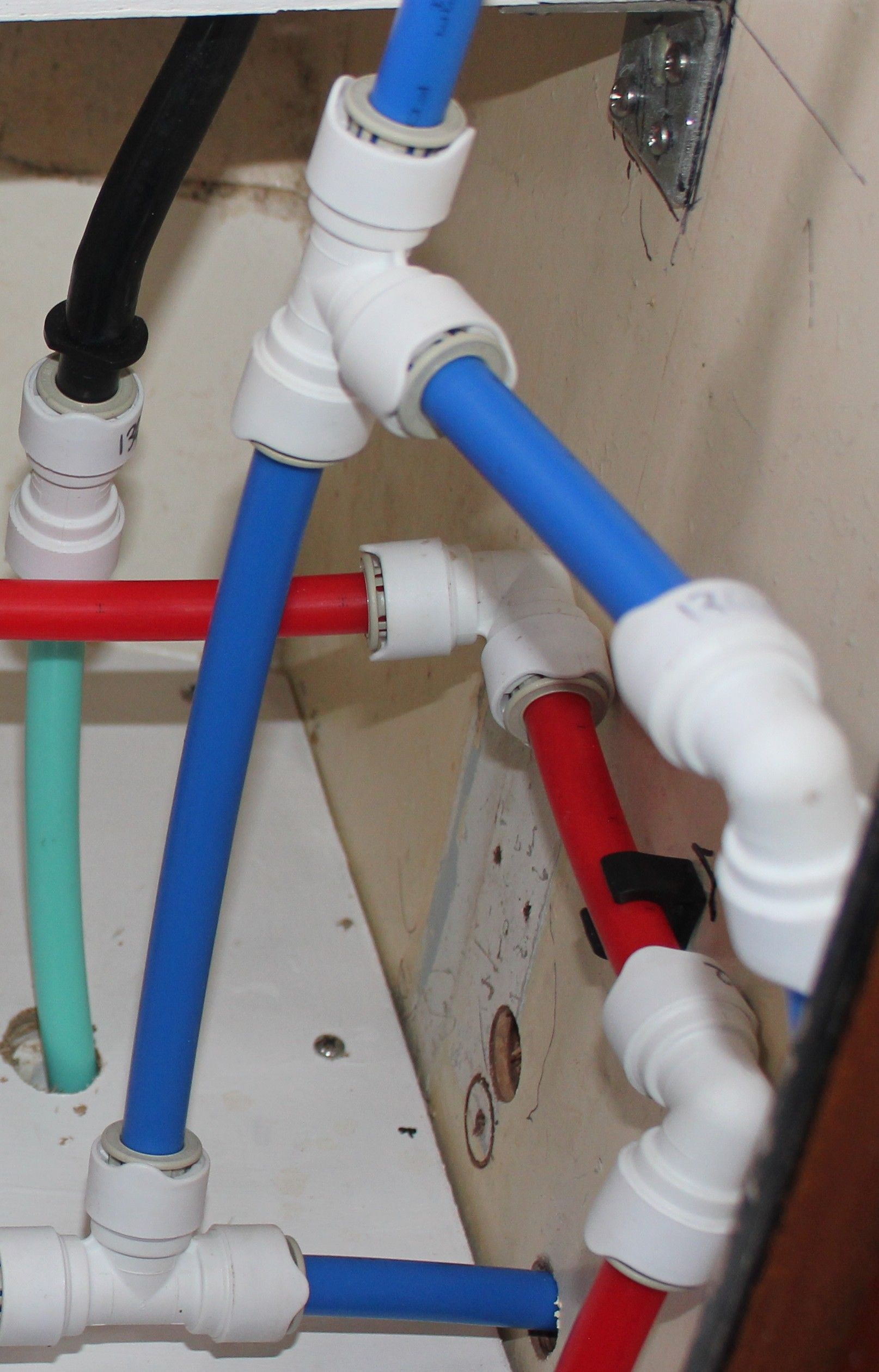
Push-fit systems (e.g., Whale, John Guest) allow rapid installation. I installed the Whale Quick Fit 15 system on my own boat. To summarize. The Whale system uses semi‑rigid 15 mm OD polyethylene pipe. The system uses push‑fit connectors (tees, elbows, straight connectors and valves). It utilizes a double‑gripper collet system for retention, with an internal support ring to stabilise the O‑ring seal and a cage collet design to prevent leaks near tight bends. The internal support ring prevents O‑ring distortion and maintains seal integrity under pressure or temperature changes. The advantages are being great for retrofits, only tool required is the cutters to ensure clean and square pipe cut for insertion, and reuseable, so opening is easy. You must use recommended tubing and tube cutters only, using a blade or hacksaw is doomed to failure. Note, if my water system is pressurized and I turn off the pump and leave the boat for several weeks, when I come back and switch on water pump there is no pump turnoff because the system has maintained pressure. Leaks are a think of the past as are hose clamps. Piping is Blue for Cold, Red for Hot Water and Green for Saltwater.

Whale QuickFit on My Boat!
Boat Plumbing Fittings – Threaded
Threaded Fittings (NPT, BSP, Parallel/ Tapered). Threaded connections are common for pumps, filters, strainers, and valves. Important Considerations are:
- Match thread type (NPT vs BSP) to avoid leaks
- Use marine-grade thread sealant, not plumber’s tape on plastic threads
- Avoid cross-threading into bronze or composite seacocks
Boat Plumbing Fittings –
Valves
Ball Valves and Seacocks. Ball valves isolate or regulate flow manually and form the heart of any seawater intake. Typical construction is:
- Full-flow internal bore
- Teflon seats
- Bronze or composite body
Technical Requirements
- Must be accessible
- Must operate smoothly
- Should be exercised monthly

Boat Plumbing Fittings –
Manifolds
Manifolds distribute freshwater or seawater to multiple branches.
Fresh Water Use
- Pressurised water distribution loops
- Watermaker product outlets
- Hot water heater circuits
Seawater Use
- AC cooling circuits
- Multiple washdown outlets
- Refrigeration cooling circuits
- Watermaker seawater supply
- Generator seawater cooling supply
- Toilet Seawater supply

Boat Plumbing Fittings –
Hose Clamps and Hoses
- Marine Hoses. Hoses must match fitting type and media.
- Freshwater hose: Reinforced, potable-grade, low taste/odor.
- Seawater hose: Wire-reinforced or heavy-wall to prevent collapse under suction.
- Sanitation hose: Odour-resistant, kink-free.
Hose Clamps
- 316 stainless steel only
- Double-clamp on any below-waterline fitting
- Clamps must not overlap or interfere with each other

Boat Plumbing Fittings –
Installation
Avoid Sharp Bends. Incorrectly routed hoses place stress on fittings and may cause leaks or premature failure.
Choose Proper Fitting for System Pressure. Freshwater pumps produce 30–45 psi, AC seawater pumps are low-pressure but high-flow. Watermaker systems have both low-pressure (5–10 psi) and high-pressure (800–1000 psi) circuits requiring specialized fittings
Use Anti-Siphon Loops. They are essential in:
- Toilet seawater intakes
- Washdown pumps
- Air conditioning seawater discharge lines
- Improperly installed loops can flood a vessel.
Chemical Compatibility. Avoid petroleum-based lubricants on plastic fittings
- Use silicone grease on O-rings
- Ensure potable-water-rated materials for drinking systems

Boat Plumbing Fittings –
Troubleshooting
Dezincification. Brass components turn pink, soften, and can fail catastrophically in seawater.
Galvanic Corrosion. Occurs between dissimilar metals, especially when connected to bronze fittings.
Stress Cracking. Over-tightening hose clamps on plastic barbs can split the fitting.
Air Leaks. A small leak on the suction side of a pump can reduces flow, cause pump cavitation, lead to watermaker damage
Thread Leaks. Caused by:
- Mixing thread standards
- Over-application of sealant
- Cross-threading


Boat Plumbing Fittings Summary
Boat plumbing fittings are fundamental elements that ensure safe, reliable operation of both freshwater and seawater systems. Their performance depends on correct material selection, proper installation, routine inspection, and ongoing corrosion prevention. Understanding the function and limitations of hose barbs, threaded connectors, manifolds, seacocks, push-fit systems, and specialized fittings enables boat owners and technicians to create robust, leak-free plumbing networks suitable for the challenging marine environment. Whether supplying potable water to a galley tap or seawater to an AC cooling pump, high-quality fittings and proper installation practices are essential for long-term vessel safety and performance. Boat plumbing fittings are the difference between staying afloat or maybe not.