Anchor Weight for Boat Size
The anchor weight for boat
size is part of anchor selection and is one of the most critical safety
decisions for any sailing yacht. While modern anchor design, fluke geometry,
and seabed compatibility all strongly affect holding performance, anchor weight
remains a core variable. Choosing the correct anchor weight for a boat’s size,
displacement, and operating environment requires understanding load mechanics,
standards, and real-world performance. An anchor that is too small risks
dragging during storms or strong tidal currents; an anchor that is excessively
large becomes difficult to deploy and may overload bow hardware.

This technical article outlines the principles behind anchor weight selection and how boat size influences recommended anchor mass. Anchor weight should match boat size, typically one pound per foot or one kilogram per meter of length. Larger vessels require heavier anchors for security, while smaller boats can use lighter options. Always round up and consider conditions, displacement, and seabed type for reliable holding. As I write this article, I am replacing my old manual anchor winch with an electric one along with the chain. The very old and well-worn plow anchor also comes into the replacement window, and anchor selection and anchor weight then becomes a rather vexed issue. Like asking ten economists a question for 10 different opinions the same applies for asking other skippers about anchors.
Anchor Weight for
Boat Size
Anchor weight contributes to holding power in several ways:
- Mass and Penetration. Heavier anchors generally penetrate more effectively into hard or compacted seabeds. The unit pressure exerted by the fluke tip is influenced by the ratio of anchor weight to the tip area. In harder sands, this can determine whether the anchor even sets.
- Stability During Setting. A heavier anchor maintains better contact with the seabed while dragging during the initial setting phase. Light anchors tend to skip or bounce if the seabed is uneven, particularly in coarse sand, shell grit, or weed-covered bottoms.
- Resistance to Vertical Loads. Although a properly set anchor relies mostly on fluke geometry and buried surface area, weight contributes significantly when the anchor is partially unburied or subjected to temporary vertical loads, such as yacht pitching, short scope, or gust-induced snatch loads.
- Compensating for Poor Geometry. Older anchor designs, especially plow or claw types, require more weight to generate the same holding as modern scoop anchors. As a result, weight recommendations vary depending on anchor type.

Boat Length, Displacement, and Anchor Sizing
Anchor manufacturers typically offer charts based on boat length, but this alone is insufficient. Two yachts of the same length may have greatly different prime factors such as:
- Vessel displacement
- Windage (tall rigs vs short rigs)
- Bow configuration
- Ground tackle (all-chain vs rope-chain)
A more accurate predictor is displacement and projected windage area. Heavier, fuller-bodied cruising yachts like my boat generate higher loads and need heavier anchors than lightweight performance yachts of the same LOA.
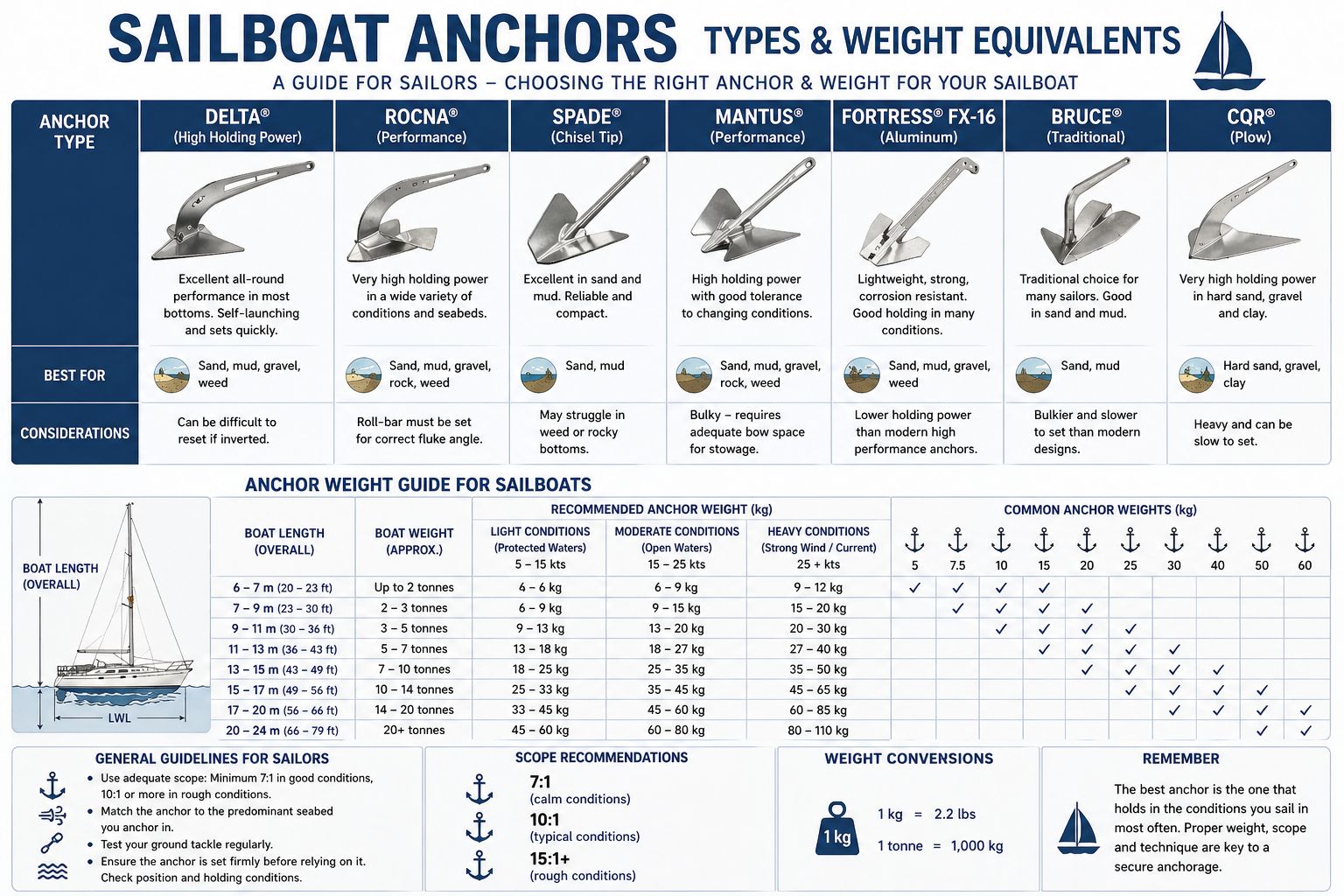
Typical Primary
Anchor Weights by Boat Size
Yacht Length (LOA) Typical Displacement Recommended New-Gen Anchor Weight:
- 8–9 m (26–30 ft) - 2–4 tonnes. 10–12 kg
- 9–10 m (30–33 ft) 3–5 tonnes 12–15 kg
- 10–11 m (33–36 ft) 4–7 tonnes 15–18 kg
- 11–12 m (36–40 ft) 6–9 tonnes 18–21 kg
- 12–14 m (40–46 ft) 8–12 tonnes 21–27 kg
- 14–16 m (46–52 ft) 12–18 tonnes 27–33 kg
- 16–18 m (52–60 ft) 18–25 tonnes 33–45 kg
These values assume use of a high-efficiency scoop anchor (e.g., Rocna, Mantus, Spade, Excel). For older plow or claw anchors, the recommended weight is typically 50–80% greater.
Mechanical and Electrical Repairs
Resource
If you are headed somewhere remote consider the need to expand your knowledge base or have an information resource on board. Why not get a copy of my book The Marine and Electrical and Electronics Bible 4th Edition. By and for yachties, with everything from batteries and charging, solar and wind, diesel engines and marine electronics and so much more. Your complete systems guide. 650 pages of practical advice. Order a copy through Barnes and Noble or check out Amazon. Marine systems are my profession so let me help you. By a liveaboard boat owner for other boat owners.

Why Modern Anchors
Require Less Weight
Traditional anchor design relied on weight as the primary performance driver. Plow anchors (CQR, Delta) and claw anchors (Bruce) compensate for small fluke areas by increasing mass. However, modern scoop anchors achieve high holding power through geometry rather than mass. Concave fluke designs bury deeply and trap large volumes of seabed—producing holding power far greater than weight alone would suggest. For example:
- A 20 kg Rocna may outperform a 35 kg CQR.
- A 17 kg Spade may equal or exceed a 25 kg Delta.
This explains why new-generation anchors recommend lower weights for the same boat length.
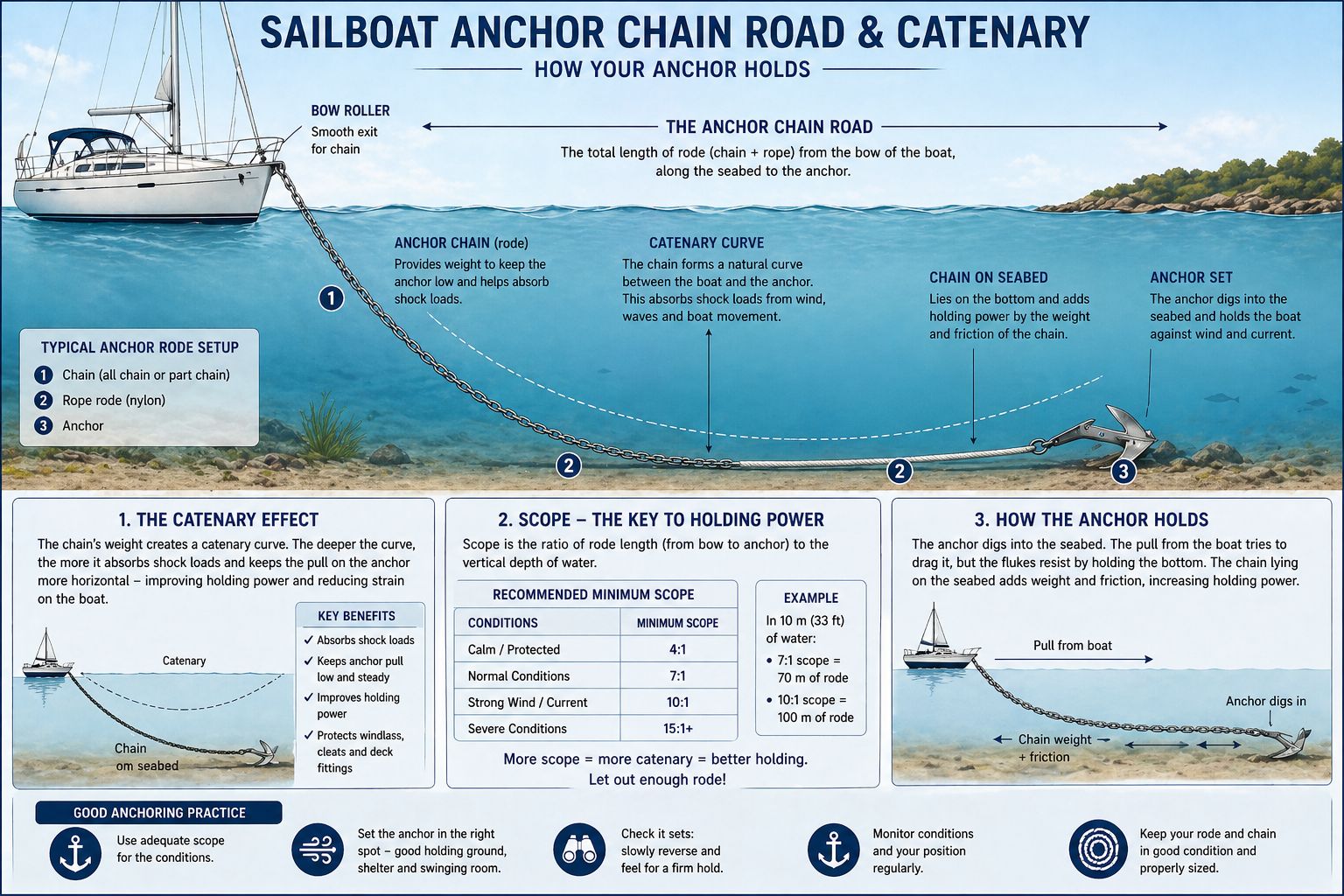
Effects of Rode
Type on Required Anchor Weight
Chain and rope behave differently under load:
All-Chain Rode
- Adds significant catenary effect
- Maintains horizontal pull longer
- Reduces required anchor weight
- Suitable for deep anchoring and strong winds
Rope–Chain Combination
- Lighter overall
- Reduces catenary at moderate–high loads
- Increases anchor weight requirement
- Requires elastic snubber to avoid shock loads
When using a mostly rope rode, increasing anchor weight by 10–20% is recommended.
Extreme Weather and Oversizing Practices
Cruising sailors including myself, often choose anchors one or two sizes above the manufacturer’s recommendation, especially for offshore or cyclone-prone regions. Oversizing provides the following:
- Greater storm holding capability
- More reliable resets during wind shifts
- Increased resistance to veering-induced load peaks
- Better bite into difficult sea beds
Modern bow rollers and windlasses can easily handle moderately oversized anchors. However, extreme oversizing can introduce several issues:
- Excessive bow weight affecting trim
- Windlass overload during retrieval
- Difficult handling in tight anchor lockers
A balanced approach, usually 10–30% above standard size gives excellent performance without drawbacks.
Anchors for Catamarans
Catamarans and trimarans. These typically require an anchor one full size larger than monohulls of the same length. Catamarans have:
- High windage
- Wide swinging arc
- Lower displacement per length


Special Considerations for Different Yacht Types
Performance Racing Yachts. Anchor weight can be at the lower end of recommendations but should not be undersized due to emergencies.
- Low displacement
- Minimal windage
- Smaller ground tackle storage
Heavy Displacement Cruisers. These yachts benefit substantially from oversized anchors and long chain rodes.
- High loads in storms
- Strong inertia when yawing at anchor
Safety Margins and Redundancy
Secondary anchors supplement holding power and provide options for different seabeds. Every yacht should carry:
- One primary anchor (oversized scoop type)
- One secondary anchor (e.g., fluke, lightweight aluminium)
- One storm or stern anchor
Anchor Weight for Boat Size
Anchor weight remains a fundamental component of anchor performance, even as modern designs shift emphasis toward geometry and deep burial. Proper sizing depends on boat length, displacement, windage, rode type, and expected operating conditions. While manufacturers provide baseline sizing, most cruising sailors benefit from selecting an anchor one size above minimum recommendations. A well-matched anchor weight ensures reliable setting, exceptional holding, and confidence during storms making it an essential aspect of seamanship and yacht safety. Anchor Weight for Boat Size is an important aspect for ensuring safe and reliable anchoring.