Turkey
Mediterranean Sailing Guide
Turkey Mediterranean sailing guide. Turkey’s Mediterranean and Aegean coastline forms a long, continuous operational corridor extending from the Greek border at Çeşme and Kuşadası through the Bodrum Peninsula, the Gulf of Gökova, the Datça Peninsula, the Bozburun Peninsula, Marmaris Bay, Fethiye Bay, Kaş, Kalkan and the Lycian coast, before turning east toward Finike, Kemer, Antalya, Alanya and the eastern Mediterranean approaches. The region is defined by steep offshore depth gradients, engineered harbours, compact municipal marinas, deep natural bays and narrow gulfs shaped by seasonal wind regimes, local acceleration zones and complex coastal geometry.
The coastline functions as a multi‑sector cruising environment where routing is determined by headland acceleration, gulf geometry, harbour spacing and the interaction between the Meltemi‑influenced Aegean and the thermal‑driven Mediterranean. The Bodrum, Datça and Bozburun peninsulas introduce confined channels and steep headlands, the Marmaris and Fethiye gulfs provide sheltered basins with deep anchorages, and the Lycian coast introduces long‑fetch exposure and steep offshore gradients. Turkey’s port network supports stern‑to mooring, anchor deployment in confined spaces and entry through engineered breakwaters across all major basins.
Turkey
Mediterranean Sailing Guide - Key
Ports by Region
- Northern Aegean: Çanakkale, Ayvalık, Dikili (secondary: Küçükkuyu, Altınova)
- Central Aegean: Çeşme, Alaçatı, Kuşadası (secondary: Seferihisar, Sığacık)
- Southern Aegean: Bodrum, Turgutreis, Yalıkavak (secondary: Gümüşlük, Torba)
- Gökova Gulf: Akyaka, Akbük (secondary: Ören)
- Datça Peninsula: Datça (secondary: Palamutbükü)
- Bozburun Peninsula: Bozburun, Selimiye, Orhaniye (secondary: Söğüt)
- Marmaris Bay: Marmaris (secondary: Turunç, İçmeler)
- Fethiye Gulf: Fethiye, Göcek (secondary: Üçağız, Kalkan)
- Lycian Coast: Kaş, Kemer (secondary: Finike, Çıralı)
- Antalya Coast: Antalya (secondary: Side, Alanya)
- Eastern Mediterranean: Mersin, İskenderun (secondary: Taşucu)
Turkey
Mediterranean Sailing Guide - Navigation
Navigation along the Turkish coast is shaped by a combination of deep offshore waters, rugged peninsulas, narrow channels, and sheltered gulfs that support predictable routing. The northern Aegean features open‑sea conditions with long fetch and occasional steep seas, while the central Aegean introduces island clusters and headlands that influence wind acceleration and sea state. The southern Aegean and Turkish Riviera form one of the most sheltered and navigationally structured regions in the eastern Mediterranean, with deep bays, fjord‑like inlets, and predictable approaches. The eastern Mediterranean sector becomes more exposed, with long coastal stretches and fewer natural harbours, requiring careful planning during strong winds. Traffic density varies by region, with higher concentrations around Bodrum, Marmaris, Fethiye, and Antalya, and increased ferry movements near Greek‑Turkish border zones.
Turkey
Mediterranean Sailing Guide - Chart
Accuracy
Turkey benefits from modern hydrographic surveys in major ports and channels, while some smaller harbours and remote anchorages may show discrepancies between charted and actual depths. Official ENCs provide the most authoritative digital representation of surveyed depths and harbour layouts, though coverage varies by region. Navionics offers strong general accuracy but may show minor offsets in older marina basins or rapidly developing waterfronts, particularly along the Turkish Riviera. C‑Map behaves similarly, sometimes presenting more conservative depth shading in shallow approaches, while Garmin BlueChart typically aligns with Navionics but may lag in reflecting recent construction or dredging works. Satellite imagery remains the most reliable tool for identifying shoal patterns, volcanic shelves, sediment plumes, and unmarked obstructions, particularly around the Lycian and Carian coasts. Cross‑checking electronic charts against visual references, depth trend logic, and updated notices ensures accurate pilotage when entering Turkish ports or navigating nearshore features.
Turkey
Mediterranean Sailing Guide - Weather
Weather along the Turkish coast is shaped by the broader patterns of the Aegean and eastern Mediterranean, with seasonal variations that influence routing and sea state. The Meltemi affects the northern and central Aegean, producing strong northerlies that can create challenging conditions, particularly around exposed headlands and open‑sea gaps. The southern Aegean and Turkish Riviera experience more moderated conditions, with predictable thermal breezes and sheltered bays supporting reliable coastal movement. The eastern Mediterranean sector is influenced by regional wind systems, including strong southerlies and occasional easterlies that affect approaches and anchoring conditions. Seasonal patterns are well‑defined, with stable summer conditions and more variable weather in spring and autumn. Localised effects around peninsulas, gulfs, and island channels can influence wind strength and direction, requiring attention when planning passages.
The Meltemi is a strong, dry northerly wind that dominates the Aegean in summer, accelerating through channels and between islands to produce steep, short seas. It is most persistent in July and August, often blowing for several days with little diurnal variation, creating fast north‑to‑south passages and challenging return routes. Its strength is shaped by pressure gradients between the Balkans and Anatolia, with local acceleration zones around major island gaps.
The Marine Electrical and Electronics Bible has a complete list of Turkish VHF Radio Channel information and weather forecast times for Turkiye along with NAVTEX UK and Europe and NAVTEX Mediterranean for 490kHz and 518kHz
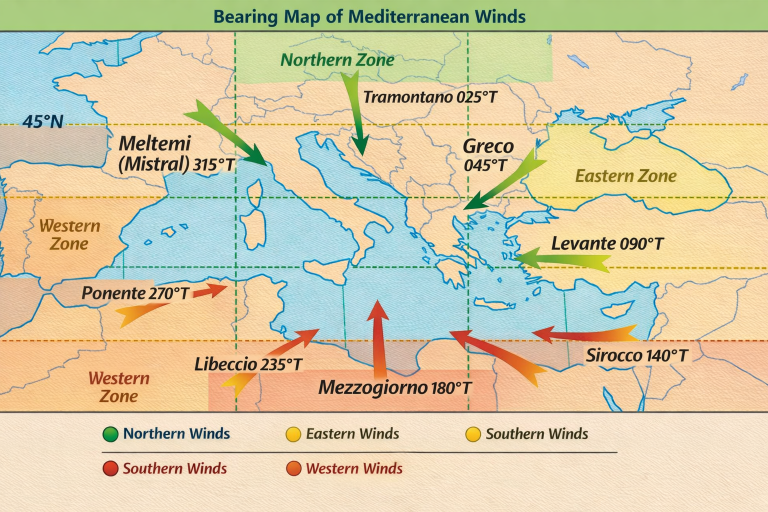
Turkey Mediterranean Winds
Meltemi (Etesian). The dominant summer wind system in the Aegean, blowing N–NE from the Balkans toward the Aegean basin. It accelerates between islands, produces steep short‑period seas, and is strongest July–August. This is the primary named wind shaping Turkish Aegean sailing.
Lodos. A SW wind affecting the Sea of Marmara, Aegean and Mediterranean coasts of Turkey. Warm, humid, often associated with low‑pressure systems and rough seas on exposed approaches. Can produce strong gusts and heavy swell.
Poyraz. A NE wind common in the Sea of Marmara and northern Aegean, cooler and drier than Lodos. It brings clear visibility and choppy seas aligned to its axis.
Karayel. A NW wind affecting the Marmara and western Black Sea, often linked to cold fronts. Produces short, steep seas and rapid temperature drops.
Keşişleme. A SE wind, warm and dry, more common in the Marmara and western Turkey. Less frequent but can bring reduced visibility and unstable conditions.
Yıldız. A N wind, cold and dry, affecting the Marmara and Black Sea sectors. Produces clean air and steep seas.
Turkey
Mediterranean Sailing Guide - Entry
Formalities
Turkey is not part of the EU or Schengen, requiring yachts arriving from Greece, Cyprus, or other countries to complete immigration and customs procedures at designated ports of entry such as Bodrum, Marmaris, Fethiye, Kaş, Kuşadası, Çeşme, and Antalya. Clearance procedures are efficient and well‑defined, with harbourmaster, immigration, and customs offices typically located within the same port complex. Turkey’s status outside the EU allows yachts to access tax‑free fuel and provides flexibility for vessels requiring time outside EU waters for regulatory or tax purposes. Once formalities are completed, movement within Turkey’s maritime zone is unrestricted, though onward travel to neighbouring countries requires re‑entry into their respective systems. Reporting requirements for equipment such as satellite communications systems may apply depending on the vessel’s configuration and intended movements, and yachts must ensure compliance with local regulations regarding radio equipment and safety gear when operating along the Turkish coastline.
Turkey
Mediterranean Sailing Guide - Provisioning
Provisioning capacity is extensive across Turkey, with full supermarket and market access in major ports including Kuşadası, Bodrum, Marmaris, Fethiye, Kaş, Finike and Antalya. Smaller coastal towns and island‑adjacent settlements provide reliable provisioning through local markets, bakeries and small supermarkets. Fish supply is widely available through municipal fish markets and local fishmongers, with larger selections in major commercial ports. Fuel availability is widespread, though some smaller harbours rely on tanker‑delivered fuel rather than fixed berths. Water and electricity are available in most marinas, though smaller fishing harbours may have limited facilities.
Turkey
Mediterranean Sailing Guide - Cuisine
Meze refers to small cold and hot plates built from regional vegetables, legumes and seafood. Common items include haydari (strained yoghurt with garlic and herbs), şakşuka (fried aubergine with tomato and pepper), fava (pureed broad beans with olive oil) and midye dolma (rice‑stuffed mussels with spices).
Kebap covers regional grilled meats, with Adana kebap using minced lamb seasoned with pepper flakes, Urfa kebap using a milder spice profile, and şiş kebap using marinated lamb or chicken cooked on skewers. Iskender kebap layers sliced lamb over bread with tomato sauce and yoghurt.
Pide is a boat‑shaped flatbread baked with toppings such as minced lamb, kasar cheese or spinach, while lahmacun is a thin dough topped with minced meat, tomato, onion and parsley.
Balık (fish) dishes include çupra (gilt‑head bream) and levrek (sea bass) grilled whole with lemon and olive oil. Hamsi tava is Black Sea anchovy lightly floured and pan‑fried.
Zeytinyağlı dishes use vegetables cooked in olive oil, including enginar (artichoke with peas and carrots), taze fasulye (green beans with tomato) and dolma (stuffed peppers or vine leaves with rice and herbs).
Soups include mercimek çorbası (red lentil soup with onion, carrot and mild spices) and ezogelin (bulgur, lentils, tomato and mint).
Desserts include baklava (layered pastry with pistachio or walnut and syrup), künefe (shredded pastry with melted cheese and syrup) and sütlaç (rice pudding baked or served cold).
About Turkish Coffee. Turkish coffee is a finely ground, unfiltered coffee brewed slowly in a small pot called a cezve, producing a dense, aromatic liquid with a characteristic foam layer on top. The grounds remain in the cup, settling naturally as the coffee rests, giving it a concentrated flavour and a thick mouthfeel. It is traditionally served in small cups with water on the side, often lightly sweetened during brewing rather than after, and sometimes accompanied by lokum (Turkish delight).I have to say a Turkish coffee and lokum is one of my favorite pairings.
Mechanical and Electrical Repairs Resource
If you are headed somewhere remote consider the need to expand your knowledge base or have an information resource on board. Why not get a copy of my book The Marine and Electrical and Electronics Bible 4th Edition. By and for yachties, with everything from batteries and charging, solar and wind, diesel engines and marine electronics and so much more. Your complete systems guide. 650 pages of practical advice. In Australia and New Zealand order a copy through Boat Books. UK and European boats can buy the UK Edition Here. US and Canadian boats can get the US Edition Order Here. Marine systems are my profession so let me help you. By a liveaboard boat owner for other boat owners.



Turkey
Mediterranean Sailing Guide - Summary
Turkey provides one of the most diverse and operationally structured sailing environments in the eastern Mediterranean, with reliable navigation, variable but predictable weather patterns, accurate charting, and strong provisioning. Its mainland ports form a dense network that supports both local cruising and basin‑wide routing, making Turkey a central hub for yachts moving between Greece, Cyprus, the Levant, and the wider Mediterranean. The Turkey Mediterranean Sailing Guide for all you need to know.