Tunisia
Mediterranean Sailing Guide
Tunisia Mediterranean sailing guide. Tunisia occupies the central southern arc of the Mediterranean and forms a key operational link between Sicily, Malta, Algeria, and the wider western basin. Its coastline extends from the Algerian border across the Gulf of Tunis, around Cap Bon, and southward toward the Gulf of Gabès, creating a sequence of commercial ports, artificial harbours, shallow bays, and island anchorages. The hydrography is varied, with deep offshore waters in the north, broad shelves in the east, and extensive tidal flats in the south. Tunisia’s maritime geography supports both coastal cruising and long‑range offshore passages, forming a stable routing corridor between the central and western Mediterranean.
Tunisia’s position outside the EU and Schengen but within a structured maritime regulatory environment creates a distinct operational profile for yachts requiring formal clearance, extended stays, or repositioning between Mediterranean regions. The country’s ports offer reliable shelter, fuel, and provisioning, with infrastructure concentrated around Bizerte, Tunis, Hammamet, Monastir, Sousse, and Djerba, some are popular as winter refuge and layup ports. The combination of predictable weather patterns, clear approaches, and defined formalities makes Tunisia a practical waypoint for yachts navigating between Italy, Malta, Algeria, and the wider Mediterranean.
Tunisia
Mediterranean Sailing Guide - Key
Ports by Region
- North Coast: Bizerte, Tunis (La Goulette), Ghar El Melh
- Cap Bon Peninsula: Kelibia, Hammamet, Nabeul
- Central East Coast: Sousse, Monastir, Mahdia
- Gulf of Gabès & Southern Coast: Sfax, Kerkennah Islands, Gabès, Zarzis, Djerba (Houmt Souk, Port Aghir)
Secondary Ports: Secondary ports such as Tabarka, Porto Farina, Korba, Hergla, Chebba, Skhira, El Ketf, and the smaller fishing harbours along the Gulf of Gabès provide additional shelter and operational flexibility.
Tunisia
Mediterranean Sailing Guide - Navigation
Navigation along the Tunisian coastline is shaped by shallow continental shelves, dredged harbour entrances, engineered breakwaters and commercial traffic density. The northern coast around Bizerte and Tunis offers deeper approaches and predictable sea states, though strong northerlies can generate steep seas. The Cap Bon Peninsula introduces exposed headlands and long‑fetch swell from the northeast. The central coast requires attention to sediment movement, harbour silting and narrow entrances, with many ports dependent on regularly dredged channels that may shift following winter storms.
The Gulf of Gabès introduces the most complex navigation in Tunisia due to extensive tidal flats, shifting shoals and the largest tidal range in the Mediterranean. Approaches to Sfax, Kerkennah and Gabès require careful timing, conservative routing and attention to charted channels. The southern coast toward Zarzis and the Libyan approaches introduces shallow gradients and long‑fetch southerlies that can affect harbour entrances.
Commercial traffic density is high around Bizerte, Tunis, Sousse and Sfax, requiring adherence to traffic separation schemes and awareness of ferry movements. Fishing vessels operate throughout the region, often with unlit gear or nets extending from small craft. Night navigation is supported by reliable light structures, though shallow gradients, fishing activity and unlit small craft require heightened vigilance.
Tunisia
Mediterranean Sailing Guide - Chart
Accuracy
Tunisia benefits from modern hydrographic surveys in major ports, while some smaller harbours and shallow areas may show discrepancies between charted and actual depths. Official ENCs provide the most authoritative digital representation of surveyed depths and harbour layouts, particularly around Bizerte, La Goulette, Sousse, Monastir, and Djerba. Navionics offers strong general accuracy but may show minor offsets in sediment‑affected areas or rapidly changing shallow zones, particularly in the Gulf of Gabès. C‑Map behaves similarly, sometimes presenting more conservative depth shading in shallow approaches, while Garmin BlueChart typically aligns with Navionics but may lag in reflecting recent dredging or harbour modifications. Satellite imagery remains the most reliable tool for identifying shoal patterns, sediment plumes, tidal flats, and breakwater structures, particularly around the Kerkennah Islands and southern coastline. Cross‑checking electronic charts against visual references, depth trend logic, and updated notices ensures accurate pilotage when entering Tunisian ports or navigating nearshore features.
Tunisia
Mediterranean Sailing Guide - Weather
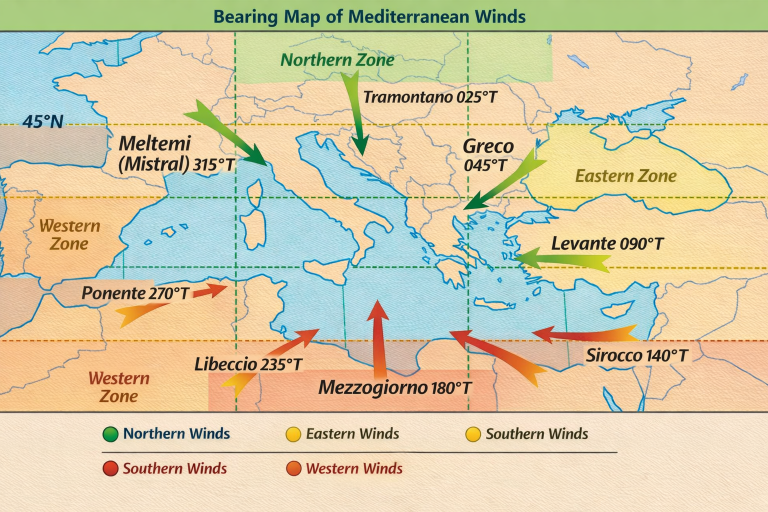
Weather along the Tunisian coast is shaped by the broader patterns of the central Mediterranean, with seasonal variations that influence routing and sea state. Summer conditions are generally stable, with predictable northerlies and thermal breezes supporting reliable coastal movement. Winter introduces more variable weather, with strong westerlies, northwesterlies, and occasional Sirocco events producing steep seas and reduced visibility. The Cap Bon Peninsula can experience significant wind acceleration during regional systems, affecting approaches and anchoring conditions. The Gulf of Gabès is influenced by tidal effects and localised wind patterns that shape sea‑state behaviour in shallow areas. Seasonal patterns are well‑defined, with summer offering the most predictable conditions and winter requiring more conservative planning for offshore passages.
The Sirocco is a warm, humid southerly wind that originates over the Sahara and moves northward across the Mediterranean, carrying dust and reduced visibility into coastal regions. As it reaches Italy, Malta, Tunisia, and the central Mediterranean, it produces long‑fetch swell, rising humidity, and uncomfortable sea states that build ahead of approaching low‑pressure systems. Its strength and duration depend on the pressure gradient between North Africa and the central Mediterranean, with the most pronounced effects occurring when a deep low forms over the Gulf of Genoa or the Adriatic.
The Marine Electrical and Electronics Bible has a complete list of VHF Radio Channel information and weather forecast times along with NAVTEX UK and Europe and NAVTEX Mediterranean for 490kHz and 518kHz.
Tunisia
Mediterranean Sailing Guide - Entry
Formalities
Tunisia is not part of the EU or Schengen, requiring yachts arriving from Italy, Malta, Algeria, Libya, or other countries to complete immigration and customs procedures at designated ports of entry such as Bizerte, La Goulette, Kelibia, Sousse, Monastir, Sfax, and Djerba. Clearance procedures are formal and structured, with harbourmaster, immigration, customs, and quarantine offices typically located within the same port complex. Once formalities are completed, movement within Tunisia’s maritime zone is regulated but straightforward, with defined reporting requirements for inter‑port movements. Yachts must ensure compliance with local regulations regarding radio equipment, safety gear, and documentation when operating along the Tunisian coastline.
Tunisia
Mediterranean Sailing Guide - Provisioning
Provisioning in Tunisia is reliable in major ports such as Bizerte, Tunis, Hammamet, Sousse, Monastir, Sfax, and Djerba, with access to supermarkets, markets, fuel stations, and marine services. Technical support is available in the main ports, with facilities capable of handling routine maintenance and minor repairs. Fuel quality is consistent in commercial ports, and spare parts can be sourced through local suppliers or imported as needed. Smaller towns along the coast offer adequate provisioning for routine needs, though major resupply is best conducted in the larger ports. The density of provisioning points across Tunisia’s maritime network supports both short‑range coastal movements and longer offshore itineraries.
Tunisia
Mediterranean Sailing Guide - Cuisine
Couscous is the core grain dish, typically served with fish, lamb or chicken, using tomato‑based broths with harissa, chickpeas and seasonal vegetables. Brik is a thin pastry filled with egg, tuna or seafood, folded and fried, widely available in coastal towns and markets. Ojja is a tomato and pepper stew cooked with eggs, merguez sausage or seafood, seasoned with cumin and harissa. Grilled fish is central along the coast, especially sea bream, sea bass, red mullet and sardines, often prepared with chermoula (garlic, coriander, paprika, cumin, lemon). Salata mechouia is a roasted pepper and tomato salad with garlic, olive oil and tuna, commonly served as a starter. Lablabi is a chickpea soup with garlic, cumin and olive oil, served with bread and optional tuna or egg. Makroud and zrir are common desserts, using dates, semolina, honey and sesame, widely available in port‑area bakeries.
Mechanical and Electrical Repairs
Resource
If you are headed somewhere remote consider the need to expand your knowledge base or have an information resource on board. Why not get a copy of my book The Marine and Electrical and Electronics Bible 4th Edition. By and for yachties, with everything from batteries and charging, solar and wind, diesel engines and marine electronics and so much more. Your complete systems guide. 650 pages of practical advice. In Australia and New Zealand order a copy through Boat Books. UK and European boats can buy the UK Edition Here. US and Canadian boats can get the US Edition Order Here. Marine systems are my profession so let me help you. By a liveaboard boat owner for other boat owners.


Tunisia
Mediterranean Sailing Guide - Summary
Tunisia provides a strategically positioned and operationally diverse sailing environment, with reliable navigation, accurate charting, predictable formalities, and strong provisioning. Its ports form a structured maritime network that supports both local cruising and basin‑wide routing, making Tunisia a key waypoint for yachts transitioning between Italy, Malta, Algeria, Libya, and the wider Mediterranean. Tunisia Mediterranean Sailing Guide for all you need to know.