Tin Can Bay Sailing Guide
Tin Can Bay Sailing Guide. Tin Can Bay sits inside the western side of the Great Sandy Strait and provides a sheltered, service‑rich port for yachts drawing 1.8–2.0 m. It is a practical diversion point for weather delays, provisioning and mechanical support, but it is not a casual detour; the entrance is shallow, narrow and tide‑dependent, and safe entry depends on daylight, disciplined channel‑keeping and a tide height that lifts the controlling sections above their 1.5–1.8 m LAT range. When approached with the same conservative mindset used for the Strait’s depth gates, Tin Can Bay becomes a reliable and predictable port.
The township sits close to the marina and offers full provisioning, fuel, water and access to marine trades, making it one of the more convenient resupply points in the lower Strait. The approach via Snapper Creek is the defining navigational challenge, and the port rewards skippers who treat the channel with respect, maintain conservative speed and avoid low‑water entry. Once inside, the marina and anchorage areas provide deep, sheltered water and an easy reset point before continuing north or south through the Strait. Tin Can Bay takes its name from Aboriginal words such as tun‑kin, tuncan and Tuncunba, all referring to dugongs, big fish, or the food‑rich mangrove country. The inlet was known for dugong hunting long before European settlement, and the name reflects that heritage. he modern township was originally known as Wallu, and the name was officially changed to Tin Can Bay in 1937, adopting the long‑standing Aboriginal‑derived name for the inlet.
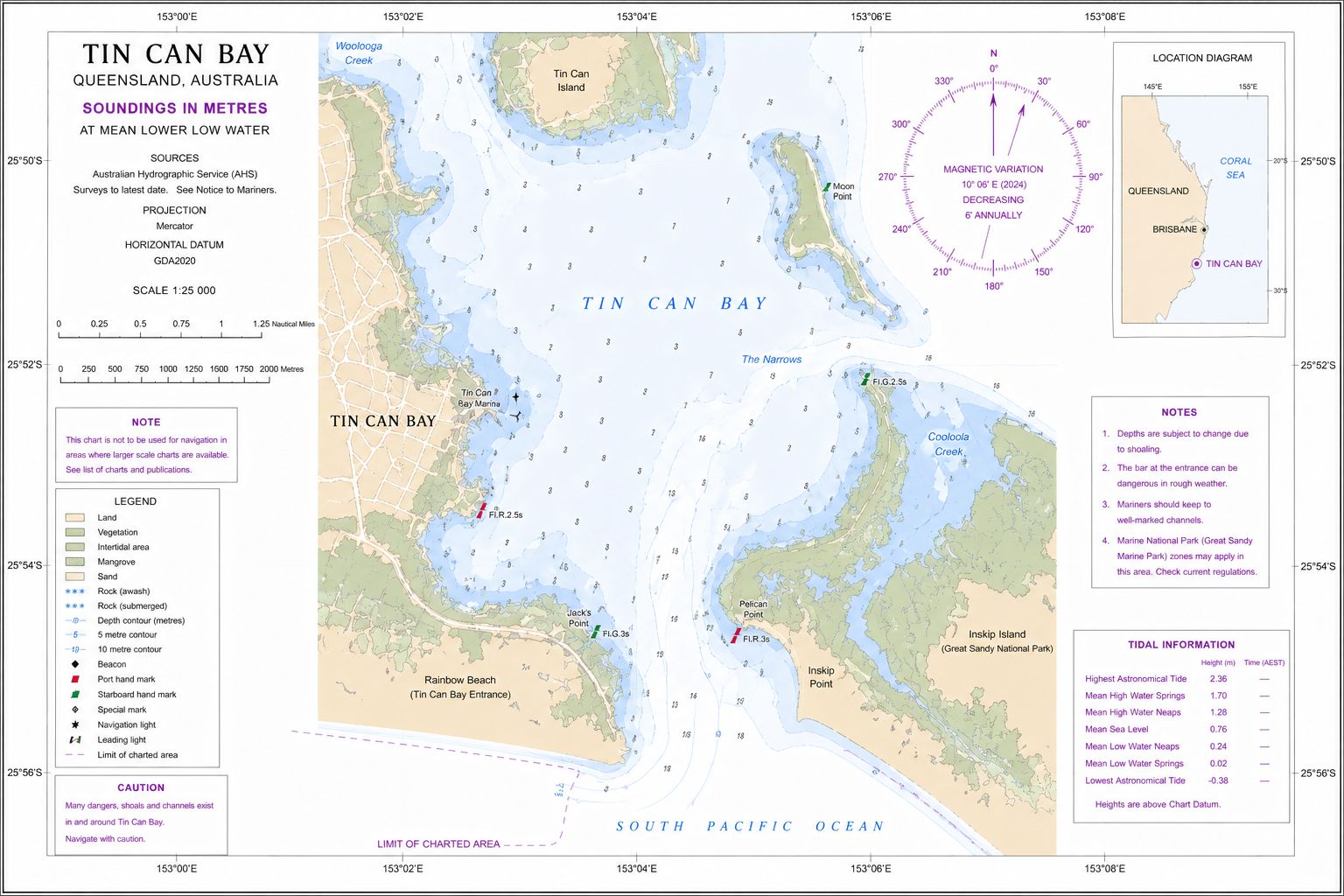
Chart Disclaimer. This chart is a schematic representation for illustrative purposes only and must not be used for navigation. Refer to official hydrographic charts for safe navigation. Be aware ENC charts may differ from official hydrographic charts. Both should be corrected and updated regularly.
Tin Can Bay Sailing Guide - Approach
via Wide Bay Bar
Southbound vessels arriving via Wide Bay Bar enter the Strait on the last of the flood and follow the main channel northward past Inskip Point. The diversion toward Tin Can Bay occurs before the southern depth gate at South White Cliffs, and the timing must still respect the tide height required for the Snapper Creek entrance. Many skippers arriving from the bar ride the flood northward and then pause in the deeper water near the turn‑off until the tide height is suitable for entry, using the remaining flood to settle the vessel before committing to the channel.
Tin Can Bay Sailing Guide - Approach
via Snapper Creek
The Snapper Creek entrance is the controlling feature of Tin Can Bay and demands daylight and disciplined pilotage. Depths at LAT commonly sit between 1.5 m and 1.8 m in the shallowest sections, with slightly deeper water in the outer bends. For yachts drawing 2.0 m, a mid‑tide rising window is the minimum workable margin, while vessels drawing 1.8 m can work with a smaller height above LAT. The channel is lightly cut, bordered by extensive drying banks and prone to sounder lag due to the soft mud bottom. The bends introduce set on the flood, and the ebb can push a vessel toward the shoals if speed is not controlled.
Tin Can Bay Sailing Guide - Entrance
Channel – Depths and Tide Requirements
The entrance channel requires a tide height that lifts the controlling sections above the 1.5–1.8 m LAT range. A 2.0 m‑draft yacht typically enters on mid‑tide rising or better, while a 1.8 m‑draft vessel can work with a smaller margin but still avoids low water. The channel edges fall away rapidly into drying sandbanks, and the soft mud bottom causes delayed or fluctuating sounder readings. Skippers watch the overall trend rather than reacting to individual dips and maintain conservative speed to allow for correction in the bends.
Tin Can Bay Sailing Guide - Channel‑Keeping
and Navigation Notes
The channel meanders through drying banks and demands precise alignment with the marks. The bends introduce noticeable set on the flood, and the ebb can push a vessel toward the shoals if speed is not controlled. After strong weather, the channel can shift slightly, altering depths by several decimetres. Local fishing vessels and crab pots are common in the narrows, requiring steady situational awareness. First‑time arrivals avoid entering on an ebb tide with fresh south‑easterlies, as the combination produces short, steep chop that reduces control.
Tin Can Bay
Sailing Guide - Tin Can Bay Inlet – Hazards and
Constraints
This section highlights the predictable risks that require conservative pilotage. Tin Can Bay’s hazards are straightforward but unforgiving. The drying banks around the entrance leave no margin for error at low water, and the narrow channel offers little room to correct if alignment is lost. Sounder lag is common in the soft mud, and skippers must interpret the overall depth trend rather than the moment. Wind‑against‑tide conditions create uncomfortable chop, and local fishing traffic adds complexity in the narrows.
Tin Can Bay
Sailing Guide - Tin Can Bay Marina – Access and
Depths
Tin Can Bay Marina sits well inside the system and offers reliable depths of two‑and‑a‑half to three metres at the berths, making it accessible on most tides once the entrance channel is cleared. The approach to the marina is deeper and more forgiving than the outer channel, and the facility provides secure berths in all weather. The marina is the safest reset point in the area for weather delays or mechanical issues, and contacting the office before arrival ensures clear instructions for the final approach and berth allocation.
Tin Can Bay
Sailing Guide - Fuel, Water, Provisioning
Tin Can Bay is one of the more convenient provisioning stops in the lower Strait because the marina sits within easy walking distance of the township. The main supermarket is the IGA Tin Can Bay, located roughly nine hundred metres from the marina, which is an easy ten‑to‑twelve‑minute walk along a flat footpath. This store carries full fresh produce, bakery items, dairy, frozen goods and general groceries, making it suitable for a complete restock before continuing north or south. The Tin Can Bay Bakery sits about seven hundred and fifty metres from the marina, usually a nine‑to‑ten‑minute walk, and is a reliable stop for early‑morning bread and pastries. A small butcher operates nearby, offering fresh meat without needing to travel outside the township.
Alcohol and general supplies are straightforward as well. Tin Can Bay Cellars is located approximately eight hundred and fifty metres from the marina, a ten‑minute walk, and carries a full range of beer, wine and spirits. Hardware and gas refills are available at Mitre 10 Tin Can Bay, which sits just over one kilometre from the marina, usually a twelve‑to‑fourteen‑minute walk, and provides basic tools, fasteners, sealants and general maintenance items. Gas bottle exchange is available both at Mitre 10 and at the local service station, which is roughly the same distance from the marina.
Mechanical
and Electrical Repairs Resource
If you are headed somewhere remote consider the need to expand your knowledge base or have an information resource on board. Why not get a copy of my book The Marine and Electrical and Electronics Bible 4th Edition. By and for yachties, with everything from batteries and charging, solar and wind, diesel engines and marine electronics and so much more. Your complete systems guide. 650 pages of practical advice. In Australia and New Zealand order a copy through Boat Books. UK and European boats can buy the UK Edition Here. US and Canadian boats can get the US Edition Order Here. Marine systems are my profession so let me help you. By a liveaboard boat owner for other boat owners


Tin Can Bay
Sailing Guide - Services
Marine services are centred around the marina precinct. Diesel is supplied at the marina fuel berth, and potable water is available at both the berths and the fuel dock. The marina maintains a small chandlery with essential consumables such as oils, filters, impellers, fuses and basic hardware. Local trades support mechanical and electrical work, and the sheltered environment makes Tin Can Bay a practical location for minor repairs or troubleshooting before committing to a tide‑timed Strait transit. The scale of the town means everything is within a short walk, and skippers can complete a full provisioning run without needing transport.
Tin Can Bay
Sailing Guide - Anchoring Options in Tin Can Bay
Tin Can Bay offers several anchorages suitable for staging before or after marina entry. The area off Snapper Creek provides two‑and‑a‑half to three‑and‑a‑half metres 2.5 - 3.5m over mud with good holding and shelter from most directions, making it the preferred waiting area for tide. The Searys Creek area offers two to three metres 2 - 3 m but is more exposed to northerlies and is used mainly for short stops. Vessels can also anchor off the marina in 3 - 4m over mud when preparing to berth or depart. All anchorages require awareness of tidal flow and swinging room, particularly during springs.
Tin Can Bay
Sailing Guide. Departure Planning
This section explains how to time your exit back into the Great Sandy Strait. Departure planning mirrors arrival logic. Yachts drawing two metres depart on mid‑tide falling or rising, avoiding low water when margins are too tight. Vessels drawing one‑point‑eight metres can work with a slightly smaller tide window but still require a positive height above LAT. Ebb tide combined with fresh south‑easterlies is avoided, as it produces uncomfortable chop in the entrance channel. Once clear of the channel, vessels rejoin the Great Sandy Strait and resume normal tide‑timed navigation toward either South White Cliffs or Sheridan Flats depending on direction.
Tin Can Bay
Sailing Guide - Integration with Great Sandy Strait
Transit Planning
This section explains how Tin Can Bay fits into the broader Strait system. Tin Can Bay is not part of the main transit route but serves as a weather refuge, provisioning stop and mechanical support point. Northbound vessels use it as a staging point before tackling the southern depth gate at South White Cliffs, while southbound vessels may divert here if tide windows for Sheridan Flats or Wide Bay Bar do not align. With disciplined timing, daylight pilotage and conservative channel‑keeping, Tin Can Bay becomes a reliable and predictable port for yachts operating in the Great Sandy Strait region.
When Tin Can Bay Is the Right Choice
This section helps skippers decide whether diverting into Tin Can Bay is operationally sensible. Tin Can Bay becomes the right choice when a vessel needs time, shelter or services that cannot be comfortably accessed while holding position in the Great Sandy Strait. Skippers divert here when a tide window for South White Cliffs or Sheridan Flats cannot be met, when the weather deteriorates faster than expected, or when the crew needs a secure berth and full provisioning without committing to a Strait transit on a marginal tide. It is also the logical stop for yachts arriving from Wide Bay Bar who prefer to reset, refuel and restock before continuing north, or for southbound vessels that find themselves ahead of the tide and unwilling to push into the southern depth gate on a falling height. Tin Can Bay is not chosen for convenience but for certainty; it is the port that gives a skipper time to regroup, repair, provision and wait for the next safe tide without the pressure of shallow water or exposed holding areas.
Tin Can Bay
Sailing Guide. Summary
Tin Can Bay is a shallow, tide‑dependent port that offers excellent shelter and services for yachts drawing 1.8–2.0 m when approached with disciplined tide planning and precise channel‑keeping. With mid‑tide entry, daylight navigation and conservative pilotage, the port becomes a reliable refuge and staging point for Great Sandy Strait transits. The Tin Can Bay Sailing Guide is here to offer advice.