Taiwan Yacht Sailing Guide
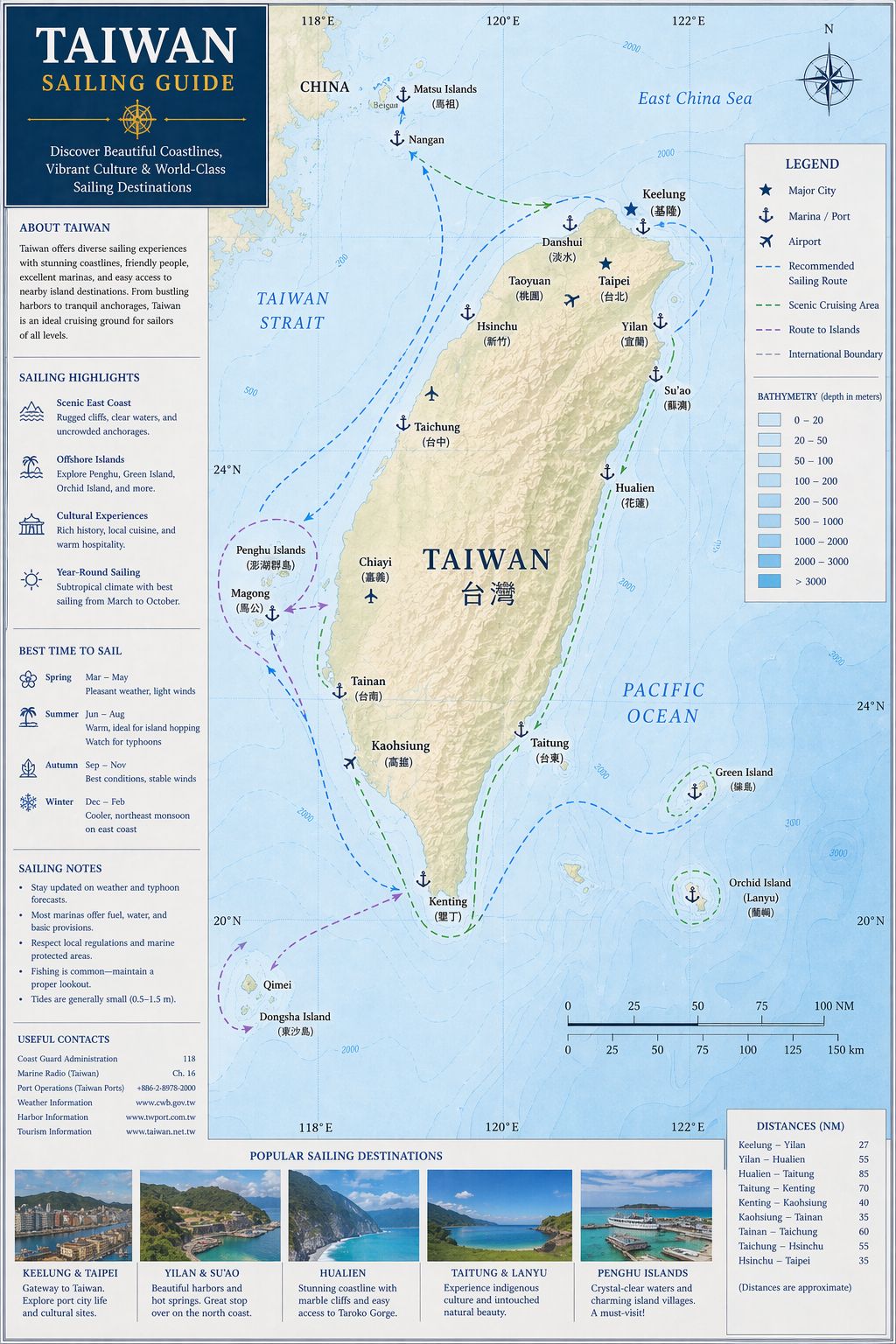
Taiwan yacht sailing guide. Taiwan sits along the western edge of the Pacific and is a practical waypoint for yachts sailing between Japan, the Philippines, Hong Kong, and Southeast Asia. Its coastline is shaped by steep mountains, strong currents, and a mix of commercial ports and fishing harbors. While not a mainstream leisure cruising destination, Taiwan is increasingly used by passage makers who value reliable infrastructure, clear procedures, and access to supplies and repairs. This Taiwan cruising guide provides practical information for yachts planning to stop along the island’s coast.
The key ports for yachts in Taiwan are Keelung, Hualien, Kaohsiung, and Tainan/Anping. Keelung and Kaohsiung are the primary entry ports due to established customs and immigration facilities. Hualien is useful for yachts arriving from Japan or the Northern Philippines, while Anping offers a quieter southwest option. Smaller fishing ports exist but are generally unsuitable for foreign yachts due to limited space, swell exposure, or lack of clearance facilities.
Taiwan Yacht Sailing Guide - Navigation
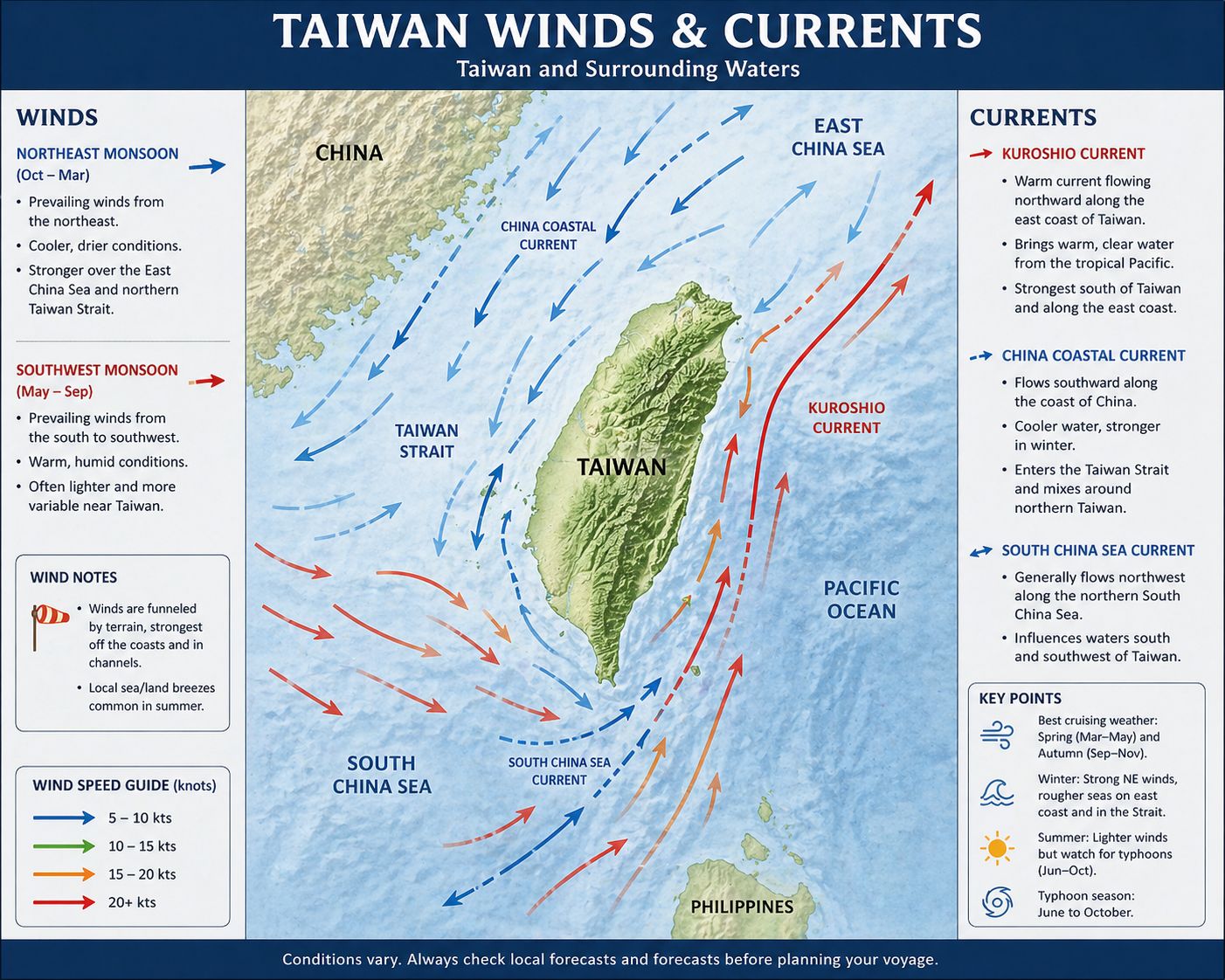
Sailing to Taiwan by yacht requires careful planning due to strong currents, steep underwater topography, and dense commercial traffic. The Kuroshio Current, a major factor in Taiwan sailing routes, flows northward along the east coast at 2–3 knots or more. Southbound yachts should expect reduced speed and occasional overfalls where the current interacts with headlands. Northbound yachts benefit from the current but must maintain situational awareness, as the east coast has few sheltered harbors and limited options in poor weather.
Approaches to Hualien and Su’ao are straightforward but exposed. Both are busy commercial ports with frequent cargo and fishing vessel movements. Yachts should monitor port control VHF channels and follow instructions precisely. Easterly swell can make the entrances uncomfortable during strong monsoon conditions.
The west coast is more sheltered but shallow in places, with extensive fishing activity, nets, and buoys. Approaches to Kaohsiung are well‑marked with clear traffic separation schemes. Keelung, on the northeast corner, is accessible in most conditions but can experience strong gusts due to surrounding hills.
Night approaches are possible at major ports, but fishing fleets operate extensively after dark, especially off the southwest coast. Radar and AIS are essential for safe navigation.
Taiwan Arrival, Entry Protocols, and
Formalities
Taiwan yacht entry requirements are clear and consistent. All foreign yachts must enter through designated ports of entry: Keelung, Kaohsiung, Hualien, or Taichung. Yachts must contact port control on VHF before entering and await instructions.
Clearance typically involves the usual Immigration, Customs, Harbor Police and Quarantine
Documents commonly requested include Passports, Ship’s registration, Crew list, Last port clearance. Safety equipment declaration (occasionally requested). Have a complete and accurate list for everything on board, spare parts, consumables, medical and so on. Have multiple copies of every list and have everything stowed in labelled plastic boxes.
Quarantine officers may ask about fresh produce, pets, and waste disposal. Taiwan has strict rules regarding animal entry; yachts with pets should confirm requirements well in advance. Most ports require yachts to remain at the quarantine berth until all inspections are complete. Clearance is generally efficient, though timing varies. After clearance, yachts are assigned a berth or permitted to anchor within the harbor.
About Visas. Taiwan does not offer visa‑on‑arrival for all nationalities, so crew should verify requirements before arrival. Extensions must be arranged through local immigration offices.
Taiwan Yacht Sailing Guide - Local Weather
Taiwan’s weather is shaped by monsoons, typhoons, and Pacific influences. The northeast monsoon (October–March) brings strong northeasterly winds, rough seas on the east coast, and cooler temperatures. The southwest monsoon (May–September) produces humid conditions, afternoon thunderstorms, and occasional heavy rain on the west coast.
Typhoon season runs from June to October, with peak activity in August and September. Taiwan has robust forecasting systems, and yachts should monitor updates closely. Harbors such as Kaohsiung and Keelung offer secure shelter; smaller ports may not be suitable during severe weather.
The east coast is exposed to Pacific swell year‑round, while the west coast is generally calmer but affected by tidal currents and river outflow
Taiwan Yacht Sailing Guide - Kaohsiung Arrival
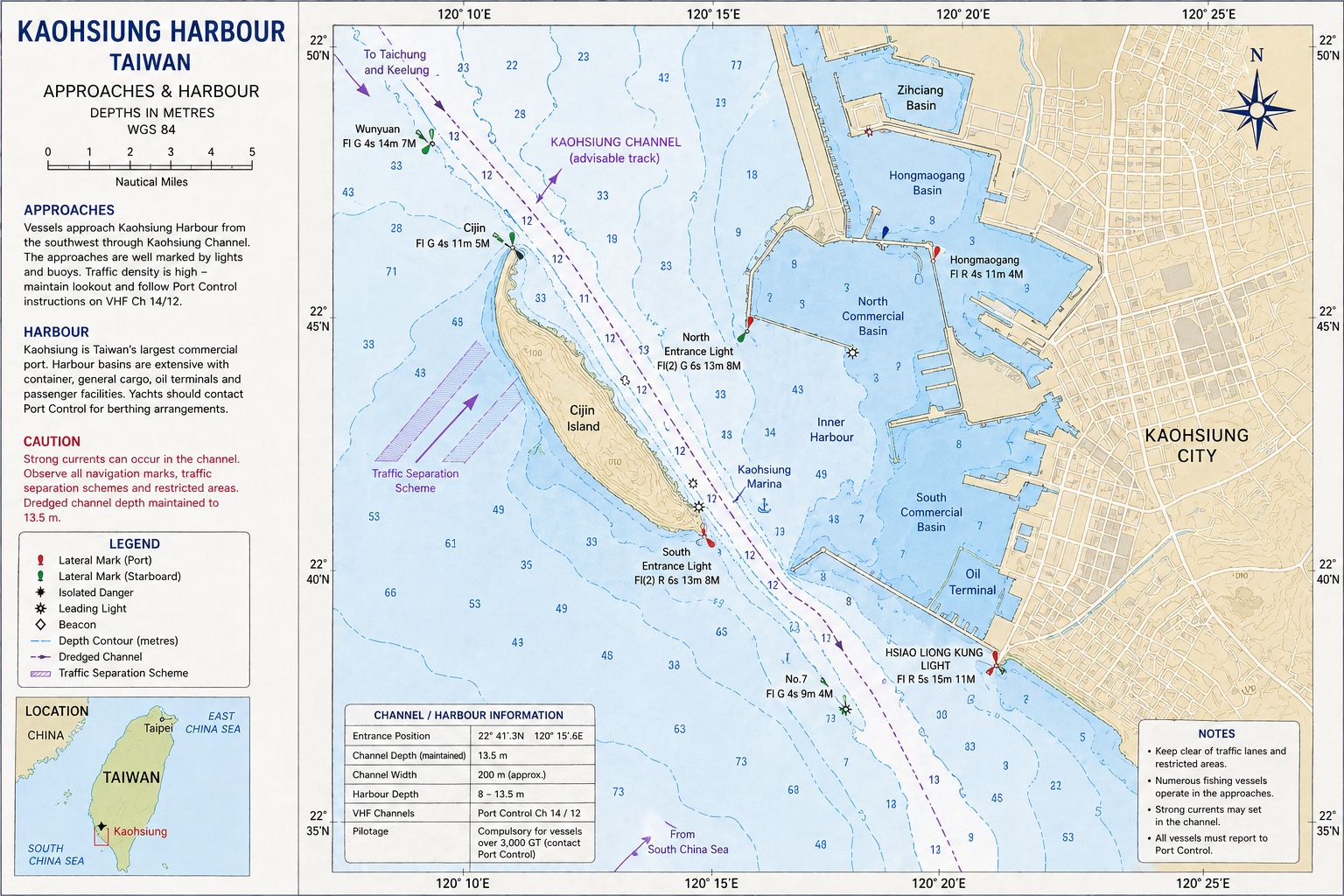
Arrive in daylight, expect strong port traffic, Monitor VTS (Vessel Traffic Service) VHF Channel 12. Kaohsiung is Taiwan’s largest commercial port and one of the busiest container hubs in Asia. container ships, tankers, tugs, trawlers, ferries and more. Approaching it safely requires early preparation, strict traffic awareness, and a clear understanding of the harbor layout. Use up to date official charts for navigation, but the typical approach pattern is the outer Approach from the south or southwest, staying outside the traffic separation scheme. The breakwater entrance is a wide, deep channel with strong cross‑currents. The inner harbor you should follow VTS instructions and remain clear of commercial lanes. Kaohsiung City Marina (Love River). This is the primary destination for cruising yachts. Features include: Floating pontoons. Access to shore power and water. Immigration and customs nearby. Easy access to the city. Good shelter from all directions. Depths are adequate for most yachts, though silting can occur near the river mouth. The harbor is well‑lit and well‑marked, but the scale can be overwhelming at first light or in poor visibility. The Kuroshio influence weakens near Kaohsiung but still affects the approach. Expect north‑setting current offshore, with cross‑currents near the breakwater entrance and a swell can wrap around the southern headland in strong monsoon conditions. Approach with caution in strong NE winds (winter) or typhoon‑season southerlies.
Taiwan Yacht Sailing Guide - Keelung Arrival
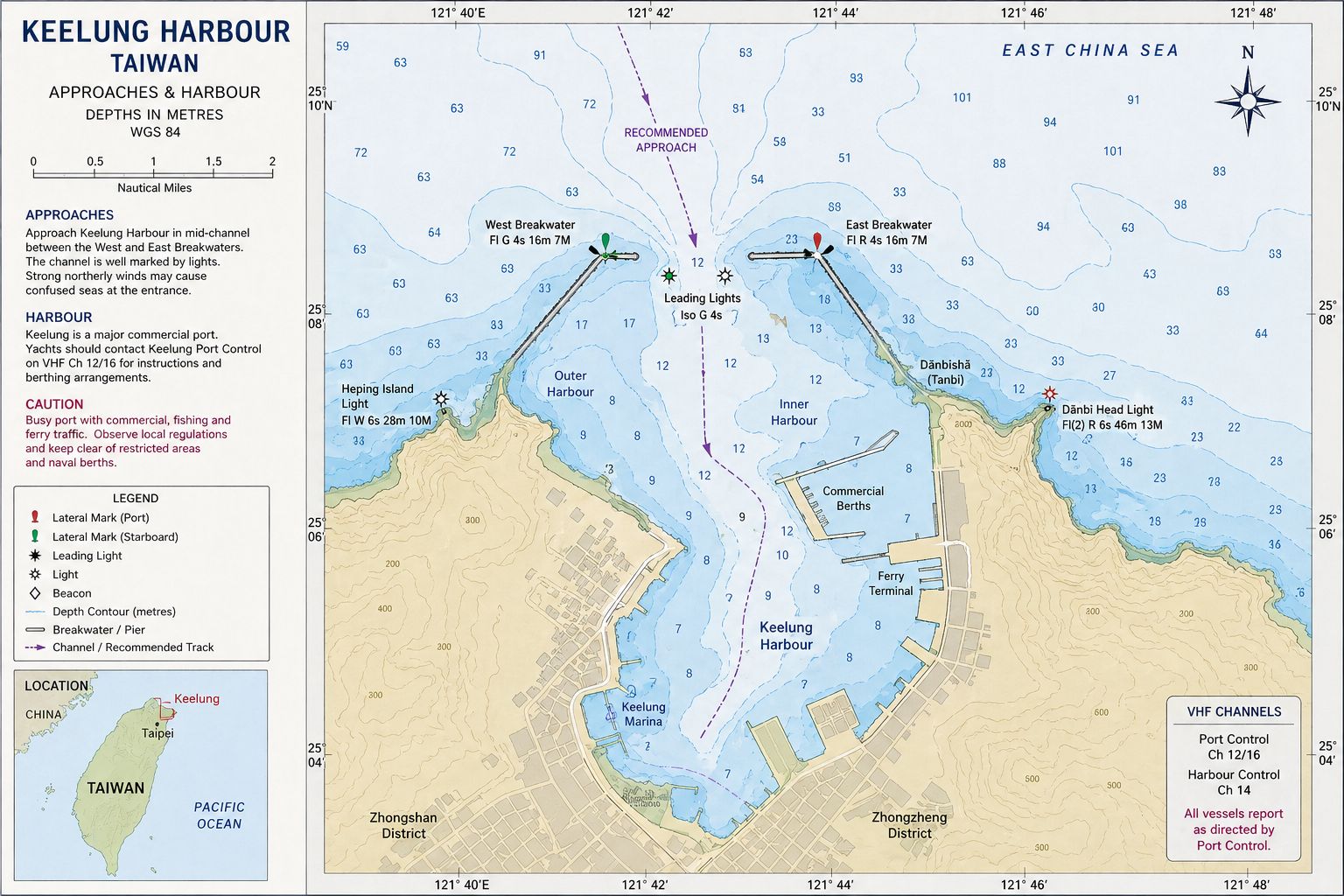
The Keelung approach is straightforward in good weather but demands attention to NE swell, wind funneling, traffic density, and variable currents. Yachts normally anchor in the Keelung ANCH area northeast of the harbor entrance, with depths of around 13 m and coordinates near 25.19189°N, 121.7286°E. The primary landmark Chi‑lung Tao (Keelung Islet) lies 2.5 nm northeast of the port entrance and is the key visual reference for aligning with the fairway. The entrance characteristics are a deep, narrow channel flanked by steep mountains. Keelung is one of Taiwan’s busiest commercial ports so expect heavy traffic. The wind and swell hazards are the Northeasterly monsoon winds that funnel between the mountains, increasing gusts and cross‑set near the entrance and the NE swell refracts into the harbor mouth, and during winter it can produce uncomfortable roll. Swell rebounds off breakwaters, creating confused seas close to the entrance. Tidal currents vary seasonally and can set across the fairway. Surface currents near the entrance may shift with wind and tide so helm corrections are often needed. There is limited room for course alteration once inside the breakwaters. Mandatory VTS contact per the Keelung Port Vessel Traffic Service Guideline. Yachts do not anchor inside the commercial harbor. The Bisha / Badouzi Area is not an anchorage. Yachts do not anchor here; instead, they berth inside Bisha Marina (Keelung’s yacht facility) and anchorage is discouraged due to fishing traffic and seabed obstructions
Taiwan Yacht Sailing Guide - Hualien Arrival
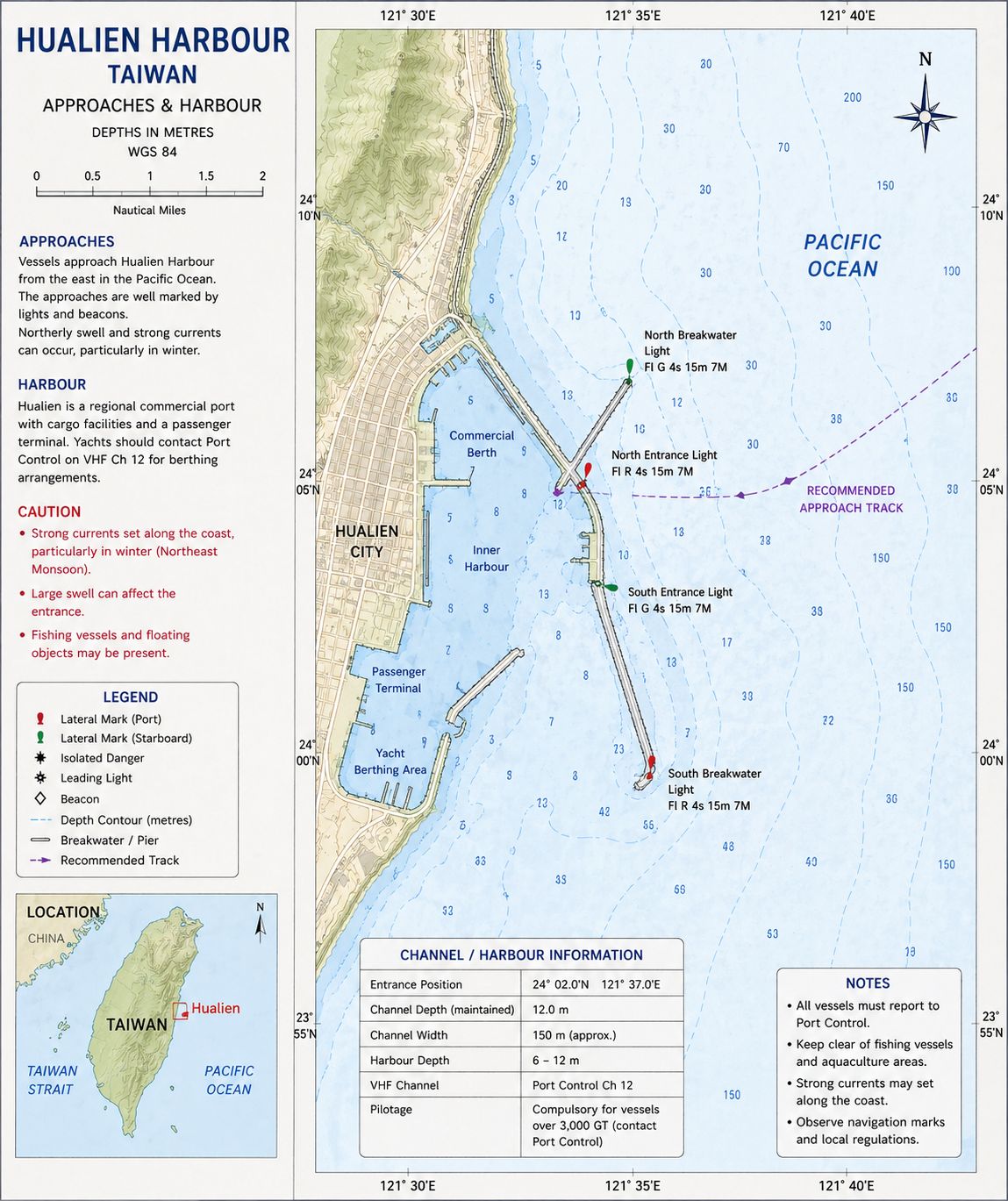
The approach to Hualien is direct as the entrance lies between two long breakwaters and is easy to identify on radar and visually. The port opens directly to the Pacific, so long‑period swell frequently propagates into the channel, producing noticeable surge at the breakwater heads. In stronger conditions, this swell can affect steering and may require timing your entry to avoid the heaviest sets. Wind‑driven surface currents often create a cross‑set near the entrance, and helm corrections are usually needed to maintain the center of the fairway. Once inside, the breakwaters provide effective shelter and the basins are deep with predictable depths. Residual surge can persist in the outer basin, but maneuvering space is adequate for small craft. Yachts do not anchor inside the commercial harbor; instead, they proceed directly to the designated small‑craft berths on the western side of the port, where port control assigns a position after clearance. These berths are functional rather than recreational, but they offer secure mooring and straightforward access to port facilities. Offshore anchoring is technically possible in calm conditions, though the open‑ocean exposure makes it unsuitable for anything other than short waiting periods.
Taiwan Yacht Sailing Guide - Tainan Arrival
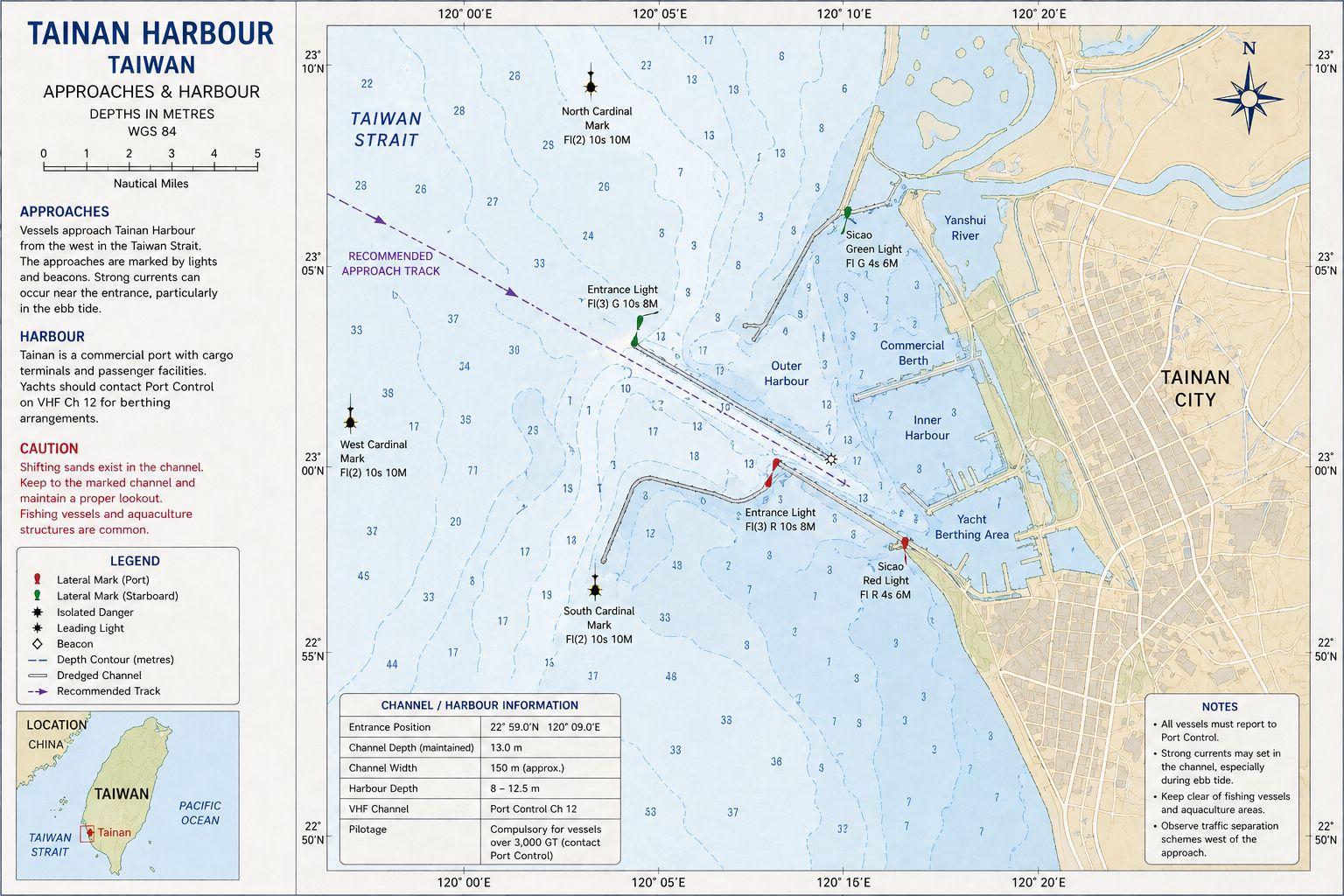
The port of Tainan is straightforward to enter but offers limited facilities for yachts, so most small craft treat it as a functional arrival point rather than a long‑stay harbor. The approach is made through Anping Port, a dredged, low‑lying entrance with breakwaters that provide partial shelter. Depths are generally adequate for yachts but swell from the Taiwan Strait can refract into the entrance, producing intermittent surge, especially during strong northerlies. Cross‑set from tidal flow is common near the breakwater heads and may require early helm correction to stay on the centerline. Visibility of the entrance can be reduced in hazy conditions because the surrounding coastline is flat and lacks strong visual landmarks. Once inside, the channel is narrow but predictable, with uniform depths and minimal obstructions. Traffic consists mainly of small commercial vessels and fishing craft, so maintaining a steady course and clear intentions is important. Yachts normally proceed directly to Anping Yacht Wharf, the designated small‑craft area on the western side of the inner harbor. Berths are functional, with basic mooring arrangements and limited maneuvering room, but they provide secure shelter from the Strait. Anchorage inside the port is not customary, and outside anchoring is exposed and generally unsuitable except for short waiting periods in calm weather.
Taiwan Yacht Sailing Guide - Anping Arrival
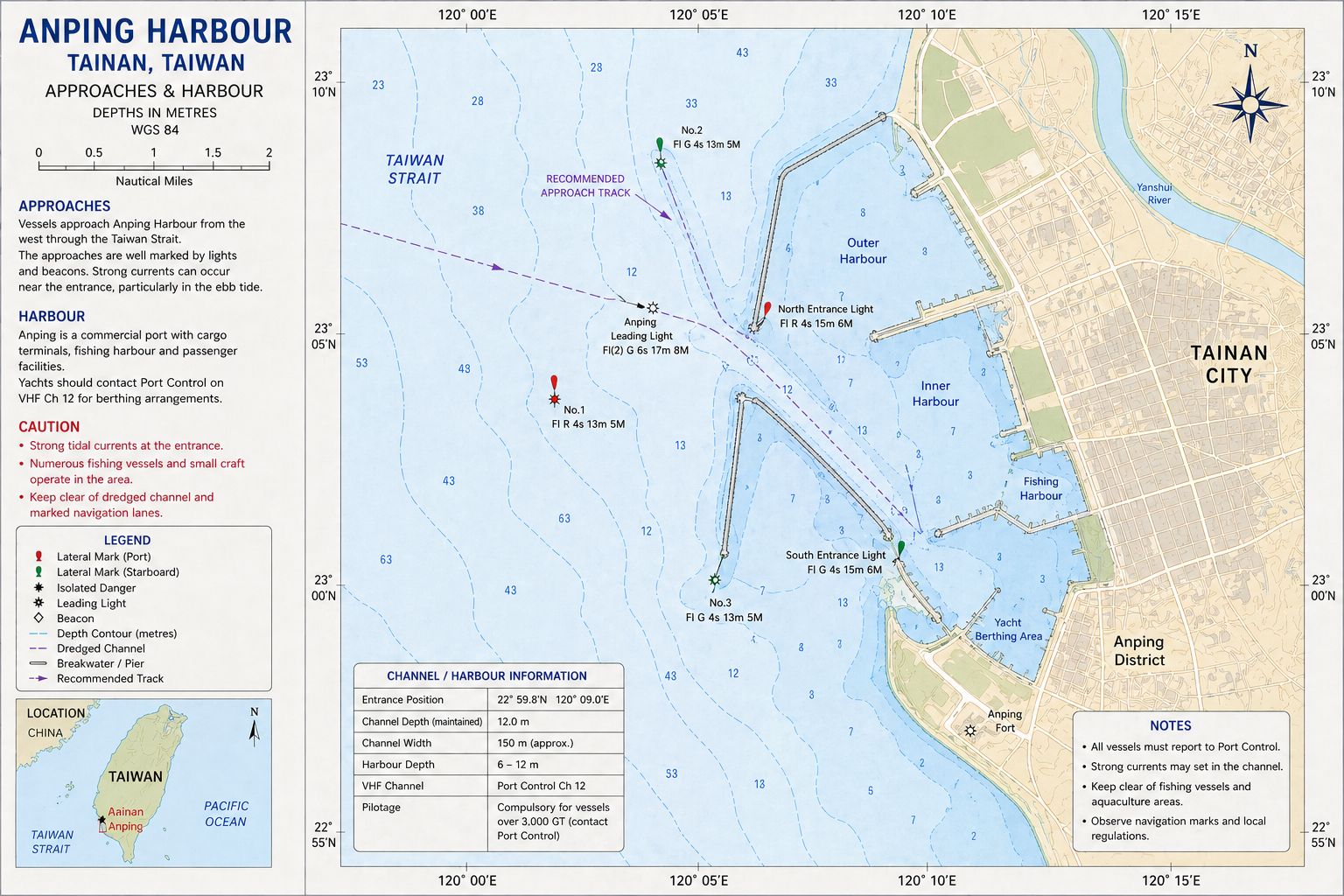
The entrance to Anping is a low‑lying, dredged channel opening directly onto the Taiwan Strait, with breakwaters that provide only partial protection. The approach is uncomplicated in clear weather, but northerly and north‑westerly winds can push short‑period Strait swell into the entrance, creating intermittent surge and some lateral motion near the breakwater heads. Tidal flow is modest but can produce a noticeable cross‑set in the final approach, so maintaining the centerline requires early helm correction. Once inside, depths are uniform and the channel geometry is predictable, though maneuvering space is limited and traffic consists mainly of small commercial and fishing vessels. Yachts proceed directly to the Anping Yacht Wharf, located on the western side of the inner harbor. This is the designated small‑craft area, offering secure mooring but minimal facilities. Anchorage inside the port is not customary, and outside anchoring is exposed to Strait swell and only suitable for short waiting periods in calm conditions.
Taiwan Yacht Sailing Guide - Su’ao Arrival
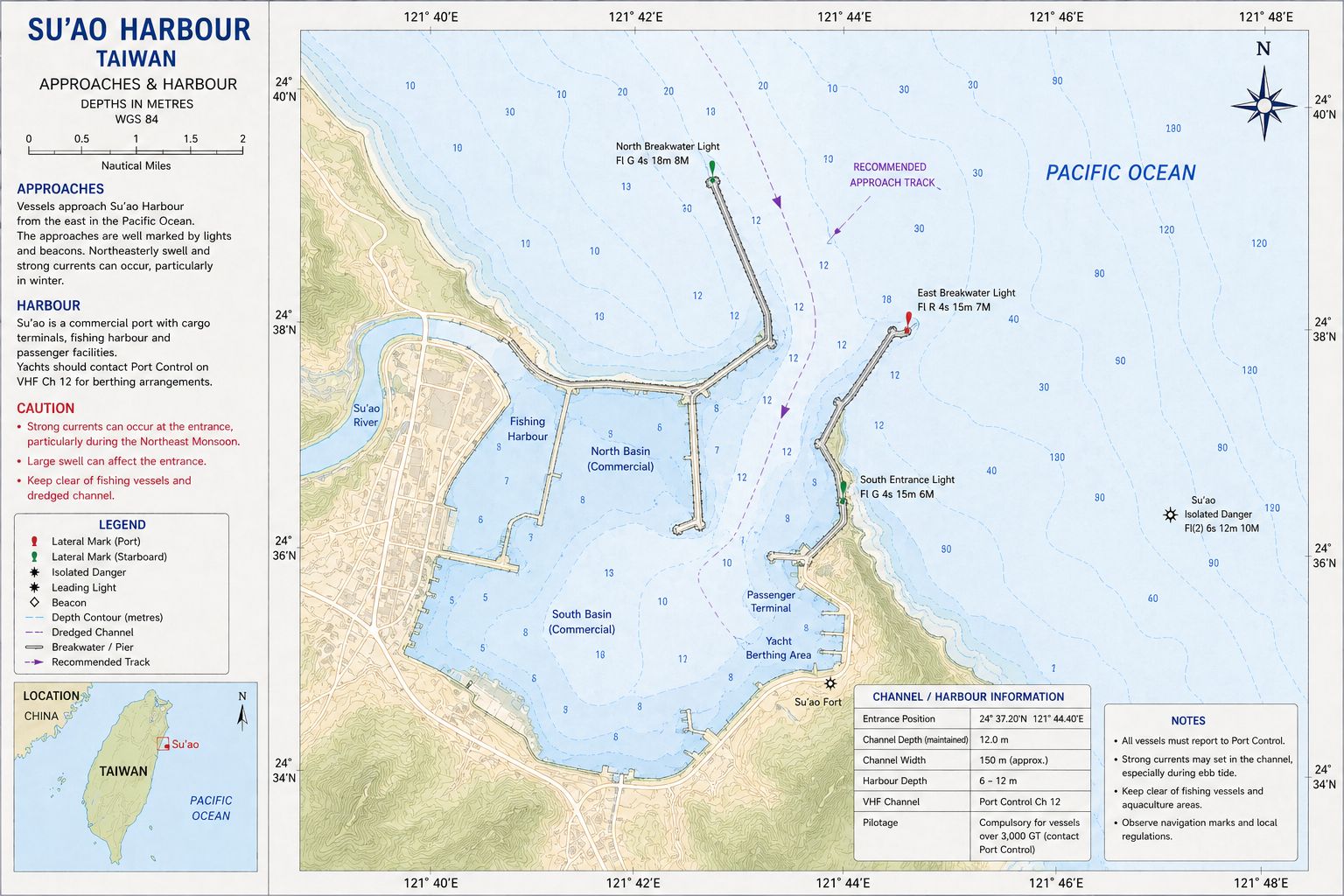
The Su’ao approach is straightforward but exposed, with the harbor opening directly to the Pacific and offering only partial protection from swell. The entrance lies between two substantial breakwaters and is easy to identify on radar. Long‑period easterly swell frequently enters the channel, producing surge at the breakwater heads and occasional lateral motion during the final approach. Wind‑driven surface currents can create a cross‑set near the entrance, particularly during northeast monsoon conditions, and early helm correction is often required to maintain the centerline. Once inside, the port is divided into commercial and fishing basins with predictable depths and limited maneuvering space. Traffic consists mainly of fishing vessels, which operate continuously and may move unpredictably near the inner turning areas. Yachts proceed directly to the Su’ao Yacht Wharf in the Nanfang’ao area, a small‑craft facility offering secure mooring but minimal services. Anchorage inside the port is not customary, and outside anchoring is generally unsuitable due to open‑ocean exposure and persistent swell, making it viable only for short waiting periods in calm conditions.
Taiwan Yacht Sailing Guide - Diesel Fuel Supply
Diesel fuel for yachts in Taiwan is widely available in major ports. Commercial fuel docks exist in Kaohsiung, Keelung, and Hualien, though some are designed for larger vessels and require careful maneuvering. Many yachts arrange fuel delivery via small tanker trucks, especially in Kaohsiung. Fuel quality is generally good. Yachts requiring low‑sulfur diesel should confirm availability in advance. Smaller fishing ports may have fuel, but access can be limited by depth or dock height.
Taiwan Yacht Sailing Guide - Fresh Water Supply
Fresh water for yachts in Taiwan is available in all major ports. Harbors typically provide water at designated berths, though pressure and fittings vary. In some ports, water is supplied via tanker truck.
Taiwan’s municipal water is treated and safe to drink, though many yachts choose to filter or treat water before filling tanks. During drought periods, particularly in the south, water restrictions may occur.
Mechanical and Electrical Repairs
Resource
If you are headed somewhere remote consider the need to expand your knowledge base or have an information resource on board. Why not get a copy of my book The Marine and Electrical and Electronics Bible 4th Edition. By and for yachties, with everything from batteries and charging, solar and wind, diesel engines and marine electronics and so much more. Your complete systems guide. 650 pages of practical advice. In Australia and New Zealand order a copy through Boat Books. UK and European boats can buy the UK Edition Here. US and Canadian boats can get the US Edition Order Here. Marine systems are my profession so let me help you. By a liveaboard boat owner for other boat owners


Taiwan Yacht Sailing Guide - Repairs and Marine Services
Taiwan has a strong shipbuilding and fishing industry, supporting a wide range of yacht repair services. Kaohsiung is the primary center for repairs, offering engine servicing, electronics repair and haul‑out facilities (limited but available). Keelung and Hualien also have repair facilities oriented toward fishing vessels. Skilled labor is available, though English proficiency varies. Specialized yacht parts may need to be imported, but Taiwan’s logistics network is efficient.
Taiwan Yacht Sailing Guide - Local Cultural Requirements
Taiwanese culture is polite, orderly, and community‑focused. Yachts should be aware of:
- Harbors are working environments; avoid obstructing fishing or commercial operations.
- Noise should be minimized, especially at night.
- Waste disposal rules are strict; garbage must be sorted and disposed of properly.
- Shoes are removed when entering homes and some offices.
- Public behavior is generally reserved.
English is spoken in major cities but less common in smaller ports. Basic Mandarin phrases are helpful.
Taiwan Yacht Sailing Guide - Provisioning
Provisioning in Taiwan is excellent and highly accessible, with a dense network of supermarkets, convenience stores, and traditional markets providing a wide range of supplies. Major cities and ports offer full-service supermarkets such as Carrefour and RT-Mart, alongside 24-hour convenience chains like 7-Eleven and FamilyMart, making everyday provisioning straightforward at any time. Fresh produce is a standout, with wet markets and street markets supplying high-quality vegetables, fruit, seafood, and meat at competitive prices, often with rapid turnover ensuring freshness. Imported goods are widely available, particularly in urban centres, while local foods including rice, noodles, tofu, and prepared meals are abundant and economical. Overall, Taiwan provides reliable, high-quality, and flexible provisioning, suitable for both short stops and full resupply before extended cruising.
Taiwan Yacht Sailing Guide - Local Cuisine
Cuisine in Taiwan is diverse, regional, and strongly influenced by Chinese traditions, particularly Fujian along with Japanese and indigenous elements, resulting in a food culture that is both refined and highly accessible. At its core are balanced, flavour-driven dishes built on rice, noodles, seafood, pork, and fresh vegetables, with a characteristic emphasis on light broths, soy-based sauces, garlic, ginger, and subtle sweetness. Signature foods include beef noodle soup (slow-braised beef in aromatic broth), lu rou fan (braised minced pork over rice), oyster omelette (eggs, oysters, and starch with savoury sauce), and xiao long bao (soup dumplings), while seafood is widely available and often simply prepared to highlight freshness. Night markets are central to Taiwanese food culture, offering an extensive range of street foods such as fried chicken cutlets, scallion pancakes, and bubble tea, which originated in Taiwan. Regional variation is notable, with coastal areas favouring seafood and inland areas offering heartier meat and noodle dishes. Overall, Taiwanese cuisine is accessible, varied, and intensely food-focused, combining traditional techniques with a strong street-food identity.
Taiwan Yacht Sailing Guide - Summary
The Taiwan yacht sailing guide. Taiwan is a practical and well‑equipped stop for yachts transiting the Western Pacific. It offers reliable ports, clear entry procedures, good provisioning, and access to repairs. The east coast requires careful navigation due to strong currents and limited shelter, while the west coast provides calmer conditions and easier access to services. For yachts moving between Japan, the Philippines, Hong Kong, and Southeast Asia, Taiwan is a dependable waypoint with a strong maritime culture and straightforward logistics.