St Martin Yacht
Cruising Guide
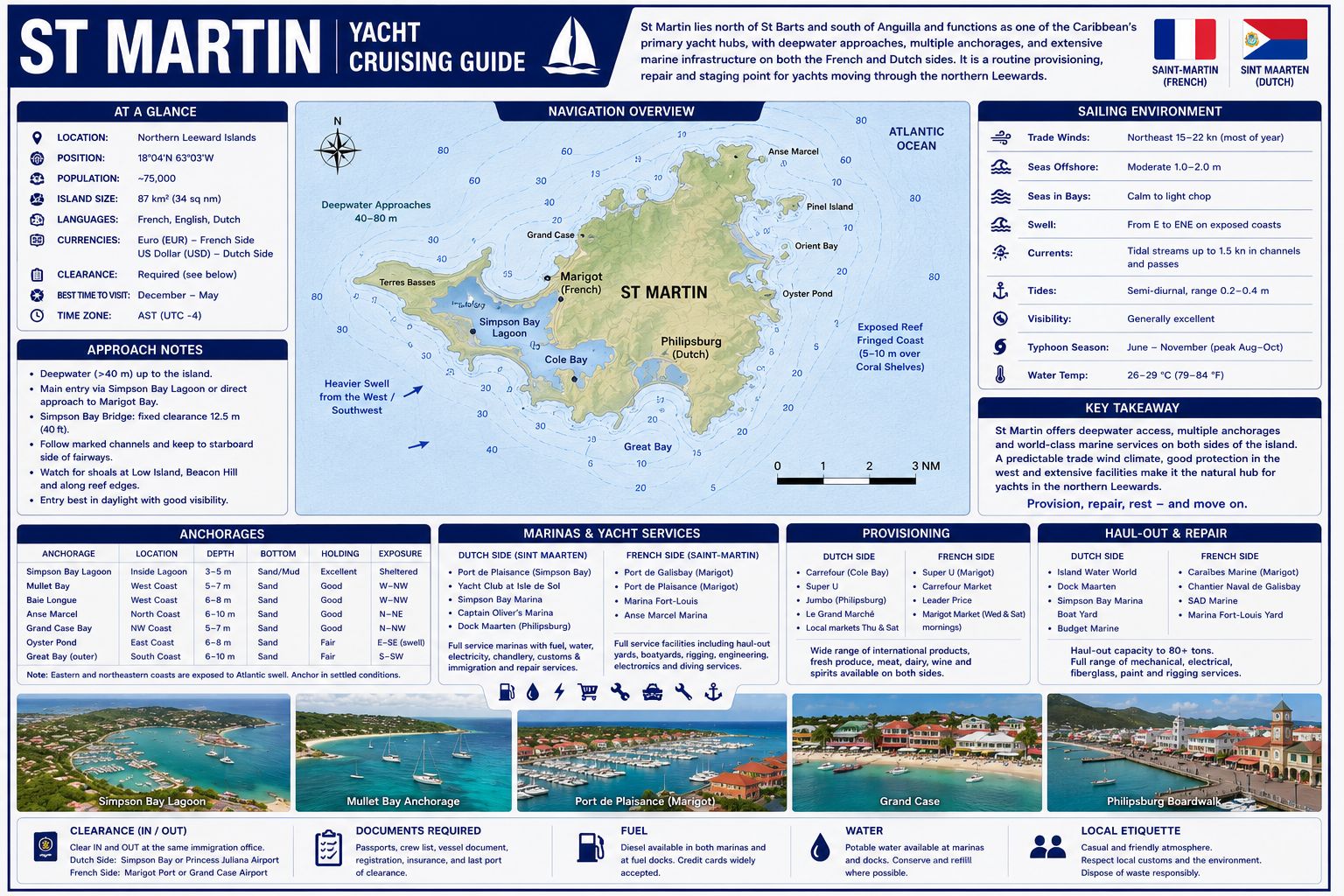
St Martin Yacht Cruising Guide. St Martin lies north of St Barts and south of Anguilla and functions as one of the Caribbean’s primary yacht hubs, with deepwater approaches, multiple anchorages, and extensive marine infrastructure on both the French and Dutch sides. Navigation is straightforward in settled trade‑wind conditions, with depths remaining above 40–80 m offshore and predictable shoaling toward the island’s western and southern bays. The island is a routine provisioning, repair, and staging point for yachts moving through the northern Leewards.
The sailing environment is shaped by the northeast trades, typically 15–22 kn, with moderate seas offshore and calmer conditions inside Simpson Bay Lagoon and the western anchorages. The eastern and northeastern coasts are reef‑fringed and exposed to Atlantic swell, with depths dropping rapidly from 30–40 m to 5–10 m over coral shelves. Marine infrastructure is extensive, with full‑service marinas, haul‑out yards, and technical support concentrated around Simpson Bay, Cole Bay, and Marigot.
St Martin Yacht
Cruising Guide - Approaches
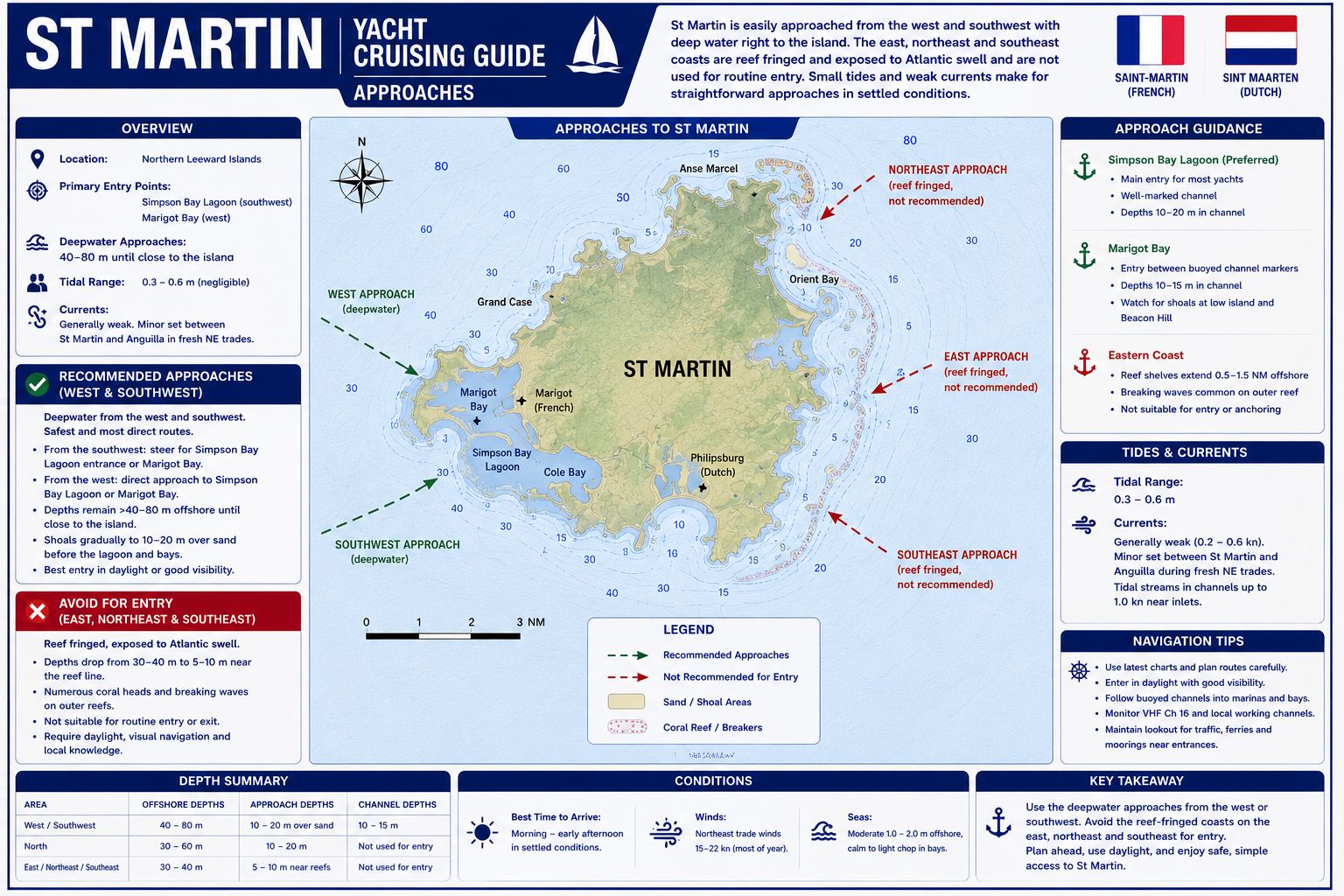
Approaches from the west and southwest are clear, with depths above 40–80 m until close to the island, shoaling to 10–20 m over sand before entering Simpson Bay or Marigot. Approaches from the east, northeast, and southeast are reef‑fringed and exposed to Atlantic swell, with depths dropping from 30–40 m to 5–10 m near the reef line; these sectors require daylight and visual navigation and are not used for routine entry. Tidal range is small at 0.3–0.6 m, and currents are weak, with minor set between St Martin and Anguilla during fresh trades.
St Martin Yacht
Cruising Guide - Anchorage
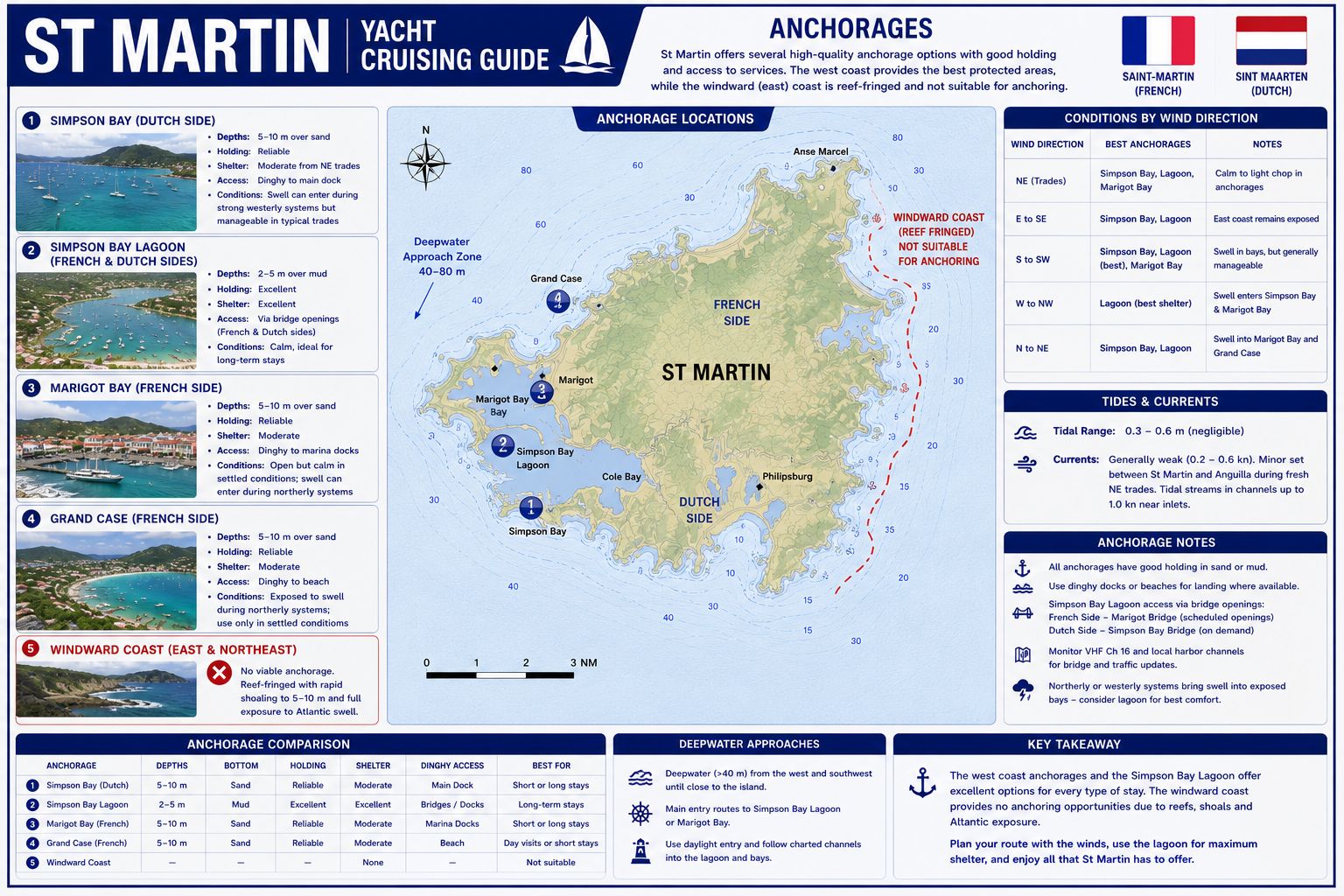
Simpson Bay (Dutch Side). Simpson Bay provides 5–10 m over sand with reliable holding and moderate shelter from the prevailing trades. The bay is wide and accessible, with predictable depth gradients and straightforward dinghy access via the main dock. Swell can enter during strong westerly systems, but conditions remain manageable in typical trade‑wind weather.
Simpson Bay Lagoon (French & Dutch Sides). The lagoon offers 2–5 m over mud with excellent shelter. Access is via bridge openings on both the French and Dutch sides. Holding is reliable, and the lagoon provides calm conditions suitable for long‑term stays. Depths are shallow but consistent, and navigation inside the lagoon is straightforward.
Marigot Bay (French Side). Marigot Bay offers 5–10 m over sand with moderate shelter. The bay is open but calm in settled conditions, with reliable holding and easy dinghy access via the marina docks. Swell can enter during northerly systems.
Grand Case (French Side). Grand Case provides 5–10 m over sand with moderate shelter. The bay is exposed to swell during northerly systems and is suitable only in settled conditions. Dinghy access is via the beach.
Windward Coast. The eastern and northeastern coasts offer no viable anchorage due to reefs, shoaling to 5–10 m, and full exposure to Atlantic swell.
St Martin Yacht
Cruising Guide - Marina Facilities
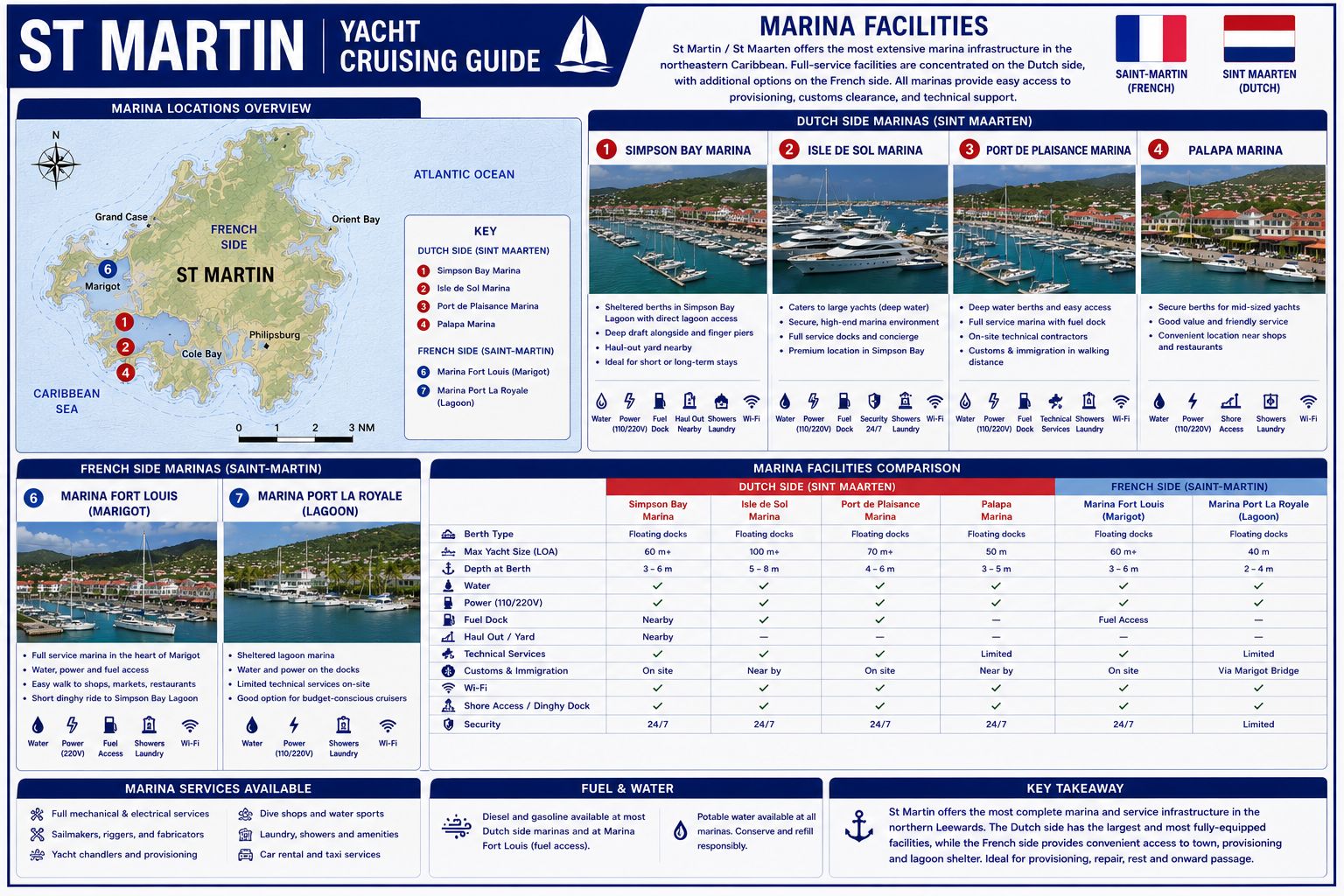
St Martin/St Maarten’s marina network is split between the French and Dutch sides, with the Dutch side holding the bulk of full‑service facilities. On the Dutch side, Simpson Bay Marina provides sheltered berths with water, power, fuel access, haul‑out nearby, and direct access to the lagoon; Isle de Sol Marina caters to large yachts with secure docks, fuel, power, and high‑end services; Port de Plaisance Marina offers deep‑water berths, fuel, water, power, and on‑site technical contractors; and Palapa Marina provides secure berths with water, power, and shore access for mid‑sized yachts. The French side centres on Marina Fort Louis (Marigot), offering berths with water, power, fuel access, and easy provisioning from the town centre, while Marina Port La Royale inside the lagoon provides sheltered berths with water and power but limited technical services. Together, these marinas form the most comprehensive yacht‑support environment in the northeastern Caribbean, with reliable fuel, water, power, haul‑out, and technical capability concentrated around Simpson Bay Lagoon and Marigot
St Martin Yacht
Cruising Guide - Local Weather
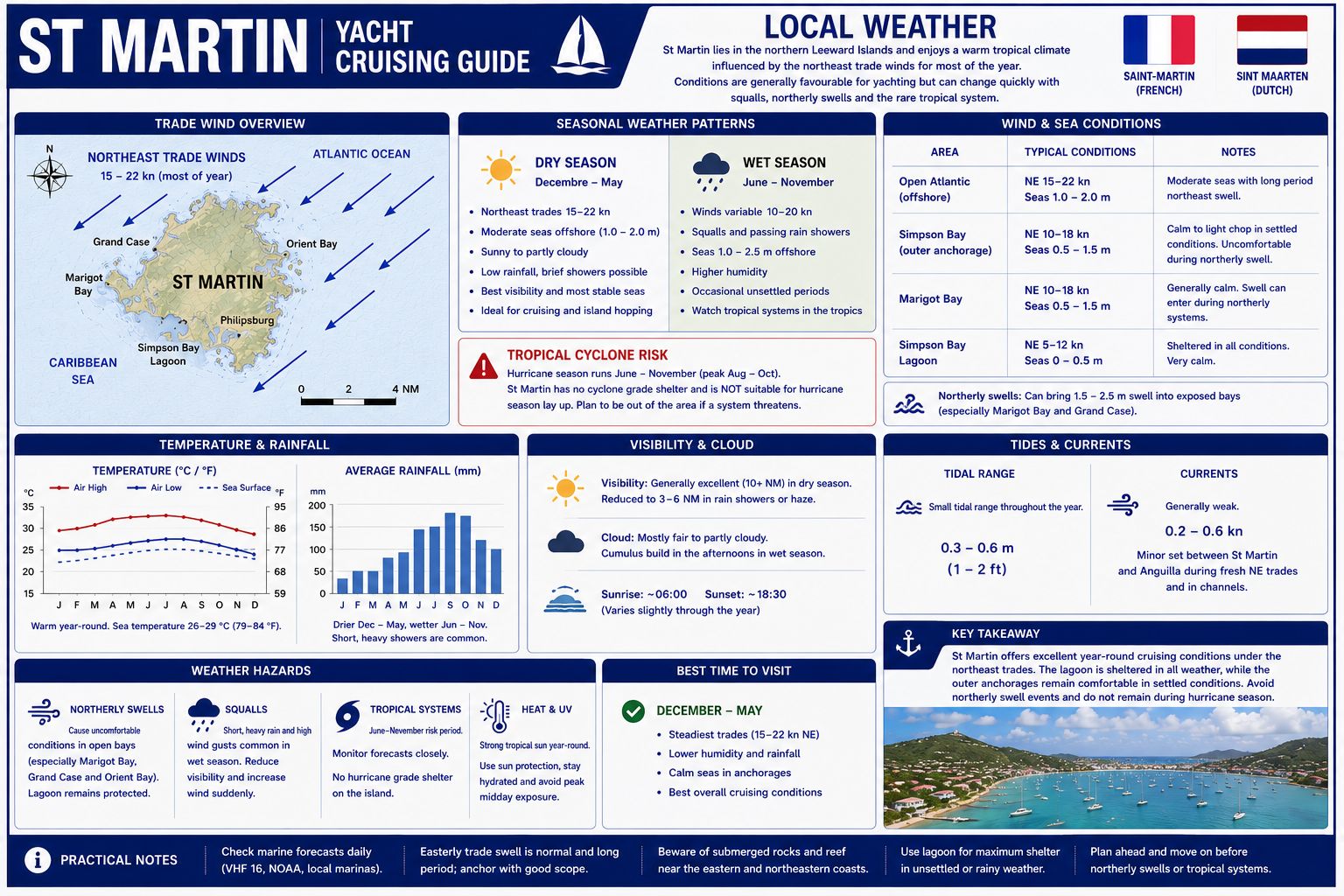
Weather follows the northern Leeward Islands pattern, with northeast trades between 15–22 kn and moderate seas offshore. Simpson Bay and Marigot Bay are calm in settled conditions but become uncomfortable during northerly swell events. The lagoon remains sheltered in all conditions. Rainfall is seasonal, with passing showers common. The island offers no cyclone‑grade shelter and is not suitable for hurricane‑season lay‑up despite its infrastructure.
The Marine Electrical and Electronics
Bible 4th Edition
The latest edition of my book has a complete Caribbean Island communications guide in Chapter 34.35. Caribbean VHF Channels with Island by Island coverage of all weather forecast sources, VHF nets and more. This also covers virtually every cruising location globally from the Pacific to the Mediterranean for VHF weather forecasts and channels.
St
Martin Yacht Cruising Guide - Provisioning
St Martin has large supermarkets on both the French and Dutch sides offering full provisioning, including fresh produce, meat, dairy, frozen goods, beverages, and packaged staples. Stock levels are reliable and suitable for long‑range provisioning.
On the French side, the primary supermarkets are Super U (Marigot), Super U (Hope Estate), Carrefour Market (Orient Bay), and Petit Casino outlets in smaller neighbourhoods. These stores carry full‑range European provisioning including fresh produce, meat, dairy, bakery, frozen goods, wine, charcuterie, and dry goods, with consistent resupply from France and Guadeloupe. Carrefour Market is the largest chain and like their markets back in France are a good place to store up. They have a big range sourced out of almost everywhere from France, USA, Netherlands, UK and so on. Store locations are outside Philipsburg, near the big roundabout, and close to the entrance of Port De Plaisance Marina. They offer yacht provisioning services with delivery services. They offer organic fruits and vegetables, a big range of meats, seafood, and of course a lot of cheese and some 2,500 wines. Super U has high quality French produce and is a big supermarket. Located in the Howell Centre in Marigot Bay. Con Market Garden is a large supermarket with a good range of fresh and frozen produce. It is conveniently located on Welfare Road close to all of the Simpson Bay marinas. Prime Cash & Carry has a big range of supplies at competitive prices, they do marina deliveries. They are located on the Orange Grove Road and open Monday to Friday 08:00 to 17:00 and 08:00 to 16:00hrs on Saturday.
On the Dutch side, the main supermarkets are Carrefour Hypermarket (Cole Bay), Carrefour Market (Jordan Village, Cupecoy), Cost U Less (Cole Bay), Prime Distributors (Cole Bay), and Le Grand Marché (Bush Road and Simpson Bay). These Dutch‑side stores operate on U.S. supply chains and are ideal for bulk provisioning, long‑term cruising loads, beverages, frozen goods, and packaged staples. All major supermarkets are within easy reach of Simpson Bay Lagoon, Oyster Pond, and Marigot.
Markets (French & Dutch Sides)
Markets on St Martin/St Maarten are concentrated on the French side, with the main produce and fish market located at Marigot Waterfront Market, where vendors sell fresh fruit, vegetables, herbs, spices, and locally caught fish including tuna, mahi‑mahi, wahoo, and reef species depending on season. Additional produce stalls operate in Hope Estate and Grand Case, offering regional imports from Dominica, Guadeloupe, and Martinique. On the Dutch side, small‑scale produce vendors appear around Philipsburg and Cole Bay, but supply is limited and inconsistent compared to the French side.
Seafood Market. Simpson Bay Fish Market is located near the bridge. Gary in Marigot sells fresh seafood and catches that come in daily and includes dorado, snapper, wahoo and tuna. He sells all his fish to the market every Wednesday. Located in Marigot close to the marina, look at for the large lobster tank.
St
Martin Yacht Cruising Guide - Local Cuisine
St Maarten/Sint Martin
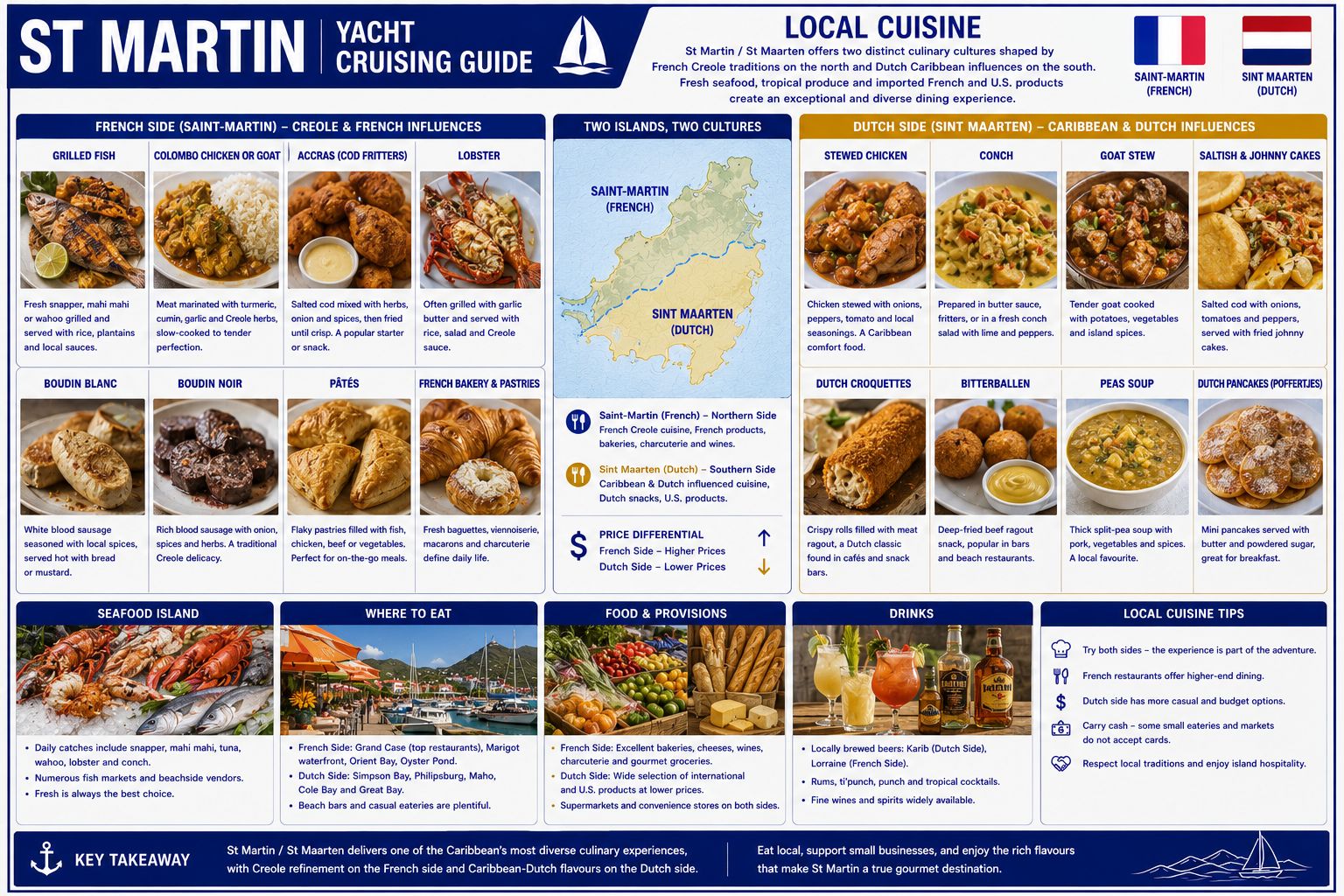
The national dish is Callaloo Soup on the French side and Conch and Dumplings on the Dutch side. Saint Martin is part of the Leeward Islands and comprises two separate countries, the Northern French side is called Saint-Martin, and the southern Dutch side is called Sint Maarten. There are big price differentials between each side.
Local cuisine on St Martin/St Maarten reflects two distinct supply chains and culinary traditions: the French side centres on Creole dishes such as grilled snapper, mahi‑mahi, and lobster served with rice, plantains, and local sauces; Colombo chicken or goat seasoned with turmeric, cumin, and herbs; accras made from salted cod mixed with herbs and fried; boudin blanc and boudin noir prepared with local spices; and pâtés filled with fish, chicken, or vegetables. Bakeries supply French breads, pastries, and charcuterie that shape everyday meals. The Dutch side leans toward Caribbean and Dutch‑influenced dishes including stewed chicken with onions, peppers, and tomato; saltfish with johnny cakes; conch prepared in butter sauce or fritters; goat stew seasoned with local spices; and Dutch snacks such as croquettes and bitterballen available around Simpson Bay and Philipsburg. Across both sides, seafood is consistent due to local landings, while imported French and U.S. products shape the broader food landscape.
St Martin Yacht
Cruising Guide - Fuel Supplies
Fuel is widely available on both the French and Dutch sides, with diesel and petrol supplied at marina fuel docks. Supply is reliable, and larger volumes can be arranged through marina offices.
St Martin Yacht
Cruising Guide - Water Supplies
Potable water is available at all major marinas through dockside hose connections. Yachts at anchor take water by jerry can from marina facilities. Water makers reduce reliance on shore supply but are not essential for short stays.
Mechanical and Electrical Repairs
Resource
If you are headed somewhere remote consider the need to expand your knowledge base or have an information resource on board. Why not get a copy of my book The Marine and Electrical and Electronics Bible 4th Edition. By and for yachties, with everything from batteries and charging, solar and wind, diesel engines and marine electronics and so much more. Your complete systems guide. 650 pages of practical advice. In Australia and New Zealand order a copy through Boat Books. UK and European boats can buy the UK Edition Here. US and Canadian boats can get the US Edition Order Here. Marine systems are my profession so let me help you. By a liveaboard boat owner for other boat owners


St Martin Yacht
Cruising Guide - Marine Services
Marine services are extensive, including mechanical, electrical, rigging, sail repair, welding, fiberglass, and chandlery supply. The island supports major repairs and refits, with specialized parts available locally or sourced through established supply chains.
St Martin Yacht
Cruising Guide - Local Customs
Local behaviour is courteous and direct. Respect for private property, controlled dinghy speeds near shore, and proper waste disposal are expected. Marina procedures are clear, and interactions with staff are straightforward. Noise should be kept low near residential areas.
St Martin Yacht
Cruising Guide - Summary
St Martin provides deepwater approaches, multiple anchorages with 2–10 m depth profiles, and the region’s strongest marine‑service base outside the Virgin Islands. Simpson Bay and Marigot serve as the operational centres, while the lagoon offers sheltered long‑term stays. Navigation is straightforward in settled conditions, and operational demands are modest for a self‑sufficient yacht. St Martin Yacht Cruising Guide for all you need to know