Sailing to the Pitcairn Islands: A
Practical Cruising Guide for Yachts
Sailing to the Pitcairn Islands. The Pitcairn Islands are among the most
remote inhabited islands in the world, located in the central South Pacific
between French Polynesia and Easter Island. For sailors planning a South
Pacific passage via Pitcairn, the island group offers a rare opportunity to
visit a small, self‑sufficient community with limited but essential services.
The region is isolated, exposed to ocean swell, and without protected harbors,
making it a challenging destination for cruising yachts. However, for well‑prepared
vessels, Pitcairn provides a valuable stop for rest, resupply, and cultural
exchange. As many will know "Pitkern" people are descendants from Bounty mutineers and Tahitians.
The primary landing point for visiting yachts is Bounty Bay, located on the northeast side of Pitcairn Island. It is not a harbor but an open‑roadstead anchorage exposed to swell and wind shifts. There are no marinas, no moorings, and no sheltered basins. Despite these constraints, the island’s residents are accustomed to supporting passing vessels, and the community offers assistance with fuel, water, provisions, and local logistics. This Pitcairn Islands cruising guide focuses on the practical realities of how to sail to the Pitcairn Islands, including navigation, anchorage conditions, entry requirements, weather, provisioning, fuel and water availability, repair options, cultural expectations, and local cuisine
Sailing to the Pitcairn Islands - Navigation
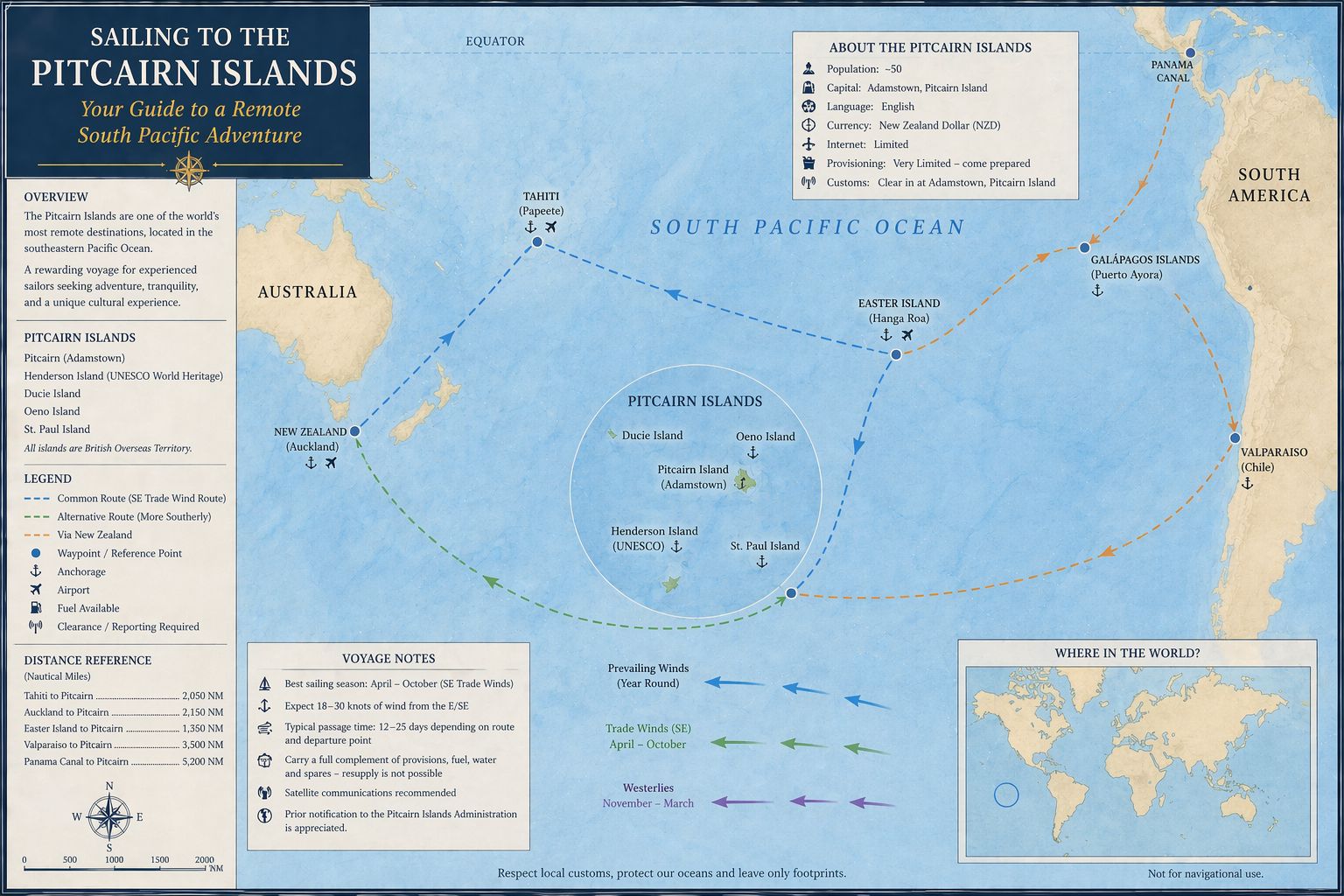
Offshore Routes and Passage Planning. Reaching the Pitcairn Islands requires long‑distance ocean passages with no intermediate stops. Common approaches include:
- From the Gambier Islands (French Polynesia): 300–330 nautical miles, typically the shortest and most common route.
- From Easter Island: 1,200 nautical miles, often with variable winds and mixed swell.
- From the Tuamotus or Marquesas: 1,000–1,500 nautical miles depending on starting point.
- From the Juan Fernández Islands or mainland Chile: 2,000+ nautical miles.
Sailing to the Pitcairn Islands - Outer Islands
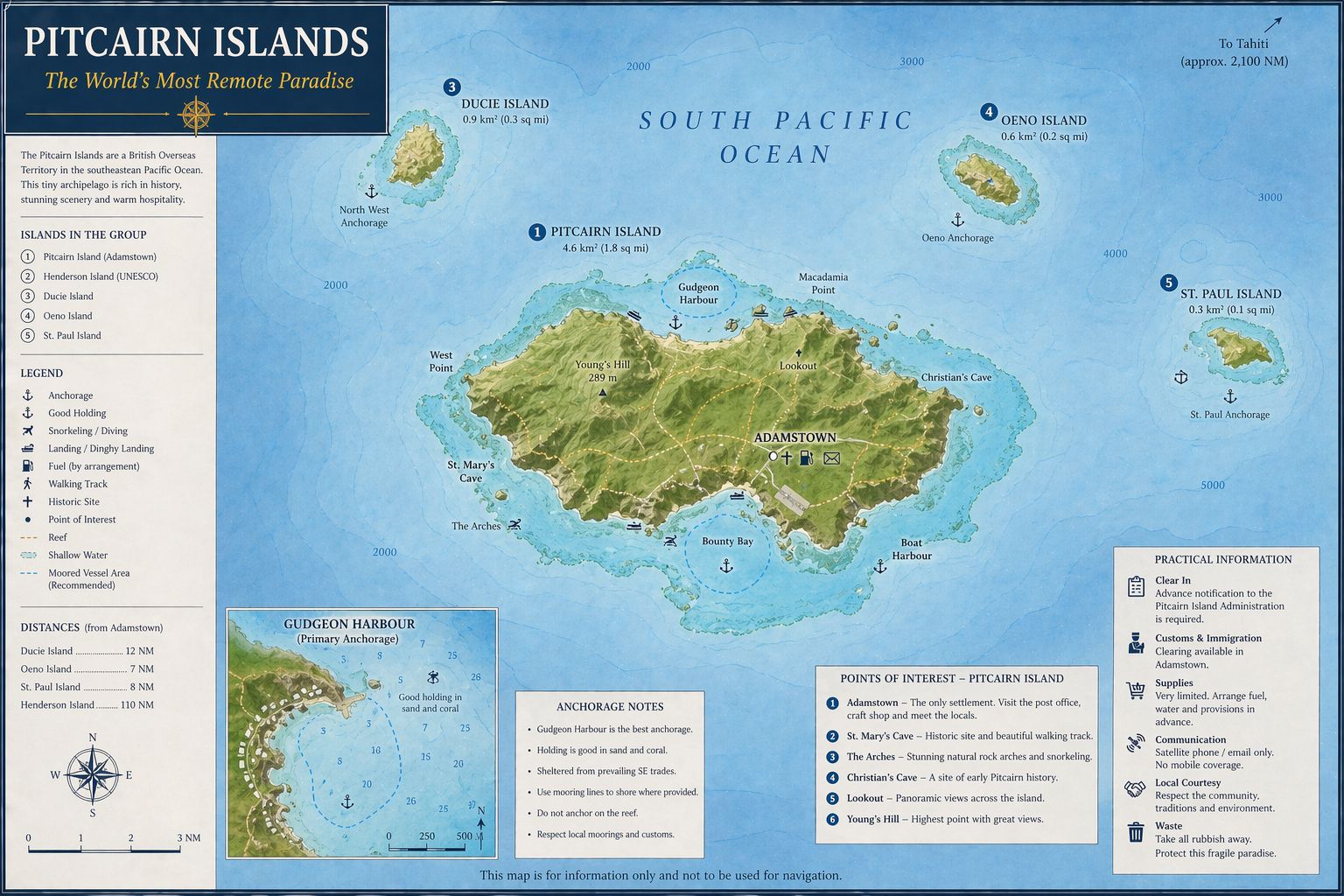
These three islands form the uninhabited outer islands of the Pitcairn Islands group, and each one has its own personality, ecology, and navigational character. They’re some of the most remote places on Earth, and for a yacht crew they feel almost mythic.
Henderson Island: This is a UNESCO World Heritage Site and one of the world’s best‑preserved raised coral atolls. It is uninhabited, extremely isolated. It is a raised limestone island (makatea) with high cliffs, no safe anchorage, surrounded by sharp coral shelves and heavy surf. Landing is notoriously difficult and often impossible. It is home to four endemic bird species, unique plants and insects found nowhere else and one of the last near‑pristine ecosystems in the Pacific. It is also sadly known for accumulating huge amounts of ocean plastic due to currents. Summary: No anchorage,No landing without special permission and usually viewed from offshore on passages between Gambier → Pitcairn → Easter Island.
Ducie Atoll: The most easternmost atoll in the world. It is uninhabited, part of the Pitcairn Islands territory. It is a classic ring‑shaped coral atoll, with a central lagoon and four small islets (Acadia, Pandora, Edwards, Westward) It is one of the Pacific’s most important seabird breeding sites with massive colonies of Murphy’s petrels, Christmas shearwaters, and others. It has a very fragile ecosystem. Summary: Anchoring is possible in calm conditions. Lagoon is shallow and tricky. Swell wraps around the atoll, so conditions change fast. A surreal, otherworldly stop for expedition yachts
Oeno Atoll: Uninhabited except for occasional Pitcairn family camps and is considered Pitcairn’s “holiday island”. It is a circular atoll with a central lagoon with one main islet (Oeno Island) with coconut palms. It is more sheltered than Ducie but still exposed. It is an important seabird nesting site with healthy coral and lagoon life, and occasional turtle nesting. Summary: Best anchorage of the three outer islands but still exposed to swell and requires good weather. Popular with Pitcairners for camping and fishing and a rare, beautiful stop for yachts heading toward Gambier or Easter Island
Sailing to the Pitcairn Islands - Approaches
Pitcairn rises steeply from deep water, with no surrounding reefs or shoals. Depths remain over 1,000 meters until close to shore. Approaches are generally clear, but the coastline is rocky, steep, and exposed.
Hazards – There are several
- Persistent swell from multiple directions.
- Strong surge near landing areas.
- Sudden wind shifts from passing systems.
- No sheltered anchorages.
- Limited holding ground.
Sailing to the Pitcairn Islands - Anchorage
Bounty Bay is the only practical anchorage for visiting yachts and is central to any Pitcairn anchorage guide for cruising yachts.
- Bottom: Rock and boulders with limited sand patches.
- Depths: 10–20 meters.
- Holding: Poor to moderate; anchors may foul on rock.
- Swell: Constant; surge can be significant.
- Wind: Anchorage becomes untenable in strong easterlies or northerlies.
Most yachts do not remain overnight unless conditions are calm. Many vessels stand off or heave‑to offshore if the anchorage becomes unsafe.
Landing Conditions
- Landing is via the small concrete jetty at Bounty Bay.
- Heavy surge is common.
- Dinghy operations require caution.
Islanders often assist with landing when conditions allow.
Sailing to the Pitcairn Islands - Entry
Protocols
Pitcairn is a British Overseas Territory with its own local administration. Visiting yachts must comply with Pitcairn yacht entry requirements, which are straightforward but strictly enforced.
- Pre‑Arrival: Notify Pitcairn authorities by email or radio before arrival. Provide vessel details, crew list, last port, and next port. Confirm weather conditions for Bounty Bay before committing to approach.
- Arrival Inspection: Officials may board the vessel or request the crew to come ashore, depending on conditions. Agencies typically involved include Pitcairn Island Council, Immigration, Customs, Biosecurity,
- Inspection Focus: Vessel documentation. Crew passports and visas (if required). Food items (biosecurity restrictions apply). Waste management. Safety equipment.
- Fees: Expect charges for Immigration processing, Landing fees, Possible inspection fees
Restrictions
- No discharge of any waste.
- No anchoring outside designated areas.
- No unauthorized landing at sensitive sites.
- No fishing within restricted zones.
Sailing to the Pitcairn Islands - Local
Weather
Understanding Pitcairn weather for sailors is essential due to the island’s exposure and lack of sheltered anchorages.
- General Climate: Subtropical maritime. Moderate temperatures year‑round. High humidity.
- Wind Patterns: Southeast trade winds dominate much of the year. Westerly systems bring strong winds and swell. Northerlies make Bounty Bay unsafe.
Seasonal Notes
- Summer (December–March): More stable weather. Lighter winds. Increased swell from the south.
- Winter (June–September): Stronger winds. More frequent low‑pressure systems. Larger swell events.
Swell: Swell is the defining factor for yacht operations. Southerly swell is common and persistent. Easterly swell makes Bounty Bay unsafe. Surge affects dinghy landings daily.
Sailing to the Pitcairn Islands - Provisioning
Provisioning on Pitcairn is limited but adequate for most cruising needs. Be mindful of the island’s small population and limited resources.
Supermarkets: Pitcairn has no supermarkets. Supplies arrive by supply ship several times per year. Stock varies widely. Local Stores are the Pitcairn General Store and is the main source of packaged goods, dry goods, canned foods, frozen items. Prices reflect transport costs. Community‑Run Shops are small shops operated by island families. Useful for basics and occasional fresh items.
Fresh Produce and Farmers Markets: Local Gardens. Many islanders grow fruit and vegetables. Produce may be available for purchase depending on season. Availability are bananas, citrus, taro, sweet potatoes, and seasonal greens. Supply inconsistent and weather‑dependent.
Seafood: Local Fishing. Islanders catch tuna, wahoo, and reef fish. Fish may be available for purchase or trade. Availability depends on weather and fishing activity.
Sailing to the Pitcairn Islands - Diesel
Fuel Supply
Diesel available from island residents. Fuel transported by jerry cans from shore. No dockside fueling for yachts. Fuel quality generally good. Bring clean jerry cans and a filtering funnel. Supply may be limited depending on island stock. Large quantities require advance notice.
Sailing to the Pitcairn Islands - Fresh
Water Supply
Rainwater is collected by island residents. Water is delivered by jerry cans. No dockside hose access for yachts. Water is generally potable. Most yachts filter or treat before storing. Water supply can be limited during dry periods. Most yachts rely on water makers.
Mechanical and Electrical Repairs
Resource
If you are headed somewhere remote consider the need to expand your knowledge base or have an information resource on board. Why not get a copy of my book The Marine and Electrical and Electronics Bible 4th Edition. By and for yachties, with everything from batteries and charging, solar and wind, diesel engines and marine electronics and so much more. Your complete systems guide. 650 pages of practical advice. In Australia and New Zealand order a copy through Boat Books. UK and European boats can buy the UK Edition Here. US and Canadian boats can get the US Edition Order Here. Marine systems are my profession so let me help you. By a liveaboard boat owner for other boat owners


Repairs and Marine Services
Small workshops for mechanical repairs. Basic welding and fabrication. Basic electrical work and outboard servicing. No haul‑out facilities, no chandlery, no sail repair loft. Spare Parts, importing parts is slow and expensive. Bring all critical spares before arrival.
Sailing to the Pitcairn Islands - Local
Culture
Pitcairn has a strong cultural identity rooted in its history and small community.
- Respect private property; the island is small and closely settled.
- Follow all instructions from island officials.
- Ask permission before photographing people.
- Do not disturb archaeological or historical sites.
- Dress modestly in town.
- Support local businesses.
Sailing to the Pitcairn Islands - Local
Cuisine
Food reflects a mix of Polynesian and British influences. Common Dishes include Tuna and wahoo grilled or served as ceviche. Pitcairn honey, a well‑known local product. Breadfruit, taro, and sweet potatoes. Island‑style stews and baked dishes.
Sailing to the Pitcairn Islands - Summary
The Pitcairn Islands are a remote and challenging destination for cruising yachts. The island offers no protected harbor, limited services, and weather conditions that can force sudden departures. Despite these constraints, it remains a valuable waypoint for vessels crossing the South Pacific. Yachts can obtain fuel, water, provisions, and rest before continuing toward French Polynesia or Easter Island. Successful visits require preparation, flexibility, and respect for local regulations and cultural heritage. For well‑equipped and experienced crews, Sailing to the Pitcairn Islands is part of maritime history.