Sailing to the Galapagos Islands: A
Practical Cruising Guide for Yachts
Sailing to the Galapagos Islands. The Galápagos Islands lie roughly 900 nautical miles west of mainland Ecuador and form one of the most regulated and environmentally sensitive cruising regions in the world. For many sailors crossing the Pacific, the archipelago serves as a strategic waypoint, a place to rest, refuel, and reset before committing to the long passage toward French Polynesia. While the islands are globally known for their wildlife and volcanic landscapes, the operational reality for cruising yachts is defined by strict environmental controls, limited services, and detailed entry procedures.
The primary ports for visiting yachts are Puerto Baquerizo Moreno (San Cristóbal), Puerto Ayora (Santa Cruz), and Puerto Villamil (Isabela). Each port offers different levels of support, anchorage conditions, and access to services. This Galápagos cruising guide focuses on the practical aspects of sailing to the Galápagos Islands, including offshore navigation, yacht entry requirements, weather patterns, provisioning, fuel and water availability, repair options, and local expectations for visiting vessels.
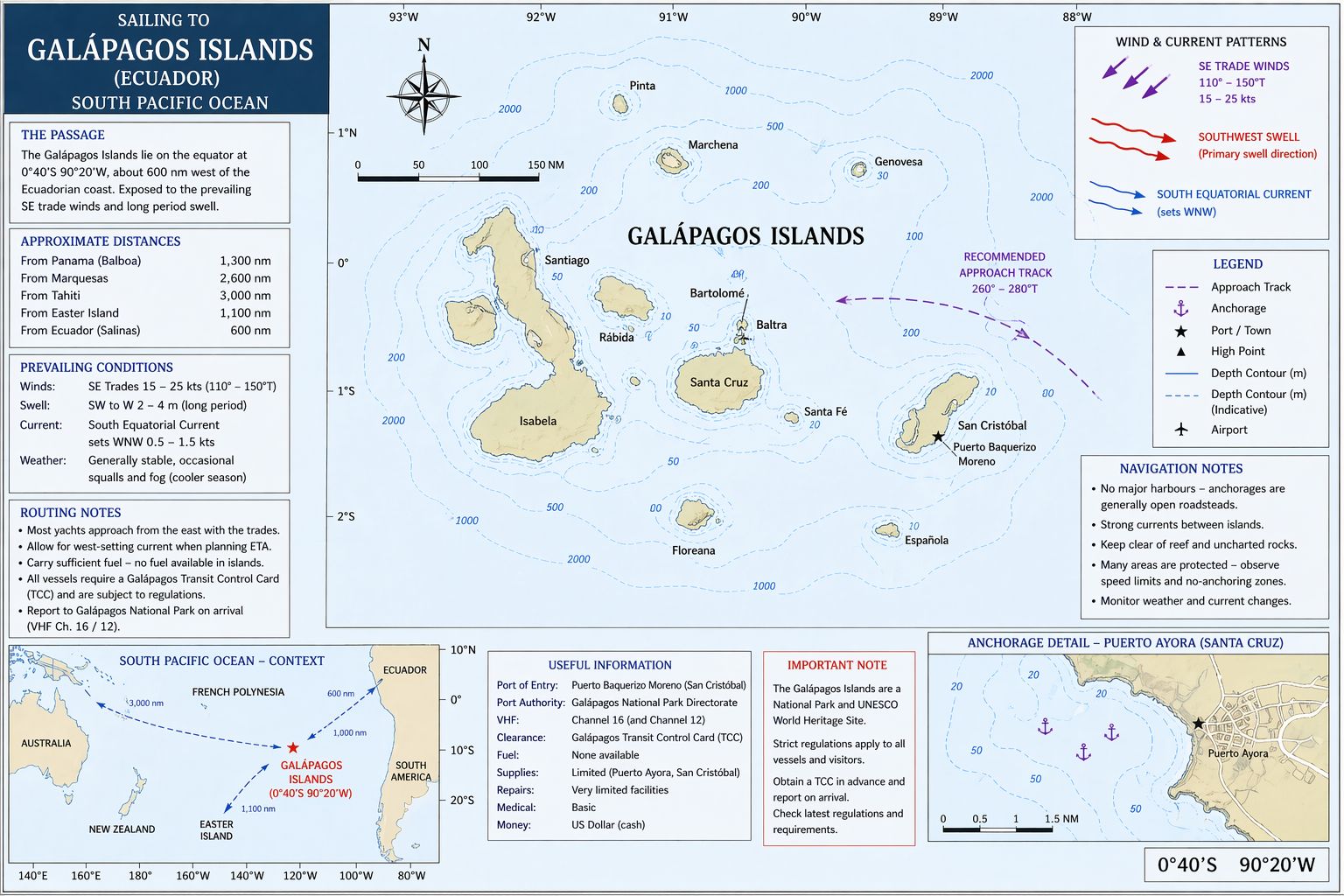
Sailing to the Galapagos Islands - Navigation
Most yachts sailing to the Galápagos Islands approach from Panama, Colombia, or mainland Ecuador. The passage is shaped by the Intertropical Convergence Zone (ITCZ), variable winds, and equatorial currents. Long periods of motoring or motor‑sailing are common, especially for vessels departing Panama.
Routes
From Panama: Sail southwest to avoid the ITCZ’s worst convection before turning west toward San Cristóbal. This is the most common route for yachts beginning a Pacific crossing via the Galápagos.
From Colombia: Expect light winds and countercurrents near the coast. Conditions improve once west of 80°W.
From Ecuador: Shortest distance but often the slowest due to light winds and adverse currents.
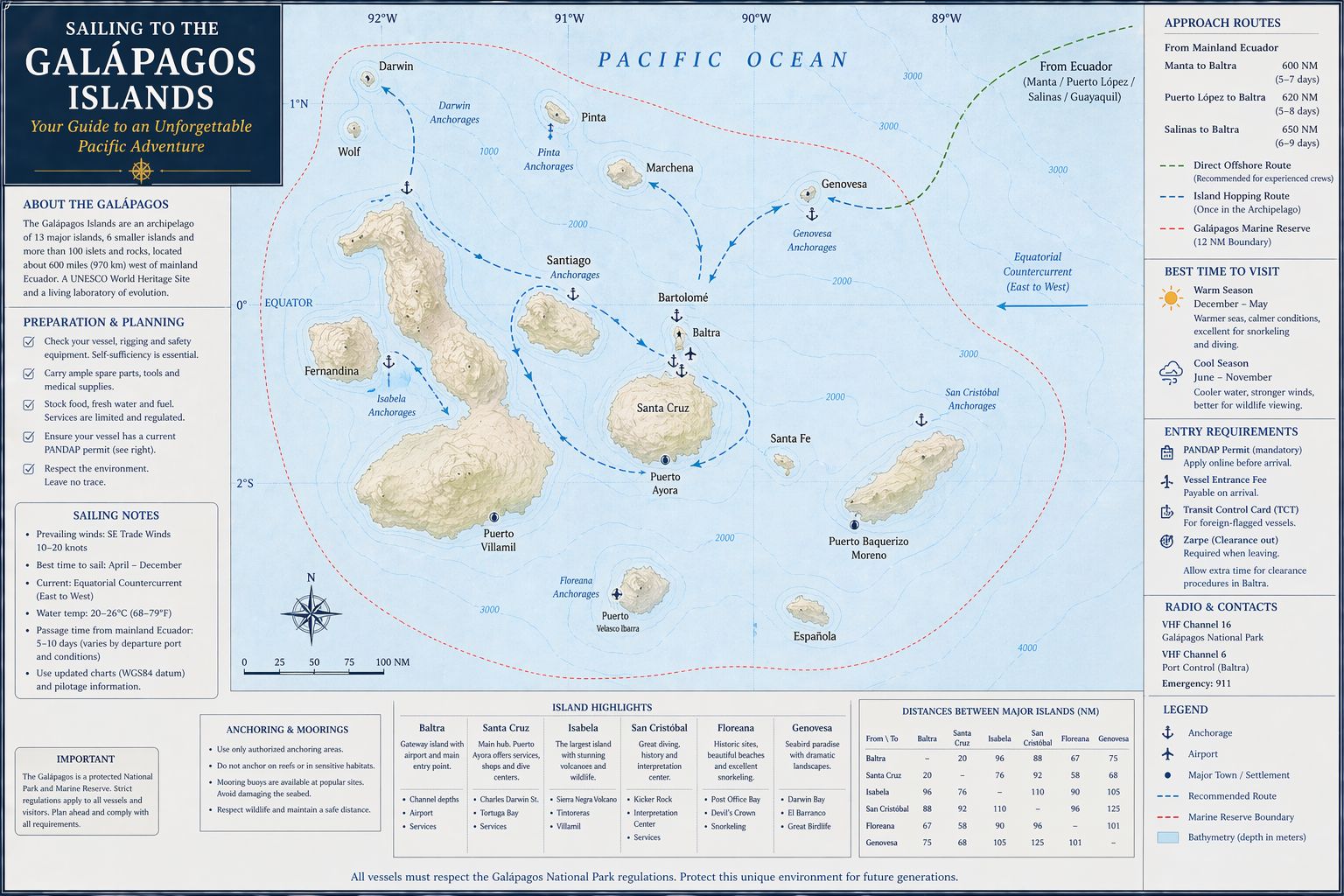
Currents and Wind Patterns
The South Equatorial Current strengthens near the islands and generally improves westbound progress. Winds near the equator are inconsistent, with extended calms common. Squalls occur near the ITCZ but are usually brief.
Sailing to the Galapagos Islands - Hazards
Fishing gear and longlines are widespread along the South American coast. Visibility can be reduced by haze or low cloud. Approaches to the islands are generally clear of hazards, but night arrivals require caution.
Sailing to the Galapagos Islands - Approaches
San Cristóbal (Puerto Baquerizo Moreno). The most common first landfall for yachts entering the Galápagos. The anchorage is open and can be rolly. Depths: 8–20 metres, sand bottom. Sea lions frequently board unattended vessels. Anchor only in designated areas.
Santa Cruz (Puerto Ayora). The busiest harbor and the main provisioning centre. More protected than San Cristóbal but still subject to surge. Water taxi traffic is constant. Mooring buoys may be available through agents.
Isabela (Puerto Villamil). A shallow, reef‑protected anchorage. Entry requires good light and careful eyeball navigation. Swell can break across the entrance in strong conditions. Only accessible with the correct inter‑island permit.
Sailing to the Galapagos Islands - Entry
Protocols
The Galápagos have some of the strictest yacht entry requirements in the world. Regulations change frequently, and all visiting yachts must work with a licensed maritime agent.
Pre‑Arrival Requirements
- Advance notice of arrival (typically 72 hours).
- Submission of vessel documentation, crew list, insurance, and intended itinerary.
Selection of permit type:
- Autógrafo (allows inter‑island movement)
- Single‑port permit (entry to one port only)
- Proof of hull cleanliness (anti‑fouling in good condition).
- Declaration of all food, plants, and animals on board.
Arrival Inspection
A multi‑agency team may board the vessel, including the Port captain, Immigration, Biosecurity (ABG), National Parks, Health officials. Inspections focus on:
- Hull cleanliness (critical)
- Waste management systems
- Holding tank functionality
- Food storage
- Presence of insects or pests
Fees and Documentation
- Immigration stamps are issued for the duration of the vessel’s permit.
- Fees vary by vessel size, permit type, and ports visited.
- Payments are made through the agent.
Restrictions for Cruising Yachts
- No discharge of any waste, including greywater, within park boundaries.
- No fishing within the marine reserve.
- No visiting unapproved anchorages.
- Strict limits on fuel transfers, diving, and shore access without guides.
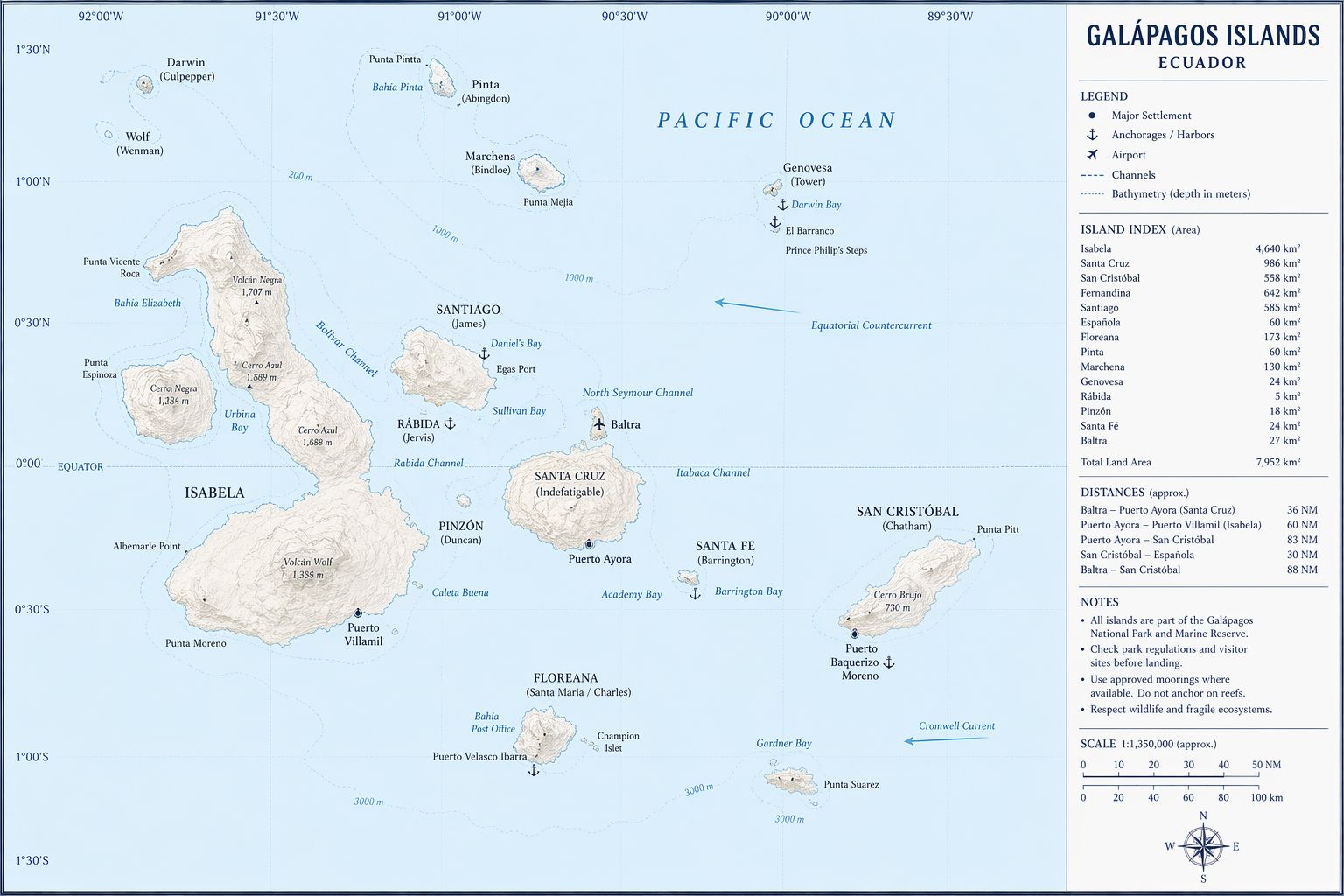
Local Weather for Cruising Yachts
The Galápagos sit on the equator but experience two distinct seasons influenced by major ocean currents. Understanding Galápagos weather for sailors is essential for safe anchoring and comfortable passages.
Warm/Wet Season (December–May)
- Air: 26–30°C
- Sea: 24–28°C
- Winds: light, variable, often northerly
- Conditions: calmer seas, more rainfall, better visibility underwater
Cool/Dry Season (June–November)
- Air: 20–26°C
- Sea: 18–24°C
- Winds: stronger southeasterlies
- Conditions: rougher seas, cooler water, low cloud from the Humboldt Current
General Weather Notes: Swell from the south affects anchorages year‑round. Afternoon sea breezes are common. No tropical storms or hurricanes form in this region. Fog and low cloud reduce visibility during the cool season.
Sailing to the Galapagos Islands - Provisioning
Provisions are very expensive in the Galapagos islands. Provisioning quality varies significantly between islands. Santa Cruz offers the best selection, followed by San Cristóbal. Isabela has limited supplies. This section focuses on Galápagos yacht provisioning, including supermarkets, farmers markets, and seafood sources.
Supermarkets: Santa Cruz (Puerto Ayora). Supermercado Proinsular near the main dock is popular and has the largest selection of packaged goods, frozen foods, and dairy. Supermercado Santa Cruz is reliable for staples. Tía Supermarket has predictable stock and reasonable pricing.
Supermarkets: San Cristóbal (Puerto Baquerizo Moreno). Proveedora del Puerto is good for dry goods and basics. Tía Supermarket has a smaller branch but useful.
Supermarkets: Isabela (Puerto Villamil). Several small tiendas with limited stock. Fresh produce availability varies by day.
Fresh Produce and Farmers Markets. Santa Cruz. Mercado Municipal has the main produce market; best selection early morning. Supplies depend on cargo ship schedules. San Cristóbal has the Mercado Central which is smaller but reliable for fruit and vegetables. Isabela has small stalls with inconsistent supply. There are many small family plots with a wide range of seasonal produce and some small roadside stalls also have produce.
Seafood Markets: Santa Cruz has Fish Market on Charles Darwin Avenue with tuna, wahoo, grouper, lobster (seasonal). Fish is sold whole or filleted. San Cristóbal where fishermen sell directly at the waterfront. Isabela has limited availability.
Sailing to the Galapagos Islands
- Diesel Fuel
Fuel availability is regulated and must often be arranged through an agent. Santa Cruz fuel is delivered by barge or jerry cans. Quality generally good; but as check for water contamination. San Cristóbal there is a fuel station near the waterfront; jerry‑can transport required. Isabela has limited supply and advance notice is required. General Notes: Direct self‑fueling from pumps is often prohibited. Documentation may be required for each transfer. Bring clean jerry cans and a filtering funnel.
Sailing to the Galapagos Islands
- Fresh Water
Water quality varies and is not always potable. Santa Cruz the water delivered by barge or jerry cans. It is non‑potable unless treated. Reverse‑osmosis water sometimes available. San Cristóbal the municipal water is supplied with jerry cans; not potable without filtration. Isabela has very limited supply and is often brackish. General Notes: Most yachts rely on water makers. Always confirm the water quality before filling tanks.
Mechanical and Electrical Repairs
Resource
If you are headed somewhere remote consider the need to expand your knowledge base or have an information resource on board. Why not get a copy of my book The Marine and Electrical and Electronics Bible 4th Edition. By and for yachties, with everything from batteries and charging, solar and wind, diesel engines and marine electronics and so much more. Your complete systems guide. 650 pages of practical advice. In Australia and New Zealand order a copy through Boat Books. UK and European boats can buy the UK Edition Here. US and Canadian boats can get the US Edition Order Here. Marine systems are my profession so let me help you. By a liveaboard boat owner for other boat owners


Sailing to the Galapagos Islands
- Marine Services
The Galápagos Islands are not a full‑service repair destination, but basic assistance is available. Santa Cruz has the best range of services. Mechanical workshops for small engine repairs. Welding and fabrication available. Limited fiberglass repair capability. Outboard servicing available. No haul‑out for large yachts. San Cristóbal has limited mechanical assistance but there are small workshops for basic repairs. Isabela has minimal repair capability. Spare Parts. Importing parts is slow and expensive so carry critical spares before arrival.
Sailing to the Galapagos Islands - Local
Culture
The Galápagos operate under strict environmental protection laws.
Expectations for Visiting Yachts
- Follow all instructions from park rangers and officials.
- Do not approach wildlife or disturb nesting areas.
- Use designated paths and landing sites only.
- No waste discharge of any kind.
- Respect local fishing zones and marine reserve boundaries.
Community Conduct
- Dress modestly in towns.
- Ask before photographing people.
- Support local businesses where possible.
Sailing to the Galapagos Islands - Local
Cuisine
Food reflects Ecuadorian coastal cuisine with local variations.
Common Dishes. Ceviche which is fish or shrimp marinated in citrus. Encocado is fish cooked in coconut sauce. Arroz con mariscos is seafood rice. Sopa de pescado is fish soup. Local Products include fresh tuna and wahoo. Lobster (seasonal). Plantains, yucca, and local fruits. Locally grown highland coffee.
Sailing to the Galapagos Islands - Summary
The Galápagos Islands are a unique and tightly regulated cruising destination. For yachts crossing the Pacific, they offer a practical waypoint with limited but adequate services, reliable anchorages, and essential provisioning opportunities. Visiting requires advance planning, strict compliance with environmental protocols, and realistic expectations about fuel, water, and repair availability. While not a conventional cruising ground, the islands provide a safe and strategically located stop for rest and resupply before the long passage west. Sailing to the Galápagos Islands and follow in Charles Darwins wake.