Mauritius Port Louis Cruising
Guide for Yachts
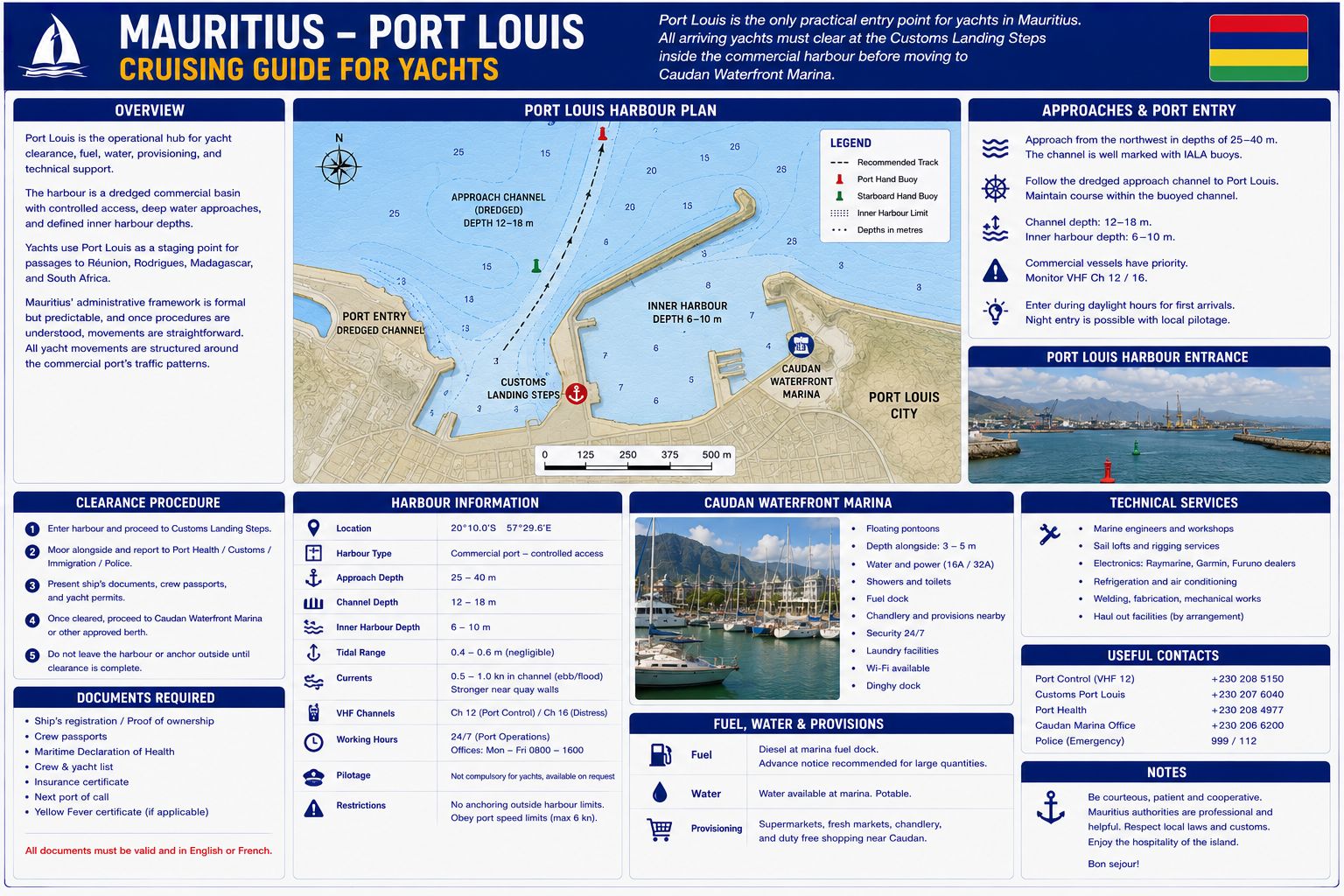
Mauritius Port Louis Cruising Guide for Yachts. Port Louis is the only practical entry point for yachts in Mauritius. All arriving yachts must clear at the Customs Landing Steps inside the commercial harbour before moving to Caudan Waterfront Marina. The harbour is a dredged commercial basin with controlled access, deep‑water approaches, and defined inner‑harbour depths. Mauritius’ administrative framework is formal but predictable, and once procedures are understood, movements are straightforward.
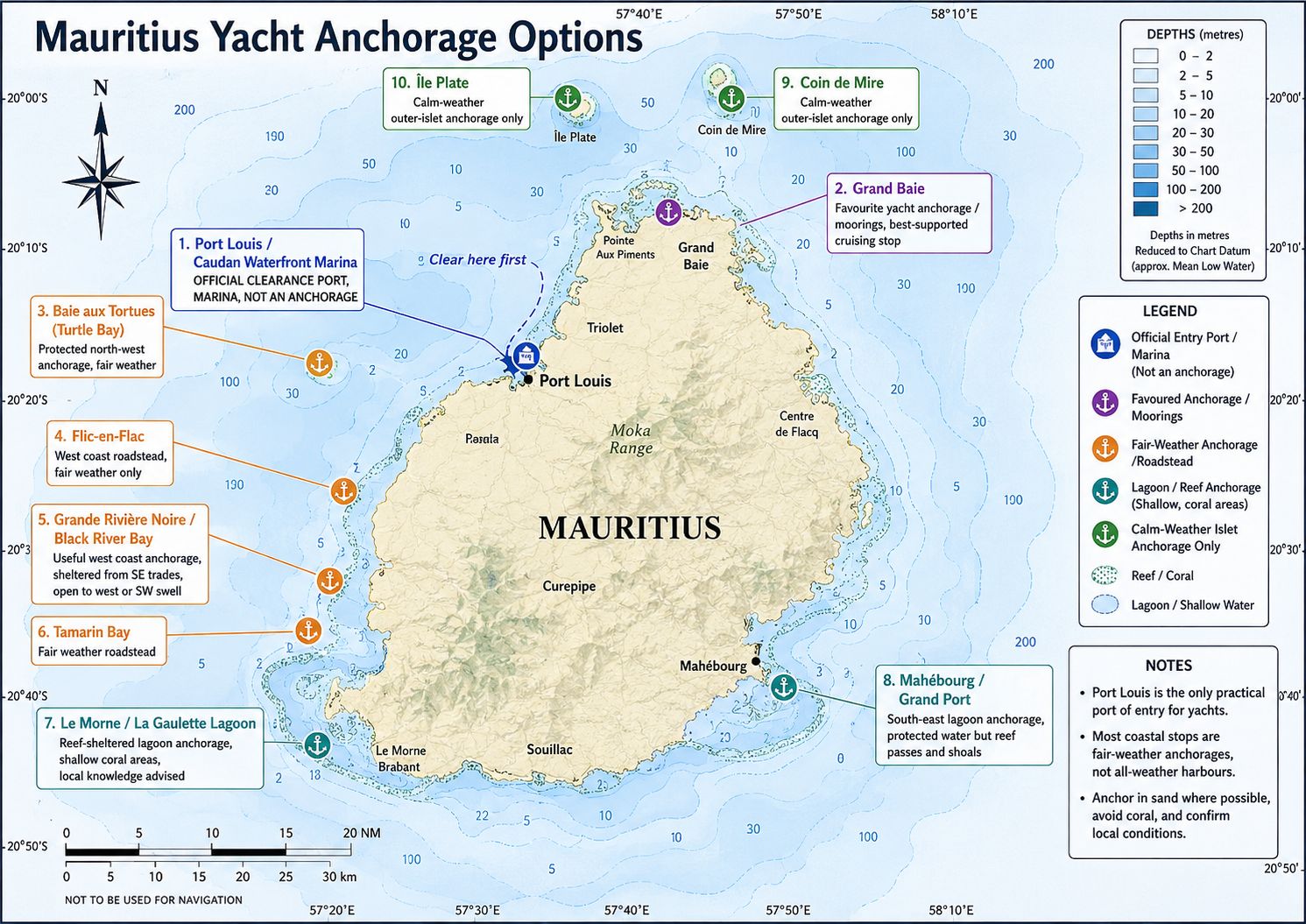
Yachts use Port Louis as a staging point for passages to Réunion, Rodrigues, Madagascar, and South Africa. The island’s steep volcanic coastline offers no alternative all‑weather harbours, and anchoring off the west coast is not a substitute for formal entry. Port Louis is the operational hub for clearance, fuel, water, provisioning, and technical support, and all yacht movements are structured around the commercial port’s traffic patterns.
Mauritius Port
Louis Cruising Guide - Approaches
Outer commercial harbour approach. Approaches to Port Louis remain above 40–50 m until close to the harbour entrance. Depths shoal predictably to around 12–15 m in the entrance channel, which is wide, dredged, and well‑marked. The coastline is volcanic with steep drop‑offs and no significant offshore shoals affecting the main approach route. Traffic includes commercial ships, tugs, and pilot boats, and yachts must maintain a clear listening watch and follow port‑control instructions precisely.
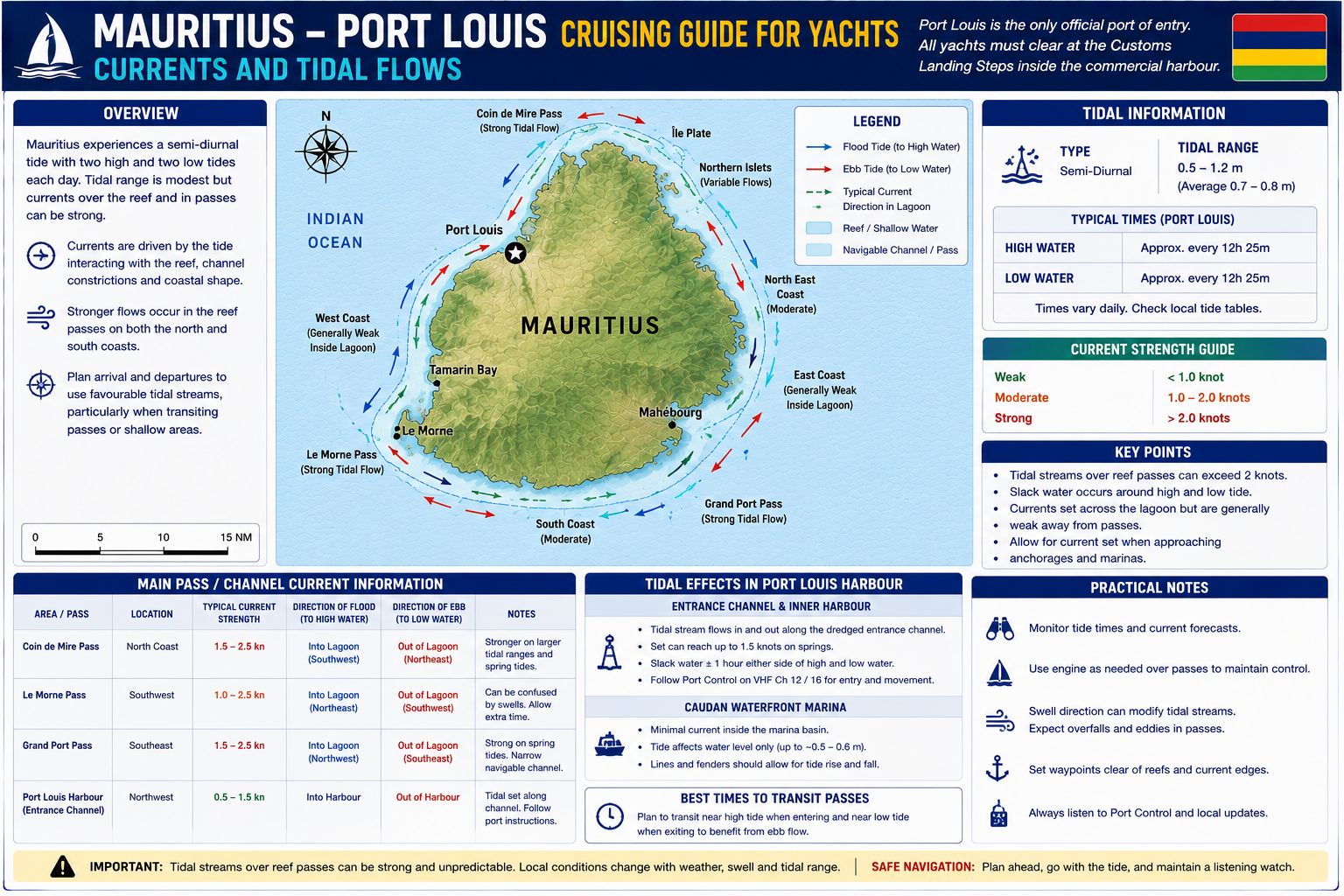
Crosswinds and swell refracted around the island can create lateral set near the breakwaters, particularly in fresh trade‑wind conditions. Visibility is generally good, but rain showers can reduce contrast on marks and structures. Night entry is technically possible but should only be attempted with prior coordination and clear instructions from port control.
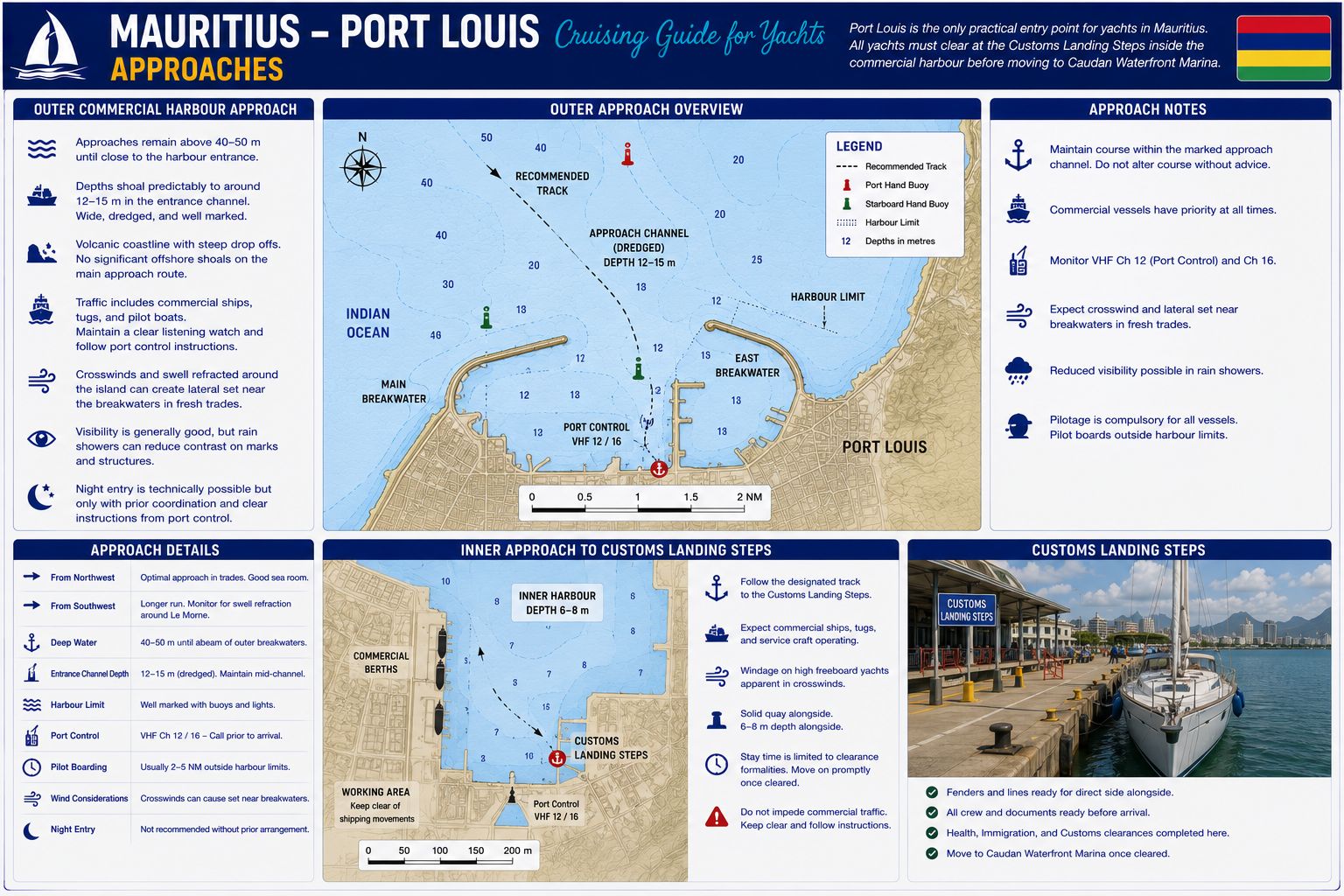
Inner approach to Customs Landing Steps. Inside the commercial harbour, depths reduce to 6–8 m in the controlled basin leading to the Customs Landing Steps. The inner harbour is a working environment with frequent ship movements, tugs, and small service craft. Yachts follow the designated track to the landing steps and must not impede commercial traffic. Manoeuvring space is adequate but not generous, and windage on high‑freeboard yachts can be noticeable in crosswinds.
The Customs Landing Steps are a solid quay with adequate depth alongside for typical cruising yachts. Fenders and lines must be prepared for a direct‑side‑to landing on a commercial‑grade structure. Stays at the steps are limited to the time required for Health, Immigration, and Customs formalities; yachts are expected to move on promptly once cleared.
Mauritius Port
Louis Cruising Guide - Arrival &
Clearance Customs Landing Steps
Mauritius requires pre‑arrival information to be submitted to the Director of Shipping before entering territorial waters. Skippers can handle this directly; appointing an agent is optional, not mandatory. Pre‑arrival submission is a legal requirement and should be treated as part of the passage plan, not an afterthought.
On arrival, yachts proceed directly to the Customs Landing Steps in Port Louis. This is the only authorised clearance point for yachts. The sequence is fixed: Health and Quarantine, Immigration, then Customs. Officials board or work from the quay depending on current practice. Documents typically include passports, vessel registration, crew list, last port clearance, and pre‑arrival confirmation. Yachts must remain at the steps until all formalities are complete and are not permitted to move to Caudan Marina or elsewhere beforehand.
Clearance is structured and formal but not adversarial. Time alongside is limited to the clearance process; once completed, yachts are instructed to move to Caudan Waterfront Marina or depart the harbour if not staying. Any firearms must be declared. Biosecurity controls apply to fresh produce. Clearance is also required on departure, with timing coordinated to avoid conflict with commercial movements.
Mauritius Port
Louis Cruising Guide - Berthing
After clearance, yachts move to Caudan Waterfront Marina, located inside the harbour but separated from the main commercial berths. Depths in the marina basin are generally 3–5 m, with floating pontoons and finger berths for visiting yachts. Access is via a short transit from the Customs Landing Steps, following port‑control instructions and avoiding commercial traffic.
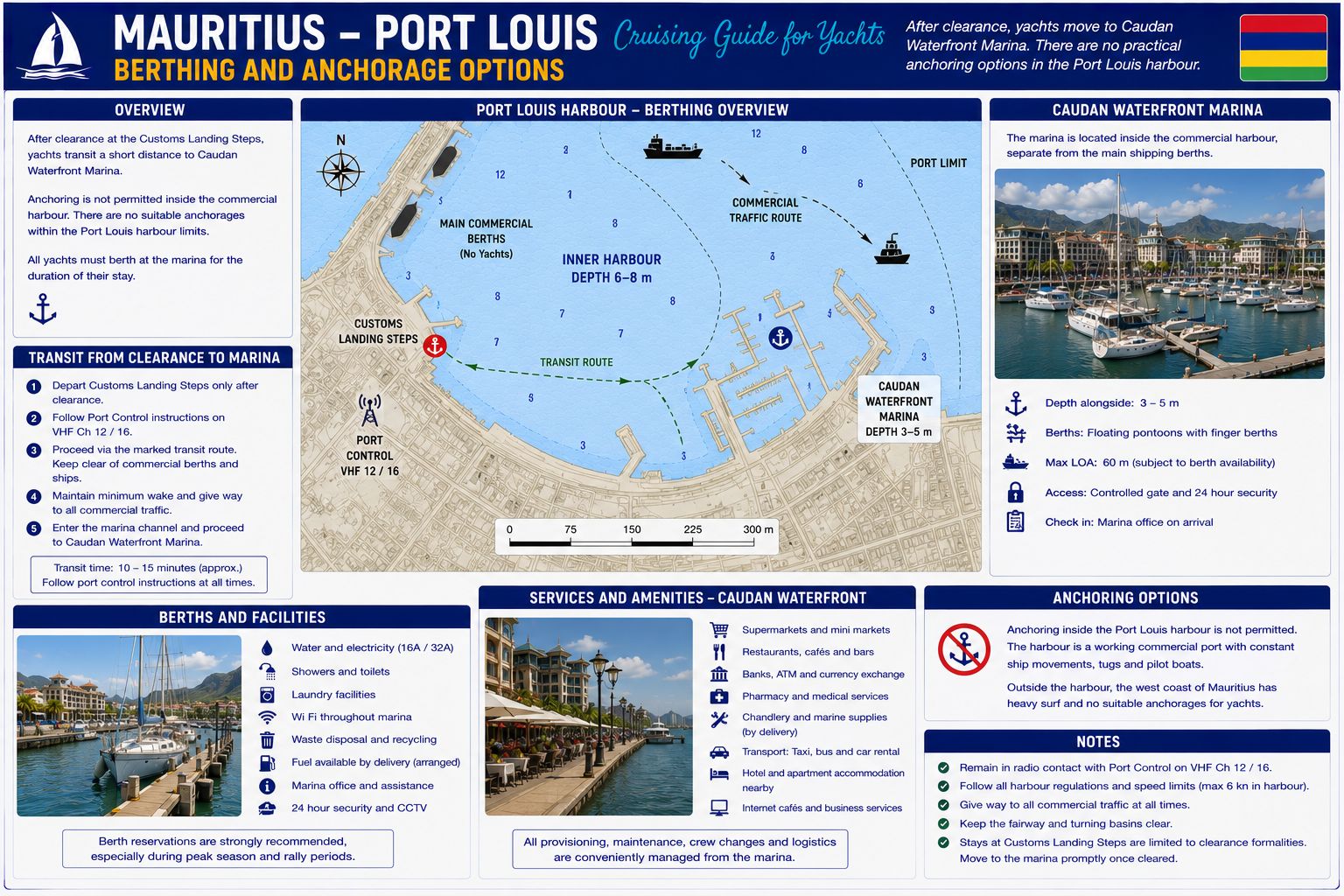
The marina provides water, electricity, secure access, showers, toilets, laundry, and Wi‑Fi. It is integrated into the Caudan Waterfront complex, with direct access to shops, restaurants, and services. Berth reservations are strongly recommended, especially during peak cruising periods or when rallies are in transit. Security is present and the environment is controlled and orderly. All yacht operations—maintenance, provisioning runs, and crew changes—are conducted from the marina.
Mauritius Port
Louis Cruising Guide - Local Weather
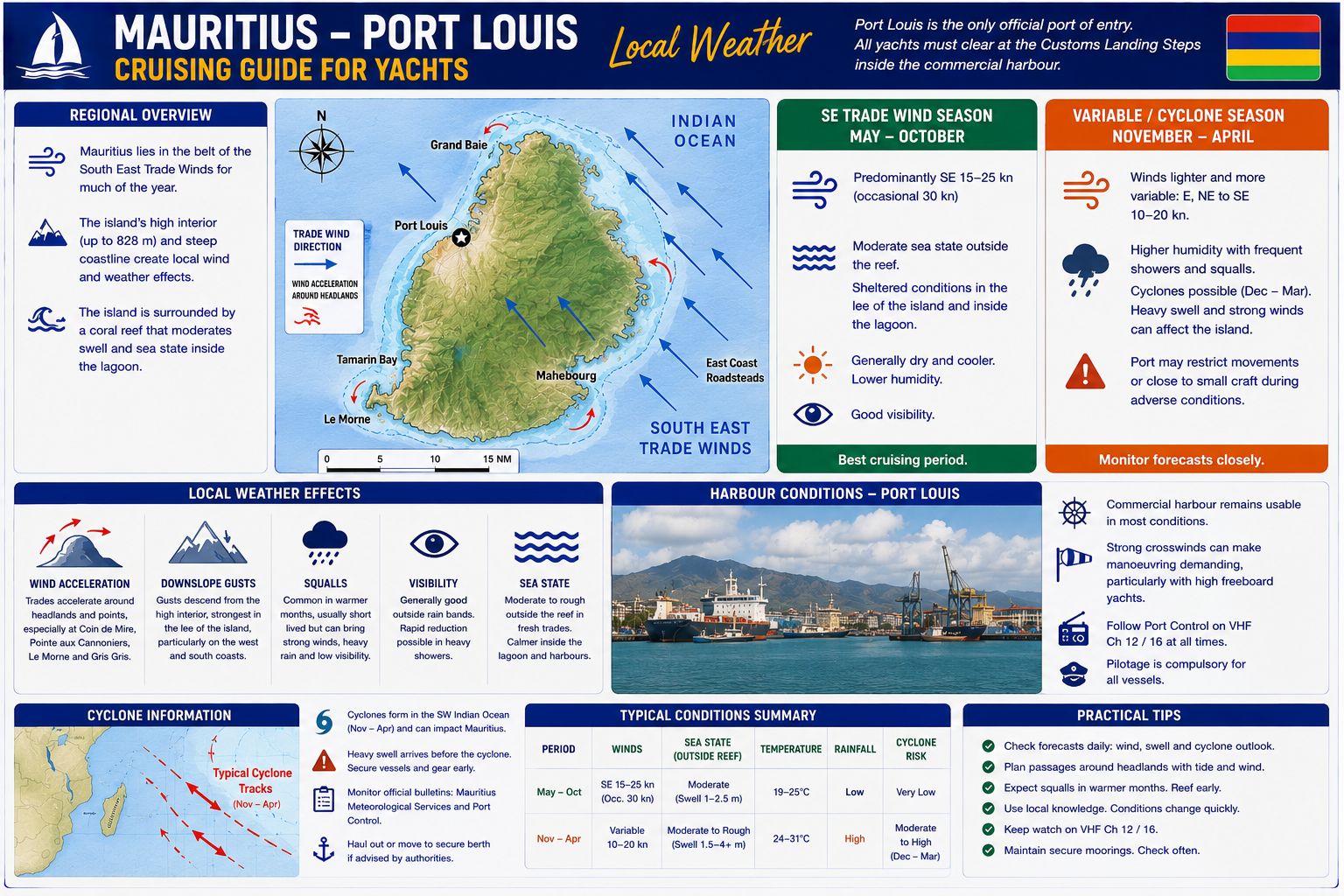
Mauritius lies in the belt of the SE trades for much of the year. From May to October, winds are predominantly SE at 15–25 kn, with a moderate sea state outside the reef and more sheltered conditions in the lee of the island. From November to April, winds are lighter and more variable, with increased humidity and cyclone risk. Cyclones can generate heavy swell and strong winds; the port may restrict movements or close to small craft during adverse conditions.
Local effects include acceleration of the trades around the island’s headlands and gusts descending from the high interior. Squalls are common, particularly in the warmer months, but are usually short‑lived. Visibility is generally good outside rain bands. The commercial harbour remains usable in most conditions, but manoeuvring can be demanding in strong crosswinds.
Mauritius Port
Louis Cruising Guide - Provisioning
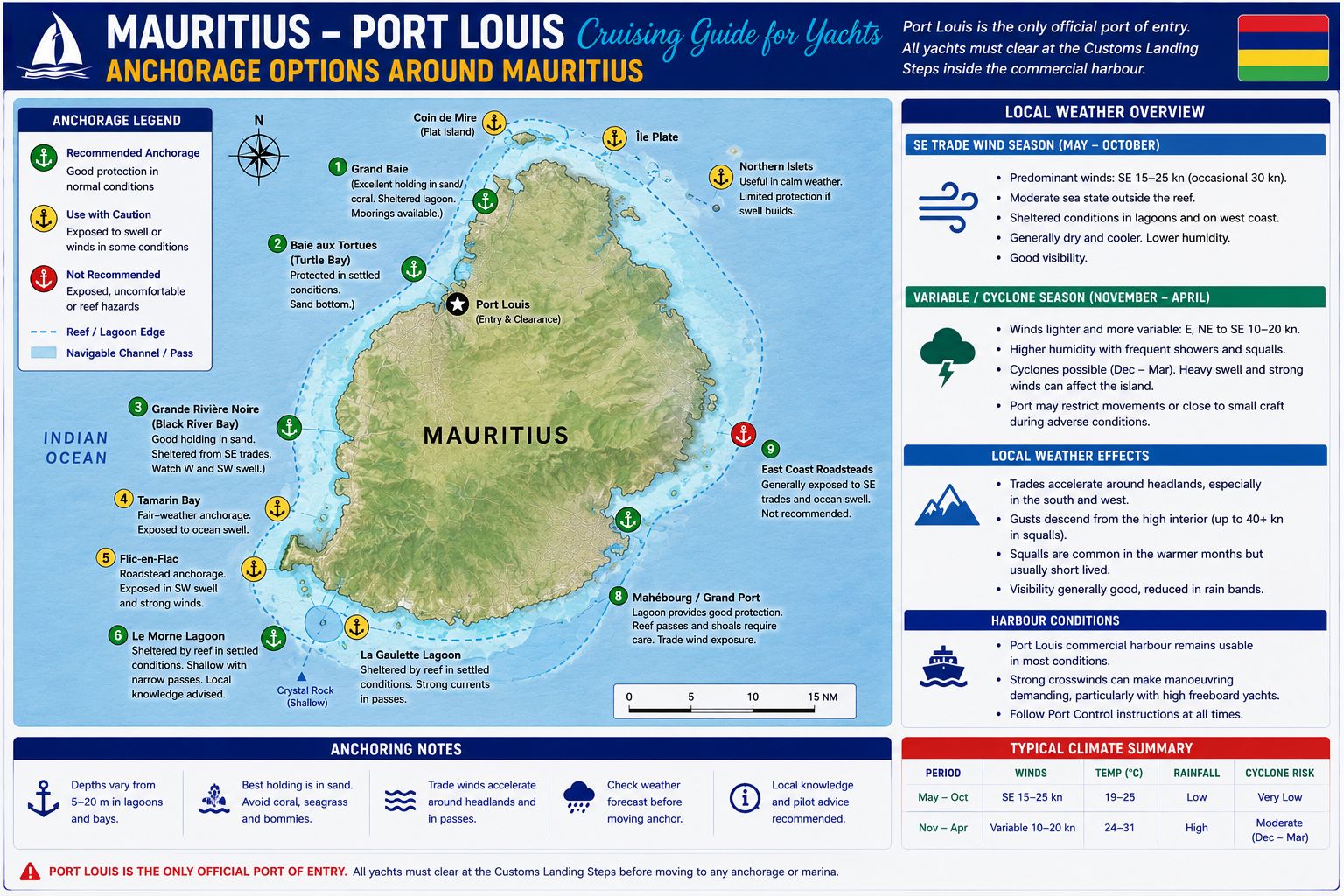
A great place to stop off and several years since I was there last. Former home of the extinct dodo. The local brew is Phoenix Beer and the Africana Beer is quite refreshing. Being a sugar producer the local rums, both dark and white are very acceptable.
Supermarkets. They have the large French chain Leader Price Supermarché which is a good storing up source with nine outlets. Intermart Port Louis is well-stocked with groceries, packaged goods, and household items. Super U & Monoprix (near Caudan Waterfront) are French-style supermarkets offering fresh produce, meats, cheeses, and imported goods. Winners Supermarket are found across Mauritius, including Port Louis with affordable groceries, bakery items, and local staples. City‑centre supermarkets and minimarkets. Basic dry goods, bottled water, snacks, soft drinks, limited fresh produce.
Markets. Port Louis Central Market on Farquhar Street. An iconic market with tropical fruits, vegetables, spices, herbal remedies, and street food like dholl puri, gateaux piments, and rougaille. High turnover and good variety. Neighbourhood markets (suburbs): Additional fruit and vegetables, often cheaper but less convenient from the marina.
Fish. Port Louis fish market and local vendors. Tuna, marlin, mahi‑mahi, reef fish, and seasonal species..
Mauritius Port
Louis Cruising Guide - Local Cuisine
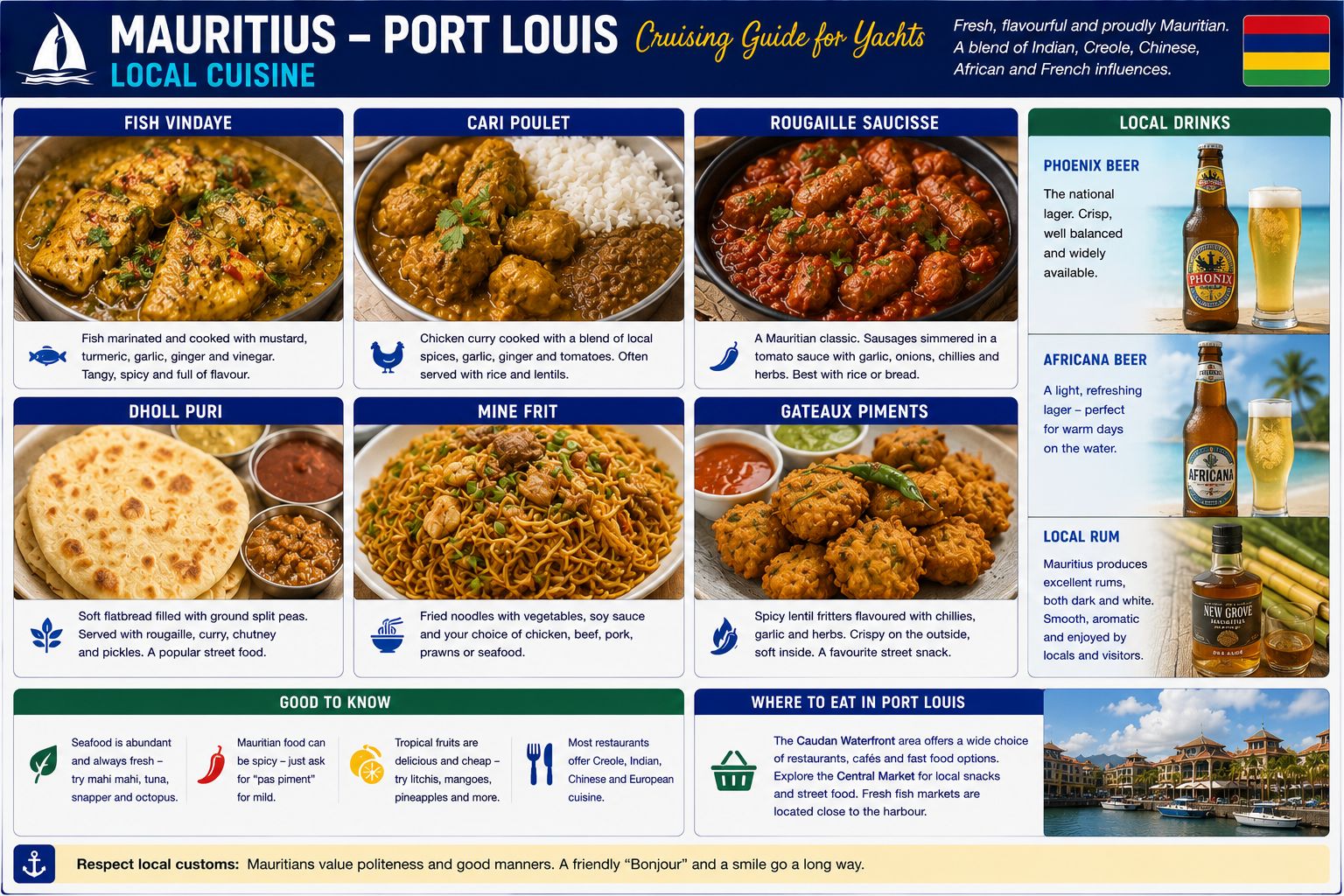
Fish vindaye. Fish marinated and cooked with mustard, turmeric, and vinegar. Cari poulet. Chicken curry with local spices, often served with rice and lentils. Rougaille saucisse. Tomato‑based sausage stew with garlic and chillies. Dholl puri. Flatbread filled with ground split peas, served with curries and pickles. Mine frit. Fried noodles with vegetables and meat or seafood. Gateaux piments. Fried chilli and lentil fritters, commonly sold as street snacks.
Mauritius Port
Louis Cruising Guide - Fuel
Diesel and petrol are available from fuel stations accessible by jerry can from the marina area. Fuel quality is generally reliable. Arrangements for bunkering alongside commercial quays are possible in some cases but are subject to port‑control approval and commercial traffic constraints; most yachts rely on jerry‑can transfers. Duty‑free fuel may be available on departure with appropriate documentation and timing.
Mauritius Port
Louis Cruising Guide - Water
Potable water is available on the marina pontoons and meets local standards. It can be taken directly into tanks. Water makers can be used outside the harbour in clean offshore water, but many skippers prefer to load tanks from the marina supply before departure. Water availability is stable and not subject to frequent restrictions.
Mechanical and Electrical Repairs
Resource
If you are headed somewhere remote consider the need to expand your knowledge base or have an information resource on board. Why not get a copy of my book The Marine and Electrical and Electronics Bible 4th Edition. By and for yachties, with everything from batteries and charging, solar and wind, diesel engines and marine electronics and so much more. Your complete systems guide. 650 pages of practical advice. In Australia and New Zealand order a copy through Boat Books. UK and European boats can buy the UK Edition Here. US and Canadian boats can get the US Edition Order Here. Marine systems are my profession so let me help you. By a liveaboard boat owner for other boat owners


Mauritius Port
Louis Cruising Guide - Marine Services
Port Louis offers a broad range of marine and technical services compared to most Indian Ocean ports. Mechanical, electrical, and electronic work can be arranged through local workshops and service providers. Some rigging and sail‑repair capability exists, though complex rig or sail projects may require coordination and lead time. Chandlery stock is adequate for common items but limited for specialised gear; critical spares should be carried on board.
Haul‑out facilities for yachts exist on the island, but capacity and suitability depend on draft and displacement. Metal fabrication, welding, and general engineering services are available through the island’s industrial base. Courier and freight services operate regularly, making it feasible to import parts from Europe or South Africa with planning.
Mauritius Port
Louis Cruising Guide - Local Customs
Transactions are in Mauritian rupees, with card payments widely accepted in supermarkets and larger businesses. Bargaining is limited to markets and small vendors; formal businesses use fixed pricing. Dress standards are casual but respectful in town and administrative areas. English and French are widely understood; Mauritian Creole is commonly spoken.
Port and government offices operate on defined hours, with closures on weekends and public holidays. Skippers should avoid planning arrivals or departures that require clearance outside normal working hours unless prior arrangements have been made. Movement within the commercial port is controlled, and access to restricted areas is by permission only.
Mauritius Port
Louis Cruising Guide - Summary
Port Louis is the operational centre for yacht movements in Mauritius. Deep‑water approaches, a controlled commercial harbour, and defined inner‑basin depths provide a predictable physical environment, while the Customs Landing Steps and Caudan Waterfront Marina structure the clearance and berthing sequence. With reliable provisioning, fuel, water, and technical support, Port Louis serves as a key staging point for Indian Ocean passages. Skippers who respect the pre‑arrival requirements, follow the fixed clearance sequence, and treat the commercial harbour as a working environment will find the port efficient and dependable. Mauritius Port Louis Cruising Guide for all you need to know.