Kupang Indonesia Cruising Guide
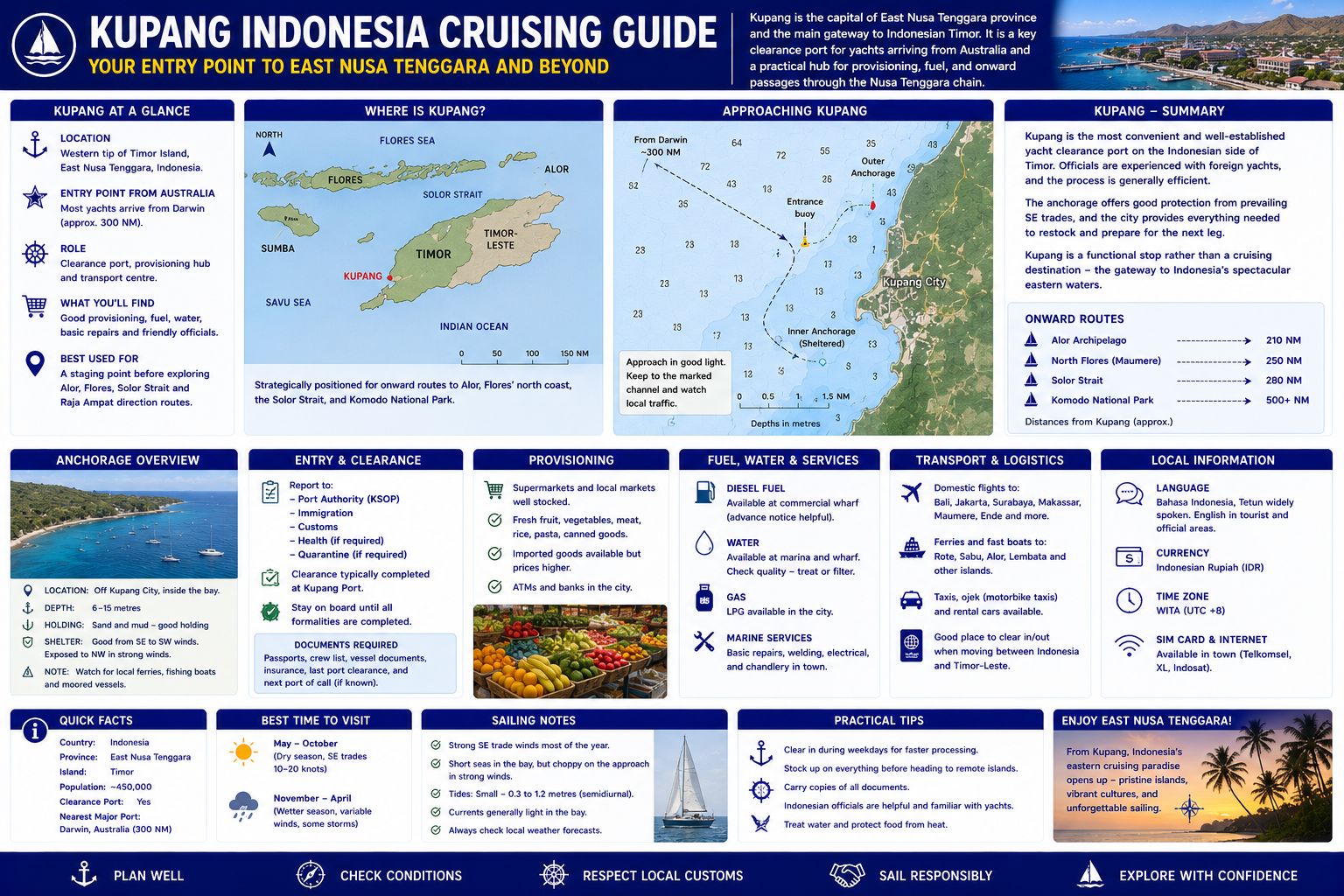
Kupang Indonesia Cruising Guide. Kupang is located on the western tip of Timor Island, and is the capital of East Nusa Tenggara province. Timor (shared between Indonesia and Timor-Leste) and Kupang is the largest city on the Indonesian side of Timor. Kupang is a key provisioning and transport hub for eastern Indonesia, especially for travel to remote islands like Rote, Sabu, and the Tanimbar group. Kupang is one of Indonesia’s most commonly used clearance ports for yachts arriving from Australia. Its position makes it the natural landfall for vessels sailing from Darwin, and it functions as a practical logistics hub rather than a dedicated cruising destination. The anchorage is straightforward, officials are familiar with foreign yachts, and the city provides access to provisioning, fuel, water, and basic repair services. For many crews, Kupang is the first stop before continuing west through the Nusa Tenggara chain or north toward Alor.
Most yachts use Kupang as a staging point before moving into Indonesia’s more protected and scenic cruising regions. Common onward routes include the Alor archipelago, Flores’ northern coast, the Solor Strait, and Komodo National Park. Kupang’s role is primarily functional: a place to complete entry formalities, restock supplies, and prepare for the longer passages through Indonesia’s island network. This guide focuses on practical information for cruising yachts, including Kupang yacht anchorage details, sailing approaches, entry procedures, provisioning, fuel, water, and local services.
Kupang Indonesia Cruising Guide - Arrival and Navigation
Kupang sits on the southwest corner of Timor and is approached through a wide, open bay with deep water extending close to shore. Approaches are generally straightforward in daylight, with no offshore reefs obstructing the main routes, but the area carries strong afternoon sea breezes, short chop, and frequent local traffic. Most yachts anchor off Pasir Panjang or Oeba, both of which offer reliable holding and easy access to shore facilities.
Approaching Kupang from the west or southwest, yachts should give Pulau Semau a wide berth. The channel between Semau and Timor is navigable but carries strong, variable currents, particularly during spring tides, and the flow can shift direction abruptly as it wraps around the island. These currents can push a vessel off its intended track when shaping course toward Kupang Bay, and helm corrections must be made early to avoid being set toward the shoaling margins of the channel.
The bay itself is free of major hazards, with deep water extending close to shore, but floating debris and unlit local boats are common at night. Many small fishing canoes operate without lights, and background illumination from Kupang makes them difficult to spot until very close. For this reason, a daylight arrival is strongly recommended for first‑time visitors, as the approach is far more straightforward when local traffic and fish traps are visible.

Chart Disclaimer. This chart is a schematic representation for illustrative purposes only and must not be used for navigation. Refer to official hydrographic charts for safe navigation. Be aware ENC charts may differ from official hydrographic charts. Both should be corrected and updated regularly.
Chart Accuracy and
Source Disclaimer– Indonesia
Chart accuracy across Indonesia is inconsistent, with most non‑commercial regions still based on pre‑1970s lead‑line surveys that provide approximate depths, generalised reef edges, and sparse or single‑point soundings. Official ENC coverage improves only in major commercial ports, while offshore islands, reef systems, and remote bays across Sumatra, Java, Kalimantan, Sulawesi, Nusa Tenggara, Maluku, and Papua rely on outdated or incomplete data. Navionics and C‑Map offer reasonable coastline shape and usable macro‑routing but suffer from interpolated contours, missing shoals, and reef offsets of 20–150 m in many areas. Garmin BlueChart inherits the same limitations. Satellite imagery (Google, Bing, ESRI, SASPlanet) provides the most accurate depiction of reef and shoal edges, typically within 3–10 m, and is essential for anchorage selection and approach planning.
Skippers should treat all charted depths outside commercial ports as approximate and rely on a combination of ENC cross‑checking, satellite‑based reef reading, visual navigation, and drone reconnaissance for safe entry into anchorages. All chart information referenced in this guide is derived from publicly available Indonesian hydrographic products, international ENC datasets, and third‑party electronic chart packages. These sources vary in age, survey method, positional accuracy, and datum consistency. No guarantee is made regarding the completeness, reliability, or currency of any charted depth, contour, hazard, or navigational feature. Mariners are responsible for verifying all information against the latest official notices, updated charts, and on‑scene conditions. Electronic charts, satellite imagery, and user‑generated data must not be relied upon as sole sources of navigational information. Safe navigation requires continuous visual assessment, prudent seamanship, and independent confirmation of all charted features.
Kupang Indonesia Cruising Guide - Approach Depths
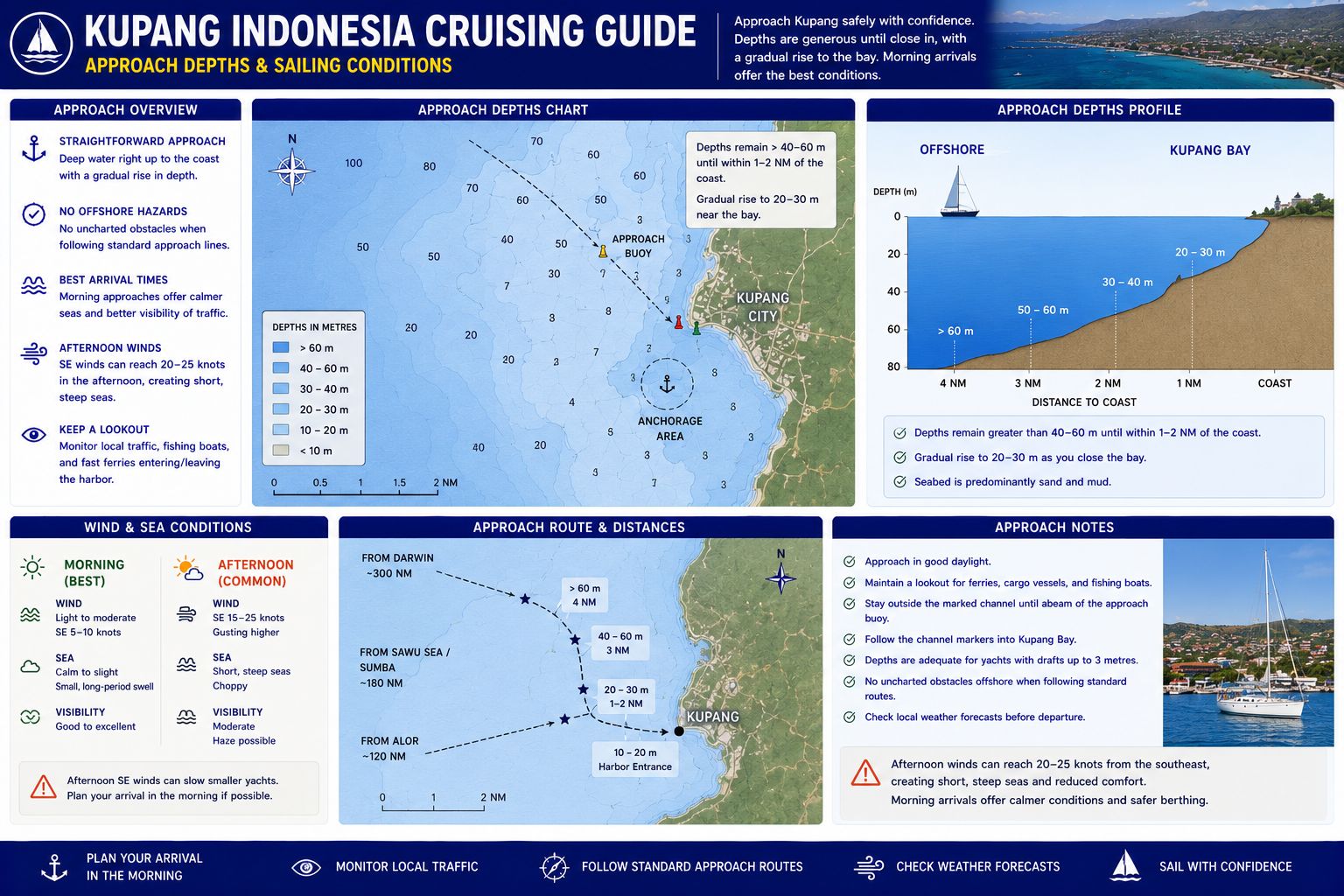
Depths remain greater than 40–60 m until within 1–2 nautical miles of the coast, with a gradual rise to 20–30 m as the vessel closes the bay. The seabed is predominantly sand and mud, and there are no uncharted offshore hazards when following standard approach lines. Afternoon winds can reach 20–25 knots from the southeast, creating short, steep seas that may slow progress for smaller yachts. Approaching in the morning provides calmer conditions and better visibility of local traffic.
Kupang Indonesia Cruising Guide - Tidal Set
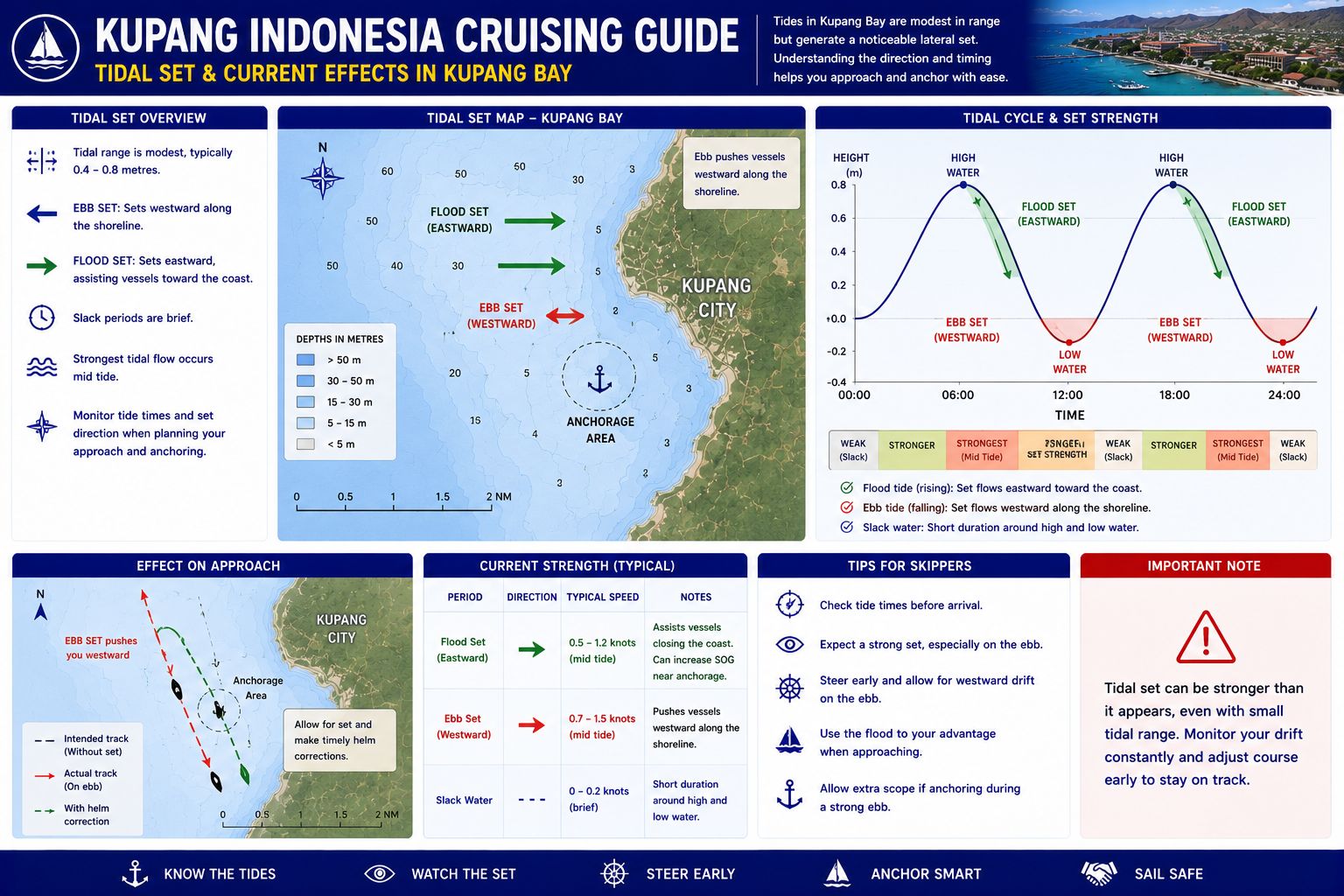
Tidal range is modest, but the bay experiences a noticeable lateral set, particularly on the ebb, which pushes vessels westward along the shoreline. This is most apparent when shaping course toward the anchorage and can cause yachts to drift off their intended track if helm corrections are delayed. The flood sets eastward and assists vessels closing the coast, though it can increase speed over ground when manoeuvring near the anchorage. Slack periods are brief, and the strongest flow occurs mid‑tide.
Kupang Indonesia Cruising Guide - Final Approach & Turning Points
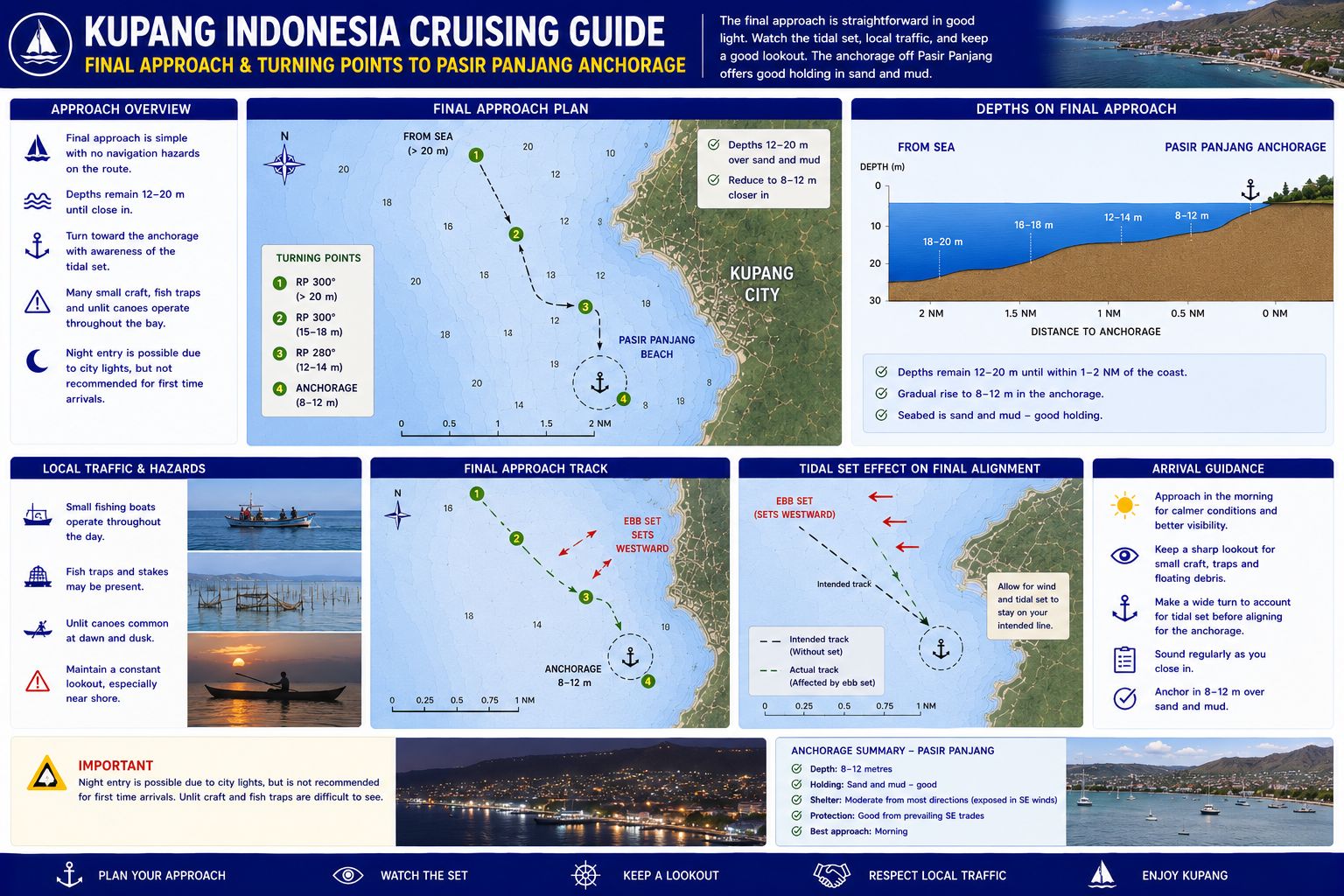
The final approach into the anchorage off Pasir Panjang carries 12–20 m over sand and mud, with depths reducing to 8–12 m closer in. The shoreline is free of hazards, but numerous small fishing boats, fish traps, and unlit canoes operate throughout the bay, especially at dawn and dusk. The turn toward the anchorage should be made with awareness of the tidal set, which can push vessels sideways during the final alignment. Background lighting from the city makes night entry possible but not recommended for first‑time arrivals due to the difficulty of spotting unlit craft.
Kupang Indonesia Cruising Guide - Anchorage
The primary yacht anchorage in Kupang lies off Pasir Panjang, directly seaward of Teddy’s Bar, a long‑established landmark for visiting crews. Depths in the anchorage range from 8–15 m over sand and mud, with the best holding found in the central section where the seabed is clean and free of debris. The approach is straightforward in daylight, with deep water extending close to shore and no submerged hazards when following a direct line from the bay entrance.
The anchorage is open to the prevailing southeast trade winds, which build through the afternoon and create a short, steep chop, but conditions remain secure with adequate scope. Mornings are typically calm, making this the preferred time for arrivals, departures, and dinghy operations. Swinging room is generous, though yachts should anchor well clear of the line of local boats and moorings that fringe the shoreline.
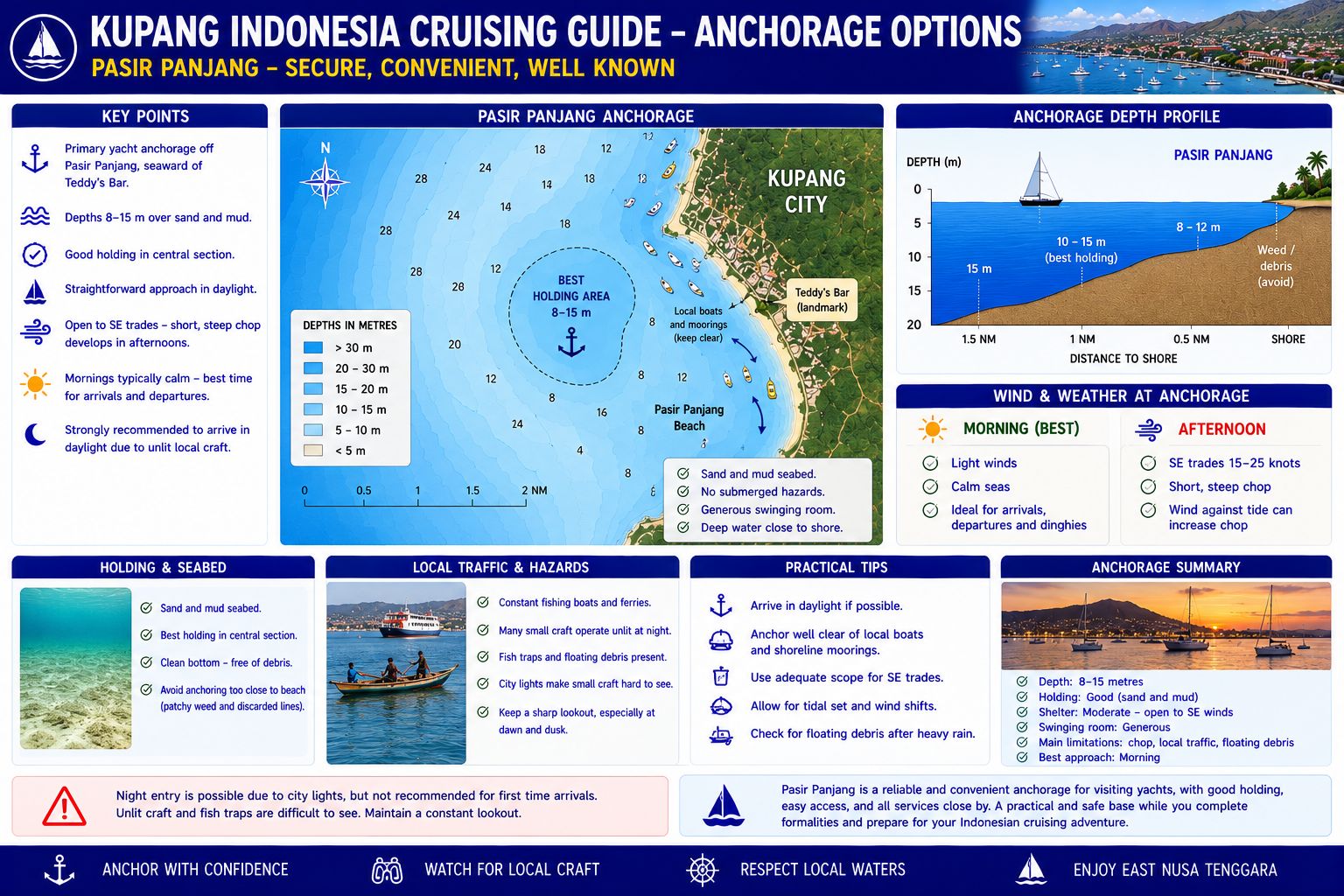
Local traffic is constant, with wooden canoes, fishing boats, and inter‑island ferries passing through the bay. Many small craft operate unlit at night, and background lighting from the city makes them difficult to detect, so a daylight arrival is strongly recommended for first‑time visitors. Holding is reliable, but yachts should avoid anchoring too close to the beach where the bottom becomes patchy with weed and discarded lines. Floating debris, including logs and fishing gear, may be encountered after heavy rain. The shoreline is lined with moorings and local boats, and yachts should anchor well clear of these areas to avoid entanglement.
Dinghy Landing and
Shore Access
Dinghy landing is typically done at Teddy’s Bar/Beachfront area or at Oeba, depending on the anchorage. Both offer straightforward access, though tidal height affects beach gradient and dinghy retrieval. Afternoon winds can make dinghy operations wet, and securing the dinghy well above the high‑water mark is recommended. Local boatmen and beach vendors are accustomed to yacht crews and can assist with directions or transport.
Kupang Indonesia Cruising Guide - Formalities
Kupang is a designated international clearance port, and procedures are well established for foreign yachts. The standard Indonesian entry sequence applies: Quarantine, Customs, Immigration, and Harbormaster (Syahbandar). This section covers the essential Kupang arrival procedures for foreign yachts. Key requirements:
- A Yacht Declaration or equivalent pre‑arrival documentation must be arranged online before entering Indonesia.
- Prepare multiple copies of the crew list, ship’s papers, passports, and previous port clearance.
- Officials may visit the yacht at anchor or request that the skipper come ashore. Procedures vary depending on workload.
- Quarantine may inspect the vessel for food items, plants, and animals. They may ask for a garbage declaration.
- Customs will record the vessel’s equipment list and may seal alcohol stores.
- Immigration will stamp passports according to the visa type arranged in advance.
- The Harbormaster completes the final clearance and issues the domestic cruising permit required for movement between Indonesian ports.
Clearance typically takes several hours, though delays can occur if multiple yachts arrive at once. Kupang officials are accustomed to yacht traffic, and the process is generally straightforward.
Kupang Indonesia Cruising Guide - Local
Weather
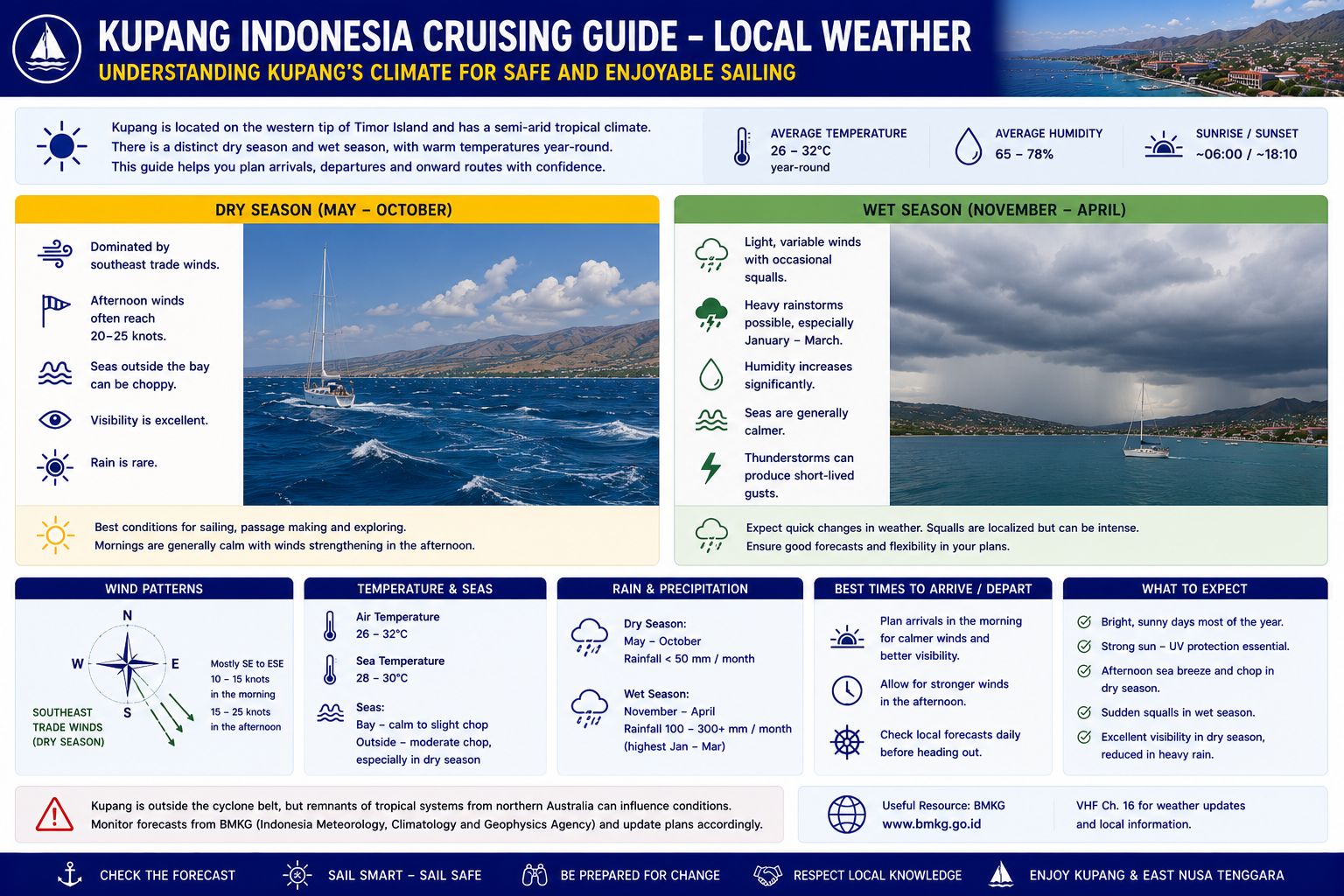
Kupang sits in one of Indonesia’s driest regions, with a clear distinction between the dry and wet seasons. Understanding Kupang weather patterns for sailing helps with planning onward routes.
Dry Season (May–October)
- Dominated by southeast trade winds.
- Afternoon winds often reach 20–25 knots.
- Seas outside the bay can be choppy.
- Visibility is excellent.
- Rain is rare.
Wet Season (November–April)
- Light, variable winds with occasional squalls.
- Heavy rainstorms possible, especially January–March.
- Humidity increases significantly.
- Seas are generally calmer, though thunderstorms can produce short‑lived gusts.
Kupang is outside the cyclone belt, but remnants of tropical systems from northern Australia can influence conditions.
Kupang Indonesia Cruising Guide - Provisioning
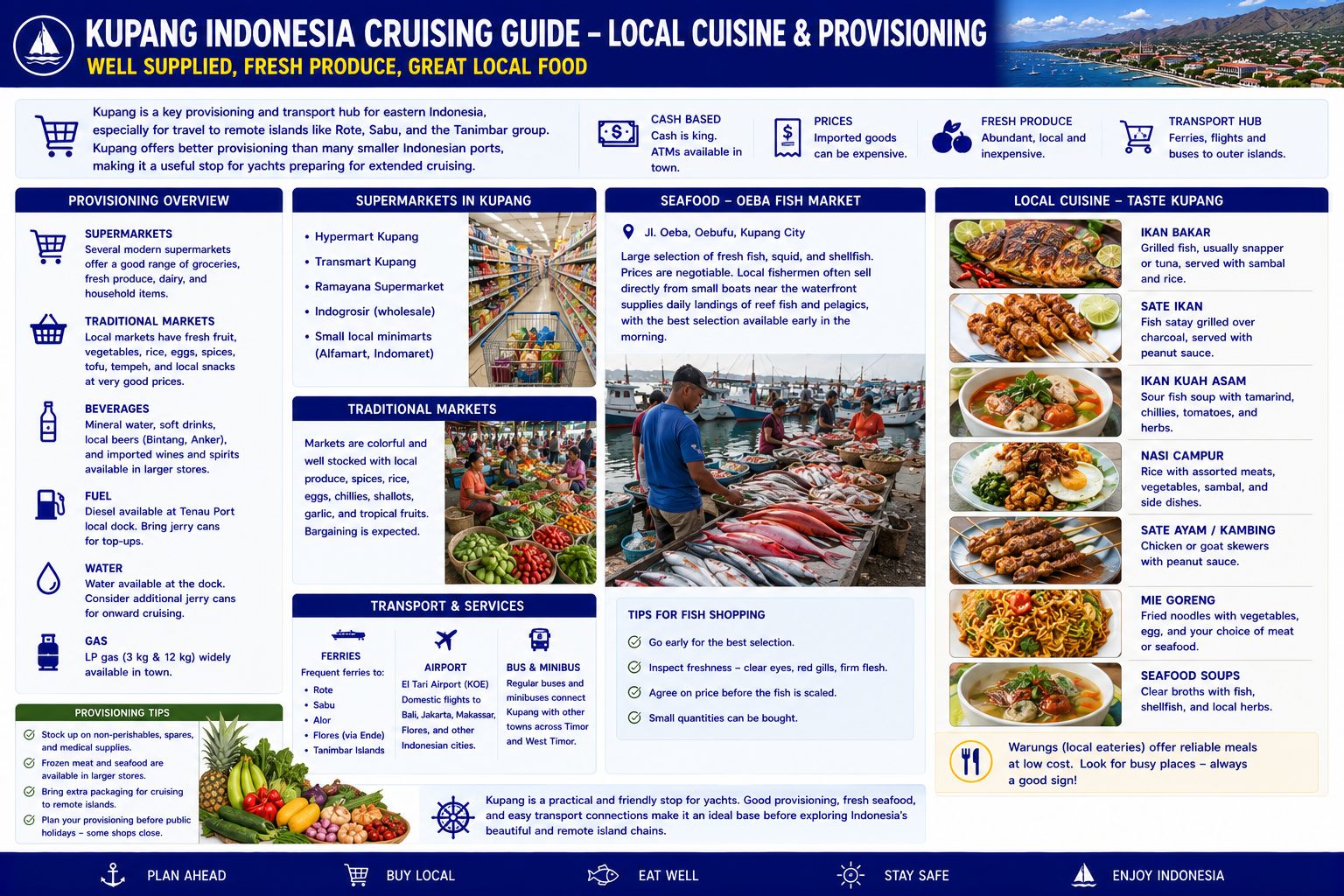
Kupang is a key provisioning and transport hub for eastern Indonesia, especially for travel to remote islands like Rote, Sabu, and the Tanimbar group. Kupang offers better provisioning than many smaller Indonesian ports, making it a useful stop for yachts preparing for extended cruising. This section covers Kupang provisioning, Kupang supermarkets, Kupang markets, and Kupang fish market options. Provisioning is cash‑based, and imported goods can be expensive. Fresh produce is abundant and inexpensive.
Supermarkets: Hypermart Bundaran (Lippo Plaza) PU, Jl. Frans Seda, Tuak Daun Merah, Oebobo District with good cold chain infrastructure for dairy, frozen goods, and snacks. Toko Borneo Jl. Jenderal Sudirman No.129, Kuanino is local grocery store. Hyperstore Kupang. Tiara Supermarket is useful for dry goods and household supplies. Flobamora Mall shops. These small stores offer snacks, drinks, and basic groceries.
Local Markets: Pasar Inpres Kupang Near Jalan El Tari is the largest wet market and best early at 05:00 onwards. Pasar Beriman, Pasar Seba, Pasar Oebelo are smaller community markets. Seafood such as tuna, snapper, squid, and shrimp are abundant, for fruits mangoes, bananas, papayas, and coconuts, and vegetables include cassava, sweet potatoes, long beans, chili, and leafy greens. The spices include dried chili, garlic, ginger, and local sambals (do try those!). Street Markets with pop-up stalls and night markets near the waterfront and bus terminals offer grilled fish, satays, and tropical drinks. Pasar Kasih Naikoten, the city’s largest general market, provides a broader range of produce, dry goods, spices, and household items, though it is busier and more chaotic than Oeba.
Seafood: Oeba Fish Market. Has a large selection of fresh fish, squid, and shellfish. Prices are negotiable. Local fishermen often sell directly from small boats near the waterfront supplies daily landings of reef fish and pelagics, with the best selection available early in the morning.
Kupang Indonesia Cruising Guide - Diesel Fuel
Kupang does not have a dedicated yacht fuel dock, and there is no wharf‑side hose service for visiting boats. Diesel is obtained by jerry can from the Pertamina station in Oeba, located a short ride inland from the waterfront. The station has high turnover and supplies standard automotive diesel, which is the cleanest and most reliable source in the region. Yachts typically transport fuel using motorbike carriers or small pickups arranged at the Oeba waterfront. Drum delivery to the shoreline is possible but inconsistent, and quality varies; all fuel should be filtered during transfer.
No outlying anchorages around Kupang Bay offer yacht‑suitable diesel. Villages may sell small quantities in bottles or drums, but this fuel is not appropriate for yacht tanks due to contamination risk and uncertain storage. All refuelling for Kupang must be done in Oeba, using jerry cans from the Pertamina station. Yachts should arrive with adequate tankage, plan for multiple jerry‑can runs, and expect no dockside refuelling anywhere in the Kupang area.
Kupang Indonesia Cruising Guide - Fresh Water
Kupang does not provide potable water at the yacht anchorage, and there is no dedicated hose point on the public waterfront used by visiting yachts. Water is normally taken by jerry can from the public tap beside the Pasar Oeba market or from the standpipe near the Oeba fishing harbour, both supplying non‑potable municipal water that must be filtered or boiled before use. Several small hotels and homestays in Oeba may allow filling from their storage tanks for a fee, but this is not guaranteed and must be confirmed on arrival. There is no reliable tanker delivery operating for yachts in Kupang.
No outlying anchorages around Kupang Bay, including Oeba, Tenau, and the small bays east of the city, offer yacht‑suitable water. Village taps exist but are low‑pressure, limited‑supply, and unsuitable for tank loading. All water provisioning for Kupang and the surrounding bay must be done in Kupang town, using the named public taps above. Yachts should plan for multiple jerry‑can runs, carry adequate filtration, and expect no dockside water service anywhere in the Kupang area
Mechanical
and Electrical Repairs Resource
If you are headed somewhere remote consider the need to expand your knowledge base or have an information resource on board. Why not get a copy of my book The Marine and Electrical and Electronics Bible 4th Edition. By and for yachties, with everything from batteries and charging, solar and wind, diesel engines and marine electronics and so much more. Your complete systems guide. 650 pages of practical advice. In Australia and New Zealand order a copy through Boat Books. UK and European boats can buy the UK Edition Here. US and Canadian boats can get the US Edition Order Here. Marine systems are my profession so let me help you. By a liveaboard boat owner for other boat owners


Kupang Indonesia Cruising Guide - Marine
Services
Kupang has limited marine repair infrastructure. Small diesel mechanics available, though not marine‑specialized. Electrical work is basic troubleshooting and wiring. Chandlery supplies – Very limited; bring essential spares. For major repairs, yachts typically continue to Bali, Lombok, or Batam.
Kupang Indonesia Cruising Guide - Local
Culture
Kupang is culturally conservative compared with major Indonesian tourist centers. Visitors should be aware of:
- Modest clothing expectations away from the waterfront.
- Polite greetings and patience during interactions.
- Respect for religious practices, especially during prayer times.
- Asking permission before photographing people.
- Bargaining respectfully in markets.
English is not widely spoken, so basic Indonesian phrases are helpful.
Kupang Indonesia Cruising Guide - Local
Cuisine
Kupang is renowned for its fresh catches like ikan bakar (grilled fish), sate ikan (fish satay), and ikan kuah asam (sour fish soup). Dishes to try also include Nasi campur which is rice with assorted meats, vegetables, and sambal. Sate ayam or kambing. Chicken or goat skewers. Mie goreng is fried noodles with vegetables and egg. Seafood soups which are clear broths with fish and herbs. Warungs (local eateries) offer reliable meals at low cost.
Kupang Indonesia Cruising Guide - Summary
Kupang is a practical and functional entry point into Indonesia, offering straightforward anchoring, predictable weather, and officials familiar with yacht clearance. While not a primary cruising destination, it provides essential services provisioning, fuel, water, and basic repairs before yachts disperse into the more sheltered and scenic cruising grounds of Nusa Tenggara. Kupang Indonesia Cruising Guide for all you need to know.