Kato Koufonisi Greece Sailing
Guide
Kato Koufonisi Greece Sailing Guide. Kato Koufonisi is the smaller and largely uninhabited island south-west of Pano Koufonisi in the Small Cyclades. It lies between Naxos, Amorgos, Schinoussa, and Keros, forming part of a compact cruising area with short passages but exposed Cycladic sea conditions. For yachts, Kato Koufonisi is mainly a settled-weather anchorage destination rather than a harbour stop.
The island has no marina, no full provisioning base, and only limited seasonal shore activity. Anchorages are found in bays and coves around the island, with sand, rock, and weed bottom, but shelter depends closely on wind direction. The area is exposed to the Meltemi, and strong north or north-west winds can create uncomfortable seas in the channels between Kato Koufonisi, Pano Koufonisi, and Keros. Fuel, water, supermarkets, and marine services are handled from Pano Koufonisi, Naxos, Paros, or Amorgos.
Kato Koufonisi
Greece Sailing Guide - History
Kato Koufonisi has a long but lightly documented history tied to the wider Small Cyclades and the nearby island of Keros. The area was occupied and used from prehistoric times, with the surrounding islands forming part of the Early Cycladic maritime network. Keros, immediately east of Kato Koufonisi, was an important Early Cycladic ritual and settlement centre, and the channels around Kato Koufonisi would have been used by small vessels moving between Naxos, Amorgos, Schinoussa, Iraklia, and the eastern Cyclades.
In later periods Kato Koufonisi remained sparsely populated and was used mainly for grazing, fishing, small-scale agriculture, and seasonal shelter. The island never developed into a major harbour or commercial settlement, partly because of its limited water supply, small size, and exposure to Cycladic winds. Today it is largely uninhabited, with only limited seasonal activity, archaeological traces, a small church, and taverna use in summer. Its practical maritime role remains as a fair-weather anchorage and day-stop island within the Small Cyclades cruising area.
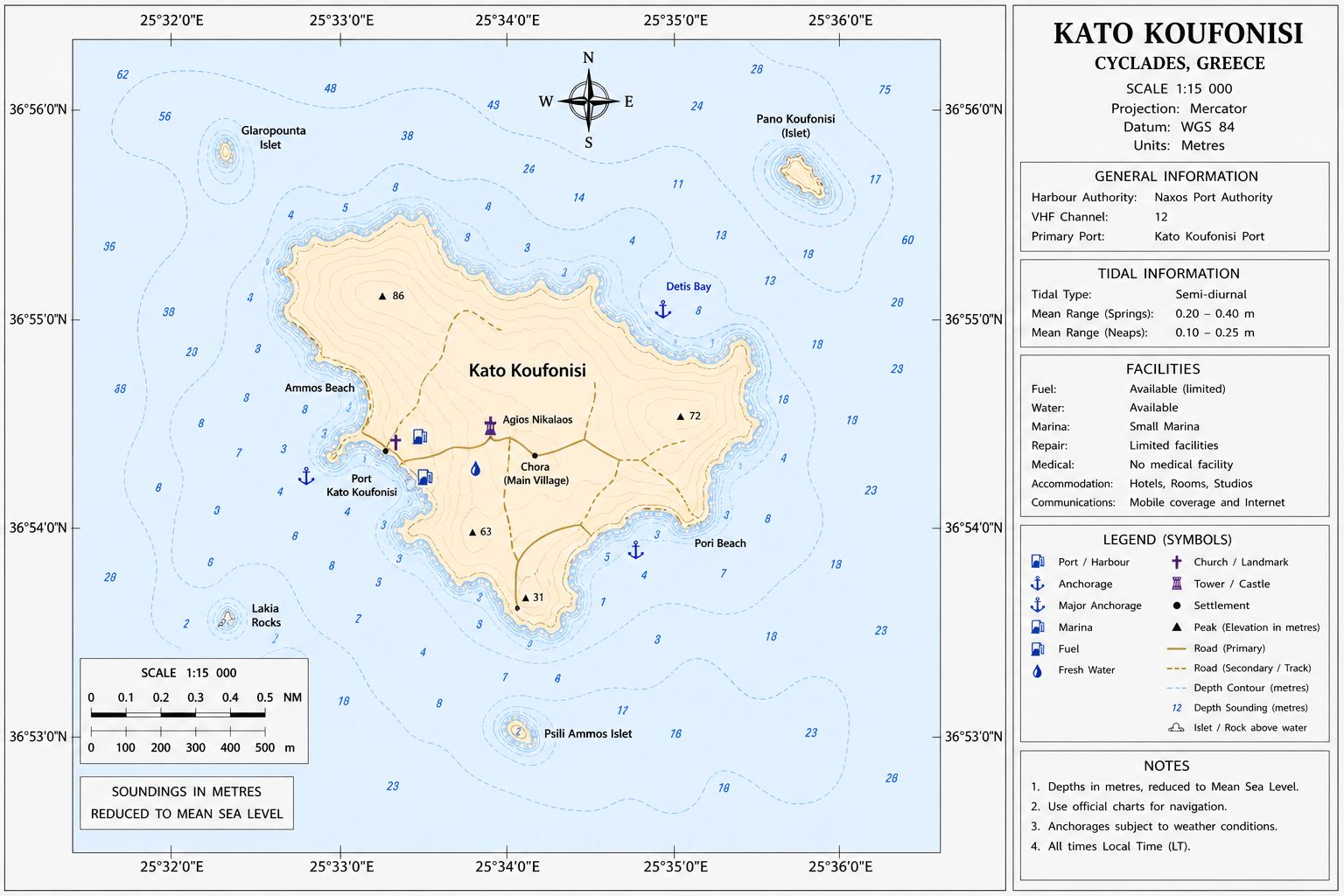
Chart Disclaimer. This chart is a schematic representation for illustrative purposes only and must not be used for navigation. Refer to official hydrographic charts for safe navigation. Be aware ENC charts may differ from official hydrographic charts. Both should be corrected and updated regularly.
Kato Koufonisi
Greece Sailing Guide - Ocean
Currents and Tidal Flow
Tidal range around Kato Koufonisi is small, normally about 0.2–0.4 m, and tidal streams are weak. Yacht handling is affected mainly by wind-driven set, channel effects, and local sea state rather than astronomical tide. In settled weather, current around the island is usually light, commonly below 0.5 knots.
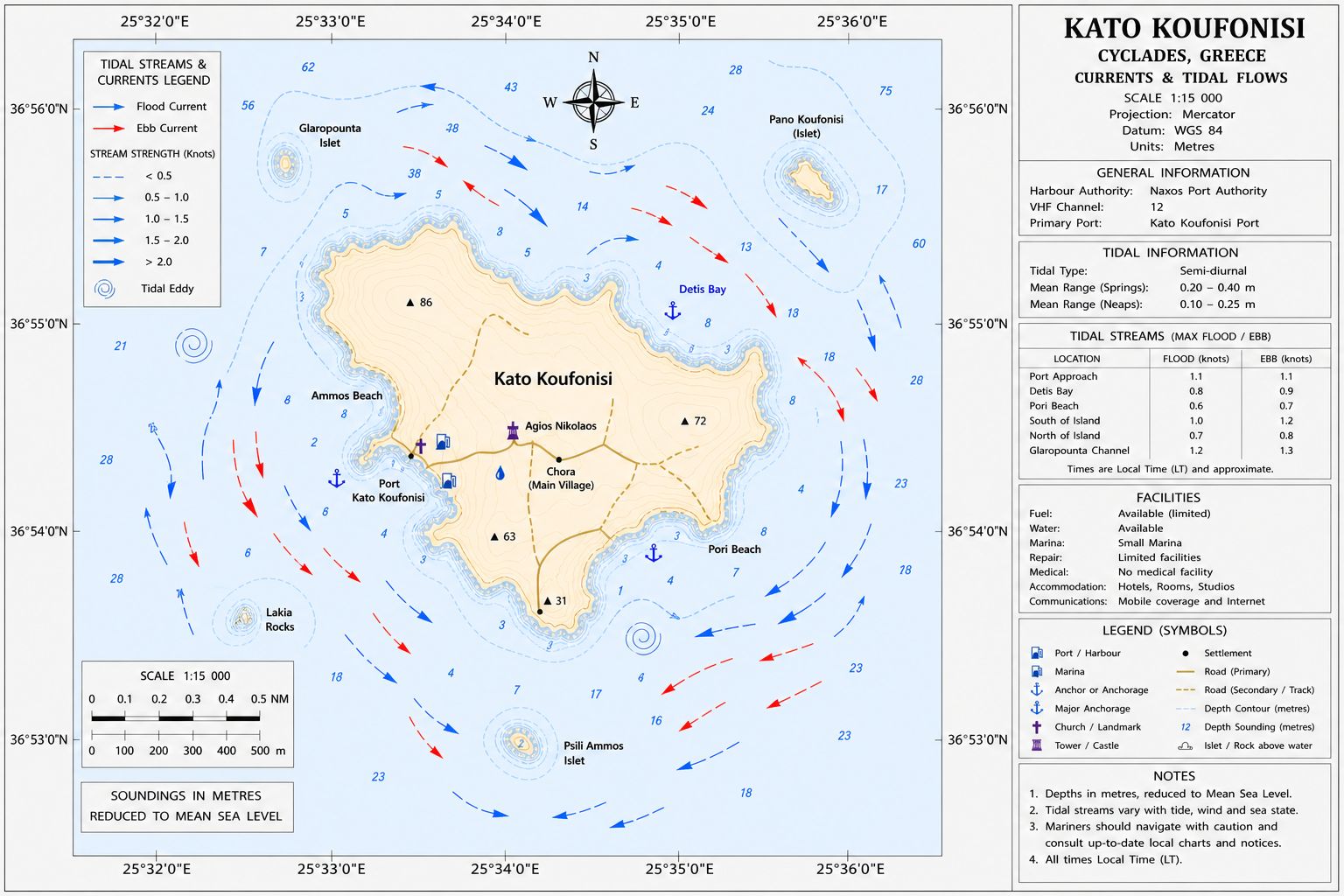
During sustained north and north-west Meltemi conditions, surface drift can develop through the channels between Kato Koufonisi, Pano Koufonisi, and Keros. Local acceleration may occur around headlands and between the islands, with short steep chop where wind opposes residual current or reflected sea state. There are no significant tidal races, but skippers should allow for wind-driven drift when anchoring close to beaches, reef edges, and rocky shelves.
Kato Koufonisi
Greece Sailing Guide - Weather
Kato Koufonisi has a dry Cycladic climate with hot summers, mild winters, and little rainfall during the cruising season. From May to September conditions are usually settled, with daytime temperatures commonly around 27–34°C, strong sun exposure, and clear visibility. The main weather factor is the Meltemi, usually from the north or north-west, strongest from June to September. It can blow for several days and creates rough conditions in the channels between Kato Koufonisi, Pano Koufonisi, and Keros. Southerly weather is less common in summer but can make north-facing and channel anchorages uncomfortable. There is no all-weather harbour on Kato Koufonisi.
The Marine Electrical and Electronics Bible has a complete list of Greek VHF Radio Channel information and weather forecast times for Greece along with NAVTEX UK and Europe and NAVTEX Mediterranean for 490kHz and 518kHz.
Kato Koufonisi
Greece Sailing Guide - Local
Winds
Local winds at Kato Koufonisi are dominated by the Meltemi, usually from the north or north-west during summer. In the main season it commonly builds from late morning into the afternoon, with 15–25 knots frequent and stronger gusts during established Meltemi periods.
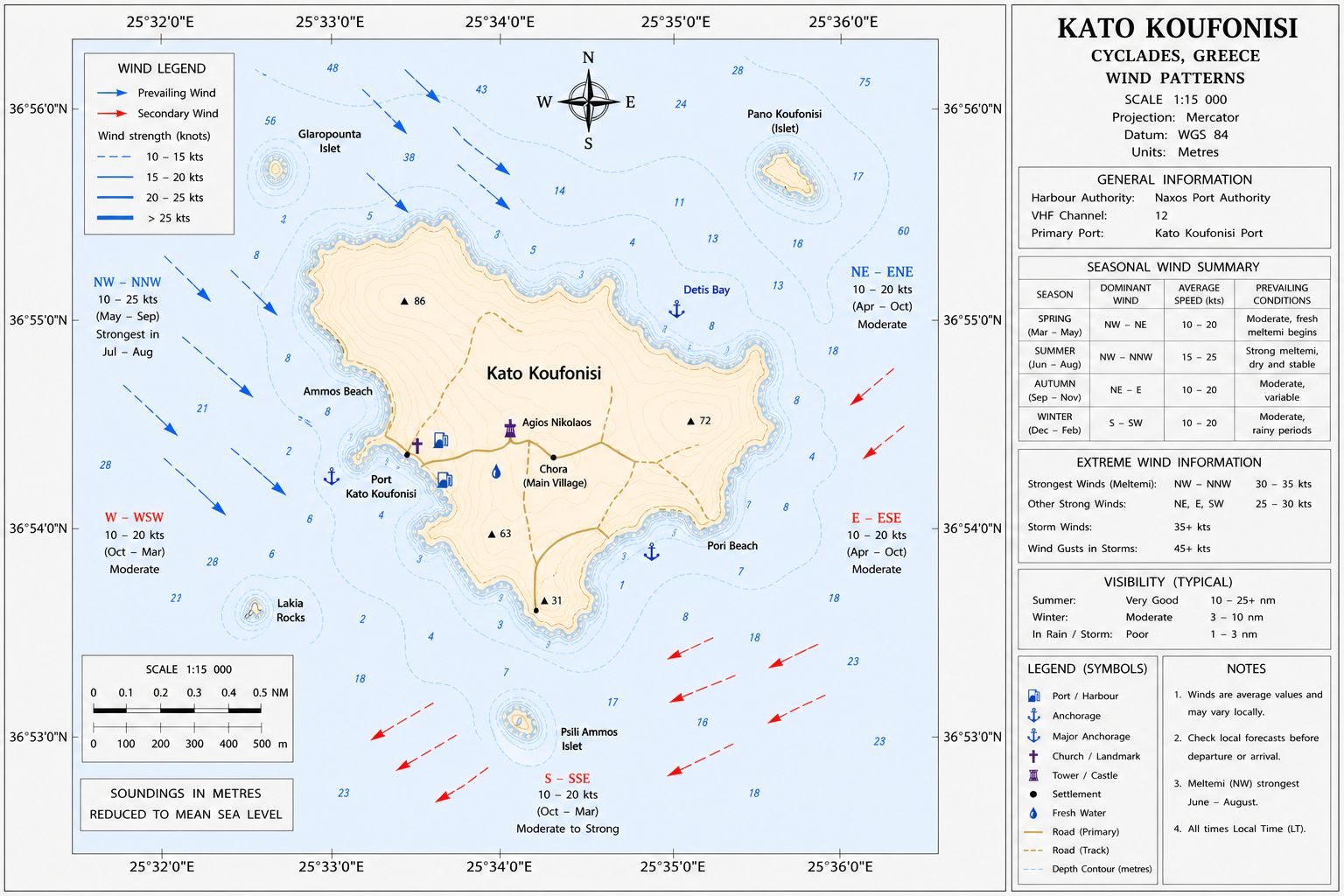
The channels between Kato Koufonisi, Pano Koufonisi, and Keros can funnel the wind and produce short steep seas. Gusts can accelerate around headlands and low saddles, especially on the northern and eastern sides of the island. Southerly winds are less frequent in summer but make the northern anchorages and channel areas uncomfortable. In light conditions, local sea breezes may shift around the island during the afternoon.
Kato Koufonisi
Greece Sailing Guide - Approaches
Approaches to Kato Koufonisi are made through the Small Cyclades channels between Pano Koufonisi, Keros, Schinoussa, and Naxos. The island is low and rocky, with clear water but limited shelter. Offshore depths are generally deep, commonly 20–50 m, then shoal quickly near the beaches, reefs, and rocky shelves. Approach in good light where possible, as sand patches, weed, rock, and shallow reef edges need visual identification.
The main yacht approaches are to the northern and eastern bays, depending on wind direction. In settled weather, approach slowly into anchoring depths of about 4–10 m, checking for sand patches between weed and rock. Strong north or north-west Meltemi can create steep seas in the channel between Kato Koufonisi and Pano Koufonisi, with gust acceleration around the headlands. Southerly weather makes the northern side uncomfortable. There is no harbour, marina, fuel berth, or protected all-weather entry point on Kato Koufonisi.
Kato Koufonisi
Greece Sailing Guide - Navigation
Navigation around Kato Koufonisi is by visual pilotage, depth sounder, and careful bottom inspection. The island has no harbour or marina, and all yacht use is by anchoring off beaches and coves. Offshore depths are commonly 20–50 m, reducing quickly near the coast to anchoring depths of about 4–10 m. The bottom is mixed sand, weed, rock, and reef patches, with best holding in clean sand.
The main navigation areas are the northern bays facing Pano Koufonisi and the eastern side facing Keros. Keep clear of shallow rock shelves, beach swimming areas, local boats, and any seasonal moorings. In Meltemi conditions, the channels between Kato Koufonisi, Pano Koufonisi, and Keros can become rough, with short steep seas and wind acceleration around headlands. Southerly weather makes the northern side exposed and uncomfortable. Daylight arrival is strongly preferable because shallow patches and bottom type are difficult to assess in poor light.
Kato Koufonisi
Greece Sailing Guide - Chart
Accuracy
Hydrographic charts accurately depict coastline and general bathymetry. Electronic charts align with official data but may lack detail on seabed composition in smaller coves. Caution is required for isolated rock patches and rapid depth changes nearshore. Sounder verification is required when anchoring.
Kato Koufonisi
Greece Sailing Guide - Anchorages
Kato Koufonisi anchorage options are limited but operationally useful. There are no all-weather anchorages.
- Detis Bay/Northern Kato Koufonisi. This is the main practical anchorage on the north side, facing Pano Koufonisi. Anchor in about 4–8 m over sand and weed patches. Holding is good in clean sand but poor where weed is thick. It is useful in settled weather and light southerlies, but exposed to Meltemi chop from the north and north-west.
- Nero Beach anchorage. This is on the south-east side of Kato Koufonisi and is one of the better fair-weather anchorages. Anchor in about 4–10 m over sand, weed, and rock patches. It gives some shelter from northerly winds, but swell can wrap around the island in stronger Meltemi conditions. Approach in good light to identify sand patches and avoid rocky ground.
- Pezoulia/Eastern coves. This can provide temporary anchoring on the east side facing Keros. Depths are generally 5–12 m over mixed sand, weed, and rock. Holding is variable. These coves are suitable only in settled conditions and are affected by gusts and chop funnelling through the channel between Kato Koufonisi and Keros.
- Lakki Bay/South-western side. This can be used in settled northerly conditions where sand patches are found. Depths are commonly 5–10 m with mixed sand, weed, and rock. It is exposed to southerly and south-westerly weather and should not be treated as a secure overnight anchorage in unsettled conditions.
- Western roadstead. This offers temporary anchoring only in calm weather. Depths are usually 8–15 m, with uneven bottom and mixed holding. It is exposed to westerly swell and Meltemi wrap-around, and is mainly a short daylight stop.
- North-east channel anchorage. This lies between Kato Koufonisi and Pano Koufonisi may be used briefly in settled conditions, clear of local traffic and shallow patches. Depths are generally 5–10 m over sand, weed, and rock. The area is exposed to strong north-westerly funnel effects and becomes uncomfortable quickly in Meltemi conditions.
Additional small coves provide anchoring in settled conditions with depths between 6 and 15 metres over mixed seabed. These locations are condition dependent and not suitable in exposed weather.
Kato Koufonisi
Greece Sailing Guide - Entry
Formalities
Entry formalities follow standard Greece procedures for visiting yachts. This is not a designated port of entry for international clearance, and there are no customs or immigration facilities on the island. Vessels arriving from outside Greece or the Schengen Area must first clear into the country at an official port of entry before proceeding to this port. Direct arrival from a non-Schengen country is not permitted. The Greek cruising tax (TEPAI) must be valid and paid, and the vessel’s cruising log (DEKPA for non-EU vessels, or transit log where applicable) should be up to date and available for inspection if requested by port authorities or coastguard.
Kato Koufonisi
Greece Sailing Guide - Marina
Facilities
Berthing and marina facilities are not available on Kato Koufonisi. There is no marina, yacht harbour, visitor quay, pontoon, laid moorings, fuel berth, water berth, shore power, chandlery, haul-out, or repair facility. Yachts anchor off in suitable coves only. Usable anchoring depths are generally 4–12 m, depending on location, over mixed sand, weed, rock, and reef patches. Holding is best in clean sand and unreliable in weed or rock. Any small landing points are for local boats, tenders, or seasonal taverna access only and should not be treated as yacht berthing facilities.
Kato Koufonisi
Greece Sailing Guide - Provisioning
Supermarkets. Provisioning on Kato Koufonisi is very limited. There is no supermarket, no bakery, and no full grocery store on the island. Seasonal food and drink may be available from Venetsanos Taverna on Kato Koufonisi, but it should not be treated as a provisioning point. Kato Koufonisi is effectively an anchorage island, not a resupply stop. Main provisioning is on Pano Koufonisi. Named options include Melissa Grocery, Veneti, Kolonaki, and small mini markets, bakery outlets, and grocery stores near the main village and harbour.
Markets. Fresh produce on Kato Koufonisi is very limited. There is no produce market, greengrocer, or regular fresh-food shop on the island.
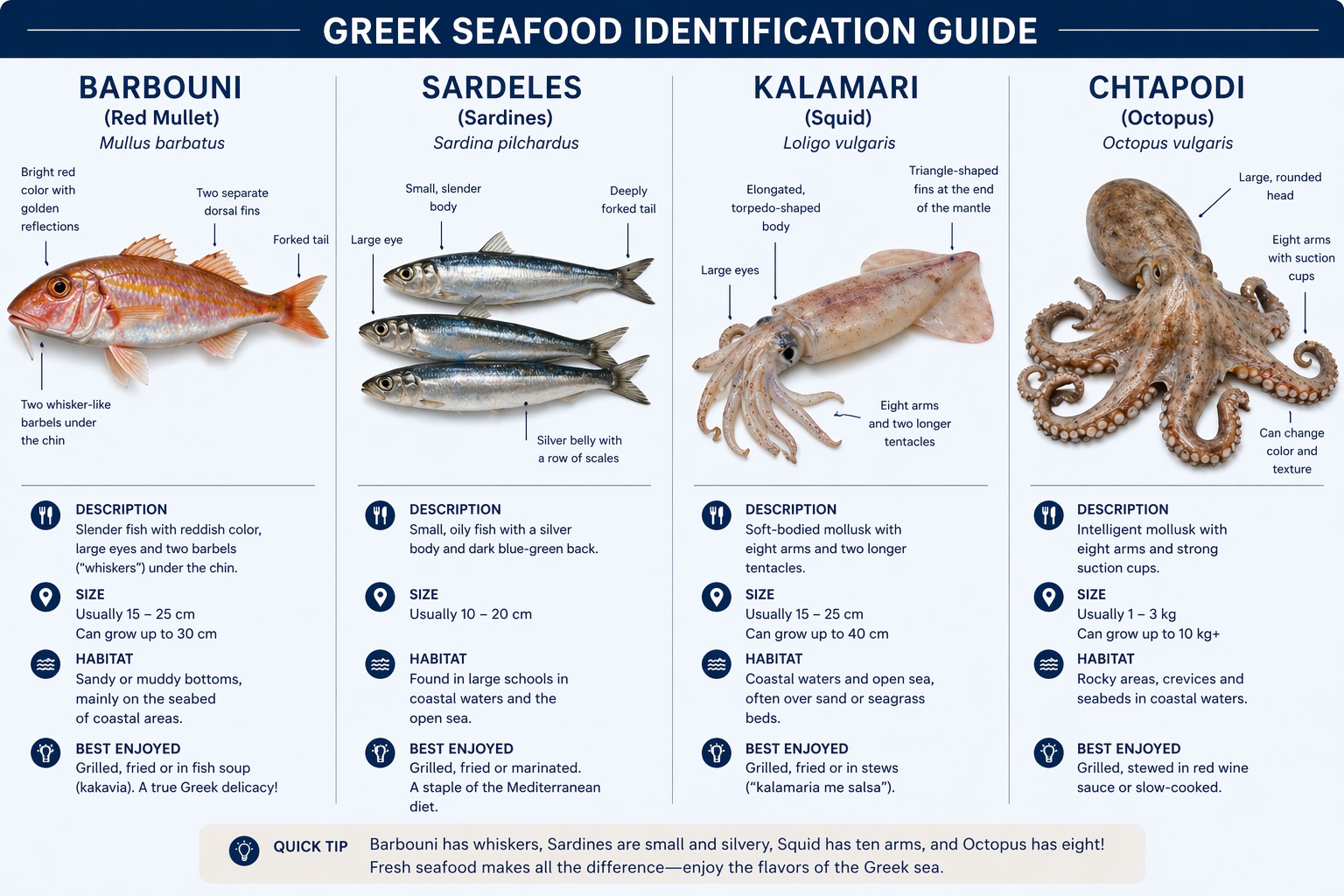
Fish Markets. Fish supply on Kato Koufonisi is limited and irregular. There is no formal fish market or seafood shop on the island. Fresh fish may occasionally be available from local fishing boats or through Venetsanos Taverna, depending on daily landings and season. Common seafood may include small local fish, sea bream, red mullet, squid, octopus, cuttlefish, and prawns
Kato Koufonisi
Greece Sailing Guide - Local
Cuisine
No permanent cuisine exists due to lack of habitation. Seasonal establishments may operate but are not reliable. Supply is dependent on nearby islands. Local cuisine on Kato Koufonisi is simple Small Cyclades cooking, based on seafood, goat, sheep cheese, pulses, potatoes, tomatoes, onions, capers, herbs, olive oil, and bread. Common dishes include grilled fish, fried calamari, octopus, kakavia fish soup, goat stew, lamb with herbs, souvlaki, fava, revithada chickpea stew, gemista, horiatiki salad, local cheese, olives, fried potatoes, and seasonal vegetable dishes.

Kato Koufonisi
Greece Sailing Guide - Local
Beverages
Local beverages on Kato Koufonisi are limited to seasonal taverna supply. Available drinks may include house wine, bottled Greek wine, ouzo, tsipouro, Greek beer, bottled water, soft drinks, Greek coffee, frappe, and basic juices. There is no dedicated bottle shop or beverage supplier on Kato Koufonisi.
Kato Koufonisi
Greece Sailing Guide - Diesel
Fuel Supplies
Diesel fuel is not available on Kato Koufonisi. There is no fuel berth, fuel dock, road tanker service, or regular yacht fuel supply on the island. Fuel must be obtained from Ano Koufonisi or Naxos.
Kato Koufonisi
Greece Sailing Guide - Water
Supplies
Water supply is not available for yachts on Kato Koufonisi. There is no marina water point, quay water service, or reliable potable water supply for visiting vessels
Mechanical and Electrical Repairs
Resource
If you are headed somewhere remote consider the need to expand your knowledge base or have an information resource on board. Why not get a copy of my book The Marine and Electrical and Electronics Bible 4th Edition. By and for yachties, with everything from batteries and charging, solar and wind, diesel engines and marine electronics and so much more. Your complete systems guide. 650 pages of practical advice. In Australia and New Zealand order a copy through Boat Books. UK and European boats can buy the UK Edition Here. US and Canadian boats can get the US Edition Order Here. Marine systems are my profession so let me help you. By a liveaboard boat owner for other boat owners.



Kato Koufonisi
Greece Sailing Guide - Marine
Services
Marine services are not available on Kato Koufonisi. Any mechanical repairs, electrical work, engine service, rigging work, fuel, water, or haul-out must be handled on Pano Koufonisi, Naxos, Paros, Ios, or Amorgos, depending on route and availability.
Kato Koufonisi
Greece Sailing Guide - Local
Etiquette
Interpersonal etiquette on Kato Koufonisi is informal and low-key. Use basic greetings with taverna staff, fishers, and any local residents: kalimera in the morning, kalispera later in the day, and efcharisto when leaving. The island is undeveloped and should be treated as a low-impact environment. Avoid leaving waste or disturbing natural areas. Anchoring should be conducted with consideration for seabed and environmental impact.
Kato Koufonisi
Greece Sailing Guide - Summary
Kato Koufonisi provides multiple condition-dependent anchorages with no infrastructure or services. Protection is determined by wind direction with no all-weather shelter. All operational support must be sourced from nearby islands. Navigation is straightforward with no significant hazards. Kato Koufonisi Greece Sailing Guide for all you need to know.